• Welcome to the new Macedonian Truth Forum. All posts, members and private messages have been moved over from the old forum.

    Passwords from the old forum could not be carried over, so please use Forgot your password? to set a new one. The reset link is emailed to the address on your account.

  • Rules and Regulations at the forum of the Macedonian Truth Organisation (MTO)

    (1) The national-ethnic and cultural-linguistic identity of the Macedonian people is historically Macedonian, and derives its character from the native, indigenous and geographic homeland of the Macedonians, which is called Macedonia. To ensure that their human rights, integrity and heritage are appropriately respected, the only nouns and adjectives acceptable when reference is made to the above character and identity markers is Macedon, Macedonia, Macedonian and Macedonians.

    (2) The nation-state of the Macedonian people is the Republic of Macedonia, and is to be referred to by this official title so long as the 'republic' prefix is consistently applied to other states. Alternative references are the Macedonian Republic, or simply, Macedonia.

    (3) The 'ethnic' prefix is only acceptable for Macedonians in cases where differentiation is specifically required - so long as it is in context and consistent where it concerns its application to other ethnic groups.

    (4) Should any other differentiation be specifically required, the names of other ethnic groups that reside with Macedonians in either the Republic of Macedonia or the occupied Macedonian regions in Greece, Bulgaria, Serbia or Albania, are to be given a prefix.

    (5) Negating the identity, language and culture of the Macedonian people by deliberate avoidance of the terms Macedonia, Macedonian and Macedonians, or by any other means, is not permitted.

    (6) Systematic anti-Macedonian propaganda and rhetoric are not permitted.

    (7) Threads irrelevant to the Macedonian Cause, the community at the Macedonian Truth Organisation or the Macedonians in general may be considered as spam or not in the spirit of the forum. In such cases they are not permitted.

    (8) Continual posting of messages in threads with the sole purpose of deviating from the initial topics with the use of unrelated and unnecessary information is not permitted.

    (9) All posts, external articles, reports, etc that are cited in languages other than Macedonian or English, must be accompanied with a translation in one or both of the said languages.

    (10) Despite the possibility of some conversations and debates becoming heated, extreme abuse and/or racism, vulgar language and/or terminology, threats, revelation of personal information about others, harassment, and other such behavior will not be permitted. If deemed necessary all relevant information including member details will be reported to the appropriate authorities for investigation which may result in legal action.

    (11) Threads that are created must have a summary of a topic or excerpt of an article found in pertinent link(s) that have been included. One line threads will be considered unaccetable spam and are therefore not permitted.

    (12) Compulsive and deliberate lies, irrespective of the topic, are not permitted.

    (13) Any symbols or avatars found to be perceived as offensive to Macedonians are not permitted.

    (13) Any explicit or extreme material is not permitted.

    Failure to adhere to the above rules and regulations will result in a ban after 3 breaches. This may be reconsidered in some cases should the circumstances be of an unorthodox nature and/or require special consideration. To assure an effective deterrent against an individual or individuals with the sole purpose of causing dissent through spamming, racism or other improper means, the above rules will be strictly enforced.

    The MTO administration will monitor all discussions as reasonably practical and reserve the right to remove any post and/or member from the forum, and update the rules and regulations as required. Members are encouraged to immediately report any post and/or member to the MTO administration if they feel that these rules have not been abided by.

    The views expressed on this forum are those of the individuals. The only official representation of the MTO is made by the "Macedonian Truth Organisation (Site Owner)" username, and no other.

  • Macedonian Cause

    The Macedonian Truth Organisation calls on God in Heaven to protect, bless and guide the endeavour it is committing to undertake, and that is to work towards:

    Securing Macedonia as a free, independent and democratic republic in which sovereignty lies with the Macedonian citizens; as the nation-state of the Macedonian people in which they can preserve their culture, language and identity; as a state in which the Macedonian language and culture form the basis of public life and act as important unifying elements of Macedonian society; as the home of all its citizens to which it guarantees and obliges their inalienable natural rights and corresponding responsibilities;

    The acknowledgment as self-evident and irrefutable the existence of the:

    1) Indigenous, ethnonational name of Macedonia;
    2) Macedonian people, language and identity;
    3) Macedonian culture, symbols and folklore;
    4) Macedonian ancestry, heritage and history in its entirety; and
    5) Macedonian Orthodox Church;

    Securing recognition by the International Community of the tragedies endured by the Macedonian people, of the division of Macedonia with the signing of the Treaty of Bucharest on August 10, 1913, and the genocide committed against the Macedonian people at the hands of the Greek, Bulgarian and Serbian states and their respective churches during the 19th and 20th centuries;

    Ensuring that the Interim Accord is declared ‘null and void’ and that all constitutional provisions, acts, commitments, agreements, legislation, regulations, policies or programs emanating from, supporting or consequential to the Interim Accord are also declared ‘null and void’, including the use of any symbols and the completion of any acts imposed by, or originating from, the Interim Accord.

    Ensuring that the Framework Agreement is abolished and that all constitutional provisions, acts, commitments, agreements, legislation, regulations, policies and programs emanating from, supporting or consequential to the Framework Agreement are also abolished and replaced by a framework of constitutional and statutory law based on inalienable natural rights and corresponding responsibilities and universally codified human rights mechanisms.

    Securing the abolishment of any existing constitutional provisions, acts, agreements, legislation, regulations, policies and programs that discriminate against the Macedonian people, in any international organisation or any of the countries of the International Community where such constitutional provisions, acts, agreements, legislation, regulations, policies and programs exist, and thereby ensuring the freedom for Macedonians to exercise their inalienable natural rights and fulfil their corresponding responsibilities, and practice their culture, language and religious faiths in all the countries of the International Community without hindrance;

    The empowerment of Macedonians to undertake a moral revolution and to instil and/or reinvigorate within themselves a deep-rooted national, cultural, linguistic and historical dignity and a commitment to the exercise of freedom based on inalienable natural rights and corresponding responsibilities;

    The recognition of the Macedonian minorities in the neighbouring states of Macedonia as well as the respect for the inalienable rights and freedoms of the Macedonian minorities, as provided for by natural law and as codified by the United Nations Charter, the Universal Declaration of Human Rights and other universally codified human rights mechanisms;

    The full and unreserved respect of, and the support for, the rights of all people of non-Macedonian descent living in Macedonia and around the world, who share a reciprocal full and unreserved respect for the Macedonian people, their homeland and their state;

    The cultural unification and solidarity of the Macedonian people living in all parts of historical Macedonia and adjacent territories, as well as Macedonians throughout the world;

    The unity of all Macedonians on the principles, objectives and achievement of the Macedonian cause as defined by this declaration.

The secrets of Macedonian civilization!

Given the lack of evidence which would be available these days, like photographs, for example, I think it is difficult to determine which exact symbol was used most frequently. However, the fact that the 16-ray sun is featured on the tombstone of a Macedonian king, one would be inclined to think that it was more prevalent as a national symbol.

But, like I said previously, none of this justifies that pathetic symbol change by 'political' Dostoinstvo.
 
Amazing, over 2000 years of history in these finds, the Macedonian people have the richest history:)
 
Is'nt it amazing our real symbol is the 16 ray sun & we just let someone take it away from us without a fight.Before the andranikos discovery the greeks never knew much of the macedonian symbols.It's only been a recent phenomenon.Some of the crazy claims the greeks are claiming that they have exclusive right to the 16 ray sun symbol because they discovered it in kutlesh vergina,they claim it is this symbol only appears there.Well i can take you to ROM & it appears every where in churches etc,the greek claims can be negated by that fact alone.The other fact is macedonians used those symbols for thousands of years & not greeks.If andronikus didn't bring up the gold larnax in 1978 the greeks would never have known about it.Who thinks that we should have given up our 16 ray sun & settled for a 8 ray sun or ventilator simply wants to capitulate.
 
What sort of evidence are you looking for that would specifically prove that those shields belonged to Macedonian soldiers, aside from the fact that they were unearthed in Macedonia and dated to the reign of the ancient Macedonians? Who else would they have belonged to, if not Macedonians, particularly in the inland regions of Pelagonia, where foreigners would have been much less than on the coast? Is there an example you can refer to with the 16-ray sun which can be used as a benchmark?
SoM, all we have is a number of shields (how many are we talking about?) which happen to have been found on Macedonian territory. They have been 'dated' to the second century BC (I think you are familiar with the problems associated with 'dating'). Other than that, we have no other information. It is a huge leap to automatically assume that those shields belonged to the Macedonian army. Particularly taking into consideration that the rule of Perseus was when the Romans finally conqured Macedonia. Further, these shields may just have been captured "loot" from other armies. There is nothing that connects those shields with the Macedonian army or that symbol with a Macedonian state.
 
Bratot,

No evidence has been provided that the shield belonged to Macedonian soldiers. Further, I'm not willing to accept the classification of those auction sites as definitive. Do you have any actual evidence that comes from a credible source and provides evidence based clarification that they are Macedonian.

What other evidence you need than the fact that this symbol was found in a Royal Tomb as well?

I have provided enough credible publication on these shields done by mixed international archaeologists.

As far as I know this is the second only Macedonian Royal Tomb beside the one from Aigae - Kutlesh.

Do you have any links/further information on the second last image you provided above?

446828.jpg


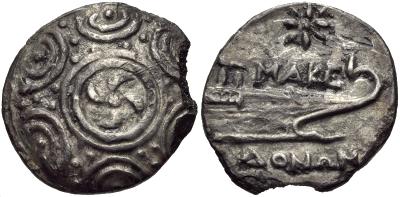
KINGS of MACEDON. Time of Philip V and Perseus. 187-168 BC. AR Tetrobol (15mm, 1.84 g). Pella or Amphipolis mint. Struck circa 184-179 BC. Macedonian shield with ornament of four crescents on boss / Stern of galley left; star of eight rays above. Liampi, Schild M43c; SNG Copenhagen 1289. VF, toned, edge chipped.

From the Jörg Müller Collection.

http://www.acsearch.info/record.html?id=446828

b2803.jpg


B2803. MACEDON, AUTOMOUS ISSUE UNDER PERSEUS, 179-168 BC. AR 2 1/2 Obol, 1.66 gm., Gaebler.122. Macedonian shield with spiral star at center/Prow r. VF. Scarce.

http://www.edgarlowen.com/a44cg.shtml

I can't offer you more pictures than the available from auction sites.


2591902349_f4541c7f41.jpg


This symbol has most probably inspired the name
for the galactic star spiral:

perseus_armedited.JPG


Galactic Surveyors
Perseus Spiral Arm of the Milky Way much closer than thought


The Perseus spiral arm, the nearest spiral arm in the Milky Way outside the Sun's orbit, lies only half as far from Earth as some previous results had suggested.

http://www.mpifr-bonn.mpg.de/public/pr/pr-perseus_en.html

The Perseus Arm is one of two major spiral arms of the Milky Way galaxy.

http://en.wikipedia.org/wiki/Perseus_Arm
 
SoM, all we have is a number of shields (how many are we talking about?) which happen to have been found on Macedonian territory. They have been 'dated' to the second century BC (I think you are familiar with the problems associated with 'dating'). Other than that, we have no other information. It is a huge leap to automatically assume that those shields belonged to the Macedonian army. Particularly taking into consideration that the rule of Perseus was when the Romans finally conqured Macedonia. Further, these shields may just have been captured "loot" from other armies. There is nothing that connects those shields with the Macedonian army or that symbol with a Macedonian state.

The tomb where the shields are found dates to the 4 century BC.

A royal grave from the 4th century B.C. has been revealed by archaeologists at the foot of Selecka Planina, between Prilep villages Krusevica and Bonce.
Taking into account its monumental dimensions, a royal dignitary must surely be resting in the grave, says archaeologist Antonio Jakimovski from the Museum of Macedonia. He is part of the team led by archaeologist Viktor Lilcic, who has claimed that he is on the trace of revealing the capital of the Upper Macedonian Kingdom Pelagonija.
“The royal grave is located at site Staro Bonce. We have revealed that the chamber was surrounded by a protective fence – a type of a podium, constructed with massive rectangle stone blocs”, says Jakimovski.
According to Lilcic, the center of the antique Pelagonians is located on mountain top Visoka at Selecka Planina. Scientists have traced the capital of the Pelagonija kings and capital of Macedonia from the 4th century B.C. for 165 years.

Stonehenge in Macedonia is the first impression when one sees an unusual tomb archaeologists have been unearthing from the firm claws of the earth for a month and a half. They say it is the only of the kind in the world and that one of the Macedonian kings was buried there. The tomb was supposed to have been raided in the antique period but scientists believe a part of the tomb has resisted greedy hands of tomb raiders for centuries. Archaeologists believe that one preserved chamber dates from the 4th century BC when a dignitary was buried there. Even if the chamber was empty, it is enough that a unique structure in the world - a Macedonian-type tomb encircled with a ring of massive stone blocks - has been found.
The tomb is located in a region that has been very responsive for archaeology for the past year. The public remembers it for the remains of Macedonian shields that were unearthed near Bonce last year. The tomb is 900 meters away from the place the shields were discovered under Visoka Mountain.
An arched part of the tomb is 11 meters long and 3 meters high. It was built in stone blocks without mortar. The blocks were processed with refinement, chiseled and joined together. They weigh 2-3 tons. A half of the ring-wall has been unearthed so far. Its west section consists of two rows of blocks and is 1.20 meters high. The east section of the ring has four rows of blocks and is 1.80 meters high. Archaeologists have also found an access to the tomb, a path chiseled in rock and then coated with large stone blocks. The path cascades to the arched part the floor of which was also chiseled in rock.
“The tomb was encircled with the ring and earth was piled on it as a mound. The higher the mound, the buried person was more important. According to the way it was built, only a king could have been buried in there. There was no other man at the time, and even today, that could pay for such funeral. This is a tomb that is unique in the world. In its concept, it is similar to the Macedonian-type tombs as is that in Vergina, but with elements left from the Iron Age - the ring,” archaeologist and the head of excavations Antonio Jakimovski explains.
“ The circle symbolizes the Universe. The upper semicircle is the place where deities lived and the kings wanted to dwell,” says Viktor Lilcic, the head of the Visoka and Old Bonce Project. He adds the tomb was robbed in the 3rd century BC but has preserved its monumental appearance.


http://www.culture.in.mk/story.asp?id=21345&rub=43
 
It is not Borza's claim only and yet you are admitting to support with full heart the biggest Greek propaganda lie in the last century.

Bratot, if you dont mind of course. Can you elaborate on the biggest Greek propaganda lie you mentioned ?
 
Bratot, if you dont mind of course. Can you elaborate on the biggest Greek propaganda lie you mentioned ?

Try with these:

1. Busting the "Vergina Tomb" myth
http://macedoniantruth.org/forum/showthread.php?t=2772&highlight=Tomb

2. Agamemnon mask - another forgery?
http://macedoniantruth.org/forum/showthread.php?t=2243&highlight=Tomb

3. Forgeries in Modern Greek History
http://macedoniantruth.org/forum/showthread.php?t=83&highlight=Tomb

4. The pen is mightier then the sword
http://macedoniantruth.org/forum/showthread.php?t=720&highlight=Tomb

5. The National Imagination in Greece
http://macedoniantruth.org/forum/showthread.php?t=4509&highlight=Tomb
 
The tomb is located in a region that has been very responsive for archaeology for the past year. The public remembers it for the remains of Macedonian shields that were unearthed near Bonce last year. The tomb is 900 meters away from the place the shields were discovered under Visoka Mountain.

Bratot, the article states that the shields were not discovered in the tomb, but nearly 1km away.
 
Bratot, you said the biggest Greek propaganda lie within the last century. What you state above are numerous items. Il stick with Vergina.

I noticed the first page deals with DNA testing. What a great start.
Anyway, if your problem is "who" was in the tomb than that is debatable.

Keep in mind, if it wasnt for Andronikos the sunburst would of never made an impact on this issue. He is the man that had publicised the findings to such a degree that basically turned it into a national dispute. He probably never gave it thought that would ever happen. This is the only issue I can fault him over since the sunburst is not found only in Macedonia.
 
Vangelovski,

It is still in the archaelogical site of this ancient Macedonian town that played important role.

Isn't enough that on these coins depicting those shields is writen Makedon?

To whom else they would probably belong?
 
Last edited:
Bratot, you said the biggest Greek propaganda lie within the last century. What you state above are numerous items. Il stick with Vergina.

I noticed the first page deals with DNA testing. What a great start.
Anyway, if your problem is "who" was in the tomb than that is debatable.

Stick to the one you like, the reasons behind all those forgery examples are same.

I 'activated' the 'vergina' thread agean so lets not polute this thread anymore.

Keep in mind, if it wasnt for Andronikos the sunburst would of never made an impact on this issue. He is the man that had publicised the findings to such a degree that basically turned it into a national dispute. He probably never gave it thought that would ever happen. This is the only issue I can fault him over since the sunburst is not found only in Macedonia.

That's another argument, but I am sure Vangelovski and Indigen have made up perfect explanation on that part as well.

So, I'll leave them to you, to explain why this symbol appeared also on Illyrian, Thracian, Spartan shields and coins or even on Crete (if I'm not wrong).
 
Last edited:
I think what needs to be stressed here is that the Kutlesko Sonce is our national symbol, but Macedonia has other symbols that need to be investigated and celebrated.

Having a rich history is nothing to be afraid of, quite the opposite.
 
Stick to the one you like, the reasons behind all those forgery examples are same.

I 'activated' the 'vergina' thread agean so lets not polute this thread anymore.


That's another argument, but I am sure Vangelovski and Indigen have made up perfect explanation on that part as well.

So, I'll leave them to you, to explain why this symbol appeared also on Illyrian, Thracian, Spartan shields and coins or even on Crete.

And Sicily ^

Id like to see Illyiran and Thracian examples of it. Anyway, if you want me to bring it to the Vergina thread than I will. Dont mean to bog down your thread, just noticed a statement I wanted some clarifcation on.
 
I think what needs to be stressed here is that the Kutlesko Sonce is our national symbol, but Macedonia has other symbols that need to be investigated and celebrated.

Having a rich history is nothing to be afraid of, quite the opposite.

That sounds reasonable enough to me and in that light I post the following:

Contemporary Macedonian Nation with Ancient Heritage and Roots!

Some images:

Grnsonc1.JPG

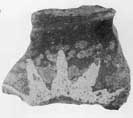
Macedonian Sun from 5500 BC
Neolithic inhabitation of the so called Porodin group on Pelagonija show a specific sign on living and burial. The archaeological material found in the many tombs near the Black river (map 4) show an exceptional knowledge of organising space, and semantic shaping of the Neolithic pots which are a clear testimony of the respect for the cult of the sun and the cult of the cosmos, (space, universe) and a longer cultural continuity with the oldest (up to now) registered solar symbols and diverse cosmographies, cosmogonies and cosmologies from around 5.500 B.C..

Phillip_Museum.jpg


heritage.gif


MakProtestSyd_93_GolemoSonce.jpg

Macedonian Rally in Sydney (Martin Place) from 1993.

IMG_0017.jpg

World Macedonian Congress (USA) Logo from 1992 publication.

makedonski_grb.jpg

Macedonian "Coat of Arms" used by a number Macedonian
community organisations in Australia since the mid 1990s.

IMG_0001a.jpg

Post card depicting a "coat of arms" with all the elements of
the Macedonian heritage. (Sydney, Australia - early 1990s).

30.jpg

Sydney Carnevale 1996

-----------------
 
I think what needs to be stressed here is that the Kutlesko Sonce is our national symbol, but Macedonia has other symbols that need to be investigated and celebrated.

Having a rich history is nothing to be afraid of, quite the opposite.

Agreeing with you and developing the theme, I suggest those with an enquiring mind look into the following symbol (also found above on the Golden casket from Kutlesh):

http://www.thefullwiki.org/Fleur-de-lis

49775595282365.png

The fleur-de-lis (or fleur-de-lys; plural: fleurs-de-lis; French pronunciation: [flœʁ də lis]) is a stylized lily (in French, fleur means flower, and lis means lily) or iris that is used as a decorative design or symbol.^ Decorative Tile: Fleur de Lis Design. It may be "at one and the same time, political, dynastic, artistic, emblematic, and symbolic", especially in heraldry.^ It may be purely ornamental or it may be "at one and the same time political, dynastic, artistic, emblematic and symbolic", especially in heraldry. It is represented in Unicode at U+269C (⚜) in the Miscellaneous Symbols block.

Usages
While the fleur-de-lis has appeared on countless European coats of arms and flags over the centuries, it is particularly associated with the French monarchy in a historical context, and continues to appear in the arms of the King of Spain and the Grand Duke of Luxembourg, members of the House of Bourbon. It remains an enduring symbol of France that appears on French postage stamps, although it has never been adopted officially by any of the French republics. In North America, the fleur-de-lis is often associated with areas formerly settled by France, such as Quebec, St. Louis, Louisville, and Louisiana, and with French-speaking people in other Canadian provinces.

.It is also the emblem of the city of Florence, and of the Swiss municipality of Schlieren.^ It is also the emblem of the city of Florence and of the Swiss municipality of Schlieren.

In Bosnia and Herzegovina, the flag of Bosnia-Herzegovina from 1992 to 1998 contained six fleurs-de-lis and is used as a national symbol of Bosniaks taken from old medieval bosnian flag that represented bosnian kingdom.

In the United Kingdom, a fleur-de-lis has appeared in the official arms of the Norroy King of Arms for hundreds of years.

The Welsh poet Hedd Wyn used Fleur de Lys as his pen name when he won his chair at the National Eisteddfod of Wales (Eisteddfod Genedlaethol Cymru), the national poetry contest.

It appears on military insignia and the logos of many different organizations, and during the 20th century it was adopted by various Scouting organizations worldwide for their badges.

Architects and designers use it alone and as a repeated motif in a wide range of contexts, from ironwork to bookbinding, especially where a French context is implied.^ How did a symbol once reserved for French royalty become such a favorite design for use in home décor?

As a religious symbol it may represent the Trinity, or be an iconographic attribute of the archangel Gabriel, notably in representations of the Annunciation.^ From France to England, to Florence, to Religious Symbolism, the Fleur-de-Lys has represented a virtuous force for good.

The symbol is also often used on a compass rose to mark the north direction, a tradition started by Flavio Gioja, a Neapolitan mariner of the fourteenth century.

[.....]

http://www.thefullwiki.org/Fleur-de-lis
 
Description
Coin, Tetrobol, silver, autonomous issues, Ancient Greek, Amphipolis, Macedonia, 196-168 BC, Silver disc with designs in relief on either side. Obverse: Macedonian shield with six ray centre pattern. Reverse: Prow of galley right, greek inscription "coin of the Macedonians" and P in field right.

http://www.dhub.org/object/290706&img=80469
 
Agreeing with you and developing the theme, I suggest those with an enquiring mind look into the following symbol (also found above on the Golden casket from Kutlesh):

http://www.thefullwiki.org/Fleur-de-lis

49775595282365.png

The fleur-de-lis (or fleur-de-lys; plural: fleurs-de-lis; French pronunciation: [flœʁ də lis]) is a stylized lily (in French, fleur means flower, and lis means lily) or iris that is used as a decorative design or symbol.^ Decorative Tile: Fleur de Lis Design. It may be "at one and the same time, political, dynastic, artistic, emblematic, and symbolic", especially in heraldry.^ It may be purely ornamental or it may be "at one and the same time political, dynastic, artistic, emblematic and symbolic", especially in heraldry. It is represented in Unicode at U+269C (⚜) in the Miscellaneous Symbols block.

Usages
While the fleur-de-lis has appeared on countless European coats of arms and flags over the centuries, it is particularly associated with the French monarchy in a historical context, and continues to appear in the arms of the King of Spain and the Grand Duke of Luxembourg, members of the House of Bourbon. It remains an enduring symbol of France that appears on French postage stamps, although it has never been adopted officially by any of the French republics. In North America, the fleur-de-lis is often associated with areas formerly settled by France, such as Quebec, St. Louis, Louisville, and Louisiana, and with French-speaking people in other Canadian provinces.

.It is also the emblem of the city of Florence, and of the Swiss municipality of Schlieren.^ It is also the emblem of the city of Florence and of the Swiss municipality of Schlieren.

In Bosnia and Herzegovina, the flag of Bosnia-Herzegovina from 1992 to 1998 contained six fleurs-de-lis and is used as a national symbol of Bosniaks taken from old medieval bosnian flag that represented bosnian kingdom.
In the United Kingdom, a fleur-de-lis has appeared in the official arms of the Norroy King of Arms for hundreds of years.

The Welsh poet Hedd Wyn used Fleur de Lys as his pen name when he won his chair at the National Eisteddfod of Wales (Eisteddfod Genedlaethol Cymru), the national poetry contest.

It appears on military insignia and the logos of many different organizations, and during the 20th century it was adopted by various Scouting organizations worldwide for their badges.

Architects and designers use it alone and as a repeated motif in a wide range of contexts, from ironwork to bookbinding, especially where a French context is implied.^ How did a symbol once reserved for French royalty become such a favorite design for use in home décor?

As a religious symbol it may represent the Trinity, or be an iconographic attribute of the archangel Gabriel, notably in representations of the Annunciation.^ From France to England, to Florence, to Religious Symbolism, the Fleur-de-Lys has represented a virtuous force for good.

The symbol is also often used on a compass rose to mark the north direction, a tradition started by Flavio Gioja, a Neapolitan mariner of the fourteenth century.

[.....]

http://www.thefullwiki.org/Fleur-de-lis

The Fleur de lys or more simply the Iris was used to symbolize Hera- and she on the other hand was symbol of the matriarchy.

hera.png


Hera is also known as Pelasgian priestess/goddess of nature.

http://www.google.com/search?tbm=bks&tbo=1&hl=pl&q=Hera+Pelasgian&btnG=Szukaj+książek

Later the IRIS became a symbol of the Virgin Mary, in both the eastern and western Christianity.
It determines the characteristics of God, purity, innocence, kingdom, power, etc.

http://books.google.com/books?id=Pp...AEwCQ#v=onepage&q=Iris ancient symbol&f=false


Something obscurely writen:
There are iris species names - Iris mesopotamia and I. kashmiriana - that correspond to territories where Alexander the Great's army marched eastward as far as India in the fourth century B.C. This son of Philip of Macedonia was the first conqueror of Western civilization and as a result was a spearhead of ancient Greek culture. Other irises collected at around the same period reflect places that the Greeks colonized on Turkish shores - Iris trojana, I. cypriana and I. junonia.

The goddess Iris of Greek mythology was a beloved messenger of the gods, especially of Hera, who became Juno to the ancient Romans. She had golden wings and was the goddess of the rainbow. Iris traveled on the rainbow's arc, carrying commands and messages from the ancient gods to mankind. Iris married the west wind, Zephyrus. To this day, the Greeks plant irises on women's graves, believing that the goddess Iris will guide the souls of women to their last resting places.

In the Christian world, the fleur-de-lis came to be particularly sacred to the Virgin Mary. A legend tells of a knight who could never remember more than the two words Ave Maria of the Latin prayer that was said to honor the Holy Mother. Night and day, he continued his supplications with these two words. After many years, the old man died and was buried in the chapel yard of a convent. Proof of the acceptance of his brief but sincere prayer by the Virgin Mary came when a plant of fleur-de-lis grew upon his grave. On each flower, golden letters spelled out Ave Maria.

http://www.herbs2000.com/flowers/i_history.htm


Hera_6.jpg

Hera and Prometheus Interior of a Red Figure Kylix by Douris, found in Vulci.

Hera appears to be the sublime embodiment of strict matronly virtue, and is on that account the protectress of purity and married women. Faultless herself in her fidelity as a wife, she is essentially the type of the sanctity of the marriage tie, and holds in abhorrence any violation of its obligations. So strongly was she imbued with this hatred of any immorality, that, finding herself so often called upon to punish the failings of both gods and men in this respect, she became jealous, harsh, and vindictive. Her exalted position as the wife of the supreme deity, combined with her extreme beauty, caused her to become exceedingly vain, and she consequently resented with great severity any infringement on her rights as queen of heaven, or any apparent slight on her personal appearance.

more:
http://aworldofmyths.com/Greek_Gods/Hera.html
 
Macedonian history stolen by Griks with their falsification of all of our symbols and the west continues to support the liars
 
Back
Top