• Welcome to the new Macedonian Truth Forum. All posts, members and private messages have been moved over from the old forum.

    Passwords from the old forum could not be carried over, so please use Forgot your password? to set a new one. The reset link is emailed to the address on your account.

  • Rules and Regulations at the forum of the Macedonian Truth Organisation (MTO)

    (1) The national-ethnic and cultural-linguistic identity of the Macedonian people is historically Macedonian, and derives its character from the native, indigenous and geographic homeland of the Macedonians, which is called Macedonia. To ensure that their human rights, integrity and heritage are appropriately respected, the only nouns and adjectives acceptable when reference is made to the above character and identity markers is Macedon, Macedonia, Macedonian and Macedonians.

    (2) The nation-state of the Macedonian people is the Republic of Macedonia, and is to be referred to by this official title so long as the 'republic' prefix is consistently applied to other states. Alternative references are the Macedonian Republic, or simply, Macedonia.

    (3) The 'ethnic' prefix is only acceptable for Macedonians in cases where differentiation is specifically required - so long as it is in context and consistent where it concerns its application to other ethnic groups.

    (4) Should any other differentiation be specifically required, the names of other ethnic groups that reside with Macedonians in either the Republic of Macedonia or the occupied Macedonian regions in Greece, Bulgaria, Serbia or Albania, are to be given a prefix.

    (5) Negating the identity, language and culture of the Macedonian people by deliberate avoidance of the terms Macedonia, Macedonian and Macedonians, or by any other means, is not permitted.

    (6) Systematic anti-Macedonian propaganda and rhetoric are not permitted.

    (7) Threads irrelevant to the Macedonian Cause, the community at the Macedonian Truth Organisation or the Macedonians in general may be considered as spam or not in the spirit of the forum. In such cases they are not permitted.

    (8) Continual posting of messages in threads with the sole purpose of deviating from the initial topics with the use of unrelated and unnecessary information is not permitted.

    (9) All posts, external articles, reports, etc that are cited in languages other than Macedonian or English, must be accompanied with a translation in one or both of the said languages.

    (10) Despite the possibility of some conversations and debates becoming heated, extreme abuse and/or racism, vulgar language and/or terminology, threats, revelation of personal information about others, harassment, and other such behavior will not be permitted. If deemed necessary all relevant information including member details will be reported to the appropriate authorities for investigation which may result in legal action.

    (11) Threads that are created must have a summary of a topic or excerpt of an article found in pertinent link(s) that have been included. One line threads will be considered unaccetable spam and are therefore not permitted.

    (12) Compulsive and deliberate lies, irrespective of the topic, are not permitted.

    (13) Any symbols or avatars found to be perceived as offensive to Macedonians are not permitted.

    (13) Any explicit or extreme material is not permitted.

    Failure to adhere to the above rules and regulations will result in a ban after 3 breaches. This may be reconsidered in some cases should the circumstances be of an unorthodox nature and/or require special consideration. To assure an effective deterrent against an individual or individuals with the sole purpose of causing dissent through spamming, racism or other improper means, the above rules will be strictly enforced.

    The MTO administration will monitor all discussions as reasonably practical and reserve the right to remove any post and/or member from the forum, and update the rules and regulations as required. Members are encouraged to immediately report any post and/or member to the MTO administration if they feel that these rules have not been abided by.

    The views expressed on this forum are those of the individuals. The only official representation of the MTO is made by the "Macedonian Truth Organisation (Site Owner)" username, and no other.

  • Macedonian Cause

    The Macedonian Truth Organisation calls on God in Heaven to protect, bless and guide the endeavour it is committing to undertake, and that is to work towards:

    Securing Macedonia as a free, independent and democratic republic in which sovereignty lies with the Macedonian citizens; as the nation-state of the Macedonian people in which they can preserve their culture, language and identity; as a state in which the Macedonian language and culture form the basis of public life and act as important unifying elements of Macedonian society; as the home of all its citizens to which it guarantees and obliges their inalienable natural rights and corresponding responsibilities;

    The acknowledgment as self-evident and irrefutable the existence of the:

    1) Indigenous, ethnonational name of Macedonia;
    2) Macedonian people, language and identity;
    3) Macedonian culture, symbols and folklore;
    4) Macedonian ancestry, heritage and history in its entirety; and
    5) Macedonian Orthodox Church;

    Securing recognition by the International Community of the tragedies endured by the Macedonian people, of the division of Macedonia with the signing of the Treaty of Bucharest on August 10, 1913, and the genocide committed against the Macedonian people at the hands of the Greek, Bulgarian and Serbian states and their respective churches during the 19th and 20th centuries;

    Ensuring that the Interim Accord is declared ‘null and void’ and that all constitutional provisions, acts, commitments, agreements, legislation, regulations, policies or programs emanating from, supporting or consequential to the Interim Accord are also declared ‘null and void’, including the use of any symbols and the completion of any acts imposed by, or originating from, the Interim Accord.

    Ensuring that the Framework Agreement is abolished and that all constitutional provisions, acts, commitments, agreements, legislation, regulations, policies and programs emanating from, supporting or consequential to the Framework Agreement are also abolished and replaced by a framework of constitutional and statutory law based on inalienable natural rights and corresponding responsibilities and universally codified human rights mechanisms.

    Securing the abolishment of any existing constitutional provisions, acts, agreements, legislation, regulations, policies and programs that discriminate against the Macedonian people, in any international organisation or any of the countries of the International Community where such constitutional provisions, acts, agreements, legislation, regulations, policies and programs exist, and thereby ensuring the freedom for Macedonians to exercise their inalienable natural rights and fulfil their corresponding responsibilities, and practice their culture, language and religious faiths in all the countries of the International Community without hindrance;

    The empowerment of Macedonians to undertake a moral revolution and to instil and/or reinvigorate within themselves a deep-rooted national, cultural, linguistic and historical dignity and a commitment to the exercise of freedom based on inalienable natural rights and corresponding responsibilities;

    The recognition of the Macedonian minorities in the neighbouring states of Macedonia as well as the respect for the inalienable rights and freedoms of the Macedonian minorities, as provided for by natural law and as codified by the United Nations Charter, the Universal Declaration of Human Rights and other universally codified human rights mechanisms;

    The full and unreserved respect of, and the support for, the rights of all people of non-Macedonian descent living in Macedonia and around the world, who share a reciprocal full and unreserved respect for the Macedonian people, their homeland and their state;

    The cultural unification and solidarity of the Macedonian people living in all parts of historical Macedonia and adjacent territories, as well as Macedonians throughout the world;

    The unity of all Macedonians on the principles, objectives and achievement of the Macedonian cause as defined by this declaration.

General Gotovina - Croatians outraged after guilty verdict

As you know, all Croatian towns and cities had Italian/Latin names before the creation of Yugoslavia (like Rageuse for Dubrovnik) since these people was always out of Ottoman influence and current Croatia became catholic and playground of Vatican for centuries. So, in an ironic way, maybe Croatia would be Italian territory today if Brits, Americans wouldn't allow creation of Yugoslavia.

Better read this book if you didn't yet;

http://www.macedoniantruth.org/forum/showpost.php?p=84270&postcount=33

Certainly parts of Dalmatia had Italians influence and some (ISTRIA) areas still consider themselves as Italian but it is, IMO, going too far to claim that for the majority of Croatian lands or that Croatia would today be Italian had it not been for creation of Kraljevina Srbov, Hrvatov i Slovencev or Kingdom of SHS (Srbs, Croats (Hrvati) and Slovenes).
 
Last edited:
but it is, IMO, going too far to claim that for the majority of Croatian lands or that Croatia would today be Italian had it not been for creation of Kraljevina Srbov, Hrvatov in Slovencev) or Kingdom of SHS (Srbs, Croats (Hrvati) and Slovenes).

No, i don't think it would be "going too far" to claim this. Italy has been joined to the WW-1 alliance because of the promises done to them by Brits. Brits promised them that when both Ottoman empire and Austria-Hungary empire would be over after the war, Italy would get Aegean and mediterranean side of Anatolia, all Aegean islands, today`s Croatia and even Albania too. That was like the recreation of Roman empire on the territories of Ottoman and Hapsburg empire. After the war, Brits&Americans didn't want that happen and they forced Italians to dismiss their forces from Croatia, Turkey and Aegean islands. They preferred weaker Greece to get Anatolia&islands and Serbs to get Croatia in the name of Yugoslavia. Italy was only able to keep Libya and as you know, they are still no.1 leecher of Libyan oil today.

Italian people and government protested this and Italian PM left Paris peace conference in the middle of negotiations. They even indirectly supported Turkish guerrilla forces against Greece in Anatolia at 1919 by allowing them to do hit and run and hide in southern Anatolia, Italian controlled areas. When Brits&Americans let Serbs to include Croatia for Yugoslavia, 1000s of Italian people has been forced to leave current Croatian cities, just like 1000s of Hungarians has been forced out from current northern part of Serbia.

Italy created Mussolini for the very same reason Germany created Hitler because both people were thinking like they have been deceived and humiliated. As you know, Italian forces tried to get Croatia again in WW-2, just as Bulgaria tried to get Macedonia at that time. So, Italy tried to occupy Croatia two times in 40 years (in WW-1 and WW-2) but you tell me that it would be unwise to think Croatia would be Italian territory if there would be no Yugoslavia.

There was only two option at that time; Croatia would either be part of Yugoslavia or part of Italy. Western powers preferred first option `till the dissolution of Yugoslavia. So, the state of Yugoslavia became just a temporary solution and a protection `till things become fixed and settled during the turbulent times of wars.


From the book;
http://www.macedoniantruth.org/forum/showpost.php?p=84270&postcount=33

But the peacemakers in Paris had the ability to withhold territory from the new state, perhaps even destroy it. They were wary, with good reason, of ambitious nations in the Balkans. It would be a mistake to give the South Slav state a navy, Wilson thought: “It will be a turbulent nation as they are a turbulent people, and they ought not to have a navy to run amuck with.”

In February 1919 the peacemakers had not yet decided whether to be good or bad fairy godmothers. Except for one. The Italian government would have preferred to strangle the infant state in its cradle. Italian nationalists were quick to cast Yugoslavia as their main enemy, the role having been left empty by the disappearance of Austria-Hungary. “To our hurt and embarrassment,” complained Prime Minister Orlando, “Yugoslavia will have taken the place of Austria, and everything will be as unsatisfactory as before.” Britain and France at first reluctantly went along with Italy and refused to recognize the new state. The United States, which had no love for Italy and Italian ambitions in the Balkans, recognized Yugoslavia in February; Britain and France did so only in June, partly in reaction to Italy’s intransigence, which at that point was threatening to break up the Peace Conference.
 
Last edited:
You got to hand it to the croations they are smart people.Their sovereignity means so much to them,They dislike being led by the noose as for the yogoslav years.They are proud & patriotic people.Wheras the macedonians seem to be the opposite to the croats.The croats know there is life away from the eu.The croats can & will look after themselves they don't need to be a member of a sham organization such as the eu.Macedonia is really the beggar when it comes to the eu.The croats are the choosers let that serve as a reminder that after all is said & done macedonian needs to choose & choose wisely.

Well said George, very well said.

The croat politicians are scumbags like every other balkan politician, but at least the croat population is keeping them in check and not making it easier for them to stuff things up.

Gee i wish macedonians would be as supportive and vocal in support for our true heroes such as Johan Tarculovski, who undeservingly is being left to rot in jail. Or would voice their disapproval to the shiptar museum that honors the terrorists that killed our people in 2001, or the various ugly shiptar "shrines" or memorials littered through out northwest macedonia that honour the dead shiptar terrorists.

Together when united no one can stop the macedonians
 
As you know, all Croatian towns and cities had Italian/Latin names before the creation of Yugoslavia (like Rageuse for Dubrovnik) since these people was always out of Ottoman influence and current Croatia became catholic and playground of Vatican for centuries. So, in an ironic way, maybe Croatia would be Italian territory today if Brits, Americans wouldn't allow creation of Yugoslavia.

Better read this book if you didn't yet;

http://www.macedoniantruth.org/forum/showpost.php?p=84270&postcount=33

Certainly parts of Dalmatia had Italians influence and some (ISTRIA) areas still consider themselves as Italian but it is, IMO, going too far to claim that for the majority of Croatian lands or that Croatia would today be Italian had it not been for creation of Kraljevina Srbov, Hrvatov in Slovencev) or Kingdom of SHS (Srbs, Croats (Hrvati) and Slovenes).

No, i don't think it would be "going too far" to claim this.
I simply challenged YOUR claims that "all Croatian towns and cities had Italian/Latin names before the creation of Yugoslavia", and I stick to that position, i.e. NOT ALL Croatian towns and cities had Italian names.

Secondly, I also challenge your hypothetical claim that "maybe Croatia would be Italian territory today if Brits, Americans wouldn't allow creation of Yugoslavia" on the basis that Croats would have fought for their independence and won it, though I would concede that it is possible that ISTRIA and parts of Dalmatia could have been Italian.


It is well known and recorded that Italian soldiers were not the best regarded for bravery or abilities in the last two world wars and the below info will highlight that.


Italy and World War One
Online College and University Degree Guide

History Learning Site > Modern World History > Italy 1900 to 1939 > Italy and World War One

In the years that led up to World War One, Italy had sided with Germany and Austria-Hungary in the Triple Alliance. In theory, Italy should have joined in the sides of these two nations when war broke out in August 1914. She did not. Italy's experience in World War One was disastrous and ended with the insult of her 'reward' at the Versailles Settlement in 1919.

What Italy did was wait and see how the war progressed. On April 26th 1915, she came into the war on the side of the Triple Entente – Britain, France and Russia.

Many socialists had supported the government ‘s stand in keeping Italy out of the war in 1914. The nationalists, however, were horrified. To start with, Mussolini was against the war:

"Down with the war. Down with arms and up with humanity." (July 1914)

However, by October 1914, he had changed his mind and referred to the war as "a great drama".

"Do you want to be spectators in this great drama? Or do you want to be its fighters?"

Mussolini was kicked out of the Socialist Party in Italy but many young socialists agreed with Mussolini and left the party and followed him. Therefore, they greeted the news of April 26th 1915, the entry of Italy into the war.

Why did the government want to go to war?

In 1915, Italy had signed the secret Treaty of London. In this treaty Britain had offered Italy large sections of territory in the Adriatic Sea region – Tyrol, Dalmatia and Istria. Such an offer was too tempting for Italy to refuse. Britain and France wanted Italy to join in on their side so that a new front could open up t the south of the Western Front. The plan was to split still further the Central Powers so that its power on the Western and Eastern Fronts was weakened. The plan was logical. The part Italy had to play in it required military success. This was never forthcoming.

Between 1915 and 1917, Italian troops only got 10 miles inside Austrian territory. But in October 1917 came the disaster of Caporetto. In this battle, in fact a series of battles, the Italians had to fight the whole Austrian Army and 7 divisions of German troops. The Italian Army lost 300,000 men. Though the Italians had a victory at Vittorio Veneto in 1918, the psychological impact of Caporetto was huge. The retreat brought shame and humiliation to Italy.

Mussolini fighting in World War One

By the end of the war in 1918, 600,000 Italians were dead, 950,000 were wounded and 250,000 were crippled for life. The war cost more than the government had spent in the previous 50 years – and Italy had only been in the war three years. By 1918, the country was hit by very high inflation and unemployment was high. But at least Italy had been on the winning side and could expect her just rewards at Versailles.........

In fact, Italy got very little at Versailles. The Italian public believed that her leaders there had been humiliated as the "Big Three" (Wilson of America, Lloyd George of Britain and Clemenceau of France) all but ignored the Italian delegation who were seen as secondary figures at Versailles. This heaped further humiliation on the government.

The Italians did not get what they felt had been promised at the Treaty of London and that caused resentment especially at the losses Italy had endured fighting for the Allies. The government came over as weak and lacking pride in Italy. For nationalists, the failure of the government to stand up to the "Big Three" at Versailles was unforgivable.

http://www.historylearningsite.co.uk/italy_and_world_war_one.htm
 
Last edited:
The croats are so close to italy they could almost touch it also they have been under roman influence.Wasn't it called dalmatia ? at one point.Also the italians were with the germans & isn't it a coincidence the croats were with the germans?
BBS i fully agree with that.
 
Last edited:
The croats are so close to italy they could almost touch it also they have been under roman influence.Wasn't it called dalmatia ?

Yes, it was called as Dalmatia, nothing else. Ottoman empire never desired to get Dalmatia because Dubrovnik`s port (called as Raguese) was an important commerce spot for them. We know that even as early as 1500s, Italian merchants was constantly coming to Istanbul, buying silk cloths, herbs, fruits etc. and go back to Dubrovnik to sell it.

This important commercial activity has been noted in several records. These illustrations has been drawn in Istanbul by Nicolas de Nicolay, an officer of French embassy in 1550s;

A merchant from Dubrovnik;
costumedesmarchandsdera.jpg


A postman from Dubrovnik;
raguse.jpg


Already, Croatia was always a tiny place inhabited by the Italian merchants&their families and local slavic speakers who has been converted to catholicism.

See Dalmatian shores here, a commerce spot which appears like purposely left as it is, right on the edge of Ottoman empire. And this position of Croatia didn't change for about ~450 years `till the formation of Yugoslavia;
Ottoman%20Empire,%20peak.gif

You can see tiny Croatian shores here, at the border of Ottoman empire.

As i said, USA&British supported the creation of Yugoslavia despite the Italian objection. The Croat leaders and groups who refused the Yugoslav idea has been assassinated by Serbs, just like the assassination attempts to Sandanski and to his friends who supported autonomous Macedonia. Then after the formation of Yugoslavia, Italians and Pope has lost their privileged position in catholic Croatia and the Italian&Latin traces has been erased from there by Serbian authorities.
 
Last edited:
Well said George, very well said.

The croat politicians are scumbags like every other balkan politician, but at least the croat population is keeping them in check and not making it easier for them to stuff things up.

Gee i wish macedonians would be as supportive and vocal in support for our true heroes such as Johan Tarculovski, who undeservingly is being left to rot in jail. Or would voice their disapproval to the shiptar museum that honors the terrorists that killed our people in 2001, or the various ugly shiptar "shrines" or memorials littered through out northwest macedonia that honour the dead shiptar terrorists.

Together when united no one can stop the macedonians

The Appeals Chamber also rejected the argument that since the State resorted to force in self-defence in an internal armed conflict against an armed group, this prevents the qualification of crimes as serious violations of international humanitarian law. The Appeals Chamber held that the legitimacy of the use of force by a party to a conflict does not affect the application of the rules of international humanitarian law.


bullshit, I dont understand how armed terrorist Albanians can be allowed to roam and pillage, and this man is imprisoned for it!!! Disgusts me
 
Yes, it was called as Dalmatia, nothing else. Ottoman empire never desired to get Dalmatia because Dubrovnik`s port (called as Raguese) was an important commerce spot for them. We know that even as early as 1500s, Italian merchants was constantly coming to Istanbul, buying silk cloths, herbs, fruits etc. and go back to Dubrovnik to sell it.

This important commercial activity has been noted in several records. These illustrations has been drawn in Istanbul by Nicolas de Nicolay, an officer of French embassy in 1550s;


Already, Croatia was always a tiny place inhabited by the Italian merchants&their families and local slavic speakers who has been converted to catholicism.

See Dalmatian shores here, a commerce spot which appears like purposely left as it is, right on the edge of Ottoman empire. And this position of Croatia didn't change for about ~450 years `till the formation of Yugoslavia;

You can see tiny Croatian shores here, at the border of Ottoman empire.

As i said, USA&British supported the creation of Yugoslavia despite the Italian objection. The Croat leaders and groups who refused the Yugoslav idea has been assassinated by Serbs, just like the assassination attempts to Sandanski and to his friends who supported autonomous Macedonia. Then after the formation of Yugoslavia, Italians and Pope has lost their privileged position in catholic Croatia and the Italian&Latin traces has been erased from there by Serbian authorities.

If this is your reply to my response to your invalid claims, you are simply reinforcing your ignorance about Croatia, ITS EXTENT and HISTORY! Why don't you read a Croatian perspective on their history and also look at a map of (modern) Croatia (and check Greater Croatian aspirations,too, and what borders they include) and see how it compares to your Dalmatian Croatia? :) FYI, Dalmatia is an important (significant) part of Croatia but it is not the main or the major part.
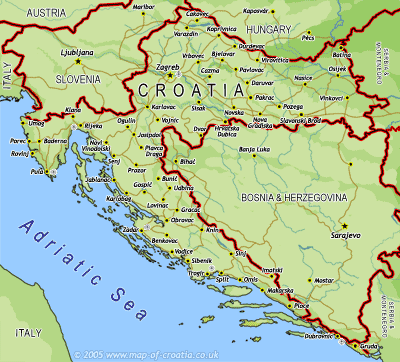
http://www.map-of-croatia.co.uk/maps/Large-map-of-croatia-400.gif
Large-map-of-croatia-400.gif
 
Something very strange about the map of Croatia compared to other Balkan states. The symmetry is not well-proportioned compared to areas of other countries. I wander if there is a meaning to this. Its as if Bosnia have taken a big chunk out of it.

Bill77, it certainly is not a natural border and Croats are aware of this anomaly and even make fun of the current shape of their state (see below).

300px-Greater_Croatia_01.png

http://wiki-images.enotes.com/thumb/d/d2/Greater_Croatia_01.png/300px-Greater_Croatia_01.png

"....Croatian assessment of the geopolitical situation

Among the many issues which burdened and still continue burdening relations between the Croats and Serbs is Croatia's geopolitical position according to the prevailing assessment of Croatian politicians and geopoliticians. Croatia's geopolitical position resembles, in the words of the Croatian historian Vjekoslav Klaić, "a well spread out sausage".

The shape of Croatia is compared by some to a banana or crescent. A Croatia such as this, in the conviction of many Croats, has no chance of surviving and progressing. Antun Radić explained it in the following words: "Dalmatia united with Croatia would resemble the crust of bread, and the middle part which you would cut out would be Bosnia and Herzegovina cut out from the Croatian bread. If we want to eat to satisfaction, we also need the soft middle, we need Herzeg-Bosnia." For Antun's brother Stjepan, Bosnia was "like the gizzard to the rest of Croatia. How can a person live if you take out his gizzard?" In the view of Frano Supilo, "Croatia without Bosnia would always be a toy in the hands of whoever ruled in today's occupied provinces," i.e. in Bosnia and Herzegovina. To gain a permanent economic and financial independence, Croatian politicians believe that they have to seize new territories. Hrvatski dnevnik of 1914 wrote about it as follows: "Croatia in its present size cannot survive because she needs some more provinces for its own economic build-up."

Dr. Ivan Pilar, known under aliases Südland, Dr. Juričić and Florian Lichttrager wrote that "from the geopolitical standpoint, Triune Kingdom without Bosnia and Herzegovina has no chance of maintaining itself either politically or economically". According to Pilar, "Croatia and Slavonia, separated from Bosnia and Dalmatia, its natural component parts, is a torso incapable of life". He wrote also: "The Kingdom of Croatia, Slavonia and Dalmatia, with its long and narrow territory of very little depth (Dalmatia in places only a few kilometers) which extends in two directions, is not capable of being the center of any state and political structure, and in this shape as a political body has no future whatever. In our opinion this realization was the cause of a feverish search for a wider framework for our national development before year 1878, when we played around with the Illyrian and Yugoslav movements. The Triune Kingdom will obtain its elementary conditions of life only once it has annexed Bosnia and Herzegovina. The Croatian people in the territory of the Triune Kingdom has very little hope of maintaining themselves, and Bosnia and Herzegovina is seen as an essential condition for the national survival and political development of the Croatian people. Limited to the Triune Kingdom only, the Croatian people can only have a hand-to-mouth life, but will have a full life if they have Bosnia and Herzegovina." According to Pilar, Croatia, Slavonia and Dalmatia are the shell, and Bosnia and Herzegovina the core of Croatia.

Croatian nationalism and maps of Croatia

Taking up this idea about the shell and the core, the Lexicographic Institute of the FPRY from Zagreb, under the leadership of Miroslav Krleža, in the fourth volume of Encyclopedia of Yugoslavia, which appeared in 1960, in the chapter on Croatia, drew up a geographic map of that republic annexing to it Bosnia and Herzegovina, all the way to the Drina river, not omitting the smallest piece of land on the left bank of that river. When the same Institute, in the seventh volume of Encyclopedia of Yugoslavia, published in 1968, in the chapter on Serbia, attached the geographic map of that republic, it did not use the same method. It stopped Serbia upon the Drina river, hardly crossing to its left bank. In this respect they have more than one century old tradition. Back in 1862, Josip Partas, following a design drafted by Franjo Kružić, published a geographic map entitled "Historical Map of the Entire Kingdom of Croatia with the marked boundaries of the existing provinces and the indication of important ancient and new settlements". This map was printed in the Zagreb printing works of Dragutin Albreht. It embraced, as lands of the Kingdom of Croatia, Bosnia and Herzegovina, Montenegro, south-eastern parts of Serbia and south-western areas of Slovenia.

In conformity with the Croatian aspirations that Croatia's eastern border should be on the Drina, is the ethnographic map by Nikola Zvonimir Bjelovučić. In his booklet Etnografske granice, Hrvata i Slovenaca (Ethnographic Borders of the Croats and Slovenes) which was published in Dubrovnik in 1954, the map Ethnographic Boundaries of the Croats in the Kingdom of Yugoslavia and Surrounding Countries, was published, drawn by Bjelovučić in 1933. Showing quite considerable territorial enlargements, this map is very reminiscent of Pavelić's NDH. As parts of Croatia are given the whole of Bosnia and Herzegovina, the Bay of Kotor until below Bar, the areas of western Bačka, the area of Baja in the then and the present Hungary, parts of Hungary southeast of Pécs, a long belt along the left bank of the Drava, from St. Martin in the east to Donja Lendava in the west, and the whole of Srem. Intentionally drawn inaccurate, Bjelovučić's map is more the expression of Croatian territorial aspirations than an expression of real ethnic relationships. It covers all the lands which according to Croat "state and historic right" should belong to Croatia. Ethnic relationships helped Bjelovučić to publicly state, albeit in an obscure way, Croatian national and political aims.

[.....]

http://www.enotes.com/topic/Greater_Croatia#Croatian_nationalism_and_maps_of_Croatia
 
Indigen, i know the current map of Croatia but i was talking about the times before the creation of Yugoslavia. Also, before 1920s, there was Serbs, Bosnians and Hungarians living in current eastern Croatia. So, there wasn't only catholic Croats in that eastern parts before 1990. Hungarians left/expelled from there first, then Bosnians and Serbs followed.

Besides that, i don't think there was any large catholic Croat community outside Dalmatia during the 450+ years of Ottoman regime. I can easily guess that catholic Croat community settled outside dalmatia only after Ottoman regime was over and most likely after Serbs and Croats decided to become yugo-slav brothers.

I don't know much about the history of that part of Balkans but i can easily guess that because catholicism and Ottoman regime doesn't fit to each other. Also, Serbian church would never allow large community of catholics settle inside Ottoman territories either if you consider the conflict between orthodoxy and catholism during that era. Also, another indication is Ottoman regime in Hungary. Ottoman authorities either killed or expelled all catholic opinion leaders of Hungary when they occupied it or they escaped to the Austria themselves. They only allowed simple peasants and villagers to continue to live in Hungary because catholics always considered as biggest enemy both by Turks and all other orthodox people of Ottoman empire.

So, during Ottoman regime, that eastern part of current Croatia has been ruled by Bosnians and Serbians. As you know, even Serbian church has been restored by the request of Bosnian muslim Mehmet Sokolovic pasha from the Ottoman sultan. The abolishment of the Serbian church after Ottoman conquest was the request of Istanbul patriarchy. When Mehmet Sokolovic restored it, Istanbul patriarch protested him by telling that muslim Mehmet pasha shouldn't intervene to the christians!
 
Last edited:
I found something intersting on why croatia is the way it is.
During the Great Turkish War (1667–1698), Slavonia was regained but hilly western Bosnia, which had been a part of Croatia until the Ottoman conquest, remained outside Croatian control and the current border, which resembles a crescent or a horseshoe, is a remnant of this historical outcome. The southern part of the 'horseshoe' was created by the Venetian conquest following the Siege of Zara and was defined by the 17–18th century wars with the Ottomans. The de jure reason for Venetian expansion was the decision of the king of Croatia, Ladislas of Naples, to sell his rights on Dalmatia to Venice in 1409.[24]
During more than two centuries of Ottoman wars, Croatia underwent great demographic changes. The Croats left the riverland areas of Gacka, Lika and Krbava, Moslavina in Slavonia, and an area in present day north-western Bosnia to move towards Austria where they remained and the present day Burgenland Croats are direct descendants of these settlers. To replace the fleeing Croats, the Habsburgs called on the Orthodox populations of Bosnia and Serbia to provide military service in Croatian and Slavonian Krajina. Serbian migration into this region, which had started in the 16th century, peaked during the Great Serb Migrations of 1690 and 1737–39. The rights and obligations of new populace of the Military frontier were decided with the Statuta Valachorum in 1630.[25]

Looking at the map it looks like the croats got a raw deal but a lot depended on the way it was settled long time ago.The croats came to croatia in the 6 century bc from iran? When they came the bosnians were there allready & supposedly can trace all their way to the illyrians & some sort of albanian link.
 
Last edited:
In a sudden turn of events, Gotovina (along with Markac) has been freed, much to the celebration of Croats and dismay of Serbs. Here are some articles in relation to the event:

http://www.telegraph.co.uk/news/wor...ro-Ante-Gotovina-acquitted-of-war-crimes.html
The unexpected result has sparked jubilant scenes in Croatia as people cheered and wept with joy as they watched a live broadcast of the UN court in Zagreb's central square. "A huge weight has been lifted off my shoulders," said Zoran Milanovic, the Croatian Prime Minister in Zagreb. "I say thank you to them for surviving so long for the sake of Croatia." Last year's conviction of General Gotovina for a criminal conspiracy to commit war crimes dealt a severe blow to Croatia's image as victim of Serb aggression during the break-up of Yugoslavia. Gen. Gotovina, and a more junior general, Mladen Markac, were acquitted on appeal by a 3-2 majority in the five judge UN appeals chamber in the most stunning reversal in the war crime court's 18-year history. Both men showed no emotion at the decision but their Croatian supporters in the court's packed public gallery cheered and clapped the court ordered them to be freed immediately.
http://www.theaustralian.com.au/new...tions-overturned/story-e6frg6so-1226518625797
THE Yugoslav war crimes tribunal has overturned the convictions of two Croat generals for murdering and illegally expelling Serb civilians in a 1995 military blitz, and both men returned home to a hero's welcome. The decision on Friday, by a 3-2 majority in the UN court's five-judge appeals chamber, is one of the most significant reversals in the court's 18-year history and overturns a verdict that dealt a blow to Croatia's self-image as a victim of atrocities, rather than a perpetrator, during the Balkan wars in the 1990s. The ruling triggered scenes of rapture in court and among Croat war veterans watching the ruling on big screens in the capital, Zagreb, but also produced fury in Serbia where it was seen as further evidence of anti-Serb bias at the tribunal. Even liberal Serbs warned it created a sense of injustice and could stir nationalist sentiments.

In The Hague, neither Ante Gotovina nor Mladen Markac showed any emotion as presiding judge Theodor Meron told them they were free men, but their supporters in the court's packed public gallery cheered and clapped. On a lawn outside the tribunal, supporters sang, waved a Croat flag and sipped champagne, while the generals were returned to their jail cells to complete release paperwork before being flown back to Croatia. Thousands of people, including Croatian war veterans, celebrated in the main square of Zagreb, the capital of Croatia.

“Finally, we can say to our children that we are not war criminals,'' said veteran Djuro Vec. “We fought for justice, and that our fight was righteous and just.'' On their arrival in Zagreb, the two were welcomed by Croatia's Prime Minister Zoran Milanovic and other top officials and a red carpet graced the foot of the plane's steps. Gotovina told the cheering crowd singing patriotic songs at Zagreb's main Bana Jelacica square that “this is our joint victory''. “We have won, the war is over and let's turn to the future,'' Gotovina said as the crowd chanted Croatia's main wartime call, “to war, to war for our people.''

Gotovina, 55, and Markac were sentenced to 24 and 18 years respectively in 2011 for crimes, including murder and deportation. Judges ruled both men were part of a criminal conspiracy led by former Croat President Franjo Tudjman to expel Serbs. Serbia claims that some 600 Serbs were killed and more than 200,000 driven from their homes during the operation. Tribunal prosecutors put the death toll lower, at 324, but told the court the victims included elderly and disabled villagers, many of whom had been shot in the head. The appeals judges said prosecutors failed to prove the existence of such a conspiracy, effectively clearing Croatia's entire wartime leadership of war crimes in the operation known as Operation Storm.

It occurred at the end of Croatia's battle to secede from the crumbling Yugoslavia and involved grabbing back land along its border with Bosnia that had earlier been occupied by rebel Serbs. Following the judgment, Serbia said it had scaled back cooperation with the UN war crimes court to protest the acquittal, Beta news agency reported. “The Serbian government decided on Friday to reduce cooperation with the International Criminal Tribunal for the former Yugoslavia to a technical level...,'' Beta quoted Serbian deputy prime minster Rasim Ljajic as saying.

Serbia's nationalist President Tomislav Nikolic declared the “scandalous'' decision by the Hague court was clearly “political and not legal'' and “will not contribute to stabilisation of the situation in the region but will reopen all wounds.''
http://www.nolanchart.com/article99...acquittal-exposes-ictys-political-agenda.html
In spite of the Tribunal’s finding to the contrary, "the permanent and forcible removal of Serb civilians from the Krajina region" was absolutely the goal of the Croatian government. On September 12, 1993, Croatian President Franjo Tudjman told his cabinet that "Croatia must resolve the [Krajina] problem by war, contrary to international norms, meaning by ethnically cleansing the Serbs from Croatia." In fact the permanent and forcible removal of Serb civilians was Croatia’s goal even before the war started. From October until December of 1990, the 12th department of the KOS (Yugoslav military counter-intelligence) secretly videotaped Croatia’s Defense Minister, Martain Spegelj and Croatia’s Interior Minister, Josip Boljkovac. Spegelj can be seen on the videotape telling Boljkovac that "Serbs in Croatia will never be there again for as long as we are there." (See also English transcript of the video)

Speaking about Knin, a Serb-inhabited city in the Krajina region, he says: "Their Knin will never be Knin again." He tells Boljkovac that "We are going to resolve Knin in that way, slaughter. We have international recognition for that and then we slaughter them." Aleksandar Vasiljevic, the KOS agent who filmed the video, testified for the Prosecution in the Slobodan Milosevic trial. He told the Tribunal, "There’s absolutely no doubt that this is absolutely trustworthy material because I filmed it myself and I had it in my own possession." Gotovina and Markac personally participated in the planning of Operation Storm, and the transcript of the meeting where Tudjman and in generals discuss it is in evidence at the Tribunal. At the meeting, President Tudjman lays out the goal. He says, "We have to inflict such blows that the Serbs will to all practical purposes disappear." He says, "it is important that those [Serbian] civilians set out, and then the army will follow them, and when the columns set out they will have a psychological impact on each other."

Gotovina, whom the Tribunal would now have you believe is innocent, is clearly in favor of the plan saying, "if we continue this pressure, probably for some time to come, there won’t be so many civilians just those who have to stay, who have no possibility of leaving." Tudjman discusses the propaganda that should accompany the operation. He says leaflets should be given to Serbian civilians saying, "We are appealing to you not to withdraw, we guarantee -- this means giving them a way out, while pretending to guarantee civil rights etc…" In addition to "pretending to guarantee civil rights" for Serbs, Tudjman wanted to make it look like the Serbs had provoked the attack. He said, "every military operation must have its political justification" and so the Serbs "should provide us with a pretext and provoke us." Chief of staff Zvonimir Cervenko suggests, "We should ask Markac to do that."

Markac, who the Tribunal also says is innocent, responds by suggesting that "We accuse them of having launched a sabotage attack against us and of heading towards Maslenica, of intending to go over Mt. Velebit to the road from Karlobag to Starigrad, that they want to cut it off, and that’s why we were forced to intervene." At that point the Croats begin to discuss false flag operations whereby they stage a fake "Serbian attack" in order to give themselves a pretext to attack the Serbs. Gen. Davor Domazet says, "I think it would be best to do it in the following way. They are using Udbina airport, we can organize an explosion as if they had struck with their air force and in this manner we can disguise all our axes." and so on. Tudjman explains in the planning meeting with his Generals that he will agree to send a delegation to the Z-4 peace negotiations in Geneva "as a mask." He says, "I am going to Geneva to hide this and not to talk … I want to hide what we are preparing [so] we can rebut any argument in the world about how we didn’t want to talk."
http://www.washingtonpost.com/natio...127984-30b3-11e2-af17-67abba0676e2_story.html
BELGRADE, Serbia — Serb nationalists burned a Croatian flag Saturday to protest a decision by a U.N. war crimes court overturning guilty verdicts against two Croatian generals, and the prime minister called the decision a blow to reconciliation in the postwar Balkans.

Many in Serbia are furious that appeals judges at the Netherlands-based tribunal on Friday freed Ante Gotovina and Mladen Markac, who had been previously sentenced to lengthy prison terms for killing and expelling Serbs from Croatia during an offensive in 1995. “This will have serious consequences at reconciliation in the region,” Serbia’s premier Ivica Dacic said. “How can someone demand that we condemn all crimes if others are allowed not to condemn the crimes against Serbs?”

Croatians, meanwhile, consider the decision proof that they were the victims in the Balkan conflict. The fighting in Croatia was part of the wars that erupted across the Balkans with the breakup of Yugoslavia in the 1990s. The most deadly was in Bosnia, where Serbs battled Muslims and Croats in a four-year struggle that claimed some 100,000 lives. Hundreds of supporters of the extremist Serbian Radical Party rallied in front of the presidency building in the center of Belgrade demanding that the government abandon plans to join the 27-nation European Union and cut ties with the court in The Hague, Netherlands.

The crowd carried banners reading “Stop The Hague” and chanted nationalist slogans in support of the party leader, Vojislav Seselj, whose own trial is ongoing at the tribunal for the role in the atrocities against non-Serbs. “Serbia has done nothing to help its own heroes who are jailed in The Hague,” said Radical Party official Nemanja Sarovic. Later Saturday, a separate protest by another far-right group was held in front of the EU headquarters.

Even liberal Serbs have warned that Friday’s ruling created a sense of injustice and could stir nationalist sentiments. Serbia’s government has scaled down cooperation with the tribunal, while Serbia’s President Tomislav Nikolic said the verdict was political. Dacic insisted “this verdict was clearly political ... designed to clear Croatia of crimes committed against Serbs.” Serbian media on Friday and Saturday repeatedly carried file footages of tens of thousands of Croatian Serb refugees fleeing in August 1995 in long columns on tractors, cars and carts. Many still have not returned to their homes.

In Croatia, the two generals received state honors and a hero’s welcome on Friday, with tens of thousands jubilant people gathering in the capital, Zagreb, to greet them. The country is also marking a remembrance day this weekend in the eastern town of Vukovar, which was heavily bombed by the Serb-led military in at the start of the Serb-Croat war in 1991. The war erupted when Croatia declared independence from Serb-led Yugoslavia triggering a rebellion by minority Serbs. About 10,000 people died in the conflict.
 
I simply challenged YOUR claims that "all Croatian towns and cities had Italian/Latin names before the creation of Yugoslavia", and I stick to that position, i.e. NOT ALL Croatian towns and cities had Italian names.

Secondly, I also challenge your hypothetical claim that "maybe Croatia would be Italian territory today if Brits, Americans wouldn't allow creation of Yugoslavia" on the basis that Croats would have fought for their independence and won it, though I would concede that it is possible that ISTRIA and parts of Dalmatia could have been Italian.


It is well known and recorded that Italian soldiers were not the best regarded for bravery or abilities in the last two world wars and the below info will highlight that.

well God bless the Italians for not being enthusiastic about fighting in those sham wars
 
Back
Top