• Welcome to the new Macedonian Truth Forum. All posts, members and private messages have been moved over from the old forum.

    Passwords from the old forum could not be carried over, so please use Forgot your password? to set a new one. The reset link is emailed to the address on your account.

  • Rules and Regulations at the forum of the Macedonian Truth Organisation (MTO)

    (1) The national-ethnic and cultural-linguistic identity of the Macedonian people is historically Macedonian, and derives its character from the native, indigenous and geographic homeland of the Macedonians, which is called Macedonia. To ensure that their human rights, integrity and heritage are appropriately respected, the only nouns and adjectives acceptable when reference is made to the above character and identity markers is Macedon, Macedonia, Macedonian and Macedonians.

    (2) The nation-state of the Macedonian people is the Republic of Macedonia, and is to be referred to by this official title so long as the 'republic' prefix is consistently applied to other states. Alternative references are the Macedonian Republic, or simply, Macedonia.

    (3) The 'ethnic' prefix is only acceptable for Macedonians in cases where differentiation is specifically required - so long as it is in context and consistent where it concerns its application to other ethnic groups.

    (4) Should any other differentiation be specifically required, the names of other ethnic groups that reside with Macedonians in either the Republic of Macedonia or the occupied Macedonian regions in Greece, Bulgaria, Serbia or Albania, are to be given a prefix.

    (5) Negating the identity, language and culture of the Macedonian people by deliberate avoidance of the terms Macedonia, Macedonian and Macedonians, or by any other means, is not permitted.

    (6) Systematic anti-Macedonian propaganda and rhetoric are not permitted.

    (7) Threads irrelevant to the Macedonian Cause, the community at the Macedonian Truth Organisation or the Macedonians in general may be considered as spam or not in the spirit of the forum. In such cases they are not permitted.

    (8) Continual posting of messages in threads with the sole purpose of deviating from the initial topics with the use of unrelated and unnecessary information is not permitted.

    (9) All posts, external articles, reports, etc that are cited in languages other than Macedonian or English, must be accompanied with a translation in one or both of the said languages.

    (10) Despite the possibility of some conversations and debates becoming heated, extreme abuse and/or racism, vulgar language and/or terminology, threats, revelation of personal information about others, harassment, and other such behavior will not be permitted. If deemed necessary all relevant information including member details will be reported to the appropriate authorities for investigation which may result in legal action.

    (11) Threads that are created must have a summary of a topic or excerpt of an article found in pertinent link(s) that have been included. One line threads will be considered unaccetable spam and are therefore not permitted.

    (12) Compulsive and deliberate lies, irrespective of the topic, are not permitted.

    (13) Any symbols or avatars found to be perceived as offensive to Macedonians are not permitted.

    (13) Any explicit or extreme material is not permitted.

    Failure to adhere to the above rules and regulations will result in a ban after 3 breaches. This may be reconsidered in some cases should the circumstances be of an unorthodox nature and/or require special consideration. To assure an effective deterrent against an individual or individuals with the sole purpose of causing dissent through spamming, racism or other improper means, the above rules will be strictly enforced.

    The MTO administration will monitor all discussions as reasonably practical and reserve the right to remove any post and/or member from the forum, and update the rules and regulations as required. Members are encouraged to immediately report any post and/or member to the MTO administration if they feel that these rules have not been abided by.

    The views expressed on this forum are those of the individuals. The only official representation of the MTO is made by the "Macedonian Truth Organisation (Site Owner)" username, and no other.

  • Macedonian Cause

    The Macedonian Truth Organisation calls on God in Heaven to protect, bless and guide the endeavour it is committing to undertake, and that is to work towards:

    Securing Macedonia as a free, independent and democratic republic in which sovereignty lies with the Macedonian citizens; as the nation-state of the Macedonian people in which they can preserve their culture, language and identity; as a state in which the Macedonian language and culture form the basis of public life and act as important unifying elements of Macedonian society; as the home of all its citizens to which it guarantees and obliges their inalienable natural rights and corresponding responsibilities;

    The acknowledgment as self-evident and irrefutable the existence of the:

    1) Indigenous, ethnonational name of Macedonia;
    2) Macedonian people, language and identity;
    3) Macedonian culture, symbols and folklore;
    4) Macedonian ancestry, heritage and history in its entirety; and
    5) Macedonian Orthodox Church;

    Securing recognition by the International Community of the tragedies endured by the Macedonian people, of the division of Macedonia with the signing of the Treaty of Bucharest on August 10, 1913, and the genocide committed against the Macedonian people at the hands of the Greek, Bulgarian and Serbian states and their respective churches during the 19th and 20th centuries;

    Ensuring that the Interim Accord is declared ‘null and void’ and that all constitutional provisions, acts, commitments, agreements, legislation, regulations, policies or programs emanating from, supporting or consequential to the Interim Accord are also declared ‘null and void’, including the use of any symbols and the completion of any acts imposed by, or originating from, the Interim Accord.

    Ensuring that the Framework Agreement is abolished and that all constitutional provisions, acts, commitments, agreements, legislation, regulations, policies and programs emanating from, supporting or consequential to the Framework Agreement are also abolished and replaced by a framework of constitutional and statutory law based on inalienable natural rights and corresponding responsibilities and universally codified human rights mechanisms.

    Securing the abolishment of any existing constitutional provisions, acts, agreements, legislation, regulations, policies and programs that discriminate against the Macedonian people, in any international organisation or any of the countries of the International Community where such constitutional provisions, acts, agreements, legislation, regulations, policies and programs exist, and thereby ensuring the freedom for Macedonians to exercise their inalienable natural rights and fulfil their corresponding responsibilities, and practice their culture, language and religious faiths in all the countries of the International Community without hindrance;

    The empowerment of Macedonians to undertake a moral revolution and to instil and/or reinvigorate within themselves a deep-rooted national, cultural, linguistic and historical dignity and a commitment to the exercise of freedom based on inalienable natural rights and corresponding responsibilities;

    The recognition of the Macedonian minorities in the neighbouring states of Macedonia as well as the respect for the inalienable rights and freedoms of the Macedonian minorities, as provided for by natural law and as codified by the United Nations Charter, the Universal Declaration of Human Rights and other universally codified human rights mechanisms;

    The full and unreserved respect of, and the support for, the rights of all people of non-Macedonian descent living in Macedonia and around the world, who share a reciprocal full and unreserved respect for the Macedonian people, their homeland and their state;

    The cultural unification and solidarity of the Macedonian people living in all parts of historical Macedonia and adjacent territories, as well as Macedonians throughout the world;

    The unity of all Macedonians on the principles, objectives and achievement of the Macedonian cause as defined by this declaration.

Greece steal Paeonia's name

Epirot

New member
If one say that modern 'Ellinas' inherit only the bad habits of their ancestors, then he is not far from the truth. The Albanian insurgents who rose up against Ottoman yoke were called pejoratively as 'Klephts'. Hence, their name derive from the basic root κλέπτειν (kleptein), which means "to steal' (See furthermore: kleptomania and kleptocracy are related terms).

Now let us see how modern 'Ellinas' celebrate this ancestral "virtue"?

Greek official and non-official circles often accuse Macedonians that 'stole' a name that is supposed to be associated with 'Greek' culture, identity, etc, etc. But I'd like to see the reverse side of coin: From 1990's onwards, Greek policies aim to 'purify' the foreign names found in Aegean Macedonia by reviving ancient toponymes.

They rename a region in Kilikis unit as Paionia:

http://en.wikipedia.org/wiki/Paionia_(municipality)

Paionia (Greek: Παιονία) is a municipality in the Kilkis peripheral unit, Central Macedonia, Greece. The seat of the municipality is the town Polykastro.[2] The municipality is named after the ancient region of Paeonia.

Indeed it's historically ascertained that neither Macedonia, nor Paeonia were related to Hellenes. More exactly, most of Paeonia territorially was situated in north of today's Greece. What's the right of 'Ellinas' to revive such a name that has no link with them?
 
Last edited:
We dont claim to be Paonians Epirot. Its used as a geographical reference.
I thought thats pretty obvious.

But this doesn't change anything because my point was that Greece revive ancient non-Greek names and put forth absurd claims either for lineal continuity or for hellenic being of peoples who bore these names.

As far as I know, in Greek historical books, Paeonians are being portrayed as 'Greeks' or heavily influenced by Hellenism. Can you say that they are used only as 'geographical reference'?

Take a look how your historians claim them:

Undoubtedly the names Paion and Paionia have Greek roots like 7taT?, 7raiav. Probably they come from an Achaian tribe...

The Hellenism of the ancient MacedoniansApostolos Vasileiou Daskalakēs
Institute for Balkan Studies, 1965
 
Last edited:
But this doesn't change anything because my point was that Greece revive ancient non-Greek names and put forth absurd claims either for lineal continuity or for hellenic being of peoples who bore these names.

what is wrong with reviving names Epirot ? I think your overexaggerating on this.

As far as I know, in Greek historical books, Paeonians are being portrayed as 'Greeks' or heavily influenced by Hellenism. Can you say that they are used only as 'geographical reference'?

I dont think anybody here claims to be Paeonian Epirot. As a matter of fact if Macedonians today would identify as such, it would be welcomed with open arms.
 
Votron you are totally wrong. The greeks beleive that paeonia belongs to them they think
that long time ago the paeonians were greeks.THe greeks were not satisfied with the land grab in 1913 if anything they want their supposedly greek paeonia.
 
Par for the course with Greeks unfortunately.
Geographic reference vs cultural reference vs political reference etc.
Voltron, why was this name chosen?
Can you please definitively let us know how/why the choice was made?
 
As a matter of fact if Macedonians today would identify as such, it would be welcomed with open arms.
On the flip side, if certain Greeks weren't trying to impose their distorted ideology on their neighbours by trying to force a name change, there would be no problem at all.
 
Par for the course with Greeks unfortunately.
Geographic reference vs cultural reference vs political reference etc.
Voltron, why was this name chosen?
Can you please definitively let us know how/why the choice was made?
The new Demos (municipalities) under Kallikratis Project are wide ones, with populations more than 10,000 people. Since, each one of them usually includes 2 or 3 towns, big and small villages, compromises are often needed to find an acceptable name. So, new names that describe this new "area" are found using older historical names of ancient cities/areas, e.g. Mygdonia or Anthemous, or even of historical figures, e.g. Aristotelis, George Karaiskakis, Emmanouil Papas.
You can find all the names here:
http://en.wikipedia.org/wiki/Administrative_divisions_of_Greece

In this case this area includes the towns of Polykastro, Axioupoli and Goumenissa and is hosting the ruins of ancient Paeonian cities Amydon, Chaetae, Amphaxitis and the Brygian city of Baerus.
 
Last edited:
For anyone interested, this is an extended Greek text on the Greekness of Paeonians, including Greek inscriptions of post-Alexander period concerning King Dropion (son of Leon), who reigned around 280 BC.
http://hellenikathemata.blogspot.com/2010/08/blog-post_530.html
These inscriptions were found in Delphi (where Dropion had gifted a statue), Kentrikon (close to Kilkis, the one in photo) and Tikves (in Republic of Macedonia).
%CE%94%CE%B9%CF%8C%CE%BD%CF%85%CF%83%CE%BF%CF%82+%CE%A0%CE%B1%CE%B9%CE%BF%CE%BD%CE%B9%CE%BA%CF%8C%CF%82.jpg

It says nothing about Greek being of them. If you persist with such logic, then you will make also Daorsians a Hellenic tribe in the midst of Illyrians:

Nine of the recovered coins had a Greek inscription with an image of a boat.[5] Money was of immense importance to the Daorsi, allowing the tribe to remain independent while securing their business, cultural and trade links with other groups.[5][7]

http://en.wikipedia.org/wiki/Daorson

Most commonly, Paeonians are related with Thracians, Illyrians and particularly with the Phrygians. One thing is certain: Paeonians were one of the most ancient Balkans tribe.
 
Last edited:
The link provides the familiar arguments:
-Greek inscriptions (a total of three)
-Greek names (about 10 king names)
-Participation in the Olympic Games
-Cult of the same Gods (Dionysus Paeonicus)

Overall not much is known about Paeonians. Probably the sum of information is less than 2 or 3 pages. References are given on mostly 2 periods:
-the mythical past (Paeon from Elis of Peloponnese, Pyraechmes fought on the Trojans side in Iliad, Thersilochos, Mydonas, Thrasios, Astypylos, Aenios, Mnesos, Ophelestes, Apisaon, Ippasides)
-4th-early 3rd century BC (Agis, Lykkeios, Patraos, Aydoleon, Ariston, Dropion)

Epirot,
It's PAeonia/Paionia, not Peonia. Peonia would in Greek mean Land of Penis.
 
Last edited:
Didn't the Paeonians fight fight agaisnt the Hellenes during the Trojan wars?? That's right they did...

Modern greek interpretation of history is actually funny to someone with some knowledge...

A greek guy asked me if I had seen the movie Thor about a greek god... :wacko:
 
The link provides the familiar arguments:
-Greek inscriptions (a total of three)
-Greek names (about 10 king names)
-Participation in the Olympic Games
-Cult of the same Gods (Dionysus Paeonicus)
.

In fact, the presence of Greek names among Paeonians does not indicate their Hellenic being, because most of Paeonian names aren't Greek but Pre-Greek.

Inscriptions in Greek are well-attested in the regions of Paeonia. That's true. But we have to make an anology with the Illyrian tribe of Daorsi, who are esteemed to have Greek names, Greek inscriptions, same cults and gods as Greeks, etc. But no one has claim ever that Daorsi were Hellenes. They were Hellenized partially but definetely their Illyrian substance remained.

I shall present a concise review written by a Bosnian archeologist:

Peonians

Another illyrian community that in its political development reached a higher degree of political organization, were the Peonians. They inhabited the region of today's southern (In addition: Rep.)Macedonia (upper 'Vardar', Stobi and 'Crna Rijeka'), but its borders were changing through a longer period of time. On the east towards the Thracians the border went with the river 'Mesta' from its mouth to its source 'Arda', and from there towards 'Krdjolsko' lake and further towards north. Accoring to sources from some writers (Strabon, VI, 331, 11; 'Plinije'(=Plinius?), IV, 35; 'Livije'(=Livius?), XL, 33, 14), it can be concluded that in its earlier era that their area covered much wider area, including here the parts of northern Greece, on the expense of some of the local communities there. They resided in also Halkidiki.

That the Peonians were belonging to a community of older and more important Balkan peoples that were politically and culturally were much more advanced from other Balkan communities , it can be witnessed by the fact that they are mentioned by Homer as participants of the Trojan war, were they were fighting on the side of Trojans ( ILL. XVII , 350). During Philip II , Peonians recognized Macedonian rule ('Diod.' XVI , 4). After his death they incited rebellion and Alexander had to stop it.

Peonians being direct neighbour of the Greeks maintained close trade religions and as a result fell early under their cultural influence. Thanks to that they were among the first Illyrian communities to have stepped towards civilisational events. Close relations with Greece is confirmed by data that states that certain Peonian rulers were granted honored citizenship rights ('proksenija'='proxenia'?) by some Greek states. That was given in order to thank them for certain services (assistance in wheat, monetarily, military aid and similar). Such relations were especially strong with Athens, which in its own foreign politics and relations with Macedonia was frequently relying on connections with Illyrian and Thracian kings.

Original sources tell us of names of three peonian kings. At the year of 357. B.C. the throne was occupied by 'Agis'. His heir was 'Likpej' (='Likipeas'?) , and at the year of 306. B.C. on the throne was king 'Audoleont' (='Autoleantos'). His son was 'Ariston' , while 'Dropion' was contemporary of Macedonian king 'Demetrije'(='Demetrius'?) II. 4

High economical and cultural development of Peonia is showed through minting of monetary coins. It is known that the Peonian rulers were minting coins as far back as during the era of Greek - Persian wars. This is a witness that the economy of Peonia was based on trade-monetary relations, with all the accompanying institutions. Minting of monetary coins occurred in continuity across long period of time. At the year of 306. B.C. king ' Audoleont' (= 'Autoleontos' ?) minted coins that stated the title 'basileus' (='vasileus'?) , in a likewise manner that Hellenistic monarchs did. The title of 'Basileus' points that the Peonia represented state organization, for if we were talking about tribal organization with tribal leader as a ruler such title ('Basileus') would not be present.

That there was a high level of political organization in Peonia also points advanced urbanisation of the country. Peonian towns were mentioned also by Herodotus ('Doberos' and 'Bymazos' ), and from younger era there were 'Stuberra', 'Astraion', 'Argos', 'Bryanion', 'Bylazora', 'Stobi', 'Idomene' and others. Since for the development of urbanisation precondition is to have strong economic base, in this case there were all the required conjectures. The country had at its disposal large surplus of products, primarily in wheat and metals, which in the trade with Greeks represented strategic goods. Bringing (or coming) of means had increased the wealth of the country, which, and had conditioned peonian society into early class differentiation. This during the course of development has resulted in establishing strong political organization, that in the finishing stage has growned to state organization. 5

Heirs of king 'Audoleont' ruled over Peonia up until middle of II century B.C. From the political standpoint, from those heirs important one was 'Dropion' , contemporary of Macedonian king 'Demetrije' II and 'Dozon' (='Doson'?). During his rule Peonia in the sources is called 'koinon ton Paionon' (state-political community of Peonians). 6 Greeks with the legal expression 'koinon' had marked statehood , characteristic for their own (Greek) communities. Peonian 'koinon' varied from Greek one to a degree that it included villagers, while with Greeks it was based on 'simpoliteja' (='simpoliteria'?) , among whom societal base was a polis, and among Poenians it was a village.

Enver Imamovic
On elements of political organization of illyrian communities
Prilozi', 30, Sarajevo, 2001., pages. 25-41

Epirot,
It's PAeonia/Paionia, not Peonia. Peonia would in Greek mean Land of Penis

My mistaken then because I was in a hurry as I was writing.
As far as I know, "AE" has the same phonetical value with "E" or in some other cases with "I". In modern historical literature, both terms are used: Paionia/Paionians and Paeonia/Paeonians.

P.S: I demand from moderators to correct the title of thread!
 
Last edited:
ennea said:
The link provides the familiar arguments:
Yeah, you're right, the familiar garbage arguments concerning the 'Greekness' (or lack thereof) of non-Greeks.

Are you going to clarify what you said earlier or not? What did you mean by 'Greekness' of the Paeonians? I hope I don't need to ask again, you're starting to appear evasive.
-Greek inscriptions (a total of three)
You will find the same among the Romans and others.
-Greek names (about 10 king names)
You will find the same among the Romans and others. Furthermore, you will find examples with other peoples, such as the Irish, who not only have English names, but also have their own patriotic Irish songs in the English language. Could you imagine if the Macedonians made a patriotic Macedonian song in the Greek language?? Wow!!

Do you know much about Côte d'Ivoire? They're an African nation under the colonial sway of the French. An African nation - yet they are officially members of La Francophonie and the Latin Union. How many knuckleheads out there would consider the Ivorians ethnically French or historically Latin, simply because they speak the language or because the name of their country is in the language? I know that some knuckleheads have similar misconceptions about the Macedonians and Paeonians, and their plastic 'Greekness'.
-Participation in the Olympic Games
Really, the Paeonians also participated in the Olympics? Anything further you can add to that?
-Cult of the same Gods (Dionysus Paeonicus)
That doesn't mean a thing, and if you bother to take the time and research the so-called 'Greek' gods, you will find that few if any are actually Greek to begin with. Just like today, different nations adopt and adapt from each other.
 
Volk,

The "Hellenes" should more correctly be called Achaeans. This is a map that couldn't be displayed as picture:
http://en.wikipedia.org/wiki/File:Homeric_Greece.svg

Both Homeric epics (Iliad) and classical dramas (e.g. Trojan Women by Euripides) do not depict Trojans as foreigners and generally do not have point of view or take sides. Yet, this is fiction and myths, loosely related to some possible historic reality.
You can read here interesting theories, arguments and counter-arguments on the “nationality” and language of the real Trojans.
http://en.wikipedia.org/wiki/Trojan_language

I wouldn’t be surprised if foreigners confuse Greek and Scandinavian Mythology, but for a Greek that would be unforgivable. I don’t remember where you are. Was that a Greek-American, Canadian, Australian?
 
Last edited:
There were more Greeks fighting on the side of Persia against Alexander so I guess the Persians weren't foreigners either?

The Romans participated the Olympic games as well, Tiberius in 4 BC later Imperator of Rome and Roman Imperator Nero in 1 AC who changed the timing of the Olympic games.

Were they Greek tribe as well?

"Unlike the Modern Olympic Games, only free men who spoke Greek were allowed to participate in the Ancient Games."
- "Olympic World" by author Peter Murray
http://books.google.com/books?id=n-...Greek+Olympic&ei=o5FjSvj7EJqwyASK5K2OAg&hl=pl


Champion48.png


Is this explaining a lot?

Why have Greeks "allowed" Romans to participate the Olympic games?

"From 228 BC or 229 BC onwards the Romans were allowed to take part in the games.[14]
The Games of 196 BC were used by Titus Quinctius Flamininus to proclaim the freedom of the Greek states from Macedonian rule.[15] "

Champion49.png


Pathetically enough you claim some "Greekness" with your twisted interpretation.
 
Epirot,

I don’t understand any of your sources. They should supposedly contradict what I wrote in my earlier posts, but it seems they do the opposite.
I’ not a scholar of History or Archaeology, just a simple-minded Greek. For me an inscription in Greek is… a Greek inscription.
You are Albanian. So, what is Illyrian for you? What is the Illyrian substance? What is pre-Greek (against Greek)?
I can accept that an obscure tribe was Illyrian and non-Greek if (Greek, Roman or other) sources say so. And that maybe later “it showed signs of Hellenization”

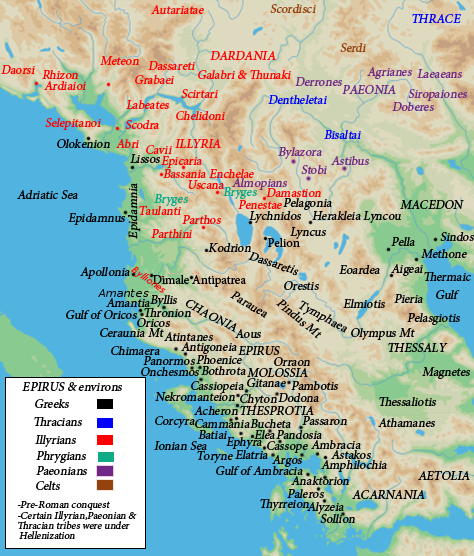
This is an interesting map that appears everywhere and is enough to fuel many conversations. Despite the colours, I hope the geographical locations are accurate. It presents Paeonians separately and Daorsians as Illyrians. In Greek we call them Daorizi or Daoursii.

Map_of_ancient_Epirus_and_environs.png
 
Last edited:
It is a false map and heavily baised in favour of the persistently stupid assertion that Macedonia was 'Greek'. Don't make a habit of posting them here.
 
Back
Top