• Welcome to the new Macedonian Truth Forum. All posts, members and private messages have been moved over from the old forum.

    Passwords from the old forum could not be carried over, so please use Forgot your password? to set a new one. The reset link is emailed to the address on your account.

  • Rules and Regulations at the forum of the Macedonian Truth Organisation (MTO)

    (1) The national-ethnic and cultural-linguistic identity of the Macedonian people is historically Macedonian, and derives its character from the native, indigenous and geographic homeland of the Macedonians, which is called Macedonia. To ensure that their human rights, integrity and heritage are appropriately respected, the only nouns and adjectives acceptable when reference is made to the above character and identity markers is Macedon, Macedonia, Macedonian and Macedonians.

    (2) The nation-state of the Macedonian people is the Republic of Macedonia, and is to be referred to by this official title so long as the 'republic' prefix is consistently applied to other states. Alternative references are the Macedonian Republic, or simply, Macedonia.

    (3) The 'ethnic' prefix is only acceptable for Macedonians in cases where differentiation is specifically required - so long as it is in context and consistent where it concerns its application to other ethnic groups.

    (4) Should any other differentiation be specifically required, the names of other ethnic groups that reside with Macedonians in either the Republic of Macedonia or the occupied Macedonian regions in Greece, Bulgaria, Serbia or Albania, are to be given a prefix.

    (5) Negating the identity, language and culture of the Macedonian people by deliberate avoidance of the terms Macedonia, Macedonian and Macedonians, or by any other means, is not permitted.

    (6) Systematic anti-Macedonian propaganda and rhetoric are not permitted.

    (7) Threads irrelevant to the Macedonian Cause, the community at the Macedonian Truth Organisation or the Macedonians in general may be considered as spam or not in the spirit of the forum. In such cases they are not permitted.

    (8) Continual posting of messages in threads with the sole purpose of deviating from the initial topics with the use of unrelated and unnecessary information is not permitted.

    (9) All posts, external articles, reports, etc that are cited in languages other than Macedonian or English, must be accompanied with a translation in one or both of the said languages.

    (10) Despite the possibility of some conversations and debates becoming heated, extreme abuse and/or racism, vulgar language and/or terminology, threats, revelation of personal information about others, harassment, and other such behavior will not be permitted. If deemed necessary all relevant information including member details will be reported to the appropriate authorities for investigation which may result in legal action.

    (11) Threads that are created must have a summary of a topic or excerpt of an article found in pertinent link(s) that have been included. One line threads will be considered unaccetable spam and are therefore not permitted.

    (12) Compulsive and deliberate lies, irrespective of the topic, are not permitted.

    (13) Any symbols or avatars found to be perceived as offensive to Macedonians are not permitted.

    (13) Any explicit or extreme material is not permitted.

    Failure to adhere to the above rules and regulations will result in a ban after 3 breaches. This may be reconsidered in some cases should the circumstances be of an unorthodox nature and/or require special consideration. To assure an effective deterrent against an individual or individuals with the sole purpose of causing dissent through spamming, racism or other improper means, the above rules will be strictly enforced.

    The MTO administration will monitor all discussions as reasonably practical and reserve the right to remove any post and/or member from the forum, and update the rules and regulations as required. Members are encouraged to immediately report any post and/or member to the MTO administration if they feel that these rules have not been abided by.

    The views expressed on this forum are those of the individuals. The only official representation of the MTO is made by the "Macedonian Truth Organisation (Site Owner)" username, and no other.

  • Macedonian Cause

    The Macedonian Truth Organisation calls on God in Heaven to protect, bless and guide the endeavour it is committing to undertake, and that is to work towards:

    Securing Macedonia as a free, independent and democratic republic in which sovereignty lies with the Macedonian citizens; as the nation-state of the Macedonian people in which they can preserve their culture, language and identity; as a state in which the Macedonian language and culture form the basis of public life and act as important unifying elements of Macedonian society; as the home of all its citizens to which it guarantees and obliges their inalienable natural rights and corresponding responsibilities;

    The acknowledgment as self-evident and irrefutable the existence of the:

    1) Indigenous, ethnonational name of Macedonia;
    2) Macedonian people, language and identity;
    3) Macedonian culture, symbols and folklore;
    4) Macedonian ancestry, heritage and history in its entirety; and
    5) Macedonian Orthodox Church;

    Securing recognition by the International Community of the tragedies endured by the Macedonian people, of the division of Macedonia with the signing of the Treaty of Bucharest on August 10, 1913, and the genocide committed against the Macedonian people at the hands of the Greek, Bulgarian and Serbian states and their respective churches during the 19th and 20th centuries;

    Ensuring that the Interim Accord is declared ‘null and void’ and that all constitutional provisions, acts, commitments, agreements, legislation, regulations, policies or programs emanating from, supporting or consequential to the Interim Accord are also declared ‘null and void’, including the use of any symbols and the completion of any acts imposed by, or originating from, the Interim Accord.

    Ensuring that the Framework Agreement is abolished and that all constitutional provisions, acts, commitments, agreements, legislation, regulations, policies and programs emanating from, supporting or consequential to the Framework Agreement are also abolished and replaced by a framework of constitutional and statutory law based on inalienable natural rights and corresponding responsibilities and universally codified human rights mechanisms.

    Securing the abolishment of any existing constitutional provisions, acts, agreements, legislation, regulations, policies and programs that discriminate against the Macedonian people, in any international organisation or any of the countries of the International Community where such constitutional provisions, acts, agreements, legislation, regulations, policies and programs exist, and thereby ensuring the freedom for Macedonians to exercise their inalienable natural rights and fulfil their corresponding responsibilities, and practice their culture, language and religious faiths in all the countries of the International Community without hindrance;

    The empowerment of Macedonians to undertake a moral revolution and to instil and/or reinvigorate within themselves a deep-rooted national, cultural, linguistic and historical dignity and a commitment to the exercise of freedom based on inalienable natural rights and corresponding responsibilities;

    The recognition of the Macedonian minorities in the neighbouring states of Macedonia as well as the respect for the inalienable rights and freedoms of the Macedonian minorities, as provided for by natural law and as codified by the United Nations Charter, the Universal Declaration of Human Rights and other universally codified human rights mechanisms;

    The full and unreserved respect of, and the support for, the rights of all people of non-Macedonian descent living in Macedonia and around the world, who share a reciprocal full and unreserved respect for the Macedonian people, their homeland and their state;

    The cultural unification and solidarity of the Macedonian people living in all parts of historical Macedonia and adjacent territories, as well as Macedonians throughout the world;

    The unity of all Macedonians on the principles, objectives and achievement of the Macedonian cause as defined by this declaration.

The Crescent symbol and Macedonia

Bratot

New member
The crescent and a star is an internationally recognized symbol of Islamic faith.
Christians have the cross, Jews the Star of David, and Muslims have the crescent.

What is the history behind the crescent as a symbol?
What symbolizes?
How and when has occurred the association with Islamic faith?


The crescent and a star are dating several thousand years before Islam.
It is difficult to determine the exact origin, but many historical sources indicate its use in central Asia and Siberia.
Other sources associated it with the symbol of Carthagine goddess - Tanit or the Greek goddess Diana.
Or in ancient Babylon and the goddess of love and war, Ishtar.

Bizantum City, later known as Constantinople / Istanbul, adopted this symbol and the flag with crescent and a star, hanging from its walls even before the birth of Christ.
The reasons today are not confirmed, one (mostly Greeks) are associating with the goddess Diana, another with the Romans and their victory over the Goths in the first day of the lunar month.

While Islam and Muslims in its beginnings did not had their own religious symbol.
Most commonly they used the black-green-white color to mark their armies.

That was until 1453 when the Ottomans captured Constantinople and have accepted this as their symbol.
Ottoman Empire under its rule has had the largest number of Islamic countries, and through their use of the crescent and a star, the symbol became associated with Islam.

There are various objections from the Muslims themselves in the use of this symbol.


Let's look through the connection of this symbol in our Macedonian history and its use.


Alexander enters Babylon, coin found in Afghanistan
aikhanoumplatesharpsb8.jpg


Byzantine coins:
Moushmov_3233.jpg


hadstar.jpg


Royal emblem of the Kotromanic dynasty who participated in the Kosovo battle:
9grbweb1qa7.jpg


The oldest preserved coat of arms is the Korenich-Neorich one from 1595
%D0%B3%D1%80%D0%B1+%D0%BE%D0%B4+%E2%80%9C%D0%98%D0%BB%D0%B8%D1%80%D1%81%D0%BA%D0%B8%D0%BE%D1%82+%D0%93%D1%80%D0%B1%D0%BE%D0%B2%D0%BD.jpg


Front page of the Coat of Arms; Illyrian coat of arms which is represented with a young crescent and a Morning Star over her, which symbolized the rebirth of the South Slavs;


St. Eronim - "Father, Patron, mirror and light the whole Illyrian country

filesfile20d095d180d0bezt9.jpg


During the Young Turk revolution Jane Sandanski carried the Macedonian flag even to Istanbul, eight rayed yellow star on a red flag with crescent in the middle:

Siekel+and+Star.jpg

%25D0%2597%25D0%25BD%25D0%25B0%25D0%25BC%25D0%25B5%2B%25D0%25BD%25D0%25B0%2B%25D0%25BC%25D0%25BB%25D0%25B0%25D0%25B4%25D0%25BE%25D1%2582%25D1%2583%25D1%2580%25D1%2581%25D0%25BA%25D0%25B0%25D1%2582%25D0%25B0%2B%25D1%2580%25D0%25B5%25D0%25B2%25D0%25BE%25D0%25BB%25D1%2583%25D1%2586%25D0%25B8%25D1%2598%25D0%25B0.png


Red Crescent Star - Turkish battle flag, Man of war.
http://www.lombardmaps.com/cat/histfig/flags/flags1.jpg

Also very popular legend:
2q9fa6t.gif


Macedonian translation of "Macedonian Imperialism" by Elis:

Полумесечината симбол од Филип II Македонски
http://www.macedonium.org/Macedonium.aspx?jazik=2&kid=9&pid=33&ppid=277&tid=663
 
I would also like to start discussion about this symbol, that many of us have seen it beside many other Macedonian symbols:

560px-Flag_of_Padania.svg.png


This is the Italian version of a separatist flag of northern Italy ...region thay call PADANIA, seeking separation from Italy.

This symbol has been often associated with the Paionians who were part of Macedonian Kingdom:
2008cover_ws-258x351.jpg


The Paionian cleric woman
paj.jpg


http://www.telegraf.mk/Pajonskata-sveshtenichka-kje-bide-otkriena-denes.html

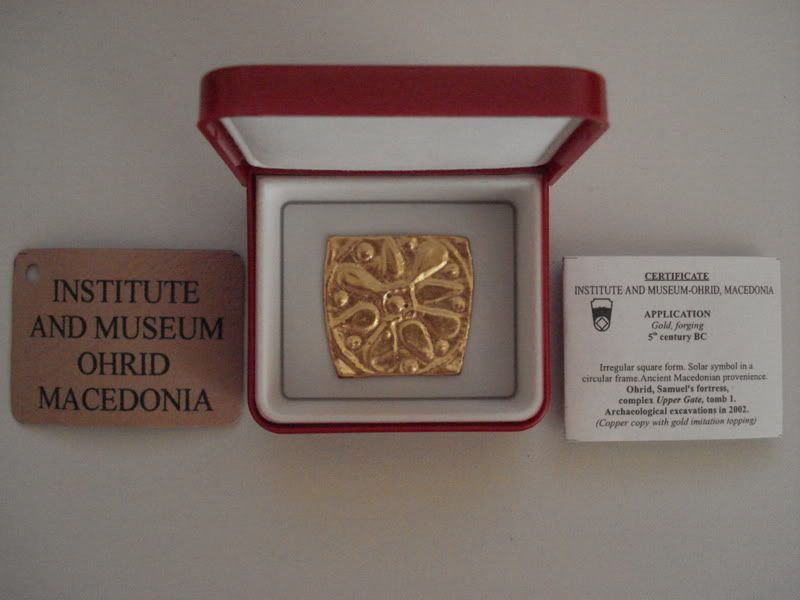
This symbol in Macedonia is sometimes called 'flower of life' and can be found engraved next to the Symbol of Eternity, brought from Stobi:
img0403w.jpg


Symbol 29:6


Previous sign Next sign All signs in Group 29 29:6 · This ideogram is, among other things, a sun symbol. It has been found on seals in Mohenjo-Daro in today's Pakistan from 3000-2000 B.C.
The sun wheel was the Gauls' most used beneficial amulet. The Gauls were the Celtic tribes living in what is now the French-speaking region of Europe. It is worth noting that the Celts used as the attribute of Taranis, the god of thunder. In this use the sign is equivalent to the staff carried by Zeus or Jupiter, , the staff of thunder and lightning.
Christian symbolism adopted the form, changing it slightly so that it became a Christ monogram drawn within a circle: .
The circle divided into six equal parts, with another circle in its center, , is the Tibetan world symbol, the world wheel. The outer is further divided into 12 parts in the same way as the Western zodiac circle. The inner circle band is divided into a light half and a dark half, which suggests that the wheel also symbolizes the same idea of the unity of opposites as does the Chinese yin-yang sign, .
In Japan is considered to be a sign with positive connotations.
This sign is not, however, widely used in modern ideography except as an electrical sign for a specific type of electric motor..
The alchemists sometimes used to denote malachite, an emerald-green mineral containing copper used, among other things, for the production of colouring pigment.

http://www.symbols.com/encyclopedia/29/296.html
 

Carl G. Liungman, the author of Symbols -- Encyclopedia of Westerns Signs and Ideograms.
http://www.symbols.com/about/

Firstly, I think we need to establish what academic qualifications, if any, does this man have in order to establish whether we are looking at a credible and scholarly source for the above information and not some crackpot making things up or bending the truth to suit his agenda. If he has academic qualifications, we then need to asses what his standing and reputation is amongst peers in his field.

A bit of googling produces some results (he is published but still no info on his academic qualifications and training/expertise):

Editorial Reviews
From Library Journal
Never before published in the United States, this authoritative four-part history, dictionary, and index of non-iconic symbols is a revision of the author's Symboler , published in Sweden in 1974. Part 1 concisely traces the historical development of symbols since their first appearance about 20,000 years ago, then develops several topical themes: astrological, hobo, and Nazi symbols, as well as modern business logotypes. Classification by form is difficult due to the diversity of symbols, yet about 1500 are painstakingly classified into 54 groups in Part 2 where the history, derivation, and meanings are described for each. In Part 3, verbal descriptions, e.g., "peace symbol," comprise the easily used word index. There are some oversights in the index (e.g., astrological signs, which are treated in some detail elsewhere, only appear sporadically), but this is not a major criticism. Part 4, a graphic index, references information in Part 2 by shape and form. All historical periods and geographical areas are treated. Engineering symbols are deliberately excluded. There is nothing else quite like this well-researched work; other titles are older or specialized. Although useful for scholars and specialists, this is excellent for general reference. Highly recommended for medium to large reference collections.
- Stanley P. Hodge, Ball State Univ. Lib., Muncie, Ind.
Copyright 1991 Reed Business Information, Inc. --This text refers to the Hardcover edition.
Review
This book will certainly become one of the key sources for tracing symbols and their meanings. (American Libraries )

1.0 out of 5 stars Dictionary of Symbols' reach is well beyond its grasp., April 15, 1998
By
Jason M. Sullivan (jason.m.sullivan@worldnet.... (Raleigh, NC, USA) - See all my reviews

This review is from: Dictionary of Symbols (Norton Paperback) (Paperback)

While the selection and classification structure of the symbols in the dictionary has much to offer, the actual _descriptions_ of the symbols leave plenty to be desired. The authour seems to come from an astrological background, and the gaps in his knowledge (particularly with respect to electronic, hobo, and non-Christian religious symbols) are evident throughout; especially when seen side-by-side with the verbose coverage of astrological and Judeo-Christian symbols.

While the classification scheme is amazing, and very well thought out, the actual content is rather below what I expected.
http://www.amazon.com/Dictionary-Symbols-Norton-Paperback-Liungman/dp/0393312364
 
Last edited:
In early times, the chief town and seat of the Paionian kings was Bylazora (now Veles in the Republic of Macedonia) on the Axios; later the seat of the kings was moved to Stobi.

Bylazora
Bylazora was a city of the Paionians, situated along the banks of the Axios (now the Vardar) river in ancient Paionia (the region is now part of the Republic of Macedonia). In pre-Roman times, it was the chief town and seat of the Paionian kings, a major Paionian city, along with Stobi.

Paeonia was later conquered by Macedon and later still by Rome, and the city eventually waned away. The modern Veles is located on the site of ancient Bylazora.

BYLAZORA:
belo - modern slavic = ´white´
zora - modern slavic = ´dawn´
(note - Western scholars hold that Slavs migrated into the Balkans in 600 AD)

Polybius-Histories — Book 5
97 At about the same time Philip occupied Bylazora, the largest town in Paeonia and very favourably situated as regards the pass from Dardania to Macedonia. So that by his conquest he very nearly freed himself from the fear of the Dardai, 2 it being no longer easy for them to invade Macedonia, now that Philip commanded the passes by holding this city. 3 After securing the place, he dispatched Chrysogonus with all speed to collect the levies of upper Macedonia 4 and he himself with those of Boeotia and Amphaxites arrived at Edessa. p235Here he was joined by the Macedonians under Chrysogonus, and setting forth with his whole army reached Larisa on the sixth day. 5 Pushing on vigorously all night without stopping, he arrived before Melitea at daybreak, and setting up his scaling-ladders, attempted to storm the town. 6 He terrified the Meliteans so much by the suddenness and unexpectedness of the attack that he could easily have taken the town; but the attempt was foiled by the ladders being far too short for the purpose.

http://penelope.uchicago.edu/Thayer/E/Roman/Texts/Polybius/5*.html

THE ACROPOLIS OF BYLAZORA, page 4

By Eulah Matthews and William Neidinger

Paionian grey ware jug with a solar stamp (above right). Compare the similar stamp on
a pithos rim (right).

SN09Finds0275.JPG


Phase 7: Destruction of Bylazora.

Most of the pottery of the Second Squatter Period dates to the third-early second century BC. That
is close to the date that the ancient authors give as the destruction of Paionian Bylazora. Wars
swept over Bylazora at this time. Polybius (V:97) says that King Philip V of Macedonia “occupied”
Paionia in 217 BC to defend Macedonia from the Dardanians, the unruly northern enemies of the
Paionians and Macedonians.
Livy (XLII:51.5) speaks of a Paionian cavalry unit fighting alongside
the Macedonians against the Romans in 171 BC
. After that Macedonia and Paionia became parts
of the Roman state
, their independent polities gone forever and their ethnic identities submerged
into a larger world. When Ptolemy writes his Geography in the second century AD, he mentions the
land of the Paionians and enumerates their cities. Bylazora is not mentioned. It clearly has been
abandoned and its ruins forgotten.

http://www.tfahr.org/BP_acrop4.html

Under the Romans, Paeonia formed a province called Macedonia Secunda or Macedonia Salutaris, belonging to the Praetorian prefecture of Illyricum.


Following the conquest of Egypt by Alexander the Great the worship of Isis spread throughout the Graeco-Roman world.[13]

http://en.wikipedia.org/wiki/Isis

Serapis or Sarapis was a Graeco-Egyptian god. He was invented during the 3rd century BC at the orders of Ptolemy I of Egypt as a means to unify the Greeks and Egyptians in his realm. The god was depicted as Greek in appearance, but with Egyptian trappings, and combined iconography from a great many cults, signifying both abundance and resurrection. His cultus was spread as a matter of deliberate policy by the Ptolemaic kings, who also built a splendid Serapeum in Alexandria.
...
Under Ptolemy Soter, efforts were made to integrate Egyptian religion with that of their Hellenic rulers. Ptolemy's policy was to find a deity that should win the reverence alike of both groups, despite the curses of the Egyptian priests against the gods of the previous foreign rulers (i.e Set who was lauded by the Hyksos). Alexander the Great had attempted to use Amun for this purpose, but he was more prominent in Upper Egypt, and not as popular with those in Lower Egypt, where the Greeks had stronger influence. The Greeks had little respect for animal-headed figures, and so a Greek-style anthromorphic statue was chosen as the idol, and proclaimed as the equivalent of the highly popular Apis.[2] It was named Aser-hapi (i.e. Osiris-Apis), which became Serapis, and was said to be Osiris in full, rather than just his Ka (life force).

http://en.wikipedia.org/wiki/Serapis

Osiris was the mythological father of the god Horus, whose conception is described in the Myth of Osiris and Isis, a central myth in ancient Egyptian belief. The myth described Osiris as having been killed by his brother Set who wanted Osiris' throne. Isis briefly brought Osiris back to life by use of a spell that she learned from her father. This spell gave her time to become pregnant by Osiris before he again died. Isis later gave birth to Horus. As such, since Horus was born after Osiris' resurrection, Horus became thought of as a representation of new beginnings and the vanquisher of the evil Set.

http://en.wikipedia.org/wiki/Osiris

look at symbols depicted in this representation of Serapis:

Serapis.JPG


Than Coat of Arms of Bulgaria by Vincenco Coronelli and the Kingdom of Yugoslavia next

500px-Coat_of_arms_of_Bulgaria_%28by_Vincenco_Coronelli%29.svg.png


425px-Coat_of_arms_of_the_Kingdom_of_Yugoslavia.svg.png


http://www.eupedia.com/forum/showthread.php?26187-Macedonians/page18
 
Last edited:
Carl G. Liungman, the author of Symbols -- Encyclopedia of Westerns Signs and Ideograms.
http://www.symbols.com/about/

Firstly, I think we need to establish what academic qualifications, if any, does this man have in order to establish whether we are looking at a credible and scholarly source for the above information and not some crackpot making things up or bending the truth to suit his agenda. If he has academic qualifications, we then need to asses what his standing and reputation is amongst peers in his field.

A bit of googling produces some results (he is published but still no info on his academic qualifications and training/expertise):


Of course, feel free to establish those academic qualifications according to you, because I can't remember who was the last that gave the "authority" to someone to establish "Authorities" and to set some criteria.

If there is particular objection to what I cited than make it precize, not with methods of 'Devil horns' in order to dismiss a whole theory.
 
This symbol has been often associated with the Paionians who were part of Macedonian Kingdom:
2008cover_ws-258x351.jpg


The Paionian cleric woman
paj.jpg


http://www.telegraf.mk/Pajonskata-sveshtenichka-kje-bide-otkriena-denes.html

This symbol in Macedonia is sometimes called 'flower of life' and can be found engraved next to the Symbol of Eternity, brought from Stobi:
img0403w.jpg

PAEONY
noun, plural -nies.
any of various plants or shrubs of the genus Paeonia, having large, showy flowers, as the widely cultivated species P. lactiflora: the state flower of Indiana.


http://dictionary.reference.com/browse/peony

peony
a merger of O.E. peonie and O.N.Fr. pione, both from L.L. peonia, from L. pæonia, from Gk. paionia (fem. of paionios), perhaps from Paion, physician of the gods (or Apollo in this aspect), supposedly so called for the plant's healing qualities. The root, flowers, and seeds formerly were used in medicine.

http://www.etymonline.com/index.php?search=paion&searchmode=none

paean
1590s, from L. paean "hymn of deliverance," from Gk. paian "hymn to Apollo," from Paian, a name of the god; originally the physician of the gods (in Homer), later merged with Apollo; lit. "one who touches," from paio "to touch, strike."

Floweroflife_sm.png


Flower of life - symbol of all major religion

The Flower of Life is a geometrical figure composed of multiple evenly-spaced, overlapping circles, that are arranged so that they form a flower-like pattern with a six-fold symmetry like a hexagon. In other words, the center of each circle is on the circumference of six surrounding circles of the same diameter. The Temple of Osiris at Abydos, Egypt contains the oldest to date example. it is carved in granite and may possibly represent the Eye of Ra a symbol of the authority of the pharaoh.

Other examples can be found in Phoenician, Assyrian, Indian, Asian, Middle Eastern, and medieval art. A Flower of Life pattern can be constructed with a pen, compass and paper, by creating multiple series of interlinking circles. In some renditions, the rosette on the unofficial flag of Padania is a partial version of the "flower of life" pattern. The Flower of Life pattern contains the basis of Metatron's Cube. From this pattern, all five of the Platonic solids can be derived

http://www.crystalinks.com/merkaba.html


Leonardo Da Vinci studied the Flower of Life form and mathematical characteristics :

Fol_DaVinci2.jpg


The "Flower of Life" can be found in all major religions of the world. In Egypt, the source of all the monotheistic religions, the "Flower of Life" can be found in the ancient Temple of Abydos. In Israel it can be found in ancient synagogues in the Galilee and in Mesada. The "Flower of Life" contains the patterns of creation as they emerged from the "Great Void". Everything is made from the Creator's thought.

http://www.ka-gold-jewelry.com/p-articles/flower-of-life.php


E. Paionian
The Paionian language is the poorly attested language of the ancient Paionians, whose kingdom once stretched north of Macedon into Dardania and in earlier times into southwestern Thrace.

Classical sources usually considered the Paionians distinct from Thracians or Illyrians, comprising their own ethnicity and language. Athenaeus seemingly connected the Paionian tongue to the Mysian language, itself barely attested. If correct, this could mean that Paionian was an Anatolian language. On the other hand, the Paionians were sometimes regarded as descendants of Phrygians, which may put Paionian on the same linguistic branch as the Phrygian language.

NOTE. Modern linguists are uncertain on the classification of Paionian, due to the extreme scarcity of materials we have on this language. However, it seems that Paionian was an independent IE dialect. It shows a/o distinction and does not appear to have undergone Satemization. The Indo-European voiced aspirates became plain voiced consonants, i.e. *bh→b, *dh→d, *gh→g, *gwh→gw; as in Illyrian, Thracian, Macedonian and Phrygian (but unlike Greek).

http://dnghu.org/indo-european-grammar/1-southern-indo-european-dialects-2.htm
 
The Miyaks flag:

Mijacko_Zname.jpg


It is familiar that most of the Mijaks accepted the Bogomilism.

Teracote icons from Vinicko Kale:

v12.JPG
 
Last edited:
In Slavic folklore and paganism the Flower of Life is called the Symbol of Perun or more traditionally the Thunder Sign. Even today for example in Russia it is inscribed on wooden beams of houses to protect them from lightning bolts, that is, to appease Perun, the Thundergod.

There are also many of old houses in my village that have the Flower of Life engraved on the roof walls facing the street, although rosettes are more common.
 
Turkic people was using crescent+star as their symbol and/or their flag, long b4 they accepted islam, much earlier than the conquest of Istanbul. Nearly all Turkic states and empires used it as their flag since 6th century AD(earliest date we know for sure) and thats still the case today. I`ve posted a msg here b4;


GokTurk Empire coins found in today`s Kyrgyzstan, Tajikistan and Uzbekistan archeological digging sites. Coins are dated between 576-600 AD. These coins are currently in a museum in Kyrgyzstan;
islam13tj.jpg


Notice the name of the state and the crescent+star on the coins.


This is the flag of Hungarian speaking Szekely people in Romania. They are believed to be the descendants of Huns and Turkic Avars(thats what Szekelys themselves say too) and this flag probably was Avar kingdom`s flag too;
rgiszkely.jpg


The crescent+star again!


Crescent+star probably accepted as a symbol of islam because Turkic people like Seljuks, Mamluks, Ottomans ruled all islamic lands from 11th century `till 20th century, for about ~900 years. These people had flags with crescent+star and most likely it`s been adopted by all muslims as their symbol during that ~900 years of time.


Also, most (if not all) symbols related with nature comes from antiquity when people adored and respected natural events, power symbols. This is from the time when we were shamans, druids or pagans. Just like the Turkic symbol of wolf. It`s related with shamanistic belief, not with islam.

It`s same for the tree of life concept. In shamanism, the bole of the great tree represents mother nature, the boughs are her creations, humans, animals, from generation to other as the boughs grows longer and the four main elements of the world are water, air, earth and fire. So, i believe the flower of life myth in slavic folklore is probably related with shamanism, not with Greek or Roman paganism because nature and animals are main themes of shamanism where those were sacred for them but in Greek paganism, animals are not that high on their list but human forms are more evident. For example, you can find God or a supreme beings represented as a tree or as a wolf, hawk in shamanistic belief but in Greek paganism, Gods has been usually represented in human forms and appearance.

Greek pagans usually searched for absolute beauty and perfection in human form when they tried to present supreme beings but on the other hand, easterner shamans considered various animals like big cats, wolves or predatory birds or a giant tree as the earthly reflections of supreme beings because those were the representation of perfect form, not human body. According to them, humans were weak comparing to a wolf or a lion. The beauty and perfection was with the animals.
 
Last edited:
Back
Top