• Welcome to the new Macedonian Truth Forum. All posts, members and private messages have been moved over from the old forum.

    Passwords from the old forum could not be carried over, so please use Forgot your password? to set a new one. The reset link is emailed to the address on your account.

  • Rules and Regulations at the forum of the Macedonian Truth Organisation (MTO)

    (1) The national-ethnic and cultural-linguistic identity of the Macedonian people is historically Macedonian, and derives its character from the native, indigenous and geographic homeland of the Macedonians, which is called Macedonia. To ensure that their human rights, integrity and heritage are appropriately respected, the only nouns and adjectives acceptable when reference is made to the above character and identity markers is Macedon, Macedonia, Macedonian and Macedonians.

    (2) The nation-state of the Macedonian people is the Republic of Macedonia, and is to be referred to by this official title so long as the 'republic' prefix is consistently applied to other states. Alternative references are the Macedonian Republic, or simply, Macedonia.

    (3) The 'ethnic' prefix is only acceptable for Macedonians in cases where differentiation is specifically required - so long as it is in context and consistent where it concerns its application to other ethnic groups.

    (4) Should any other differentiation be specifically required, the names of other ethnic groups that reside with Macedonians in either the Republic of Macedonia or the occupied Macedonian regions in Greece, Bulgaria, Serbia or Albania, are to be given a prefix.

    (5) Negating the identity, language and culture of the Macedonian people by deliberate avoidance of the terms Macedonia, Macedonian and Macedonians, or by any other means, is not permitted.

    (6) Systematic anti-Macedonian propaganda and rhetoric are not permitted.

    (7) Threads irrelevant to the Macedonian Cause, the community at the Macedonian Truth Organisation or the Macedonians in general may be considered as spam or not in the spirit of the forum. In such cases they are not permitted.

    (8) Continual posting of messages in threads with the sole purpose of deviating from the initial topics with the use of unrelated and unnecessary information is not permitted.

    (9) All posts, external articles, reports, etc that are cited in languages other than Macedonian or English, must be accompanied with a translation in one or both of the said languages.

    (10) Despite the possibility of some conversations and debates becoming heated, extreme abuse and/or racism, vulgar language and/or terminology, threats, revelation of personal information about others, harassment, and other such behavior will not be permitted. If deemed necessary all relevant information including member details will be reported to the appropriate authorities for investigation which may result in legal action.

    (11) Threads that are created must have a summary of a topic or excerpt of an article found in pertinent link(s) that have been included. One line threads will be considered unaccetable spam and are therefore not permitted.

    (12) Compulsive and deliberate lies, irrespective of the topic, are not permitted.

    (13) Any symbols or avatars found to be perceived as offensive to Macedonians are not permitted.

    (13) Any explicit or extreme material is not permitted.

    Failure to adhere to the above rules and regulations will result in a ban after 3 breaches. This may be reconsidered in some cases should the circumstances be of an unorthodox nature and/or require special consideration. To assure an effective deterrent against an individual or individuals with the sole purpose of causing dissent through spamming, racism or other improper means, the above rules will be strictly enforced.

    The MTO administration will monitor all discussions as reasonably practical and reserve the right to remove any post and/or member from the forum, and update the rules and regulations as required. Members are encouraged to immediately report any post and/or member to the MTO administration if they feel that these rules have not been abided by.

    The views expressed on this forum are those of the individuals. The only official representation of the MTO is made by the "Macedonian Truth Organisation (Site Owner)" username, and no other.

  • Macedonian Cause

    The Macedonian Truth Organisation calls on God in Heaven to protect, bless and guide the endeavour it is committing to undertake, and that is to work towards:

    Securing Macedonia as a free, independent and democratic republic in which sovereignty lies with the Macedonian citizens; as the nation-state of the Macedonian people in which they can preserve their culture, language and identity; as a state in which the Macedonian language and culture form the basis of public life and act as important unifying elements of Macedonian society; as the home of all its citizens to which it guarantees and obliges their inalienable natural rights and corresponding responsibilities;

    The acknowledgment as self-evident and irrefutable the existence of the:

    1) Indigenous, ethnonational name of Macedonia;
    2) Macedonian people, language and identity;
    3) Macedonian culture, symbols and folklore;
    4) Macedonian ancestry, heritage and history in its entirety; and
    5) Macedonian Orthodox Church;

    Securing recognition by the International Community of the tragedies endured by the Macedonian people, of the division of Macedonia with the signing of the Treaty of Bucharest on August 10, 1913, and the genocide committed against the Macedonian people at the hands of the Greek, Bulgarian and Serbian states and their respective churches during the 19th and 20th centuries;

    Ensuring that the Interim Accord is declared ‘null and void’ and that all constitutional provisions, acts, commitments, agreements, legislation, regulations, policies or programs emanating from, supporting or consequential to the Interim Accord are also declared ‘null and void’, including the use of any symbols and the completion of any acts imposed by, or originating from, the Interim Accord.

    Ensuring that the Framework Agreement is abolished and that all constitutional provisions, acts, commitments, agreements, legislation, regulations, policies and programs emanating from, supporting or consequential to the Framework Agreement are also abolished and replaced by a framework of constitutional and statutory law based on inalienable natural rights and corresponding responsibilities and universally codified human rights mechanisms.

    Securing the abolishment of any existing constitutional provisions, acts, agreements, legislation, regulations, policies and programs that discriminate against the Macedonian people, in any international organisation or any of the countries of the International Community where such constitutional provisions, acts, agreements, legislation, regulations, policies and programs exist, and thereby ensuring the freedom for Macedonians to exercise their inalienable natural rights and fulfil their corresponding responsibilities, and practice their culture, language and religious faiths in all the countries of the International Community without hindrance;

    The empowerment of Macedonians to undertake a moral revolution and to instil and/or reinvigorate within themselves a deep-rooted national, cultural, linguistic and historical dignity and a commitment to the exercise of freedom based on inalienable natural rights and corresponding responsibilities;

    The recognition of the Macedonian minorities in the neighbouring states of Macedonia as well as the respect for the inalienable rights and freedoms of the Macedonian minorities, as provided for by natural law and as codified by the United Nations Charter, the Universal Declaration of Human Rights and other universally codified human rights mechanisms;

    The full and unreserved respect of, and the support for, the rights of all people of non-Macedonian descent living in Macedonia and around the world, who share a reciprocal full and unreserved respect for the Macedonian people, their homeland and their state;

    The cultural unification and solidarity of the Macedonian people living in all parts of historical Macedonia and adjacent territories, as well as Macedonians throughout the world;

    The unity of all Macedonians on the principles, objectives and achievement of the Macedonian cause as defined by this declaration.

The exact meaning of 'Macedonians and the rest of Greeks'

Epirot

New member
Virtual propagandists from Greece are not ashamed to put forth some truncated quotes, trying to pass them as truth. For their needs, they have manufactured a list of certain citations to convince erroneously others with the 'Greekness' of Macedonia.

“Macedonia and the Rest of Greece” in the ancient Literary & E***raphical sources

Arrian II.14.4: "Macedonia and the rest of Greece" (..Είς Μακεδονίαν και είς την άλλην Ελλάδα)

Polybius 7.9.3: "Macedonia and the rest of Greece" (..Μακεδονίαν και τήν άλλην Ελλάδα)


Strabo, 7.9: "Macedonia, of course, is a part of Greece[..]without taking her [Macedonia] from the rest of Greece" (..έστι μεν ουν Ελλάς και η Μακεδονίαν[...]χωρίς έγνωμεν αυτήν από της άλλης Ελλάδος )

Polybius 7.9.5: "Philip and Macedonians and the rest of Greeks“ (..Φιλίππον και Μακεδόνων και υπό τών άλλων Ελλήνων)


Julius Valerius Alexander Polemios I.18: omni Macedonia et et reliqua Graecia conspirante


Polybius 7.9.7: "Macedonians and the rest of Greeks" (..και Μακεδόνες και των άλλων Ελλήνων)

Plutarch, Alexander's Fortune 99.3.6: "Macedonians and the rest of Greeks" (...Μακεδόνες και οι άλλοι Έλληνες)

Arrian Ι.16.7: "Alexander, son of Philip and the Greeks.." (Αλέξανδρος Φιλίππου και οι Έλληνες )

Strabo, 10.2.23: "to the Macedonians and the rest of Greeks" (...πρός τε τους Μακεδόνας και τους άλλους Έλληνας )


Dio Chrysostom, Discourse on Kingship no. 4; 9 and 48:, Macedonians and the rest of Greeks(...Μακεδόνας τε και τους άλλους Έλληνας )

IG XII,2 525: "...Alexander and the Greeks.." (..καὶ πόλεμον ἐξε[νι]- [κ]άμενος πρὸς Ἀλέξανδρον καὶ τοὶς Ἔλλανας τοὶς μὲν πολίταις παρελόμενος τὰ ὄπλα ἐξε- κλάϊσε) (Eresos 332 BC)

IG X(2.1) no.1031 lines 6-7: "..Macedonians and the rest of Greeks.." (..και τους λοιπούς Μακεδόνας και τους άλλους Έλληνας) (Olympia, Damon the Macedonian, 143 BC)

Syll. 3 nos. 372, lines 6 kai 7: "Kings and the rest of Greeks", (..[υ]πό των βασιλέων και /[τ]ών άλλων Ελλήνων) (Samothrace 288-281 BC)


Magnesia 6, 557, lines 30-31: "of the kings and the rest of Greeks“ (..των βασιλέων [κ]αί των άλλ[ων] Ελλήνων απάν]τωμ) (Magnesia et Maian.: Artemis Leukofryni, 207/6 BC)

Syll.³ 398 590, line 30, "of the kings and the rest of Greeks" (..τοίς βασιλεύσι και τοις άλλοις Έλλησι) (SbBerlin 24 (1905) 979-993, 196 BC)

Ephesos 163: ”..Macedonians and the rest of Greek ethne" (..εἶναι μῆνα καλούμενον παρ̣’ ἡ̣[μ]ῖν μὲν Ἀρτεμισ[ι]-ῶνα, παρὰ δὲ Μακεδόσιν καὶ τοῖς λοιποῖς ἔθνεσιν τοῖς Ἑλληνικοῖς) (Ephesos 160 BC)

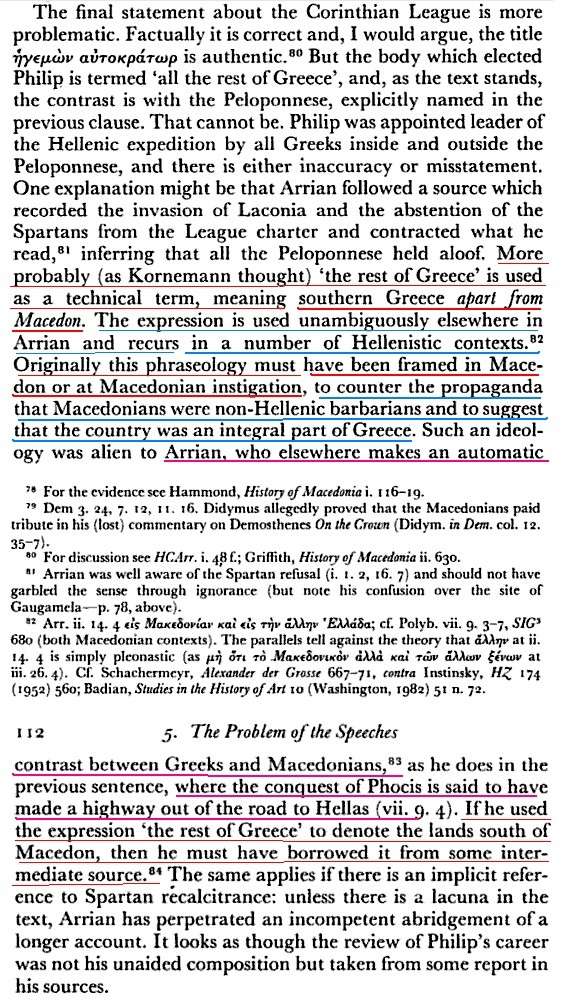
But let see what is the opinion of one of the most renowned authorities in ancient Macedonia:
1_bmp15.jpg

From Arrian to Alexander: studies in historical interpretation By A. B. Bosworth

"Macedonians and the rest of Greeks' occurs in several cases into Hellenistic literature. This expression must be classified within the framework of propaganda of Macedonian kings, who aimed to counter the immense propaganda of Greeks about non-Hellenicity of Macedonians. But again they do not have much credibility since they are firmly refuted by dozens of ancient sources, who draw a sharp line between Macedonians and Greeks.

For example, "AMAC" propagandists like to quote Polybius where he has stated "Μακεδονίαν και τήν άλλην Ελλάδα", but cynically they omit to quote Polybius where he has transmitted originally a part of Philip V speech:

POLYBIUS - 'THE RISE OF THE ROMAN EMPIRE', HISTORIES Book XVIII.5

Αἰτωλῶν δ' οὐκ ἀνεκτόν: ποίας δὲ κελεύετέ με" [7] φησὶν " [8] ἐκχωρεῖν Ἑλλάδος καὶ πῶς ἀφορίζετε ταύτην; αὐτῶν γὰρ Αἰτωλῶν οὐκ εἰσὶν Ἕλληνες οἱ πλείους: τὸ γὰρ τῶν Ἀγραῶν ἔθνος καὶ τὸ τῶν Ἀποδωτῶν, ἔτι δὲ τῶν Ἀμφιλόχων, οὐκ ἔστιν Ἑλλάς. [9] ἢ τούτων μὲν παραχωρεῖτέ μοι;"

'What is this Greece which you demand that I should evacuate, and what how do you define Greece?. Certainly most of the Aetolians themselves are not Greeks!. The countries of the Agraae, the Apodotea, and the Amphilochians cannot be regarded as Greeks. So do you allow to me to remain in those territories'
 
Last edited:
Virtual propagandists from Greece are not ashamed to put forth some truncated quotes, trying to pass them as truth. For their needs, they have manufactured a list of certain citations to convince erroneously others with the 'Greekness' of Macedonia.
That's pathetic!Greeks haven't manipulated anything,these are the exact quotes of ancient authors!
Epirot;107876 But let see what is the opinion of one of the most renowned authorities in ancient Macedonia: [IMG said:
http://i45.servimg.com/u/f45/13/95/49/70/1_bmp15.jpg[/IMG]
From Arrian to Alexander: studies in historical interpretation By A. B. Bosworth
"Macedonians and the rest of Greeks' occurs in several cases into Hellenistic literature. This expression must be classified within the framework of propaganda of Macedonian kings, who aimed to counter the immense propaganda of Greeks about non-Hellenicity of Macedonians. But again they do not have much credibility since they are firmly refuted by dozens of ancient sources, who draw a sharp line between Macedonians and Greeks.
That's even more pathetic!What propaganda of Macedonian kings?Some of these quotes were writen in Roman time,like this here of Cassius Dio:

"These were the events that took place in Gaul, and Caesar wintered there, thinking that he would be able to bring the Gauls under strict control. 12 But Crassus, desiring for his part to accomplish something that involved glory and at the same time profit, and seeing that no such thing was possible in Syria, where the people themselves were quiet, and those who had formerly warred against the Romans were by reason of their powerlessness causing no disturbance, made a campaign against the Parthians. He had no complaint to bring against them nor had the war been assigned to him; but he heard that they were exceedingly wealthy and expected that Orodes would be easy to capture, because he was but newly established. 2 Therefore he crossed the Euphrates and advanced far into Mesopotamia, devastating and ravaging the country. For since his p423 crossing was unexpected by the barbarians no careful guard of the ford had been kept. Consequently Silaces, then satrap of that region, was quickly defeated near Ichnae, a fortress so named, after contending with a few horsemen; and being wounded, he retired to report personally to the king the Romans' invasion. 13 Crassus, on his side, quietly won over the garrisons and especially the Greek cities, among them one named Nicephorium. FOR COLONISTS IN GREAT NUMBERS,DESCENDANDS OF THE MACEDONIANS AND OF THE OTHER GREEKS WHO HAD CAMPAIGNED IN ASIA WITH THEM, readily transferred their allegiance to the Romans, since they were oppressed by the violence of the barbarians (?), and placed strong hopes in the invaders, whom they regarded as friends of the Greeks."

http://penelope.uchicago.edu/Thayer/E/Roman/Texts/Cassius_Dio/40*.html

Cassius Dio lived in 2nd AD century as you see:
http://en.wikipedia.org/wiki/Cassius_Dio

Were there any Macedonian kings in 2nd AD century who convinced him to write that Macedonians were Greeks,or perhaps he dreamt the ghosts of Alexander and Philip threatening him?
 
Last edited:
That's pathetic!Greeks haven't manipulated anything,these are the exact quotes of ancient authors!

I did not dispute the originality of the quotes but their erroneous interpretation. They were intentionally taken out of their content, so the conclusion that your buddies have drew up is fairly manipulated.

Originally Posted by Agamoi Thytai

That's even more pathetic!What propaganda of Macedonian kings?Some of these quotes were writen in Roman time,like this here of Cassius Dio:

Originally Posted by Agamoi Thytai

Were there any Macedonian kings in 2nd AD century who convinced him to write that Macedonians were Greeks,or perhaps he dreamt the ghosts of Alexander and Philip threatening him?

You are purposefully twisting the analysis of Bosworth. In the underlined passage, he is not referring to the Cassius Dio but to Arrian. I know that both of them lived in Roman period, but you forgot the part when Bosworth clearly said: "...he must have borrowed it from some intermediate source". To my opinion, the standard expression "Macedonia and the rest of Greece" or "Macedonians and the rest of Greeks" partially derive from these 'intermediate sources' of Macedonian propaganda. Or, there is also an another conclusive explanation. Greece was under Macedonian rule from 338 B.C - 197 B.C, so as a matter of fact Greece was considered as integral part of Macedonia.

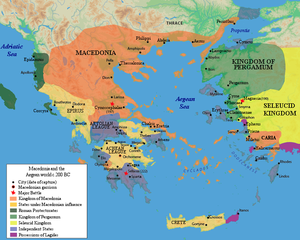
300px-Macedonia_and_the_Aegean_World_c.200.png


The Roman province of Macedonia (Latin: Provincia Macedoniae, Greek: Επαρχία Μακεδονίας) was officially established in 146 BC, after the Roman general Quintus Caecilius Metellus defeated Andriscus of Macedon, the last Ancient King of Macedon in 148 BC, and after the four client republics ("tetrarchy") established by Rome in the region were dissolved. The province incorporated ancient Macedon, Epirus, Thessaly, and parts of Illyria, Paeonia and Thrace.

250px-Map_Macedonia_province.png

The province of Macedonia within the Roman Empire, ca. 117 AD

The Diocese of Macedonia (Latin: Dioecesis Macedoniae, Greek: Διοίκησις Μακεδονίας) was a diocese of the later Roman Empire, forming part of the praetorian prefecture of Illyricum. Its capital was Thessalonica.The diocese was formed, probably under Constantine I (r. 306–337), from the division of the Diocletianian Diocese of Moesia. It included the provinces of Macedonia Prima, Macedonia Secunda or Salutaris (periodically abolished), Thessalia, Epirus vetus, Epirus nova, Achaea, and Crete. The Diocese of Macedonia, together with the Diocese of Dacia and (up to 379) the Diocese of Pannonia, made up the Prefecture of Illyricum.

Therefore, your selected quotes indicate nothing about the ethnicity of Macedonians. They were referred to administrative boundaries of Macedonia and Greece. It's true that Strabo wrote:"...έστι μεν ουν Ελλάς και η Μακεδονίαν", but this cannot sustain as a solid proof on the alleged Greekness of Macedonians. Again its Strabo himself who leaves no doubt about the geographical boundaries of Epirus and Macedonia, which were excluded either geographically and ethnically from Greece.

The Peneius forms the boundary between Lower Macedonia, or that part of Macedonia which is close to the sea, and Thessaly and Magnesia; the Haliacmon forms the boundary of Upper Macedonia; and the Haliacmon also, together with the Erigon and the Axius and another set of rivers, form the boundary of the Epeirotes and the Paeonians.

http://penelope.uchicago.edu/Thayer/E/Roman/Texts/Strabo/7Fragments*.html

ὅτι Πηνειὸς μὲν ὁρίζει τὴν κάτω καὶ πρὸς θαλάττῃ Μακεδονίαν ἀπὸ Θετταλίας καὶ Μαγνησίας,

μετὰ μὲν οὖν τοὺς Ἠπειρώτας καὶ τοὺς Ἰλλυριοὺς τῶν Ἑλλήνων Ἀκαρνᾶνές εἰσι καὶ Αἰτωλοὶ καὶ Λοκροὶ οἱ Ὀζόλαι·

After the Epeirotes and the Illyrians, then, come the following peoples of the Greeks: the Acarnanians, the Aetolians, and the Ozolian Locrians; and, next, the Phocians and Boeotians.

In another place Strabo did call Thessalians as Greeks living in the most northerly region:

Strabo 11.14.12.

ἔδει μὲν γὰρ αὐτοῖς ἐπιθέτου κόσμου τοιούτου τινός, οἱ δὲ Θετταλοὶ μάλιστα βαθυστολοῦντες, ὡς εἰκός, διὰ τὸ πάντων εἶναι Ἑλλήνων βορειοτάτους καὶ ψυχροτάτους νέμεσθαι τόπους ἐπιτηδειοτάτην παρέσχοντο μίμησιν τῇ τῶν ὑποκριτῶν διασκευῇ ἐν τοῖς ἀναπλάσμασιν·

"The Thessalians in particular wore long robes, probably because they of all the Greeks lived in the most northerly and coldest region".

Greece-under-Theban-Headship-362-BC.jpg

Ἔφορος μὲν οὖν ἀρχὴν εἶναι τῆς Ἑλλάδος τὴν Ἀκαρνανίαν φησὶν ἀπὸ τῶν ἑσπερίων μερῶν· ταύτην γὰρ συνάπτειν πρώτην τοῖς Ἠπειρωτικοῖς ἔθνεσιν.

Ephorus says that, if one begins with the western parts, Acarnania is the beginning of Greece; for, he adds, Acarnania is the first to border on the tribes of the Epeirotes

Your buddies tried unsuccessfully to invent a ridiculous response:

Strabo talks about the story of Armenus who accompanied Jason in Armenia. In other words at the time of Argonautic expedition which of course happened centuries *before* the Macedonian migration from Pindos and *obviously* at the time being, Thessalians were “in the most northerly and coldest region” since Macedonia didnt exist.

I've a couple of questions:

Let admit that Strabo is referring to the Argonautic expedition (XIII-XII century B.C it is guessed, correct if I am mistaken). But, how come that Strabo did not describe for examples Epirotes as Greeks living in the most northern regions? All the ancient geographers did not count Macedonians and Epirotes as Greeks. For them, Greece starts from Ambracia Gulf and river Peneus must have been the boundary which separated Greek speaking world from 'barbarian' one.
 
Last edited:
Gandeto is an expert in this field. These are quotes perhaps he might like to look it. Just about everything the New Greek has bee able to produce about the identity and nature of Macedonian territory has been a distortion, or some kind of wilful fabrication up to date to suite 20th century conquest of Macedonian territory.
 
I find it interesting that "Macedonia and the rest of Greece" was being used even though a large portion of Greek land was under Macedonian control until the end of the Roman era, including Thessaly and Central Greece, ignoring these lands in the process. Should we consider Thessaly a part of Macedonia by these standards?

These days people use slang words with a different definition then held previously. Look at the word "gay", it used to mean "happy" but today it means "homosexual". Nobody seems to realize meanings and definitions of words change with time. How can we know "Greece" in ancient times means "Greece" in modern times? It didn't and to make things more confusing one word could of had multiple meanings at that time, with a different meaning being held by different people! Why was "Hellas" only used to refer to the southern portions of Greece, yet today "Hellas" is supposed to mean the whole Greece Republic?
 
Gandeto is an expert in this field. These are quotes perhaps he might like to look it. Just about everything the New Greek has bee able to produce about the identity and nature of Macedonian territory has been a distortion, or some kind of wilful fabrication up to date to suite 20th century conquest of Macedonian territory.

It would be injustice to say that modern Greeks have nothing in common with ancient ones. At least, they have inherited the habit of claiming the land of others as their own:

STRABO 12.8.4
....τῶν Ἑλλήνων ὁρμῇ τινι χρησαμένων πρὸς τὴν τῆς ἀλλοτρίας κατάκτησιν·

...the Greeks feel an impulse to acquire possession of the countries of others

But Strabo ignore the impulses of Greeks to acquire the possession of the countries of others, as he did not mix apples with pears:

(Book VII, 4)...just as the Peneius flows through Tempe and thus fortifies Macedonia on the side of Greece

...ὡς ὁ Πηνειὸς διὰ τῶν Τεμπῶν φερόμενος ἀπὸ τῆς Ἑλλάδος αὐτὴν ἐρυμνοῖ:
 
Last edited:
Funnily enough, our friend 'Agamoi Thyati' vanished into thin air, without giving any response!!! I am pretty sure he cannot avoid from this disastrous accident, which is caused by the excessive speed, drink-driving and drug-driving of his bike into dangerous cross-roads he got no clue. Anyway, this is the logical end of his natural stupidity:

funny greek bike accident - YouTube

Our 'Agamoi' had not felt the injuries he got because of the adrenaline. It seem from real cases, that injuries will not be felt during the critic moment of encounter. But, sooner or later he will realize the mental consequences of his wild adventures with motor-bike hahahahahh

How long should we wait for a single answer of you? Oh apologize me because you have first to consult for a while with Andreas Kyropoulos, the well-known racist scum who used to sodomize himself by inventing out of nothing some possible scenarios of Greekness of Macedonia..lol
 
Last edited:
Funnily enough, our friend 'Agamoi Thyati' vanished into thin air, without giving any response!!! I am pretty sure he cannot avoid from this disastrous accident, which is caused by the excessive speed, drink-driving and drug-driving of his bike into dangerous cross-roads he got no clue. Anyway, this is the logical end of his natural stupidity:
Don't worry brainless creature,I didn't vanish,I'm just busy in real life.
You are purposefully twisting the analysis of Bosworth. In the underlined passage, he is not referring to the Cassius Dio but to Arrian. I know that both of them lived in Roman period, but you forgot the part when Bosworth clearly said: "...he must have borrowed it from some intermediate source". To my opinion, the standard expression "Macedonia and the rest of Greece" or "Macedonians and the rest of Greeks" partially derive from these 'intermediate sources' of Macedonian propaganda. Or, there is also an another conclusive explanation. Greece was under Macedonian rule from 338 B.C - 197 B.C, so as a matter of fact Greece was considered as integral part of Macedonia.
Your interpretation of the phrase "Macedonia and the rest of Greece" is at least stupid.If the authors wanted to stress that Greece was conquered by Macedonia and thus part of the Macedonian empire,then the proper expression to demonstrate that political status would be "Greece and the rest of Macedonia",at least this is what common sense dictates,otherwise there is created exactly the opposite impression,that is Macedonia is conquered by Greece!
Therefore, your selected quotes indicate nothing about the ethnicity of Macedonians. They were referred to administrative boundaries of Macedonia and Greece. It's true that Strabo wrote:"...έστι μεν ουν Ελλάς και η Μακεδονίαν", but this cannot sustain as a solid proof on the alleged Greekness of Macedonians. Again its Strabo himself who leaves no doubt about the geographical boundaries of Epirus and Macedonia, which were excluded either geographically and ethnically from Greece.
"The Peneius forms the boundary between Lower Macedonia, or that part of Macedonia which is close to the sea, and Thessaly and Magnesia; the Haliacmon forms the boundary of Upper Macedonia; and the Haliacmon also, together with the Erigon and the Axius and another set of rivers, form the boundary of the Epeirotes and the Paeonians."

http://penelope.uchicago.edu/Thayer/...ragments*.html

ὅτι Πηνειὸς μὲν ὁρίζει τὴν κάτω καὶ πρὸς θαλάττῃ Μακεδονίαν ἀπὸ Θετταλίας καὶ Μαγνησίας,
Where exactly in that passage are Macedonians distinguished from Greeks in terms of ethnic belonging???Are you on drugs???
μετὰ μὲν οὖν τοὺς Ἠπειρώτας καὶ τοὺς Ἰλλυριοὺς τῶν Ἑλλήνων Ἀκαρνᾶνές εἰσι καὶ Αἰτωλοὶ καὶ Λοκροὶ οἱ Ὀζόλαι·

After the Epeirotes and the Illyrians, then, come the following peoples of the Greeks: the Acarnanians, the Aetolians, and the Ozolian Locrians; and, next, the Phocians and Boeotians.
Here Strabo makes a distinction between Epirotes,Illyrians and some Greek peoples (which leaves no space for you claiming "Epirotic" identity,you can't be both an Illyrian and an Epirote when all ancient sources make clear distinction between them).It is true that some ancient authors questioned the Greekness of Epirotes,due to their primitive and backward way of life,and this was mainly a result of the Athenian arrogance for their sophisticated way of life and advanced culture (though Strabo himself was not Athenian).This happened with with other known Greek tribes too whose Greekness is beyond doubt,it was not only the Epirotes that were labeled as "barbarians" by the Athenian superiority complex.The author Heraclides mentions the Athenian habit of mockering the other Greeks about their local dialects and has the Macedonian poet Poseidippos from Cassandreia accusing them in one of his poems:

http://img442.imageshack.us/img442/9329/poseidippos.png

While another ancient author,Dicaearchos commented on this passage of Poseidippos:

"To those that consider neither Thessaly as part of Hellas,nor the Thessalians,while they are descendands of Hellen,as Hellenic-speaking,this must be said."
http://i388.photobucket.com/albums/oo321/zratak/posidipus.jpg

In this passage,Thessalians are again described as barbarians together with the Eleans and the Boetians:

http://img377.imageshack.us/img377/6976/eleansbarbmr3.png

The people of the island of Lesbos too:
http://books.google.gr/books?id=Oe0...v=onepage&q=prodicus lesbos barbarian&f=false
http://books.google.gr/books?id=CWs...v=onepage&q=prodicus lesbos barbarian&f=false

However many other authors considered Epirotes as Greek:

Herodotus
"Cleisthenes son of Aristonymus son of Myron son of Andreas had one daughter, whose name was Agariste. He desired to wed her to the best man he could find in Hellas...Then all the Greeks who were proud of themselves and their country came as suitors....From Italy came Smindyrides of Sybaris...and Damasus of Siris..from the Ionian Gulf, Amphimnestus...From Aetolia came Males...From the Peloponnese came Leocedes...and Amiantus, an Arcadian from Trapezus, son of Lycurgus; and an Azenian from the town of Paeus, Laphanes, son of that Euphorion....from Athens Megacles...From Eretria came Lysanias...From Thessaly came a Scopad, Diactorides of Crannon...AND FROM THE MOLOSSIANS CAME ALCON."
http://www.perseus.tufts.edu/hopper/text?doc=Perseus:text:1999.01.0126:book=6:chapter=127

Eutropius
Thus the ambassador of Pyrrhus returned; and, when Pyrrhus asked him "what kind of a place he had found Rome to be," Cineas replied, that "he had seen a country of kings, for that all there were such, as Pyrrhus alone was thought to be in Epirus and the rest of Greece."
http://www.tertullian.org/fathers/eutropius_breviarium_2_text.htm

Pausanias
"how he (Pyrrhus) expelled Demetrius and ruled Macedonia until he was in turn expelled by Lysimachus, the most important of his achievements until he waged war against the Romans,[1.11.7] being the first Greek we know of to do so...[1.12.1] XII. So Pyrrhus was the first to cross the Ionian Sea from Greece to attack the Romans."
http://www.theoi.com/Text/Pausanias1A.html

Dionysius of Halicarnassus
"1 Of the horse, he stationed the Samnite, Thessalian and Bruttian squadrons and the Tarentine mercenary force upon the right wing, and the Ambraciot, Lucanian and Tarentine squadrons and THE GREEK MERCENARIES CONSISTING OF Acarnanians, Aetolians, MACEDONIAN and ATHAMANIANS,on the left (Athamanians were an Epirotic tribe)...10 (19.11) It was for this reason that Pyrrhus was defeated by the Romans also in a battle to the finish. For it was no mean or untrained army that he had, but the mightiest of those then IN EXISTENCE AMONG THE GREEKS and one that had fought a great many wars;"
http://penelope.uchicago.edu/Thayer/E/Roman/Texts/Dionysius_of_Halicarnassus/20*.html

Aristotle
"Of the rivers in the Greek world, the ACHELOOUS FLOWS FROM PINDUS, the Inachus from the same mountain; the Strymon, the Nestus, and the Hebrus all three from Scombrus; many rivers, too, flow from Rhodope... The deluge in the time of Deucalion, for instance, took place chiefly in the Greek world and in it especially about ancient Hellas, the country about Dodona and the Achelous, a river which has often changed its course. Here the Selli dwelt and those who were formerly called Graeci and now Hellenes."
http://classics.mit.edu/Aristotle/meteorology.1.i.html

Procopius:
http://img81.imageshack.us/img81/5597/procopiuscf4.jpg

Claudius Ptolemy
http://v1.iimmgg.com/images/is8gr/8521634028043ff2aebf858a85b8b2db.gif

In another place Strabo did call Thessalians as Greeks living in the most northerly region:
Quote:
Strabo 11.14.12.
ἔδει μὲν γὰρ αὐτοῖς ἐπιθέτου κόσμου τοιούτου τινός, οἱ δὲ Θετταλοὶ μάλιστα βαθυστολοῦντες, ὡς εἰκός, διὰ τὸ πάντων εἶναι Ἑλλήνων βορειοτάτους καὶ ψυχροτάτους νέμεσθαι τόπους ἐπιτηδειοτάτην παρέσχοντο μίμησιν τῇ τῶν ὑποκριτῶν διασκευῇ ἐν τοῖς ἀναπλάσμασιν·
"The Thessalians in particular wore long robes, probably because they of all the Greeks lived in the most northerly and coldest region".
Your buddies tried unsuccessfully to invent a ridiculous response:

Quote:
Strabo talks about the story of Armenus who accompanied Jason in Armenia. In other words at the time of Argonautic expedition which of course happened centuries *before* the Macedonian migration from Pindos and *obviously* at the time being, Thessalians were “in the most northerly and coldest region” since Macedonia didnt exist.
I've a couple of questions:

Let admit that Strabo is referring to the Argonautic expedition (XIII-XII century B.C it is guessed, correct if I am mistaken).
Strabo was indeed referring to the Argonautic expedition.Here is the whole text:

"There is an ancient story of the Armenian race to this effect: that Armenus of Armenium, a Thessalian city, which lies between Pherae and Larisa on Lake Boebe, as I have already said,1 accompanied Jason into Armenia; and Cyrsilus the Pharsalian and Medius the Larisaean, who accompanied Alexander, say that Armenia was named after him, and that, of the followers of Armenus, some took up their abode in Acilisene, which in earlier times was subject to the Sopheni, whereas others took up their abode in Syspiritis, as far as Calachene and Adiabene, outside the Armenian mountains. They also say that the clothing of the Armenians is Thessalian, for example, the long tunics, which in tragedies are called Thessalian and are girded round the breast; and also the cloaks that are fastened on with clasps, another way in which the tragedians imitated the Thessalians, for the tragedians had to have some alien decoration of this kind; and since the Thessalians in particular wore long robes, probably because they of all the Greeks lived in the most northerly and coldest region, they were the most suitable objects of imitation for actors in their theatrical make-ups. And they say that their style of horsemanship is Thessalian, both theirs and alike that of the Medes. To this the expedition of Jason and the Jasonian monuments bear witness, some of which were built by the sovereigns of the country, just as the temple of Jason at Abdera was built by Parmenion."
http://www.perseus.tufts.edu/hopper/text?doc=Perseus:text:1999.01.0198:book=11:chapter=14:section=12

Also from the same chapter of Strabo:

"There are also some Greek cities in Media, founded by the Macedonians, among which are Laodiceia, Apameia and the city2 near Rhagae, and Rhaga3 itself, which was founded by Nicator.By him it was named Europus, but by the Parthians Arsacia;"
http://www.perseus.tufts.edu/hopper/text?doc=Perseus:text:1999.01.0198:book=11:chapter=13:section=6
Hey,how come that Macedonians founded Greek cities and called them by Greek names?

And how come you are an Epirote when Strabo says your original homeland was near the Caspian Sea:

"and then on the north by the Ocean as far as the mouth of the Caspian Sea;8 and then on the east by this same sea as far as the boundary between Albania and Armenia, where empty the rivers Cyrus and Araxes,the Araxes flowing through Armenia and the Cyrus through Iberia and Albania; and lastly, on the south by the tract of country which extends from the outlet of the Cyrus River to Colchis, which is about three thousand stadia from sea to sea, across the territory of the Albanians and the Iberians, and therefore is described as an isthmus. "
http://www.perseus.tufts.edu/hopper/text?doc=Perseus:text:1999.01.0198:book=11:chapter=1:section=5
But, how come that Strabo did not describe for examples Epirotes as Greeks living in the most northern regions?
Because,you clueless fool,Thessalians at that time were living in Epirus and migrated later to the land that is currently known as Thessaly;
http://books.google.com/books?id=CS...&resnum=1&ved=0CDAQ6AEwAA#v=onepage&q&f=false
How come Epirotes were not Greek when their language was full of archaic Greek words???According to Plutarch,Epirotes called Achilles "aspetos" in their local dialect,which is an archaic Greek word used mainly in Homeric poems:

http://img22.imageshack.us/img22/5408/aspetos.jpg
http://www.perseus.tufts.edu/hopper/text?doc=Perseus:text:1999.04.0057:entry=a)/spetos
http://i300.photobucket.com/albums/nn17/kostas68/aspetos181.gif
http://i300.photobucket.com/albums/nn17/kostas68/aspetos186.gif
http://i300.photobucket.com/albums/nn17/kostas68/aspetos126.gif

Strabo also says that in the language of Molossians,Thesprotians and Macedonians old women are called "peliai" and old women "pelioi"
http://img194.imageshack.us/img194/9026/strabopeloi.jpg

These words are not only Greek,they are Doric Greek according to Hesychius' lexicon,something that excludes the possibility they were loanwords from Attic or Koine Greek and furthermore prove the Doric origin of these tribes:

"pelioi"=old men,Doric
http://i388.photobucket.com/albums/oo321/zratak/pellahesychius.jpg

"pelious"=so are called the old men and women by Epirotes and Coans (people of Cos island who also were of Doric origin)
http://i388.photobucket.com/albums/oo321/zratak/peleiousgerhesych.jpg

And I can also play that game with maps,and not outdated 19th centuries ones:
http://i388.photobucket.com/albums/oo321/zratak/alexmichburg11.gif
http://i388.photobucket.com/albums/oo321/zratak/LifeInAncGreece.jpg
http://www.bitsofnews.com/images/graphics/map_ancient_greece_large.jpeg
http://bookbuilder.cast.org/view_print.php?book=14532
http://www.earth-history.com/Greece/index.htm
http://www.usu.edu/markdamen/ClasDram/images/05/mapAthens&Sparta.jpg
http://farm1.static.flickr.com/220/486481344_46280998c0.jpg

However if you still prefer a good old 19th century edition:
http://books.google.gr/books?id=lpAWAAAAYAAJ&pg=PA233
 
Agamoi Thytai said:
If the authors wanted to stress that Greece was conquered by Macedonia and thus part of the Macedonian empire,then the proper expression to demonstrate that political status would be "Greece and the rest of Macedonia",at least this is what common sense dictates...............
Not exactly, as Greece was never a part of Macedonia, it was forced into a league which was controlled by Macedonian kings.
........how come that Macedonians founded Greek cities and called them by Greek names?
Why have Turks given Arabic names to some of their cities? How come Irish people have patriotic songs in the English language that are aimed against English people? You give way too much emphasis on the Macedonians' use of the Greek language during ancient times. Don't blind yourself to the obvious, as this circumstance does nothing to prove the 'Greekness' of Macedonians. As for the discussion relating to the title of this thread, such statements can be misleading. Take, for example, the below from Strabo:
http://www.macedoniantruth.org/forum/showthread.php?t=430&highlight=strabo
However, for a very long time the Aetolians, together with the Acarnanians, stood firm, not only against the Macedonians and the other Greeks, but also finally against the Romans, when fighting for autonomy. Book 10, Chapter 2, 23.
At first glance, it appears to group the Macedonians with the Greeks. But a closer inspection reveals the exact opposite. As I have explained in the thread of the link cited above, with reference made to the Romans, it is clear that the 'other Greeks' cannot be inclusive of the Macedonians, as again, the topic (during the point in question) speaks of a time when the Greeks were under Macedonian rule. Therefore, the Aetolians and Acarnanians stood firm against the rulers (Macedonians) and the other Greeks, and then later (finally) the Romans. Apart from the purpose of maintaining a distinction, there is no other reason why the Macedonians would be mentioned in the above quote by Strabo.
 
agamoi phytai.Where does it say that macedonia is part of greece & is a city state.Nowhere.Please explain to me the hate & uncooperation that the macedonians received from the greeks.There was so much fighting to the death where that is concerned.Di you think demosthenes loved alexander.He hoped that alexander would be killed.Do you think that greek writers that wrote hundreds of years would write something honorable about the macedonians they would just condemn them & also they would say that they are the same people.
 
Epirot said:
For their needs, they have manufactured a list of certain citations to convince erroneously others with the 'Greekness' of Macedonia.
Context is important. Here is a moderate selection of references that display the other side of the coin, which make plain the fact that the Macedonians and Greeks were not the same people, and that they shared a great deal of animosity towards each other - contrary to the fictional stories that are conjured by some.


5th century BC, Thrasymachus, On Behalf of the Lariasaeans
"Shell we being Greeks, be slaves to Archelaus (note: a Macedonian king), a barbarian?"
5th century BC, Herodotus, Histories (8-142)
"Do not let Alexander's smooth-sounding version of Mardonius' proposals seduce you; he does only what one might expect of him--a despot himself, of course he collaborates with a despot. But such conduct is not for you - at least, not if you are wise; for surely you know that in foreigners there is neither truth nor trust."
5th century BC, Thucydides, Peloponnesian War (4-124)
Perdiccas' army consisted of the forces of his Macedonian subjects together with a force of hoplites from the Hellenes living in Macedonia........
4th century BC, Isocrates, Letters to Phillip (106-8)
..........entirely aloof from Hellenic territory.....the throne of Macedon.......
4th century BC, Isocrates, Letters to Phillip (154)
I assert that it is incumbent upon you to work for the good of the Hellenes, to reign as king over the Macedonians, and to extend your power over the greatest possible number of the barbarians.
4th century BC, Demosthenes, Phillipics (3-31)
......Philip......is not only no Hellene, nor related to the Hellenes, but not even a barbarian from any place that can be named with honor, but a pestilent knave from Macedonia.......
1st century AD, Quintus Curtius Rufus, Alexander (8, 5, 5-7)
To feed this desire of his there was no lack of pernicious flattery – ever the curse of royalty, whose power is more often subverted by adulation than by an enemy. Nor were the Macedonians to blame for this, for none of them could bear the slightest deviation from tradition; rather it was the Greeks, whose corrupt ways had also debased the profession of the liberal arts.
1st-2nd century AD, Plutarch, Flaminius
.........the Romans came not to fight against the Greeks, but for the Greeks, against the Macedonians......having vanquished king Philip and the Macedonians, restored the Corinthians, Locrians, Phocians, Eubœans, Achæans of Phthiotis, Magnetians, Thessalians, and Perrhæbians to their own lands, laws, and liberties; remitting all impositions upon them, and withdrawing all garrisons from their cities........all were only eager to leap up and salute and address their thanks to the deliverer and champion of Greece.
1st-2nd century AD, Plutarch, Alexander (51)
Then Alexander, turning to Xenodochus of Cardia and Artemus of Colophon, said: "Do not the Greeks appear to you to walk about among Macedonians like demi-gods among wild beasts?"
2nd century AD, Arrian, Alexander (Book 2)
The fight was further embittered by the old racial rivalry of Greek and Macedonian.
2nd century AD, Marcus Justinus, Epitome of Phillip (8,1-4)
The states of Greece, while each sought to gain the sovereignty of the country for itself, lost it as a body...........for Philip, king of Macedonia....obliged victors and vanquished alike to submit to his royal yoke.........It was a shameful and miserable sight, to behold Greece.....a country that had constantly been the conqueror of kings and nations, and was still mistress of many cities, waiting at a foreign court to ask or deprecate war…….
2nd century AD, Marcus Justinus, Epitome of Phillip (30,3)
Philip....allowed that “he might be induced to submit to the Romans, but that it was intolerable that the Greeks, who had been subdued by his ancestors Philip and Alexander, and brought under the yoke of the Macedonian empire, should dictate articles of peace to him, as if they were conquerors; and that they ought to give an account of their conduct in their state of slavery, before they sought to recover their liberty.”
2nd century AD, Pausanias, Description of Greece (2.8.4)
........all the Greeks were afraid of the Macedonians and of Antigonus, the guardian of Philip, the son of Demetrius........
2nd century AD, Pausanias, Description of Greece (7.7.5)
When Philip, the son of Demetrius, reached man's estate, and Antigonus without reluctance handed over the sovereignty of the Macedonians, he struck fear into the hearts of all the Greeks. He copied Philip, the son of Amyntas.........
2nd century AD, Pausanias, Description of Greece (7.15.6)
.........the Greeks who were struggling at Chaeroneia against the Macedonians under Philip.........
2nd century AD, Pausanias, Description of Greece (9.6.5)
.......the defeat at Chaeroneia was a disaster for all the Greeks……….
 
Nice compilation, SoM!

While I was searching Dio Chrysostom account, I found randomly a passage which clearly separate Macedonians from Greeks in terms of ethnicity:

Again, Philip, who is reputed to have been the cleverest of kings, engaged Aristotle as teacher and ruler for his son Alexander, believing that he himself was not competent to give instruction in the science of kingship; nay, while he thought himself fit to rule the other Macedonians and Thracians and Illyrians and all the Greeks, he handed his son over to another to be ruled, and while he gave orders to so many myriads, he did not dare give orders to p299that one man. The reason is that he did not feel his own risk to be as great if he should err where it concerned any one else as it would be if he should commit some error in connexion with his son.

http://penelope.uchicago.edu/Thayer/E/Roman/Texts/Dio_Chrysostom/Discourses/49*.html
 
Good collection SoM.

I like this one:

5th century BC, Thucydides, Peloponnesian War (4-124)

Perdiccas' army consisted of the forces of his Macedonian subjects together with a force of hoplites from the Hellenes living in Macedonia........
 
Back
Top