• Welcome to the new Macedonian Truth Forum. All posts, members and private messages have been moved over from the old forum.

    Passwords from the old forum could not be carried over, so please use Forgot your password? to set a new one. The reset link is emailed to the address on your account.

  • Rules and Regulations at the forum of the Macedonian Truth Organisation (MTO)

    (1) The national-ethnic and cultural-linguistic identity of the Macedonian people is historically Macedonian, and derives its character from the native, indigenous and geographic homeland of the Macedonians, which is called Macedonia. To ensure that their human rights, integrity and heritage are appropriately respected, the only nouns and adjectives acceptable when reference is made to the above character and identity markers is Macedon, Macedonia, Macedonian and Macedonians.

    (2) The nation-state of the Macedonian people is the Republic of Macedonia, and is to be referred to by this official title so long as the 'republic' prefix is consistently applied to other states. Alternative references are the Macedonian Republic, or simply, Macedonia.

    (3) The 'ethnic' prefix is only acceptable for Macedonians in cases where differentiation is specifically required - so long as it is in context and consistent where it concerns its application to other ethnic groups.

    (4) Should any other differentiation be specifically required, the names of other ethnic groups that reside with Macedonians in either the Republic of Macedonia or the occupied Macedonian regions in Greece, Bulgaria, Serbia or Albania, are to be given a prefix.

    (5) Negating the identity, language and culture of the Macedonian people by deliberate avoidance of the terms Macedonia, Macedonian and Macedonians, or by any other means, is not permitted.

    (6) Systematic anti-Macedonian propaganda and rhetoric are not permitted.

    (7) Threads irrelevant to the Macedonian Cause, the community at the Macedonian Truth Organisation or the Macedonians in general may be considered as spam or not in the spirit of the forum. In such cases they are not permitted.

    (8) Continual posting of messages in threads with the sole purpose of deviating from the initial topics with the use of unrelated and unnecessary information is not permitted.

    (9) All posts, external articles, reports, etc that are cited in languages other than Macedonian or English, must be accompanied with a translation in one or both of the said languages.

    (10) Despite the possibility of some conversations and debates becoming heated, extreme abuse and/or racism, vulgar language and/or terminology, threats, revelation of personal information about others, harassment, and other such behavior will not be permitted. If deemed necessary all relevant information including member details will be reported to the appropriate authorities for investigation which may result in legal action.

    (11) Threads that are created must have a summary of a topic or excerpt of an article found in pertinent link(s) that have been included. One line threads will be considered unaccetable spam and are therefore not permitted.

    (12) Compulsive and deliberate lies, irrespective of the topic, are not permitted.

    (13) Any symbols or avatars found to be perceived as offensive to Macedonians are not permitted.

    (13) Any explicit or extreme material is not permitted.

    Failure to adhere to the above rules and regulations will result in a ban after 3 breaches. This may be reconsidered in some cases should the circumstances be of an unorthodox nature and/or require special consideration. To assure an effective deterrent against an individual or individuals with the sole purpose of causing dissent through spamming, racism or other improper means, the above rules will be strictly enforced.

    The MTO administration will monitor all discussions as reasonably practical and reserve the right to remove any post and/or member from the forum, and update the rules and regulations as required. Members are encouraged to immediately report any post and/or member to the MTO administration if they feel that these rules have not been abided by.

    The views expressed on this forum are those of the individuals. The only official representation of the MTO is made by the "Macedonian Truth Organisation (Site Owner)" username, and no other.

  • Macedonian Cause

    The Macedonian Truth Organisation calls on God in Heaven to protect, bless and guide the endeavour it is committing to undertake, and that is to work towards:

    Securing Macedonia as a free, independent and democratic republic in which sovereignty lies with the Macedonian citizens; as the nation-state of the Macedonian people in which they can preserve their culture, language and identity; as a state in which the Macedonian language and culture form the basis of public life and act as important unifying elements of Macedonian society; as the home of all its citizens to which it guarantees and obliges their inalienable natural rights and corresponding responsibilities;

    The acknowledgment as self-evident and irrefutable the existence of the:

    1) Indigenous, ethnonational name of Macedonia;
    2) Macedonian people, language and identity;
    3) Macedonian culture, symbols and folklore;
    4) Macedonian ancestry, heritage and history in its entirety; and
    5) Macedonian Orthodox Church;

    Securing recognition by the International Community of the tragedies endured by the Macedonian people, of the division of Macedonia with the signing of the Treaty of Bucharest on August 10, 1913, and the genocide committed against the Macedonian people at the hands of the Greek, Bulgarian and Serbian states and their respective churches during the 19th and 20th centuries;

    Ensuring that the Interim Accord is declared ‘null and void’ and that all constitutional provisions, acts, commitments, agreements, legislation, regulations, policies or programs emanating from, supporting or consequential to the Interim Accord are also declared ‘null and void’, including the use of any symbols and the completion of any acts imposed by, or originating from, the Interim Accord.

    Ensuring that the Framework Agreement is abolished and that all constitutional provisions, acts, commitments, agreements, legislation, regulations, policies and programs emanating from, supporting or consequential to the Framework Agreement are also abolished and replaced by a framework of constitutional and statutory law based on inalienable natural rights and corresponding responsibilities and universally codified human rights mechanisms.

    Securing the abolishment of any existing constitutional provisions, acts, agreements, legislation, regulations, policies and programs that discriminate against the Macedonian people, in any international organisation or any of the countries of the International Community where such constitutional provisions, acts, agreements, legislation, regulations, policies and programs exist, and thereby ensuring the freedom for Macedonians to exercise their inalienable natural rights and fulfil their corresponding responsibilities, and practice their culture, language and religious faiths in all the countries of the International Community without hindrance;

    The empowerment of Macedonians to undertake a moral revolution and to instil and/or reinvigorate within themselves a deep-rooted national, cultural, linguistic and historical dignity and a commitment to the exercise of freedom based on inalienable natural rights and corresponding responsibilities;

    The recognition of the Macedonian minorities in the neighbouring states of Macedonia as well as the respect for the inalienable rights and freedoms of the Macedonian minorities, as provided for by natural law and as codified by the United Nations Charter, the Universal Declaration of Human Rights and other universally codified human rights mechanisms;

    The full and unreserved respect of, and the support for, the rights of all people of non-Macedonian descent living in Macedonia and around the world, who share a reciprocal full and unreserved respect for the Macedonian people, their homeland and their state;

    The cultural unification and solidarity of the Macedonian people living in all parts of historical Macedonia and adjacent territories, as well as Macedonians throughout the world;

    The unity of all Macedonians on the principles, objectives and achievement of the Macedonian cause as defined by this declaration.

Fields of Wheat, Hills of Blood - Anastasia Karakasidou

Soldier of Macedon

Senior Member
Here are some excerpts taken from a book written by Anastasia Karakasidou, a descendant of Turkish-speaking Christians that were settled in the modern Greek state during the 1920's. The author of the book had travelled to some regions in Greek-occupied Macedonia and recorded interviews and events concerning the local "Slavic language" in the region and the people who spoke it, the Macedonians. For her efforts to expose some of the lies of 'Greek' history and society in Greek-occupied Macedonia she had the publishing of her book initially declined and even endured death threats made by Greek nationalists for her apparent treachery against the modern Greek state.

Those present-day inhabitants of Assiros who are descendants of Guvezna’s Slavic-speakers conceive of and conduct themselves as nothing less than Greek citizens and full-fledged members of the nation of Hellenes; they maintain strong convictions that Macedonia is Greek and some believe that they themselves are the Greek descendants of Alexander the Great. Yet they do not call themselves Macedonians. Some may have considered themselves Macedonians in the past and several referred to their former Slavic language as Macedonian(Makedhonika). Page 22
So the Macedonians of Gostovo/Guvezna who speak the local Macedonian language are now full-fledged Grkomani, no suprise there, but more interesting, they do not call themselves Macedonians now that they are Grkomani, although they did in the past prior to becoming 'Greeks'. And even still, they (Grkomani) refer to the local language as Macedonian.
I leave the issue of the cultural or ethnic identity of these migrant settlers open, for while their descendants claimed that they had been Greek, other evidence suggests that they may have been Hellenized Vlachs who spoke Greek………..As one descendant told me:

Our grandfather’s father came from Trikala. There are Vlachs there. All of them there from the mountains are Vlachs. The Trikaliotes have strange words, they speak differently. From Trikala, they say they are all Vlachs. Our grandfather spoke no Macedonian (Makedhonika). He only spoke Turkish. He had a mill in Balaftsa (Kolhikon). They spoke Macedonian there. Page 50-51
Even the Vlach Grkomani know the language as Macedonian.
As a descendant of an old Palehora put it:
My uncle married a woman from Vissoka (Present-day Ossa). She was a Bulgarian-speaker(voulgharofoni). She spoke Macedonian (Makedhonika). Bulgarian is a different language. She spoke Greek as well. And my mother, my father, and my mother-in-law all spoke Macedonian. It was the custom (ethimo) here. We were used to it. We call the aunt (thia) “tsino” and the water (nero) “voda”. Page 70-71
Have a look at the level of confusion even a regular Greek has to endure just to ensure he stays within the rules of the anti-Macedonian aspect of 'Hellenism'. She was a "Bulgarian" speaker, she spoke "Macedonian", but "Bulgarian" is a different language:confused: The simple explanation here would have been for him to say she speaks Macedonian which is different to Bulgarian...........Nevertheless, at least among all that smoke, a regular Greek still notes that Macedonian and Bulgarian are different languages. I wonder, how many other 'Greeks' speak Macedonian as an 'ethimo'?
A man from the village of Xiloupolis, raised by his Slavic-speaking grandmother, asserted the he spoke only Macedonian (Makedhonika) until he began Greek primary school. He claimed that his mother had been obliged to go to night school in the 1930’s for Greek language lessons while she was pregnant with him. “The Macedonian language is lost,” he told me. “It has vanished. What a pity.” Other voices, sometimes public, often private, were more militant. One of the few elderly Assiriotes to speak directly about the Macedonian issue maintained that a certain village leader “used to say in the 1930’s that the Macedonian nation (Makedhoniko ethnos) is lost.” “Don’t listen to what the politicians say,” he told me. “They are themselves from Macedonian villages. What do you think the Langadhas area was?” Page 74
Some familiar stories for much of our Macedonian brethren in the south.

The last story always stands out as one of the most moving. The author had previously interviewed the old lady Pashkalina, where she was provided her account on certain matters. When the author conducted a follow-up interview, there was a significant change in the story of the old lady, here is the reason why:
During our conversation, I raised the question that her previous accounts had provoked in my mind. In response, she recounted her story for me once again, only this time with significant alterations in certain details. I asked Paskhalina why her previous accounts had differed from this third version. She replied that all these years she had been afraid to tell the truth, for fear of recriminations. Paskhalina spoke “Bulgarian” when she was growing up in Ambar-Koy. But the “Bulgarian” she spoke, she claimed, is not the same as the Bulgarian spoken by her relatives who now live in Bulgaria. Paskhalina told me that she met a man in Veroia and they spoke the same language. They communicated without any problem. Paskhalina also communicated well with people from Liti……..........Guvezna was called “Gostovo” in “her language”. Paskhalina’s father’s last name in Ambar-Koy was Galtsanoff, but he later adopted a Greek surname. Page 129-30
Even this poor old lady knew that the language spoken by her relatives who had moved to Bulgaria is not the same as the language she speaks, which can only be Macedonian (Makedonski, Makedonika).
 
During our conversation, I raised the question that her previous accounts had provoked in my mind. In response, she recounted her story for me once again, only this time with significant alterations in certain details. I asked Paskhalina why her previous accounts had differed from this third version. She replied that all these years she had been afraid to tell the truth, for fear of recriminations. Paskhalina spoke “Bulgarian” when she was growing up in Ambar-Koy. But the “Bulgarian” she spoke, she claimed, is not the same as the Bulgarian spoken by her relatives who now live in Bulgaria. Paskhalina told me that she met a man in Veroia and they spoke the same language. They communicated without any problem. Paskhalina also communicated well with people from Liti……..........Guvezna was called “Gostovo” in “her language”. Paskhalina’s father’s last name in Ambar-Koy was Galtsanoff, but he later adopted a Greek surname. Page

reading the book a few years ago, this was the passage that struck me most, proof of the fear that many macedonians felt in occupied macedonia.
 
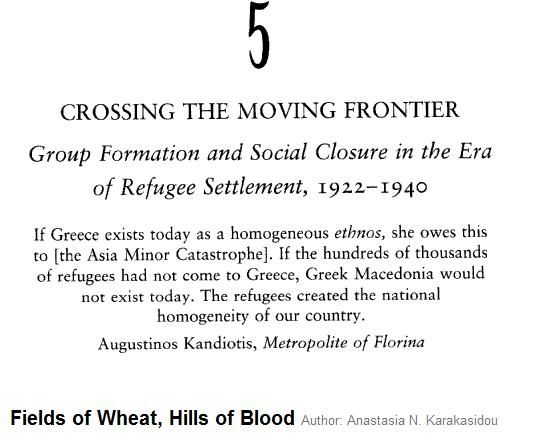
AugustinosKandiotis.jpg
 
"The refugees created the national homogeneity of our country"
If this is indeed the case, then it can logically be deduced the national homogeneity only ever potentially existed from the 1930's onwards. In reality, the 1960's ... enough time to wash away the Turkisms from public consumption.

But I do take into account the Metropolitan's statement about "IF Greece exists today as a homogeneous ethnos". He would have been reminded of the real Macedonian identity very often in Lerin.
 
Interesting period, Todor Alexandrov himself and thus surely many other Macedonians envisioned the end the Greek state around the same time. What a shame we lost him to a traitor's bullet, he was the last great leader of VMRO where the dream was still very much alive and real. That Grkoman bishop is right, were it not for the Asian-turn-Hellene refugees of the 20's, Greek-occupied Macedonia would not have been (artificially) "Greek" and so easy to control, furthermore, with WWII only about a decade or so away, all things were possible.
 
I think I have a solution to this name debate.
Greeks who have an unhealthy fascination with Macedonia and wish to call themselves as such, should say "Macedonians1923". The 1923 identifier should be used as it refers to the date the Treaty of Lausanne was signed which allowed the migration of christians from Turkey into Greece. These immigrants are the ones who self-describe as Macedonians (apparently) and form the majority of the region nowadays. So the identifier is appropriate.

We Macedonians will simply continue to call ourselves Macedonian.
 
Macedonians1923? That could be an ingenius idea, but I have reservations about anyone else using the name Macedonian, to describe themselves.

I love this study by Karakasidou.

I wish there were just a few more like it, of that quality. These kinds of studies are very important.
 
Sorry for the bump, but wanted to include this quote from the book

pg 83, second paragraph

"American missionaries working in Bulgaria in the 1850s created the first standardized Bulgarian script, choosing to base the national language on the dialect of Thrace and eastern Macedonia rather than on that spoken in the regions of northern Bulgaria. Until the work of such American missionaries, memories of an ecclesiastical past in Bulgaria had been preserved in large part only by Slavonic monks. The American Board of Missionaries, with their network of locally posted missionaries, intentionally or not assisted nascent Bulgarian national elites to forge a different picture of the past.

Dr. Elias Riggs, for example, crossed "European Turkey" in the late 1840s and in 1847 compiled a Bulgarian grammar primer. According to Tsanoff (1919:ix), it had been the American missionaries who had discovered (or, we might say, helped to invent) the Bulgarian nation. They published some of the first books in Bulgarian, and in 1864 began putting out the first monthly magazine in the region written in Bulgarian."
 
Thanks for that Bij. It is interesting to note how the Bulgarians could never accept this literary language that was a half-way between Macedonian and Bulgarian dialects, several of them ridiculed the language used by Macedonian writers from the 19th century such as the Miladinov brothers and co. They didn't even know who they were themselves at the time yet their descendants today are crystal clear about their Khanic origins, pitiful to say the least.

It seems that most of our neighbours had some sort of a 'sponsor' in the great powers, and all achieved their statehood with such help. Whereas us Macedonians, lacking such support, lacking a state, still held our own and kept our identity.
 
Well it's also interesting because we are often accused of using the Bulgarian language. In fact, it seems to be the other way around :)

and SoM you bring up a valid point, since Greeks needed a Bavarian to forge them a national identity, and the bulgars needed yanks, who does Macedonia have to thank for this? Surely not Tito since he was on the scene a few centuries too late from all the information we have been able to gather in recent years.
 
3min in to this documentary, Anastasia talks about what she whent through. Infact the whole doco is worth watching. And i ask this, why is it that each time i hear Nationalism in Greece, the Greek orthadox church pops up some where in footage or discusion?


Nationalism Threatens Democracy - Greece

July 1994
A militant and dangerous nationalism is sweeping Greece. Radical Greeks want their country to take back land that has been independent for centuries. Those who urge restraint are branded traitors. A Greek academic is threatened with death by rape for daring to acknowledge the state of Macedonia. A right-wing newspaper details graphic tortures to punish her for speaking out. Relations with Albania worsen as the Church stirs up a movement to merge southern Albania with Greece. A prominent author warns that Greek insecurity could bring war and turmoil.

Produced by ABC Australia
Distributed by Journeyman Pictures

YouTube - Nationalism Threatens Democracy - Greece
 
This is a very good thread that needs some more attention.

Indeed it is. Here's more from 'Fields of Wheat, Hills of Blood':

"Local residents used proper (though equally unspecified) nouns that referred to national groups such as Ellines (Greeks), Servyi (Serbs), Tourkyi (Turks), and Voulgharyi (Bulgarians). Some, however, especially those whose families came from Gnoina/Palehora, used the term Makedhones (Macedonians) in reference to the Slavic-speaking population of the area prior to 1913. But those who did so insisted unequivocally that such people had a sort of commonality which marked them as somehow different from others. When pressed to clarify such distinctions, Assiriotes overwhelmingly insisted that the local Slavic-speakers had spoken a language similar to yet distinct from Bulgarian. Yet nonetheless, most still referred to them and to the Slavic-speakers in general as "Bulgarians" (Voulgharyi) or "Bulgarian-speakers" (Voulgharophonyi), two broad and politicized labels that date to the ideological and military conflict between Greece and Bulgaria over Macedonia at the turn of the century." (1997: 106)
 
I think I have a solution to this name debate.
Greeks who have an unhealthy fascination with Macedonia and wish to call themselves as such, should say "Macedonians1923". The 1923 identifier should be used as it refers to the date the Treaty of Lausanne was signed which allowed the migration of christians from Turkey into Greece. These immigrants are the ones who self-describe as Macedonians (apparently) and form the majority of the region nowadays. So the identifier is appropriate.

We Macedonians will simply continue to call ourselves Macedonian.

To argue there were never Greeks in Macedonia before 1922 is ridiculous nonsense. There are alot of hypocrites on this forum.
 
To argue there were never Greeks in Macedonia before 1922 is ridiculous nonsense. There are alot of hypocrites on this forum.
Oh there were very small Greek pockets Damian.
They would have sooner shot themselves than describe themselves as anything other than Romioi (or later "Greek"). So, again, the fascination with "Macedonia" by Greeks over the last few years is a little bit painful.

You seem a little touchy about things Damian. Tell me, how many Greeks do you think would have been in what is now RoMacedonia before 1923?
 
i read somewhere that the local greek population in the aegean area was about 10% of the
macedonian one numbering more than a million & was the major population there prior to 1912.The greeks prior to 1912 were a minority & in solun they had a consular embassy.
 
Oh there were very small Greek pockets Damian.
They would have sooner shot themselves than describe themselves as anything other than Romioi (or later "Greek"). So, again, the fascination with "Macedonia" by Greeks over the last few years is a little bit painful.

You seem a little touchy about things Damian. Tell me, how many Greeks do you think would have been in what is now RoMacedonia before 1923?

I dont know the exact stats but there were Greek-speakers all over Macedonia. South Macedonia, Bitola, Serres etc West Macedonia going into Epirus and towards Thessaly. I really doubt Greek speaking peasants in Macedonia ever reffered to themselves as "Romaioi". I am familiar with the rural-highland Greek spoken in West Macedonia there is no such word as "Romaioi".
 
Last edited:
Back
Top