• Welcome to the new Macedonian Truth Forum. All posts, members and private messages have been moved over from the old forum.

    Passwords from the old forum could not be carried over, so please use Forgot your password? to set a new one. The reset link is emailed to the address on your account.

  • Rules and Regulations at the forum of the Macedonian Truth Organisation (MTO)

    (1) The national-ethnic and cultural-linguistic identity of the Macedonian people is historically Macedonian, and derives its character from the native, indigenous and geographic homeland of the Macedonians, which is called Macedonia. To ensure that their human rights, integrity and heritage are appropriately respected, the only nouns and adjectives acceptable when reference is made to the above character and identity markers is Macedon, Macedonia, Macedonian and Macedonians.

    (2) The nation-state of the Macedonian people is the Republic of Macedonia, and is to be referred to by this official title so long as the 'republic' prefix is consistently applied to other states. Alternative references are the Macedonian Republic, or simply, Macedonia.

    (3) The 'ethnic' prefix is only acceptable for Macedonians in cases where differentiation is specifically required - so long as it is in context and consistent where it concerns its application to other ethnic groups.

    (4) Should any other differentiation be specifically required, the names of other ethnic groups that reside with Macedonians in either the Republic of Macedonia or the occupied Macedonian regions in Greece, Bulgaria, Serbia or Albania, are to be given a prefix.

    (5) Negating the identity, language and culture of the Macedonian people by deliberate avoidance of the terms Macedonia, Macedonian and Macedonians, or by any other means, is not permitted.

    (6) Systematic anti-Macedonian propaganda and rhetoric are not permitted.

    (7) Threads irrelevant to the Macedonian Cause, the community at the Macedonian Truth Organisation or the Macedonians in general may be considered as spam or not in the spirit of the forum. In such cases they are not permitted.

    (8) Continual posting of messages in threads with the sole purpose of deviating from the initial topics with the use of unrelated and unnecessary information is not permitted.

    (9) All posts, external articles, reports, etc that are cited in languages other than Macedonian or English, must be accompanied with a translation in one or both of the said languages.

    (10) Despite the possibility of some conversations and debates becoming heated, extreme abuse and/or racism, vulgar language and/or terminology, threats, revelation of personal information about others, harassment, and other such behavior will not be permitted. If deemed necessary all relevant information including member details will be reported to the appropriate authorities for investigation which may result in legal action.

    (11) Threads that are created must have a summary of a topic or excerpt of an article found in pertinent link(s) that have been included. One line threads will be considered unaccetable spam and are therefore not permitted.

    (12) Compulsive and deliberate lies, irrespective of the topic, are not permitted.

    (13) Any symbols or avatars found to be perceived as offensive to Macedonians are not permitted.

    (13) Any explicit or extreme material is not permitted.

    Failure to adhere to the above rules and regulations will result in a ban after 3 breaches. This may be reconsidered in some cases should the circumstances be of an unorthodox nature and/or require special consideration. To assure an effective deterrent against an individual or individuals with the sole purpose of causing dissent through spamming, racism or other improper means, the above rules will be strictly enforced.

    The MTO administration will monitor all discussions as reasonably practical and reserve the right to remove any post and/or member from the forum, and update the rules and regulations as required. Members are encouraged to immediately report any post and/or member to the MTO administration if they feel that these rules have not been abided by.

    The views expressed on this forum are those of the individuals. The only official representation of the MTO is made by the "Macedonian Truth Organisation (Site Owner)" username, and no other.

  • Macedonian Cause

    The Macedonian Truth Organisation calls on God in Heaven to protect, bless and guide the endeavour it is committing to undertake, and that is to work towards:

    Securing Macedonia as a free, independent and democratic republic in which sovereignty lies with the Macedonian citizens; as the nation-state of the Macedonian people in which they can preserve their culture, language and identity; as a state in which the Macedonian language and culture form the basis of public life and act as important unifying elements of Macedonian society; as the home of all its citizens to which it guarantees and obliges their inalienable natural rights and corresponding responsibilities;

    The acknowledgment as self-evident and irrefutable the existence of the:

    1) Indigenous, ethnonational name of Macedonia;
    2) Macedonian people, language and identity;
    3) Macedonian culture, symbols and folklore;
    4) Macedonian ancestry, heritage and history in its entirety; and
    5) Macedonian Orthodox Church;

    Securing recognition by the International Community of the tragedies endured by the Macedonian people, of the division of Macedonia with the signing of the Treaty of Bucharest on August 10, 1913, and the genocide committed against the Macedonian people at the hands of the Greek, Bulgarian and Serbian states and their respective churches during the 19th and 20th centuries;

    Ensuring that the Interim Accord is declared ‘null and void’ and that all constitutional provisions, acts, commitments, agreements, legislation, regulations, policies or programs emanating from, supporting or consequential to the Interim Accord are also declared ‘null and void’, including the use of any symbols and the completion of any acts imposed by, or originating from, the Interim Accord.

    Ensuring that the Framework Agreement is abolished and that all constitutional provisions, acts, commitments, agreements, legislation, regulations, policies and programs emanating from, supporting or consequential to the Framework Agreement are also abolished and replaced by a framework of constitutional and statutory law based on inalienable natural rights and corresponding responsibilities and universally codified human rights mechanisms.

    Securing the abolishment of any existing constitutional provisions, acts, agreements, legislation, regulations, policies and programs that discriminate against the Macedonian people, in any international organisation or any of the countries of the International Community where such constitutional provisions, acts, agreements, legislation, regulations, policies and programs exist, and thereby ensuring the freedom for Macedonians to exercise their inalienable natural rights and fulfil their corresponding responsibilities, and practice their culture, language and religious faiths in all the countries of the International Community without hindrance;

    The empowerment of Macedonians to undertake a moral revolution and to instil and/or reinvigorate within themselves a deep-rooted national, cultural, linguistic and historical dignity and a commitment to the exercise of freedom based on inalienable natural rights and corresponding responsibilities;

    The recognition of the Macedonian minorities in the neighbouring states of Macedonia as well as the respect for the inalienable rights and freedoms of the Macedonian minorities, as provided for by natural law and as codified by the United Nations Charter, the Universal Declaration of Human Rights and other universally codified human rights mechanisms;

    The full and unreserved respect of, and the support for, the rights of all people of non-Macedonian descent living in Macedonia and around the world, who share a reciprocal full and unreserved respect for the Macedonian people, their homeland and their state;

    The cultural unification and solidarity of the Macedonian people living in all parts of historical Macedonia and adjacent territories, as well as Macedonians throughout the world;

    The unity of all Macedonians on the principles, objectives and achievement of the Macedonian cause as defined by this declaration.

Justinian the Great and General Belisarius

Similarly, it is today believe that the Slavonic word for king - kral, korol, kralj, kráľ, etc. derives from the name of Charlemagne - Karl, in English Charles. But I think it could be of a much older origin deriving from something like the root *kar - "to rule", "to smite". There are no words for a ruler or king in any Slavic language that derive from the IE root *h₃reǵ- (Lat. regere, Gk. ὀρέγω (oregō), Eng. riht/right, Gm. reht/recht, ON réttr, Goth. raihts, Thrac. rhesus, Toch. räk/räk, Arm. arcvi/ardzvi;
*H₃rēǵ-(H₃ón-) / "ruler, king": Skr. राजन् (rājan), Oscan regaturei, Lat. rēx, Gaul. rīx, Ir. ríg/rígh, Welsh rhi, Av. raz, Pers. rahst, Alb. radhë), unless borrowed, but I couldn't find anything on *kar, so I won't go any further on that.

Regarding *kar - I can say it only reminds me of the name of first macedonian mitycal king Karan.
Аctually, there is a word "kara" - a verb that is used in a part of macedonian dialects (south and eastern) and in modern bulgarian literary language which have a meaning of "drive, lead, to make, to force to compel".

welcome to the forum Po-drum, good first post!
 
oxi re he was a slavophonos glick like the other one the arabophonos glick, they were all glick from the nth to the sth, sorry guys to bring the conversation down to a glick leval.
 
I want to point out something :)

First, do I notice the word SLAV descend of Beliesarius?

Born: 505 AD

When exactly the "Slavs" arrived? :)

Or they were always present there...


Another thing:

The last victory of Belisarius was gained in repelling an inroad of the Bulgarians, A. D. 559. (Agath.^^. V. 15-20; Theophanes, pp. 198,199.)
In a. D. 563 he was accused of a conspiracy against the life of Justinian, and his fortune was seques*tered. All that is certain after this is, that he died on the 13th of March, A. D. 565. (Theophanes pp. 160, 162.)

http://www.ancientlibrary.com/smith-bio/0488.html

He also was fighting against the Bulgarians, who were intruders.

:)
 
First, do I notice the word SLAV descend of Beliesarius?

Born: 505 AD

When exactly the "Slavs" arrived? :)

Or they were always present there...

It's also interesting to note another "Slav" General in Justinians army who also fought against the Bulgars. Chilbudius the Slav-http://books.google.com/books?id=n5pRANRQ-D0C&pg=PA51&lpg=PA51&dq=chilbudius+the+slav+general&source=bl&ots=waUCYw8wWh&sig=cL_veSSE9BZjAl4v8QR7028akL4&hl=en&ei=XJ_KSa6qOeHinQeW6OnHCQ&sa=X&oi=book_result&resnum=5&ct=result

Here's what Florin Curta has to say about Chilbudius(or Phoney Chilbudius) http://books.google.com/books?id=mn...6OnHCQ&sa=X&oi=book_result&resnum=1&ct=result
 
I guess they didn't payed attention by using the terms "Slav" to point out somebody living before the 6th century. :)

Contradiction huh!?!
 
Precisely.

Why couldn't he be the Byzantine General of Macedonian descent?

This whole "Slav" shit that is creeping its way into our posts is starting to shit me.
 
Justinians Fortress

Justinians Fortress

http://www.balkanalysis.com/2009/05/26/in-eastern-macedonia-a-lost-fortress-of-justinian/
Great pictures on the link.

By Christopher Deliso
High on a windswept ridge in Macedonia’s barren northeastern expanse, some 17 kilometers down a rough dirt track heading towards Kratovo, it stands as a cryptic reminder of the country’s still largely undocumented past: the rocky remains of what was once an important outpost in the Early Byzantine imperial hinterland.

Nevertheless, the lack of specific references in Late Antique and Byzantine sources means that we may never know what the name of the settlement or its fortress actually was- a tantalizing omission that could only be resolved “by epigraphy finds, which we so far haven’t encountered,” says Dr. Carolyn Snively, an archaeologist and professor from Gettysburg College in Pennsylvania. For the last decade, Dr. Snively has been working jointly with international and Macedonian experts, supported by local workers at Konjuh- in the process, shedding light on this little-documented period of Macedonia’s remote history.

Recently having arrived back in Macedonia, Dr. Snively will soon lead excavations into an eleventh season of work. The dig will last from May 28 through August. Earlier today, she shared some insights and projections for this season’s upcoming work with Balkanalysis.com.

Background and Significance

The Konjuh site was originally discovered in 1938, but only worked on extensively during the 1970s by Yugoslav archaeologist Ivan Mikulcic. This Serbian expert drew the original plan of the site, which has been redrawn several times. Although the plan “seriously needs to be updated,” says Dr. Snively, “we have not had an architect on site with enough free time and surveying skill to do it in recent seasons.”

Although the name of the settlement and fortress has vanished, pottery finds date the ruins, clearly a fortress standing watch over now buried remnants of an urban settlement and church, to the 6th century- and the reign of Emperor Justinian I (r. 517-565), one of the greatest Byzantine rulers. Under Justinian, imperial authority was reasserted as far as northern Africa and parts of Italy. Justinian’s expansion efforts were executed by a powerful military led by his renowned general, Belisarius, considered a master tactician who could win battles even when cut off from communications with the capital or other parts of the army.

Serbian archaeologist Ivan Mikulcic’s original plan of the Konjuh site, with fortifications of the lower city outlined in orange (courtesy Carolyn Snively)

The Kratovo region, part of the mineral-rich Osogovski Mountain range, has always had strategic importance for its mines. Romans, Byzantines and Ottomans all excavated it extensively for gold, silver and iron. In the 6th century, the Byzantine Empire was beset by barbarian tribes in the Balkans but still held on to large areas through an extensive system of fortresses that allowed military garrisons to provide some measure of protection for settlements and ongoing economic activities. Indeed, an important part of the Justinianic legacy was the refortification of the region as part of his general military strategy.

At the fortress site, finds have revealed that one significant local activity then was the excavation of iron ore, a substance which archaeologists have discovered in large quantities among the various artifacts discovered to date.

The mining was carried out near today’s village of Konjuh. A tiny enclave of a few hundred people, without even a village shop, the village is about 500m south of the ridgeline upon which the bygone fortress stands. Here there are no great stone towers or constructions, at least no remaining ones here, but the steepness of the ridge and its width at the top would have provided protection for defenders and adequate space to store weapons, provisions and, when necessary, people.

The fortress ridgeline is surrounded by valleys and, further on, flanked by other small ridges that could also have served as military outposts. At the top, the acropolis, there is a remarkable 3m (15ft)-deep cistern, and the remains of several small stairways and paths chiseled into the sides of the rock. Naturally formed turrets overlook the plain, behind which Byzantine bowmen could have taken aim at any invaders below.

Below, on the northern base of the fortress, excavators have made their most substantial discoveries. A street system, and the base of a Late Antique church indicate organized settlement occurred there over a period of several centuries. The settlement likely dates from the 5th century, says Dr. Snively, adding that “there was probably a 3rd or 4th-century settlement in the vicinity, though I don’t think the inhabitants started living on the sun-exposed northern terrace until the need for building a fortification arose later.”

2009: Upcoming Plans

In keeping with the professional approach to managing the site, the remains of the foundations are all painstakingly reburied each year at the end of the digging season- partly, for their own protection, since the project hasn’t the funds to hire a full-time guard. According to Dr. Snively, the team won’t re-dig everything that has been buried in previous seasons. “This year, we will concentrate on excavating the apse of the basilica we discovered last year,” she says.

This exciting discovery confirms the significance of the site as a former center of civilization with some amount of population. According to Dr. Snively, one of the main goals of the 2009 dig in terms of this structure will be “to define the basilica’s shape and dimensions- we can say with 95 percent certainty that it is a 6th-century basilica, which would have been built within a few decades of Justinian’s fortification works.”

Indeed, the whole region is remarkably rich in sites once populated during the Late Antique period. According to Katie Haas, an archaeology student from Gettysburg College who has come to Macedonia for the summer thanks to a grant from the Mellon Foundation, “there is a marked efflorescence of Late Antique sites in this region.” As a member of the dig team, Katie will concentrate on the important job of small finds analysis- particularly, spatial pattern analysis of the site. She is part of a nine-person team (comprised of American, British and Macedonian archaeologists, who will be aided by local workmen.

Methodology and Cultural Heritage Protection

While locals have since learned to respect the site’s integrity and have developed good relations with the excavation teams, some nefarious diggers have in the past attempted to search here, as almost everywhere in Macedonia, for gold – in the process, breaking their drill heads when inadvertently striking the solid bedrock.

While occasionally outsiders continue to show up illegally, Dr. Snively does not anticipate any trouble this summer from the “wild diggers,” as such people are known in the press. Indeed, other local inhabitants are more in danger, as when the villagers’ sheepdogs were sadly poisoned en masse by a probable sheep-rustler- indicating that this still is the wild east to some extent.

Part of the archaeologists’ sustained good relations with the locals owes to education and trust-building efforts carried out since 1998. But it also owes to something that helps explain why the fortress has attracted relatively little attention thus far- a lack of shiny objects. The lack of major awareness of the site, despite its historical significance, probably stems from the fact that neither gold nor silver, nor colorful mosaics have yet been discovered. Traditionally, these sort of ‘big-ticket’ items are what draw attention from the central government (this is of course not only the case in Macedonia).

Although archaeologists do not anticipate making stunning discoveries of buried treasure at Konjuh, the possibility cannot be completely excluded. Working with extraordinary diligence since 1998, Dr. Snively has deliberately not chosen to dig for burial areas on the site – even though such spots would have the best chance of containing jewelry and coins – partly because there has not been sufficient support available to protect the site during the off-season. Were the site to gain a reputation for riches, the thinking goes, it would become more difficult to protect it from looters.

Another reason why the team is deliberately not looking for burial sites is because of lack of sufficient support for an activity which would greatly enlarge the scope and character of the operation.

“If we found a cemetery, we would then have to bring in a physical anthropologist too,” says Dr. Snively, noting also the further permits and bureaucratic requirements that would be needed in such cases. While the Macedonian government has pledged an all-out campaign for excavating “mega-sites” like Stobi, Heraclea and Ohrid-area locales, more modest sites like Konjuh have gone largely unnoticed.

Konjuh: “A Great Example of Cooperation”

Konjuh locals have also been happy to see the site remain undisturbed, archaeologist Snively believes, because it has provided an occasional source of employment for the economically depressed village, when additional workers or watchmen have been needed over the past decade. “Injecting even a few thousand dollars into the local economy makes a big difference in a small village like this,” she notes.

Future Tourism Potential?

Indeed, one of the very interesting aspects of the site for the future is its specific placement. The fortress is set in what is today literally the middle of nowhere, on a ridge above the Kriva River near Konjuh. However, some raised concrete pillars that might seem equally mysterious to outsiders may hold the key for the area’s development as a tourism destination. Long-neglected skeletons of bridge supports, these and other similar structures dot the wilderness in eastern Macedonia- unfinished pieces of proposed railway and highway links to Bulgaria. For various reasons, the long-hoped-for infrastructure project has never been completed. If it were, the site would be ideally located for travelers to access.

Even today, the Konjuh fortress site is accessible enough for visitors, if coming with a professional guide, and part of a cluster of local sites around Kratovo, such as the standing stone dolls of Kuklica, the enigmatic Neolithic rock site of Cacev Kamen, and the magnificent Lesnovski Monastery. When combined with the natural beauty of this mountainous region and the potential for outdoor activities, plus the architectural attractiveness of Kratovo itself, this clearly indicates the potential for a multi-faceted tourism product that could conceivably put this forgotten corner of northeastern Macedonia back on the map- even if the name of the fortress settlement has vanished from the map long ago.

The cultural heritage protection aspect of the Konjuh fortress site is particularly intriguing to Seth Elder, an American Fulbright scholar from DePauw University in Indiana. Seth chose to come to Macedonia for his research on the practical connections between archaeology, local communities and economic development. Since arriving in Macedonia last year, and touring numerous sites, he has gained insight into the Konjuh site from a comparative sense.

According to him, “the Konjuh site is a great example of cooperation between local and international archaeologists, and also with the local community. Since Macedonia has been somewhat isolated from international archaeologists’ attention, there’s a real need for more work like this to be carried out in the future.” He also emphasizes the need for Macedonian archaeologists to publish their findings more widely in foreign journals, as this activity is a key part of attracting the attention of outside experts who often have the ability to acquire funding and personnel for increasing archeological efforts.

 
Village of Bader, Tauresium, Justinian, + more

Village of Bader, Tauresium, Justinian, + more

bader.png

page 96
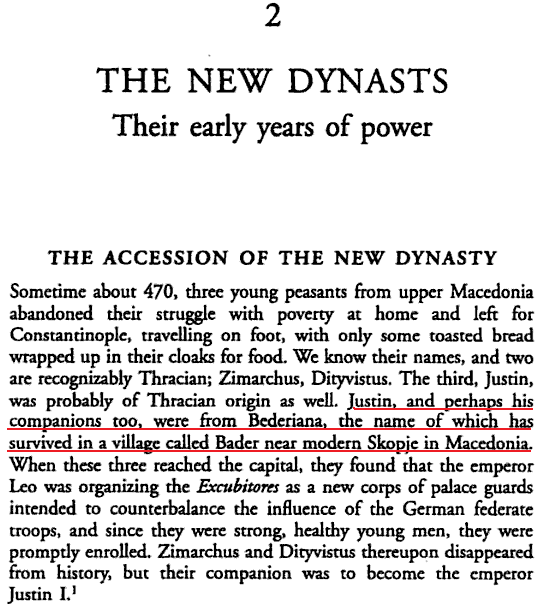
bader96.png


http://www.taurisium.com/english/za_tauresium.html

About Tauresium

Tauresium, the birthplace Justinian I (527-565), is mentioned by ancient author Prokopius in his composition ”De aedificiis” – “For buildings”.
In his composition, Prokopius declared:
“… Somewhere in the area of European Dardanians, who live behind Epidamnian border, close to castle Baderiana (today, village Bader), was found village Tavrisi (today, Taor). Here was born king Justinian, founder of world kingdom. Surrounding this village with square walls and building tower on each corner, he created four corner castles and named it Tetrapirgus. Here he build nice city and named it Justiniana Prima, on this way he wants to show his gratitude to parenthood…”
The site of archeological locality “Gradishte” – v. Taor is 20 km southeast from Skopje. First time, it is discovered hundred and more years ago, from English traveler Arthur Evans, who recognized lost city as Justiniana Prima, where ancient Skupi was located, and village Taor as Tauresium, birthplace of king Justinian I. In historical chronology this locality is related with big imperator Justinian I, mostly because of the quoted data from his biographer Procopius. According to historian Procopius, Justinian I was born in the place named Tauresium, near castle Baderiana. This settlement was destroyed in the big earthquake in 518 year; the epicenter was in present Skopje and beside other cities, ancient colonia of Skupi suffered lost. Justinian I renovate and build up again this city; with this showing gratitude to its birthplace. Close to this place, he builds wonderful and fascinating city of his archiepiscopy, Justiniana Prima.
The excavations showed that in Taor really exist castle from IV century with four towers (tetrapirgia). As Procopius noticed, 6 km east from Taor, near village Bader is settled castle with oddments from IV-VI century. Maybe its real name was Baderiana, which Procopius indicates it as nearest landmark. It is important to declare that names of villages Taor and Bader has before Slavic heritage, which indicates, the possibility this names are deductive from Tauresium and Baderiana. In 2000 year started a systematic excavation performed from Museum of the city of Skopje and leader of excavation was archeologist Kiro Ristov.
First explorations on the field recorded artifacts from early bronze century (which are sporadically and without parallel cultural layer as context). Later was discovered part from the bulwark which surrounded the settlement. The focus, for now, is on remains on two public buildings, from which second one is more interesting, because researchers assume this is atrium. The atrium induce the idea that here we should expect existence of bigger public building. This shows that in the period of late antique, from IV-VI century and later, the population in this area had active social life. For this testify the big number of coins, jewelry, ceramic plates, glass objects for everyday use, armor remains, tools, weapons and other artifacts.
 
Why are Zimarchus and Dityvistus "recognisably Thracian"?
We see them described a Illyrian in other texts.
Does anyone feel that many Proto Thracians became the Vlachs we know in modern times?
 
Why are Zimarchus and Dityvistus "recognisably Thracian"?
We see them described a Illyrian in other texts.
Does anyone feel that many Proto Thracians became the Vlachs we know in modern times?

There's no solid evidence to suggest that the Vlachs are from Thracian stock. The Goths were settled in Dacia by Emperor Aurellian where they managed to remain peaceful for a short while before moving on to destroy most of the Roman empire. They might be descendents of these people but who really knows.
 
I feel that the Thracians (all tribes collectively) were the main element that formed the core of the 6th century Slavic-speaking people, I don't think there can be any doubt if all the evidence was reviewed.

Good sources TM.
 
I really enjoyed reading this about Justinian. He is our Macedonian.

The Latin element in Macedonia is a funny thing, and native Vlachs seem to have moved around alot. They seem to be most heavily clustered along the Via Egnatia which indicates they are the descendants of Roman soldiers and citizens, but that is just a guess.

Whatever he may have been ethnically he was still related to the Macedonians some how, especially culturally - http://www.macedoniantruth.org/forum/showthread.php?t=1029

His reign resonates today through the Christian world with the Hagia Sophia.

As for Latin elements in Macedonia what about this;

traian.png

page 73
traian73.png
 
Last edited:
Justinian I OF Macedonia

Justinian I OF Macedonia

Justinian I
Justinian was one of the most famous and successful emperors of the Byzantine era after Constantine I. He was born in Ilyricum (near Skopje in Macedonia) in 482 or 483 AD. In 523 he married Theodora, a scandalous dancer thus he was criticized a lot, and ascended to the throne in 527 AD after the death of Justin I. After becoming an emperor, he fought against the Persians between 528-530 who invaded Mesopotamia and attacked on the Byzantine lands, and he stopped them thanks to one of his great commanders of the army, Belisarius.
It was under his reign when Nika Riot destroyed the city and most of its important monuments including Hagia Sophia Church, killing over 30.000 people in five days of urban warfare. Justinian managed to end the riot with a great difficulty and than he dedicated himself on the reconstruction of Constantinople and its monuments; Hagia Sophia church, Hagia Irene church, Underground cistern were all built under his rule.
In 533 AD Justinian sent his army to Africa under the command of Belisarius to get rid of the Vandal Kingdom which caused the Byzantines many problems, and he succeeded. In 535 AD he sent his army to Italy with his most favorite commander to end the incapable government of Theodahad, landing in Sicily and advancing all the way to Rome and Ravenna fighting against the Goths until 540. Afterwards another war broke out with Persians in the east, who attacked on the Byzantines and captured Antioch. The war went on until finally Justinian signed a peace pact with Persians in 555 AD.
As for the interior affairs, Justinian supported the Roman Law. He established the Justinian Code (Codex Justinianus) in 529 AD uniting all valid imperial laws under one and thus founding the base of almost all legal systems in Europe. He also introduced the silk-worm culture to Europe. But on the other hand, his passion for building great monuments such as Hagia Sophia put the Byzantine treasure under stress and this brought high taxes damaging the trade and industry. Same thing happened with a heavy war taxation to support his war campaigns.
Emperor Justinian died in 565 AD at the age of 83, after reigning for 38 years. He was succeeded by his nephew Justin II. Justinian was buried at the Church of the Holy Apostles in today's Fatih district, which was plundered by the Crusaders and later destroyed by earthquakes.

Macedonian Emperors
867–886 Basil I, the Macedonian
886–912 Leo VI, the Wise
912–913 Alexander III
913–959 Constantine VII, Porphyrogenitus
919–944 Romanus I, Lecapenus
959–963 Romanus II
963–969 Nicephorus II, Phocas
969–976 John I, Tzimisces
976–1025 Basil II, Bulgaroktonus
1025–28 Constantine VIII
1028–50 Zoë
1028–34 Romanus III, Argyrus
1034–41 Michael IV, the Paphlagonian
1041–42 Michael V, Calaphates
1042–54 Constantine IX, Monomachus
1054–56 Theodora
1056–57 Michael VI, Stratioticus
1057–59 Isaac I, Comnenus
1059–67 Constantine X, Dukas
1067 Andronicus
1067 Constantine XI
1067–71 Romanus IV, Diogenes
1071–78 Michael VII, Parapinakes
1078–81 Nicephorus III, Botaniates
1081–1118 Alexius I, Comnenus
1118–43 John IV, Calus
1143–80 Manuel I
1180–83 Alexius II
1182–85 Andronicus I
1185–95 Isaac II, Angelus-Comnenus
1195–1203 Alexius III, Angelus
1203–04 Alexius IV
1204 Alexius V, Dukas
527–565 Justinian I (The Great)
565–578 Justin II
 
Back
Top