• Welcome to the new Macedonian Truth Forum. All posts, members and private messages have been moved over from the old forum.

    Passwords from the old forum could not be carried over, so please use Forgot your password? to set a new one. The reset link is emailed to the address on your account.

  • Rules and Regulations at the forum of the Macedonian Truth Organisation (MTO)

    (1) The national-ethnic and cultural-linguistic identity of the Macedonian people is historically Macedonian, and derives its character from the native, indigenous and geographic homeland of the Macedonians, which is called Macedonia. To ensure that their human rights, integrity and heritage are appropriately respected, the only nouns and adjectives acceptable when reference is made to the above character and identity markers is Macedon, Macedonia, Macedonian and Macedonians.

    (2) The nation-state of the Macedonian people is the Republic of Macedonia, and is to be referred to by this official title so long as the 'republic' prefix is consistently applied to other states. Alternative references are the Macedonian Republic, or simply, Macedonia.

    (3) The 'ethnic' prefix is only acceptable for Macedonians in cases where differentiation is specifically required - so long as it is in context and consistent where it concerns its application to other ethnic groups.

    (4) Should any other differentiation be specifically required, the names of other ethnic groups that reside with Macedonians in either the Republic of Macedonia or the occupied Macedonian regions in Greece, Bulgaria, Serbia or Albania, are to be given a prefix.

    (5) Negating the identity, language and culture of the Macedonian people by deliberate avoidance of the terms Macedonia, Macedonian and Macedonians, or by any other means, is not permitted.

    (6) Systematic anti-Macedonian propaganda and rhetoric are not permitted.

    (7) Threads irrelevant to the Macedonian Cause, the community at the Macedonian Truth Organisation or the Macedonians in general may be considered as spam or not in the spirit of the forum. In such cases they are not permitted.

    (8) Continual posting of messages in threads with the sole purpose of deviating from the initial topics with the use of unrelated and unnecessary information is not permitted.

    (9) All posts, external articles, reports, etc that are cited in languages other than Macedonian or English, must be accompanied with a translation in one or both of the said languages.

    (10) Despite the possibility of some conversations and debates becoming heated, extreme abuse and/or racism, vulgar language and/or terminology, threats, revelation of personal information about others, harassment, and other such behavior will not be permitted. If deemed necessary all relevant information including member details will be reported to the appropriate authorities for investigation which may result in legal action.

    (11) Threads that are created must have a summary of a topic or excerpt of an article found in pertinent link(s) that have been included. One line threads will be considered unaccetable spam and are therefore not permitted.

    (12) Compulsive and deliberate lies, irrespective of the topic, are not permitted.

    (13) Any symbols or avatars found to be perceived as offensive to Macedonians are not permitted.

    (13) Any explicit or extreme material is not permitted.

    Failure to adhere to the above rules and regulations will result in a ban after 3 breaches. This may be reconsidered in some cases should the circumstances be of an unorthodox nature and/or require special consideration. To assure an effective deterrent against an individual or individuals with the sole purpose of causing dissent through spamming, racism or other improper means, the above rules will be strictly enforced.

    The MTO administration will monitor all discussions as reasonably practical and reserve the right to remove any post and/or member from the forum, and update the rules and regulations as required. Members are encouraged to immediately report any post and/or member to the MTO administration if they feel that these rules have not been abided by.

    The views expressed on this forum are those of the individuals. The only official representation of the MTO is made by the "Macedonian Truth Organisation (Site Owner)" username, and no other.

  • Macedonian Cause

    The Macedonian Truth Organisation calls on God in Heaven to protect, bless and guide the endeavour it is committing to undertake, and that is to work towards:

    Securing Macedonia as a free, independent and democratic republic in which sovereignty lies with the Macedonian citizens; as the nation-state of the Macedonian people in which they can preserve their culture, language and identity; as a state in which the Macedonian language and culture form the basis of public life and act as important unifying elements of Macedonian society; as the home of all its citizens to which it guarantees and obliges their inalienable natural rights and corresponding responsibilities;

    The acknowledgment as self-evident and irrefutable the existence of the:

    1) Indigenous, ethnonational name of Macedonia;
    2) Macedonian people, language and identity;
    3) Macedonian culture, symbols and folklore;
    4) Macedonian ancestry, heritage and history in its entirety; and
    5) Macedonian Orthodox Church;

    Securing recognition by the International Community of the tragedies endured by the Macedonian people, of the division of Macedonia with the signing of the Treaty of Bucharest on August 10, 1913, and the genocide committed against the Macedonian people at the hands of the Greek, Bulgarian and Serbian states and their respective churches during the 19th and 20th centuries;

    Ensuring that the Interim Accord is declared ‘null and void’ and that all constitutional provisions, acts, commitments, agreements, legislation, regulations, policies or programs emanating from, supporting or consequential to the Interim Accord are also declared ‘null and void’, including the use of any symbols and the completion of any acts imposed by, or originating from, the Interim Accord.

    Ensuring that the Framework Agreement is abolished and that all constitutional provisions, acts, commitments, agreements, legislation, regulations, policies and programs emanating from, supporting or consequential to the Framework Agreement are also abolished and replaced by a framework of constitutional and statutory law based on inalienable natural rights and corresponding responsibilities and universally codified human rights mechanisms.

    Securing the abolishment of any existing constitutional provisions, acts, agreements, legislation, regulations, policies and programs that discriminate against the Macedonian people, in any international organisation or any of the countries of the International Community where such constitutional provisions, acts, agreements, legislation, regulations, policies and programs exist, and thereby ensuring the freedom for Macedonians to exercise their inalienable natural rights and fulfil their corresponding responsibilities, and practice their culture, language and religious faiths in all the countries of the International Community without hindrance;

    The empowerment of Macedonians to undertake a moral revolution and to instil and/or reinvigorate within themselves a deep-rooted national, cultural, linguistic and historical dignity and a commitment to the exercise of freedom based on inalienable natural rights and corresponding responsibilities;

    The recognition of the Macedonian minorities in the neighbouring states of Macedonia as well as the respect for the inalienable rights and freedoms of the Macedonian minorities, as provided for by natural law and as codified by the United Nations Charter, the Universal Declaration of Human Rights and other universally codified human rights mechanisms;

    The full and unreserved respect of, and the support for, the rights of all people of non-Macedonian descent living in Macedonia and around the world, who share a reciprocal full and unreserved respect for the Macedonian people, their homeland and their state;

    The cultural unification and solidarity of the Macedonian people living in all parts of historical Macedonia and adjacent territories, as well as Macedonians throughout the world;

    The unity of all Macedonians on the principles, objectives and achievement of the Macedonian cause as defined by this declaration.

Deconstruction of the term Bulgar/B'lgar/Bugar/Voulgar!

Daskalot

New member
There is a great misconception regarding the above term, its use and meaning during history. When did it get national, ethnic, etc?
 
Some collection on it:

Гърците наричали българина "хондрокефалос", което означава дебелоглав, в смисъл твърдоглав, тъп, прост. На Запад през средновековието еретиците наричали "бугри" (фр. bougres), което произлиза от bulgare (българин) и означавало нещо лошо. Според френската енциклопедия "Ларус" думата означава оскърбителен термин, ругатня. В речника на Бл. Мавров тя означава тип, нехранимайко, проклетник. Академик Йордан Иванов в книгата си "Богомилски книги и легенди" пише, че във френския език са останали и до ден днешен думи и изрази, идещи от името "българин" (bougre) с негативно значение

Translation:

The Greeks called the Bulgarians "Hondrokephalos", which designates ticken headed person, in the sense of stubborn, dumb. In the West during Medieval Times the Heretics were called "Bugri" (Franch bougres), which derives from bulgare (Bulgarian) and designates something bad. Accoding to the Ecyclopedia "Larus" the word designates an derogative term. In the dictionary of Bl. Mavrov the word designates a Type, vagabont, cursed one. Academmian Jordan Ivanov in his book "Bogomils Books and Legends" writes, that the French language preserved till the modern day the words, that are derived from the term "Bulgarian" (bougre) with negative meaning.


Taken from:
BOZHIDAR DINKOV
-------------------------------------------------------------------------------------------------

Babylon French-English
bougre (m) n. fellow; damn; bugger

Babylon English-English

bugger
n. fellow, chap; person who commits sodomy
v. sodomize; bother


The etymology of this word is amusing, it returns to… Bulgarian!
To the Middle Ages (fine Xe S.), the Bulgarian ones went guilty to the eyes of Rome of the heresy bogomile (they did not believe where the pope said to them to believe). Have showed them to be sodomites, which charged the Latin term bulgarus with a sexual connotation.
The francized term became bogre then guy (= heretic, discharged, homosexual - much of significance for only one term!), bougrery being male homosexuality.
By extension one invented the bougress, designating the lesbian.
The scholars of the rebirth them replaced the bougrery term by a more elegant name because resulting from the Greek: pederasty.

Nowadays the sexual connotation of the term was largely erased, a guy is almost the equivalent of a strapping man.

Babel Forum

------------------------------------------------------------------------------------------------


From Wikipedia:

"Vulgarism" derives from Latin vulgus, the "common folk", and has carried into English its original connotations linking it with the low and coarse motivations that were supposed to be natural to the commons, who were not moved by higher motives like fame for posterity and honor among peers — motives that were alleged to move the literate classes. Thus the concept of vulgarism carries cultural freight from the outset, and from some social and religious perspectives it does not genuinely exist, or — and perhaps this amounts to the same thing – ought not to exist.


While people who were known as the "Common Folk" under Roman Rule and later the same Term was used as Mass designation into the East Roman Empire, came to be misunderstood with the new comer Tatar Mongol Tribes designation "Bulgarian".

Latin vulgaris means common, ordinary, usual. This same word is only one character away from the Ethnic name of Proto Bulgarians Bolgari in Cyrilic Болгари (in Greek Βουλγαρoς pronounced VULGAROS which was mostly used to designate the Tatar Bulgarians, cause they were seen as low life creatures).


------------------------------------------------------------------------------------------------


Also interesting to consider is the Latin: burgus and burgarius > small fortification; soldier stationed at burgus; which left traces in the Old Germanic as burgarius precisely in Old High German, and burgõri* 7, burgeri*, Burgbewohner, Einwohner; nhd. Bürger, M., Bürger, Burgbewohner, Stadtbewohner.


Middle English, from Latin vulgaris of the mob, vulgar, from volgus, vulgus mob, common people

In the same context, there is also Musica Vulgaris in a sense of Folk Music!

The Designation comes from the Latin vulgaris („belonging to the People, Commoner“) orVulgar Latin (in Latin, sermo vulgaris, "folk speech").

In other words: Bulgaria is the land of the Vulgaren.
 
Last edited:
Good findings, are there any historical sources, books or dictionaries, supporting the above?

Never looked for some !

The above is on linguistic basis though the Hondrokephalos Vulgaris exceped...

For the Hondrokephalos Vulgaris there are deffinitly historical sources, Misirkov included.

But there are some instances of travelers who were finding Bulgarians in Bosnia and Serbia though. The Armenian traveler Lehaci wrote:
Оттуда за пять дней мы достигли Босна-Сарая.* Это был большой город, построенный на высокой горе. Через него протекала широкая река, еще большая, чем остальные. Это был благоустроенный и торговый [город] и место купцов. Там сидел беглербек Румелии. Мы разыскали там четырех армянских купцов, которые, утешив нас, с любовью встретили и почтили у себя дома, за что да вознаградит их Господь! Там мы пробыли два дня. Люди той страны – здоровые богатыри, сильные и могучие, рослые и мускулистые; они совсем не знают турецкого языка, но только болгарский. Говорят, что в Румелии, кроме городов, есть 80 тысяч болгарских сел; по исповеданию они греки, а их архиепископ сидит в Атране. Почему же они всем округом приняли мусульманскую веру? Говорят, что как-то прибыли к ним хараджчи, и они из-за нищеты отреклись от веры, чтобы не платить харадж. Тогда хараджчи, собравшись, отправились в Высокую Порту (“Высокие Врата” или “Высокая Порта” (Баб и-Али), так называли Стамбул) и дали понять хондкару, что боснийцы приняли мусульманство не во имя бога, а из-за хараджа. Тогда царь повелел: «Пусть платят [все], хоть и стали мусульманами, кроме хаджи, которые ходили в Мекку». Увидели [62] они, что и веры лишились и харадж платят, стали ходить из-за хараджа в Мекку. Все они хаджи; среди них очень мало платящих харадж, таких называют румелийскими газиями. В Боснии повсюду есть также много болгарских монастырей. В пяти милях [от города] на высокой горе стоит большой известный и великолепный монастырь; нам сказали, что в эту епархию входит триста сел. Войдя внутрь, мы обошли его и благословили бога. Рядом с монастырем находился большой горячий источник, который приводил в движение 12 мельниц. В другом месте, около Хулупа, мы увидели построенные царями большие бассейны и каменные украшения, подобные источникам Бурсы. В Боснии все люди говорят по-болгарски и если клянутся, то, кроме имени Мехмета, ничего по-турецки не знают, поэтому говорят: «Такоми бога и вира Мехметская», то есть «Вот те бог и вера Мехметова», и т. д.

http://www.armenianhouse.org/lekhatsi/chronicle-ru/notes/chapter1_6.html#5

With quick Google Translate:

From there, five days we reached Bosnia-shed .* It was a great city built on a high mountain. Through its extensive river run, even more than the rest. It was comfortable and trade [city] and the place of merchants. There sat beglerbek Rumeli. We found there four Armenian merchants, who will comfort us with love and honor the meet at home, so that the reward of their Lord! There we stayed two days. The people of the country - Bogatyrs healthy, strong and mighty, tall and muscular, and they do not know the Turkish language, but the only Bulgarian. They say that in Rumeli, except the cities, there are 80 thousand Bulgarian villages, on the [*fathe i.e religion] practice of them Greeks, and their archbishop seated in Atrane. Why are they all the district took the Muslim faith? They say that once they arrived haradzhchi, and they are due to poverty denied the faith, not to pay HARAJ. Then haradzhchi met, went to the High Oporto ( "High Gate" or "High-port (and Bab-Ali), the so-called Istanbul) and made it clear hondkaru that Bosnians are not adopted Islam in the name of God, but because of the HARAJ. Then the king commanded: «Let the pay [all], it's become Muslims but Haji, who went to Mecca». See [62] they that have lost faith and HARAJ pay, have to walk because of HARAJ in Mecca. They all Haji, among them very few paying HARAJ such call rumeliyskimi gaziyami. In Bosnia, everywhere there are also many Bulgarian monasteries. At five miles [from the city] on a high mountain is a large well-known and magnificent monastery, we were told that in this diocese are three hundred villages. Once you log in, we walked around it, and blessed God. Near the monastery is a large hot spring, which resulted in the movement of 12 mills. Elsewhere, about Khulup, we saw the kings built large pools and stone ornaments, such as sources of Bursa. In Bosnia, all the people speak in Bulgarian, and if you swear, then, except for the name of Mehmet, nothing in Turkish do not know why say: «Tacoma god and Wira Mehmetskaya», ie «These are the god and faith Mehmetova», and so e.

Translated with: http://translate.google.com/translate

My edit [*....] cause исповеданию = religious practice
 
Very good, what do our Greek friends have to say about Voulgaroi? Its Very similar to the Latin term Vulgar/Vulgus.
 
We have a field day with that chant everytime PAOK comes to G.Karaiskakis stadium, the home of the greatest team in the Balkans/southeastern Europe, the great Olympiakos.
It goes something like this-

BOU-BOU-BOULGARI

HAHA, I love it, the poor bastards get so mad!!
 
I have a feeling that our modern Bulgarian friends have taken their national name from the older term which meant christian slavic peasant, the East Romans used the term in this way, as did the Ottomans. We need to find sources backing this, lets go treasure hunting in our local library!
 
In the Balkans, the term 'Bulgar' was originally a name of a Turkic tribe with Iranian admixtures among others. What we need to establish is wether or not the Latin term 'Vulgar' derives from the above or whether it was used earlier.
 
What we need to establish is wether or not the Latin term 'Vulgar' derives from the above or whether it was used earlier.

Hard if even imposible task.

How ever the term Vulgar predates the Bulgars of Asparuh, that is for sure.

It may be the faith is in play, when the two terms with totaly different meanings colide and get confused.
 
Here just for you Terriaky:


According to GHM, a report from the Reuters news agency has confirmed that a Greek court has slapped a temporary injunction on
sales of a dictionary in the latest round of a dispute over an allegedly insulting definition contained in the boo
k. On 26 May 1998,
court officials in Thessaloniki (in northern Greece) confirmed the decision, made in response to complaints by a local conservative
politician over one of the dictionary's definitions for "Bulgarians."'

The dictionary states that "Bulgarians'' is used in Greek slang as a pejorative term for supporters or players of sports teams in
Thessaloniki, which is near the Bulgarian border. Fans of soccer and basketball teams from Athens and the rest of the south often taunt
northern fans and players, especially from the PAOK team, with the term.
Greece: Violations of freedom of expression ....... klick here terry to see the source ;-)


Freedom of Speech in Greece :-)

End to dictionary furore

The government today praised the author of a Greek dictionary who agreed (= forced) to eliminate from the second edition an explanation of the word 'Bulgarians' which caused a furore when the reference work was recently published. In the first edition of the dictionary, under the entry 'Bulgarians', Professor George Babiniotis' second explanation was "the supporter or player of a (sports) team of Thessaloniki, mainly of PAOK". The entry notes that the term is used as an insult. Fans of Athenian soccer and basketball teams in particular often chant the word pejoratively to goad fans of Thessaloniki teams.

http://www.hri.org/news/greek/apeen/1998/98-05-25_1.apeen.html


*(my edit)
 
Last edited:
I have a feeling that our modern Bulgarian friends have taken their national name from the older term which meant christian slavic peasant, the East Romans used the term in this way, as did the Ottomans. We need to find sources backing this, lets go treasure hunting in our local library!
I have the same feeling.
And I would also suggest it sounds somewhat familiar to another name like "Greek".
 
Are there anymore findings on the above topic?

How about some Honest Bulgarian testemony?

Read it here

Or Bulgarian Identity crisis

What is a Bulgar was a matter of definition of their intelegentsia:

Bulgarian elite had to invent, elaborate and underpin a myth of common ancestry and made this pedigree putative for the sense of ethnic identification

It appears though that the definition is still pending :D
 
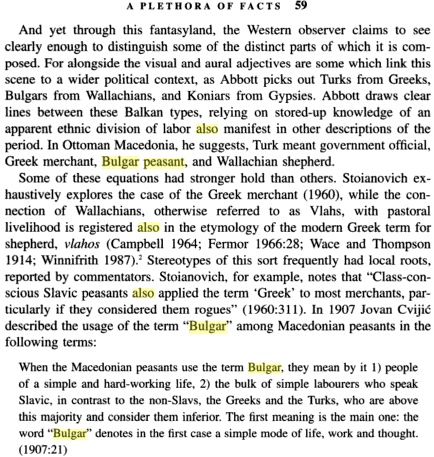
I don't know if this helps but here goes.

brown.png

brown59.png


So according to the text above;

1) Turk meant government official.
2) 'greek' meant merchants
3) Bulgar meant peasant.
4) Vlach meant shepard.

The balkans is a strange place. The only place where religion earns you a name like 'greek' or your social status earns you a name like 'bulgarian'.
 
nice Makedonin, but are there any linguistic references for what Bugar could mean in our language??

Bugar is a loan word. It is Vulgar, exactly as described in True Macedonian post.

It meant the common hard working population, which stood oposed in contrast to the Merchant and Governing class i.e. Turks and Greeks.

The bulk of the Vlach were in deed Shepherds, and not every each of them called them Armin...

For examle, Albanians are known as Vlachs cause they as well as the Armin were shepherds.

Vlah's in Greek Βλαχοι in deed means shepherd.

As for Vulgar and Vulgus I have already explained.

PS.

TM nice post..
 
I don't know if this helps but here goes.

brown.png

brown59.png


So according to the text above;

1) Turk meant government official.
2) 'greek' meant merchants
3) Bulgar meant peasant.
4) Vlach meant shepard.

The balkans is a strange place. The only place where religion earns you a name like 'greek' or your social status earns you a name like 'bulgarian'.

this is exactly what I am looking for, could we find the source from the above book, the one from 1907.
 
Bugar is a loan word. It is Vulgar, exactly as described in True Macedonian post.

It meant the common hard working population, which stood oposed in contrast to the Merchant and Governing class i.e. Turks and Greeks.

The bulk of the Vlach were in deed Shepherds, and not every each of them called them Armin...

For examle, Albanians are known as Vlachs cause they as well as the Armin were shepherds.

Vlah's in Greek Βλαχοι in deed means shepherd.

As for Vulgar and Vulgus I have already explained.

PS.

TM nice post..

thank you Makedonin, good observation, I have also read that "Vlach" is applied to almost anyone that was a shepherd in Greece.
 
this is exactly what I am looking for, could we find the source from the above book, the one from 1907.


Jovan Cvijic's text was originally written in Serbian. I'm having difficulty locating it online.
Many bulgars say that he lied about the Macedonians in order to appropriate them into "south serbia". However this is false because Dr.Cvijic recognised a seperate Macedonian ethnicity alongside Serbian and Bulgarian as well as a serperate Macedonian language.Could it be that he was a rare honest scholar in the balkans?

I will dig into this TM, I have some resources to check up.
 
Back
Top