• Welcome to the new Macedonian Truth Forum. All posts, members and private messages have been moved over from the old forum.

    Passwords from the old forum could not be carried over, so please use Forgot your password? to set a new one. The reset link is emailed to the address on your account.

  • Rules and Regulations at the forum of the Macedonian Truth Organisation (MTO)

    (1) The national-ethnic and cultural-linguistic identity of the Macedonian people is historically Macedonian, and derives its character from the native, indigenous and geographic homeland of the Macedonians, which is called Macedonia. To ensure that their human rights, integrity and heritage are appropriately respected, the only nouns and adjectives acceptable when reference is made to the above character and identity markers is Macedon, Macedonia, Macedonian and Macedonians.

    (2) The nation-state of the Macedonian people is the Republic of Macedonia, and is to be referred to by this official title so long as the 'republic' prefix is consistently applied to other states. Alternative references are the Macedonian Republic, or simply, Macedonia.

    (3) The 'ethnic' prefix is only acceptable for Macedonians in cases where differentiation is specifically required - so long as it is in context and consistent where it concerns its application to other ethnic groups.

    (4) Should any other differentiation be specifically required, the names of other ethnic groups that reside with Macedonians in either the Republic of Macedonia or the occupied Macedonian regions in Greece, Bulgaria, Serbia or Albania, are to be given a prefix.

    (5) Negating the identity, language and culture of the Macedonian people by deliberate avoidance of the terms Macedonia, Macedonian and Macedonians, or by any other means, is not permitted.

    (6) Systematic anti-Macedonian propaganda and rhetoric are not permitted.

    (7) Threads irrelevant to the Macedonian Cause, the community at the Macedonian Truth Organisation or the Macedonians in general may be considered as spam or not in the spirit of the forum. In such cases they are not permitted.

    (8) Continual posting of messages in threads with the sole purpose of deviating from the initial topics with the use of unrelated and unnecessary information is not permitted.

    (9) All posts, external articles, reports, etc that are cited in languages other than Macedonian or English, must be accompanied with a translation in one or both of the said languages.

    (10) Despite the possibility of some conversations and debates becoming heated, extreme abuse and/or racism, vulgar language and/or terminology, threats, revelation of personal information about others, harassment, and other such behavior will not be permitted. If deemed necessary all relevant information including member details will be reported to the appropriate authorities for investigation which may result in legal action.

    (11) Threads that are created must have a summary of a topic or excerpt of an article found in pertinent link(s) that have been included. One line threads will be considered unaccetable spam and are therefore not permitted.

    (12) Compulsive and deliberate lies, irrespective of the topic, are not permitted.

    (13) Any symbols or avatars found to be perceived as offensive to Macedonians are not permitted.

    (13) Any explicit or extreme material is not permitted.

    Failure to adhere to the above rules and regulations will result in a ban after 3 breaches. This may be reconsidered in some cases should the circumstances be of an unorthodox nature and/or require special consideration. To assure an effective deterrent against an individual or individuals with the sole purpose of causing dissent through spamming, racism or other improper means, the above rules will be strictly enforced.

    The MTO administration will monitor all discussions as reasonably practical and reserve the right to remove any post and/or member from the forum, and update the rules and regulations as required. Members are encouraged to immediately report any post and/or member to the MTO administration if they feel that these rules have not been abided by.

    The views expressed on this forum are those of the individuals. The only official representation of the MTO is made by the "Macedonian Truth Organisation (Site Owner)" username, and no other.

  • Macedonian Cause

    The Macedonian Truth Organisation calls on God in Heaven to protect, bless and guide the endeavour it is committing to undertake, and that is to work towards:

    Securing Macedonia as a free, independent and democratic republic in which sovereignty lies with the Macedonian citizens; as the nation-state of the Macedonian people in which they can preserve their culture, language and identity; as a state in which the Macedonian language and culture form the basis of public life and act as important unifying elements of Macedonian society; as the home of all its citizens to which it guarantees and obliges their inalienable natural rights and corresponding responsibilities;

    The acknowledgment as self-evident and irrefutable the existence of the:

    1) Indigenous, ethnonational name of Macedonia;
    2) Macedonian people, language and identity;
    3) Macedonian culture, symbols and folklore;
    4) Macedonian ancestry, heritage and history in its entirety; and
    5) Macedonian Orthodox Church;

    Securing recognition by the International Community of the tragedies endured by the Macedonian people, of the division of Macedonia with the signing of the Treaty of Bucharest on August 10, 1913, and the genocide committed against the Macedonian people at the hands of the Greek, Bulgarian and Serbian states and their respective churches during the 19th and 20th centuries;

    Ensuring that the Interim Accord is declared ‘null and void’ and that all constitutional provisions, acts, commitments, agreements, legislation, regulations, policies or programs emanating from, supporting or consequential to the Interim Accord are also declared ‘null and void’, including the use of any symbols and the completion of any acts imposed by, or originating from, the Interim Accord.

    Ensuring that the Framework Agreement is abolished and that all constitutional provisions, acts, commitments, agreements, legislation, regulations, policies and programs emanating from, supporting or consequential to the Framework Agreement are also abolished and replaced by a framework of constitutional and statutory law based on inalienable natural rights and corresponding responsibilities and universally codified human rights mechanisms.

    Securing the abolishment of any existing constitutional provisions, acts, agreements, legislation, regulations, policies and programs that discriminate against the Macedonian people, in any international organisation or any of the countries of the International Community where such constitutional provisions, acts, agreements, legislation, regulations, policies and programs exist, and thereby ensuring the freedom for Macedonians to exercise their inalienable natural rights and fulfil their corresponding responsibilities, and practice their culture, language and religious faiths in all the countries of the International Community without hindrance;

    The empowerment of Macedonians to undertake a moral revolution and to instil and/or reinvigorate within themselves a deep-rooted national, cultural, linguistic and historical dignity and a commitment to the exercise of freedom based on inalienable natural rights and corresponding responsibilities;

    The recognition of the Macedonian minorities in the neighbouring states of Macedonia as well as the respect for the inalienable rights and freedoms of the Macedonian minorities, as provided for by natural law and as codified by the United Nations Charter, the Universal Declaration of Human Rights and other universally codified human rights mechanisms;

    The full and unreserved respect of, and the support for, the rights of all people of non-Macedonian descent living in Macedonia and around the world, who share a reciprocal full and unreserved respect for the Macedonian people, their homeland and their state;

    The cultural unification and solidarity of the Macedonian people living in all parts of historical Macedonia and adjacent territories, as well as Macedonians throughout the world;

    The unity of all Macedonians on the principles, objectives and achievement of the Macedonian cause as defined by this declaration.

Deconstruction of the term Bulgar/B'lgar/Bugar/Voulgar!

Ancestors of the "bulgarian" Macedonians

Ancestors of the "bulgarian" Macedonians

As there are other threads that go deep into the reasoning as to why Macedonians of the 19th and 20th century identified as 'Bulgarians' in some instances, this thread will demonstrate who these "bulgarian" Macedonians considered their ancestors.

1845: Russian Chronicler Victor Grigorovich, who travelled among these "bulgarian" Macedonians, has the following to say -
In all areas I visited, I have not heard other names but the names of Alexander the Great and King Marko. Both are alive in the memory of the people…Still, the memory of Alexander the Great is the more established in the people.

1852: Macedonian writer Jordan Dzinot identified as a 'Bulgarian' or 'Slav-Bulgarian' in his writings, yet his ancestry, although called 'Bulgarians' by him, pre-date the Bulgar hordes of the 7th century -
Bulgarian children! In the times before SS Cyril and Methodius, the most known people in the Eastern Empire were Bulgarians: Such as Emperor Justinian.........and Emperor Basil the Macedon was a Bulgarian.......

1866: Bosnian writer Stefan Verkovich, who also speaks of the 'Bulgarian' reference regarding Macedonians, recorded the following about these people -
The Marvatsi have tales and folklore passed down through generations from the distant past, which could fill the gaps in general and local Slavic history, as well as clarify and correct many inaccurate and troubling opinions and arguments among ancient and more recent historians about the people living in the Balkan peninsula, about their forefathers, the ancient Thracians, Macedonians and Illyrians…The folksong a very unusual and significant which come down from a distant past. They also relate a song about Alexander and Bucephalus; about his crusade in Asia and war against Darius and Porus….

1868: Bosnian writer Stefan Verkovich, after having travelled through Macedonia and recorded such rich culture and songs, was thus compelled to write the following to the Zagreb newspaper 'Dragoljub' -
The Slavs, and not the Greeks, are the forefathers of the civilisation

1878: The background of the Macedonian Rebel Committee is intertwined with the Russian invasion of Turkey in Europe and the confidence inspired in the Balkan Slavs such as the Serbs, Bulgarians and Macedonians. Although sometimes referred to as a 'Bulgarian' movement by some writers (namely those from Bulgaria), the ancestry cited in the prescripts again betrays the Bulgarian manipulation of history -
With the wish to cast off the Turkish bondage from our fatherland, each and every one of us stands ready to sacrifice whatever is necessary. We have rebelled as champions of freedom. By shedding our blood throughout the fields and forests of Macedonia, we serve as the Macedonian army of Alexander the Great once did. We fight for freedom and our motto is: "Freedom or Death!"

1892: Macedonian writer Kuzman Shapkarev, who also often identified as a "bulgarian" Macedonian, considers the following his ancestors -
During our childhood my father would telling us many stories about King Marko and about Tsar Alexander – Alexander the Great.

1903: Nikola Karev during an interview for a Greek paper, is clear about what the ancient Macedonians meant to him - ......
I am Macedonian
. The Greek interviewer asks,
direct descendant to Alexander the Great?
Karev responds,
.

1923: Macedonian writer Krste Misirkov, who had his Macedonian identity often contested and compromised by his Bulgarian peers, and who at times identified as a Bulgarian himself, wrote the following with regard to the ancestors of the Macedonians -
King Mark is the son and pride of Macedonia and one of the three great conquerors who spread the name of their land far beyond its territories: (1) Alexander of Macedon spread the glory of Macedonia as far as the Central Asian rivers of Amu Darya [Oxus] and Syr Darya [Jaxartes], and also to India and the Indian Ocean; (2) The holy Cyril and Methodius spread the Macedonian word and script among all the Slavic peoples, and (3) King Marko placed under his authority and under that of the Macedonian muse all popular singers and peoples on the Balkan Peninsula, including you, the descendants of his sworn enemies......


The key point here is simple: The people that produced these texts often referred to the Macedonians as 'Bulgarians' during the era cited above. However, despite their 'Bulgarian' terminology, it is clear from the texts that these so-called 'Bulgarians' from Macedonia considered as their ancestors the historical figures of Macedonia, and not Bulgar Khans from Asia. Yet another reason why the 'Bulgarian' name was eventually dropped due to being rendered useless for the national aspirations of the Macedonians.

If the 'Bulgarian' name and so-called Bulgarian origins from Asia were dear to the Macedonians, they would have been retained by the Macedonians the same way the Macedonian name and local Macedonian history was.
 
Nice comparison SOM, I like that chronology it tells a lot especcially this part:

".. it is clear from the texts that these so-called 'Bulgarians' from Macedonia considered as their ancestors the historical figures of Macedonia, and not Bulgar Khans from Asia."
 
"БУЛГАРЫ - ЭТНОС и ЭТНОНИМ"

Абрар Каримуллин

СОДЕРЖАНИЕ:

1. ИТОГИ НАУЧНОЙ СЕССИИ О ПРОИСХОЖДЕНИИ ТАТАР

2. ПРОИСХОЖДЕНИЕ НАЗВАНИЯ "ТАТАРЫ" и КОГО НАЗЫВАЛИ ЭТИМ ИМЕНЕМ?

3. О ПРЕДКАХ СОВРЕМЕННЫХ ТАТАР

4. БУЛГАРЫ В СРЕДНЕМ ПОВОЛЖЬЕ

5. ИЗ ИСТОРИИ ЭТНОНИМОВ

6. О НАЗВАНИИ "ТАТАРЫ" и ЭТНОНИМЕ "БУЛГАРЫ"

7. КАК НАЗЫВАЮТ СЕБЯ СОВРЕМЕННЫЕ ТАТАРЫ

8. ЭКВИЛИБРИСТИКА С АЗВАНИЕМ "ТЮРК", "ТУРОК", "ТАТАР", "МУСУЛЬМАНИН"

9. БОЛГАРЫ, БАЛКАРЫ, БУЛГАРЫ

10. О ЖИВУЧЕСТИ ПРОЗВИЩА "ТАТАРЫ"

11. НЕСКОЛЬКО СЛОВ О БЫТЕ И КУЛЬТУРЕ БУЛГАР - "ТАТАР"

12. КАКОВ ВЫВОД?

- Еве како изгледа содржината на дело за еднородноста и вистинското потекло на Бугарите, а дури внатре е има што да се види, НО КОЈ САКА ДА ВИДИ?!


Булгары - предки TATAP

"Мы - БУЛГАРЫ.
Мы - блоковские скифы.
Творцы легенд.
И сами полумифы."

(Н.Беляев, "Казанская тетрадь")

- "...Писателите от IX и началото на Хв. още не гонаричат "български", защото го отделят от езика на прабългарите. Този тюркски език,макар и вече на изживяване, още не е изчезнал окончателно. ..."

http://www.peoples.org.ru/tjurk.html

"Тюркские языки - семья языков..." - Турски јазици

Источник Русский филологический портал

..... Булгарская (булгарский, чувашский)

1. Разделение тюрских языков на четыре самые древние ветви (якутскую, тувинскую, булгарскую и западную) произошло практически одновременно в течение трех первых веков нашей эры. ..... Булгарская подгруппа (чувашский язык) равноудалена от других подгрупп тюркских языков и выделилась из единого тюркского праязыка не ранее (а возможно, даже несколько позже), чем другие ветви. ..."

http://www.kyrgyz.ru/?page=30


"В IX-X веках в связи с принятием ислама предки современных татар - булгары свое руническое письмо заменили арабской графикой, что положительно влияло на расширение массовой грамотности населения. В 1927 году вместо арабского письма..."

- ОСНОВНЫЕ СВЕДЕНИЯ ПО ТАТАРСКОМУ ЯЗЫКУ

"...Татарский язык относится к кипчакско-булгарской группе тюркских языков.......В IX-X веках в связи с принятием ислама предки современных татар - булгары свое руническое письмо заменили арабской графикой..."

http://tatural.ru/deres/base-inf.html

Aкадемик Mирфатук Zакиев : "Происхождение тюрков и татар"
(Москва, Издательство «Инсан», 2002)

pецензенты: доктор философских наук, профессор Р.Х.Бариев
доктор исторических наук, профессор Д.К.Сабирова


В первой части книги делается попытка раскрытия древнейших этнических корней тюркоязычных племен и народов: субаров, сумеров, кангаров, хорасмиев, парфян, согдийцев, ариев, тохаров-тавров, ку¬санов, саков-скифов, сарматов, этрусков, оногуров, аланов-асов, хунов-сюнов и т.д. Сравнительно подробно описанные в других трудах этниче¬ские корни тюрков периода собственно тюркских государств затрагиваются лишь в общих чертах. Эта часть книги может быть полезной для воссоздания этнической истории не только булгаро-татар, но и других тюркоязычных народов.

Вторая часть книги посвящена освещению проблем этногенеза и ос¬новных вопросов этнополитической истории не вообще татар, а их кон¬кретной части, а именно булгаро-татар, в состав которых исто¬ри¬чески вошли татары Урало-Поволжья, сибирские татары и литовские татары.

Наряду с этим вносится некоторая ясность в отдельные аспекты этно¬генеза древних татар, монголо-татар, тартар, ордынских татар, тюр¬ко-татар, крымских татар и добруджинских (буджакских) татар.

http://bolgar.by.ru/ct/nesost.htm

История изучения этногенеза татар

I 67. Первые попытки изучения этногенеза татар. Булгаро-татары формировались на основе консолидации местных тюрк¬ских и тюркизированных племен, которые в составе Волж¬ско-Булгарского государства получили общее название булгары; далее в составе татарского государства Джучиева Улу¬са они приобрели внешний этноним татары (т.е. другие на¬роды называли их татарами, хотя сами они продолжали именовать себя булгарами). Затем, в середине XIX в. этноним татары начал применяться у них как самоназвание, хотя при этом в народе сохранилось и прежнее на¬звание — булгары. Таким образом, современные булгаро-татары как этнос происходят от булгар в широком смысле этого слова, а этноним татары проник в их среду от названия монголо-татарского государства Джучиева Улуса и русского названия ордынского населения татарами. Поэтому при изучении этногенеза булгаро-татар мы не можем оставить в стороне и проблемы семантики этнонима татар, и истории его проникновения в среду булгар.

Первую попытку изучения татар и их этногенеза сделал тюрк по происхождению Махмуд Кашгарлы (Кашгарский, т.е. Махмуд из Кашгара) в своем энциклопедическом труде «Дивану лугат ит-тюрк» (Сборник тюркских наречий). Этот труд был написан на арабском языке под влиянием арабской культуры для обучения арабов тюркскому языку в 466 году по мусульманскому летосчислению (хиджри), который соответствует 1072—73 году по христианскому летосчислению (милади). Как и другие достижения арабско-тюркской культуры, «Дивану» М. Кашгарлы был утерян, его обнаружили лишь в начале ХХ в., и он постепенно вошел в научный оборот. Тем не менее мы считаем его первой попыткой определения этноса татар.

И уште за потеклото на Бугарите.

".....През втората половина на 7 в. на територията на днешна Североизточна България се заселват и прабългарите, народ от тюркски произход....."


".....Не след дълго, когато прабългарите се стапят в славянската маса и названието „българин" остава като общо и единствено название на единното българско население, започва да се слага знак на равенство между „славянски" и „български" език и книги....."

- И уште факти и од секаде за Бугарскиот корен:


К вопросу об образовании булгаро-татарской народности - Исследования по исторической диалектологии татарского языка," . Казань, 1985 г.:


"Имеют место утверждения о том, что на рубеже XIV-XV вв. булгарская народность существовала, Это - так. Но удивительно и странно другое: там же одновременно утверждается, что развитие булгарской народности прекратилось, Возникает вопрос, а куда же она исчезла? По мнению некоторых авторов, начинается XV век и начинается новая народность - так называемая народность казанских татар. Между тем, для образования новой народности, как утверждают советские ученые, необходим срок, по крайней мере, в 200 лет. А тут и пятидесяти лет нет! В действительности, в XV-XVI вв. никакая новая народность не образовалась, а продолжала свое существование и переживала следующий этап своего рaзвития та же, но уже более развитая булгарская народность...

...Mишари... нельзя их считать отдельной народностью. Потому что они были наделены общими с булгарами признаками: одна территория - Среднее Поволжье; один язык; одна общественно - эконо¬мическая система - феодализм; одна духовная культура, развивавшаяся под воздействием религии - ислам и др.

...Mногие деятели культуры татарского, а также башкирского (Г. Чукрый) народов до самого ХIХ в. называли себя по старинной традиции по месту рождения или учения - эль-Болгари, т.е. Булгарский. Длинный список таких эль-Булгари приводится в трудах Ш. Марджани. У татарского народа сохранилось множество преданий о булгарских временах, богатырях и царях, например "Жизнь Алпа и основание города Булгара", "Святые города Булгара" "Похищение Акбики" и др.

Потомками древних булгар казанские татары являются не только по легендам. Они выступают конкретными продолжателями традиций древней Булгарии в областях письменной и педагогической культуры, религии, и обычаев, а также в области государственной жизни (торговля), архитектуры и изобразительного искусства".


Според БАН кои се се Бугарски цареви и од кого поставувани:


Цар Ивайло
1277-1280 г.
Оглавява селското въстание през 1277 г. Завзема престола, след като разбива войските на цар Константин Тих, а самия него убива. През 1280 г. търси помощ от татарския хан Ногай, от когото е убит.

Цар Смилец
1292-1298 г.
Поставен от татарския хан Ногай.

Цар Чака
1299 г.
Син на татарския хан Ногай и зет на цар Георги Тертер I от кумански произход.

Рускиот Aкадемик Н.И. Золотницки:

"...Вотяки Татар зовут Бигер, т.е. Булгар... это указание... дополняет свидетельство Н.В.Григорьева тем, что не только нынешние Татары, в воспоминание древней славы, иногда еще с гордостью величают себя Булгарлыком, Булгарством... Не могу... пропустить позднейшего известия Куника.., что 'Казанских Татар и по сию пору в Средней Азии называют Болгарами'."

(Лингвистическая заметка о названиях Булгар, Биляр и Моркваши (читана 30 ноября I878г.) - ИОАИЭ, т. III. Казань, I884 г.).
 
It is those Turkic peoples that still live in the regions of Volga Bulgaria that are the true descendants of the original Bulgars. The Slavic-speakers of Thrace and Moesia carry a name which was adopted due to political circumstances centuries ago, and was the title of their oppressors. Other than that, the Bulgar name has no ethnic, cultural or linguistic significance in the Balkans.

Take for example the pride of modern Serbia, its capital Belgrade, and its history from the 9th century onwards.

http://www.beograd.org.yu/cms/view.php?id=201243
The town was mentioned again not until the IX century, under the Slavic name BEOGRAD (White Town - probably because of the walls made of white limestone). It was in a letter of April 16, 878 which Pope John VIII wrote to the Bulgarian prince Boris-Mihailo, about the dismissal of a Christian bishop Sergije.
Later, this name appeared in several variants: ALBA GRAECA, GRIECHISCH WEISSENBURG, NANDOR ALBA, NANDOR FEJERVAR, CASTELBIANCO, ALBA BULGARICA.

The Travels of Sir John Mandeville, by Sir John Mandeville, 1357
And the King of Hungary is a great lord and a mighty, and holdeth great lordships and much land in his hand. For he holdeth the kingdom of Hungary, Sclavonia, and of Comania a great part, and of Bulgaria that men call the land of Bougiers……….

And after, go men to Belgrade, and enter into the land of Bougiers
; and there pass men a bridge of stone that is upon the river of Marrok.

However, the Bulgar appellation extends further than Serbia, and into Bosnia, as the below text indicates.

http://www.vostlit.info/Texts/rus/Lechaci/frametext1.htm
Simeon Lehaci, Balkan Traveller of Armenian origin, 1608-1620.
In Bosnia, everywhere there are also many Bulgarian monasteries .... In Bosnia, all the people speak in Bulgarian........

http://books.google.com.au/books?id...v8zEBw&sa=X&oi=book_result&resnum=1&ct=result
The term "Bulgarian," which had earlier been used to refer to all the Slavs of the Ottoman Empire (Friedman 1975:84), or as a virtual synonym for "peasant" without any political significance at all (Wilkinson 1951:149), came to mean "Bulgarian" in a national sense.

The Bulgar term is historically irrelevant from an ethnic, linguistic and cultural perspective where it concerns the Macedonians, which is the reason it was dropped by everybody except the Slavic-speaking people of Moesia, which is the territory where the first Turkic Bulgar state was established along the Danube.
 
http://en.wikipedia.org/wiki/Bulgars
Contemporaneous sources like Procopius, Agathias and Menander called the Bulgars "Huns" while others, like the Byzantine Patriarch Michael II of Antioch, called them "Scythians" or "Sarmatians", but this latter identification was probably due to the Byzantine tradition of naming peoples geographically. Due to the lack of definitive evidence, a modern scholarship instead uses an ethnogenesis approach in explaining the Bulgars' origin.
There are others that call them Avars.

I wonder, which sources exactly call these people Bulgars for the first time, particularly in the Balkans?
 
No probs TM, the notion that terms such as Bulgar were applied by East Romans to the peasant masses in Thrace and much of the Balkans is strengthened by the above, although I would still like to know who and when reference was made to 'Bulgars' in the Balkans for the first time.
 
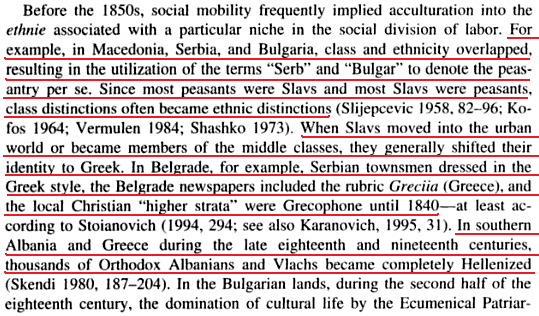
During the Ottoman period, therefore, terms like 'Greek' or 'Bulgarian' were not used to designate different ethnic or national groups, but rather broad socio-cultural categories (Danforth 1995:59)
Mediating the Nation..., by Mirca Madianou, p.30
 
nog48.png


Nationalism,Orthodoxy, and Globalization page 48 by Victor Roudometof.
 
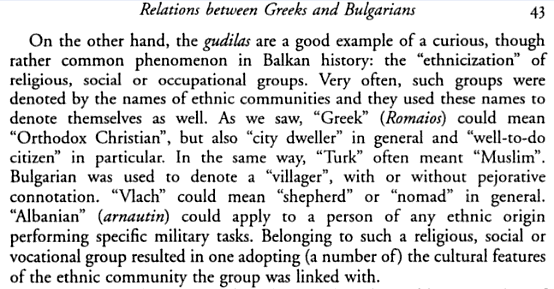
gudila43.png


Greece and the Balkans By Dēmētrēs Tziovas
Macedonians cannot keep up with mythological definitions of ethnicity.
How glorious it would be to have so many mythical reasons for calling yourself a given nationality.

Perhaps the new definition for a Macedonian is "someone who does not have fake excuses for a new ethnicity".
 
gudila43.png


Greece and the Balkans By Dēmētrēs Tziovas

That summed it up quite well, how the various "ethno-religious" labels were used during the Ottoman empire.

The funny thing is, this is coming from an enlightened Greek scholar and not from a Macedonian, which gives this statement even more leverage.
 
Here is another one:

.......the legacy of the Ottoman millet system which divided the empire's population according to religious affiliation, leading to a long-lasting correlation between religion and identity.

Taken from here
 
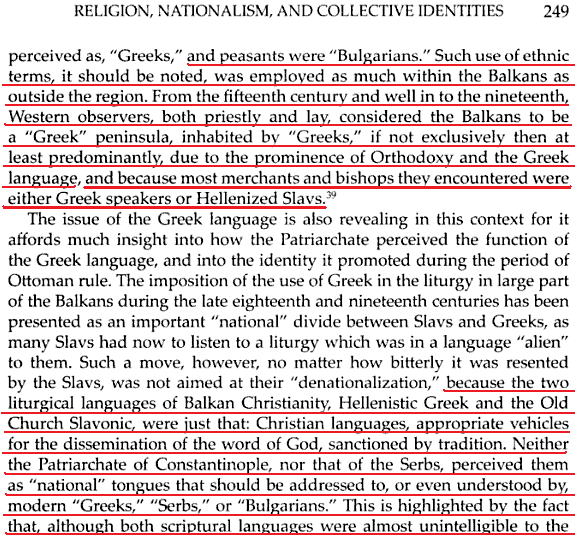
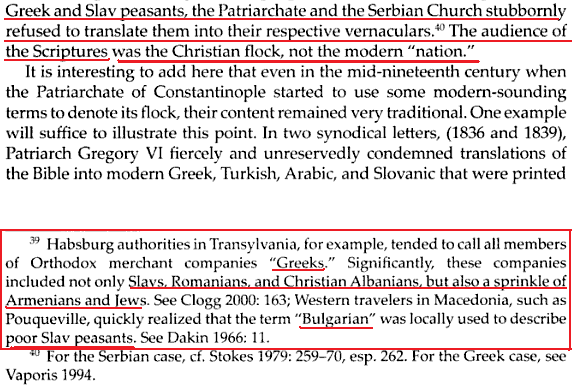
What strikes me is that the interchangeable use of the term 'Bulgar' in particular its use by Greek speakers, or writers as a kind of class of people.

We know that people of Macedonia had been calling themselves Macedonians, for centuries.

I believe that one wedge or schism, in our culture and our history, happened when this "class" was transformed into a Nationality. At that moment, the Bulgarian nationality had been transferred to include all Slavic speaking peasants, even those who had been calling themselves Macedonians.

This is how our national energies, our literature and culture, had been robbed from us - through a simply play of words, wrong classifications backed by modern institutions.
 
livianos249.png

livianos249a.png

Hellenisms: culture, identity, and ethnicity from antiquity to modernity Edited by Katerina Zacharia and written by Dimitris Livianos.

Interesting to note what Livianos thinks about the church situation. I will be posting more of his work soon. Especially about the Baptised Turk Karamanlis who spoke Turkish and did not speak a word of Romaica.
 
That is very interesting read, TM.

Look at this one:

§ 8. Southwards, towards and along the mountains which are called the Alps, are the boundaries of the Baegthware and of the Swaefas already mentioned; and then to the eastwards of the Carendrae country, and beyond the Waste[39], is Pulgara-land or Bulgaria[40]. To the east is Greca-land[41] or Greece; and to the east of the Moroaro or Moravians, is Wisle-land[42]; and to the east of that is Datia, though it formerly belonged to the Gottan[43] or Goths. To the north-east of the Moroara or Moravians, are the Delamensen[44]. East of the Delamensen are the Horithi[45]; and north of the Delamensen are the Surpe[46]; to the west also are the Syssele[47]. To the north of the Horithi is Maegtha-land[48], and north of Maegtha-land is Sermende[49], quite to the Riffin[50], or the Riphean mountains.

-----------------------------------------------------------------------------------------------

§ 10. We shall now speak of Greca-land or Greece, which lies south of the Danube. The Proponditis, or sea called Propontis, is _eastward_ of Constantinople; to the north of that city, an arm of the sea issues from the Euxine, and flows _westwards_; to the _north-west_ the mouths of the Danube empty themselves into the south-east part of the Euxine[64].
To the south and west of these mouths are the Maesi, a Greek nation; to the west are the Traci or Thracians, and to the east the Macedonians. To the south, on the southern arm of the Egean sea, are Athens and Corinth, and to the south-west of Corinth is Achaia, near the Mediterranean. All these countries are inhabited by the Greeks. To the west of Achaia is Dalmatia, along the Mediterranean; and on the north side of that sea, to the north of
Dalmatia, is Bulgaria and Istria. To the south of Istria is the Adriatic, to the west the Alps, and to the north, that desert which is between Carendan[65] and Bulgaria.

Taken from:

A General History and Collection of Voyages
and Travels, Volume I, by Robert Kerr

Kerr, Robert, 1755-1813

Mizians a Greek nation, lol Thracians, Macedonians all Greeks. Bulgarians are Greeks. lol Istra, Dalmatia all are Greeks.

The whole Balkan is Greek :37:

A nationalist of Grk would look at this and embrace it as if it is true and will look for Greeks all over the Balkan.

But, if one looks with help of what you posted, than it is only clear what it means.
 
Here is something interesting, take note of the "Bulgarian" names:

http://en.wikipedia.org/wiki/Bulgarian_Academy_of_Sciences

As Bulgaria was under Ottoman occupation, Bulgarian émigrés founded the Bulgarian Literary Society on 26 September 1869, in Brăila, the Kingdom of Romania. The first Statutes accepted were:

Board of Trustees

Nikolai Tsenov – President
Vasilaki Mihailidi
Petraki Simov
Kostaki Popovich

Stefan Beron
Acting members:

Marin Drinov (1838-1906) – Chairman
Vasil Drumev (1840-1901) – Member
Vasil D. Stoyanov (1839-1910) – Secretary
The following year, the Literary Society began issuing the Periodical Journal, its official publication, and in 1871 elected its first honorary member - Gavril Krastevich.

Were the pre-Exarchate Bulgarians Srbomani? Or Grkomani?

Here is something else:

http://www.makedonika.org/Bojdimi1.htm

В. Друмев пише: “И взехме ние да се учим на гръцки, да говорим по гръцки, да наричаме себе си гърци. И досега има между нас почитани българи, които се гърчеят, които хортуват... на гръцки, които мразят българите”.

Translation: V. Drumev wrote: And we began to learn Greek, to speak in Greek, to call ourselves Greeks. And even till now there are among us respected Bulgarians, that Greekocise, who (?).....in Greek, who hate the Bulgarians.

Tsk, tsk, I guess these 'Hellenes' were missed by Bakoyan and Karaman, somebody alert kathireminioglou......
 
Back
Top