• Welcome to the new Macedonian Truth Forum. All posts, members and private messages have been moved over from the old forum.

    Passwords from the old forum could not be carried over, so please use Forgot your password? to set a new one. The reset link is emailed to the address on your account.

  • Rules and Regulations at the forum of the Macedonian Truth Organisation (MTO)

    (1) The national-ethnic and cultural-linguistic identity of the Macedonian people is historically Macedonian, and derives its character from the native, indigenous and geographic homeland of the Macedonians, which is called Macedonia. To ensure that their human rights, integrity and heritage are appropriately respected, the only nouns and adjectives acceptable when reference is made to the above character and identity markers is Macedon, Macedonia, Macedonian and Macedonians.

    (2) The nation-state of the Macedonian people is the Republic of Macedonia, and is to be referred to by this official title so long as the 'republic' prefix is consistently applied to other states. Alternative references are the Macedonian Republic, or simply, Macedonia.

    (3) The 'ethnic' prefix is only acceptable for Macedonians in cases where differentiation is specifically required - so long as it is in context and consistent where it concerns its application to other ethnic groups.

    (4) Should any other differentiation be specifically required, the names of other ethnic groups that reside with Macedonians in either the Republic of Macedonia or the occupied Macedonian regions in Greece, Bulgaria, Serbia or Albania, are to be given a prefix.

    (5) Negating the identity, language and culture of the Macedonian people by deliberate avoidance of the terms Macedonia, Macedonian and Macedonians, or by any other means, is not permitted.

    (6) Systematic anti-Macedonian propaganda and rhetoric are not permitted.

    (7) Threads irrelevant to the Macedonian Cause, the community at the Macedonian Truth Organisation or the Macedonians in general may be considered as spam or not in the spirit of the forum. In such cases they are not permitted.

    (8) Continual posting of messages in threads with the sole purpose of deviating from the initial topics with the use of unrelated and unnecessary information is not permitted.

    (9) All posts, external articles, reports, etc that are cited in languages other than Macedonian or English, must be accompanied with a translation in one or both of the said languages.

    (10) Despite the possibility of some conversations and debates becoming heated, extreme abuse and/or racism, vulgar language and/or terminology, threats, revelation of personal information about others, harassment, and other such behavior will not be permitted. If deemed necessary all relevant information including member details will be reported to the appropriate authorities for investigation which may result in legal action.

    (11) Threads that are created must have a summary of a topic or excerpt of an article found in pertinent link(s) that have been included. One line threads will be considered unaccetable spam and are therefore not permitted.

    (12) Compulsive and deliberate lies, irrespective of the topic, are not permitted.

    (13) Any symbols or avatars found to be perceived as offensive to Macedonians are not permitted.

    (13) Any explicit or extreme material is not permitted.

    Failure to adhere to the above rules and regulations will result in a ban after 3 breaches. This may be reconsidered in some cases should the circumstances be of an unorthodox nature and/or require special consideration. To assure an effective deterrent against an individual or individuals with the sole purpose of causing dissent through spamming, racism or other improper means, the above rules will be strictly enforced.

    The MTO administration will monitor all discussions as reasonably practical and reserve the right to remove any post and/or member from the forum, and update the rules and regulations as required. Members are encouraged to immediately report any post and/or member to the MTO administration if they feel that these rules have not been abided by.

    The views expressed on this forum are those of the individuals. The only official representation of the MTO is made by the "Macedonian Truth Organisation (Site Owner)" username, and no other.

  • Macedonian Cause

    The Macedonian Truth Organisation calls on God in Heaven to protect, bless and guide the endeavour it is committing to undertake, and that is to work towards:

    Securing Macedonia as a free, independent and democratic republic in which sovereignty lies with the Macedonian citizens; as the nation-state of the Macedonian people in which they can preserve their culture, language and identity; as a state in which the Macedonian language and culture form the basis of public life and act as important unifying elements of Macedonian society; as the home of all its citizens to which it guarantees and obliges their inalienable natural rights and corresponding responsibilities;

    The acknowledgment as self-evident and irrefutable the existence of the:

    1) Indigenous, ethnonational name of Macedonia;
    2) Macedonian people, language and identity;
    3) Macedonian culture, symbols and folklore;
    4) Macedonian ancestry, heritage and history in its entirety; and
    5) Macedonian Orthodox Church;

    Securing recognition by the International Community of the tragedies endured by the Macedonian people, of the division of Macedonia with the signing of the Treaty of Bucharest on August 10, 1913, and the genocide committed against the Macedonian people at the hands of the Greek, Bulgarian and Serbian states and their respective churches during the 19th and 20th centuries;

    Ensuring that the Interim Accord is declared ‘null and void’ and that all constitutional provisions, acts, commitments, agreements, legislation, regulations, policies or programs emanating from, supporting or consequential to the Interim Accord are also declared ‘null and void’, including the use of any symbols and the completion of any acts imposed by, or originating from, the Interim Accord.

    Ensuring that the Framework Agreement is abolished and that all constitutional provisions, acts, commitments, agreements, legislation, regulations, policies and programs emanating from, supporting or consequential to the Framework Agreement are also abolished and replaced by a framework of constitutional and statutory law based on inalienable natural rights and corresponding responsibilities and universally codified human rights mechanisms.

    Securing the abolishment of any existing constitutional provisions, acts, agreements, legislation, regulations, policies and programs that discriminate against the Macedonian people, in any international organisation or any of the countries of the International Community where such constitutional provisions, acts, agreements, legislation, regulations, policies and programs exist, and thereby ensuring the freedom for Macedonians to exercise their inalienable natural rights and fulfil their corresponding responsibilities, and practice their culture, language and religious faiths in all the countries of the International Community without hindrance;

    The empowerment of Macedonians to undertake a moral revolution and to instil and/or reinvigorate within themselves a deep-rooted national, cultural, linguistic and historical dignity and a commitment to the exercise of freedom based on inalienable natural rights and corresponding responsibilities;

    The recognition of the Macedonian minorities in the neighbouring states of Macedonia as well as the respect for the inalienable rights and freedoms of the Macedonian minorities, as provided for by natural law and as codified by the United Nations Charter, the Universal Declaration of Human Rights and other universally codified human rights mechanisms;

    The full and unreserved respect of, and the support for, the rights of all people of non-Macedonian descent living in Macedonia and around the world, who share a reciprocal full and unreserved respect for the Macedonian people, their homeland and their state;

    The cultural unification and solidarity of the Macedonian people living in all parts of historical Macedonia and adjacent territories, as well as Macedonians throughout the world;

    The unity of all Macedonians on the principles, objectives and achievement of the Macedonian cause as defined by this declaration.

Deconstruction of the term Bulgar/B'lgar/Bugar/Voulgar!


I had this on my youtube favorite videos. Watch this Cuman guy from Hungary. He is shooting arrows like his ancestors did 1000 years ago. Its unbelievable archery skill;​
YouTube - Archery Rapid Fire Hun Archery Kassai


YouTube - Kassai Lajos 4th Guinness World record

I've seen this before. Incredible precision, and proof that it can still certainly be done.

So, if bows can be as effective (or close to) as firearms, I wonder why none of the groups involved in the 19th century rebellions and revolutions against the Ottomans used them? There were times where Macedonian leaders weren't able to adequately supply their men with the proper arsenal and firearms, perhaps this could have been a useful weapon instead? Just a thought, mainly in relation to the Ilinden Uprising in Krusevo, I am thinking about hundreds of men (archers) in the forests waiting to assault and intercept the oncoming Ottoman army. Sounds a little Robin Hoodish, lol, but, could it have been effective, should proper strategy, stealth and positioning have been applied? I can't see why not.
 
I've seen this before. Incredible precision, and proof that it can still certainly be done.

So, if bows can be as effective (or close to) as firearms, I wonder why none of the groups involved in the 19th century rebellions and revolutions against the Ottomans used them? There were times where Macedonian leaders weren't able to adequately supply their men with the proper arsenal and firearms, perhaps this couldn't have been a useful weapon instead? Just a thought, mainly in relation to the Ilinden Uprising in Krusevo, I am thinking about hundreds of men (archers) in the forests waiting to assault and intercept the oncoming Ottoman army. Sounds a little Robin Hoodish, lol, but, could it have been effective, should proper strategy, stealth and positioning have been applied? I can't see why not.


This certainly cant be done without years of training. AFAIK, some of these Hungarian(actually the Cumans) archers abandon everything related with modern world. They are riding horse all day long like their ancestors did 1000+ years ago, maybe even practicing shamanism! This precision at archery is the result of all this. So, it cant be done for an ordinary guy with only months of training :) cuz It requires certain dedication.


Also, this was the secret of Ottoman Empire army for 500+ years. Mehter, the military marching band coordinating 1000s of Janissary infantry and horsemen archers. You know, they were practically unbeatable for centuries. The only considerable rival was Hapsburg army.
 
Last edited:
Years of practice could have been arranged, had it been considered as an option. I was thinking only the archery and not the horse riding, nevertheless, even on foot, I think we can both agree that they're very effective. Macedonians had dedication, but in some of our latter battles against the Ottomans we lacked proper foresight and innovation (aside from the other obvious strengths of the Ottomans that comes from being the ruling group in the empire).
 
Years of practice could have been arranged, had it been considered as an option. I was thinking only the archery and not the horse riding, nevertheless, even on foot, I think we can both agree that they're very effective.


Ohhh ok :) I was talking about horseback archery.

I think regular archery should be much easier than horseback style...and yes, probably it could be very effective `till the technological advancements of 1920s.
 
The meaning of the terms "Grecian" and "Bulgarian"

The meaning of the terms "Grecian" and "Bulgarian"

Bulgarian "scientific" methods bring the term "Bulgarian" into generic link not only with the old Bulgarian, but with everything that ever appeared at any time under this name (!?)

For shorter and better review of the use and meaning of the term "Bulgarian" starting from the 10th century and especially during the Turkish domination of the Balkans will consider several referential examples that testify against Bulgarian Nationalist doctrine.

According to the Bulgarian historiography all mentions,and very often wrong, with this name which is for her a fateful moment, that this is them - Bulgarians.

“Bulgarian elite had to invent, elaborate and underpin a myth of common ancestry and made this pedigree putative for the sense of ethnic identification.”
- (Smith, Anthony. "National Identity" published in London 1991, p. 22)

A.Todorov-Balan in his "One Macedonian theory”, book 9-10, Sofia, 1905, 818, states that in the XIX century the Balkan peoples,called the Russian czar -" Bulgarian Tsar "and the Serbian and Russian language - "Bulgarian".

The term "Bulgarian” during the Ottoman rule denoted – a peasant farmer.

While the "Grecian" denoted a person of higher class or merchant.

"During the Ottoman period, therefore, terms like 'Greek' or 'Bulgarian' were not used to designate different ethnic or national groups, but rather broad socio-cultural categories" (Danforth 1995:59)
- (Mirca Madianou , “Mediating the Nation“, p. 30, is Lecturer and Director of Studies in Social and Political Sciences, Lucy Cavendish College, University of Cambridge)

"The term "Bulgarian," which had earlier been used to refer to all the Slavs of the Ottoman Empire (Friedman 1975:84), or as a virtual synonym for "peasant" without any political significance at all came to mean "Bulgarian" in a national sense. "(Wilkinson 1951:149),
- (Loring M. Danforth „The Macedonian Conflict: Ethnic Nationalism in a Transnational World Princeton University Press, 1997, p. 59)

“ For example, in Macedonia, Serbia and Bulgaria, class and ethnicity overlapped, resulting in the utilization of the terms “Serb” and “Bulgar” to denote the peasantry per se. Since most peasants were Slavs and most Slavs were peasants, class distinctions often became ethnic distinctions ( Slijepcevic 1958, 82-96; Kofos 1964; Vermulen 1984; Shashko 1973).
When the Slavs moved into the urban world or became members of the middle classes, they generally shifted their identity to Greek. In Belgrade, for example, Serbian townsmen dressed in the Greek style, the Belgrade newspapers included the rubric Greciia (Greece), and the local Christian “higher strata” were Grecophone until 1840 – according to Stoianovich 1994, 294; and Karanovich 1995, 31.
In Southern Albania and Greece during the late eighteenth and nineteenth centuries, thousands of Orthodox Albanians and Vlachs became completely Hellenized ( Skendi 1980, 187-204)”.
- (Victor Roudometof “Nationalism,Orthodoxy, and Globalization”p. 48)


We are witnesses of the phenomenon of “ethnicization” of the religious, social or occupational groups in Balkans, very often these groups were denoted by the names of ethnic communities and they used these names to denote themselves as well.

The term "Grecian" could mean "an Orthodox Christian," but also "reseller" or generally "well situated" citizen. in the same way, "Turk" most marked "Muslim" and "Bulgarian" was a highlight, "villager", with or without an offensive meaning. "Vlach" and marked "shepherd" or "nomads" in general. "Albanian" (arnautin) could be applied to a man from each ethnic group who performed certain military tasks
The term “Grecian” could mean “Orthodox Christian” but also a “city dweller” or gennerally “well to do citizen”. In the same way,”Turk” often meant “Muslim”, with “Bulgarian” to denote a “villager”, with ot without pejorative connotation. “Vlach” could mean “shepherd” or “nomad” in general.”Albanian” (arnautin) could apply to a person of any ethnic origin performing specific military tasks
- (Dēmētrēs Tziovas , „Greece and the Balkans“ p. 43)


According the references of Prof. Keith Brown, “Turk” implied official persona – functionary, “Grecian” meant – merchant, “Bulgarian” – villager, farmer and “Vlach” – shepherd, rancher.
“When the Macedonian peasants use the term Bulgar, they mean by it: 1) people of a simple and hard-working life, 2) the bulk of simple labourers who speak Slavic, in contrast to the non-Slavs, the Greeks and the Turks, who are above this majority and consider them inferior. The first meaning is the main one: the word “Bulgar” denotes in the first case a simple mode of life, work and thought.”
- (Keith Brown, „The Past in Question, modern Macedonia and the Uncertainties of Nation“, p. 59)

Habsburg authorities in Transylvania, tended to call all members of Orthodox merchant companies “Greeks”, irrespective thet they included not only Slavs, Romanians, and Christian Albanians, but also a sprinkle of Armenians and Jews. Western travelers in Macedonia, quickly realized that the term “Bulgarian” was locally used to describe poor Slav peasants.
- (Katerina Zacharia и Dimitris Livianos „ Hellenisms: culture, identity, and ethnicity from antiquity to modernity“, p. 249)

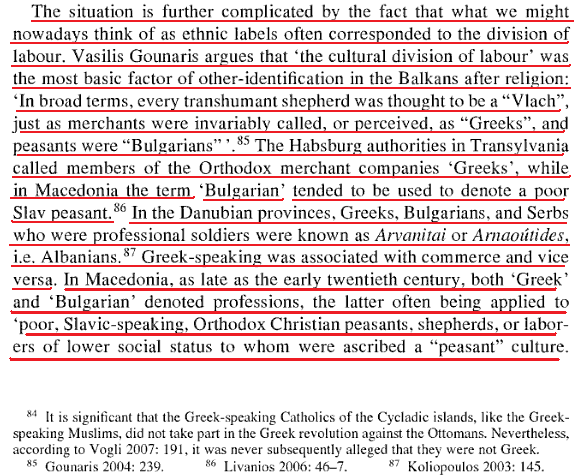
“In Macedonia, as late as the early twentieth century, both “Greeks” and “Bulgarian: denoted professions, the later often being applied to poor, Slavic-speaking, Orthodoc Christian peasants, shepherds, or laborers of lower social status to whom were ascribed a “peasant” culture.”
- ( Peter Mackridge, „Language and National Identity in Greece, 1766 – 1976“)

Trajan Stojanović in his book "Balkan Worlds: The First and Last Europe", p.143 again underlines that the term "Bulgarians" were called the farmers and with "Vlachs" the shepherds.

The Bulgarian member of the Bulgarian Academy of Sciences Vasil Drumev wrote: "And we've began to learn Greek, to speak in Greek, to call ourselves Greeks. And there is still among us respected Bulgarians, who are grecoficating, who speak .. in Greek, who hate the Bulgarians.”

K. Irachek in - "History of Bulgarians”, Sofia, 1929, 385-386, says that the citizens for the simple, uneducated provincials (peasants) always used the name - "Bulgarians" by adding the obligatory – thick headed, prick, stumps and other abusive words.

The Traveler Sir John Mandeville, in1357 travelling throught Balkans wrote that Serbia is land of Bougiers, while Blegrade in that time was known by the name “Alba Graeca” and “Alba Bulgarica”.

Simeon Lehaci in his journey memories wrote that all the people in Bosnia speaks in "Bulgarian", and they were "Greeks" in religion.


“All peasants were Macedonians; shepherds were Vlachs; merchants and bureaucrats were Greeks; and the high administrators were Muslims.”- (“Minorities and mother country imagery” By Gerald L. Gold, Memorial University of Newfoundland. Institute of Social and Economic Research, p. 60.)

Prof. Stilpon Kyriakidis in the “Northern ethnological frontiers of Hellenism ", on p.39:
"While at the time of Simeon did not cease to differ Dragovites from Strumianites and generally Sclavinians from Bulgarians, since Samuel the name of Sclavinias completely disappeared, and all Macedonian Slavs are called Bulgarians by the Byzantines and the country that Samuel ruled, that is western and northern Macedonia is called Bulgaria. In this way, we ourselves gave the name Bulgarian to everyone that speaks Slavic ".

The propaganda consisted of introducing among the common Slavic people the world “Bolgar”, as a synonym for “Slavonic Christian”; As this propaganda was so strong, really the word “Bolgar” became a synonym for “Christian that speak Slavonic” in the 19 Cent., but not and nationality.
When bulgarian peasant used to say "we are Bulgars", he meant "we are Christians", i.e. Orthodox (Periodichesko spisanie (Sofia), LXV (1904), p.818)

Another indisputable proof that the “Bulgarian” at that time meant Slav, and then "Bulgarians" thought of themselves as pure Slavs, the same people with the Serbs and the Macedonians and Illyrians (Croats, Slovenes and Montenegrins) presents "The History of Bulgarian people " by Fr. Spiridon of Gabrovo, which in its short history says:

"Bolgarians came into rule in Thrace, Macedonia, Dalmatia, White Sea and the Rome... Illyrians (Serbs and Croats, my note) are called Bolgarians... and from Bolgarians originated the Serbs, and when Alexander took the whole Ilyrian army to conquer of the world ... since then Bolgarians began to call themselves Macedonians and Slavs "
- (Spyridon Yeroschimonach, History in short of Bolgarian Slav nation 1792, tran. B. Hristova, prof. Raikov B., BAK at NB “Ss.Cyril and Methodius ", and" GAL-ICO, Sofia, 1992)

Jordan Hadzhikonstantinov - Dzinot, tells that for him the term Bulgarians means Slavs, so in his "Legend of Thessaloniki," published in 1859 says St. Cyril and Methodius, the apostles of all Bulgarians (Slavs), and in Bulgarians includes the Moravians from Great Moravia and Pannonia (Glasnik drustva srpske slovenosti, VIII, p. 146-147)

Krste Petkov Misirkov explains the concept “Bulgarian”: "The Greeks also did not differ the Slavic nations and all Slavs ... called with the despised name "Bulgarians"
... The Greeks used the name Bulgarian to incarnate in him their contempt for everything Slavic. .. With the name Bulgarians, we Macedonians were christen by the Greeks,as well. But this re-christening was not the only one... “ (Krste Petkov Misirkov "On Macedonian Matters" Preface, Sofia, Printing House of the Liberal Club, 1903).

For Mr. Gennady, Metropolitan of Veles in 19th century ( born in the village Podkozhene, Podgradec) the concept “Bulgarian” is the same with the term Slavs, and he wrote that the Czechs and Slovakians are Bulgarians: “ of Bohemia and Moravia they are all Slavs, pure Bulgarians, our brothers” (Source: Simeon Radev “ Early memories”, titled “Meeting of four Bulgarian bishops” new, revised and expanded edition, edited by Trajan Radev, publishing house “Strelec”, Sofia, 1994)

Macedonian teacher Nikola Pop-Philipov, says that "Bulgarian" language is a general Balkan language (newspaper "Macedonia" Constantinople, April 6, 1868), referring to the Slavic language.

Grigor Prlicev writes in his autobiography: “... the Bulgarian alphabet only to three was known and was called Serbian..” (Grigor Prlicev, Autobigraphy). For him and the Serbians were Bulgarians i.e. Slavs; at that time, only Serbs had reformed and codified Slavic alphabet, and because of it Prlicev says that the Bulgarian (Slavonic) alphabet was called Serbian.

The famous Macedonian textbook writer Dimitar Macedonian sees its people as ancient Macedonians, and in one of his article writes that the ancient Macedonians are not swallowed by the earth, but are pure Slavs: "... Macedonians are not Vlachs or some other nation, but pure Bulgarians (thinking of Slavs) ... therefore you’ll learn that the Macedonians are not lost from the face of the earth, as some allow to say, because, as far as we know, they did not done anything so bad, what should open the earth to swallow them. "(see Makedonia of 16/02/1871).

In its “Brief holy history for the schools in Macedonia (in Macedonian dialect) printed in “ The printing of Macedonia”, Constantinople in 1867, writes:
Q.[Question] Who are those Bulgarians(Slavs), who were baptized in the early first century after Christ’s birth?
A.[Answer] They are Bulgarians who live in Macedonia
Q. From whom are they baptized?
A. The Apostle Paul, who first preached at Philippi and Thessaloniki

It becomes obvious that under the umbrella of the term "Bulgarians" also enter the ancient Macedonians, who were first baptized by the Apostle Paul, whole 5 centuries before the ethnic name "Bulgarians" to appear on the Balkans at all and generally European geographic regions.

Next reference is the book of Mark Mazower “Salonica City of Ghosts” p.249, who writes about the visit of Sir Henry Layards of Thessaloniki, and here’s what he means under these terms:
To be a “Greek” meant to be a “Orthodox Christian” while under the term “Bulgarian” was held to be one of reproach and contempt.

Not last confirmation, but sufficient for completion of this reference overview of the meaning of these terms, according to the book of Nace Dimov “Historical line of Macedonia and Macedonian Slavs” Chapter first p.13-15, from 1913:

”Therefore, in Macedonia there was such a position that the same Macedonian nation was called Grecian, Serbian and Bulgarian, just because one recognizes the Greek patriarch and pray in Greek churches, and another goes into a Slavic church. In each the same towns and villages the priests that receive a salary of Bulgarian Exarchate call themselves Bulgarians, those receiving the salary from the Serbian Diocese called themselves Serb and Macedonian Slav population that goes into one or another school or church calling itself Grecian, Serb or Bulgarian

From all that I expressed I can say that the Macedonians have a hundred percent right to autonomy and not be subjected to fragmentation among Greeks, Serbs and Bulgarians. Regardless of that the Serbian, Greek and Bulgarian government, for extending their boundaries on Macedonian territory, without saving money and exterminating the Macedonians who do not want to call themselves Greek, Serb and Bulgarian and those who do not know how to speak Serbian and Greek.”


http://macedonianspark.com/mk/istorijaideologija/opropaganda/437-2010-10-31-20-28-55

 
Charles King - The Black Sea, A History,
Oxford University Press Inc., New York, 1994, pg. 214


“...The Lausanne treaty has been written as if distinguishing between "Greeks" (the term for Orthodox Christians) and Muslims was an easy thing—as if both communities should have felt some affinity for Greece and the new Turkish Republic as their natural homelands. But in a many communities, the lines were indistinct. A person of Orthodox religious affiliation—the only criterion, according to the treaty, for being "Greek" —might speak only Turkish or a variety of Greek unintelligible to a Greek-speaker from the Aegean. A Muslim from Greece likewise might be most comfortable in Greek or a Balkan Slavic language, not Turkish.

Nevertheless, communities were marked for wholesale removal based on their presumed ethnic traits. Disputes over whether a person or a family was, in fact, "exchangeable"—subject to a compulsory deportation—were adjudicated by a special intergovernmental committee established under Lausanne.

By the middle of the 1920s, Trabzon, Samsun and Sinop had been virtually emptied of Christians. Even the Greek-speaking communities of the Pontic uplands, the Matzouka region where the last remnants of Byzantium had lingered on in monasteries and villages for centuries, came to an end.

People who still called themselves Romans—Romaioi or Rumlar—suddenly became "Hellenes", just as people who had once been simply Muslim now became "Turks".
And both found themselves in new, national homelands to which they had never owed allegiance.


It was "a thoroughly bad and vicious solution," declared Lord Curzon, one of the framers of the Lausanne treaty, "for which the world would pay a heavy penalty a hundred years to come." …’’


That one i found some time ago here in the MT Forum:

petemack.png


petemack56a.png
 
Last edited:
"The archaeologist from Republic of Macedonia Ivan Mikulčić revealed the presence not only of the Kuber group, but an entire Bulgar archaeological culture throughout Macedonia and eastern Albania [7].
He describes the traces of Bulgars in this region, which consist of typical fortresses, burials, various products of metallurgy and pottery (including treasure with supposed Bulgar origin or ownership), lead seals, minted from Kuber, amulets, etc.
However, part of this could actually represent traces of Avar presence. They are known to have raided as far south as Macedonia, and the material culture of the Avars was very similar to the Bulgars.[2]"

look up Kuber in Wikipedia for reference 2 and 7

There is a good possibility of having had bulgars in macedonia, unless you are 100% sure you had only avars to rule out the bulgars...
 
Last edited:
Yes, the events are usually written in exaggerated way in medieval times but it doesn't mean that these events didn't happen at all.

Also Vlad the impaler was really impaling people. It`s a fact. He mostly impaled Turks, probably 100s or maybe 1000s but he was mad and i think he also impaled his own family members and his fellow people if i`m not mistaken. Then the Sultan in Istanbul gone mad because of this and he sent an army of 10.000+ soldiers to kill him and give it an end to his reign and thats how he died and his head has been taken to the Istanbul as a proof of his death.

I agree Onur, I said the same thing.
 
Quotes from Soldier of Macedon:

Quote: "The origin and core of Samuel's domains were in Macedonia, his capital was there, his church too, and therefore the majority of his citizens. It was a Macedonian state that expanded and assumed the name of its predecessor in the region, similar to East Rome and the Holy Roman Empire assuming the name of the Romans themselves, after the original Roman Empire disappeared."

However nowadays noone claims the existance of a Roman or Holy Roman state with the same borders. Which of his contemporary sourses call his kingdom Macedonia?

"All of geographical Macedonia (as defined in the 19th century) is claimed because it is historically Macedonian; that is not a denial of the existence of other peoples in Macedonia, for example, I have no issue with a Greek minority along the coast, a Vlach minority in the south, etc, but Macedonia should have been united as one entity, and its people should have been able to interact with each other in this compact geographical unit, as they have done, for centuries prior. To suggest that Macedonia has underwent population movements, and disregard the same possibility for the regions surrounding (including Bulgaria), is rather silly and ill-informed."

So does modern collective macedonia (in all three countries) represent the borders of Samuil's Macedonia? I don't think there were any particular permanent borders in those days. Why did the land within those exact boundries was decided to be called Macedonia in 19th century and not some additional territories for instance?

When you say: "The origin and core of Samuel's domains were in Macedonia, his capital was there, his church too, and therefore the majority of his citizens." do you mean Macedonia as defined by the boundries that were assigned in 19th century?
The boundries of Samuil's kingdom were changing all the time, yet you claim the territory asigned in 19th century?

My question:"Genetically are macedonians different from the bulgarians and the serbs? "
Answer: "If that's the case, why not have the Bulgarians call themselves Macedonians also, and drop the Turkic label?"
My question: Well, is this the case?
 
Last edited:
My question: "Are there any genetic or cultural studies that show that some of us are related to Alexander while others aren't? Either culturally, linguistically or genetically?"

S of M answer: "I can tell you for a fact that the Macedonians of today have more cultural, linguistic and genetical similarities with the ancient Macedonians than they do with Bulgars from the Volga and further east from where they originated. So do today's Bulgarians for that matter, despite the fantasies about Khan Asparuh".

I agree with you, people in the republic of Macedonia and those in Bulgaria have as much to do with the bolgars from Volga as each other. As you can see from the genetic study that I posted a link to, modern bulgarian and macedonians exhibit clasic south easter mediteranian and iranian genetic profile, completely different from that of the turkic chuvashi people who live where Volga Bulgaria used to be.

However when you say: "I can tell you for a fact that the Macedonians of today have more cultural, linguistic and genetical similarities with the ancient Macedonians than they do with Bulgars from the Volga" you leave my question unanswered

Are there any genetic or cultural studies that show that some of us are more similar to the ancient macedonians than others? Either culturally, linguistically or genetically? By "us" I mean slavic people on the balkans.
 
Last edited:
I think discussions are good, but I looked some posts in other forums and guess what.. topics like this go for years and years. This is going nowhere guys.. I think that the actual professional historians need to sit down and work it out. I known that everyone has different feelings based on where they are born. I have to say Greece has had the most military and political success in the last 100 years and has probably comitted a fantastic number of crimes agains the human rights of the slavs on its territory. Bulgaria has driven out 300 000 turks, Serbia has mass graves of albanians. What's a 100 in comparison with 1000s of years of history of the balkans? I think we should all preserve our traditions and drink rakia together and discuss other topics. I'm already over this endless discussion...

I am happy to be called bulgarian as this is my ethnos and it has survived a long time under that name, even though the word originates from genetically and culturally different people. Still those people made possible the existance of a state with one religion and one alphabet, which was a great achievment for its time. The bulgars took up slav names and language. The mixture of peoples has remained and fused into one modern bulgarian nation. I'm happy with that at this point. The macedonian truth is out there, I have a feeling it has to do a lot with the bulgarian and a tiny bit with the bulgar history.

I guess many of us are idealists...

All the best.
 
Voltron said:
It comes down to what each ethnicity thinks of themselves and nothing more than that. Sometimes they conflict, like we have with Macedonians today.
It involves much more than what one 'thinks', your assertion is ridiculous, and completely unsupported by reality. Let me know how well an African or Korean would fare in Athens while telling everybody they are 'Hellenes' because they 'think' they are. The Macedonian identity reaffirmed itself through the natural development of a grass-roots movement, it wasn't an identity that was imposed or 'taught' to the inhabitants, like some others in the Balkans.
DimitarP said:
Does it say in a source of his time that he was a king of the ethnic macedons or macedonians?
I would perhaps have used some different words in my response, but I can certainly understand TM's frustration with such questions. I will give you a medal if you can find any reference prior to the 19th century that talks about "ethnic" Bulgars or "ethnic" Bulgarians. Seriously, a stupid question, and you have managed to derail the specific point in this thread, which was to dispute the apparent blinding of 15,000 men. There are other threads to discuss the validity of your own ethnicity, find them, and raise your concerns there.
.......why is he calling him king of the wrong people? why didn't he or someone else call Samuel king of the macedonians?
Dimitar, your confusion between politicial and ethnic terms is something you need to address rather urgently if you are to continue looking into the history of the Balkans.
However, part of this could actually represent traces of Avar presence. They are known to have raided as far south as Macedonia, and the material culture of the Avars was very similar to the Bulgars.
They were Avars, similar finds have probably been unearthed in Greece and elsewhere. Bulgars didn't reach much further south than Moesia, and any of them that did reach Macedonia were insignificant specs that are irrelevant in an 'ethnic' sense. Can you find me a source that specifically talks about a Bulgar settlement in Macedonia?
However nowadays noone claims the existance of a Roman or Holy Roman state with the same borders.
I am not sure what you're trying to say here.
Which of his contemporary sourses call his kingdom Macedonia?
I am not aware of any, but a valid explanation has already been given as to why this was so. Do we need to go back to square one?
So does modern collective macedonia (in all three countries) represent the borders of Samuil's Macedonia?
No, they don't.
Why did the land within those exact boundries was decided to be called Macedonia in 19th century and not some additional territories for instance?
The general region has been identified as Macedonia more or less continuously from ancient times, nobody conjured the term in the 19th century. The reason why its boundaries were defined (and hence confined) in the 19th century has more to do with politics rather than history and ethnic heritage. If Macedonia was the first country in the Balkans to obtain liberty from the Ottomans, the picture would be markedly different. Bulgaria and Greece should count themselves lucky in that regard.
When you say: "The origin and core of Samuel's domains were in Macedonia, his capital was there, his church too, and therefore the majority of his citizens." do you mean Macedonia as defined by the boundries that were assigned in 19th century?
I mean a territory that is mostly located within today's Macedonian republic and geographical Macedonia as defined in the 19th century.
My question:"Genetically are macedonians different from the bulgarians and the serbs? "
Answer: "If that's the case, why not have the Bulgarians call themselves Macedonians also, and drop the Turkic label?"
My question: Well, is this the case?
I have already remarked that many people in the Balkans are genetically related to the ancient populations that lived there, and hence, each other. What is your point? That we should use a collective Turkic name (Bulgar) because of this commonality? I would rather use a native, indigenous and Indo-European name, thanks anyway.
Are there any genetic or cultural studies that show that some of us are more similar to the ancient macedonians than others?
The ancient Macedonians are grouped together with other Paleo-Balkan peoples where it concerns genetic studies. Trying to pin-point if an individual today has a connection specifically to ancient Macedonians (as opposed to the gene pool that made up the DNA of ancient Macedonians, Thracians and Illyrians) would be difficult, if not impossible.
Either culturally, linguistically or genetically? By "us" I mean slavic people on the balkans.
I am sure there are plenty of studies done with regard to this topic, probably more by eastern European writers (including Bulgarians, have you bothered to search?) as opposed to those from the west. Linguistically, there is no doubt that the ancient Macedonian language is closer to today's Slavic languages than the Turkic Bulgar language is, purely on the basis that the first two are Indo-European languages while the latter is not. Due to the lack of adequate research (and I say adequate because the possibility of a connection to Balto-Slavic languages is continually disregarded by the west) the topic of the ancient Macedonian language requires an in-depth understanding and elaboration, and this is not the right thread for it.
I am happy to be called bulgarian as this is my ethnos and it has survived a long time under that name, even though the word originates from genetically and culturally different people. Still those people made possible the existance of a state with one religion and one alphabet, which was a great achievment for its time.
Actually, the original Bulgars had little to do with the existence of uniformity where it concerns religion and literature. This was an achievement of Macedonian students that were returning from Moravia, and of their cooperation with Boris, who was a Bulgar in name only, and certainly more inclined towards the Slavic (and/or Thracian) elements in his kingdom/empire.
The bulgars took up slav names and language. The mixture of peoples has remained and fused into one modern bulgarian nation. I'm happy with that at this point. The macedonian truth is out there, I have a feeling it has to do a lot with the bulgarian and a tiny bit with the bulgar history.
The Macedonian Truth is here, and Macedonian history has little to do with the Turkic Bulgars or Slavic Bulgarians of Moesia.
 
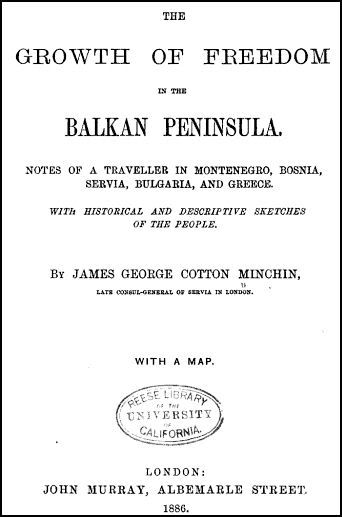
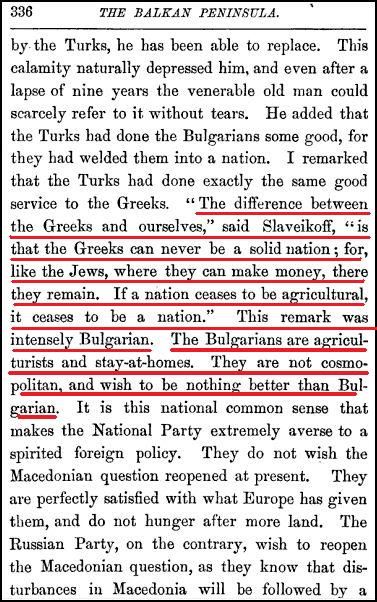
Minchin.jpg

Minchin336.jpg


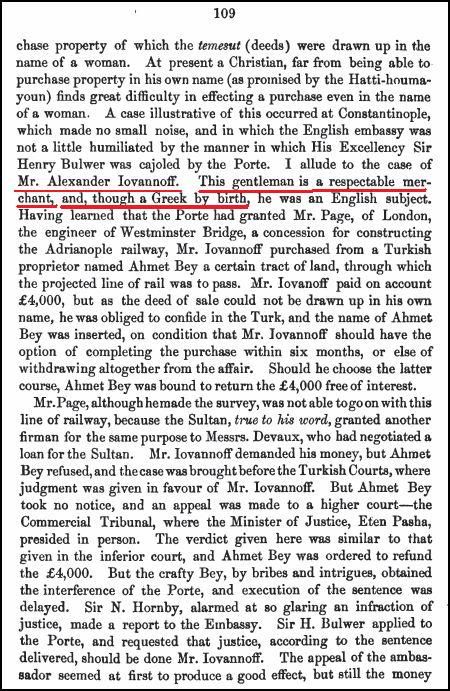
Yes a "Bulgarian" was a home-body, agriculturist, a tiller of the soil. A "Greek" was cosmopolitan, merchant, a city-dweller.

It's interesting how these terms went from one of social meaning to one of ethnicity in a matter of decades within the 19th century.
 
“...Кога Македонецот говори за себе "Јас сум Грк" -- тоа воопшто не значи дека тој и припаѓа на грчката националност. Девет десетини од оние што сде нарекуваат Грци не знаат и не разбираат ни еден збор грчки. "Грк" во Македонија значи или минувач на православната црква, патријаршист, или -- во селската навика "граѓанин", "човек од градот". Остаток од сосем дамнешни времиња, кога европскиот и азискиот евет се делел на две половини -- грубо варварско селанчиште, што лежи покорено под меч и потем -- и цивилизацијата и градската грчка сила, што ги победи селските варвари и го распространи меѓу нив светот на своите институции, науки и уметности.

Како балканските Словени го злоупотребуваат зборот "Грк" во ова последно значење, ни раскажа бугарскиот научник Орфејков, притоа без секаква задна мисла, просто како куриозитетна шега за "глупоста на селанчиштата". Патувајќи по Русија, попаднал на едно од бугарските села во Бесарабија. Гледа: селаните го држат цврсто за обичај донесен отаде дунавската татковина, јазикот го паметат одлично, со еден збор -- оберачки се држат за својата националност и преданија. Ги прашува:

- Па имате ли свештеник и учител?
- Се разбира! Добри луѓе, бог да им даде здравје.
- Ваши се, едноселци?
- Не, порано беа наши, но откако изумреа, ни пратија Грци.

Ова објаснување, се разбира го удрило бугарскиот научник, фанатик-националист, како нож во срце: како? - грчко духовенство во бугарско село?! Оди кај свештеникот. Се покажува дека тој е Бугарин. Научникот е во недоумица.

- Братче -- моли тој -- од какво потекло сте вие.
- Се разбира, Бугарин.
- Зошто парохијаните ве викаат Грк?
- А, затоа -- се смее попот -- дека сум родум од Кишињев и учев во Кишињев. Според нив, Бугаринот е селанец што живее и ора земја. А во градовите живеат Грци. Па и јас, иако сум Бугарин, градски жител, би требало според нив да сум - Грк.

Недоразбирања од слична природа имало и со зборот "Србин". Гилфердинг сведочи дека "Србин" во старата балканска навика значи "православен" народ. - Ја се чудим, му говореле на Гилфердинг Помаците - је се чудим, да е ваш цар помого Немцу на Маѓара: ваш цар е Србин, а немац е шокац (католик) ... истражувачите србофили, како [Спиридон] Гопчевиќ, со сесрдност ги внесувале во своите списоци сите како Срби, кој се нарекувал себе си Србин само во смисол на својата припадност кон српската, т.е. православната вера.

Сосем неодамна, преку лажна и чудно нападна по своите претензии, статистика, Грците користејќи се со такви недоразбирања во народната фразеологија, што се вели и ги замаглува олите на Европа, претставувајќи го сето македонско население како елинско (до осум милиони луѓе), оставајќи на други национални елементи сосем ништожен процентуален дел. ...’’

Извор: А. В. Амфитеатаров, "Во Македонската осаменост (1901)", превземено од Цветан Станоевски, "Како ја видоа Македонија", (Руски публикации за Македонија 1828-1913), Македонска книга, Скопје 1978 година, стр. 177-178.
 
No probs TM, the notion that terms such as Bulgar were applied by East Romans to the peasant masses in Thrace and much of the Balkans is strengthened by the above, although I would still like to know who and when reference was made to 'Bulgars' in the Balkans for the first time.
Just bringing this up from the past because we still haven't determined when the people were first recorded as 'Bulgars'. Contemporary and later authors appear to have referred to them as Huns, Avars and/or Scythians. The name Bulgaria obviously first appears in the Balkans after the establishment of their kingdom in Moesia. But is that how it was first recorded in Middle Latin and Greek, was it adopted from the Bulgars as a native Turkic name, or did the Bulgars themselves (or those that came to be known as such) adopt it?
 
Eastern Romans knew Bulgars and mentioned about them much earlier than their migration to Danube.

Due to civil war inside Gokturk empire, few tribes broke up with Asena clan (rulers of Gokturk empire) and formed their own kingdoms inside the empire. Avar tribe formed theirs in the north of Blacksea, then expanded in to the Pannonia. Bulgars under the leadership of Kubrat formed his kingdom around Volga river. Khazar tribe formed theirs, right at the north of Bulgar one. Khan Kubrat`s Volga Bulgar kingdom short lived because Khazar tribe forced them to be subjugated inside Khazar kingdom. In the end, Kubrat`s heirs and their armies expelled out from Volga region and the youngest son of Kubrat, Asparuh migrated to the danube.

All these events has been recorded by eastern Romans and the existence of the Bulgar tribe recorded by them after the reign of Kubrat in early 7th century. Kubrat`s grave has been founded in today`s Ukraine and it was full of gifts given by the eastern Roman emperor, golden cups and other golden materials. Brief story of Bulgars and Kubrat are also recorded by the Gokturk rulers, on the Orkhon monuments after Kubrat`s death. He is recorded as Kurt Kubrat, meaning "wolf" in Turkish.

So, the very first Bulgars in danube, leaded by Asparuh knew that they were Bulgars and eastern Romans also knew how and why they came there and who they were. Later authors probably writes about them as Huns, Scythians just to indicate their origin because they were part of the Huns and formerly Scythians.
 
Last edited:
Onur, can you name any eastern Romans who referred to them as Bulgars during the 7th century AD and prior?
I have "the chronicle of Theophanes Confessor" written in 780-818 AD by Theophanes himself. It includes major events from 214-818 AD but he says that he used earlier Roman chronicles to write the events of the past. Most of these earlier chronicles are lost (says so on the preface) but i think i saw one chronicle from 7th century which mentions of Bulgars, dont remember atm.

Like i said, Bulgars are getting mentioned in eastern Roman chronicles since Khan Kubrat gained their independence from Gokturk empire in 632 AD (checked wiki for the date). Eastern Romans was quite interested with the events related with Turkic people, Gokturk empire, Khazars, Bulgars, Avars etc. because they were either good allies or major rivals to them.


Here is Theophanes about the Bulgars. He writes their history when he was talking about Asparuh`s migration to the Danube in 678 AD;
clipboard011y.jpg
 
Onur said:
I have "the chronicle of Theophanes Confessor" written in 780-818 AD by Theophanes himself.
I have seen his chronicle. He writes about events relating to the Bulgars 100 years before his time. If you come across any contemporary sources, let me know.
 
Back
Top