• Welcome to the new Macedonian Truth Forum. All posts, members and private messages have been moved over from the old forum.

    Passwords from the old forum could not be carried over, so please use Forgot your password? to set a new one. The reset link is emailed to the address on your account.

  • Rules and Regulations at the forum of the Macedonian Truth Organisation (MTO)

    (1) The national-ethnic and cultural-linguistic identity of the Macedonian people is historically Macedonian, and derives its character from the native, indigenous and geographic homeland of the Macedonians, which is called Macedonia. To ensure that their human rights, integrity and heritage are appropriately respected, the only nouns and adjectives acceptable when reference is made to the above character and identity markers is Macedon, Macedonia, Macedonian and Macedonians.

    (2) The nation-state of the Macedonian people is the Republic of Macedonia, and is to be referred to by this official title so long as the 'republic' prefix is consistently applied to other states. Alternative references are the Macedonian Republic, or simply, Macedonia.

    (3) The 'ethnic' prefix is only acceptable for Macedonians in cases where differentiation is specifically required - so long as it is in context and consistent where it concerns its application to other ethnic groups.

    (4) Should any other differentiation be specifically required, the names of other ethnic groups that reside with Macedonians in either the Republic of Macedonia or the occupied Macedonian regions in Greece, Bulgaria, Serbia or Albania, are to be given a prefix.

    (5) Negating the identity, language and culture of the Macedonian people by deliberate avoidance of the terms Macedonia, Macedonian and Macedonians, or by any other means, is not permitted.

    (6) Systematic anti-Macedonian propaganda and rhetoric are not permitted.

    (7) Threads irrelevant to the Macedonian Cause, the community at the Macedonian Truth Organisation or the Macedonians in general may be considered as spam or not in the spirit of the forum. In such cases they are not permitted.

    (8) Continual posting of messages in threads with the sole purpose of deviating from the initial topics with the use of unrelated and unnecessary information is not permitted.

    (9) All posts, external articles, reports, etc that are cited in languages other than Macedonian or English, must be accompanied with a translation in one or both of the said languages.

    (10) Despite the possibility of some conversations and debates becoming heated, extreme abuse and/or racism, vulgar language and/or terminology, threats, revelation of personal information about others, harassment, and other such behavior will not be permitted. If deemed necessary all relevant information including member details will be reported to the appropriate authorities for investigation which may result in legal action.

    (11) Threads that are created must have a summary of a topic or excerpt of an article found in pertinent link(s) that have been included. One line threads will be considered unaccetable spam and are therefore not permitted.

    (12) Compulsive and deliberate lies, irrespective of the topic, are not permitted.

    (13) Any symbols or avatars found to be perceived as offensive to Macedonians are not permitted.

    (13) Any explicit or extreme material is not permitted.

    Failure to adhere to the above rules and regulations will result in a ban after 3 breaches. This may be reconsidered in some cases should the circumstances be of an unorthodox nature and/or require special consideration. To assure an effective deterrent against an individual or individuals with the sole purpose of causing dissent through spamming, racism or other improper means, the above rules will be strictly enforced.

    The MTO administration will monitor all discussions as reasonably practical and reserve the right to remove any post and/or member from the forum, and update the rules and regulations as required. Members are encouraged to immediately report any post and/or member to the MTO administration if they feel that these rules have not been abided by.

    The views expressed on this forum are those of the individuals. The only official representation of the MTO is made by the "Macedonian Truth Organisation (Site Owner)" username, and no other.

  • Macedonian Cause

    The Macedonian Truth Organisation calls on God in Heaven to protect, bless and guide the endeavour it is committing to undertake, and that is to work towards:

    Securing Macedonia as a free, independent and democratic republic in which sovereignty lies with the Macedonian citizens; as the nation-state of the Macedonian people in which they can preserve their culture, language and identity; as a state in which the Macedonian language and culture form the basis of public life and act as important unifying elements of Macedonian society; as the home of all its citizens to which it guarantees and obliges their inalienable natural rights and corresponding responsibilities;

    The acknowledgment as self-evident and irrefutable the existence of the:

    1) Indigenous, ethnonational name of Macedonia;
    2) Macedonian people, language and identity;
    3) Macedonian culture, symbols and folklore;
    4) Macedonian ancestry, heritage and history in its entirety; and
    5) Macedonian Orthodox Church;

    Securing recognition by the International Community of the tragedies endured by the Macedonian people, of the division of Macedonia with the signing of the Treaty of Bucharest on August 10, 1913, and the genocide committed against the Macedonian people at the hands of the Greek, Bulgarian and Serbian states and their respective churches during the 19th and 20th centuries;

    Ensuring that the Interim Accord is declared ‘null and void’ and that all constitutional provisions, acts, commitments, agreements, legislation, regulations, policies or programs emanating from, supporting or consequential to the Interim Accord are also declared ‘null and void’, including the use of any symbols and the completion of any acts imposed by, or originating from, the Interim Accord.

    Ensuring that the Framework Agreement is abolished and that all constitutional provisions, acts, commitments, agreements, legislation, regulations, policies and programs emanating from, supporting or consequential to the Framework Agreement are also abolished and replaced by a framework of constitutional and statutory law based on inalienable natural rights and corresponding responsibilities and universally codified human rights mechanisms.

    Securing the abolishment of any existing constitutional provisions, acts, agreements, legislation, regulations, policies and programs that discriminate against the Macedonian people, in any international organisation or any of the countries of the International Community where such constitutional provisions, acts, agreements, legislation, regulations, policies and programs exist, and thereby ensuring the freedom for Macedonians to exercise their inalienable natural rights and fulfil their corresponding responsibilities, and practice their culture, language and religious faiths in all the countries of the International Community without hindrance;

    The empowerment of Macedonians to undertake a moral revolution and to instil and/or reinvigorate within themselves a deep-rooted national, cultural, linguistic and historical dignity and a commitment to the exercise of freedom based on inalienable natural rights and corresponding responsibilities;

    The recognition of the Macedonian minorities in the neighbouring states of Macedonia as well as the respect for the inalienable rights and freedoms of the Macedonian minorities, as provided for by natural law and as codified by the United Nations Charter, the Universal Declaration of Human Rights and other universally codified human rights mechanisms;

    The full and unreserved respect of, and the support for, the rights of all people of non-Macedonian descent living in Macedonia and around the world, who share a reciprocal full and unreserved respect for the Macedonian people, their homeland and their state;

    The cultural unification and solidarity of the Macedonian people living in all parts of historical Macedonia and adjacent territories, as well as Macedonians throughout the world;

    The unity of all Macedonians on the principles, objectives and achievement of the Macedonian cause as defined by this declaration.

Tsar Samoil and the Archbishopric of Ohrid in Macedonia

I read the forum rules Julie. I dont intend on breaking any.
For your own sake, I suggest you leave your hate behind you. It will only make you that much more miserable as a person.

On the contrary, I am a very happy person. Happy people don't like liars, and don't take well when read the lies that Macedonians were not forced into speaking Greek, and the dribble on names by you. I suggest if you don't know what people have endured,and if you want to know the truth, ask, for your own sake, of course.
 
Voltron let me add my input as my father is from that villiage and lived on the island. Before the civil war my grandfather would trade freely with the neighboring villiages in that region and there was no greek, this new stuff built there is from greece and on the island there was only 3 houses left standing as the entire villiage was evacuated. Seeing from the pictures new houses were built probaly over my familys houses and grave stones. My grandmothers brother was still living there in their basement of the house. Sar Samoil was macedonian the greeks have twisted everything, they have made mala prespa into a cash cow for tourism which im happy as its a beutiful place{but not in a way to show our rich culture) That bridge before was not there, they had to take a row boat to and from the island. Must be nice to visit places that have no significance to you greeks, its funny my family was born their and they are denied to this day to come back but only if we proclaim my last name is greek not macedonian.

The houses there were pretty old Makedonetz. I didnt see anything new on that island. Although I wouldnt know where you house would be. I didnt go very far into the village, just went up to a couple houses and came back. They had livestock there and didnt want to disturb the animals and was thinking a guarddog would jump out. The passway was narrow. To row back and forth must been quite a chore. Nonetheless absolutly beautiful. There are Vlach villages in the area, although I dont know how far from the island. I can understand what you mean though, our ancestral home was confiscated through similar events. I dont think they would deny your entry to Greece. You should try.
 
Voltron, your comment the Greek language was not forced I am taking as a personal insult. My mother went to school totally in the Greek language, my grandmother had the shot beaten out of her for speaking Macedonian IN HER HOME where Greek spies under her window heard her speaking to my family. My grandfather was led away to be murdered for SPEAKING Macedonian instead of your disgusting language. I suggest you read this forum, the threads, and the rules. You may feel a lot more at home on one of your Vlach forums. We are free here.

Voltron, I also confirm this -and this comes from a Greek- that people were forced to speak Greek throughout the region. At school and even at home.
 
But the fact is common sense (like blinding so many soldiers is unrealistic) which should be more suitable in regards to accuracy than mere nationalistic interpretations to invent pseudo-history books for the indoctrination of children.

OK TM you may find the number questionable but does that really negate the essence of the story ? Its probably unrealistic for Vlad Tepesh to impale defeated soldiers into a forrest of human beings but does that mean it didnt happen ? I understand your point of view though and why you would consider it false.
 
Voltron the so called slavic hordes went through greece,albania,bulgaria,& turkey to classify just macedonia as slavic is completely unfair.What did happen when these illiterate hordes went through macedonia they adopted the macedonian language & writing & ere assimilated.The slavic hordes did no more damage than other people who went trough macedonia.If we apply the same logic then greece should be called slavic & other countries as well.The slavic smear is actually more widespread when macedonia became part of yugoslavia
& part of the brainwashing that all sides used was to tell the macedonian population that they should take pride in their slavic heritage & renounce their beleif in the ancient macedonian heritage.Even today famous politicians still beleive in the slavic theory that we have no connection with the ancients.They beleive that the macedonians got wiped out in the sixth century when the slavic hordes invaded.This theory & others are flawed as the slavs were assimilated & they adopted the macedonian language as they were illitrate.

Your right George, the Slavs did reach southern Greece. The Byzantines even planted them there. Nothing wrong with Slavic nations George. I dont know why its casted in a negative light here. Heck, half of Euorpe are Slav speakers. Not too bad if you ask me.
 
Voltron, I also confirm this -and this comes from a Greek- that people were forced to speak Greek throughout the region. At school and even at home.

John, thanks for your advise. As SOM suggested I will read up on it in the history section. No offense intended.
 
John, thanks for your advise. As SOM suggested I will read up on it in the history section. No offense intended.

Yes, that's the best idea. One, if he wants to be objective should read and go through thoroughly all aspects of history. E.g. you want to know about Macedonia? Read also the Macedonian side. By all means, read the Greek side, but move on...read the Macedonian, the Bulgarian, and if available some from distant and objective countries. You'll find that the truth is not necessarily what you have been taught in school.
If you are curious about history, do the same for all historical events you're interested in. For sure you will acquire a more holistic approach on viewing things.
 
OK TM you may find the number questionable but does that really negate the essence of the story ? Its probably unrealistic for Vlad Tepesh to impale defeated soldiers into a forrest of human beings but does that mean it didnt happen ? I understand your point of view though and why you would consider it false.

But the essence of the story changes considerably when you see that the so-called "blinding" of all these soldiers never happened the way Skylitzes penned it. The Battle of Kleidon is where Basil II would get the nickname "Bulgar-Slayer" centuries later due to the myth of these East Romans and their exaggerations. Sorry I know you want to play make believe but one day you have to grow up. How about you actually read the first page again and stop taking this topic off-topic because of its content and how it hurts your modern claims to BS:

MarkWhittow.jpg

page 387
MarkWhittow387.jpg

MarkWhittow388.jpg

MarkWhittow388a.jpg


CatherineHolmes.jpg

CatherineHolmes155.jpg

CatherineHolmes155a.jpg


PaulStephenson.jpg

page 2
PaulStephenson2.jpg

PaulStephenson3.jpg

PaulStephenson3a.jpg

PaulStephenson4.jpg

PaulStephenson4a.jpg

PaulStephenson5.jpg

PaulStephenson6.jpg

PaulStephenson7.jpg
 
Last edited:
TM, your making it sound like I get a kick out of this. I dont have a problem with you or Macedonians. Again, I read it all and it seems as if there is a dispute of the numbers and how that is impossible due to the sheer damage 15000 blindings would of been. I read the first page and its says that Skylitzes was confused. But it didnt say how or why he was confused. Can you shed light on this ? Again it was a very interesting read and I have to admit it does make sense. The medevil ages did have its moments of exaggeration and hyperbole. Not to mention that the reference to Bulgar Slayer was made later. I understand that.
 
OK TM you may find the number questionable but does that really negate the essence of the story ? Its probably unrealistic for Vlad Tepesh to impale defeated soldiers into a forrest of human beings but does that mean it didnt happen ? I understand your point of view though and why you would consider it false.

Yes, the events are usually written in exaggerated way in medieval times but it doesn't mean that these events didn't happen at all.

Also Vlad the impaler was really impaling people. It`s a fact. He mostly impaled Turks, probably 100s or maybe 1000s but he was mad and i think he also impaled his own family members and his fellow people if i`m not mistaken. Then the Sultan in Istanbul gone mad because of this and he sent an army of 10.000+ soldiers to kill him and give it an end to his reign and thats how he died and his head has been taken to the Istanbul as a proof of his death.
 
TM, your making it sound like I get a kick out of this. I dont have a problem with you or Macedonians. Again, I read it all and it seems as if there is a dispute of the numbers and how that is impossible due to the sheer damage 15000 blindings would of been. I read the first page and its says that Skylitzes was confused. But it didnt say how or why he was confused. Can you shed light on this ? Again it was a very interesting read and I have to admit it does make sense. The medevil ages did have its moments of exaggeration and hyperbole. Not to mention that the reference to Bulgar Slayer was made later. I understand that.

Stephenson writes in the source provided that Skylitzes uses the word phasi, 'they say', and Stephenson goes on to explain that the story was under scrutiny then considering Skylitzes "the copyist" had no firsthand accounts available about the exaggerations of this battle. The numbers "14,000-15,000" are the exaggeration. Was it a small garrison as Stephenson says? Most likely. Skylitzes more than likely altered an already altered tale and used Herodotus as inspiration and melded sequences of what transpired at Thermopylae for his fictional accounts at Belasica/Kleidon.
 
Good to hear that samuel was macedonian & not bulgarian.A lot of people say from different countries try to missapropriate him ,just because his rule encompassed bulgaria doesn't mean he is bulgarian.Also they'll try & put a slant for one reason or another to say that he is bulgarian.The problem is they try & write our history for us instead of us writing our own history.
 
Here is an older post from a discussion between TM and Bratot, more relevant on this thread given the information concerning the so-called Bitola 'inscription'.

http://www.macedoniantruth.org/forum/showthread.php?t=3006&highlight=olympics&page=4

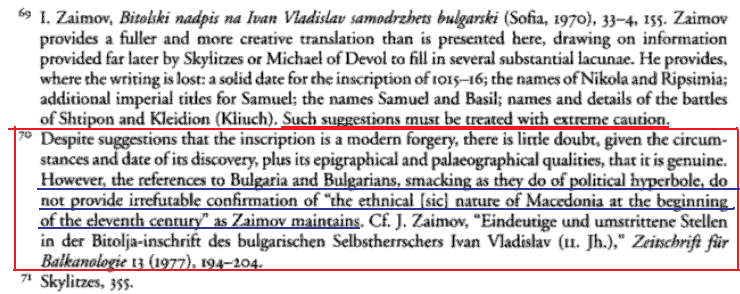
But what about the so-called Bitolski Nadpis? Here's something on it;


stephenson30a.png


I know many people call it a forgery. But what if it's not?(how many objective scholars call it a forgery?) This would be a year or 2 after Samoil's death.

This is logical and explains alot about the term "Bulgar" during this time.


If we accept that assumption than those scholars should explain why the Bulgarian Chan Crume (802-814) have tittled himself 2 times as „De Cruma rege Macedonie“ and „Cruma rex Macedonie“.

On the other hand the other Bulgarian Tzar Ivan Alexandar have tittled himself as: Sanctus Johannes Alexander Macedo (Macedonian S.A.), meaning Ivan Alexander the Macedonian.

The both of them were not even close to being Macedonians, but should we make claims on them using the Bulgarian propaganda logic?

Prof. Lunt:

"In 1956 a marble block serving as part of the threshold of a sixteenth-century mosque in Bitola was discovered to contain a badly worn Slavonic inscription. The text clearly must have spilled over to a lost block on the left, and to one or more blocks at the top. Yet the twelve preserved lines refer to ”John, autocrat of the bulgars„ and, later, ”son of Aron.„

The historian and paleographer Vladimir Moshin published the text (in Makedonski jazik, 1966), with a bold series of conjectures and emendations arguing that the inscription included reference to Samuel's defeat in 1014 and had been set up by Ivan Vladislav, Samuel's nephew (ruled 1015-1018). The Zaimovs confidently ”restore„ most of the text, including dates, and proceed to take their wish thoughts as incontrovertible proof of a number of historical events otherwise unknown.

Unfortunately there is no even remotely reliable set of criteria for dating early South Slavic Cyrillic, and epigraphic material is sparse and extremely controversial. I must respectfully disagree with Moshin's estimate that this text fits in the early eleventh century. Zaimov's paleographic and linguistic arguments are inaccurate and naive.

One basic point: Moshin clearly records the fact that the date he confidently reconstructs as 6522 (1014) has been worn away (”datata e izlizhana„; p.39 in Slovenska pismenost, ed P.Ilievski, Ohrid, 1966).
Indeed it does not show up in any published photographs (note that Zaimov's plate 2 has been doctored in an unspecified manner, and plate 3 is frankly drawing), nor is it found in a latex mold made by Professor Ihor Sevchenko of Dumbarton Oaks.
Assuming that this spot does contain a date, one can grant the 6 and the final 2, and a vertical line with a partial crosspiece that could be F(500) but looks much more like ps (700), and is followed by a space wide enough even for M (40). If one then conjectures the numbers as 6742, the date would be 1234. This fits beautifully with the ortography and language, and identifies Ivan as Asen II, who gained power over Macedonia in 1230. Yet it also demolished the inctricate historical explanations elaborated by the Zaimovs and generally diminishes the light that this inscription allegedly throws on an obscure period of Macedonian and Bulgarian history. The crucial questions remains open.

Horace G Lunt
Harvard University

( http://en.wikipedia.org/wiki/Horace_Lunt )

Review-HoraceGLunt-Info.png


Review-HoraceGLunt.png


According to Igor Schevchenko
( http://www.nytimes.com/2010/01/05/world/europe/05sevcenko.html ):

"The little of this numeral can be seen on unretouched photograph might indeed be part of the cyrillic letter f (=500); but, as Horace G Lunt has pointed out, it might be also part of the cyrilic letter ps(=700), in which case the Bitolja inscription would seem to be of the thirteen century." (Slavic and Eastern European Journal, 1977, 21, 1)

R. Mathiesen (emeritus, Brown University http://brown.edu/web/directory/academicsdepts.shtml):

"Lunt informs me that Sevchensko's photogrpaphs exclude the possibility of the numeral being an f (=500), but not being a ps (=700), amd may even exclude the possibility of the numeral being part of date. The date may then have stood at the beggining of line 12." (Slavic and Eastern European Journal, 1977, 21,1)

His conclusion:

"As long as its true age remains in doubt, the evidence of the Bitolja inscription will have to be used with great caution; but this does not lessen the special importance of cyrillic palaegraphy which it will have as the work of two stonecutters--whatever the outcome if and when doubts are ever finally laid to rest." (Slavic and Eastern European Journal, 1977, 21, 1)


So we have three significant figures pointing out on the inacurate date and they have no Macedonian background to have an personal interest in this situation which is not the same for the Bulgarian side.
 
The lists are from wikipedia so not sure of their complete accuracy.

Bishoprics (diocese) under the jurisdiction of the Archbishopric of Ohrid in Macedonia, mentioned in 1019:

Bishopric of Ochrid
Bishopric of Kostur
Bishopric of Strumica
Bishopric of Pelagonia, seat at Bitola
Bishopric of Velbazhd
Bishopric of Ras, seat at Stari Ras, formed by 878 (as of 1219 part of Serbian Orthodox Church)
Bishopric of Prizren, formed in 10th century (as of 1219 part of Serbian Orthodox Church)
Bishopric of Niš, formed by 343 (as of 1219 part of Serbian Orthodox Church)
Bishopric of Braničevo, formed by 878 (as of 1219 part of Serbian Orthodox Church)
Bishopric of Vidin,
Bishopric of Sredets,
Bishopric of Drastar, including the Theme of Paristrion (Moesia Inferior)
Bishopric of Servia, formed in 5th century (as of 1882 part of Ecumenical Patriarchate)


Bishops and Archbishops of Justiniana Priima and the Archbishopric of Ohrid in Macedonia:

Justiniana Prima Bishops, 535 - 602
Saint Clement of Ohrid, Sveti Kliment Ohridski, 893-916
Philip, Filip, 997
John I of Debar, Jovan I, 1018-1037
Leo, Lav, 1037-1056
Theodulus I, Teodul I, 1056-1065
John II Lampinus, Jovan II Lampinos, 1065-1078
John III, Jovan III, 1078-1079
Theophylact, Teofilakt, 1084 1107
Leo II Mung, Lav Mung, 1108 1120
Michael Maximus, Mihail Maksim, 1120
John IV Komnenos, Jovan IV Komnin, 1143-1160 (resurrected the title of Archbishop of Justiniana Prima in 1143)
Constantine I, Konstantin I, 1160
Јоhn V Kamateros, Јovan V Kamatir, 1183-1216
Demetrios Chomatianos, Dimitar Homatijan, 1216-1234
Joannicius, Joanikij
Sergius, Sergej
Constantine II Kavasilas, Konstantin II Kavasila, 1255-1259, 1260-1282
Jacob Proarchius, Jakov Proarhij, 1275-1285
Hadrian, Adrijan
Gennadius, Genadij
Macarius, Makarij
Anthimus Metochites, Antim Metohit, 1341-1346
Nicholas I, Nikolaj I, 1346
Gregory II, ,Grigorij II, 1364/65
Matthew, Matej, 1408
Nicodemus, Nikodim, 1452
Dositheos I, Dositej I
Dorotheos, Dorotej, 1466 (expatriated to Istanbul in 1466 along with his administration due to support provided to George Kastriot - Skenderbeg)
Mark Xylokaravis, Marko Ksilokaraf, 1466
Nicholas II, Nikolaj II
Zacharius, Zaharij, 1486
Prochorus, Prohor, 1528-1550
Simeon, 1550-1557
Nicanor, Nikanor, 1557-1565
Paisius, Pajsij, 1565
Parthenius I, Partenij I
Sophronius, Sofronij, 1567-1572
Gabriel, Gavril, 1572-1588
Theodulus II, Teodul II, 1588-1590
Gregory III, Grigorij III, 1590-1593
Joachim, Joakim, 1593-1596
Athanasius I, Atanasij I, 1596-1598
Varlaam, 1598-1598
Nectarius I, Nektarij I, 1598-1613
Metrophanes, Mitrofan, 1614-1616
Nectarius II, Nektarij II, 1616-1624
Porphyrius Palaiologos, Porfirij Paleolog, 1624-1627
George, Georgij, 1627-1628
Joasaph, Georgij, 1628-1629
Abraham Mesaps, Avramij Mesaps, 1629-1637
Meletius I, Meletij I, 1637-1643
Chariton, Hariton, 1643-1650
Daniel, Daniel, 1650-1652
Dionysius I, Dionisij I, 1652-1653
Athanasius II, Atanasij II, 1653
Paphnutius, Pafnutij
Ignatius I, Ignatij I, 1660-1663
Arsenius I, Arsenij I, 1663-1663
Zosimus, Zosim, 1663-1670
Panaretus 1671 1673
Nectarius III, Nektarij III, 1673-1676
Ignatius II, Ignatij II, 1676-1676
Teophanes, Teofan, 1676-1676
Meletius II, Meletij II, 1676-1677
Parthenius II, Partenij II, 1677-1683
Gregory IV, Grigorij IV, 1683-1688
Germanus, German, 1688-1691
Gregory V, Grigorij V, 1691-1693
Ignatius III, Ignatij III, 1693-1703, 1695-1706
Zosimus II, Zosim II, 1695-1707, 1699-1708
Raphael, Rafail, 1699-1702
Germanus II, German II, 1702-1702
Dionysius II, Dionisij II, 1706-1709, 1706-1714
Methodius I, Metodijus I, 1708-1708
Philotheus, Filotej, 1714-1718
Joasaph II, Joasaf II, 1719-1745
Joseph, Josif, 1746-1752
Dionysius III, Dionisij III, 1752-1756
Methodius II, Metodijus II, 1757-1758
Cyril, Kiril, 1759-1762
Jeremy, Ieremija, 1763-1763
Ananias, Ananij, 1763-1763
Arsenius II, Arsenij II, 1763-1767

 
Here is another perspective on the Macedonian Empire under Samuel, by George Ostrogorski (History of the Byzantine State).
After the death of John Tzimisces, a revolt broke out in the Macedonian region, led by the provincial governor of Macedonia. The rising took on serious proportions and became a war of liberation, which spread over the whole of Macedonia and sought to remove the greater part of the Balkans from Byzantine rule.
Samuel became the founder of a powerful Empire, which had its centre first at Prespa and later at Ochrida. Little by little he gathered under his sway the whole Macedonian region except Thessalonica, the old Bulgar territory between the Danube and the Balkan range, Thessaly, Epirus, part of Albania including Dyrrachium, and finally Rascia and Dioclea.
Politically and ecclesiastically, the new empire was the direct descendant of the empire of Symeon and Peter, and was regarded by Samuel and the Byzantines alike as being simply the Bulgarian Empire. For apart from Byzantium, only Bulgaria at that time possessed a tradition of empire with a patriarchate of its own. Samuel was entirely committed to these traditions. But in reality his Macedonian kingdom was essentially different from the former kingdom of the Bulgars. In composition and character, it represented a new and distinctive phenomenon. The balance had shifted towards the west and south, and Macedonia, a peripheral region in the old Bulgarian kingdom, was its real centre.
For Basil II, the struggle with Samuel became his chief task and the annihilation of Samuel's empire his life's ambition. He seems to have sought the support of other Balkan rulers against the powerful Macedonian Empire, and to have made an alliance with the prince John Vladimir of Dioclea.
 
Back
Top