• Welcome to the new Macedonian Truth Forum. All posts, members and private messages have been moved over from the old forum.

    Passwords from the old forum could not be carried over, so please use Forgot your password? to set a new one. The reset link is emailed to the address on your account.

  • Rules and Regulations at the forum of the Macedonian Truth Organisation (MTO)

    (1) The national-ethnic and cultural-linguistic identity of the Macedonian people is historically Macedonian, and derives its character from the native, indigenous and geographic homeland of the Macedonians, which is called Macedonia. To ensure that their human rights, integrity and heritage are appropriately respected, the only nouns and adjectives acceptable when reference is made to the above character and identity markers is Macedon, Macedonia, Macedonian and Macedonians.

    (2) The nation-state of the Macedonian people is the Republic of Macedonia, and is to be referred to by this official title so long as the 'republic' prefix is consistently applied to other states. Alternative references are the Macedonian Republic, or simply, Macedonia.

    (3) The 'ethnic' prefix is only acceptable for Macedonians in cases where differentiation is specifically required - so long as it is in context and consistent where it concerns its application to other ethnic groups.

    (4) Should any other differentiation be specifically required, the names of other ethnic groups that reside with Macedonians in either the Republic of Macedonia or the occupied Macedonian regions in Greece, Bulgaria, Serbia or Albania, are to be given a prefix.

    (5) Negating the identity, language and culture of the Macedonian people by deliberate avoidance of the terms Macedonia, Macedonian and Macedonians, or by any other means, is not permitted.

    (6) Systematic anti-Macedonian propaganda and rhetoric are not permitted.

    (7) Threads irrelevant to the Macedonian Cause, the community at the Macedonian Truth Organisation or the Macedonians in general may be considered as spam or not in the spirit of the forum. In such cases they are not permitted.

    (8) Continual posting of messages in threads with the sole purpose of deviating from the initial topics with the use of unrelated and unnecessary information is not permitted.

    (9) All posts, external articles, reports, etc that are cited in languages other than Macedonian or English, must be accompanied with a translation in one or both of the said languages.

    (10) Despite the possibility of some conversations and debates becoming heated, extreme abuse and/or racism, vulgar language and/or terminology, threats, revelation of personal information about others, harassment, and other such behavior will not be permitted. If deemed necessary all relevant information including member details will be reported to the appropriate authorities for investigation which may result in legal action.

    (11) Threads that are created must have a summary of a topic or excerpt of an article found in pertinent link(s) that have been included. One line threads will be considered unaccetable spam and are therefore not permitted.

    (12) Compulsive and deliberate lies, irrespective of the topic, are not permitted.

    (13) Any symbols or avatars found to be perceived as offensive to Macedonians are not permitted.

    (13) Any explicit or extreme material is not permitted.

    Failure to adhere to the above rules and regulations will result in a ban after 3 breaches. This may be reconsidered in some cases should the circumstances be of an unorthodox nature and/or require special consideration. To assure an effective deterrent against an individual or individuals with the sole purpose of causing dissent through spamming, racism or other improper means, the above rules will be strictly enforced.

    The MTO administration will monitor all discussions as reasonably practical and reserve the right to remove any post and/or member from the forum, and update the rules and regulations as required. Members are encouraged to immediately report any post and/or member to the MTO administration if they feel that these rules have not been abided by.

    The views expressed on this forum are those of the individuals. The only official representation of the MTO is made by the "Macedonian Truth Organisation (Site Owner)" username, and no other.

  • Macedonian Cause

    The Macedonian Truth Organisation calls on God in Heaven to protect, bless and guide the endeavour it is committing to undertake, and that is to work towards:

    Securing Macedonia as a free, independent and democratic republic in which sovereignty lies with the Macedonian citizens; as the nation-state of the Macedonian people in which they can preserve their culture, language and identity; as a state in which the Macedonian language and culture form the basis of public life and act as important unifying elements of Macedonian society; as the home of all its citizens to which it guarantees and obliges their inalienable natural rights and corresponding responsibilities;

    The acknowledgment as self-evident and irrefutable the existence of the:

    1) Indigenous, ethnonational name of Macedonia;
    2) Macedonian people, language and identity;
    3) Macedonian culture, symbols and folklore;
    4) Macedonian ancestry, heritage and history in its entirety; and
    5) Macedonian Orthodox Church;

    Securing recognition by the International Community of the tragedies endured by the Macedonian people, of the division of Macedonia with the signing of the Treaty of Bucharest on August 10, 1913, and the genocide committed against the Macedonian people at the hands of the Greek, Bulgarian and Serbian states and their respective churches during the 19th and 20th centuries;

    Ensuring that the Interim Accord is declared ‘null and void’ and that all constitutional provisions, acts, commitments, agreements, legislation, regulations, policies or programs emanating from, supporting or consequential to the Interim Accord are also declared ‘null and void’, including the use of any symbols and the completion of any acts imposed by, or originating from, the Interim Accord.

    Ensuring that the Framework Agreement is abolished and that all constitutional provisions, acts, commitments, agreements, legislation, regulations, policies and programs emanating from, supporting or consequential to the Framework Agreement are also abolished and replaced by a framework of constitutional and statutory law based on inalienable natural rights and corresponding responsibilities and universally codified human rights mechanisms.

    Securing the abolishment of any existing constitutional provisions, acts, agreements, legislation, regulations, policies and programs that discriminate against the Macedonian people, in any international organisation or any of the countries of the International Community where such constitutional provisions, acts, agreements, legislation, regulations, policies and programs exist, and thereby ensuring the freedom for Macedonians to exercise their inalienable natural rights and fulfil their corresponding responsibilities, and practice their culture, language and religious faiths in all the countries of the International Community without hindrance;

    The empowerment of Macedonians to undertake a moral revolution and to instil and/or reinvigorate within themselves a deep-rooted national, cultural, linguistic and historical dignity and a commitment to the exercise of freedom based on inalienable natural rights and corresponding responsibilities;

    The recognition of the Macedonian minorities in the neighbouring states of Macedonia as well as the respect for the inalienable rights and freedoms of the Macedonian minorities, as provided for by natural law and as codified by the United Nations Charter, the Universal Declaration of Human Rights and other universally codified human rights mechanisms;

    The full and unreserved respect of, and the support for, the rights of all people of non-Macedonian descent living in Macedonia and around the world, who share a reciprocal full and unreserved respect for the Macedonian people, their homeland and their state;

    The cultural unification and solidarity of the Macedonian people living in all parts of historical Macedonia and adjacent territories, as well as Macedonians throughout the world;

    The unity of all Macedonians on the principles, objectives and achievement of the Macedonian cause as defined by this declaration.

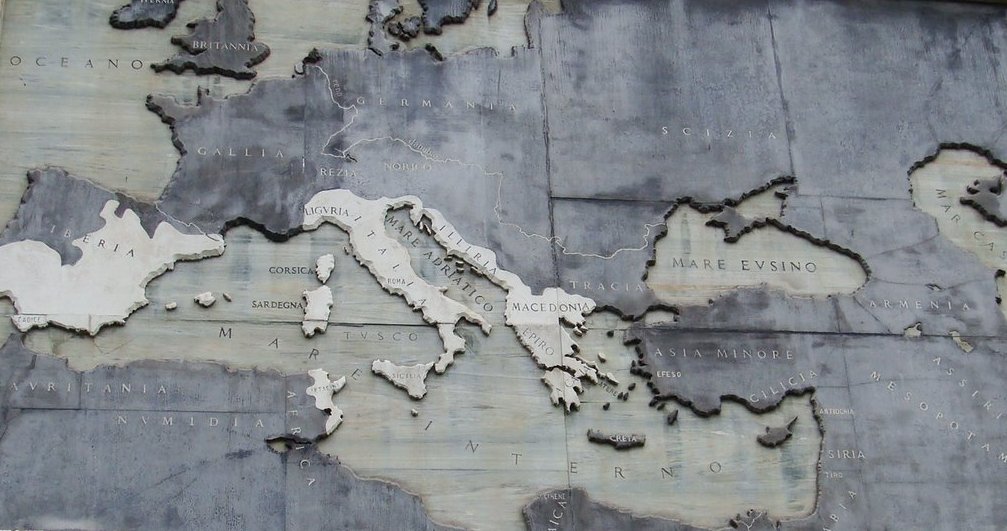
Macedonia found on the Colosseum in Rome!

Daskalot

New member
These two great maps have I found on the Colosseum in Rome, they are depicting the Roman Empire during its different phases. One thing is certain, there was a Macedonia but never a Greece. See for yourselves.

Map 1 found on the Colosseum:
rome-colosseum-macedonia-map1.jpg


Map 2 found on the Colosseum:
rome-colosseum-macedonia-map2.jpg


I am stunned, where is this Ancient state of Greece??? It seems that the Romans could not find it...... :eek:
 
So much for the idea that the Macedonians "united" the Ancient Greek cities... if that was the case... we would see the Greece on the map!
 
correct, Ancient Greece is a figment of the imagination of our Modern Greek imposters to legitimize their claim on history
 
Greece proper is referred to as 'Achaia' on those maps
It was an administrative name given by the Romans to the Pelloponnesse after it was absorbed into the empire in 146bc.
Heres a wiki reference-
In Ancient Roman times the name of the province of Achaea was given to the whole of Greece, except Thessaly, most of Epirus, and Acarnania. It is in this latter enlarged meaning that the name is always used in the New Testament (e.g., Acts 18:12, 27; 19:21; Romans 15: 26; 16:5). It was conquered and incorporated into the Roman Empire in the year 146 BC. Emperor Augustus established Achaea as a senatorial province; generally speaking, the region benefited from the enlightened attitude of Roman emperors such as Augustus. This was because Achaea was geographically closer to Rome than other provinces, and so it was given political advantages and greater status in order for the Roman court to maintain a political equilibrium within the empire.[1]
Homer, in his 2 epics, often refers to the Greeks as 'Achaean' as well.
It is an old name, with roots from ancient Greece.
A province in the north Pelloponnese bears the name 'Achaea' to this day.
Under the Roman empire Greece, or Achaia, was simply one province among many
http://students.missouri.edu/~csgsa/conf03.html

The Achaeans (in Greek Ἀχαιοί, Achaioi) is the collective name given to the Greek forces in Homer's Iliad (used 598 times). An alternative name, used interchangeably, is Danaans (Δαναοί, used 138 times) and Argives (Ἀργεῖοι, used 29 times). Argives is a political annotation drawn from the original capital of the Achaeans, Argos. Danaans is the name attributed to the tribe first dominating the Peloponnese and the area near Argos. Achaeans is the name of the tribe that, reinforced by the Aeolians, first dominated Greek territories, centering itself around its capital in Mycenae. The Homère Caetani bust at the Louvre, a 2nd century Roman copy of a 2nd century BC Greek original. ... The Iliad (Ancient Greek , Ilias) is, together with the Odyssey, one of the two principal ancient Greek epic poems. ... Argos (Greek: Άργος, Árgos, IPA argos) is a city in Greece in the Peloponnese near Nafplio, which was its historic harbor, named for Nauplius. ... The Peloponnese or Peloponnesus (Greek: Πελοπόννησος Peloponnesos; see also List of traditional Greek place names) is a large peninsula in southern Greece, forming the part of the country south of the Gulf of Corinth. ... The Aeolians were one of the Hellenic tribes. ... Mycenae (ancient Greek: , IPA, , in modern Greek: Μυκήνες, , U.S. English: ; see also List of traditional Greek place names), is an archaeological site in Greece, located about 90km south-west of Athens, in the north-eastern Peloponnese. ...
http://www.nationmaster.com/encyclopedia/Achaeans
 
Last edited:
Hmmmm, so during the course of history "Greece" has changed names quite frequently, and still the majority of the Greeks claim ancestry of the Ancients, isnt that quite absurd given the various names of the area which today encompasses Greece and even the various terms used for describing a "Greek" inhabiting the same area.
 
Daskalot
The way I see it, and I am not an expert by any stretch, many names have been used for the Pelloponnese, 'Achaea' probably being among the oldest.
Seeing as the ancient Romans were fascinated by Ancient Greek history(remember, at the time of Romes glory, Greek history would have ben "ancient" to the Romans of 146)it does not shock me that they would rename their newly aquired province by its old Homeric name. 'Achea or Achaean' is just another name for the Southern Greeks/Greece.
Regardless of what you want to call the Pelloponnese- Morea, Achaea, China or Siberia, the fact remains that Greek was spoken as the the main language through recorded history on this small Penninsula.
Now I understand language doesnt = ethnicity, but what would you, or anyone for that matter, call the inhabitants of Achaea of 146 bc?

The ethnicity of the people doesnt change with the name is my point.
For example, when the Greek state changed the names of Solun or Lerin to Thessaloniki and Florina, did the Macedonians who were from there cease to be Macedonian?
Of course not, they remain Macedonians, regardless of the 'official' name of their land.

Now apply this same logic in the above instance, and we should come to the conclusion that the people of Achaea,Pelloponnesse or Morea (whatever you want to call it)remain Greek, despite the name changes.

Its also well known that Macedonia became a Roman province after after the Romans conquered it.
I dont see why anyone would be surprised to see Macedonia on a map of the Roman empire

The Fourth Macedonian War or revolt occurred between 149 and 148 BC. The Macedonians wanted a restoration of their kingdom and supported a man who pretended to be the son of the last king. The rebels overran Macedon in 150, attacked southern Greece in 149, but were finally crushed by the Romans in 148 under the praetor Metellus Macedonicus. The Romans razed the Greek city of Corinth, one of the leading cities of the revolt and put an end to Greek resistance under Roman rule. It was this point, in 146 BC, that Macedonia became an official province with mainland Greece to follow shortly thereafter.
http://www.unrv.com/provinces/macedonia.php

Map of the Greatest Extent of the Roman Empire


Also notice how far south the roman province of Macedonia stretches.
Almost to Athens!!
 
Last edited:
Spartan, very reasonable statements and observations from you.
I agree.
The only thing I will add is that I am absolutely sure nobody in Greece is attached to Danaan and Achaea as titles of self description nowadays. So the few names that the modern Greeks have plucked from history remain non-negotiable and the rest are cast aside on a heap of irrelevance. Macedonia is a jewel the Greeks care to claim now due to its historical significance. It is 1,000,000 times more irrelevant than the Danaan and Achaean names, yet they persist. Ultimately, self-identification will prevail and the modern Greeks have already chosen their self-descriptors. The debate about Macedonia will begin to vanish this year in my opinion, I can feel the (unjustified) passion disappearing from the modern Greeks on this matter.

But notwithstanding this, the maps make it clear that if we are talking about anything resembling nations from a historical sense, then we see Macedonia and Achaea as separate entities. We Macedonians say this as well.
 
Spartan, very reasonable statements and observations from you.
I agree.
Thank you Risto
You are reasonable as well to see what I am trying to say.
I feel like I have to walk on eggshells to show my point of view sometimes. I will always state my arguments in a way as to not offend the identity of the Macedonians. As I said once on this forum, I dont believe our histories are at odds with one anothers, and I believe they can both co-exist.
I only debate(occasionally) the history I read as it pertains to Greece, not Macedonia.
The only thing I will add is that I am absolutely sure nobody in Greece is attached to Danaan and Achaea as titles of self description nowadays.
I am sure of this as well
Never heard anyone refer to themselves as an 'Achaean' in my brief time on this earth :D
But notwithstanding this, the maps make it clear that if we are talking about anything resembling nations from a historical sense, then we see Macedonia and Achaea as separate entities. We Macedonians say this as well.
Like oil and water my friend....

PS
I just adde a map to my previous post
Check it out
 
Last edited:
Sure buddy
sounds good to me

Tell me Risto, did you notice how far south the Macedonian province reaches?
were you aware of this?
 
Last edited:
Claim them if you want brother!
Although Macedonia stretched far south on that map, it isnt far enough for me to go dusting off my armour or anything crazy like that ;)
 
^^
Thats just how I see things my friend
Perhaps Im totally wrong
So far, I believe Im correct on this though, as SoM hasnt disagreed yet lol
 
Achaia is the Roman name for Greece, as it is in the bible mostly. I think the significance of the Roman maps is in the fact that Macedonia exists as an entity by her name while an entity named Greece or Hellas does not at all. If Achaia is to be considered representative of ‘the’ Greece or Hellas, then it limits the Roman perception of the Greek homeland to be the Peloponnesus and some surrounding regions. The Macedonian state (and name), even after defeat, was still respected by the Romans due to its glorious past.

Despite the multitude of Philhellenic Romans, no state or province called Hellas was on their minds, which indicates a lack of necessity to accomodate a 'Hellenic' people even after the Romans saved them from the defeated Macedonians (Plutarch, Pasuanias).
 
SoM
I agree with all you say above, except when you say "Achaea is the Roman name for Greece". It is actually one of the homeric names for the southern Greeks/Greece from what I understand.....
 
It may have been so in the past Spartan, but it was also the official name of a Roman province that roughly corresponds to where the 'real' ancient Greeks once lived. Homer refers to the general collective from 'Greece' as Achaians, Argives or Danaans, from the southern tip all the way up to the northern limits, in the vicinity of the river Peneus.

The names of Greece and Hellas, at least where it concerns the important map above, do not exist in an official capacity within the Roman Empire. Macedonia does. I think in the end those factors will tower above the rest in this respect.
 
Did you notice how far the Roman Macedonia reached to the south on those maps?
I found it quite interesting.
Btw, how far north is this river Peneus?
I always thought 'Achaean' was used by Homer to describe the Greeks of the south.

I dont have time to dig too deep right now, but heres aquick Wiki reference.
Make of it what you will.
When I have more time Ill try to find something more reliable...

The Achaeans (Greek: Ἀχαιοί, Akhaioí) is one of the collective names used for the Greeks in Homer's Iliad (used 598 times) and Odyssey. The other names are the Danaans (Δαναοί, used 138 times in the Iliad) and Argives (Ἀργεῖοι, used 29 times in the Iliad). In the historical period, the Achaeans were the inhabitants of the region of Achaea, a region in the north central part of the Peloponnese. The city states of this region formed a confederation known as the Achaean League which was influential during the 3rd and 2nd centuries BC.

Description
The Achaeans are one of the four main tribes occupying the ancient Greek mainland (Achaeans, Aeolians, Ionians, Dorians). The name Achaeans came to mean all the Greeks in the oral tradition that was crystallized by Homer; earlier usage is unattested.

The Homeric "long-haired Achaeans" would have been a part of the Mycenaean civilization that dominated Greece from ca. 1600 BC, with a history as a tribe that may have gone back to the prehistoric Hellenic immigration in the late 3rd millennium BC. It has been suggested that the Achaeans had not settled in the Greek mainland until the Dorian invasions of the 12th century BC. It is possible that Homer's Achaean leaders held power in the Mycenean world but were replaced by the Dorians. Herodotus identified the Achaeans of the northern Peloponnese as descendants of these earlier Achaeans.
A scholarly consensus has not yet been reached on the origin of the historic Achaeans, and is still hotly debated.

So what this tells me is that Homer used the word to describe all the Greeks, but it is actually the name of a Greek tribe that settled in the Pelloponnesse.
 
Last edited:
Back
Top