• Welcome to the new Macedonian Truth Forum. All posts, members and private messages have been moved over from the old forum.

    Passwords from the old forum could not be carried over, so please use Forgot your password? to set a new one. The reset link is emailed to the address on your account.

  • Rules and Regulations at the forum of the Macedonian Truth Organisation (MTO)

    (1) The national-ethnic and cultural-linguistic identity of the Macedonian people is historically Macedonian, and derives its character from the native, indigenous and geographic homeland of the Macedonians, which is called Macedonia. To ensure that their human rights, integrity and heritage are appropriately respected, the only nouns and adjectives acceptable when reference is made to the above character and identity markers is Macedon, Macedonia, Macedonian and Macedonians.

    (2) The nation-state of the Macedonian people is the Republic of Macedonia, and is to be referred to by this official title so long as the 'republic' prefix is consistently applied to other states. Alternative references are the Macedonian Republic, or simply, Macedonia.

    (3) The 'ethnic' prefix is only acceptable for Macedonians in cases where differentiation is specifically required - so long as it is in context and consistent where it concerns its application to other ethnic groups.

    (4) Should any other differentiation be specifically required, the names of other ethnic groups that reside with Macedonians in either the Republic of Macedonia or the occupied Macedonian regions in Greece, Bulgaria, Serbia or Albania, are to be given a prefix.

    (5) Negating the identity, language and culture of the Macedonian people by deliberate avoidance of the terms Macedonia, Macedonian and Macedonians, or by any other means, is not permitted.

    (6) Systematic anti-Macedonian propaganda and rhetoric are not permitted.

    (7) Threads irrelevant to the Macedonian Cause, the community at the Macedonian Truth Organisation or the Macedonians in general may be considered as spam or not in the spirit of the forum. In such cases they are not permitted.

    (8) Continual posting of messages in threads with the sole purpose of deviating from the initial topics with the use of unrelated and unnecessary information is not permitted.

    (9) All posts, external articles, reports, etc that are cited in languages other than Macedonian or English, must be accompanied with a translation in one or both of the said languages.

    (10) Despite the possibility of some conversations and debates becoming heated, extreme abuse and/or racism, vulgar language and/or terminology, threats, revelation of personal information about others, harassment, and other such behavior will not be permitted. If deemed necessary all relevant information including member details will be reported to the appropriate authorities for investigation which may result in legal action.

    (11) Threads that are created must have a summary of a topic or excerpt of an article found in pertinent link(s) that have been included. One line threads will be considered unaccetable spam and are therefore not permitted.

    (12) Compulsive and deliberate lies, irrespective of the topic, are not permitted.

    (13) Any symbols or avatars found to be perceived as offensive to Macedonians are not permitted.

    (13) Any explicit or extreme material is not permitted.

    Failure to adhere to the above rules and regulations will result in a ban after 3 breaches. This may be reconsidered in some cases should the circumstances be of an unorthodox nature and/or require special consideration. To assure an effective deterrent against an individual or individuals with the sole purpose of causing dissent through spamming, racism or other improper means, the above rules will be strictly enforced.

    The MTO administration will monitor all discussions as reasonably practical and reserve the right to remove any post and/or member from the forum, and update the rules and regulations as required. Members are encouraged to immediately report any post and/or member to the MTO administration if they feel that these rules have not been abided by.

    The views expressed on this forum are those of the individuals. The only official representation of the MTO is made by the "Macedonian Truth Organisation (Site Owner)" username, and no other.

  • Macedonian Cause

    The Macedonian Truth Organisation calls on God in Heaven to protect, bless and guide the endeavour it is committing to undertake, and that is to work towards:

    Securing Macedonia as a free, independent and democratic republic in which sovereignty lies with the Macedonian citizens; as the nation-state of the Macedonian people in which they can preserve their culture, language and identity; as a state in which the Macedonian language and culture form the basis of public life and act as important unifying elements of Macedonian society; as the home of all its citizens to which it guarantees and obliges their inalienable natural rights and corresponding responsibilities;

    The acknowledgment as self-evident and irrefutable the existence of the:

    1) Indigenous, ethnonational name of Macedonia;
    2) Macedonian people, language and identity;
    3) Macedonian culture, symbols and folklore;
    4) Macedonian ancestry, heritage and history in its entirety; and
    5) Macedonian Orthodox Church;

    Securing recognition by the International Community of the tragedies endured by the Macedonian people, of the division of Macedonia with the signing of the Treaty of Bucharest on August 10, 1913, and the genocide committed against the Macedonian people at the hands of the Greek, Bulgarian and Serbian states and their respective churches during the 19th and 20th centuries;

    Ensuring that the Interim Accord is declared ‘null and void’ and that all constitutional provisions, acts, commitments, agreements, legislation, regulations, policies or programs emanating from, supporting or consequential to the Interim Accord are also declared ‘null and void’, including the use of any symbols and the completion of any acts imposed by, or originating from, the Interim Accord.

    Ensuring that the Framework Agreement is abolished and that all constitutional provisions, acts, commitments, agreements, legislation, regulations, policies and programs emanating from, supporting or consequential to the Framework Agreement are also abolished and replaced by a framework of constitutional and statutory law based on inalienable natural rights and corresponding responsibilities and universally codified human rights mechanisms.

    Securing the abolishment of any existing constitutional provisions, acts, agreements, legislation, regulations, policies and programs that discriminate against the Macedonian people, in any international organisation or any of the countries of the International Community where such constitutional provisions, acts, agreements, legislation, regulations, policies and programs exist, and thereby ensuring the freedom for Macedonians to exercise their inalienable natural rights and fulfil their corresponding responsibilities, and practice their culture, language and religious faiths in all the countries of the International Community without hindrance;

    The empowerment of Macedonians to undertake a moral revolution and to instil and/or reinvigorate within themselves a deep-rooted national, cultural, linguistic and historical dignity and a commitment to the exercise of freedom based on inalienable natural rights and corresponding responsibilities;

    The recognition of the Macedonian minorities in the neighbouring states of Macedonia as well as the respect for the inalienable rights and freedoms of the Macedonian minorities, as provided for by natural law and as codified by the United Nations Charter, the Universal Declaration of Human Rights and other universally codified human rights mechanisms;

    The full and unreserved respect of, and the support for, the rights of all people of non-Macedonian descent living in Macedonia and around the world, who share a reciprocal full and unreserved respect for the Macedonian people, their homeland and their state;

    The cultural unification and solidarity of the Macedonian people living in all parts of historical Macedonia and adjacent territories, as well as Macedonians throughout the world;

    The unity of all Macedonians on the principles, objectives and achievement of the Macedonian cause as defined by this declaration.

Was Basil the Macedonian really Armenian???

Slavs is a linguistic term. Basil was a Slav means his native tongue was a Slavic language. That is from the modern perspective of things and usage of modern terminology. Now, what ethnicity was Basil?
If anything could be considered an ethnicity back then, how would it be defined?

Southern Thrace was often identified with Macedonia and/or Macedonians during ancient and biblical times, and centuries later it appears to have become a centre for some Macedonians who travelled away from the rebellious enclaves of the 'Sclavinae' in Macedonia proper, and further east closer to Constantinople, prompting the creation of a new administrative unit in East Rome named the Macedonia Theme, which was centred around Adrianople. These factors need to be taken into consideration, especially the latter, as it is where Basil originates from.

If we look at the simple reality, Basil, the emperor of East Rome;

1) Came from a region known in his lifetime as Macedonian
2) Identified as a Macedonian
3) Was of a Slavic-speaking family


If we are to apply the logical interpretation of 'ethnicity', in the context of the ethnic groups that exist in the Balkan region today, how can he be anything other than a Macedonian?
 
I have some more info on the supposed Armenian ancestry of Basil. Here is something his son Leo wrote about Basil;

Kazhdan.png

kazhdan111.png


and this;
beckwith.png

page 190
beckwith190.png
 
If anything could be considered an ethnicity back then, how would it be defined?

Southern Thrace was often identified with Macedonia and/or Macedonians during ancient and biblical times, and centuries later it appears to have become a centre for some Macedonians who travelled away from the rebellious enclaves of the 'Sclavinae' in Macedonia proper, and further east closer to Constantinople, prompting the creation of a new administrative unit in East Rome named the Macedonia Theme, which was centred around Adrianople. These factors need to be taken into consideration, especially the latter, as it is where Basil originates from.

If we look at the simple reality, Basil, the emperor of East Rome;

1) Came from a region known in his lifetime as Macedonian
2) Identified as a Macedonian
3) Was of a Slavic-speaking family


If we are to apply the logical interpretation of 'ethnicity', in the context of the ethnic groups that exist in the Balkan region today, how can he be anything other than a Macedonian?

Here's something that you should check out SoM;

Kazhdan.png

Kazhdan173.png


:macedonia A rarity in those times to actually point out ethnic groups.
 
If anything could be considered an ethnicity back then, how would it be defined?

Southern Thrace was often identified with Macedonia and/or Macedonians during ancient and biblical times, and centuries later it appears to have become a centre for some Macedonians who travelled away from the rebellious enclaves of the 'Sclavinae' in Macedonia proper, and further east closer to Constantinople, prompting the creation of a new administrative unit in East Rome named the Macedonia Theme, which was centred around Adrianople. These factors need to be taken into consideration, especially the latter, as it is where Basil originates from.

If we look at the simple reality, Basil, the emperor of East Rome;

1) Came from a region known in his lifetime as Macedonian
2) Identified as a Macedonian
3) Was of a Slavic-speaking family


If we are to apply the logical interpretation of 'ethnicity', in the context of the ethnic groups that exist in the Balkan region today, how can he be anything other than a Macedonian?

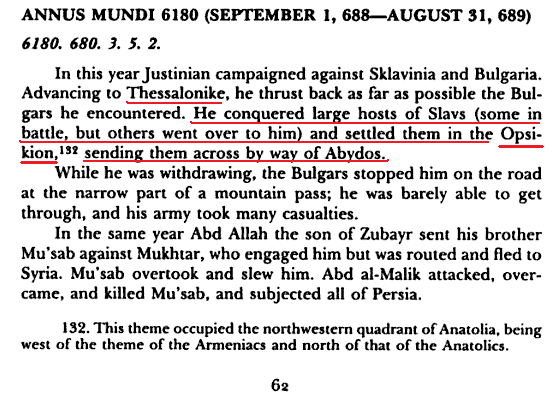
SoM this is from Theophanes;

neboulos62.png


Basil the Macedonians family may have originally settled in Solun, mixed with the aboriginals, and were forced to move to Adrianople. Just a theory using Theophanes.
 
Basil the 2nd the 2nd Macedonian
Avtor: Axios Sobota, 15 III 2008 12:00.

.In relation to the presenting of famous personalities with Macedonian origin, in this issue we\'ll mention something about the members of the Macedonian dynasty that ruled wit Byzantine from 9th till the 11th century. A certain number of historians think that the members of the Macedonian dynasty in Byzantine were actually descendents of the ancient Macedonians. Among those historians is the author of these lines. To set down arguments in favour of his we should add certain additional explanations.
In the 8th century, on the territory of today\'s Trachea and in part of South Eastern Macedonia, Byzantine formed a thema (an administrative area), which it called "Macedonia". It is fi gured that this thema was named so because of the fact it was populated with a certain number of de¬scendents of ancient Macedonians. Later from their ranks the members of the Macedonian dynasty in Byzantine came from. This dynasty began with the emperor Basil the 1st of Macedonia (867-886), and ended in 1081. As an illustration of their Macedonian origin we will quote the Encarta Encyclopedia (quote from the work,title Basil I), where in relation to the origin of Basil the 1st we can read:

"Basil the 1st (812-886), a Byzantine Emperor (867-886) and founder of the Macedonian dynasty. He is born in Ma¬cedonia and originated from a peasant family (...)"•
In the famous "Compton Encyclopaedia" in relation to the founding of the Macedonian dynasty in Byzantine we can read:
"With the coronation of Basil the 1st the Macedonian in 867 the lengthy dy¬nasty of Macedonian emperors was es¬tablished" (Compton\'s Encyclopedia Online v3.0 © 1998 The Learning Com¬pany, Inc.).
In the Catholic Encyclopedia (1908) it is written that the members of this dynasty were from Armenia, but that they were of Macedonian ethnic origin.
("The Catholic Encyclopedia, Volume III", Copyright © 1908 by Robert Appleton Company, Online Edition Copyright © 1999 by Kevin Knight Nihil Obstat, November 1, 1908. Remy Lafort, S.T.D)

BASIL THE 2ND THE HE 2 MACEDONIAN

The most famous emperor of this dynasty was the emperor Basil the 2nd the Macedonian - the enemy of the medieval Macedonian emperor Samuel! Little is taught about these ethnic Macedonians in today\'s historiography from the aspect of their connection with the ancient Macedonian gene. Even the most famous representative of this dynasty, Basil the 2nd the Macedonian, in our historiography (probably rightly so), was taught strictly in a negative context as a "destroyer" of Samuel\'s Empire. After he conquered Samuel\'s Empire, it can be said that Basil the 2nd behaved towards the Macedonian population correctly.

For example, he left certain privileges to the clergy of the Ohrid archdiocese, and even in his time the monk Jovan from Debar was selected. Some of Samuel\'s dignitaries held their status, although they fought against Basil the 2nd. For the inadequate interest for the studying of these ethnic Macedonians in our historiography a contributing factor is the fact that they lived outside of the territory of ethnic Macedonia and ruled with another country (Byzantine). Actually it is the same case as with the Ptolemy, Macedonians who in their time ruled Egypt, as well as with the case of the Macedonian Seleucids, who ruled with the Eastern Mediterranean. We have the same situa¬tion with the reign of the Macedonian dynasty in Byzantine.

EVIDENCE FOR THEIR R MACEDONIAN ORIGIN

That these emperors have not forgotten their Macedonian ethnic origin a number of facts have shown. First, here is the name of their dynasty which is called "Macedonian".
Further more, in their time, in the Byzantine army an active role was played by the Macedonian phalange. It is known that the Byzantine emperor Constantine (brother and heir of Basil the 2nd the Macedonian) fought excellently with the long spire, as the Byzantine historian Michael Psel writes (1.14).
The Croatian historian D-r. Stjepan Antoljak ("Medieval Macedonia", Skopje,1985, page 212), calling upon the Byzantine historian Skilica, writes:
In the Byzantine army the Macedonian phalange was incorporated, as Skilica writes, in 1071 it participated in the pillaging of Samuel\'s capital Prespa".
So the Macedonian phalange within the composition of the Byzantine army fought against their own brothers- heirs of the Macedonian medieval empire, known trough history as Samuel\'s Empire.

There are other data from the time of Basil the 2nd, in which the Macedonians are mentioned as soldiers in his army. Some of them fought in southern Italy, in the then thema Langobardia. For one of these Macedonians it is known that he was from Stip! He was called Lav and was a high ranking commander of the Macedonian and Trachean units in the composition of the Byzantine army. D-r Stjepan Antoljak (quote work, page 206), in relation to this he writes:
"... then he was mentioned as a military commander of of the Macedonians and Tracheans the patrician Lav, who they called Stipion i.e. "Stipjanec".
This commander is also mentioned by Cons¬tantine Pfrofi rogenit".

The member of the Macedonian dynasty in Byzantine kept most of their tra¬ditional markings from their ancient Macedonian ancestors. It is known that the main markings of the ancient Mace¬donian emperors were: the colour of purple on there robes, sceptre and diadem. We have the same condition with the Byzantine emperors from the Macedonian dynasty! The poet Ivan Kiriotes, called Geometres, who was archbishop of Metilena in the 10th century, in his songs he sang about the events surrounding the rule of Basil the 2nd the Macedonian, and in one of them he clearly mentions (quote): "the royal sceptres and diadems, as well as purple robes", which the Byzantine emperors of the Macedonian dynasty wore, exactly as their ancestors did - the famous ancient Macedonians emperors ( Joannis Geometrae, J.P. Migne, PG 106, 919; quote according to D-r. Stjepan Antoljak, "The Medieval Macedonia", Skopje, 1985, page 242).

The Byzantine historian Michael Psel (1,31) describes the purple colour of the robes which Basil the 2nd wore.
Then even the saying "born in purple" existed, which referred to the emperors of the Macedonian dynasty.
Psel gives an interesting fact (3,8), in which he writes that the Byzantine emperor Roman the 3rd (1028-1034) of the Macedonian dynasty, wanted to imitate the great rulers, among which he mentions Alexander the Great of Macedonia.
Psel writes that this Byzantine emperor too, also dressed in purple robes (3,15), the same as ancient Macedonian emperors did.
http://www.veneti.info/articles-2/m...articles/206-basil-the-2nd-the-2nd-macedonian

 
TrueMacedonian said:

This is another example of a historical figure claiming mythical or unrealistic descent from other historical figures before them. All for the purpose of increasing their prestige by being identified with others that have achieved fame in their lives. No different to Alexander claiming to be descended from Heracles.
 
This is another example of a historical figure claiming mythical or unrealistic descent from other historical figures before them. All for the purpose of increasing their prestige by being identified with others that have achieved fame in their lives. No different to Alexander claiming to be descended from Heracles.
SOM, that was very common in medieval world, both in east and west. I think nearly all European societies claimed to be the descendants of Trojans. Also in eastern world, it was so common to claim to be a descendant of prophet Mohammed, Genghis Khan, Tamerlane etc.

Ofc most of these claims was just lies.
 
Here is some further comments from Aleksandar Donski about Basil II I found on Facebook

Aleksandar Donski:
Thank you for mentioning me. Basil II CAN NOT BE AN ARMENIAN!!! And the reason for this is very simple – he had light blue eyes (as is described from Michael Psellus who personaly knew him and described what he saw). With all respect we know that the Armenians are people with darker skin and eyes and there are no blond people among them. Further, Basil II was a distinct relative of Basil I for whom is clearly written that was born in Macedonia. Nothing is strange if the war between Samuel and Basil II was partialy war between Macedonians (although their armies were multi-ethnical). Before them Seleucides made war against Ptolemeis, although both of them were Macedonians and there are many cases like this among almost every people in the ancient times, but also later. There are endless wars between Hellens against other Hellens, or Romans against other Romans, or civil wars in new Age and so...

About Basil II and his dynasty I published data in my books VIZANTISKI CAREVI OD MAKEDONSKO POTEKLO and UDELOT NA MAKEDONCITE VO SVETSKATA CIVILIZACIJA. Here is small, but heavy :-), data from all of this.

Vo svetski poznatata enciklopedija Microsoft Encarta (1998, naslov Basil I), vrska so potekloto na Vasilij Prvi chitame:
"Vasilij Prvi (812-886), vizantiski imperator (867-886) i osnovach na Makedonskata dinastija. Roden e vo Makedonija i poteknuval od selansko semejstvo (...)".
Vo poznatata "Kompton Enciklopedija" vo vrska so vostanovuvanjeto na Makedonskata dinastija vo Vizantija chitame:
"So krunisuvanjeto na Vasil Prvi Makedonski vo 867 godina bila vostanovena dolgata dinastija makedonski carevi". (Compton's Encyclopedia Online v3.0 © 1998 The Learning Company, Inc.).

VERY INTERESTING FACT. THE ANCIENT MACEDONIAN PHALANX WAS INCLUDED IN THE BYZANTINE ARMY UNDER THE CZAR BASIL II THE MACEDONIAN. Again paert from my books will follow (in Macedonian):

Hrvatskiot istorichar d-r Stjepan Antoljak (eksper za makedonskata srednovekovna istorija) vo svojata kniga "Srednovekovna Makedonija" (Skopje, 1985, str. 212), povikuvajki se na trudovite na vizantiskiot istorichar Skilica, pishuva:
"Vo vizantiskata vojska bila svoevremeno vklopena Makedonskata falanga, kako shto pishuva Skilica i taa, vo 1072 godina, uchestvuvala vo ograbuvanjeto na nekogashnata Samuilova prestolnina Prespa".


Kiril Stefan xxxxxxx :
With all due respect, neither eye nor skin color is always tied to absolute ethnicity. I live near the largest enclave of pure-blooded armenians in the world (Watertown, Mass.) and there are plenty of blue-eyed and lighter skinned Armenians. There are even blondes among them, my armenian professor at MIT who was a pure-blooded Armenian from Bulgaria. Among my own family lineage there are blond and blue eyed armenians that are part-armenian and part-macedonian as well as full blooded armenians that escape their genocide.


Aleksandar Donski :
We are talking about Middle Age Armenians and there is no doubt how they looked like. Simmilar was with Jews and Turks. Now there are a lot of blonde Turks, but of course that original Turks are dark haired which means that blond Turks now are nothing more than descendants of mainly Balkan people who were islamized. Simmilar was with Jews - it is wellknown that a lot of Balkan people lived in the Holy Land after it was liberated from Alexander the Great... But it is a long story
http://answers.yahoo.com/question/index?qid=20100605023652AAHCqwq
What did ancient Armenians look like?
 
The following article is in Greek.
http://www.freeinquiry.gr/pro.php?id=509

It contains the list of all East Roman (Byzantine) rulers and dynasties.

Under the column "KATAGOGI or ΚΑΤΑΓΩΓΉ" in the chart, the reader can find the ancestry/ethnic origin of each individual ruler.

Scroll down to the Macedonian Dynasty section and observe that almost all of them are of "Armeno-Slavic" descent.

PS: FYI - No Byzantine Emperor was of Greek ethnic origin.
 
Back
Top