• Welcome to the new Macedonian Truth Forum. All posts, members and private messages have been moved over from the old forum.

    Passwords from the old forum could not be carried over, so please use Forgot your password? to set a new one. The reset link is emailed to the address on your account.

  • Rules and Regulations at the forum of the Macedonian Truth Organisation (MTO)

    (1) The national-ethnic and cultural-linguistic identity of the Macedonian people is historically Macedonian, and derives its character from the native, indigenous and geographic homeland of the Macedonians, which is called Macedonia. To ensure that their human rights, integrity and heritage are appropriately respected, the only nouns and adjectives acceptable when reference is made to the above character and identity markers is Macedon, Macedonia, Macedonian and Macedonians.

    (2) The nation-state of the Macedonian people is the Republic of Macedonia, and is to be referred to by this official title so long as the 'republic' prefix is consistently applied to other states. Alternative references are the Macedonian Republic, or simply, Macedonia.

    (3) The 'ethnic' prefix is only acceptable for Macedonians in cases where differentiation is specifically required - so long as it is in context and consistent where it concerns its application to other ethnic groups.

    (4) Should any other differentiation be specifically required, the names of other ethnic groups that reside with Macedonians in either the Republic of Macedonia or the occupied Macedonian regions in Greece, Bulgaria, Serbia or Albania, are to be given a prefix.

    (5) Negating the identity, language and culture of the Macedonian people by deliberate avoidance of the terms Macedonia, Macedonian and Macedonians, or by any other means, is not permitted.

    (6) Systematic anti-Macedonian propaganda and rhetoric are not permitted.

    (7) Threads irrelevant to the Macedonian Cause, the community at the Macedonian Truth Organisation or the Macedonians in general may be considered as spam or not in the spirit of the forum. In such cases they are not permitted.

    (8) Continual posting of messages in threads with the sole purpose of deviating from the initial topics with the use of unrelated and unnecessary information is not permitted.

    (9) All posts, external articles, reports, etc that are cited in languages other than Macedonian or English, must be accompanied with a translation in one or both of the said languages.

    (10) Despite the possibility of some conversations and debates becoming heated, extreme abuse and/or racism, vulgar language and/or terminology, threats, revelation of personal information about others, harassment, and other such behavior will not be permitted. If deemed necessary all relevant information including member details will be reported to the appropriate authorities for investigation which may result in legal action.

    (11) Threads that are created must have a summary of a topic or excerpt of an article found in pertinent link(s) that have been included. One line threads will be considered unaccetable spam and are therefore not permitted.

    (12) Compulsive and deliberate lies, irrespective of the topic, are not permitted.

    (13) Any symbols or avatars found to be perceived as offensive to Macedonians are not permitted.

    (13) Any explicit or extreme material is not permitted.

    Failure to adhere to the above rules and regulations will result in a ban after 3 breaches. This may be reconsidered in some cases should the circumstances be of an unorthodox nature and/or require special consideration. To assure an effective deterrent against an individual or individuals with the sole purpose of causing dissent through spamming, racism or other improper means, the above rules will be strictly enforced.

    The MTO administration will monitor all discussions as reasonably practical and reserve the right to remove any post and/or member from the forum, and update the rules and regulations as required. Members are encouraged to immediately report any post and/or member to the MTO administration if they feel that these rules have not been abided by.

    The views expressed on this forum are those of the individuals. The only official representation of the MTO is made by the "Macedonian Truth Organisation (Site Owner)" username, and no other.

  • Macedonian Cause

    The Macedonian Truth Organisation calls on God in Heaven to protect, bless and guide the endeavour it is committing to undertake, and that is to work towards:

    Securing Macedonia as a free, independent and democratic republic in which sovereignty lies with the Macedonian citizens; as the nation-state of the Macedonian people in which they can preserve their culture, language and identity; as a state in which the Macedonian language and culture form the basis of public life and act as important unifying elements of Macedonian society; as the home of all its citizens to which it guarantees and obliges their inalienable natural rights and corresponding responsibilities;

    The acknowledgment as self-evident and irrefutable the existence of the:

    1) Indigenous, ethnonational name of Macedonia;
    2) Macedonian people, language and identity;
    3) Macedonian culture, symbols and folklore;
    4) Macedonian ancestry, heritage and history in its entirety; and
    5) Macedonian Orthodox Church;

    Securing recognition by the International Community of the tragedies endured by the Macedonian people, of the division of Macedonia with the signing of the Treaty of Bucharest on August 10, 1913, and the genocide committed against the Macedonian people at the hands of the Greek, Bulgarian and Serbian states and their respective churches during the 19th and 20th centuries;

    Ensuring that the Interim Accord is declared ‘null and void’ and that all constitutional provisions, acts, commitments, agreements, legislation, regulations, policies or programs emanating from, supporting or consequential to the Interim Accord are also declared ‘null and void’, including the use of any symbols and the completion of any acts imposed by, or originating from, the Interim Accord.

    Ensuring that the Framework Agreement is abolished and that all constitutional provisions, acts, commitments, agreements, legislation, regulations, policies and programs emanating from, supporting or consequential to the Framework Agreement are also abolished and replaced by a framework of constitutional and statutory law based on inalienable natural rights and corresponding responsibilities and universally codified human rights mechanisms.

    Securing the abolishment of any existing constitutional provisions, acts, agreements, legislation, regulations, policies and programs that discriminate against the Macedonian people, in any international organisation or any of the countries of the International Community where such constitutional provisions, acts, agreements, legislation, regulations, policies and programs exist, and thereby ensuring the freedom for Macedonians to exercise their inalienable natural rights and fulfil their corresponding responsibilities, and practice their culture, language and religious faiths in all the countries of the International Community without hindrance;

    The empowerment of Macedonians to undertake a moral revolution and to instil and/or reinvigorate within themselves a deep-rooted national, cultural, linguistic and historical dignity and a commitment to the exercise of freedom based on inalienable natural rights and corresponding responsibilities;

    The recognition of the Macedonian minorities in the neighbouring states of Macedonia as well as the respect for the inalienable rights and freedoms of the Macedonian minorities, as provided for by natural law and as codified by the United Nations Charter, the Universal Declaration of Human Rights and other universally codified human rights mechanisms;

    The full and unreserved respect of, and the support for, the rights of all people of non-Macedonian descent living in Macedonia and around the world, who share a reciprocal full and unreserved respect for the Macedonian people, their homeland and their state;

    The cultural unification and solidarity of the Macedonian people living in all parts of historical Macedonia and adjacent territories, as well as Macedonians throughout the world;

    The unity of all Macedonians on the principles, objectives and achievement of the Macedonian cause as defined by this declaration.

The first President of Greece was an Albanian, 1824!

No but rather of Krste P Misirkov...... do you know where he was born?

Not really,but I guess ...somewhere inside the Greek borders :)

Thats life Daskale...some members of my family also descend outside the borders of Greece.
We can't live in the past.

Some of your compatriots though believe that they are direct descendants of Alex..
 
Not really,but I guess ...somewhere inside the Greek borders :)

Thats life Daskale...some members of my family also descend outside the borders of Greece.
We can't live in the past.

Some of your compatriots though believe that they are direct descendants of Alex..

He was born in Postol which was given the new name of Pella by Greek authorities.

Do you know where Pella is? :kiss:
 
He was born in Postol which was given the new name of Pella by Greek authorities.

Do you know where Pella is? :kiss:

Pella? I ve been several times there.There is a new museum -its nice.(pella katadesmos is exhibited also there :P)
Then since Alex was also from Postol (does this come from Apostol?) then Krste could be his child.:)

@makedonin what are you talking abt? we can be sure only for our mothers and noone else (incl fathers.....:) )
And in what way would this really matters..? (I mean let's say if both of us have 0.8% of Alexander's right testicle..)
 
In your country they are you, big difference. In Macedonia a Macedonian and Albanian are distinguished, in Greece a Greek and Albanian are one in the same, at least in many cases.
 
We dont have issues distinguishing ourselves we are Macedonians, its okay to be jelous :rmacedonia

My grandfather was macedonian, My Mother is Macedonian, My Father is Macedonian, Im Macedonian, My Wifes (in 15 days)isMy macedonian, and by fucking god she makes the cutest macedonian babies :001_wub:
 
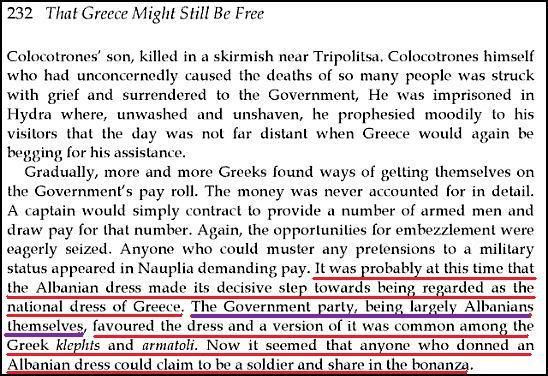
An old post of mine but still very revealing as to what lurked and ruled in modern "greece" before it even gained its independence:

WilliamStClaire232.jpg


That Greece Might Still Be Free by William St.Claire
 
An old post of mine but still very revealing as to what lurked and ruled in modern "greece" before it even gained its independence:

WilliamStClaire232.jpg


That Greece Might Still Be Free by William St.Claire

TM
Great reminder! I started reading from the paragraph that commences..."Gradually, more and more Greeks found ways of getting themselves on the Governments' pay roll."
Abosolutely astounding! Not only are they Albanians in disguise but they still wantanly partake in embezzlement, some things just don't change!

You are absolutely right Makedonche. The country won its independence with the help of thieves and corrupted Ottoman officials and it was literally stolen from the Bavarian crown prince by these same Albanian thieves! A legacy of 'thiefdom' and corruption, not 'hellenism', is what is unbroken and familiar for todays inhabitant of bankrupt grcija. Here's an ineresting article I came across - http://www.spiegel.de/international/europe/0,1518,729492,00.html

The 'Atimorisia' Illness
Greece's Toothless Battle against Corruption
By Manfred Ertel

Greek Prime Minister George Papandreou is doing his best to ward off national bankruptcy. But not all government agencies are cooperating. The country's justice system refuses to file charges in hundreds of prominent corruption cases.

The second the doorbell rings, the lights go off and the shades are drawn on the second floor of an apartment building on the outskirts of Athens. For the unwanted visitor, this is apparently meant to convey that no one is home. Since Nikos Kanellopoulos, 62, began appearing in the headlines, he is no longer available for comment.


Kanellopoulos is probably Greece's best-known public official at the moment. He was a civil servant for about 37 years, most recently as a department head in the Ministry of Culture. He went into retirement at the end of December 2008. He must have been very successful: According to the tax authorities, he now owns 10 properties, including the four-story apartment building containing his own, 126-square meter (1,356-square foot) apartment in the suburb of Nikaia.

Tax investigators also discovered 11 personal banking accounts with four different banks. The grand total of all deposits made into the 11 accounts amounted to the stately sum of €8,923,506.58 (over $12 million). Of this amount, more than €8 million went into the accounts during Kanellopoulos's last 10 years as a civil servant. The question is, where did the money come from?

The Kanellopoulos case is seen as a particularly drastic example of the Greek malaise. It is making headlines at the moment because it contrasts so sharply with Prime Minister George Papandreou's massive efforts to fend off the national bankruptcy that still threatens Greece.

Bloated Civil Service

In addition to completely revamping his country's financial policy, the prime minister has to reeducate an entire nation. Despite a number of general strikes, he has raised taxes, followed through with a radical austerity program and trimmed the bloated civil service.

The sweeping administrative reforms, a first for Greece, are called "Kallikratis." At the beginning of the year, the number of municipalities will be reduced from 1,074 to 325 and the number of regional administrations from 52 to 13. With so many levels of government, "corruption is almost the natural consequence," says Foreign Minister Dimitris Droutsas, noting that Kallikratis is one of the most important building blocks for a "new Greece." Greek voters appear to agree, handing Papandreou's socialists a victory in recent municipal elections, though their margin was much smaller than in national elections last October.

Of course, the Greek government could also milk the Kanellopoulos case for its propaganda value, by pointing out what appalling abuses it is clearing up. But is that really what is going on?

The general inspector of public administration, Leandros Rakintzis, brought the Kanellopoulos case to the public's attention. His job is to track down waste and corruption in the government bureaucracy. Although the chief watchdog did not name any names, he provided so many facts and details about the case that the retired civil servant was quickly exposed.

'Don't Want to Talk About It'

Kanellopoulos claims that he received the money as a government subsidy for a cultural association within his ministry, which pays for Christmas celebrations, summer parties and outings for ministry staff. He was briefly vice-president of the association twice, in 1996 and 1998. The only problem with his story is that he is unable to provide receipts, according to the report on an internal audit performed by the tax authorities, which SPIEGEL has obtained.

Kanellopoulos has avoided making public statements. "We don't want to talk about it," says his wife Athanasia. Nevertheless, he is unlikely to face serious consequences. That too is typically Greek.

The Kanellopoulos case involves a phenomenon that is popularly known as "Atimorisia" and could seriously jeopardize efforts to bring about much-needed change in Greece. "Atimorisia" means "impunity" or "getting off Scot free" in Greek. Next to "fakelaki," a term used to describe minor bribes, and "rousfeti," the word for special favors, this is the third expression emerging from the Greek crisis that is likely to find its way into the European vocabulary to describe mismanagement.

The problem is nothing new. For years, Greece's criminal justice system has been criticized for being slow and ineffective, losing files and allowing trials to drag on. According to General Inspector Rakintzis, the European Court of Justice has already ruled against Greece 340 times in cases related to this problem.

For years, there has also been an ongoing discussion of the substantial loopholes many Greek laws offer. In the Kanellopoulos case, for example, the tax authority reached the astounding conclusion that it could not demand payment of back taxes on his shockingly high income. Because the source of the funds "is not related to the exercise of his profession," the funds are "not subject to taxation, even if they were acquired in an illegal manner."

Special Treatment

What is new, however, is the charge -- recently made before a parliamentary committee by General Inspector Rakintzis -- that the judiciary systematically covers up corruption cases the minute they involve civil servants or public office holders. As a former judge with 38 years of experience, most recently as a member of the country's supreme court, the Areopag, Rakintzis speaks with authority.

He told the committee that even the public prosecutor's office often shows little interest in systematic prosecution. Besides, he added, there have been "verdicts that I cannot explain, even with my experience." What he was saying is that prominent figures are given special treatment.

Since taking office in 2004, Rakintzis has reported 427 cases of embezzlement, abuse of office, bribery and corruption to investigators. Shockingly, he says, his efforts have not led to the launching of a single investigation or the filing of charges -- even though public prosecutor's offices is required to do so. "The most likely explanation is that most of these cases are still in the preliminary investigation phase," Rakintzis says diplomatically.

His analysis has had even less of an impact internally. This summer, Rakintzis submitted a formal complaint to the chief public prosecutor attached to the country's supreme court, pointing out that there had been no movement whatsoever on any of the cases he had reported. The prosecutor reacted immediately, but not as expected. He gave Rakintzis a deadline by which he was to provide, in writing, additional, concrete details to back his charges, case-by-case. He did so a month later -- and added another 749 cases to the list. He has yet to receive a response.

"I am an honorary constitutional judge. I don't make any money on this," says Rakintzis, a short, rotund man who sees his job as a calling. "That's why I'm free to do as I please."

'The Big Patient'


Thus freed from constraints, he uncovers abuses and delivers his sharp criticism without regard to name or position. For instance, he discovered the now-legendary "Kopais" agency, which was created in 1957 to supervise the draining of Lake Kopais near Thebes. The lake disappeared that same year, but the agency and its staff of 30 still exist today. It has finally been placed on a list of 750 government agencies that are to be shut down. Now the only question is when?

About three years ago, Rakintzis discovered 32 doctors who worked at the largest hospital in Athens and had performed about 400 appendix, heart and eye operations -- at least according to what they had written in patient files. In reality, they had performed cosmetic surgery, which is not covered by insurance, and had sent the bills to the patients' health insurance agencies. "It was a gang," says Rakintzis, and it even had the audacity to place the cosmetic surgery at the top of their priority lists, while patients with serious conditions and emergency cases were kept waiting.

The case still hasn't seen the inside of a courtroom. "It often seems as if we had no judiciary," says former constitutional judge Rakintzis. The judiciary itself, he adds, is "the big patient."

Translated from the German by Christopher Sultan


Isn't corruption lovely
 
TM
Great article - no surprises there! Liars and thieves for hundreds of years, the continiuing character of a falsely created nation - some things will never change (unless it's with a bullet).
 
Source: History of the Greek Revolution By George Finlay, Published by W. Blackwood and sons, 1861, page 30.

The first President of Greece was an Albanian who could not speak a word of modern Greek. Why is that so?

Why is not George Konduriottes mentioned over at Wikipedia as a President of Greece?

LOL, unlike what Finlay says, George Countouriotes was not … President of Greece. He was positioned to preside the (so called) Executive Committee (often called Executive Body), a coordinative Body of the Revolution. While this body had disastrous effect and lead to the First Civil War of 1824 it should be emphasized that George Countouriotes himself is mostly known for his insignificance.

There are very few things you can find about him, and are so extremely negative (occasionally in a contradictory manner) that it’s hard to take seriously. It’s fair to say that George was positioned as a straw man of his older brother Lazaros Countouriotes (the head of the family, a powerful and significant, yet bizarre personality who allegedly never wanted to leave his office at Hydra). Thus, according to various sources Georgios is described as a coward, an idiot, or a person of high education and knowledge, or an asthenic who never appeared in battlefield, or a wealthy person who was a honorary Head of the Committee so that his money would be used, or a corrupted man who made a fortune by misappropriating the Revolution Funds, etc. So, go figure. Yet, no one has suggested that a rich and educated Arvanite would not speak Greek.

That’s a ridiculous claim by Finlay and I’m not sure how he means it (poor rhetoric skills, broken Greek, poor knowledge of ancient Greek?). Maybe, the various Institutes and Museum of Countouriotes Family or the General State Files can provide us hand-written documents, or other proof.

More and more stuff is gradually uploaded on the internet, yet still most material can only be found in libraries. The full daily correspondence of George and Lazarus (between 1821-1832) was published in the 1990s (in 9 volumes!). Maybe I’ll go and check it as it can be found in libraries of Thessaloniki. Another book called “Hydra: A forgotten language” may be useful, as it presents a letter that was sent to George that is written partly in Arvanite and partly in Greek.

Many “histories” and memoirs of the revolution (either by Finlay, Macryiannes, Sp. Trikoupes, Colocotrones) can bring truths inside their polemic slanders and accusations, but hey… there should be a limit. The problem with Finlay is that his history was published 40 years after the events, but not in Greece, so it probably didn’t receive the proper commendation. I haven’t read it, but I have to remind you how Finlay was involved in the events, so you should be a little reserved when he speaks of his political opponents. On the other hand George Countouriotes is mercilessly ridiculed by almost everybody.

First President of Greece

Before the Revolution some unclear role was destined for Prince Ypselante (due to his aristocratic origins) but he failed in all possible ways to impress anybody and later was captured, fell ill and died.

During the revolution, Greece did not have a president, an actual or official leader. If you’re interested, most historians agree there were basically two major figures that stand above the others, Colocotrones and Maurocordatos. I think Paparegopoulos agrees with this evaluation. Finlay adds a third one, Ioannes Colettes.

The first “President” of the Greek State was Ioannes Capodistrias, but the correct term for him is “Governor”. After his murder Greece became a monarchy.
 
Last edited:
Source: History of the Greek Revolution By George Finlay, Published by W. Blackwood and sons, 1861, page 30.

The first President of Greece was an Albanian who could not speak a word of modern Greek. Why is that so?

Why is not George Konduriottes mentioned over at Wikipedia as a President of Greece?

When Wikipedia says

He was the brother of Lazaros Kountouriotis, another ship-owner of the Greek War of Independence and grandfather of Pavlos Kountouriotis who fought in the First Balkan War and later served as first President of the Greek Republic.

they mean Paulos Countouriotes (grandson of Georgios) as first President of the Greek Republic. Unfortunately that's not correct either.
 
well have to agree to disagree if you cant agree that the first president was an Albanian you go for dodge & weave method.We know now that a lot of things weren't right & the Albanians had a role to fill in every greek sphere.
 
Back
Top