• Welcome to the new Macedonian Truth Forum. All posts, members and private messages have been moved over from the old forum.

    Passwords from the old forum could not be carried over, so please use Forgot your password? to set a new one. The reset link is emailed to the address on your account.

  • Rules and Regulations at the forum of the Macedonian Truth Organisation (MTO)

    (1) The national-ethnic and cultural-linguistic identity of the Macedonian people is historically Macedonian, and derives its character from the native, indigenous and geographic homeland of the Macedonians, which is called Macedonia. To ensure that their human rights, integrity and heritage are appropriately respected, the only nouns and adjectives acceptable when reference is made to the above character and identity markers is Macedon, Macedonia, Macedonian and Macedonians.

    (2) The nation-state of the Macedonian people is the Republic of Macedonia, and is to be referred to by this official title so long as the 'republic' prefix is consistently applied to other states. Alternative references are the Macedonian Republic, or simply, Macedonia.

    (3) The 'ethnic' prefix is only acceptable for Macedonians in cases where differentiation is specifically required - so long as it is in context and consistent where it concerns its application to other ethnic groups.

    (4) Should any other differentiation be specifically required, the names of other ethnic groups that reside with Macedonians in either the Republic of Macedonia or the occupied Macedonian regions in Greece, Bulgaria, Serbia or Albania, are to be given a prefix.

    (5) Negating the identity, language and culture of the Macedonian people by deliberate avoidance of the terms Macedonia, Macedonian and Macedonians, or by any other means, is not permitted.

    (6) Systematic anti-Macedonian propaganda and rhetoric are not permitted.

    (7) Threads irrelevant to the Macedonian Cause, the community at the Macedonian Truth Organisation or the Macedonians in general may be considered as spam or not in the spirit of the forum. In such cases they are not permitted.

    (8) Continual posting of messages in threads with the sole purpose of deviating from the initial topics with the use of unrelated and unnecessary information is not permitted.

    (9) All posts, external articles, reports, etc that are cited in languages other than Macedonian or English, must be accompanied with a translation in one or both of the said languages.

    (10) Despite the possibility of some conversations and debates becoming heated, extreme abuse and/or racism, vulgar language and/or terminology, threats, revelation of personal information about others, harassment, and other such behavior will not be permitted. If deemed necessary all relevant information including member details will be reported to the appropriate authorities for investigation which may result in legal action.

    (11) Threads that are created must have a summary of a topic or excerpt of an article found in pertinent link(s) that have been included. One line threads will be considered unaccetable spam and are therefore not permitted.

    (12) Compulsive and deliberate lies, irrespective of the topic, are not permitted.

    (13) Any symbols or avatars found to be perceived as offensive to Macedonians are not permitted.

    (13) Any explicit or extreme material is not permitted.

    Failure to adhere to the above rules and regulations will result in a ban after 3 breaches. This may be reconsidered in some cases should the circumstances be of an unorthodox nature and/or require special consideration. To assure an effective deterrent against an individual or individuals with the sole purpose of causing dissent through spamming, racism or other improper means, the above rules will be strictly enforced.

    The MTO administration will monitor all discussions as reasonably practical and reserve the right to remove any post and/or member from the forum, and update the rules and regulations as required. Members are encouraged to immediately report any post and/or member to the MTO administration if they feel that these rules have not been abided by.

    The views expressed on this forum are those of the individuals. The only official representation of the MTO is made by the "Macedonian Truth Organisation (Site Owner)" username, and no other.

  • Macedonian Cause

    The Macedonian Truth Organisation calls on God in Heaven to protect, bless and guide the endeavour it is committing to undertake, and that is to work towards:

    Securing Macedonia as a free, independent and democratic republic in which sovereignty lies with the Macedonian citizens; as the nation-state of the Macedonian people in which they can preserve their culture, language and identity; as a state in which the Macedonian language and culture form the basis of public life and act as important unifying elements of Macedonian society; as the home of all its citizens to which it guarantees and obliges their inalienable natural rights and corresponding responsibilities;

    The acknowledgment as self-evident and irrefutable the existence of the:

    1) Indigenous, ethnonational name of Macedonia;
    2) Macedonian people, language and identity;
    3) Macedonian culture, symbols and folklore;
    4) Macedonian ancestry, heritage and history in its entirety; and
    5) Macedonian Orthodox Church;

    Securing recognition by the International Community of the tragedies endured by the Macedonian people, of the division of Macedonia with the signing of the Treaty of Bucharest on August 10, 1913, and the genocide committed against the Macedonian people at the hands of the Greek, Bulgarian and Serbian states and their respective churches during the 19th and 20th centuries;

    Ensuring that the Interim Accord is declared ‘null and void’ and that all constitutional provisions, acts, commitments, agreements, legislation, regulations, policies or programs emanating from, supporting or consequential to the Interim Accord are also declared ‘null and void’, including the use of any symbols and the completion of any acts imposed by, or originating from, the Interim Accord.

    Ensuring that the Framework Agreement is abolished and that all constitutional provisions, acts, commitments, agreements, legislation, regulations, policies and programs emanating from, supporting or consequential to the Framework Agreement are also abolished and replaced by a framework of constitutional and statutory law based on inalienable natural rights and corresponding responsibilities and universally codified human rights mechanisms.

    Securing the abolishment of any existing constitutional provisions, acts, agreements, legislation, regulations, policies and programs that discriminate against the Macedonian people, in any international organisation or any of the countries of the International Community where such constitutional provisions, acts, agreements, legislation, regulations, policies and programs exist, and thereby ensuring the freedom for Macedonians to exercise their inalienable natural rights and fulfil their corresponding responsibilities, and practice their culture, language and religious faiths in all the countries of the International Community without hindrance;

    The empowerment of Macedonians to undertake a moral revolution and to instil and/or reinvigorate within themselves a deep-rooted national, cultural, linguistic and historical dignity and a commitment to the exercise of freedom based on inalienable natural rights and corresponding responsibilities;

    The recognition of the Macedonian minorities in the neighbouring states of Macedonia as well as the respect for the inalienable rights and freedoms of the Macedonian minorities, as provided for by natural law and as codified by the United Nations Charter, the Universal Declaration of Human Rights and other universally codified human rights mechanisms;

    The full and unreserved respect of, and the support for, the rights of all people of non-Macedonian descent living in Macedonia and around the world, who share a reciprocal full and unreserved respect for the Macedonian people, their homeland and their state;

    The cultural unification and solidarity of the Macedonian people living in all parts of historical Macedonia and adjacent territories, as well as Macedonians throughout the world;

    The unity of all Macedonians on the principles, objectives and achievement of the Macedonian cause as defined by this declaration.

Boris Sarafov - Macedonian Revolutionary

Soldier of Macedon

Senior Member


Boris Sarafov, on the right side of the picture, together with Vasil Chakalarov, Macedonian revolutionary in the southern districts.


Boris Sarafov was born in 1872, Nevrokop, Eastern Macedonia. He grew up schooled through the Exarchate and all of its Bulgarian propaganda, but nevertheless displayed clear Macedonian separatist tendencies during some critical points in his life. Like many energetic Macedonians, Sarafov travelled outside of Macedonia for an education, and had attended the Military Academy in Sofia, capital of the recently created principality of Bulgaria. His training in this institution ended in 1894, and in his memoirs he states that as of that same year he had begun to gather a clique of Macedonians with similar thinking, among the emigrant population in the principality of Bulgaria.

In 1895 the ex-prime minister of Bulgaria, Stefan Stambolov, was brutally murdered by Macedonians in Sofia for his anti-Macedonian and pro-Bulgarian/pro-Turkish stance. Still raging, Macedonians caused a riotous uproar and created an unwanted spectacle at his funeral. During the same year, ripe with Macedonian disturbances, Sarafov led an attack against the Ottomans at Melnik, Eastern Macedonia, which was held by the Macedonians for less than a week. Sarafov's reflections on this event are as follows,
A correspondent of the news sheet Information has had an interview with M. Sarafof, the president of the Bulgarian Macedonian Committee, who was arrested a few days ago at Sofia. M. Sarafof made an instructive statement. He said that the whole movement had been misunderstood. It must be divided into two periods. During the first period it was under the leadership of men who were in close connection with the Bulgarian court itself and had been employed by several successive Ministries. The latter used the committee and the influence which it had in the country in order to fortify their own position, and to carry out the programmes of their parties. M. Sarafof continued thus: - In 1895 we young men were sent to Macedonia to prepare an insurrection, or, at all events, to try and start an outbreak of some kind, if only to show Europe that Prince Ferdinand constituted a powerful factor in the Balkan Peninsula and that his deposition would be a greater danger for the peace of the continent. It was only after these disturbances that the Powers, one after the other, recognized Prince Ferdinand as chief of the new Bulgarian dynasty. This first phase of the Macedonian movement, owing to the fact that it was subordinated to different party interests, acquired no hold on the bulk of the population in Macedonia. We young people have therefore been endeavouring for some years past to separate the Macedonian cause from Bulgarian domestic politics. If the rulers of the Principality now declare that they cannot tolerate us as a State within the State, it shows that we have at least succeeded in emancipating ourselves from the pernicious influence of the Bulgarian government. It is only because we are no longer disposed to sacrifice ourselves for this or that party, and regard the liberation of Macedonia as a question of honour for the entire people, that the Bulgarian Government is persecuting us.....(The Times, London, April 12, 1901.)

Sarafov (along with many of his type) initially favoured Prince Ferdinand of Bulgaria, although several Macedonians soon realized that neither the Bulgarian government nor its Germanic Prince(s) could be trusted. During his time under the patronage of Ferdinand, Sarafov was conjuring revolutionary ideas that later proved to be at odds with the policy of the Prince and government. Although he played no part in the formation of the Macedonian Revolutionary Organisation, only 6 years after its establishment (during 1899), the charismatic Macedonian nevertheless became leader of the Supremist faction based in Sofia.

The rest of the London Times article cited earlier gives further insight of the mind and sentiment of Sarafov during 1901,
It is a grievous error to suppose that we seek to acquire Macedonia on behalf of Bulgaria. We Macedonians consider ourselves to be an entirely separate national element, and we are not in the least disposed to allow our country to be seized by Bulgaria, Servia, or Greece. We will, in fact, oppose any such incorporation with all our might. Macedonia must belong to the Macedonians. The misunderstanding has arisen through our residing in Bulgaria. The circumstance of our having prepared a Macedonian insurrection while living in this country led to the conclusion that we were aiming at a union between the two Slav provinces. That is, however, perfectly absurd. If we were to be expelled from Bulgaria and were to settle in Switzerland nobody would suppose that we intended to liberate Macedonia on behalf of Switzerland; we merely go where we find the most favourable opportunities for our revolutionary work........

But, wherever we may be, we wish to keep our movement distinct from the national aspirations of the independent Balkan States. We shall energetically resist any attempt on the part of those States to secure Macedonia for themselves.............

We will have nothing to do either with official Bulgaria or with official Servia, nor yet with official Austria-Hungary. We are revolutionists, and count only upon one-half of the peoples of Europe. In order to put and end to the misunderstandings among the Slav States of the Balkans concerning the movement in which we are engaged, two of our friends will shortly go to Servia and then proceed further in order to deliver lectures. Macedonia must no longer be a source of dissension among the Balkan countries. Emancipation must form the basis upon which the federation of those countries can be founded................

Another article during the same period corroborates these sentiments.
Boris Sarafov had made extremely important statements with a correspondent from Vienna. Some of the more important points are summarized: 1º The Macedonian movement is not a Bulgarian movement; the Macedonians constitute a unique nationality who do not want to be incorporated in Bulgaria, Serbia, or Greece..........(Pro Armenia, Paris, 25 April, 1901, Nouvelles d’Orient.)

Going by the above, the Macedonian identity of Boris Sarafov is prevalent above the Bulgarian influence and propaganda. He is strongly adamant that the Macedonians are not Bulgars or Serbs, and will not accept subjugation by one or the other. This clear Macedonian sense of identity was again echoed in a fascimile from 1902, and quoting Sarafov, it was displayed in the Macedonian Voice (printed in 1914), a periodical paper distributed by D. Chupovski, a Macedonian in Russia.
We, the Macedonians, are not Serbs nor Bulgarians, but simply Macedonians. The Macedonian people exist independent of the Bulgarian and Serb people. We sympathise with both, Bulgarians and Serbs; whoever will help us achieve our freedom, to them we will be thankful, but let the Bulgarians and Serbs not forget, that Macedonia is only for the Macedonians.

At some point during the end of the 19th century, the Internal faction managed to gain control of the Supremist faction, which eventually resulted in a division among the Supremists. Many chose loyalty to their brethren in Macedonia, while others, largely those that had become officers in the Bulgarian army, chose to serve the foreign interests of Ferdinand, Bulgaria and her government. General Tsonchev, who gained the leadership of the Supremist faction after a struggle with Sarafov, raised an unsuccessful rebellion in the Struma region of Eastern Macedonia during 1902, which provoked greater pressure from the Ottomans towards the Macedonian peasantry. The Macedonians were left with little option but to prepare for a pre-mature rebellion on a large scale. Tsonchev was opposed, often with force, by the likes of Delchev, Sandanski, Chernopeev and co. Tsonchev, Prince Ferdinand's man, was responsible for several battles that took place where the Macedonians of the Internal faction fought against his Macedonian Supremists.

Despite Sarafov's clear frictions with many of the revolutionaries from the Internal faction such as Jordan Piperkata, he shared better relations with others such as Gruev, at least for certain periods. He participated in the Ilinden Uprising of 1903, and after all seemed lost, he (along with Gruev) attempted to exploit the Supremists' former favourable position with the Bulgarian government, by sending them a desperate letter pleading for assistance. In it, he wholly assumed the Bulgarian label as an identity, largely due to the common faith in the Exarchate Church, in his effort to appeal to the humanity and Bulgarian 'patriotism' of his recipients. The opportunity for Bulgaria and the Bulgarians to 'liberate' Macedonia and the Macedonians, was presented. They did nothing. Nothing. Even Tsonchev's men made peace with the Internal faction, for the sake of the Macedonian cause if not anything else, but no Bulgarian Army and no Bulgarian mass of volunteer fighters arrived to the assistance of the Macedonians.

Karev, Gruev, Sugarev, Sarafov, Piperkata, etc and the Macedonians in their agony, were to receive help from none of the Balkan states or Great Powers. After the failure of the Ilinden Uprising, the Supremist faction loyal to the Prince was dissolved and the Macedonians were viewed with even greater suspicion by the Bulgarian government. In the years to come, they would also become a full fledged enemy. The failure of the Ilinden Uprising also re-ignited the old rivalries between the varying factions of the Macedonian Revolutionary Organisation.

Sarafov resorted back to his old ways, turning against leading figures such as Sandanski and Chernopeev, earning him much suspicion and hatred by several members of the Macedonian Revolutionary Organisation. A certain character named Daev was found to be complicit in a death plot against Sandanski, which also implicated Sarafov. The order was given, Daev, Garvanov and Sarafov were sentenced to death. The man entrusted with the job of killing Sarafov was none other than Todor Panitsa, a staunch supporter of Sandanski's faction. After having visited Sarafov and Garvanov, discussing a range of issues, Panitsa prepared to bid his farewell as he approached the front door. He then turned towards the two men, and is said to have remarked, "there is just one more question.....", before shooting them both dead.

Such was the end of Boris Sarafov, the untamed, energetic and charismatic Macedonian revolutionary. Always involved in the smuggling of weapons, the promotion of the cause abroad, lionised and demonised by the international media, he was constantly in some sort of exciting scenario or taking great risks during his spectacular attacks against the Ottoman army. Sarafov was viewed variously by the other Macedonians, to some a patriot, to others an opportunist, to others still a traitor. Ever the curse of the Macedonians, internal disputes resulted in the death of several prominent fighters.


Boris Petrov Sarafov, Macedonian, 1872 - 1907.
 
Good summary SoM.

I doubt it will be accepted by many Macedonians. I have been posting this interview of Sarafov from the The Times for a while, and on the end, it is always like that, silence and no comment. :rolleyes1:
 
The communists did a good job with demonizing him. Boris Sarafov was a Macedonian patriot.

I will be adding this to the front page!
 
Thanks Makedonin, and it need not receive too much comment, I wanted to present a chronology of his life, people can read and make up their own minds.

You must know though, Boris Sarafov was often a person that could not be trusted, at least not by the likes of Sandanski, Delcev, Piperkata, etc, and this is not so much for serving Bulgarian interests against the Macedonian cause, but moreso for the fact that Sarafov was prone to mischief and had worked against the Macedonians of the Internal faction, sometimes fatally. This was his ultimate downfall, he was a patriot and revolutionary, no doubt, but he appears to have also succumbed to opportunism on more than one occasion.

The fact that he was a Macedonian and not Bulgarian, however, is beyond doubt. He still deserves to be honoured, as the rest of our ancestors.
 
The communists did a good job with demonizing him. Boris Sarafov was a Macedonian patriot.

I will be adding this to the front page!

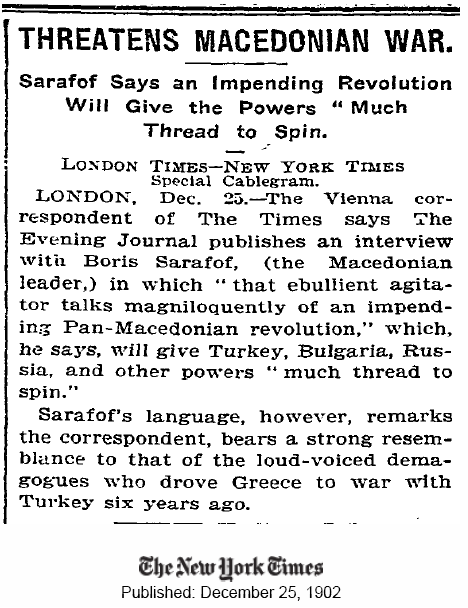
Daskalot, you should add the image of the original interview in the Times.

You can download it here: The Macedonian Agitation

I dug this up years ago in the Times digital archive, but the original post as text was given by Bosnian on Maknews.

@SoM you are welcome, job well done.

I don't say that Sarafov is a angel. I am aware that he was able to work against the Macedonian cause.

I guess this had to do with his Idea how Macedonia has to trow the Ottoman government.

He was to work with anybody to achieve this goal.

Some other things to read about him:

http://query.nytimes.com/mem/archive-free/pdf?res=9406E2D61E3DEE32A25756C2A9649D946397D6CF

http://query.nytimes.com/mem/archive-free/pdf?_r=1&res=9B07E4DB1E3BE631A2575BC2A9649C946597D6CF

http://query.nytimes.com/mem/archive-free/pdf?res=9E07E5D91E38E733A25754C0A9629C946097D6CF

http://query.nytimes.com/mem/archive-free/pdf?res=9901E2DC1230E733A25757C2A9659C946397D6CF

http://query.nytimes.com/mem/archive-free/pdf?res=9D07E7DC1039E333A25755C1A9669D946297D6CF

He was the patriot and the devil at times and certainly followed his own agenda. It was his downfall, as you say.
 
Last edited:
My grandma say that our family nick name is conected to this guy, Sarafi, i can not prove it, do you know the mine in Sasa, she shay that it beleonged in that time to his father (boris) i will ask her for the name, well folowing my root my garnd father had two brothers, all three of them had diferent surnames, Nikolov, Dimitrov and Petrov, so this are the names of their grand fathers, my grnd grand father name was Stojan the only thing that remaind is nick name from the past, Sarfot or Sarafci in Vinica.

When i was litlle i asked my grnd father what the nick was meaning,and he say ''GAZDA'', i saied to whom, and he say to whole region of Kamenica, Lukovica, Sasa.

Ironic thing, when we moved in Slovenia in 1985, we lived in small place called Lukovica also. Sudbina valjda?

Dont think i'm silly, but that is the way i know, will say more when get more info.:blush:
 
Here are the thoughts about Boris Sarafov from some other revolutionaries that were cited in their memoirs.

Sava Mihailov
Even from then I was compelled to agree with Delchev and Gjorcho, that it did not suit to trust Tsonchev, because we could forsee how they will again, like Sarafov, want to lead the Internal Organisation.

Atanas Lozancev
At the Smilevo Congress there was disarray among the warlords. One day Boris Sarafov told me, that he intended to shoot Jordan Piperkata.

Hristo Chernopeev
Even I also discontinued any links with Sarafov, I kept them only with Delchev………..I departed for Djumajsko with 8 people: Nikola Dechev of Stara Zagora and a young man, Aleksandar Drvodelov of Vraca; the other six were Macedonians. Then the battle began from the side of Sarafov against the Internal Organisation: so that Sarafov may enter as a supremist leader of the internals.

Jane Sandanski
I came to know Gjorche Petrov in Sofia during 1899. In the year 1900, when the battle against Sarafov begun, I had taken the side of the Internal Organisation.
 
My grandma say that our family nick name is conected to this guy, Sarafi, i can not prove it, do you know the mine in Sasa, she shay that it beleonged in that time to his father (boris) i will ask her for the name, well folowing my root my garnd father had two brothers, all three of them had diferent surnames, Nikolov, Dimitrov and Petrov, so this are the names of their grand fathers, my grnd grand father name was Stojan the only thing that remaind is nick name from the past, Sarfot or Sarafci in Vinica.

When i was litlle i asked my grnd father what the nick was meaning,and he say ''GAZDA'', i saied to whom, and he say to whole region of Kamenica, Lukovica, Sasa.

Ironic thing, when we moved in Slovenia in 1985, we lived in small place called Lukovica also. Sudbina valjda?

Dont think i'm silly, but that is the way i know, will say more when get more info.:blush:
Any more information Sarafot? Any connection between families from Vinica and Nevrokop?
 
Makedonin already had this link posted on this very topic but I think it's such a good topic that it needs a bump up;

sarafoff1902.png
 
fantastic thread great post som. the history of the great revoluntionary movement has been polluted by many different vested interests, and its time we began to rethink and rewrite our history by ourselves as macedonians not as anything else.
 
the evidence is building conclusively that the bulgarophil feeling of some of our people in the late 19th and early 20th centirues was in fact a result of the propaganda and terrror of the germano bulgarian kingdom.
 
Back
Top