• Welcome to the new Macedonian Truth Forum. All posts, members and private messages have been moved over from the old forum.

    Passwords from the old forum could not be carried over, so please use Forgot your password? to set a new one. The reset link is emailed to the address on your account.

  • Rules and Regulations at the forum of the Macedonian Truth Organisation (MTO)

    (1) The national-ethnic and cultural-linguistic identity of the Macedonian people is historically Macedonian, and derives its character from the native, indigenous and geographic homeland of the Macedonians, which is called Macedonia. To ensure that their human rights, integrity and heritage are appropriately respected, the only nouns and adjectives acceptable when reference is made to the above character and identity markers is Macedon, Macedonia, Macedonian and Macedonians.

    (2) The nation-state of the Macedonian people is the Republic of Macedonia, and is to be referred to by this official title so long as the 'republic' prefix is consistently applied to other states. Alternative references are the Macedonian Republic, or simply, Macedonia.

    (3) The 'ethnic' prefix is only acceptable for Macedonians in cases where differentiation is specifically required - so long as it is in context and consistent where it concerns its application to other ethnic groups.

    (4) Should any other differentiation be specifically required, the names of other ethnic groups that reside with Macedonians in either the Republic of Macedonia or the occupied Macedonian regions in Greece, Bulgaria, Serbia or Albania, are to be given a prefix.

    (5) Negating the identity, language and culture of the Macedonian people by deliberate avoidance of the terms Macedonia, Macedonian and Macedonians, or by any other means, is not permitted.

    (6) Systematic anti-Macedonian propaganda and rhetoric are not permitted.

    (7) Threads irrelevant to the Macedonian Cause, the community at the Macedonian Truth Organisation or the Macedonians in general may be considered as spam or not in the spirit of the forum. In such cases they are not permitted.

    (8) Continual posting of messages in threads with the sole purpose of deviating from the initial topics with the use of unrelated and unnecessary information is not permitted.

    (9) All posts, external articles, reports, etc that are cited in languages other than Macedonian or English, must be accompanied with a translation in one or both of the said languages.

    (10) Despite the possibility of some conversations and debates becoming heated, extreme abuse and/or racism, vulgar language and/or terminology, threats, revelation of personal information about others, harassment, and other such behavior will not be permitted. If deemed necessary all relevant information including member details will be reported to the appropriate authorities for investigation which may result in legal action.

    (11) Threads that are created must have a summary of a topic or excerpt of an article found in pertinent link(s) that have been included. One line threads will be considered unaccetable spam and are therefore not permitted.

    (12) Compulsive and deliberate lies, irrespective of the topic, are not permitted.

    (13) Any symbols or avatars found to be perceived as offensive to Macedonians are not permitted.

    (13) Any explicit or extreme material is not permitted.

    Failure to adhere to the above rules and regulations will result in a ban after 3 breaches. This may be reconsidered in some cases should the circumstances be of an unorthodox nature and/or require special consideration. To assure an effective deterrent against an individual or individuals with the sole purpose of causing dissent through spamming, racism or other improper means, the above rules will be strictly enforced.

    The MTO administration will monitor all discussions as reasonably practical and reserve the right to remove any post and/or member from the forum, and update the rules and regulations as required. Members are encouraged to immediately report any post and/or member to the MTO administration if they feel that these rules have not been abided by.

    The views expressed on this forum are those of the individuals. The only official representation of the MTO is made by the "Macedonian Truth Organisation (Site Owner)" username, and no other.

  • Macedonian Cause

    The Macedonian Truth Organisation calls on God in Heaven to protect, bless and guide the endeavour it is committing to undertake, and that is to work towards:

    Securing Macedonia as a free, independent and democratic republic in which sovereignty lies with the Macedonian citizens; as the nation-state of the Macedonian people in which they can preserve their culture, language and identity; as a state in which the Macedonian language and culture form the basis of public life and act as important unifying elements of Macedonian society; as the home of all its citizens to which it guarantees and obliges their inalienable natural rights and corresponding responsibilities;

    The acknowledgment as self-evident and irrefutable the existence of the:

    1) Indigenous, ethnonational name of Macedonia;
    2) Macedonian people, language and identity;
    3) Macedonian culture, symbols and folklore;
    4) Macedonian ancestry, heritage and history in its entirety; and
    5) Macedonian Orthodox Church;

    Securing recognition by the International Community of the tragedies endured by the Macedonian people, of the division of Macedonia with the signing of the Treaty of Bucharest on August 10, 1913, and the genocide committed against the Macedonian people at the hands of the Greek, Bulgarian and Serbian states and their respective churches during the 19th and 20th centuries;

    Ensuring that the Interim Accord is declared ‘null and void’ and that all constitutional provisions, acts, commitments, agreements, legislation, regulations, policies or programs emanating from, supporting or consequential to the Interim Accord are also declared ‘null and void’, including the use of any symbols and the completion of any acts imposed by, or originating from, the Interim Accord.

    Ensuring that the Framework Agreement is abolished and that all constitutional provisions, acts, commitments, agreements, legislation, regulations, policies and programs emanating from, supporting or consequential to the Framework Agreement are also abolished and replaced by a framework of constitutional and statutory law based on inalienable natural rights and corresponding responsibilities and universally codified human rights mechanisms.

    Securing the abolishment of any existing constitutional provisions, acts, agreements, legislation, regulations, policies and programs that discriminate against the Macedonian people, in any international organisation or any of the countries of the International Community where such constitutional provisions, acts, agreements, legislation, regulations, policies and programs exist, and thereby ensuring the freedom for Macedonians to exercise their inalienable natural rights and fulfil their corresponding responsibilities, and practice their culture, language and religious faiths in all the countries of the International Community without hindrance;

    The empowerment of Macedonians to undertake a moral revolution and to instil and/or reinvigorate within themselves a deep-rooted national, cultural, linguistic and historical dignity and a commitment to the exercise of freedom based on inalienable natural rights and corresponding responsibilities;

    The recognition of the Macedonian minorities in the neighbouring states of Macedonia as well as the respect for the inalienable rights and freedoms of the Macedonian minorities, as provided for by natural law and as codified by the United Nations Charter, the Universal Declaration of Human Rights and other universally codified human rights mechanisms;

    The full and unreserved respect of, and the support for, the rights of all people of non-Macedonian descent living in Macedonia and around the world, who share a reciprocal full and unreserved respect for the Macedonian people, their homeland and their state;

    The cultural unification and solidarity of the Macedonian people living in all parts of historical Macedonia and adjacent territories, as well as Macedonians throughout the world;

    The unity of all Macedonians on the principles, objectives and achievement of the Macedonian cause as defined by this declaration.

19th century Athenian Albanians didn't mind Elgin taking parthenon marbles!!!

Then there is the very thorny issue of whether modern nation-states can justifiably claim exclusive cultural rights to an ancient object created by a defunct civilization whose influence has spread far beyond its borders, a question raised by James Cuno, the highly respected director of the Art Institute of Chicago, who argues in defense of the benefits of the universal museum. Modern Greece is certainly not the same entity as ancient Athens, in the same way that modern Egypt is certainly not the land of the pharaohs. His dissection of the cultural history of the Rosetta Stone squarely argues against the importance of the object as an Egyptian relic, and in favor of it as a touchstone of European intellectual history, justifying its placement in the British Museum. In fact, as Cuno sees it, history is often cherry-picked to serve political ends, and cultural objects are used as pawns in political, nationalistic games. He argues that universal museums -- like the British Museum or the Louvre, which house objects representing cultures spanning broad expanses of time and geography, which are visited by millions of people every year -- promote tolerance and act as a hedge against the expedient and sometimes dangerous divisiveness of excessive nationalism. One need look no further than the 2001 destruction of Afghanistan's Bamiyan Buddha statues to fear for the safety of cultural treasures in ideological conflicts. On the other hand, the universal museums Cuno so eloquently defends certainly did not build these great collections in ways that would now be seen as entirely beyond reproach.

Precisely. This is all posturing by the New Greeks. Probably just another clever way of sending out a message to simple minded people that they are the ancient Greeks. (Its all smoke and mirrors by the New Greeks).
 
But there is more to this.

I found this in my papers (boxes and boxes of them. I have to get organized one of these days).

From the Galaxy, November 11, 1874


Just some food for thought.

Pelister thank you for that. It is undeniable that the modern "greeks" will do anything to revise history. What a shame. The extent of denial by the modern "greeks" has been at an all time disgusting level as of late with Macedonians who are denied basic human rights.
 
So what was the name of the modern "greek" who built the new Acropolis Museum we've been reading in this thread??? Oh that's right I forgot. He wasn't a modern "greek" at all but a Swiss architect Bernard Tschumi :lol:
It seems that a German recreated Athens. A Frenchman re-modeled Solun to look "hellenic". And now a Swiss architect was hired to create the museum that is to represent the symbol of their "hellenism" :21:

http://www.smh.com.au/travel/a-new-life-for-ancient-history-20090829-f2qv.html

According to the article in the link;

Naturally, the critics had a field day before it was even opened. Some pointed to the cost, some to the museum's position at the foot of the Acropolis rather than on it, others to the fact that a Swiss architect – Bernard Tschumi – was employed rather than a Greek.
 
The museum should have been built on the right hand side of Zeus' throne. Right next to other mythical moments preserved for posterity. For the glory of Greece! I would have visited it every day. Marvelous!
 
This article made me laugh because it's as if this writer just wanted to jab our southern neighbors in the ribs lol.

http://www.guardian.co.uk/artanddesign/2009/sep/26/ian-jack-museums-free-admission

A fiver for the Elgin marbles, anyone?
Only in Britain are all the national museums and galleries free – it is time to show our gratitude

Ian Jack The Guardian, Saturday 26 September 2009 Article history

You can come to London and see the Elgin marbles for nothing; at the new Parthenon Museum in Athens you'll pay €5 not to see them.

Interesting article inside besides this little amusing jab.
 
Greeks today cannot live to the expectations of the ancients so they want their elgin marbles back.But they forget that it's the British who helped perpetuate the greek myth of hellenes etc.The elgin marbles have more significance where they are as .In the end the greeks haven't cared enough otherwise they would have got them back sooner.
 
The greeks only care to make money out of the elgin marbles.As can be seen by many tourists visiting Athens,To take a photograph of the pathenon for example it's so many euros. to pass the fence to take a photo.One of my friends who went to greece recently said they forget that there is such a thing as Zoom lens.So everyone is out to milk the euro out of the tourists.My friend asked a cafe owner how come there's hardly anything in the athens museum on macedonia.He said no one gives a stuff it's all gone north to northern greece.No one takes it seriously here & there is no need for it here.
The cafe owner said all that hysteria it's all bullshit drummed up by the greek government & perfectly orchestrated by the media.They are like a pack of hungry wolves!
 
Last edited:
It could be a money thing motivating them.

I would bet however that they are more interested in representing themselves internationally as the inheritors of the ancient Hellenes. In other words its probably a propoganda/publicity stunt.
 
Todays imposter Hellenes lying to themselves again;

http://www.npr.org/templates/story/story.php?storyId=113889188&ps=cprs

For Greeks, the return of the Parthenon Marbles is an issue of national and cultural pride.

Maro Kakridi-Ferrari, professor in the philosophy department of Athens University, says the Parthenon — and what it symbolizes — were traumatized by the sculptures' removal.

"They are the material proof of what democracy has built in Athens of the Classical period," she says. "They are identified with the glory of ancient Greece, and they are part of the national identity."

Click the link and read the article as well as readers comments. One comment sticks out like a knife for me;

G G (Kokoropita) wrote:

I understand Mitchell H's point. True: the Greek state has certainly invested much of its educational apparatus into the construction of a nationalist myth, an uninterrupted continuum of culture beginning with the Athenian hegemony and continuing through the Macedonian occupation, the Roman occupation, the multicultural (though largely hellenophonic) Byzantine Empire, and the controversial Ottoman Occupation. But the fact remains that a national "Greek" identity never existed in any of these phases save the last.

True. Yet when Mitchell H. argues that Greece, as a modern nation, has not been manipulated and exploited by foreign powers, he reveals how little he understands the region. Greece only gained its independence as a nation because Britain wanted a proxy state in the Eastern Mediterranean: in order to protect its trade routes and fight Russian influence. The idea of Greek autonomy was a joke. More recently, during the Second World War, Germany invaded the nation and absolutely devasted its economy, confiscating local industries and agriculture and shipping it all abroad. Afterwards, as the Germans were pulling out and the local Greek resistence (ELAS) was gaining control, Britain again intervened and sparked a civil war.
The Junta that seized power in the late 1960s was given tactical and economic support from the United States (CIA). During this regime, free speech was banned, dissenters were imprisoned or exiled, and public dialogue was snuffed out.

I see that none of this has much to do with the Elgin marbles, but the point is, the West has always manipulated Greece (and the rest of the Balkan states) for its own advantage. This is not to say that it has not invested billions in Greece's infrastructure; without the U.S. aid of the post-war years, Greece would still be a third-world backwater. But that aid was certainly not given altruistically. It was given with an eye to U.S. interests, just as before the same was done by others.

As Thucydides writes, "It is a natural necessity that man rule over whatever he can. Neither did we make this law nor are we the first to use it. We found it already in use and we'll leave it to those who come after. But also we use it, knowing that you too, and others, if you had the power, would do the same."

And of course you see the imposter hellenes making a big stink out of teh decision their Albanian forefathers made when they decided not to really give a damn about a bunch of marbles.
 
Here's the Mitchell H comment the other reader commented on;

Mitchell H (Potomacker) wrote:

"when Greece was an unwilling member of the Ottoman Empire."
I have never understood why Greece has gotten a pass on so many aspects of its nationalist myth. The Ottoman empire conquered the Byzantine empire piecemeal, often raising the standards of living for the inhabitants. There was no Greece prior to the collapse of the Ottoman empire. Furthermore to suggest that the Parthenon is a monument of Greek achievement is to blur historical reality. It is the product of the Athenian empire, which reached its peak under Pericles, and crumbled precipitously. Art treasures have been segmented, divided, and housed in private collections and museum all across the globe. For which we all ought to be grateful. Most art treasures have been lost forever due to neglect and destruction.
The relocation of the Parthenian marbles have no basis in history nor aesthetics. They are simply pawns in a pathetic Greek campaign of nationalism that continues to portray Greece as a victim of foreign aggression while perpetuating the myth of its own timeless unity.
Monday, October 19, 2009 11:03:19 PM
 
It seems that many people are well aware of the lies that permeated out of modern "greece" where it concerns origins. I am happy to see this coming out more and more.
 
These people are far too well informed to be armchair critics. I would suggest their anonymity affords them more capacity to be truthful about Greece's history. I also suspect in their real jobs they would not be able to talk like this because the academic institutions have long been on the payroll of Greece's ministry of culture.
 
lowenthal.png

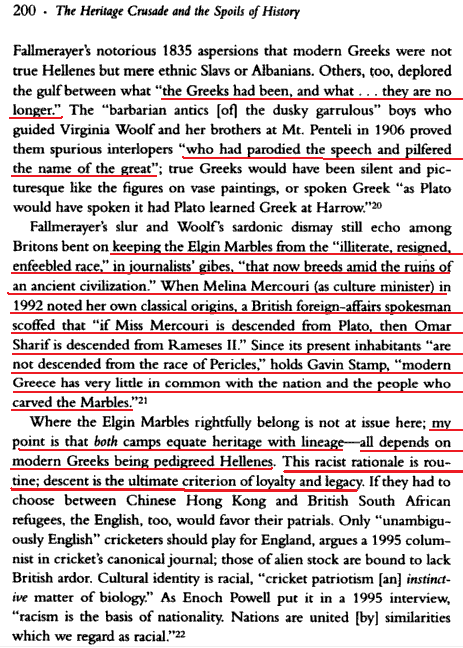
lowenthal200.png

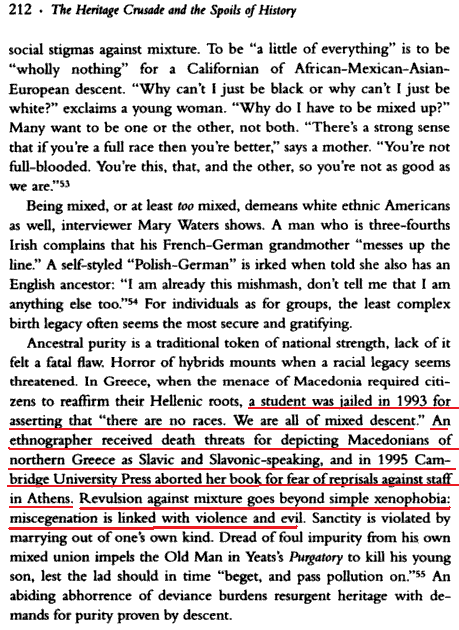
lowenthal212.png

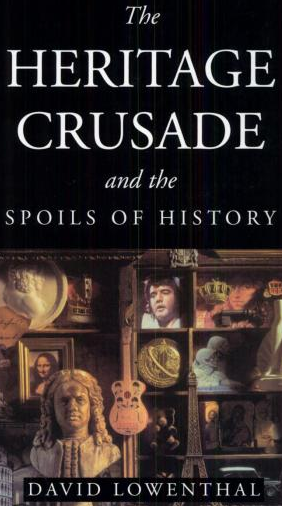
Thank you David Lowenthal for telling it like it is.
 
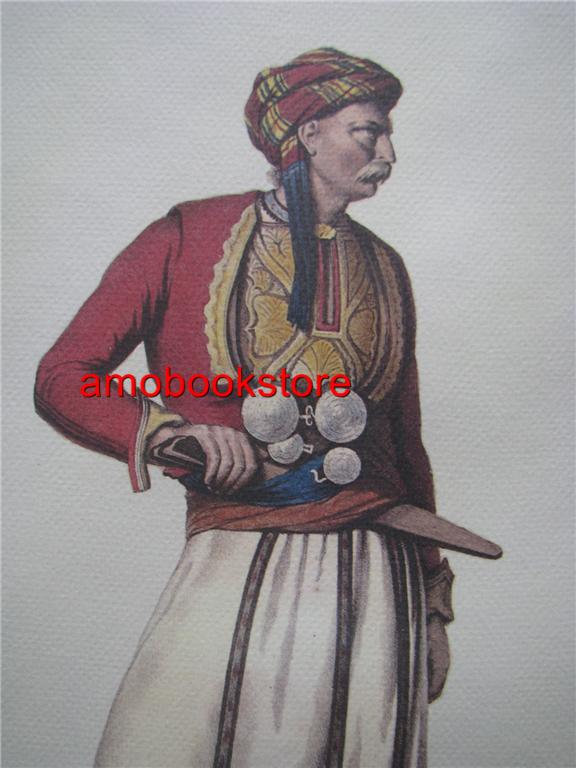
Here you have a "Greek" of XIX century:

149964359_o.jpg


Albanian in Athens 1839
LUIS DUPRE ,PUBLISHER: PORTO LEONE, ATHENS
 
A friend of mine emailed to me an interesting picture of a wedding ceremony of Albanians in "Plaka" which is still an important quarter of Athens.

28tb4a0.jpg


This picture gives an impression about how Albanians of Athens felt their identity. They were so proud of being Albanian, they singed and cried in Albanian, told fairy-tales and proverbs in Albanian, practiced the same customs as the rest of Albanians, had the same dress as Albanians, etc, etc. And after 1820-30 they were transformed magically in 'Greeks'. Now after they adopt in their corp a soul of 'Hellenism' they saw differently the world. They forgot their national identity and scandalously they try to usurp in the name of Hellenism the lands of others. In short, this history of our 'Ellines'.
 
They forgot their national identity and scandalously they try to usurp in the name of Hellenism the lands of others. In short, this history of our 'Ellines'.


Epirot, is there anyone among these people in central Greece who can speak Albanian or feel like Albanian? There should be a different dialect of Albanian language b4 all this in Greece, is it still alive?

As far as i see, all christian Albanians in Greece are fully hellenized but only the muslim ones resisted assimilation or Greeks didn't even try to assimilate them because of their different religion, i dunno. As we know that the Cham Albanians who resisted hellenization has been expelled out from Greece.
 
Last edited:
Epirot, is there anyone among these people in central Greece who can speak Albanian or feel like Albanian? There should be a different dialect of Albanian language b4 all this in Greece, is it still alive?

To be honest, in some district of Central Greece Albanian is dying fast because Greece do not permit Albanian schools. However, in other districts of Attica Albanian is still spoken. Many Albanian refugees during the last war in Kosova were settled temporarily at their Arvanite brethren.

It is true that Albanian dialect of them bears many archaic forms. But beside these changes and archaisms, an Albanian from Shkodra is able to communicate with an Arvanite, in the same way as he communicate with an Albanian from Calabria (southern Italy).

For instance, one of the prominent leaders of Arvanites, Aristidh Kola was from Kaskaveli of Thiva, in central Greece. It should be noted that he died in the same way as many Arvanite leaders died.

"Please do not feed any ilusions. I was killed and so have they acted with the other two presidents of the Arvanitas Society "Marko Botchari" whom also died from "leucemia". I've told these words to the other friends of mine..." The words of the great arvanitas Aristidh P. Kolia before his death. Here is an interesting article regarding Aristidh and his mysteriously death.

The Second Murder of Aristidh P. Kolia

"Please do not feed any ilusions. I was killed and so have they acted with the other two presidents of the Arvanitas Society "Marko Botchari" whom also died from "leucemia". I've told these words to the other friends of mine..." The words of the great arvanitas Aristidh P. Kolia before his death.


Written by KOLEC TRABOINI, Boston


Who hasn’t met the great arvanitas writer and hasn’t managed to read his writings, could never think how close to death this person was living, and this for two reasons, firstly, because all his life he had been searching both the light and dark sides of history, where bravery was mixed with infidelity, poison with the bullet and knife, and revealed the tragic end of the many arvanitas leaders who became famous through the history of Greece.
Secondly, even in the ones who until today they believe in the Great Idea to take over Albania, which reaches until the mouth of the ex-presidents like Saratzetakis, or even the kapsaliots who demand in publicity the return of Istambul in the Greek capital, they were organising plans for the neutralisation of Aristidh P. Kolia masterpiece and if it would be possible even his physical elimination.

In the extremist national newspapers, Aristidh Kolia was characterised as the enemy of Greece, as an Albanian agent, as a curse, and every possible accusations that could be told for someone. Everyone who knew the arvanitas writer would confirm that they had to do with a person of*good heart, calm, loving, patient, that was honoured to be a Greek citizen and at the same time, the Albanian blood that used to boil in his heart.

And exactly it was for the Albanian blood that the ghosts of the Great Idea used to hate him, which was also expressed from an Albanian athlete Piro Dhima who used to say that if he had Albanian blood running through his veins, then he would cut his veins so that not even one drop of that blood would remain from that nation where he was born and grew up.
In this atmosphere of humiliation towards Albanians and Arvanits, the writer and researcher Aristidh Kolia used to live.
But it was not only for the overall atmosphere, but also for the hidden and public threats for his life, threats that he had spoken about to his Albanian friend, the painter Robert Alia Dragot, who had worked two of his book covers.

Letters, phone calls, phonecall detections, followind every step, and especially during the war in Kosova, in the anxiety of the proserb and antialbanian greeks, the courage of the extremist greeks became even greater and they even reached at that point to fill the walls of the Greek capital with messages asking for the punishment with death of the writer of the book ‘Greece in the trap of Millosevic’s serbs’.

Aristidh Kolia, within the proserb Greece, had the courage to protect the liberation war rights of UCK at tens of TV programmes and everywhere at the greek media, by going against that hysterical propaganda against our Kosovan brothers, during the massacres of the barbaric serbs in Kosova and the bombings of NATO on the remainings of the called Yugoslavia.

Aristidh Kolia, as a leader of the Arvanitas community in Greece ‘Marko Bocari’, will be accused continuously from the ultranational greek orthodox powers, for the reality of the Kosova’s events, ( ‘I am also Kosovar – was written in his magazine ‘Arvanon’), and also for the reality of the Albanians in Greece, whom he represented through his community – recognisable from the Greek law. ‘He – the lawyer Ilir Malindi wrote – would be driven to the court from the ultrareactional greek organisation, and would be threatened with death. It is not a coincidence, that in the whole Athens, in summer 1999 (during the tragic events in Kosova) there were thousands of messages, where it was asked the hanging of Aristidh Kola and his death’.

It was that atmosphere, when a TV discussion directed from the commentator Liana Kaneli, of the greek TV ‘Skai’, turned into an aggressive attack from her and the other fanatic greeks of the media towards the invited writer Aristidh Kolia, as if he was the enemy of the whole Greece.
The arvanitas writer responded to the public attacks of the media with seriousness, without aggression, with a level that was suitable to his name as a great writer and researcher, whose writings were widely known and were re-edited many times.
‘Many friends called me to express their concerns about the mood that Mrs. Liana Kaneli threw on me, during the TV programme at ‘Skai’ 5 May 1999, and asked me why I faced it calm, while I should attack them back… My friends, do not worry and do not bitter for this, because ‘the truth reveals when its time comes’… I have loved and I do love my country, but my love is not with words but with my writings, which will be remembered when Mrs. Kaneli will be forgotten in time. I have always preferred to go against the stream and not from where the stream goes and where the air blows. I have never licked and I have never kissed the dirty feet and for this I am paying it very expensive and in a daily way with my honour of my knowledges and my freedom…’

However, the great heart of Aristidh Kolia knew how much stress and how much damage they brought to his creation, how many shakings they brought also to his family, because the pressure of the community opinion used to fall also upon his family, his relatives and friends.

Aristidh Kolia used to be followed in silence, in the intentions of trying to make his life hell, because he was the person who gave rebirth to the honour and pride of the many hundred of thousands of Arvanits around Greece. It was Aristidh Kolia the first arvanitas writer who wrote in his books that the Arvanits should be proud, because 90 per cent of the heroes of the revolution for the Greek Independence were arvanits from blood and language.

Thanks to his ability of history research, for which he left his profession of lawyer, he gave facts that not only the sons of the arvanits were the heroes of the Greek nation, but also that the culture and arts of Arvanits had now become part of the national Greek traditions including the songs, dresses and continued until he reached to explain the ancient greek mythology through the arvanitas language, the names of the Olympic gods, something that could not be explained through the greek language.
His book ‘Arvanits and the origin of Greeks’, was first edited in 1983, a volume book with more than 500 pages was edited more than ten times in Greece, and became like the Bible for the Arvanits, who had kept secret for so many years their feelings of pride for their origins of the Albanian blood.
Together with the book ‘The language of Gods’ first edited in 1989, which Aristidh Kolia used to consider as part of the chapter in the big book ‘Arvanits’, they made two monuments that Aristidh Kolia raised for his people, and with this monument his name remains immortal.

He together with the great Antonia Bellushi, in the year 1988, close to the national organisation, make officially known that in Greece live more than 2 million Albanians, and also that there were more than 600 accommodation centres of Albanian-speakers. This became public through many ways of media, starting from the magazine of Kozenca ‘Bond’ that was published from Papas Bellushi.

It was for these writings of his monumental aim and the acts of the national greek extremists, who dreamed their public burning in the court together with their heretic writer.
Without having power from the law (the Greek law is democratic), they used more diluted methods to make his life unaffordable with the hope that he would leave his writings. Firstly, they were asking, the killing of his creation by destroying its source, by creating stories that the author is a betrayer of Greece, in order to make the arvanits to go away from his writings, his organisations, the buyings and readings of the magazine that Aristidh Kolia used to publish as a leader of the Center of the Arvanits Research, in the beginning known with the name ‘Besa’ and later as ‘Arvanon’.
The use of the other diluted method which was also the platform of the greek media, newspapers and TV, was to make put dirt publicly about the Albanian emigrants as people born to kill and steal.

These kind of propagandas reached until the point to make a village near Athens with Arvanits habitants, to gather the whole village and make Albanians go away, by using the arms of fire and agricultural tools.

Aristidh Kolia was feeling the things that were happening, and was smelling the wrong intentions of the official propaganda that with one stone it could kill two birds, it used to put dirt upon the Albanian emigrants as an oppression to the Albanian government to give lands from the south of Albania, and secondly to make the arvanits population hate their own brothers of the same Albanian blood who came in Greece many centuries ago.

The arvanitas writer had the courage to stigmatize these sneaky trials of the greek media that used to synchronise perfectly with the ultranationalists of Greece.
All that anti-albanian propaganda, all that atmosphere with the aim of killing the honour of being Albanian, was counting to create the fascist desire for the Arvanits to consider themselves as the same blood with the emigrants of lower level who used to work as slaves for few drahmes without value, and in turn the creation of Aristidh would lose its colour, would be left aside as the writings of a person that does not know what he is saying. But, it did not happen like this. The creation of the great arvanitas writer met a distribution wider and wider, his magazine with research for the traditions and culture of the arvanits was in demand, and from the other side Kolia continued to publish new writings.
He had many books in his hands. He had so much work to do. Lately he was preparing the Arvanitas-Greek dictionary, which would distinguish the Arvanitas language from the official Greek language.
It had been for a while that he had expressed the idea of publishing a dictionary with a latin alphabet for the Albanians of Greece, so that he could bring closer the Albanian language and communication with history, culture and Albanian arts. Aristidh Kola used to cooperate with all the circles of Albanian diaspora around the world. He kept the connections and always cooperated with the Albanians in USA, with his close friend and co-researcher Papas Antonio Belushi in Kozenc of Italy, with the intellectuals of Kosova, Macedonia, Turkey and Albania. He was connected even with the Arberesh of Korsike.

As if he felt the danger of being threatened, he published a writing, and for its publishing he invited researchers, and many friends, from Greece, Albania and Italy. His closest friend had also come, the Italian researcher, Antonio Bellusi and also the Albanian ambassador in Athens, Kastriot Robo.
It was 24 May. It was the publishing of the book, when the 55 years old writer Aristidh Kolia started to feel sudden pain that hadn’t felt before. Something was happening to his organism. He was feeling something bad.
It crossed his mind all the curses and the threatens for his death a year ago. He had a hot summer in Athens with many extraordinary side effects for his sudden situation and for the luck of his writings that he was holding in his hands. September found him in bed. October was damaging his body.
Friends used to come but he couldn’t accept the sympathises. It crossed his mind as a vision, the luck of the Arvanit historical personalities for whom he had written in his own great creation ‘Arvanits’.
Teodor Kollokotroni was poisoned in jail, even though he never said with words that he was Arvanit, and his real surname kept through generations was Bithguri, Gjergj Karaskaki was killed by a trap and his last word when he caught the bullet was in the Arvanit language.
They had killed many others, including the Arvanit hero Laskarina Bubulina.
Who doesn’t know the story of the poisoned coffee aiming to vanish the famous arvanit of the previous century, the journalist from Salamina, Anastas Kullurioti?
Until lately the leakage of the poison and the bullet had reached the lives of two presidents of the community ‘Marko Bocari’. These two were more memorable to him, as they were much closer to his time. They had also been, like him, president of arvanits of Greece. And the diagnosis for both sudden deaths had been the same: Leukemia. The same symptom of deathbroughter for three presidents of arvanits of Greece, Two lives taken mysteriously, from the hands that never appear in the scene, and a third life was coming soon. It was his.

In one of the last meetings next to the bed of death, the Albanian ambassador together with the Albanian lawyer Ilir Malindi had gone to see him, and the lawyer said:
‘I had the chance to visit the great Aristidh Kola, in the last day of his life, in the hospital of Athens ‘Evangjelismos’ and I saw his hopeless situation. He told me that he was happy that the Albanian newspapers had written for his sickness… I gave him courage, saying that he would recover very soon and that together we would continue the research and new publications, but…. Ahhh! He, with disappointment and pride at the same time, told us these words:
‘Please do not feed any illusion. They killed me and that is how they have acted for other two leaders of the Albanian community ‘Marko Bocari’, who also died from ‘leukemia’. I have said these words also to my other friends’ …
‘I went to see him again in the first days of October- the Albanian ambassador told me from a phone discussion from Athens- but when I called him from the first floor of the hospital ‘Evangjelismo’, that is close to the embassy, he told me that that day he was feeling very bad, and would welcome his visit one of the following days. Four days later, they inform me that Aristidh died. They were extremely sad news’.

It was 11 October 2000 the day that the mysterious physical death of the writer and leader of Arvanits happened, in order to add another enigmatic death in the Greek history.

However, the second murder continues. And this happens in a platform not at all mystical and silent as the physical elimination of the writer. Everything possible is done to burry his writings together with his body. In Athens for the death of Aristidh Kolia, only one newspaper wrote. The magazine ‘Klan’ in Albania refused the publication of the writing for the death with the reason that ‘this topic is covered by the newspaper ‘Albania’.’ His close arvanit friends remained hesitated and shocked from the happening and maybe from the fear. The question that I asked to the current president of arvanits Jorgo Jeru, if he intends to edit any declaration, necrology, or communication for the creation of the great writer, he told me that they do not have any plans.

The death happened in a silent dark way. The national greeks from the black bushes, where not satisfied with the physical elimination of the great arvanit who gave rebirth to ‘the language of Gods’, now they were prepared to attack and bring death again to his creations.
If the arvanits and Albanians will not understand this black mission of the Greek Great Idea( Megaloidhea), that does not even save the money and the poison, with the black intentions towards arvanits, emigrants and all the Albanian nation, then each of us, has taken his/her part with their silence in the second murder of Aristidh Kolia. The creation of the great Aristidh Kolia, that deserves a place of honour in the historic Albanian letters, can kill it both our lack of interest and the unwill of giving.
Let us think for today so that our self-consciousness does not kill us tomorrow!

'DIELLI" Vol.91, Nr.4 2000, New York

As far as i see, all christian Albanians in Greece are fully hellenized but only the muslim ones resisted assimilation or Greeks didn't even try to assimilate them because of their different religion, i dunno. As we know that the Cham Albanians who resisted hellenization has been expelled out from Greece

That's true! All of Albanian Muslims were able to preserve their identity because they were not depend of Church policies who managed to hellenize all Albanian orthodoxes.
 
Last edited:
Back
Top