• Welcome to the new Macedonian Truth Forum. All posts, members and private messages have been moved over from the old forum.

    Passwords from the old forum could not be carried over, so please use Forgot your password? to set a new one. The reset link is emailed to the address on your account.

  • Rules and Regulations at the forum of the Macedonian Truth Organisation (MTO)

    (1) The national-ethnic and cultural-linguistic identity of the Macedonian people is historically Macedonian, and derives its character from the native, indigenous and geographic homeland of the Macedonians, which is called Macedonia. To ensure that their human rights, integrity and heritage are appropriately respected, the only nouns and adjectives acceptable when reference is made to the above character and identity markers is Macedon, Macedonia, Macedonian and Macedonians.

    (2) The nation-state of the Macedonian people is the Republic of Macedonia, and is to be referred to by this official title so long as the 'republic' prefix is consistently applied to other states. Alternative references are the Macedonian Republic, or simply, Macedonia.

    (3) The 'ethnic' prefix is only acceptable for Macedonians in cases where differentiation is specifically required - so long as it is in context and consistent where it concerns its application to other ethnic groups.

    (4) Should any other differentiation be specifically required, the names of other ethnic groups that reside with Macedonians in either the Republic of Macedonia or the occupied Macedonian regions in Greece, Bulgaria, Serbia or Albania, are to be given a prefix.

    (5) Negating the identity, language and culture of the Macedonian people by deliberate avoidance of the terms Macedonia, Macedonian and Macedonians, or by any other means, is not permitted.

    (6) Systematic anti-Macedonian propaganda and rhetoric are not permitted.

    (7) Threads irrelevant to the Macedonian Cause, the community at the Macedonian Truth Organisation or the Macedonians in general may be considered as spam or not in the spirit of the forum. In such cases they are not permitted.

    (8) Continual posting of messages in threads with the sole purpose of deviating from the initial topics with the use of unrelated and unnecessary information is not permitted.

    (9) All posts, external articles, reports, etc that are cited in languages other than Macedonian or English, must be accompanied with a translation in one or both of the said languages.

    (10) Despite the possibility of some conversations and debates becoming heated, extreme abuse and/or racism, vulgar language and/or terminology, threats, revelation of personal information about others, harassment, and other such behavior will not be permitted. If deemed necessary all relevant information including member details will be reported to the appropriate authorities for investigation which may result in legal action.

    (11) Threads that are created must have a summary of a topic or excerpt of an article found in pertinent link(s) that have been included. One line threads will be considered unaccetable spam and are therefore not permitted.

    (12) Compulsive and deliberate lies, irrespective of the topic, are not permitted.

    (13) Any symbols or avatars found to be perceived as offensive to Macedonians are not permitted.

    (13) Any explicit or extreme material is not permitted.

    Failure to adhere to the above rules and regulations will result in a ban after 3 breaches. This may be reconsidered in some cases should the circumstances be of an unorthodox nature and/or require special consideration. To assure an effective deterrent against an individual or individuals with the sole purpose of causing dissent through spamming, racism or other improper means, the above rules will be strictly enforced.

    The MTO administration will monitor all discussions as reasonably practical and reserve the right to remove any post and/or member from the forum, and update the rules and regulations as required. Members are encouraged to immediately report any post and/or member to the MTO administration if they feel that these rules have not been abided by.

    The views expressed on this forum are those of the individuals. The only official representation of the MTO is made by the "Macedonian Truth Organisation (Site Owner)" username, and no other.

  • Macedonian Cause

    The Macedonian Truth Organisation calls on God in Heaven to protect, bless and guide the endeavour it is committing to undertake, and that is to work towards:

    Securing Macedonia as a free, independent and democratic republic in which sovereignty lies with the Macedonian citizens; as the nation-state of the Macedonian people in which they can preserve their culture, language and identity; as a state in which the Macedonian language and culture form the basis of public life and act as important unifying elements of Macedonian society; as the home of all its citizens to which it guarantees and obliges their inalienable natural rights and corresponding responsibilities;

    The acknowledgment as self-evident and irrefutable the existence of the:

    1) Indigenous, ethnonational name of Macedonia;
    2) Macedonian people, language and identity;
    3) Macedonian culture, symbols and folklore;
    4) Macedonian ancestry, heritage and history in its entirety; and
    5) Macedonian Orthodox Church;

    Securing recognition by the International Community of the tragedies endured by the Macedonian people, of the division of Macedonia with the signing of the Treaty of Bucharest on August 10, 1913, and the genocide committed against the Macedonian people at the hands of the Greek, Bulgarian and Serbian states and their respective churches during the 19th and 20th centuries;

    Ensuring that the Interim Accord is declared ‘null and void’ and that all constitutional provisions, acts, commitments, agreements, legislation, regulations, policies or programs emanating from, supporting or consequential to the Interim Accord are also declared ‘null and void’, including the use of any symbols and the completion of any acts imposed by, or originating from, the Interim Accord.

    Ensuring that the Framework Agreement is abolished and that all constitutional provisions, acts, commitments, agreements, legislation, regulations, policies and programs emanating from, supporting or consequential to the Framework Agreement are also abolished and replaced by a framework of constitutional and statutory law based on inalienable natural rights and corresponding responsibilities and universally codified human rights mechanisms.

    Securing the abolishment of any existing constitutional provisions, acts, agreements, legislation, regulations, policies and programs that discriminate against the Macedonian people, in any international organisation or any of the countries of the International Community where such constitutional provisions, acts, agreements, legislation, regulations, policies and programs exist, and thereby ensuring the freedom for Macedonians to exercise their inalienable natural rights and fulfil their corresponding responsibilities, and practice their culture, language and religious faiths in all the countries of the International Community without hindrance;

    The empowerment of Macedonians to undertake a moral revolution and to instil and/or reinvigorate within themselves a deep-rooted national, cultural, linguistic and historical dignity and a commitment to the exercise of freedom based on inalienable natural rights and corresponding responsibilities;

    The recognition of the Macedonian minorities in the neighbouring states of Macedonia as well as the respect for the inalienable rights and freedoms of the Macedonian minorities, as provided for by natural law and as codified by the United Nations Charter, the Universal Declaration of Human Rights and other universally codified human rights mechanisms;

    The full and unreserved respect of, and the support for, the rights of all people of non-Macedonian descent living in Macedonia and around the world, who share a reciprocal full and unreserved respect for the Macedonian people, their homeland and their state;

    The cultural unification and solidarity of the Macedonian people living in all parts of historical Macedonia and adjacent territories, as well as Macedonians throughout the world;

    The unity of all Macedonians on the principles, objectives and achievement of the Macedonian cause as defined by this declaration.

Macedonians in the East Roman Empire

Good work TM, another set of interesting sources. This quote in particlar stands out:

"The Byzantines were Romans who happened to speak Greek, and not Greeks who happened to call themselves Romans"


How true, how true, a living contradiction, just like the title of the book "Hellenism in Byzantium", lol.
 
Thanks SoM. I posted some of Kalledis' pages in this thread here - http://www.macedoniantruth.org/forum/showthread.php?t=542&page=4

And here's something I just found;

http://books.google.com/books?pg=PA41&dq=romanized+slavs&lr=&id=1S5zGxF8VMoC&as_brr=3

It would appear that Maurice had intended to break down the barrier, which had been interposed in the fourth century, between the class which paid the taxes and that which recruited the national army. ' We wish,' he writes; ' that every young Roman of free condition should learn the use of the bow, and should be constantly provided with that weapon and with two javelins.' If, however, this was intended to be the first step towards the introduction of universal military service, the design was never carried any further. Three hundred years later Leo is found echoing the same words, as a pious wish rather than as a practical expedient. The rank and file, however, of the imperial forces were now raised almost entirely within the realm, and well nigh every nation contained in its limits, except the Greeks, furnished a considerable number of soldiers. The Armenians and Isaurians in Asia, the ' Thracians' and ' Macedonians'—or more properly the semi-Romanized Slavs—in Europe, were considered the best material by the recruiting officer.

The Art of War in the Middle Ages, A. D. 378-1515 By Charles William Chadwick Oman page 41
 
http://www.questia.com/PM.qst?a=o&d=102924949

Sometime about 470, three young peasants from upper Macedonia abandoned their struggle with poverty at home and left for Constantinople, travelling on foot, with only some toasted bread wrapped up in their cloaks for food. We know their names, and two are recognizably Thracian; Zimarchus, Dityvistus. The third, Justin, was probably of Thracian origin as well. Justin, and perhaps his companions too, were from Bederiana, the name of which has survived in a village called Bader near modern Skopje in Macedonia. When these three reached the capital, they found that the emperor Leo was organizing the Excubitores as a new corps of palace guards intended to counterbalance the influence of the German federate troops, and since they were strong, healthy young men, they were promptly enrolled. Zimarchus and Dityvistus thereupon disappeared from history, but their companion was to become the emperor Justin I.
I thought it worthy to note as Serbs tend to try and claim Justin and Justinian for themselves, even though Bederiana (Bader) and Tauresium (Taor) are both in Macedonian territory, not Serbian.
 
"The Byzantines were Romans who happened to speak Greek, and not Greeks who happened to call themselves Romans"

while greek was the official language i very much doubt that many people in the empire actually spoke greek, it was a multi cultural multi lingual empire and the majority of its population would have spoken their native language only. greek would have been limited to a very small section of the population.

if greek was the language of the empire we would most likely have a similar situation that exists in the west with latin forming the basis of all the languages spoken. even constantinople was a totally multilingual city, with over 40 languages spoken by its citizens.

i would suggest that in the smaller cities the lingua franca would not have been greek, witness the remarks of the emperor who chose cyril and methodius as missionaries, didnt he say they are Thessalonians and all thessalonians speak slav. to me that suggests that slavic was the peoples language of the empires 2nd largest city and most likely throughout the whole balkan peninsula including parts of greece during the 9th to 12 centuries.

the problem is that historians are to constantinople centric and that has colored their view of cultural and linguistic makeup of the empire
 
Could the following be regarded as an accurate general summation of the re-emerging objectivist interpretation of the period in question?

As the Gothic Insurrection, which Procopius had recorded earlier, swept through the Eastern Roman Empire, dividing populations into authoritarian loyalists (Romans) and egalitarian separatists (Sklavenes), colonial rule among the Romans had come to be eclipsed by indigenous leaders, who often shared the same ethnic backgrounds as those who continued to oppose the ruling class and those who this ruling class governed. Political divisions, once fairly absolute, blended together in certain areas, with economic and political interests blurring sides in military conflicts, producing the Antic division among the indigenous military democracies, for example. Religious division continued to further fragment the region’s populations, as well, with belief systems such as Arianism, which was adopted by Getic populations earlier on, prying away at political uniformity.

________________________

St. Columban

“the land of the Veneti, who are also called Sclavi.”

“the land of the Venetians, who we also now refer to as Sklavi, because they fought alongside the Thracians.”

“The land of the Americans, who are also informally called Yankees, because they rejected British subjugation in favor of independence.”

The Yankee Language Group?

The Ethnogenesis of the Yankees?

The New York Slavs?

_______________________​
What I thought was really interesting when I was reading these passages was that, what had come to be viewed as a gradual collapse of the Eastern Roman Empire due to (uncivilized) external forces during the 19th Century by Western European nationalist scholars was actually viewed as more of an internal implosion by those who actually experienced these events; a classic case of class struggle that arose out of a previous period of more isolated waves of rebellion and non-Roman (Venetic,etc.) military interventions in many ways.

An excellent collection of research material, many thanks to many people.
 
Sovius said:
As the Gothic Insurrection, which Procopius had recorded earlier, swept through the Eastern Roman Empire, dividing populations into authoritarian loyalists (Romans) and egalitarian separatists (Sklavenes), colonial rule among the Romans had come to be eclipsed by indigenous leaders, who often shared the same ethnic backgrounds as those who continued to oppose the ruling class and those who this ruling class governed.
And often shared the same origins as the 'Slavs' from the Danube, what you suggest is very probable indeed.
 
The Danube River represented an equator of sorts for populations archeologically defined as the Neolithic Balkan Painted and Impressed Pottery cultures, which also extended well into Northwestern Anatolia. The Getae regained Dacia from the Romans, the northernmost region of this Neolithic zone of cultural uniformity, in 292 AD. The Dacians were regarded as a kindred people to the Thracians, who existed largely on the other side of the Danube and spoke a language similar to the Dacian language.

Looking through the eyes of the Romans, we have a political border defined by a water system, but through Gothic eyes, this river represented a partition of their motherland, if we are to incorporate genetic evidence demonstrating population continuity in the region since before the Neolithic Period.

It’s within the general region of Dacia, where archeologists have found evidence of admixture between both Linear Pottery cultures and Trypolye-Cucuteni cultures to the Northwest and Northeast respectively. Beyond the Carpathians, a period of admixture occurred between populations representing Linear Pottery and Trypolye-Cucuteni material traits during the Neolithic Period, as well.

It’s interesting to note that the region of Dacia was an early cultural center during what has been generically classified as Europe’s Urnfield Period. It may well come to be that what was left unwritten during the Ancient Period may be of more value to contemporary historical researchers in terms of gaining a more complete understanding of the cultural and political dynamics during this era than the written record. There was a motivation displayed in the military conflicts recorded during this period that remains defined by this region’s archeological record. Before the Romans conquered the Dacians, who conquered the Romans?
 
Sovius said:
Looking through the eyes of the Romans, we have a political border defined by a water system, but through Gothic eyes, this river represented a partition of their motherland, if we are to incorporate genetic evidence demonstrating population continuity in the region since before the Neolithic Period.
Well said, I would also include available historical data of the people in the region.
 
varangian.png

varangian52.png
 
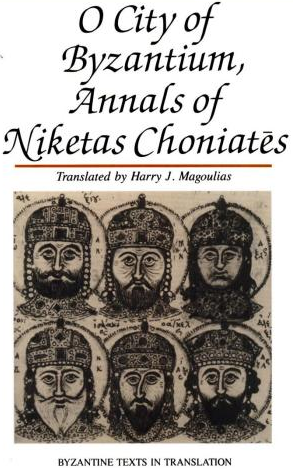
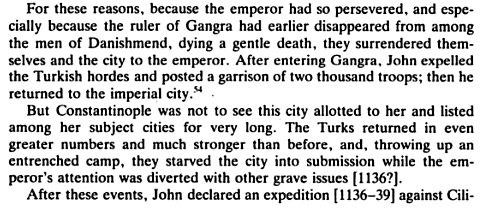
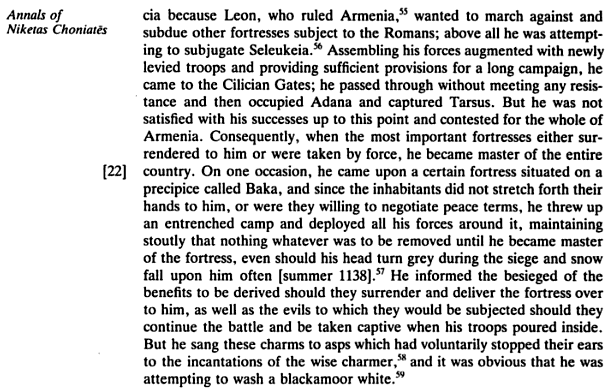
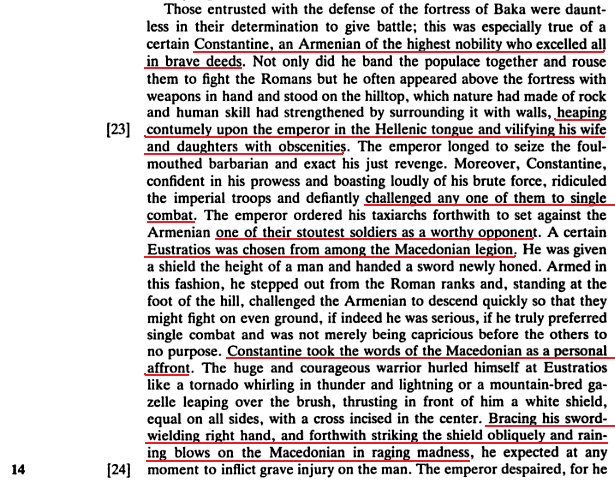
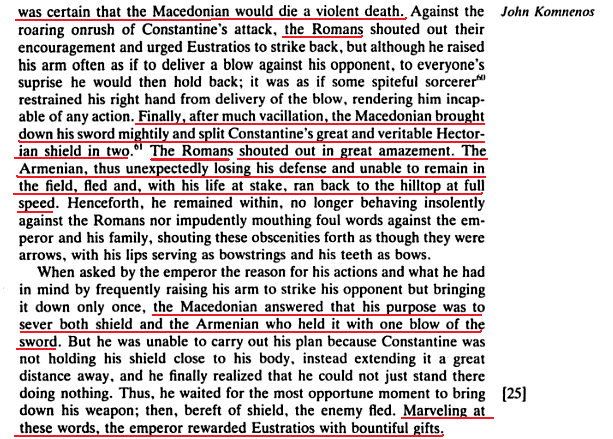
Doing my research on Eustratios I noticed that some imposter hellenes make the arguement that his name is "greek". That arguement stinks like :shit: considering that the Armenian he fought would supposedly have a "greek" name. Funny how the armenian also spoke "hellenic" or more appropriately, according to scholar Anthony Kalldellis, he spoke "Roman". Also the soldiers rooting for Eustratios were called Roman and not "greek". Considering also what Nicetas Choniates own brother has to say about Athens during this period - http://www.macedoniantruth.org/forum/showthread.php?t=1855 -
I highly doubt that any ancient Hellenes survived passed the 3rd or 4th centuries A.D.
Sorry imposter hellenes. Better luck usurping entire empires next time.
 
Again, excellent sources, and well done on revealing some more information about the Macedonian Niketas who spoke the Slavonic tongue and became the Patriarch, there isn't much around about him.
 
Back
Top