
• Welcome to the new Macedonian Truth Forum. All posts, members and private messages have been moved over from the old forum.

    Passwords from the old forum could not be carried over, so please use Forgot your password? to set a new one. The reset link is emailed to the address on your account.

  • Rules and Regulations at the forum of the Macedonian Truth Organisation (MTO)

    (1) The national-ethnic and cultural-linguistic identity of the Macedonian people is historically Macedonian, and derives its character from the native, indigenous and geographic homeland of the Macedonians, which is called Macedonia. To ensure that their human rights, integrity and heritage are appropriately respected, the only nouns and adjectives acceptable when reference is made to the above character and identity markers is Macedon, Macedonia, Macedonian and Macedonians.

    (2) The nation-state of the Macedonian people is the Republic of Macedonia, and is to be referred to by this official title so long as the 'republic' prefix is consistently applied to other states. Alternative references are the Macedonian Republic, or simply, Macedonia.

    (3) The 'ethnic' prefix is only acceptable for Macedonians in cases where differentiation is specifically required - so long as it is in context and consistent where it concerns its application to other ethnic groups.

    (4) Should any other differentiation be specifically required, the names of other ethnic groups that reside with Macedonians in either the Republic of Macedonia or the occupied Macedonian regions in Greece, Bulgaria, Serbia or Albania, are to be given a prefix.

    (5) Negating the identity, language and culture of the Macedonian people by deliberate avoidance of the terms Macedonia, Macedonian and Macedonians, or by any other means, is not permitted.

    (6) Systematic anti-Macedonian propaganda and rhetoric are not permitted.

    (7) Threads irrelevant to the Macedonian Cause, the community at the Macedonian Truth Organisation or the Macedonians in general may be considered as spam or not in the spirit of the forum. In such cases they are not permitted.

    (8) Continual posting of messages in threads with the sole purpose of deviating from the initial topics with the use of unrelated and unnecessary information is not permitted.

    (9) All posts, external articles, reports, etc that are cited in languages other than Macedonian or English, must be accompanied with a translation in one or both of the said languages.

    (10) Despite the possibility of some conversations and debates becoming heated, extreme abuse and/or racism, vulgar language and/or terminology, threats, revelation of personal information about others, harassment, and other such behavior will not be permitted. If deemed necessary all relevant information including member details will be reported to the appropriate authorities for investigation which may result in legal action.

    (11) Threads that are created must have a summary of a topic or excerpt of an article found in pertinent link(s) that have been included. One line threads will be considered unaccetable spam and are therefore not permitted.

    (12) Compulsive and deliberate lies, irrespective of the topic, are not permitted.

    (13) Any symbols or avatars found to be perceived as offensive to Macedonians are not permitted.

    (13) Any explicit or extreme material is not permitted.

    Failure to adhere to the above rules and regulations will result in a ban after 3 breaches. This may be reconsidered in some cases should the circumstances be of an unorthodox nature and/or require special consideration. To assure an effective deterrent against an individual or individuals with the sole purpose of causing dissent through spamming, racism or other improper means, the above rules will be strictly enforced.

    The MTO administration will monitor all discussions as reasonably practical and reserve the right to remove any post and/or member from the forum, and update the rules and regulations as required. Members are encouraged to immediately report any post and/or member to the MTO administration if they feel that these rules have not been abided by.

    The views expressed on this forum are those of the individuals. The only official representation of the MTO is made by the "Macedonian Truth Organisation (Site Owner)" username, and no other.

  • Macedonian Cause

    The Macedonian Truth Organisation calls on God in Heaven to protect, bless and guide the endeavour it is committing to undertake, and that is to work towards:

    Securing Macedonia as a free, independent and democratic republic in which sovereignty lies with the Macedonian citizens; as the nation-state of the Macedonian people in which they can preserve their culture, language and identity; as a state in which the Macedonian language and culture form the basis of public life and act as important unifying elements of Macedonian society; as the home of all its citizens to which it guarantees and obliges their inalienable natural rights and corresponding responsibilities;

    The acknowledgment as self-evident and irrefutable the existence of the:

    1) Indigenous, ethnonational name of Macedonia;
    2) Macedonian people, language and identity;
    3) Macedonian culture, symbols and folklore;
    4) Macedonian ancestry, heritage and history in its entirety; and
    5) Macedonian Orthodox Church;

    Securing recognition by the International Community of the tragedies endured by the Macedonian people, of the division of Macedonia with the signing of the Treaty of Bucharest on August 10, 1913, and the genocide committed against the Macedonian people at the hands of the Greek, Bulgarian and Serbian states and their respective churches during the 19th and 20th centuries;

    Ensuring that the Interim Accord is declared ‘null and void’ and that all constitutional provisions, acts, commitments, agreements, legislation, regulations, policies or programs emanating from, supporting or consequential to the Interim Accord are also declared ‘null and void’, including the use of any symbols and the completion of any acts imposed by, or originating from, the Interim Accord.

    Ensuring that the Framework Agreement is abolished and that all constitutional provisions, acts, commitments, agreements, legislation, regulations, policies and programs emanating from, supporting or consequential to the Framework Agreement are also abolished and replaced by a framework of constitutional and statutory law based on inalienable natural rights and corresponding responsibilities and universally codified human rights mechanisms.

    Securing the abolishment of any existing constitutional provisions, acts, agreements, legislation, regulations, policies and programs that discriminate against the Macedonian people, in any international organisation or any of the countries of the International Community where such constitutional provisions, acts, agreements, legislation, regulations, policies and programs exist, and thereby ensuring the freedom for Macedonians to exercise their inalienable natural rights and fulfil their corresponding responsibilities, and practice their culture, language and religious faiths in all the countries of the International Community without hindrance;

    The empowerment of Macedonians to undertake a moral revolution and to instil and/or reinvigorate within themselves a deep-rooted national, cultural, linguistic and historical dignity and a commitment to the exercise of freedom based on inalienable natural rights and corresponding responsibilities;

    The recognition of the Macedonian minorities in the neighbouring states of Macedonia as well as the respect for the inalienable rights and freedoms of the Macedonian minorities, as provided for by natural law and as codified by the United Nations Charter, the Universal Declaration of Human Rights and other universally codified human rights mechanisms;

    The full and unreserved respect of, and the support for, the rights of all people of non-Macedonian descent living in Macedonia and around the world, who share a reciprocal full and unreserved respect for the Macedonian people, their homeland and their state;

    The cultural unification and solidarity of the Macedonian people living in all parts of historical Macedonia and adjacent territories, as well as Macedonians throughout the world;

    The unity of all Macedonians on the principles, objectives and achievement of the Macedonian cause as defined by this declaration.

History of the Modern Serbs

Soldier of Macedon

Senior Member
Below is collection of information from this forum and other sources, presenting a chronology of Serbian historical events where reference to the inhabitants and areas as Bulgarian and/or Greek is prevalent. The purpose is not to demonstrate that Serbs are the latter two, but that such terms are as insignificant to them as they are to the Macedonians and any others they applied to in the relevant centuries.


9th Century
http://www.beograd.org.yu/cms/view.php?id=201243
The town was mentioned again not until the IX century, under the Slavic name BEOGRAD (White Town - probably because of the walls made of white limestone). It was in a letter of April 16, 878 which Pope John VIII wrote to the Bulgarian prince Boris-Mihailo, about the dismissal of a Christian bishop Sergije.
Later, this name appeared in several variants: ALBA GRAECA, GRIECHISCH WEISSENBURG, NANDOR ALBA, NANDOR FEJERVAR, CASTELBIANCO, ALBA BULGARICA.

14th Century
The Travels of Sir John Mandeville, by Sir John Mandeville, 1357
And the King of Hungary is a great lord and a mighty, and holdeth great lordships and much land in his hand. For he holdeth the kingdom of Hungary, Sclavonia, and of Comania a great part, and of Bulgaria that men call the land of Bougiers……….

And after, go men to Belgrade, and enter into the land of Bougiers
; and there pass men a bridge of stone that is upon the river of Marrok.

17th Century
http://www.vostlit.info/Texts/rus/Lechaci/frametext1.htm
Simeon Lehaci, Balkan Traveller of Armenian origin, 1608-1620.
In Bosnia, everywhere there are also many Bulgarian monasteries .... In Bosnia, all the people speak in Bulgarian........

19th Century (Early)
Mark Mazower, The Balkans
As late as 1810, for instance, there were only two elementary schools in the Pashalik of Belgrade(the core of future Serbia), and in both the language of instruction was Greek.

19th Century (Mid)
Victor Roudometof, Nationalism,Orthodoxy, and Globalization
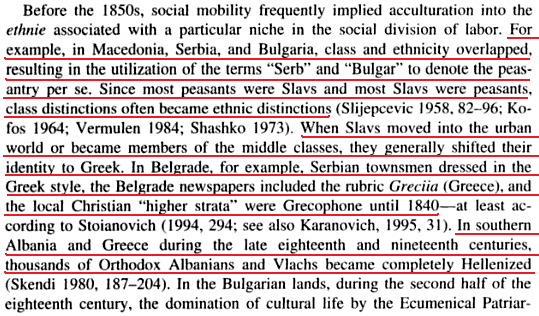
nog48.png


TrueMacedonian, Daskalot and others, if you guys have more please add it here. One question I would like answered is how many times was the language of the Serbs referred to as 'Serbian' prior to the 19th century? Puchki was the common term as far as I know, any further information would be useful.
 
throughout many parts of Austria-Hungary to be a Serb meant to be a peasant and vice versa

Austrian history yearbook, page 43, By Rice University, American Historical Association. Conference Group for Central European History, University of Minnesota. Center for Austrian Studies.
 
I have noticed that the term Sebar, which meant commoner or peasant, has been a rejected theory as to the name of the Serbs themselves. Maybe it wouldn't be a bad idea to look more into this name "sebar".
 
Serb, Croat and Bulgar are all non-Slavic names that have a likely Iranic origin, and for the latter possibly even Turkic.

Albania and Montenegro are both Latin names yet neither one or the other is Latin.

Even the words Greece and Athens have no recognised 'Hellenic' etymology.

Yet most of the above are too busy trying to negate Macedonian history, when they can't even explain the official and international names of their states in their own languages.

That the 'Serb' name was used as a synonym for a Slavic peasant is beyond doubt, the user Bosnian once cited texts where the Serb and Bulgar names are mentioned as far as Dalmatia. The name for the language however, is somewhat different. I am having a hard time finding anything that refers to a 'Serbian language' prior to the 19th century.
 
What, Don't say things like that, it colours everything else you say with the same brush !!
How should I say things Giorgo? Should I lie and say that the words 'Greece' and 'Athens' do have an etymology in the Greek language? I encourage you to open a specific thread for the topic and explain to all readers the Hellenic etymology of the above words.

Back to the topic at hand. Prior to, during and after its creation, Serbia had newspapers with the name 'Greciia' labelled on them, they only had 2 elementary schools in Belgrade in which the language of education was Greek, according to Serbs themselves such as Stojanovic and Karanovic the upper classes spoke and identified as Greeks. This was the exact same situation in Macedonia, Bulgaria and Albania. According to the logic that you people use in trying to criminally usurp the Macedonian identity for yourselves (unsuccessfully), even the Serbian population consisted of 'Hellenes'.
 
Serbia had newspapers with the name 'Greciia' labelled on them, they only had 2 elementary schools in Belgrade in which the language of education was Greek

Wow, I did not realise the "brotherhood" ran that strong.

As an aside point, I did read that the (forming) Serbs of the 14th century were so fearful of becoming catholics that they preferred the oppression of the Turks.
 
Now I know why the Serbs and Greeks see them self as brothers.

Serbs are Greeks as Slavonians under cover, while the Greeks are Slavonians as Hellens under cover.

Wow, that even makes sense in a kind of bizar way :helpsmilie:
 
Here is an apparent citation of a 'Serbian' language from Bosnia in the 14th century.
http://cafehome.tripod.com/serbianbosnia.pdf
Bosnian Rullers called their Language Serbian. Bosnian ban (viceroy) Stjepan Kotromanic (1322-1353) declares in 1333. a letter to Dubrovnik in which he states: "thus I evoke to the noble ban Stefan my golden seal, so that all may know and see the truth. This is why the seals are equal, two in Latin and two in Serbian and all are sealed in gold". At the time, it was a tradition to give out four letters of the same text in Serbian and Latin. This letter may be found in Franc Miklosic, Monumenta Serbica, Vienna 1858. str. 105-109 Lj. Stojanovic - "Stare Srpske povelje i pisma" (old Serbian letters), I, 46.
 
Could it be that the peasant noted in Wachtel's book was how many of the illiterate peasants of his time felt about their language. Simply as "our language"?
 
Indeed he did, I would say that the name for the language such as 'nashi' or 'ilirski' would have been the norm, whereas names such as 'Serb' and 'Croat' would denote groups of people, but not ethnicities or linguistic names. Interesting to note is that when I conducted a search on the Serbian language some time ago I could find more pre 19th century reference to it as 'pucki', now it seems as that information is scarce. Before Karadzic defined Serbian as a language, who spoke of it, as a Serbian language? The events prior to him refer to a period of time where the local vernacular was melted together with OCS and Russian, and called Slavo-Serbian.
http://en.wikipedia.org/wiki/Slavoserbian
The Slavonic-Serbian language (славяносербскій / slavjanoserbskij or словенскій slovenskij; Serbian: славеносрпски / slavenosrpski) is a form of the Serbian language which was predominantly used at the end of the 18th century and the beginning of the 19th century by Serbian population in Vojvodina, and the Serbian diaspora in other parts of the Habsburg Monarchy, mainly as a written language. As such, it was also used in Montenegro and early stages of liberated Serbia.

Slavoserbian was under high influence of the Church Slavonic language and the Russian language of that time.
Slavo-Serbian, Slavjano-Bulgarian, Slav-Macedonian, seems to be a common trend in the early stages of modern development for these languages, as we know, Pulevski adds the 'Slav' prefix in some of his writings to glorify the fact that OCS is an ancestor tongue of Macedonian.


Here is something interesting also, concerning the Orthodox refugees from the Balkans that settled in Russia during the 18th century, among whom were Serbs, Macedonians and Bulgarians.
By the decree of the Senate of May 29, 1753, the free lands of this area were offered for settlement to Serbs, Bulgarians, Romanians, Hungarians and other Balkan peoples of Orthodox Christian denomination in order to ensure frontier protection and development of this part of Southern steppes.

Slavo-Serbia was directly governed by Russia's Governing Senate. The settlers eventually formed the Bakhmut hussar regiment in 1764. Also in 1764, Slavo-Serbia was transformed into the Donets uyezd of Yekaterinoslav Governorate (now in Dnipropetrovs'ka oblast', Ukraine).
 
Interesting stuff SoM.
I wonder if some of those Russian immigrants coming into Greece now are some of these people (of varied ethnicity) who maintained an Orthodox connection to the Patriachate?
 
Back
Top