• Welcome to the new Macedonian Truth Forum. All posts, members and private messages have been moved over from the old forum.

    Passwords from the old forum could not be carried over, so please use Forgot your password? to set a new one. The reset link is emailed to the address on your account.

  • Rules and Regulations at the forum of the Macedonian Truth Organisation (MTO)

    (1) The national-ethnic and cultural-linguistic identity of the Macedonian people is historically Macedonian, and derives its character from the native, indigenous and geographic homeland of the Macedonians, which is called Macedonia. To ensure that their human rights, integrity and heritage are appropriately respected, the only nouns and adjectives acceptable when reference is made to the above character and identity markers is Macedon, Macedonia, Macedonian and Macedonians.

    (2) The nation-state of the Macedonian people is the Republic of Macedonia, and is to be referred to by this official title so long as the 'republic' prefix is consistently applied to other states. Alternative references are the Macedonian Republic, or simply, Macedonia.

    (3) The 'ethnic' prefix is only acceptable for Macedonians in cases where differentiation is specifically required - so long as it is in context and consistent where it concerns its application to other ethnic groups.

    (4) Should any other differentiation be specifically required, the names of other ethnic groups that reside with Macedonians in either the Republic of Macedonia or the occupied Macedonian regions in Greece, Bulgaria, Serbia or Albania, are to be given a prefix.

    (5) Negating the identity, language and culture of the Macedonian people by deliberate avoidance of the terms Macedonia, Macedonian and Macedonians, or by any other means, is not permitted.

    (6) Systematic anti-Macedonian propaganda and rhetoric are not permitted.

    (7) Threads irrelevant to the Macedonian Cause, the community at the Macedonian Truth Organisation or the Macedonians in general may be considered as spam or not in the spirit of the forum. In such cases they are not permitted.

    (8) Continual posting of messages in threads with the sole purpose of deviating from the initial topics with the use of unrelated and unnecessary information is not permitted.

    (9) All posts, external articles, reports, etc that are cited in languages other than Macedonian or English, must be accompanied with a translation in one or both of the said languages.

    (10) Despite the possibility of some conversations and debates becoming heated, extreme abuse and/or racism, vulgar language and/or terminology, threats, revelation of personal information about others, harassment, and other such behavior will not be permitted. If deemed necessary all relevant information including member details will be reported to the appropriate authorities for investigation which may result in legal action.

    (11) Threads that are created must have a summary of a topic or excerpt of an article found in pertinent link(s) that have been included. One line threads will be considered unaccetable spam and are therefore not permitted.

    (12) Compulsive and deliberate lies, irrespective of the topic, are not permitted.

    (13) Any symbols or avatars found to be perceived as offensive to Macedonians are not permitted.

    (13) Any explicit or extreme material is not permitted.

    Failure to adhere to the above rules and regulations will result in a ban after 3 breaches. This may be reconsidered in some cases should the circumstances be of an unorthodox nature and/or require special consideration. To assure an effective deterrent against an individual or individuals with the sole purpose of causing dissent through spamming, racism or other improper means, the above rules will be strictly enforced.

    The MTO administration will monitor all discussions as reasonably practical and reserve the right to remove any post and/or member from the forum, and update the rules and regulations as required. Members are encouraged to immediately report any post and/or member to the MTO administration if they feel that these rules have not been abided by.

    The views expressed on this forum are those of the individuals. The only official representation of the MTO is made by the "Macedonian Truth Organisation (Site Owner)" username, and no other.

  • Macedonian Cause

    The Macedonian Truth Organisation calls on God in Heaven to protect, bless and guide the endeavour it is committing to undertake, and that is to work towards:

    Securing Macedonia as a free, independent and democratic republic in which sovereignty lies with the Macedonian citizens; as the nation-state of the Macedonian people in which they can preserve their culture, language and identity; as a state in which the Macedonian language and culture form the basis of public life and act as important unifying elements of Macedonian society; as the home of all its citizens to which it guarantees and obliges their inalienable natural rights and corresponding responsibilities;

    The acknowledgment as self-evident and irrefutable the existence of the:

    1) Indigenous, ethnonational name of Macedonia;
    2) Macedonian people, language and identity;
    3) Macedonian culture, symbols and folklore;
    4) Macedonian ancestry, heritage and history in its entirety; and
    5) Macedonian Orthodox Church;

    Securing recognition by the International Community of the tragedies endured by the Macedonian people, of the division of Macedonia with the signing of the Treaty of Bucharest on August 10, 1913, and the genocide committed against the Macedonian people at the hands of the Greek, Bulgarian and Serbian states and their respective churches during the 19th and 20th centuries;

    Ensuring that the Interim Accord is declared ‘null and void’ and that all constitutional provisions, acts, commitments, agreements, legislation, regulations, policies or programs emanating from, supporting or consequential to the Interim Accord are also declared ‘null and void’, including the use of any symbols and the completion of any acts imposed by, or originating from, the Interim Accord.

    Ensuring that the Framework Agreement is abolished and that all constitutional provisions, acts, commitments, agreements, legislation, regulations, policies and programs emanating from, supporting or consequential to the Framework Agreement are also abolished and replaced by a framework of constitutional and statutory law based on inalienable natural rights and corresponding responsibilities and universally codified human rights mechanisms.

    Securing the abolishment of any existing constitutional provisions, acts, agreements, legislation, regulations, policies and programs that discriminate against the Macedonian people, in any international organisation or any of the countries of the International Community where such constitutional provisions, acts, agreements, legislation, regulations, policies and programs exist, and thereby ensuring the freedom for Macedonians to exercise their inalienable natural rights and fulfil their corresponding responsibilities, and practice their culture, language and religious faiths in all the countries of the International Community without hindrance;

    The empowerment of Macedonians to undertake a moral revolution and to instil and/or reinvigorate within themselves a deep-rooted national, cultural, linguistic and historical dignity and a commitment to the exercise of freedom based on inalienable natural rights and corresponding responsibilities;

    The recognition of the Macedonian minorities in the neighbouring states of Macedonia as well as the respect for the inalienable rights and freedoms of the Macedonian minorities, as provided for by natural law and as codified by the United Nations Charter, the Universal Declaration of Human Rights and other universally codified human rights mechanisms;

    The full and unreserved respect of, and the support for, the rights of all people of non-Macedonian descent living in Macedonia and around the world, who share a reciprocal full and unreserved respect for the Macedonian people, their homeland and their state;

    The cultural unification and solidarity of the Macedonian people living in all parts of historical Macedonia and adjacent territories, as well as Macedonians throughout the world;

    The unity of all Macedonians on the principles, objectives and achievement of the Macedonian cause as defined by this declaration.

Population of Macedonia and Adjacent Areas

Armenians obviously were not that 'great' in terms of numbers in Solun, or there would have been more contemporary evidence of them.

It's the one ethnic group, in my opinion, that doesn't get enough recognition in terms of migrations within Macedonia. We have to remember a few things about the Armenians;

1) They were a major part of the East Roman Empire.
2) They were a merchant peoples which means they settled in big cities.
3) As far as Macedonia and Bogomilism they were part of the process that made the Bogomil movement big - http://www.macedoniantruth.org/forum/showthread.php?t=4125 - through direct Paulician and other Armenian sects of influence.

So there is evidence (Tsar Samuel himself was possibly half Armenian) written and otherwise somewhat cultural at that time.
 
The Austrian army did not interfere anymore in the fights against the Ottoman - Tartar forces. After the suppression of the Karposh Uprising, the Grand Vizier declared the war 'Holy' and that the raya and the Muslims became equal. The Tartars of Crimea were stationed in the Skopje Field, and from there they entered Tetovo, Veles and Mariovo, suppressing the rebellions, and robbing the population. In the meantime, the Arnaut (Albanian) Koja Halil Pasha arrived ftom Peloponnese in Skopje. He had also destroyed everything in his path, and met Tartar Khan in Skopje. Although the forces of Arnaut Koja Halil Pasha did not participate in the suppression of the Karposh Uprising, because they arrived later, his Albanian mercenaries began to take over. Later they acquired land in Skopje and Tetovo region as a gratitude from the Sultan, for the evil that they had spread in these areas.

Vanche Stojchev. “Military History of Macedonia" page 155.

The consequences of the Karposh Uprising were of historical and permanent significance for the Macedonian people. The Empires, the Austrian and the Ottoman, declared the war Holy. In the name of God and Allah they fought to improve the conditions of the Christians and the Muslims. The Macedonian people suffered the most from the penetration of the Austrian army, and later from the revenge of the Ottoman and the Tartar forces. Their torture forced the Macedonian people to leave their homes and their land. The pashas gave their properties to those who caused the greatest suffering to the Macedonian people.


The hard life under the Ottoman rule became even harder after the suppression of the Karposh Uprising and the retreat of the Austrian army. Although the Grand Vizier Kuprulu carried out reforms to improve the status of the Christians, the local authorities took severe revenge on the unarmed people. As a result of that situation, in the areas of Skopje, Tetovo and Tikves, many refugees left to the north. Under the leadership of the Patriarch of Pech, Arsenije III Carnojevich, in 1690, the Great Migration of the Christians was organized. People from Pech, Prishtina, Vranje, Prizren, from Skopje area, Kumanovo area, Kratovo area, Kriva Palanka, Polog, Veles, Shtip, Kochani, Bitola and even Salonica, were all moving north to Hungary, that is Vojvodina. There are data about the number of people who migrated. In some sources the figure of 30 or 40,000 people is noted. However, recent sources prove that the number was between 70-80,000 and 100,000 people. After the migration of the Macedonian population, the Ottoman authorities brought Turks- Yuruks, Albanians and other population on their properties. These people accepted Islam. After arriving in Austria, that is Vojvodina, Macedonians moved to Russia, where a Macedonian regiment was created.

Vanche Stojchev. “Military History of Macedonia" page 157
 
The following is taken from Fields of Wheat, Hills of Blood written by Anastasia Karakasidou concerning inhabitants in Occupied Macedonia.

page 48
Yet by the mid-nineteenth century, economy and society in Guvezna began to undergo yet another series of fundamental changes. As noted earlier, genealogical reconstructions of family histories for present-day Assiros villagers who claimed their ancestors had come from Trikala (Thessaly), date the arrival of these Greek-speaking migrant settlers to the mid-to-late nineteenth century, or the 1830's-1880's in particular. Most of these newcomers established themselves, as their family occupational histories revealed, as merchants and artisans. These Christians soon came to dominate the flow of goods in and out of the settlement and by the end of the nineteenth century had built a church and brought in a teacher of Greek to educate their children.But what brought these men to Guvezna?

page 50
During the mid-nineteenth century, a number of un-married young Greek (or Greek-speaking) men, mainly from the area of Trikala in Thessaly, came to the Langadhas basin and established themselves in Guvezna as merchants, millers, wagoners, and tax collectors. I leave the issue of the cultural or ethnic identity of these migrant settlers open, for while their descendants claimed that they had been Greek, other evidence suggests that they may have been Hellenized Vlachs who spoke Greek.

page 61
In fact, one villager in Assiros, related to one of these men from Thessaly, asserted that they had come to Guvezna for propaganda purposes (yia propaghandha), to Hellenize the inhabitants in this part of Macedonia.


Hellenized Vlachs migrating to Macedonia :huh: impossible. Macedonia has been Grk for 4,000,000 years. It is purely homogenous :yawn:
 
In many cases communal disputes seem to be related to the different geographical origin of the local clans. Though no proper research has been done, it is a fact that between 1750 and 1850 successive waves of refugees settled in Macedonia. They were Christians, Albanian-, Greek- or Vlach-speaking, evicted from Epirus due to the continuous disturbances caused initially by the Albanian tribes and later on by the Ali pasha irregulars. In the course of a century a considerable number of new villages were established throughout Macedonia, while in other cases refugee families settled in Slav-speaking communities.

Social cleavages and national "awakening" in Ottoman Macedonia, by Basil Gounaris, East European Quarterly, Winter 1995 v29 n4 p409(18).


New-comers since the 18th century. How pathetic the Arvanito-Vlach Athenians continue to play a game of political chauvenism and propaganda, with a land their ancestors got acquainted with not too long ago, proclaiming an impossible 4000 years of lies.
 
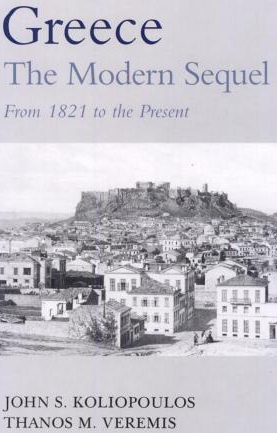
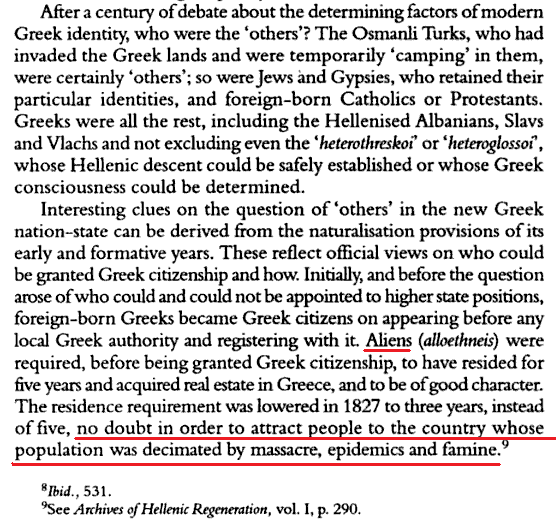
veremes.png

page 256
veremes256.png


Of course "Aliens were required" in modern "greece". Everyone there in the 1830's was an alien lol.

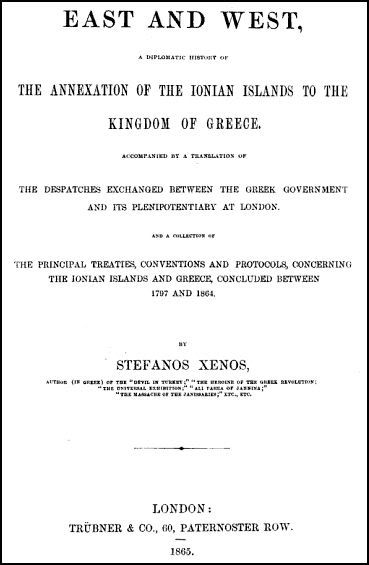
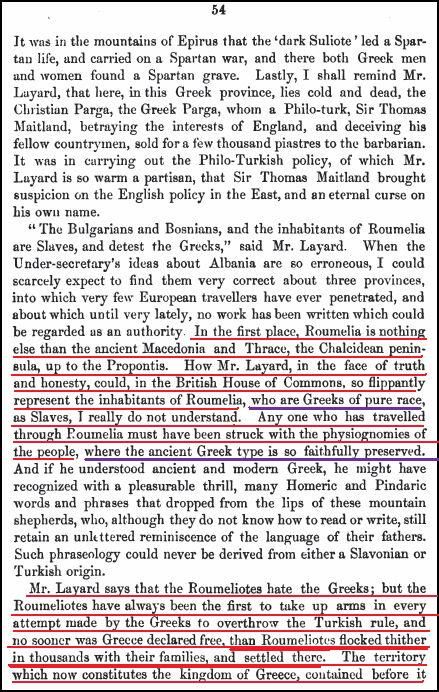
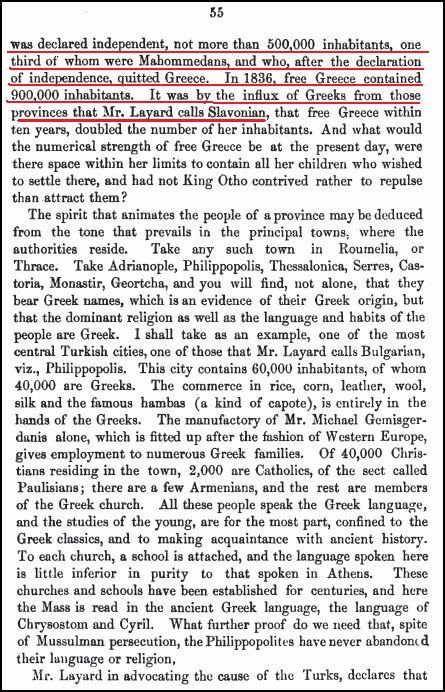
Some of these Aliens came from Albania and Macedonia. Warning: the following is 19th century imposter hellene propaganda. It shows how nothing of the simpleton mentality has changed about these racist thieves that make false claims.

StefanosXenos.jpg

StefanosXenos54.jpg

StefanosXenos55.jpg

StefanosXenos100.jpg

StefanosXenos101.jpg
 
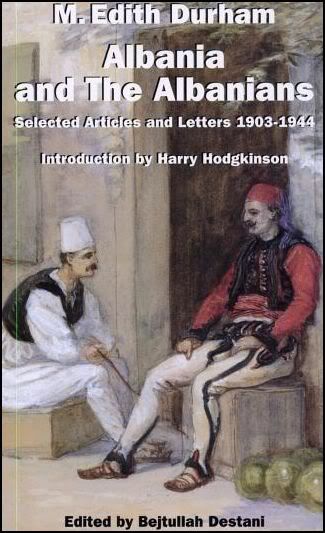
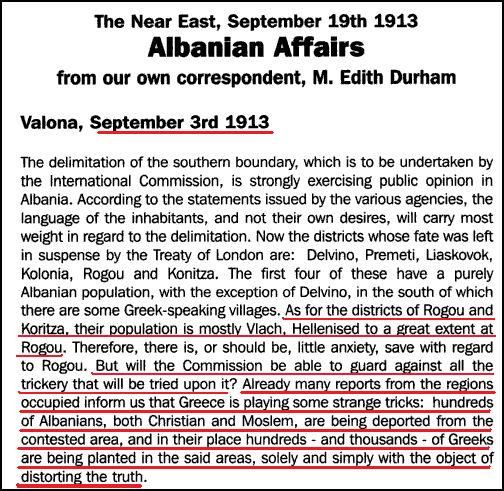
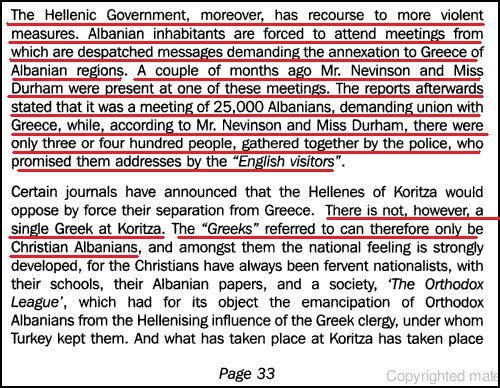
MaryDurham.jpg

MaryDurham33.jpg

MaryDurham33a.jpg

page 34
MaryDurham34.jpg


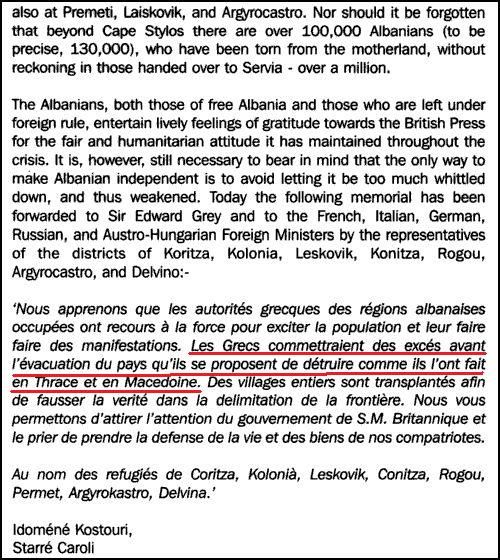
The translation for the French passage above is courtesy of google translate:

'We learn that the Greek authorities of the Albanian regions engaged have used force to excite people and make them do manifestations. The Greeks commit excesses before the evacuation of the country they intend to destroy as they did in Thrace and Macedonia. Entire villages are transplanted to distort the truth in the delimitation of the boundary. We allow you to attract the attention of the Government of His Britannic Majesty and pray to the defense of life and property of our countrymen.

On behalf of refugees from Coritza, Kolonia, Leskovik, Conitzer, Rogou, Allows, Argyrokastro, Delvina. "


This is how ridiculous these people and their forefathers are. The need to dump imposter hellenes in areas they don't belong to make false claims with pseudo-history and then say "Greek for 10,000 years" is the oldest trick in the book.
 
This is how ridiculous these people and their forefathers are. The need to dump imposter hellenes in areas they don't belong to make false claims with pseudo-history and then say "Greek for 10,000 years" is the oldest trick in the book.

TrueMacedonian, you can also see same bullshit directly from the mouth of Venizoles in the official records of Paris peace conference in 1919.

Like this one for example;

clipboard01vtg.jpg


So, whenever Venizelos criticized by the Italians about his false claims, the only explanation of Venizelos was "Greeks have higher civilization than Albanians, so Albania(Epirus, according to them) should be part of Greece". The usual fantasy called ancient Greece.

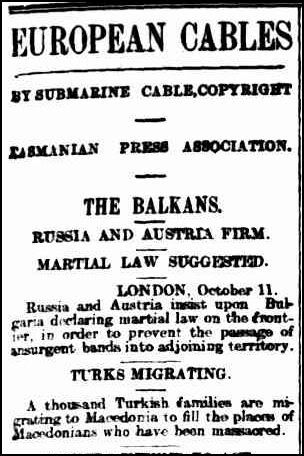
Greeks stole western Thrace just like that from Turkey. Half of Thrace has been awarded to them by great powers even tough Greeks wasn't more than 10% in there. Also 90% of the western Thrace was the property of local Turkish people in 1920s. Actually not only Thrace, you know, half of Anatolia has been awarded to them but we were able to kick them out from here but we couldn't from western Thrace.


I already posted PDF version of this book. You can read here;

http://www.macedoniantruth.org/forum/showpost.php?p=84270&postcount=33
 
Last edited:
TrueMacedonian, you can also see same bullshit directly from the mouth of Venizoles in the official records of Paris peace conference in 1919.

Like this one for example;

clipboard01vtg.jpg


So, whenever Venizelos criticized by the Italians about his false claims, the only explanation of Venizelos was "Greeks have higher civilization than Albanians, so Albania(Epirus, according to them) should be part of Greece".

Greeks stole western Thrace just like that from Turkey. Half of Thrace has been awarded to them by great powers even tough Greeks wasn't more than 10% in there. Also 90% of the western Thrace was the property of local Turkish people in 1920s. Actually not only Thrace, you know, half of Anatolia has been awarded to them but we were able to kick them out from here but we couldn't from western Thrace.


I already posted PDF version of this book. You can read here;

http://www.macedoniantruth.org/forum/showpost.php?p=84270&postcount=33

I've read about this already my friend :wink: - http://www.macedoniantruth.org/forum/showthread.php?t=3841&page=12
 
Greeks stole western Thrace just like that from Turkey. Half of Thrace has been awarded to them by great powers even tough Greeks wasn't more than 10% in there. Also 90% of the western Thrace was the property of local Turkish people in 1920s. Actually not only Thrace, you know, half of Anatolia has been awarded to them but we were able to kick them out from here but we couldn't from western Thrace.
Now, that hurt my Thracian roots and my great-grandfather’s efforts; he was a statesman and Patriarch’s exarch (special envoy) in Komotini at late 1800s... I still haven't found what he stated... exactly. :laugh:
Look at the map. The final outcome doesn't seem very weird.
vlkerundsprachenkartedeax4.jpg
 
Moon Tiki, did you know that anyone can make a map like that and say it's evidence? the people that make those maps have their own point of view, there's no facts in them unless it's legit(unlikely).

That map doesn't show any statistics, so why do you believe in it?
 
I wasn't making a point based on a specific map. Here are some more; skip the differences and focus on the common parts.
Also, this time it was about Thrace. I somehow sense you're looking at Macedonia.
Ethnic_map_of_Balkans_-_russian_1867.jpg
Balkans-ethnic_(1861).jpg

Ethnic_map_of_Balkans_-_german_1882.jpg
 
Populations displayed in eastern Thrace is quite wrong. There are overly exaggerated Greek population in there. In reality, Greeks was so few, not more than 10%. There should be more Bulgarians in both eastern and western Thrace. Also there should be more Turks in Bulgaria, just outside of Thrace. And Salonika has been shown as fully Greek!!! that`s B.S.

It`s also quite funny to see that both German and French ethnography maps puts Hungarians in same category with Turks under the branch "Turanische Ougro-Tatars". Actually this was quite a norm `till WW-2 but this is not politically correct anymore since Hungarians considered as Europeans atm.
 
It might be useful to document every occasion that a proper census of the Macedonian demographic, was turned down or rejected; and to inform readers as to why the results for Macedonian territory for the Greek census of 1920, were destroyed.
 
I found a website which provides an outline of Albania and describes in short its population, economy, peoples, and neighboring countries they inhabit. I do not agree with everything in this website. However for the sake of this topic here is something I did find quite interesting;

http://www.everyculture.com/A-Bo/Albania.html

History and Ethnic Relations

Emergence of the Nation. Albanians are a native Balkan people, although their exact origin is unclear. The national ideology insists on an unequivocal ethnic relationship with the ancient Illyrians. As little is known about the Illyrians and there are no historical records referring to the existence of the Albanian people during the first millennium C . E ., it is difficult to affirm or deny the relationship. Albanians entered postclassical recorded history in the second half of the eleventh century, and only in this age can one speak with any degree of certainty about the Albanian people as they are known today. In his History written in 1079–1080, the Byzantine historian Michael Attaleiates was the first to refer to the Albanoi as having taken part in a revolt against Constantinople in 1043 and to the Arbanitai as subjects of the duke of Dyrrachium. Similarly, the historian John Scylitzes refers (ca. 1081) to the Arbanites as forming part of the troops assembled in Durrës by Nicephorus Basilacius. It can be assumed that the Albanians began expanding from their mountain homeland in the eleventh and twelfth centuries, initially taking possession of the northern and central coastline and by the thirteenth century spreading southward toward what are now southern Albania and western Macedonia. In the middle of the fourteenth century, they migrated farther south into Greece, initially into Epirus, Thessaly (1320), Acarnania, and Aetolia. By the middle of the fifteenth century, which marks the end of this process of colonization, the Albanians had settled in over half of Greece in such great numbers that in many regions they constituted the majority of the population. Despite these extensive settlements, the Albanians, largely a herding and nomadic people, do not seem to have created any substantial urban centers. There were no noticeable Albanian communities in the cities of the Albanian coast during the Middle Ages. Durrës was inhabited by the Venetians, Greeks, Jews, and Slavs; Shkodra, by the Venetians and Slavs; and Vlorë, by the Byzantine Greeks. It is estimated that a considerable proportion of Albanians were assimilated by the time of the Turkish invasion; in other words, the Albanians had been largely marginalized in their own country. Only during the Ottoman period did they began to settle in towns and acquire some of the characteristics of a nation rather than those of nomadic tribes.
 
Last edited:
Back
Top