• Welcome to the new Macedonian Truth Forum. All posts, members and private messages have been moved over from the old forum.

    Passwords from the old forum could not be carried over, so please use Forgot your password? to set a new one. The reset link is emailed to the address on your account.

  • Rules and Regulations at the forum of the Macedonian Truth Organisation (MTO)

    (1) The national-ethnic and cultural-linguistic identity of the Macedonian people is historically Macedonian, and derives its character from the native, indigenous and geographic homeland of the Macedonians, which is called Macedonia. To ensure that their human rights, integrity and heritage are appropriately respected, the only nouns and adjectives acceptable when reference is made to the above character and identity markers is Macedon, Macedonia, Macedonian and Macedonians.

    (2) The nation-state of the Macedonian people is the Republic of Macedonia, and is to be referred to by this official title so long as the 'republic' prefix is consistently applied to other states. Alternative references are the Macedonian Republic, or simply, Macedonia.

    (3) The 'ethnic' prefix is only acceptable for Macedonians in cases where differentiation is specifically required - so long as it is in context and consistent where it concerns its application to other ethnic groups.

    (4) Should any other differentiation be specifically required, the names of other ethnic groups that reside with Macedonians in either the Republic of Macedonia or the occupied Macedonian regions in Greece, Bulgaria, Serbia or Albania, are to be given a prefix.

    (5) Negating the identity, language and culture of the Macedonian people by deliberate avoidance of the terms Macedonia, Macedonian and Macedonians, or by any other means, is not permitted.

    (6) Systematic anti-Macedonian propaganda and rhetoric are not permitted.

    (7) Threads irrelevant to the Macedonian Cause, the community at the Macedonian Truth Organisation or the Macedonians in general may be considered as spam or not in the spirit of the forum. In such cases they are not permitted.

    (8) Continual posting of messages in threads with the sole purpose of deviating from the initial topics with the use of unrelated and unnecessary information is not permitted.

    (9) All posts, external articles, reports, etc that are cited in languages other than Macedonian or English, must be accompanied with a translation in one or both of the said languages.

    (10) Despite the possibility of some conversations and debates becoming heated, extreme abuse and/or racism, vulgar language and/or terminology, threats, revelation of personal information about others, harassment, and other such behavior will not be permitted. If deemed necessary all relevant information including member details will be reported to the appropriate authorities for investigation which may result in legal action.

    (11) Threads that are created must have a summary of a topic or excerpt of an article found in pertinent link(s) that have been included. One line threads will be considered unaccetable spam and are therefore not permitted.

    (12) Compulsive and deliberate lies, irrespective of the topic, are not permitted.

    (13) Any symbols or avatars found to be perceived as offensive to Macedonians are not permitted.

    (13) Any explicit or extreme material is not permitted.

    Failure to adhere to the above rules and regulations will result in a ban after 3 breaches. This may be reconsidered in some cases should the circumstances be of an unorthodox nature and/or require special consideration. To assure an effective deterrent against an individual or individuals with the sole purpose of causing dissent through spamming, racism or other improper means, the above rules will be strictly enforced.

    The MTO administration will monitor all discussions as reasonably practical and reserve the right to remove any post and/or member from the forum, and update the rules and regulations as required. Members are encouraged to immediately report any post and/or member to the MTO administration if they feel that these rules have not been abided by.

    The views expressed on this forum are those of the individuals. The only official representation of the MTO is made by the "Macedonian Truth Organisation (Site Owner)" username, and no other.

  • Macedonian Cause

    The Macedonian Truth Organisation calls on God in Heaven to protect, bless and guide the endeavour it is committing to undertake, and that is to work towards:

    Securing Macedonia as a free, independent and democratic republic in which sovereignty lies with the Macedonian citizens; as the nation-state of the Macedonian people in which they can preserve their culture, language and identity; as a state in which the Macedonian language and culture form the basis of public life and act as important unifying elements of Macedonian society; as the home of all its citizens to which it guarantees and obliges their inalienable natural rights and corresponding responsibilities;

    The acknowledgment as self-evident and irrefutable the existence of the:

    1) Indigenous, ethnonational name of Macedonia;
    2) Macedonian people, language and identity;
    3) Macedonian culture, symbols and folklore;
    4) Macedonian ancestry, heritage and history in its entirety; and
    5) Macedonian Orthodox Church;

    Securing recognition by the International Community of the tragedies endured by the Macedonian people, of the division of Macedonia with the signing of the Treaty of Bucharest on August 10, 1913, and the genocide committed against the Macedonian people at the hands of the Greek, Bulgarian and Serbian states and their respective churches during the 19th and 20th centuries;

    Ensuring that the Interim Accord is declared ‘null and void’ and that all constitutional provisions, acts, commitments, agreements, legislation, regulations, policies or programs emanating from, supporting or consequential to the Interim Accord are also declared ‘null and void’, including the use of any symbols and the completion of any acts imposed by, or originating from, the Interim Accord.

    Ensuring that the Framework Agreement is abolished and that all constitutional provisions, acts, commitments, agreements, legislation, regulations, policies and programs emanating from, supporting or consequential to the Framework Agreement are also abolished and replaced by a framework of constitutional and statutory law based on inalienable natural rights and corresponding responsibilities and universally codified human rights mechanisms.

    Securing the abolishment of any existing constitutional provisions, acts, agreements, legislation, regulations, policies and programs that discriminate against the Macedonian people, in any international organisation or any of the countries of the International Community where such constitutional provisions, acts, agreements, legislation, regulations, policies and programs exist, and thereby ensuring the freedom for Macedonians to exercise their inalienable natural rights and fulfil their corresponding responsibilities, and practice their culture, language and religious faiths in all the countries of the International Community without hindrance;

    The empowerment of Macedonians to undertake a moral revolution and to instil and/or reinvigorate within themselves a deep-rooted national, cultural, linguistic and historical dignity and a commitment to the exercise of freedom based on inalienable natural rights and corresponding responsibilities;

    The recognition of the Macedonian minorities in the neighbouring states of Macedonia as well as the respect for the inalienable rights and freedoms of the Macedonian minorities, as provided for by natural law and as codified by the United Nations Charter, the Universal Declaration of Human Rights and other universally codified human rights mechanisms;

    The full and unreserved respect of, and the support for, the rights of all people of non-Macedonian descent living in Macedonia and around the world, who share a reciprocal full and unreserved respect for the Macedonian people, their homeland and their state;

    The cultural unification and solidarity of the Macedonian people living in all parts of historical Macedonia and adjacent territories, as well as Macedonians throughout the world;

    The unity of all Macedonians on the principles, objectives and achievement of the Macedonian cause as defined by this declaration.

Ancient Historians considered Macedonians as separate & distinct entity!

GeorgeS said:
Where did the Greeks come from they came from the sudan subhara Afrika................Macedonians were tall & fair,the greeks were short & black people
George, while I agree with some of what you have written, with the quoted text above you do no Macedonian any favours, as such statements that lack corroboration are counter-productive. We've been down this road before bracko, we appreciate your presence here and want you to advance some of your arguments a little so they can hold more weight and be easier to back-up and defend.
 
George, while I agree with some of what you have written, with the quoted text above you do no Macedonian any favours, as such statements that lack corroboration are counter-productive. We've been down this road before bracko, we appreciate your presence here and want you to advance some of your arguments a little so they can hold more weight and be easier to back-up and defend.
Arno reche SOM. dushmanite taka prat. zborvat bez veza i racist. Ne mozime po nivni pat da odime. Ne velam deka Gjorgi e takov. Gjorgi e patriotec, ama treba tro pojke odzbilni da sne site i pametno da si kazvame pravoto. pozz...... Shit my Maco is bad :biggrin:
 
Jouguet, Pierre., Macedonian Imperialism and the Hellenization of the East, London, 1928

Greek considered the Macedonians to be barbarians.

Now the enemies of Macedon represented the Macedonians as barbarians ... p.68

The Macedonians did not consider themselves to be Greek either, even though its upper crust was gradually Hellenized.

What is important is to know whether by their culture, sentiments and disposition the Macedonians felt that they were Greeks and were received as such by the Hellenes? It seems fairly certain that they had gradually come to Hellenism rather than that they had originally belonged to it. It is also true that one can speak of the Hellenization of Macedonia. p.68

Isocrates and the Delphic Amphictiony make a case of Greek institutions excluding the Macedonians.

So little do the Macedonians seems to have belonged to the Hellenic community at the beginning, that they did not take part in the great Games of Greece, and when the Kings of Macedon were admitted to them it was not as Macedonians, but as Heraclids. Isocrates, in the Phillip, praises them for not having imposed their kingship on the Hellenese, to whom kingship is always oppressive, and for having gone among foriegners to establish it. He, therefore, did not regard the Macedonians as Greeks. So too, when after the Sacred War, Phillip obtained a voice in the Delphic Amphictiony, it was given to the King and not to the people of Macedonia. p. 69

Who were the Macedonian Kings fighting for ? For "Hellenism" or for the "Glory of Greece" ?

Certainly it was not for Greece that the King of Macedon was fighting. p. 394

Conclusion:

It is sufficient for our purposes to note that the Hellenes and the Macedonians regarded themselves as different nations ... p.69
 
shea62.png

Macedonia and Greece, by John Shea.
 
George, while I agree with some of what you have written, with the quoted text above you do no Macedonian any favours, as such statements that lack corroboration are counter-productive. We've been down this road before bracko, we appreciate your presence here and want you to advance some of your arguments a little so they can hold more weight and be easier to back-up and defend.

In defense of George S. I believe his is referring to scientific research in genetics that traces the origin of those currently living in Greece as having originate from Sub-Saharan areas. The expression is rather direct and emotive, but is that not a Macedonian trait? :biggrin:
 
When Thessaly, late in the 5th century BC, was attacked by a Macedonian King, Archelaus, a speech "On Behalf of the Larissaeans" was composed by Thrasymachus contained the sentence;

Shall we be slaves to Archelaus, we, being Greeks, to a Barbarian.
 
There is a very interesting write up in the latest UMD Issue by Aleksandar Donski.

It has to be one of the greatest revelations I have read in some time.

It about the surviving the texts of ancient Macedonian historians. That's write. Ancient Macedonian historians, and there appears to be 8 newly discovered ancient historians who were all Macedonians.

http://umdiaspora.org/images/UMDVoiceWinter2009.pdf

I hope he redeems himself from his last book. If he can truly interpret these pages correctly I would love to know what is written from these ancient Macedonian writers. It's funny because I found an old topic on Maknews pertaining to this and asked if Donski found our smoking gun yet.
 
The last time I have spoke to Donski, June this year, he said that he has the texts. The translation is waiting for the funds he needs, and the book should appear late 2010.

That is what I have from him, back than. I don't know what is new or what was going on in the mean time.

By the way, all those Ancient Texts are part of private library of some German family.
 
Interesting,but can you show me any other Athenean rhetor,except Demosthenes?It is known that,Demosthenes had some kind of conflicts with Philip,because Philip had already ''beaten'' him at Macedonian Court.
At that time,Athens was in decrease.Rhetors were the ones that were really ruling the city-state.As you know,Atheneans were very sensitive on the freedom of speech.So especially,a famous rhetor could say whatever he wanted,up to a certain point in Ekklisia.
Thank you,

The "window of opportunity" was essentialy limited to the reign of Filip II and Alexander III of Macedon (Makedonski), i.e. the "Greeks" or Athenians in particular did not see the light of freedom after the Lamia ("Hellenic") War in 323-322 before our era. It is also very questionable/ debatable whether the current (neo) "Hellenes" can claim to have regained it, as some modern historians claim, in 1829 after more than 2,000 years of foreign domination. During this "window of opportunity" Demosthenes was the pre-eminent Orator/leading ideologist in Athens and when he was absent, due to exile or legal exclusion by Athenians for taking bribes, Hypereides emerged to elequently take his place. There was no opportunity for anti-Macedonian agitation between Macedonian victory at Battle of Chaeronea in 338 B.C. and the start of the Lamia ("Hellenic") War in 323 B.C., a period of approximately 15 years.

Following Alexander the Great’s death in 323 in Babylon, the Athenians were moved to liberate Hellas from Macedonian hegemony, whence the name “Hellenic War”. Shortly before Alexander expired he had ordered the return of all exiles hitherto banished from the Greek cities. For the most part this measure was popular, but was unwelcome in Athens and Aetolia for different reasons, and the death of Alexander was to be their opportunity for repealing this act.[1] Swayed principally by Hypereides, a staunch anti-Macedonian rhetor and demagogue, the Athenians went to war in the hopes of engendering a new, anti-Macedonian Hellenic League, and appointed Leosthenes general of the allied forces.[2]
http://en.wikipedia.org/wiki/Lamian_War

You can read more about what Hyparides said at following link:
Hyperides, Funeral Oration: To Fallen General Leosthenes & Fellow Greek Soldiers

[34] For if it is for pleasure that men recall such feats of courage, what could be more pleasing to Greeks than the praise of those who gave them freedom from the Macedonian yoke?....
 
Thanks for posting these quotes Indigen.

The Macedonian dance 'Teshkoto' performed by that group is absolutely stunning.

Macedonians (mainly UMD) who argue our ancient Macedonian roots are a product of 19th century nationalism - are ignorant of the facts.

Recall the Greek archeologist, Andronicus, who was murdered by poison shortly after he made the comment: "This is not a Greek tomb, its a Macedonian tomb".
 
...
In the wild Mariovo region in southern Macedonia (RM) matriarchy still reigns, costumes and customs are still archaic and civilization has only begun to arrive with a road built recently...”.

[Pribichevich: Macedonia – Its People and History, 1982.]

exactly :) and not only that, the people dont have in their collective memory any signs of some migrations, some "coming from..."
btw, you posted few of my favorites, but here are few more :)

Diodorus Siculus

- The commandant of the garrison of that city, Archelaus, who was a Macedonian by RACE, welcomed Attalus and surrendered the city to him… 18.37.3-4.

Аρχеλαος, Μακεδоν τὸ γеνος (Архелеу, Македон то генос, по ген...род, РАСА)

Quintus Curtius Rufus

( Patron, the Greek commander, speaks with Darius:)

"we few are all that remain of 50,000 Greeks. We were all with you in your more fortunate days, and in your present situation we remain as we were when you were prospering, ready to make for and to accept as our country and our home any lands you choose. We and you have been drawn together both by your prosperity and your adversity. By this inviolable loyalty of ours I beg and beseech you: pitch your tent in our area of the camp and let us be your bodyguards. We have left Greece behind; for us there is no Bactria; our hopes rest entirely in you - I wish that were true of the others also! Further talk serves no purpose. As a foreigner born of ANOTHER RACE I should not be asking for the responsibility of guarding your person if I thought anyone else could do it." [p.112-13]
Династијата на Дариус како и поголемиот дел од Иранците се БЕЛА РАСА, Македонците исто. Ако Патрон за себе вели дека е од друга раса, значи не е бел. (Меѓутоа МОЖЕБИ се работи и за просторно определување - роден од друг Род, друго „племе“, друг ентитет, и сепак припадник на белата раса, така да треба да се истражува дополнително. moj komentar)

Btw, think about
...we few are all that remain of 50,000 Greeks...
fighting FOR Darius III Kodoman and the Persian Empire.

Greek conquest? Greek Expedition? :confused1:

Diodorus Siculus (again)

- For many days the king lay helpless under his treatment, and the Greeks who had been settled in Bactria and Sogdiana, who had long borne unhappily their sojourn among peoples of another race and now received word that the king has died of his wounds, revolted against the Macedonians. They formed a band of 3000 men and underwent great hardship on their homeward route. Later they were massacred by the Macedonians after Alexander’s death. 17.99.5-6.

Than, authors from 18th century and earlier speaking about "Macedonian" (not greek, Macedonian..) blood, when describing the events after Alexandro´s death.

books


We should also have in mind that his name is AlexandroY, NOT AlexandroS.

And "Phillip" is FillipoY, not PhillipoS.

Pronounced probably something like Ale(k)sandro-I or Ale(k)sandro-U, and Filipo-I or Filipo-U, where (k) were pronounced in some, and missed in some dialects.

Take in note that we have "-oV" on the end of our surnames or second names.

Petko TrajkoV FilipoV

DelcheV, KareV, AleksandroV

the Vlachs - AlexandrU, KonstantinU, VlahU

books
 
Last edited:
Here is a tight little piece written by Gandeto.

http://www.americanchronicle.com/articles/view/98213

Herodotus 5 .22 reports that Alexander I was regarded as ´barbaros´, a foreigner, a non-Greek by the Greek competitors at Olympia. The Olympic Games were reserved for Hellenes only. We are not concern whether he was later adjudged by the Hellanodikai as Greek. (Perhaps, Alexander I carried his "driver´s license" with him.) The point to remember is that he was not recognized as Greek to start with.

Isocrates 5.108, 154, paid tribute to Philip II as blue-blooded Greek and made it clear that Macedonians were not Greeks. "Isocrates himself", writes Werner Jeager, "the very man who heralds the idea of Macedonian leadership in Hellas, designates the people of Macedonia as members of an alien race in Phil. 108. He purposely avoids the word Barbaroi but this word is one that inevitably finds a place for itself in the Greek struggle for national independence and expresses the views of every true Hellene" (Jeager 1968: 249 n.7). Noteworthy point is Isocrates side stepping the people of Macedonia who would not be the rulers over Greece but their king Philip, who, naturally, is not a son of these Macedonians, but ethnologically proven to be a Heraclid, and thus of pure Greek extraction. Jeager, in regards to race, places the Macedonians outside the Greek fold and sees no historical excuse to use the race card in legitimizing the Macedonian conquest and dominion over the Greeks. In other words, the role of the Macedonians in their conquest of Persia does not have to travel through Greece and be viewed through a Greek perspective.

In the Histories (Herodotus), as we have just touched it upon, we find the Athenians giving reasons to the Spartans as to why they would not betray Greece (8.144.2); besides the destruction of the Greek shrines and the images of gods laying strewed on the ground and the burning desire for revenge by all Greeks, they include the following attributes common to all Greeks: common blood, common religion, common customs, common sacrifices and common language, and then, all together comprise the common way of life that separates the Greeks from all other foreigners i.e., barbarians. Here the language is one of the typically peculiar ´thing´ to Greeks only. He says that the Greeks always spoke Greek (1.58.1), and that Pelasgians a non-Hellenic population spoke a barbarian language that he could not understand. Only after learning Greek language did they become Greek (1.57.3).

Indeed, if one could speak Greek one would unquestionably be classed as Greek. Asiatics, and specifically Persians and Egyptians, whose cultural advances permeated into the Greek life, were classed as barbarian speaking peoples - meaning by ´barbarian´ no more then non- Hellenic. There are very few instances recorded in literature where a Greek learns a foreign language. Plutarch reports that Themistocles spoke Persian (Them. 29.5), but for the most part we find the other races learning Greek. As a matter of fact, Greeks behaved as if learning a foreign language was reserved for the barbarians only, who could not speak Greek and it was their duty to learn it. There was this persistent, and a high degree of arrogant lack of interest in learning a foreign language.

"The Greek language was seen as a symbol of Greek unity, and of Greeks belonging to their land; it was also a weapon" (Harris "Herodotus Conception of Foreign languages" HISTOS Vol 2 1998). Naturally, it was understood, and readily accepted, that speakers of a same language must have had a common descent. A common descent meant sharing of some primordial connections to, and acquiring inborn influences from, a distant progenitor whose progeny enjoyed, and subsequently passed on the learned social manifestations, customs and religious observances. These social belonging and interactions, coupled with the unifying glue called language, produced the first awareness of ethnicity among the ancient people.

Hence, genos and syngeneia expressed the notion of common belonging, of ´sameness´, of kinship. This awareness of kinship was transmitted through the element of haima, blood, and thereby, we come to a point where blood is taken to represent the essence of connectedness with the original progenitor. In Herodotus we find ´blood´ as one of the principal determinant of Greekness, of purity, and we have also established the connection between language and ethnicity, where language came to reinforce ´blood´ in defining ethnic groups. Thus, ethnicity was characterized through purity of blood, expressed through social and cultural interactions and defined and/or determined through the usage of a language. In sum a foreigner is any person who does not speak Greek, and thus, he is a barbarian, meaning non-Hellene.

Thuc. 20. 80.5-7; 2. 81.6; 4. 124.1 puts the Macedonian contingents among the barbarians. Badian in "Greeks and Macedonians" n.21 writes: "from the very etymology of that word "barbarians" were people whom Greeks could not understand. When the ancient Macedonian kings were called barbarians it was not done for political reasons or a personal vendetta, but it was a calculated choice used to denigrate their culture, their race, their origin and their way of life; in other words ´barbaroi´ meant ´I hold you, and your institutions and your way of life as beneath me, because you lack the basic determinants/attributes of which a Greek is in possession of. You neither speak like a Greek, do not live like a Greek, nor do you think like a Greek.

And, once again, we came to this often visited intersection; there are some very progressive Greeks who do not subscribe to this middle-age Greek thinking and who see the people in the Balkans living in peace and harmony—these are the true Greeks and then, there are newly created Greeks, those whose heritage has been wiped out and replaced with the newly "morphed" ethnicity "Greek-Macedonian". Since they—in this Greek created problem—stand to lose the most, they are the "true" Greek soldiers in the forefront fighting the battle. I am sure they wouldn´t dare dig deeper into their past because they will inevitably find "skeletons" which have another story to tell: their grandfathers did not even speak Greek nor did they share in these "megali" Greek dream. What they dreamed the most and with a heavy heart longed for, were their abandoned homes, forsaken culture and their way of life in their Asia Minor communities.

Sooner than later all these Greek lies and fabrications will run their course and Europe will have no choice but to put an end to this Greek farce.
 
Evidence Of Ancient Macedonian Culture Surviving In The Living Culture Of Modern Indigenous Macedonian Nation:

“...The Macedonian dances ...belong among the oldest recorded dances in the world....

....West Macedonian dances.......slow motion dances, danced only by men, with long, measured steps. The only accompaniment is the drum and a high-pitched wind instrument. One of these dances is the “Teshkoto”. Now it is called a shepherd’s dance, of nimble leaps from rock to rock, watching for possible beast or bandit.

Actually, it is an archaic Macedonian dance from pre-slav times, dramatizing the difficult life of the Macedonians, recalling border warfare and raids, the unending battle to defend the flocks, the land, the tribe.

YouTube - Teskoto-Ansambl TANEC.avi

In the beginning , says Dr. Mane Chuchkov, Macedonian musicologist and economic geographer, people had nothing but body movements to show how they lived. …

There are also ancient Macedonian dances performed to the beat of drums only. And there are silent dances with no instruments or singing or hand-clapping at all. They are the eeriest, sometimes interspersed with weird cries. In “silent” dances rhythm and beat are supplied either by a measured repetition of an accented dance step or by the jingling of the coins and trinkets with which the women’s dresses are adorned, or by periodic shouts. It is these strange and haunting “dumb” dances, where the feet thud in precise unison without a sound of song or music and men every once in a while leap high into the air, which more than any other stir the spectator in a profound way.

The instruments accompanying the Macedonian dances are usually the drum and various wind instruments. Among the latter is the kaval, an ordinary pipe. The longer the pipe, the more sonorous its sound.
The kaval has no “tongue” or whistle-head. You blow it as you do a pencil cap, across the edge of the opening. The zurla, a wood instrument similar to the oboe, has a double mouthpiece and two whistle-heads is a double-reed instrument. In London the zurla player of the dance group of Tanec, Slave Tashevski, created a furor. You could ask him to play this song or that or “just nothing,” that is, to improvise. He could not read music. The zurla and the drum are not Turkish, as often believed. You find them in frescoes preceding the Turks. They arrived in the Balkans before the Slavs. The Macedonian bagpipe has a seventh little hole with a straw, not for producing a tone but for ornamenting it: it does the murmuring. It is therefore called mrmorec— the “murmurer”— and is only one-and-a-half millimeters wide.


In the wild Mariovo region in southern Macedonia (RM) matriarchy still reigns, costumes and customs are still archaic and civilization has only begun to arrive with a road built recently...”.

[Pribichevich: Macedonia – Its People and History, 1982.]


----------

Pece Atanasovski x2 - Macedonian folk dances

II. Pece Atanasovski - Macedonian folk dances
Tracklist w. notes transcribed from cover:

TESHKOTO - this dance originates from the Western part of Macedonia and it is well-known as the most expressive representative of the Macedonian folklore. It is danced only by men. Rhytham 4/4.

[...]

----------

Simple Dances: Where Do They Come From, Where Do They Lead?
by Laura Shannon


Many of the most common folk dances belong to a single family, whose basic step provides an ancient and archetypal template for many of the simple dances in our repertoire. There are so many different variations on the basic theme that we tend to overlook their interrelation and treat them as completely separate dances, and it can be surprising to find out how many dances derive from the same root pattern. This discovery suggests that something essential and unchanging is common to dances of many different cultures, and also, paradoxically, illuminates the process of evolution through which dance forms continually change.

The ancient dance family of which I speak is the group of three-measure dances such as the Macedonian Pravo Oro, where the first two measures travel and the third measure mirrors the second. Another way to describe it is `step, step, step, do something, step, do something'. Still another way is `three steps forward (pause), one step back (pause).'

[.....]

http://www.laurashannon.net/articles/SimpleDances/SimpleDances.html


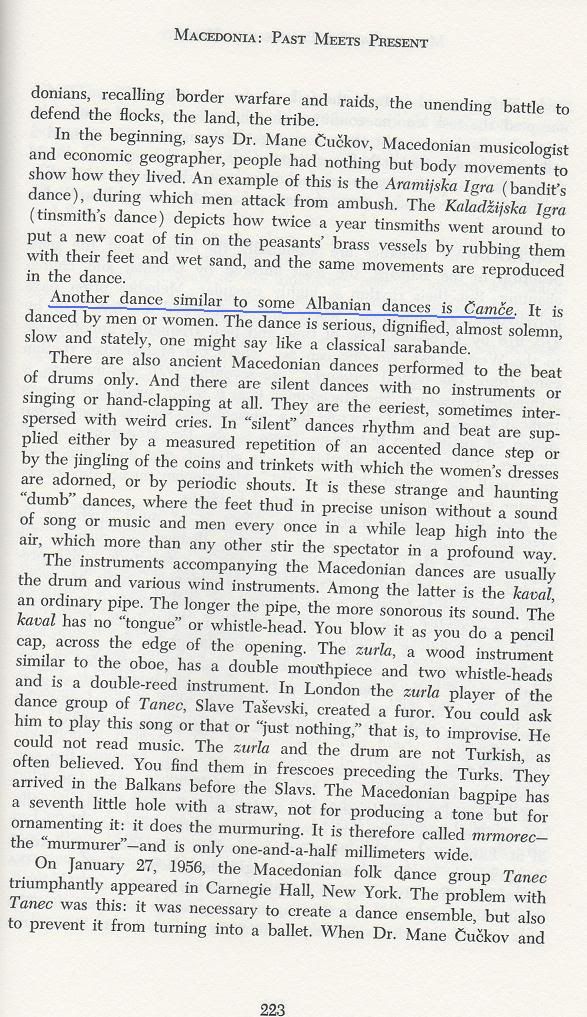
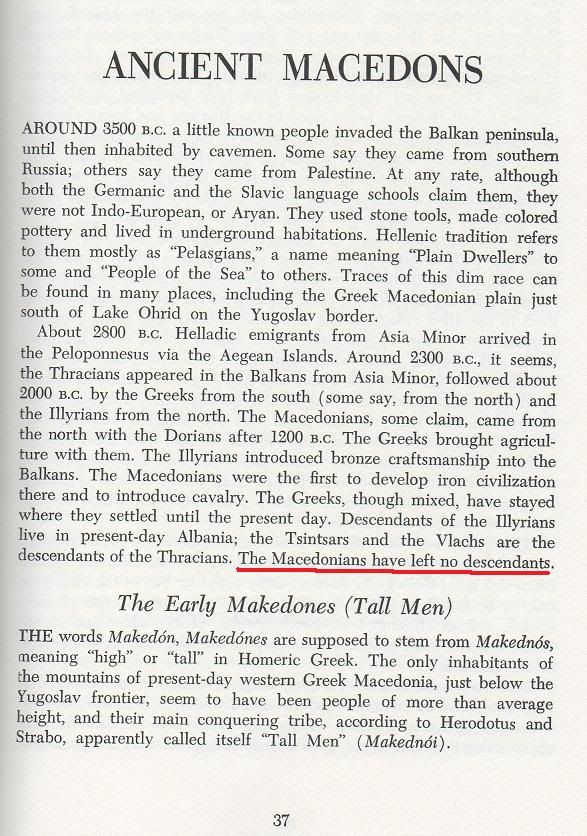
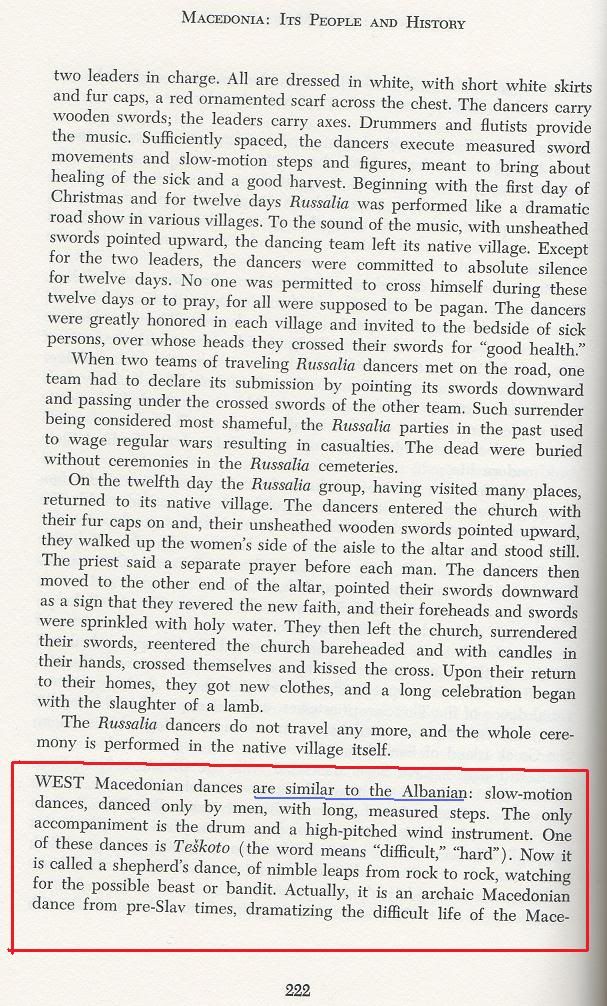
Don't dupe our people with Pribichevich's book because you are outright misinforming them now in order to prove your indigenous cultural continuity theory. Here's what Pribichevich actually states which you knowingly left out;

Pribichevich37.jpg


Really,,, the ancient Macedonians left no descendents but the Albanians are the descendents to the Illyrians, the modern 'greeks' the descendents of the ancient Hellene, and the Vlachs the descendents of the Thracians? I've noticed you using Pribichevich alot for other facets of Macedonian history. However you are duping the reader into a false conclusion by not including what he actually wrote. How about showing everyone what you left out specifically;

Pribichevich222.jpg

Pribichevich223.jpg


I saw somewhere that you said that you don't like it when Macedonians on forums post scanned pages of books. I can see why after you mislead people with Pribichevich's book by skipping sentences and avoiding his comparison to Albanian dances which would infer something different than your indigenous theory.
 
Thanks for posting these quotes Indigen.

The Macedonian dance 'Teshkoto' performed by that group is absolutely stunning.

Macedonians (mainly UMD) who argue our ancient Macedonian roots are a product of 19th century nationalism - are ignorant of the facts.

Recall the Greek archeologist, Andronicus, who was murdered by poison shortly after he made the comment: "This is not a Greek tomb, its a Macedonian tomb".

I recommend you actually read Pribichevich's book instead of blindly taking indigens post serious and pointing fingers at people. Indigen seems no better than Vasil Bogov in this instance.
 
Last edited:
Back
Top