• Welcome to the new Macedonian Truth Forum. All posts, members and private messages have been moved over from the old forum.

    Passwords from the old forum could not be carried over, so please use Forgot your password? to set a new one. The reset link is emailed to the address on your account.

  • Rules and Regulations at the forum of the Macedonian Truth Organisation (MTO)

    (1) The national-ethnic and cultural-linguistic identity of the Macedonian people is historically Macedonian, and derives its character from the native, indigenous and geographic homeland of the Macedonians, which is called Macedonia. To ensure that their human rights, integrity and heritage are appropriately respected, the only nouns and adjectives acceptable when reference is made to the above character and identity markers is Macedon, Macedonia, Macedonian and Macedonians.

    (2) The nation-state of the Macedonian people is the Republic of Macedonia, and is to be referred to by this official title so long as the 'republic' prefix is consistently applied to other states. Alternative references are the Macedonian Republic, or simply, Macedonia.

    (3) The 'ethnic' prefix is only acceptable for Macedonians in cases where differentiation is specifically required - so long as it is in context and consistent where it concerns its application to other ethnic groups.

    (4) Should any other differentiation be specifically required, the names of other ethnic groups that reside with Macedonians in either the Republic of Macedonia or the occupied Macedonian regions in Greece, Bulgaria, Serbia or Albania, are to be given a prefix.

    (5) Negating the identity, language and culture of the Macedonian people by deliberate avoidance of the terms Macedonia, Macedonian and Macedonians, or by any other means, is not permitted.

    (6) Systematic anti-Macedonian propaganda and rhetoric are not permitted.

    (7) Threads irrelevant to the Macedonian Cause, the community at the Macedonian Truth Organisation or the Macedonians in general may be considered as spam or not in the spirit of the forum. In such cases they are not permitted.

    (8) Continual posting of messages in threads with the sole purpose of deviating from the initial topics with the use of unrelated and unnecessary information is not permitted.

    (9) All posts, external articles, reports, etc that are cited in languages other than Macedonian or English, must be accompanied with a translation in one or both of the said languages.

    (10) Despite the possibility of some conversations and debates becoming heated, extreme abuse and/or racism, vulgar language and/or terminology, threats, revelation of personal information about others, harassment, and other such behavior will not be permitted. If deemed necessary all relevant information including member details will be reported to the appropriate authorities for investigation which may result in legal action.

    (11) Threads that are created must have a summary of a topic or excerpt of an article found in pertinent link(s) that have been included. One line threads will be considered unaccetable spam and are therefore not permitted.

    (12) Compulsive and deliberate lies, irrespective of the topic, are not permitted.

    (13) Any symbols or avatars found to be perceived as offensive to Macedonians are not permitted.

    (13) Any explicit or extreme material is not permitted.

    Failure to adhere to the above rules and regulations will result in a ban after 3 breaches. This may be reconsidered in some cases should the circumstances be of an unorthodox nature and/or require special consideration. To assure an effective deterrent against an individual or individuals with the sole purpose of causing dissent through spamming, racism or other improper means, the above rules will be strictly enforced.

    The MTO administration will monitor all discussions as reasonably practical and reserve the right to remove any post and/or member from the forum, and update the rules and regulations as required. Members are encouraged to immediately report any post and/or member to the MTO administration if they feel that these rules have not been abided by.

    The views expressed on this forum are those of the individuals. The only official representation of the MTO is made by the "Macedonian Truth Organisation (Site Owner)" username, and no other.

  • Macedonian Cause

    The Macedonian Truth Organisation calls on God in Heaven to protect, bless and guide the endeavour it is committing to undertake, and that is to work towards:

    Securing Macedonia as a free, independent and democratic republic in which sovereignty lies with the Macedonian citizens; as the nation-state of the Macedonian people in which they can preserve their culture, language and identity; as a state in which the Macedonian language and culture form the basis of public life and act as important unifying elements of Macedonian society; as the home of all its citizens to which it guarantees and obliges their inalienable natural rights and corresponding responsibilities;

    The acknowledgment as self-evident and irrefutable the existence of the:

    1) Indigenous, ethnonational name of Macedonia;
    2) Macedonian people, language and identity;
    3) Macedonian culture, symbols and folklore;
    4) Macedonian ancestry, heritage and history in its entirety; and
    5) Macedonian Orthodox Church;

    Securing recognition by the International Community of the tragedies endured by the Macedonian people, of the division of Macedonia with the signing of the Treaty of Bucharest on August 10, 1913, and the genocide committed against the Macedonian people at the hands of the Greek, Bulgarian and Serbian states and their respective churches during the 19th and 20th centuries;

    Ensuring that the Interim Accord is declared ‘null and void’ and that all constitutional provisions, acts, commitments, agreements, legislation, regulations, policies or programs emanating from, supporting or consequential to the Interim Accord are also declared ‘null and void’, including the use of any symbols and the completion of any acts imposed by, or originating from, the Interim Accord.

    Ensuring that the Framework Agreement is abolished and that all constitutional provisions, acts, commitments, agreements, legislation, regulations, policies and programs emanating from, supporting or consequential to the Framework Agreement are also abolished and replaced by a framework of constitutional and statutory law based on inalienable natural rights and corresponding responsibilities and universally codified human rights mechanisms.

    Securing the abolishment of any existing constitutional provisions, acts, agreements, legislation, regulations, policies and programs that discriminate against the Macedonian people, in any international organisation or any of the countries of the International Community where such constitutional provisions, acts, agreements, legislation, regulations, policies and programs exist, and thereby ensuring the freedom for Macedonians to exercise their inalienable natural rights and fulfil their corresponding responsibilities, and practice their culture, language and religious faiths in all the countries of the International Community without hindrance;

    The empowerment of Macedonians to undertake a moral revolution and to instil and/or reinvigorate within themselves a deep-rooted national, cultural, linguistic and historical dignity and a commitment to the exercise of freedom based on inalienable natural rights and corresponding responsibilities;

    The recognition of the Macedonian minorities in the neighbouring states of Macedonia as well as the respect for the inalienable rights and freedoms of the Macedonian minorities, as provided for by natural law and as codified by the United Nations Charter, the Universal Declaration of Human Rights and other universally codified human rights mechanisms;

    The full and unreserved respect of, and the support for, the rights of all people of non-Macedonian descent living in Macedonia and around the world, who share a reciprocal full and unreserved respect for the Macedonian people, their homeland and their state;

    The cultural unification and solidarity of the Macedonian people living in all parts of historical Macedonia and adjacent territories, as well as Macedonians throughout the world;

    The unity of all Macedonians on the principles, objectives and achievement of the Macedonian cause as defined by this declaration.

Do Ancient Greeks have African Origins?

Soldier of Macedon

Senior Member
Let's clear this up once and for all. There has been evidence of all sorts displayed for both sides of the argument, I would like to see all of the information consolidated here, so we can validate this argument or discard it altogether.

If anybody has any material on the matter, please post it here. Black Athena and other such publications would be a good start.
 
The Black Athena (Part1)
watch


The Black Athena (Part2)
watch
 
THE GREEK HERACLES WAS A BLACK MAN AND THE AFRICAN INFLUENCE ON GREEK AESTHETICS

By Samuel David Ewing

It has occurred to me lately as I pondered about the next article for this section that the lineage, pedigree, or family tree of the Greek Heracles must be clarified once and for all. Diodorus Siculus and Herodotus recorded that it was the Egyptian Heracles who was the hero who performed the legendary 12 Labors, subdued the animals of the wild that had threatened the people, ushered in the building of cities, water systems, fortifications, and laws. Walter Burkert has estimated that this original Heracles was renowned as far back as 20,000 years ago. The Greek Heracles ended up receiving honors for the accomplishments of his predecessor, having the title of "Heracles", furthermore by the Bronze Age of Greece in which the Greek Heracles was said to have lived the taming of the wilderness had already been accomplished. The Greek Heracles was not likely to be wearing lion skin armor, wielding a club, with spear as weapons, and the danger of lions running amok was remote. The Egyptian Heracles did wear lion's skin and or leopard skin (leopards were considered to be lions without manes), he used the spear and club as his weapons, he traveled on foot because there were no chariots during the early history of Egypt, and the black rulers of Egypt were the persons who fit the description of the Egyptian Heracles. Richard Poe, author of BLACK SPARK WHITE FIRE, Did African Explorers Civilize Ancient Europe, Prima Publishing, P.O. Box 1260BK , Rocklin, CA 95677, pg. 316 quotes Diodorus on the differences between the Egyptian Heracles and the Greek Heracles; "By the time the Greek Heracles lived, said Diodorus, "most parts of the inhabited world had already been reclaimed from their wild state by agriculture and cities and the multitude of men settled everywhere over the land". Again quoting Diodorus, Richard Poe reveals; "Likewise, both the club and the lion's skin are appropriate to their ancient [Egyptian] Herakles, because in those days arms had not yet been invented, and men defended themselves against their enemies with clubs of wood and used the hides of animals for defensive armor".
Herodotus' research led him to discover that the most ancient Heracles was Egyptian (a native black African). In Pausanias, 9.38.6-8 (Jones, trans.) Herodotus reports that the Greek Heracles was a black man also; "There is plenty of evidence to prove the truth of this, in particular, that both parents of Herakles - Amphitryon and Alkmene - were of Egyptian origin". The Greek Herakles was a black man? How could this be? Ancient literature by the Greek scholars reveals that:
1. Herakles' parents were descendants of the Egyptian King Danaos who was a native black African of Egypt. The Egyptians, of course were predominantly black people.
2. Herakles' father, Amphitryon and his mother, Alkmene were first cousins, grandchildren of the mighty hero Perseus, who is the great, great, great, great grandson of King Danaos. In addition there was miscegenation between Egyptians and Greeks. One can obviously understand that the Greek Herakles would hardly resemble a European or Caucasian male. In present day American society he would be considered a black man, mulatto or at the very least having a 'biracial background'. This information was gathered by Herodotus who researched the Greek Herakles' pedigree. Apollodorus points to the fact that the Greek Herakles' parents were also descended from Perseus' wife, Andromeda, whose parents were Cepheus and Cassiopeia, the rulers of Ethiopia. Thus we see in the Greek Herakles the hero whose parents are of Ethiopian and Egyptian descent, both groups of people who are native Africans (black people) with some Greek mixture also.
3. Richard Poe further reports on page 317 that the ancient Roman poet, Ovid emphasizes that the beautiful Andromeda was "dark (fusca)". On page 318, BLACK SPARK WHITE FIRE, Richard Poe further clarifies that; "We, of course, have no way of knowing to what extent the Herakles of legend represents a real person. But even if he does not, his portrayal as an African prince-- part Egyptian and part Ethiopian-- suggests that the ancient storytellers held a profoundly different view of Bronze Age Greece than that served up by Hollywood scriptwriters. Rightly or wrongly, ancient tradition places African dynasts at the head of some of Greece's most powerful and prominent cities. It also portrays Herakles as an ambitious hydraulic engineer, responsible for damming rivers and digging canals all over Greece--- an occupation peculiarly appropriate for a prince of an Egyptian royal dynasty". Richard Poe asks these thought provoking questions, "Was Herakles a Paul Bunyan of his time? Do his adventures reflect the achievements of real- life canal diggers and dam builders in early Greece? If so, then the legend implies that those ancient engineers had a strong ancestral link with Africa and particularly with Egypt. It seems more than coincidental that Herakles' great, great, great, great, great, great grandfather Danaos was also remembered, in legend, for his feats of water engineering".
Briefly I want to talk about Zeus, the Supreme Father god who was said to be the Greek Herakles' actual father. Zeus is the name or title of the supreme god of ancient Ethiopians and the Egyptian. He was known as Zeus, Zeus-Ammon, Ausar, Khnum, Ammon- Zeus, and Ethiops. The ancient Greeks' religion was copied from the ancient Ethiopians and Egyptians from whom they learned spiritual and religious teachings. The Greeks and Romans referred to Zeus using the African titles previously mentioned in addition calling him Serapis, Jupiter, Jove, Zagreus, Dionysus, and Osiris.
Joel A. Rogers, author of “Nature Knows No Color Line”, reports; "Negroes were first worshipped in Greece and Rome. White masses bowed down to black deities. The rites of Apollo were founded by Delphos and his Negro mother, Melainis; and the worship of black Isis and Horus were popular in Rome and the Roman colonies as far north as Britain. When this later evolved into the worship of the Black Madonna and the Black Christ, Christian Whites also bowed down to them. Negroes, as was said, were deified in the early Greece. They appear as gods in Greek mythology. The chief title of Zeus, greatest of the Greek gods, was 'ETHIOPS', that is 'BLACK'".
In addition to this information the same Ethiops or Zeus is the historical king named CUSH who ruled over the native African peoples (the black race, the Hamites ).
Godfrey Higgins, author of ANACALYPSIS, Vol. 1, published by A & BOOKS PUBLISHERS, 149 Lawrence Street, Brooklyn, New York, 11201, reports that; "In my research for the origin of the Ancient Druids, I continually found, at last, that my labors terminated with something black. Thus the Oracles of Dodona and of Apollo at Delphi were founded by Black Doves. Doves are not often, I believe, never black. Osiris and his Bull were black, at least this was the case with Jupiter, Bacchus, Hercules, Apollo, Ammon. The goddesses Venus, Isis, Hecati, Juno, Metis, Ceres, Cybele were black in the Campdoglio in Rome". Higgins further states on page 286 of the same book; "We have found the black complexion or something relating to it whenever we have approached the origin of nations......... or first idols were black". J.A. Rogers, author of Sex And Race, Vol.1, New York, 1967 reports; ".......the earliest gods and messiahs on all the continents were black."
The ancient Greeks, ancestors of some of the present Greek peoples readily admitted that they were descendants of Ethiopians (native African black people of Ethiopia) and the Europeans of ancient times. The ancient Greeks, with pride tell the story of how Zeus (Cush, first Ethiopian Ruler ) and the prototype for the king of the Olympian gods, made love to the white-skinned IO, who gave birth to Epaphus, a mulatto male.
This story which was one of many reveals the Greeks acknowledging their biracial heritage. In Sex And Race, Vol.1, J.A. Rogers has this to say, "As was said several scientists, among them Sergei, declare that the Europeans, especially those of the Meditteranean, are, strictly speaking, Eur- Africans. Thus we find anthropology supporting mythology".

Archaeologist have found numerous vases, statues and other forms of art from the Archaic Period of Ancient Greece in which the native Greek people portray themselves as Africans and as people having a mixture of African and European features. The constant miscegenation between the people of Ancient Crete (Western Ethiopians) and the Europeans, during 2000-1200 B.C. was a well known fact to the Archaic Greeks. Andromeda, Perseus' wife is shown on a terracotta vase, from the 4th century B.C. as the beautiful black woman that she was. Is there any proof that the ancient Greeks of the of the Archaic Period acknowledged and portrayed Heracles (HERCULES) as a black man? YES THERE IS! In the Oesterreichisches Museum, Vienna was kept the Ionian 'Caeratan' hydria (very large water jar), made during the middle of the 6th Century B.C. The title of the art work on the hydria is 'HERAKLES AND BUSIRIS KING OF EGYPT'. This art reveals the Greek Herakles as an enormously muscled black African giant who is crushing evildoers beneath his feet, strangling and breaking the necks of evildoers with his bare hands, as well as by trapping their throats between his elbow and bicep region, in his left hand he is holding a man in the air by his left ankle using the superhuman might of his left arm, and finally the rest of the evildoers are fleeing from the Greek Herakles in terror. The story has to do with Herakles putting a stop to human sacrifices which were instituted by an evil group of cultist under the direction of King Busiris of Egypt. Heracles allowed them to attempt to use him as a sacrifice, then at the right moment he broke his bonds, slaying 1000 cultists including the king. The story resembles that told of Samson.*** The point to be emphasized here is that the Greek Herakles was originally thought of as a BLACK MAN by the ancient Greek peoples before his features were altered by the later Eurocentric influence centuries later.
The Greek Heracles as a black man on this hydria is shown slaying black men (Egyptians) who have features like himself, such as black skin, flat nose, flaring nostrils, large lips, and the wooly textured hair of Hamites. This same Herakles is also shown slaying fair skinned Greeks, and Europeans, the difference between these opponents and Herakles the black man leaves know room for doubt concerning who is of what race.
Martin Bernall, author of BLACK ATHENA, VOL. 1, pages 476- 477 has this to say about this particular hydria; ".....While both point out that Bousiris has black attendants and that Bousiris himself is portrayed as one on another vase, neither Boardman nor Snowden ( 1970, p.159 ) mentions the fact that the 'Greek hero Herakles' is depicted as a curly-haired African Black. This is something that the Aryan Model is completely unable to handle. For reasons that Herakles should have been seen this way, see Vol.3." I would like to add that I have seen photo-prints of this vase myself therefore I know Martin Bernall is telling the truth! Finally apparently it isn't mentioned that an equal amount of Bousiris' attendants on this vase are obviously European.

 
Are the Greeks "still" Indo-European? Were they ever?
http://www.white-history.com/refuting_rm/7.html

The Negro Presence in Classical Greece
http://www.white-history.com/greece_negroes.htm

GENETIC EVIDENCE OF RACIAL MIXING IN GREECE
http://www.white-history.com/greece.htm
Thanks TLWR. The second link has some useful quotes about the presence of Ethiopians and other African types in Ancient Greek society, worth a closer look. Here is something else to look over for quotes: http://clyde.winters.tripod.com/chapter6.html The origins of Heracles are also interesting.
 
The below has been disputed, can it be confirmed that the word ELAS meant black in ancient Greek? I am not so sure, also, what of the 'Hellenic' name and its connection to the Selloi?
The most common words that the Greeks used to designate the color of the Ethiopian’s skin were ELAS (black) and compounds of ELAS KELAINOS (black or dark- Aesch. Prom. 808 and Theoc. 17.87.) and (dark - Quint. Smyrn. 2.101; cf. Hes. Op. 527.


Here is a list of more quotes taken from the links that may be of interest.
Aristotle, in his Gen. An. 5.3.782B, contrasts the straight hair of the Scythians and Thracians with the woolly hair of the Ethiopians and people who live in hot regions.
In the mythological ‘Labors of Hercules’, Negro bodyguards marched to the assistance of the Egyptian Busiris whom Heracles had laid low. (Beardsley, G.H, 1929 The Negro in Greek and Roman Civilization: A Study of the Ethiopian Type, The John Hopkins University Press, Baltimore, no. 7 and fig. 1; nos. 104-110.)
A passage in Menander refers to Ethiopians in this way:

"The man whose natural bent is good,
He, mother, he, though Aethiop, is nobly born.
"A Scyth," you say? Pest! Anacharsis was a Scyth
! "

- (Frg. 533 Koch. Allinson's translation in the Loeb edition.
Xenophanes (Frg. 16 (Diels) in a similar contrast recounts that the Negroes represent their gods as black-faced and flat-nosed, while the Thracians show their gods to be blue-eyed and red-haired.
Negroes soldiers were employed by the Minoans as auxiliaries. (EVANS, A. J., 928 The Palace of Minos, II. Macmillan, London, pp. 755-757 and plate XIII. Evans (p. 756) states that the Blacks also served as palace guards at the King’s residence in Minos.)
A Negro on a human mask from a bronze age tomb was found at Cyprus (MARSHALL, F. H., 1911 Catalogue of the Jewellery, Greek, Etruscan, and Roman in the Departments of Antiquities, British Museum. London. No. 144).
A Negro trumpeter appears on the shield of a Homeric warrior. (CHASE, G. H., 1902 The Shield Devices of the Greeks. Harvard Studies in Classical Philology, 13, p. 88.)
In Homer’s Odyssey, Eurybates, who came from Ithaca, as Odysseus' herald, is described as follows: "He was round-shouldered, dark-skinned, and woolly-haired, and his name was Eurybates; and Odysseus honoured him above his other comrades." (Homer, Odyssey. 19.246-248).
The mask of a Negro, discovered at Akragas along with the representations of Demeter and Persephone and their worshipers, portrays the flat nose, thick lips and short woolly hair with an accuracy obviously derived from direct observation of the real racial type. (MARCONI, P., 1931 New Light on Greek Religion in Sicily: Great Discoveries at the Sanctuary of the Earth-Goddesses at Agrgentum: Art Relics Ranging from the 6th Century B.C. to the Hellenistic Age. London Illustrated News, 178, pp. 959-960, and figs. I and 2).
One of the pupils of Herodes Atticus was a Negro. When his pupils died, including the Negro, he erected statues to them (Philostr., V. A. 3.11; V. S., 2.558-559.)
Graindor believes that a Negro-faced herm, discovered at Athens is that of Memnon, one of the pupils of Herodes Atticus. (GRAINIDOR, P., 1915 Tête de Nègre du Musée de Berlin. Bulletin de Correspondance Hellénique, 39, p. 402; and 1930: Un Milliardaire Antique: Hérode Atticus et Sa Famille, Recueil de Travaux Publiés par la Faculte des Lettres. Cairo, pp. 114-116, 128, 131, 150.)
Negroes even appear on Greek coins of Phocis, Delphi, Lesbos, and Athens (BABELOX, E., 1907 Traité des Monnaies Grecques et Romaines, DeuxièmePartie: Tome Premier, Description Historique. E. Leroux, Paris, pp. 1000-1001 and plate XLII, figs. 22 and 23).
Negroes often appeared as actors on the Greek stage. (Beardsley, G.H, 1929 The Negro in Greek and Roman Civilization: A Study of the Ethiopian Type, The John Hopkins University Press, Baltimore, pp. 113-114, and WEBSTER, T. B. L., 1936 An Introduction to Sophocles. The Clarendon Press, Oxford, p. 173.)
It is likely that Negroes appeared as actors not only in regular dramatic performances but also in myths danced in pantomime. (HARRISON, J. E., 1890 Mythology and Monuments of Ancient Athens. Macmillan, London and New York, p. cxvii.)
Despite Pericles’ law, the Classical Greeks, according to Zimmern, showed very little other traces of racial awareness (what Zimmern calls “color-prejudice” - ZIMMERN, A. E., 1931 The Greek Commonwealth , fifth edition. The Clarendon Press, Oxford, p. 323.)
Another scholar, Westermann, goes even further and states that Classical “Greek society had no color line”. (WESTERMANN, W. L., 1943 Slavery and the Elements of Freedom. Quarterly Bulletin of the Polish Institute of Arts and Sciences in America, 1, p. 346.)
"Further, children are like their more remote ancestors from whom nothing has come, for the resemblances recur at an interval of many generations, as in the case of the woman in Elis who had intercourse with the Aethiop; her daughter was not an Aethiop but the son of the daughter was." - Aristotle, Gen. An. 1.18.722A


The Africans appear to have a presence in the region since Minoan times, which predates the Dorian 'invasion', and even the Mycenaean period. What was the impact of a seemingly pre-existing African presence where it concerns the Greek language?

There is also the below:
Using archaeological evidence and the classical literature C.A. Winters (1983b) explained how the African/Black founders of Grecian civilization originally came from the ancient Sahara. Winters(1983b) makes it clear that these Blacks came to the Aegean in two waves 1) the Garamantes a Malinke speaking people that now live along the Niger river, but formerly lived in the Fezzan region of Libya; and 2) the Egyptians, Phoenicians and East Africans who were recorded in Greece's history as the Pelasgians. The Pelasgian civilization has been discussed in detail by Parker (1917,1918).

The Pelasgians founded many cities. The Pelasgian founding of Athens is noted by Plutarch in Theseus 12, and Ovid in Metamorphosis vii, 402 ff. According to Herodotus vii.91, the Pelasgians also founded Thebes. Many of these Athenians may have introduced the Geometric style to Greece during the so-called Dark Ages (1200- 600 BC).
These Blacks are frequently depicted in the art associated with the so-called Dark Ages (1200-600 BC). There are also fine frescos from Thera (Sanorin) Island which illustrate one of the Agean cities occupied by these Blacks during the 16th and 15th centuries BC.
The Aryan-Greeks adopted the language of the Pelasgians and Egyptians. The linguistic evidence shows that there was a differentiation of Greece into East Greek and West Greek. The Black Greeks spoke East Greek (Achaioi or Achaean). West Greek was spoken by the Dorian or Aryan Greeks. The earliest Aryan tribe called Ionians spoke a dialect of East Greek called Aeolic.
Dr. Anna Morpurgo Davies, has made it clear that "less than 40% of the words which have an Indo-European etymology". According to Dr. Davies, 52.2 % of the Greek terms in Chantraine's Dictionnaire Etymologique de la langue Grecque (1968) have an unknown etymology. The mixed nature of the Greek language results from the early settlement of the Aegean by Blacks from Africa.

Some of these words are of African origin. Robert K.G. Temple, in The Sirius Mystery, shows that many of the most common words of the Greek vocabulary are of Egyptian origin. Diop (1991) has also discussed the Egyptian origin for many Greek terms.
There is frequent mention of the Garamantes of the Fezzan, in Classical literature of Greece and Rome. The Garamantes were recognized as a Black tribe. They were known to the Greeks and Romans as dark skinned. In Ptolemy (I.8.5.,p.31) a Garamante slave was described as having a body the color of pitch or wholly black.

Graves (1980) and Leo Frobenius linked the Garamante to the ancient empire of Ghana (c.300 BC to A.D. 1100). Graves (1980) claims that the term Garamante is the Greek plural for Garama or Garamas. He said that the present Jarama or Jarma are the descendants of the Garamante; and that the Jarama live near the Niger river.

The Olympian creation myth, as recorded by Pindar in Fragment , and Apollonius Rhodius, makes it clear that the Garamantes early colonized Greece. Their descendants were called Carians. The Carians practiced apiculture. As in Africa the Carians practiced matrilineal descent. According to Herodotus , even up until his time the Carians took the name of their mother.
Apollonius Rhodius (.iv.1310) tells us that the goddess Athene was born beside Lake Triton in Libya. The goddess Athene, was called Neith by the Egyptians and Nia by the Cretans in Linear A writing. This shows that the Garamantes took this god to Europe in addition to Demeter and Amon (=Ammon ,Amma).
EGYPTIANS

The Egyptians established many colonies in ancient Europe. The Egyptians called themselves Melampodes or "Blackfeet". The Egyptians were also called Danaans in Greek history. According to Hyainus in Fabula, and Apollonius Rhodius when the Danaans came to Greece they were a combination of diverse African tribes.

When the Danaans came to Greece they took away part of Argolis from the Canaanites. The Danaans took the Mysteries of Themoporia and the oracle of Dodona to Greece. This view is supported by the discovery of an inscribed stone in the Peloponnese that had Egyptian writing on it dating to the Vth Dynasty of Egypt. Greek traditions speak of Egyptian colonies founded by Cecrops who settled Atica, Danaus the brother of Aegyptus was the founder of Argolis. Danaus is alleged to have taught the Greeks agriculture and metallurgy.

MYCENEANS

The ancient Myceneans were Blacks. These ancient people came from Crete, and the Western Sahara. Alain Anselin has shown how many of these Myceneans spoke Dravidian languages especially the Termils of Asia Minor.

The cities of Troy, Mycenae, Tiryns, Thebes and Orochomenos were founded by the Eteocretans or "Real Minoans", as opposed to the later Greco-Cretans. These Eteocretans spoke a Manding language.

Mycenean art gives ample evidence of the rich and varied culture shared by the Africans of Mycenae. Africans are depicted in hunting and war motifs on artifacts recovered from the Shaft Graves at Mycenae.

The best known African artifacts from Mycenae include the "Stag Hunt", "Lion and Spearman Hunt" and the "Siege Scene" depicted on the Silver Rhyton Cup. All of these artifacts date to 1500 BC

Achaeans

By 1200 BC, much of the Mycenae civilization was under the control the Achaeans. The Achaeans later founded other city-states in Greece. After conquering the Mycenaeans, the Achaeans formed the Greek states of Peloponnesus. Their major cities: Mycenae and Tiryns in Argolis, and Pylos Messenia were originally founded by other Pelasgian groups.

Between 1200-800 BC, the Achaeans began to take control of the Greek mainland , the southern part of the Balkan Peninsula, Crete and numerous islands in the Aegean Sea. The Achaeans conquered the Nubian, Egyptian and Phoenician armies at Troy. Some of the troops fighting with the Achaeans were Indo-European speaking people.
The Kurgan folk in small numbers slowly migrated into the centers of civilization, first in northern Mesopotamia, then India. By 3500 BC, the Kurgans were invading the Caucasus region. Beginning in 3700 B.C., Old European settlements had walls built around them to keep out the Kurgan warriors............

The People of the Sea began to infiltrate the Aegean area after 1200 BC. These people usually wore horn helmets and used round shields..........

The Dorians learned the art of writing from the Phoenicians..............


Alot of dumped information which is a mess at the moment, I will go through it and present it a little clearer soon.
 
I have already posted this elsewhere and just discovered this thread. This place is more appropriate and i will enter them here.


Actually, the name of this Egyptian god was called "Neith"

"Apollonius Rhodius (.iv.1310) tells us that the goddess Athene was born beside Lake Triton in Libya. The goddess Athene, was called Neith by the Egyptians and Nia by the Cretans in Linear A writing. This shows that the Garamantes took this god to Europe".

The Garamantes or Carians originally lived in the Fezzan ( a remote region in Libya). These Garamante were described by the Latin classical writers as black or dark skinned: perusti (Lucan 4.679), furvi (Arnoloius, Adversus Nationes , 6.5) and nigri (Anthologia Latina, 155,no.183).

Now you understand why this Athenian called Demosthenes said to Phillip "not only no Greek, nor related to the Greeks",?
Thats because Macedonians were not Black
 
I found something interesting by J.A. Rogers, Parker (1917,1918).


Parker (1917,1918) used anthropological, archaeological, historical and classical sources to prove that blacks once lived in the Aegean. Parker (1917,1918) used the Greek classics to prove that the Pelasgians were of African origin. He also discussed the origin stories about the Pelasgic founders of selected Grecian cities and proved that these men were blacks and not Indo-Europeans. Parker (1917, pp.341-42) also observed that "the great Grecian epics are epics of an African people and Helen, the cause of the Trojan war, must henceforth be conceived as a beautiful brown skin girl" . These Africans sailed to the Greece from North Africa.


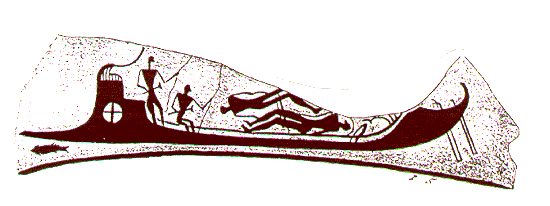
Early boat used by the ancient Pelasgians in Greece
Image147.gif


Using archaeological evidence and the classical literature C.A. Winters (1983b) explained how the African/Black founders of Grecian civilization originally came from the ancient Sahara. Winters(1983b) makes it clear that these Blacks came to the Aegean in two waves 1) the Garamantes a Malinke speaking people that now live along the Niger river, but formerly lived in the Fezzan region of Libya; and 2) the Egyptians, Phoenicians and East Africans who were recorded in Greece's history as the Pelasgians. The Pelasgian civilization has been discussed in detail by Parker (1917,1918).

The Pelasgians founded many cities. The Pelasgian founding of Athens is noted by Plutarch in Theseus 12, and Ovid in Metamorphosis vii, 402 ff. According to Herodotus vii.91, the Pelasgians also founded Thebes. Many of these Athenians may have introduced the Geometric style to Greece during the so-called Dark Ages (1200- 600 BC).

Another by G. W. Parker wrote that:

"I need not go into details concerning the ethnical relations of the Romans, since they, too are Mediterranean and are closely related to the same African confederation of races ...[situated in Greece]. Aeneas, their mythical founder of Troy. The Aenead, like the Illiad, and Odyssey and all other of the world's great epics, is the poetic story dealing with African people". The heroes of these tales used long shields, the characteristic shields of the Indo-European speaking Greeks were round.
 
Check this out. :14:


Winters (1983b) makes it clear that the Garamantes founded the Greek cities of Thrace, Minoan Crete and Attica. The Garamantes were also called Carians by the Indo-European Greeks.

The Garamantes or Carians originally lived in the Fezzan. These Garamante were described by the Latin classical writers as black or dark skinned: perusti (Lucan 4.679), furvi (Arnoloius, Adversus Nationes , 6.5) and nigri (Anthologia Latina, 155,no.183).

Although these people of the Heroic age came from diverse origins, the Aryan-Greeks called them Pelasgians. According to the Greeks, the first man was Pelasgus--ancestor of the Pelasgians. The Pelasgians were a combination of different Black tribes called Achaeans, Cadmeans, Leleges, Carians or Garamantes.

The term Pelasgian was applied to all these pre-Hellenic inhabitants of Greece. R.J. Hopper, in The Early Greeks, noted that "indeed the classical Greeks believed in the separate existence of diverse ethnic elements side by side, and thought particularly of the Pelasgians in this connection".

According to tradition, the Pelasgians inhabited Arcadia and many Aegean Islands. These Blacks took their own writing to Greece which was later used by the Aryan-Greeks. According to Herodotus quadrigas or four-horse chariots were introduced to Greeks by the Libyans .

The Aryan-Greeks adopted the language of the Pelasgians and Egyptians. The linguistic evidence shows that there was a differentiation of Greece into East Greek and West Greek. The Black Greeks spoke East Greek (Achaioi or Achaean). West Greek was spoken by the Dorian or Aryan Greeks. The earliest Aryan tribe called Ionians spoke a dialect of East Greek called Aeolic.

Many classical scholars teach the world that the Greek language is entirely Indo-European. This view of Greek is wrong.

Dr. Anna Morpurgo Davies, has made it clear that "less than 40% of the words which have an Indo-European etymology". According to Dr. Davies, 52.2 % of the Greek terms in Chantraine's Dictionnaire Etymologique de la langue Grecque (1968) have an unknown etymology. The mixed nature of the Greek language results from the early settlement of the Aegean by Blacks from Africa.

Some of these words are of African origin. Robert K.G. Temple, in The Sirius Mystery, shows that many of the most common words of the Greek vocabulary are of Egyptian origin. Diop (1991) has also discussed the Egyptian origin for many Greek terms.

GARAMANTES

Some of the first African colonists to arrive in Greece came from Crete. These Cretans were called Garamantes. After the goddess Ker or Car, these people also came to be also known as the Carians. The Carians spoke a Mande languages.


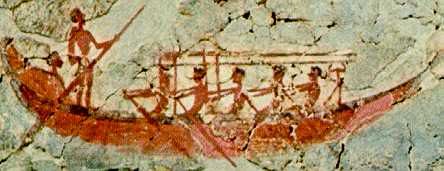
A Pelasgian boat from Thera
Image151.jpg


These people usually sailed to the Islands in Aegean and the surrounding coast were they established prosperous trading communities.

There is frequent mention of the Garamantes of the Fezzan, in Classical literature of Greece and Rome. The Garamantes were recognized as a Black tribe. They were known to the Greeks and Romans as dark skinned. In Ptolemy (I.8.5.,p.31) a Garamante slave was described as having a body the color of pitch or wholly black.

Graves (1980) and Leo Frobenius linked the Garamante to the ancient empire of Ghana (c.300 BC to A.D. 1100). Graves (1980) claims that the term Garamante is the Greek plural for Garama or Garamas. He said that the present Jarama or Jarma are the descendants of the Garamante; and that the Jarama live near the Niger river.

The Olympian creation myth, as recorded by Pindar in Fragment , and Apollonius Rhodius, makes it clear that the Garamantes early colonized Greece. Their descendants were called Carians. The Carians practiced apiculture. As in Africa the Carians practiced matrilineal descent. According to Herodotus , even up until his time the Carians took the name of their mother.

The classical Carians and Egyptians were very close. Having originated in the Fertile African Crescent they had similar gods and cultural traditions dating back to the Proto-Saharan period.

The Garamantes founded Attica, where they worked the mines at Laureium. Demeter, the goddess of agriculture and fruitfulness, came from the Fezzan (Libya) by way of Crete. It was Demeter who took poppy seeds and figs to Europe.

Apollonius Rhodius (.iv.1310) tells us that the goddess Athene was born beside Lake Triton in Libya. The goddess Athene, was called Neith by the Egyptians and Nia by the Cretans in Linear A writing. This shows that the Garamantes took this god to Europe in addition to Demeter and Amon (=Ammon ,Amma).

By 3000 BC, the Garamantes has spread their influence to Thrace and early Hellenic Greece. Hesiod, who was a Kadmean (i.e., of Egyptian descent), in Works and Days , said that before the Hellenic invasion the Grecian people lived in peace and tranquility and had matriarchal societies. The name Europe comes from Aerope, the daughter of King Catreus, a Cretan. Thucydides observed that:

http://clyde.winters.tripod.com/chapter6.html
 
Last edited:
THE PELASGIANS

The Greeks often called the first inhabitants of Greece Pelasgians. The Greek writers claimed that Pelasgus, the great ancestor of the Pelasgians was the first man. The Pelasgians were a combination of diverse Black tribes which included the Achaeans , Kadmeans, and Leleges. The Garamantes were also often called Pelasgians by some classical writers. Strabo said "that the Pelasgi, as indeed the most ancient nation, were diffused through all Greece, and especially among the Aeolians".

The city of Argo was founded by Phoroneus, the father of Pelasgus, Iasus and Agenor. It was these folks who divided the Peloponnese between them.

Herodotus referred to the Pelasgians as "venerable ancestors". He said that the first Athenians "they were Pelasgi, the later possessing the country now designed Hellas". The Pelasgian founding of Athens is also noted by Plutarch in Theseus 12, and Ovid in Metamorphosis vii.402ff. According to Herodotus vii.91, the Pelasgians also founded Thebes in Europe. Pausanias, noted that "The Arcadians make mention of Pelasgus as the first person who existed in their country. From this king the whole region took the name Pilasgia". Hopper noted that the Pelasgians founded Attica.

The Black immigrants from Canaan were also settled in the Aegean at Argolis. They called themselves the "Sons of Abas". Many of the Melampodes later took part of Argolis away from the Canaanites.

The earliest Greek alphabet was made by the Pelasgians, it was lost and later reintroduced by Kadmus to Boeotia. Another Pelasgian, Evander of Arcadia introduced writing to the Italians. This script was used to make the first fifteen characters of the Latin script according to Pliny and Plutarch.
 
Yeah and modern Greeks have names like oglou which means son in Turkish, Greeks you are all sons of Turks. :D
 
Last edited:
Ottoman after all that they were turkish & they didn't know about it.THey are too busy on other threads telling us that macedonian names are greek.They forgot to mention what hellenising means.
 
Last edited:
I dont belive that Pelasgians were black. They were regarded as ancesters of the Macedonians and other non greek tribes. Danaians were the black people..
 
the greeks themselves were from black africa from the sudan that's one thing the greeks don't want the world to know.The word greece means black people.The greeks are so stupid they won't admit their real past,they are quite happy to steal other people's past & masquerade as their own.They forgot the real macedonians are there & were not going to take their shit anymore.
 
Ottoman after all that they were turkish & they didn't know about it.THey are too busy on other threads telling us that macedonian names are greek.They forgot to mention what hellenising means.

Greeks cannot handle the real truth mate thats the problem, look I know my ancestors got mixed with Greeks I accept this TRUTH but our Greek friends cannot accept this, they hate us and call us Mongols all the time but they forget modern Greeks are just like Turks in every way, when I was in Greece I felt like I was walking in Turkey, they should just accept that Greeks and Turks are just the same people these days.
 
I dont belive that Pelasgians were black. They were regarded as ancesters of the Macedonians and other non greek tribes. Danaians were the black people..
The word "Pelasgians" was used in ancient times as a term meaning "pre-Hellenic inhabitants or original inhabitants" did not necessarily mean "black".
Pelasgian was not a term describing an Ethnicity. The Macedonians Could have been Pelasgians (original inhabitants) of Macedonia.


"Pelasgians" was used in early times, was later changed to "Barbarians" (Both meaning not related to Greeks) IMO when things got Nasty

The term Pelasgian was applied to all these pre-Hellenic inhabitants of Greece. R.J. Hopper, in The Early Greeks, noted that "indeed the classical Greeks believed in the separate existence of diverse ethnic elements side by side, and thought particularly of the Pelasgians in this connection"


But regarding the Grecian cities and Islands, these Pelasgians happen to be Black. There Ethnicity and Language (if you can call it that) was "Garamante" a Malinke speaking people.
Using archaeological evidence and the classical literature C.A. Winters (1983b) explained how the African/Black founders of Grecian civilization originally came from the ancient Sahara. Winters(1983b) makes it clear that these Blacks came to the Aegean in two waves 1) the Garamantes a Malinke speaking people that now live along the Niger river, but formerly lived in the Fezzan region of Libya;

These Garamante were described by the Latin classical writers as black or dark skinned: perusti (Lucan 4.679), furvi (Arnoloius, Adversus Nationes , 6.5) and nigri (Anthologia Latina, 155,no.183).

The Garamantes were also often called Pelasgians by some classical writers. Strabo said "that the Pelasgi, as indeed the most ancient nation, were diffused through all Greece, and especially among the Aeolians".

Winters (1983b) makes it clear that the Garamantes founded the Greek cities of Thrace, Minoan Crete and Attica. The Garamantes were also called Carians by the Indo-European Greeks.

According to the Greeks, the first man was Pelasgus--ancestor of the Pelasgians.
Again Pelasgians meaning "Pre- Hellenic" or "Original inhabitants" and in this case, the Authors are only talking about Arcadia and many Aegean Islands
The Pelasgians were a combination of different Black tribes called Achaeans, Cadmeans, Leleges, Carians or Garamantes.

The Pelasgians founded many cities. The Pelasgian founding of Athens is noted by Plutarch in Theseus 12, and Ovid in Metamorphosis vii, 402 ff. According to Herodotus vii.91, the Pelasgians also founded Thebes. Many of these Athenians may have introduced the Geometric style to Greece during the so-called Dark Ages (1200- 600 BC).

As recorded by Pindar in Fragment , and Apollonius Rhodius, makes it clear that the Garamantes early colonized Greece. Their descendants were called Carians. The Carians practiced apiculture. As in Africa the Carians practiced matrilineal descent. According to Herodotus , even up until his time the Carians took the name of their mother.
 
Last edited:
Back
Top