• Welcome to the new Macedonian Truth Forum. All posts, members and private messages have been moved over from the old forum.

    Passwords from the old forum could not be carried over, so please use Forgot your password? to set a new one. The reset link is emailed to the address on your account.

  • Rules and Regulations at the forum of the Macedonian Truth Organisation (MTO)

    (1) The national-ethnic and cultural-linguistic identity of the Macedonian people is historically Macedonian, and derives its character from the native, indigenous and geographic homeland of the Macedonians, which is called Macedonia. To ensure that their human rights, integrity and heritage are appropriately respected, the only nouns and adjectives acceptable when reference is made to the above character and identity markers is Macedon, Macedonia, Macedonian and Macedonians.

    (2) The nation-state of the Macedonian people is the Republic of Macedonia, and is to be referred to by this official title so long as the 'republic' prefix is consistently applied to other states. Alternative references are the Macedonian Republic, or simply, Macedonia.

    (3) The 'ethnic' prefix is only acceptable for Macedonians in cases where differentiation is specifically required - so long as it is in context and consistent where it concerns its application to other ethnic groups.

    (4) Should any other differentiation be specifically required, the names of other ethnic groups that reside with Macedonians in either the Republic of Macedonia or the occupied Macedonian regions in Greece, Bulgaria, Serbia or Albania, are to be given a prefix.

    (5) Negating the identity, language and culture of the Macedonian people by deliberate avoidance of the terms Macedonia, Macedonian and Macedonians, or by any other means, is not permitted.

    (6) Systematic anti-Macedonian propaganda and rhetoric are not permitted.

    (7) Threads irrelevant to the Macedonian Cause, the community at the Macedonian Truth Organisation or the Macedonians in general may be considered as spam or not in the spirit of the forum. In such cases they are not permitted.

    (8) Continual posting of messages in threads with the sole purpose of deviating from the initial topics with the use of unrelated and unnecessary information is not permitted.

    (9) All posts, external articles, reports, etc that are cited in languages other than Macedonian or English, must be accompanied with a translation in one or both of the said languages.

    (10) Despite the possibility of some conversations and debates becoming heated, extreme abuse and/or racism, vulgar language and/or terminology, threats, revelation of personal information about others, harassment, and other such behavior will not be permitted. If deemed necessary all relevant information including member details will be reported to the appropriate authorities for investigation which may result in legal action.

    (11) Threads that are created must have a summary of a topic or excerpt of an article found in pertinent link(s) that have been included. One line threads will be considered unaccetable spam and are therefore not permitted.

    (12) Compulsive and deliberate lies, irrespective of the topic, are not permitted.

    (13) Any symbols or avatars found to be perceived as offensive to Macedonians are not permitted.

    (13) Any explicit or extreme material is not permitted.

    Failure to adhere to the above rules and regulations will result in a ban after 3 breaches. This may be reconsidered in some cases should the circumstances be of an unorthodox nature and/or require special consideration. To assure an effective deterrent against an individual or individuals with the sole purpose of causing dissent through spamming, racism or other improper means, the above rules will be strictly enforced.

    The MTO administration will monitor all discussions as reasonably practical and reserve the right to remove any post and/or member from the forum, and update the rules and regulations as required. Members are encouraged to immediately report any post and/or member to the MTO administration if they feel that these rules have not been abided by.

    The views expressed on this forum are those of the individuals. The only official representation of the MTO is made by the "Macedonian Truth Organisation (Site Owner)" username, and no other.

  • Macedonian Cause

    The Macedonian Truth Organisation calls on God in Heaven to protect, bless and guide the endeavour it is committing to undertake, and that is to work towards:

    Securing Macedonia as a free, independent and democratic republic in which sovereignty lies with the Macedonian citizens; as the nation-state of the Macedonian people in which they can preserve their culture, language and identity; as a state in which the Macedonian language and culture form the basis of public life and act as important unifying elements of Macedonian society; as the home of all its citizens to which it guarantees and obliges their inalienable natural rights and corresponding responsibilities;

    The acknowledgment as self-evident and irrefutable the existence of the:

    1) Indigenous, ethnonational name of Macedonia;
    2) Macedonian people, language and identity;
    3) Macedonian culture, symbols and folklore;
    4) Macedonian ancestry, heritage and history in its entirety; and
    5) Macedonian Orthodox Church;

    Securing recognition by the International Community of the tragedies endured by the Macedonian people, of the division of Macedonia with the signing of the Treaty of Bucharest on August 10, 1913, and the genocide committed against the Macedonian people at the hands of the Greek, Bulgarian and Serbian states and their respective churches during the 19th and 20th centuries;

    Ensuring that the Interim Accord is declared ‘null and void’ and that all constitutional provisions, acts, commitments, agreements, legislation, regulations, policies or programs emanating from, supporting or consequential to the Interim Accord are also declared ‘null and void’, including the use of any symbols and the completion of any acts imposed by, or originating from, the Interim Accord.

    Ensuring that the Framework Agreement is abolished and that all constitutional provisions, acts, commitments, agreements, legislation, regulations, policies and programs emanating from, supporting or consequential to the Framework Agreement are also abolished and replaced by a framework of constitutional and statutory law based on inalienable natural rights and corresponding responsibilities and universally codified human rights mechanisms.

    Securing the abolishment of any existing constitutional provisions, acts, agreements, legislation, regulations, policies and programs that discriminate against the Macedonian people, in any international organisation or any of the countries of the International Community where such constitutional provisions, acts, agreements, legislation, regulations, policies and programs exist, and thereby ensuring the freedom for Macedonians to exercise their inalienable natural rights and fulfil their corresponding responsibilities, and practice their culture, language and religious faiths in all the countries of the International Community without hindrance;

    The empowerment of Macedonians to undertake a moral revolution and to instil and/or reinvigorate within themselves a deep-rooted national, cultural, linguistic and historical dignity and a commitment to the exercise of freedom based on inalienable natural rights and corresponding responsibilities;

    The recognition of the Macedonian minorities in the neighbouring states of Macedonia as well as the respect for the inalienable rights and freedoms of the Macedonian minorities, as provided for by natural law and as codified by the United Nations Charter, the Universal Declaration of Human Rights and other universally codified human rights mechanisms;

    The full and unreserved respect of, and the support for, the rights of all people of non-Macedonian descent living in Macedonia and around the world, who share a reciprocal full and unreserved respect for the Macedonian people, their homeland and their state;

    The cultural unification and solidarity of the Macedonian people living in all parts of historical Macedonia and adjacent territories, as well as Macedonians throughout the world;

    The unity of all Macedonians on the principles, objectives and achievement of the Macedonian cause as defined by this declaration.

Do Ancient Greeks have African Origins?

I hope you also know that if ancient Greece had African influence then so would ancient Macedonia, the two were next to eachother and had a lot of population exchanges,
Yes they were next to each other and i think they still are :tongue_smilie:

But didn't a great Philhellene N.G.L.Hammond say,

"Literary evidence and archeological evidence show that between 460 and 360 the standard of life in Upper Macedonia was at a primitive level and the area was remote from the orbit of Greek trade, and even from coastal Macedonia".

This might explain why African influence did not spread to Macedonia, because of the remoteness.

Ulrich Wilcken in his book 'Alexander the Great' also mentions,

"Having stayed in the extreme north, they (Macedonians) were unable to participate in the progressive civilization of the tribes which went further south, and so, when in the time of the Persian wars they emerged in the horizon of the other Greeks, they appeared to them as non-Greek, as barbarians".
http://www.mymacedonia.net/ancient/ancient.htm

Again for what ever reason, Macedonians were seen not to be progressive as their neighbors further south. So its fair to say there was not much contact between the two.
 
An interesting read on the Philistine Greek connection.

This certainly answers the traditional Greek-Israeli animosity in the past. lol.
Also raises few questions about the adoption of the "Phoenician" alphabet. In fact it may have been Greek all along.

oh and of course, another reason for the curly hair. :)

http://www.msnbc.msn.com/id/43695120/ns/technology_and_science-science/

Bible's bad guys
The Philistines 'are the ultimate other, almost, in the biblical story,' archaeologist says


Greek roots

In a square hole, several Philistine jugs nearly 3,000 years old were emerging from the soil. One painted shard just unearthed had a rust-red frame and a black spiral: a decoration common in ancient Greek art and a hint to the Philistines' origins in the Aegean.

The Philistines arrived by sea from the area of modern-day Greece around 1200 B.C. They went on to rule major ports at Ashkelon and Ashdod, now cities in Israel, and at Gaza, now part of the Palestinian territory known as the Gaza Strip.

At Gath, they settled on a site that had been inhabited since prehistoric times. Digs like this one have shown that though they adopted aspects of local culture, they did not forget their roots. Even five centuries after their arrival, for example, they were still worshipping gods with Greek names.
 
Last edited:
Voltron if you look at the words they seem similar.I wonder why you don't see giants in greek people anymore??The greeks are short & black people whereas macedonians are tall & fair.
Macedonians could have some kind of connection with the caanannites but i'm just speculating here.
 
Sir george ythe description of greeks is adequate all i have to do is show you pictures of lybians & youd swear that they are greeks.But i'm not saying that of all greeks.Generally the greeks are short people.Sir george you are taking this black thing to the nth degree we don't mean to say that they are black as negroes.They might have been in the beginning but it's just dark people now.Dark skinned does not mean black.Also who cares if they are black white in between etc they are still people.
 
Last edited:
SirGeorge8600 said:
SoM, I am referring to things I have seen on other European nationalist forums on the internet, not necessarily on here.
Ok, I needed to clarify that because I certainly don't consider this a "hate" forum where we wish the demise of a nation or people as a collective objective (unlike several racist Greek websites who need to be under some sort of sedation before they accept the existence of Macedonians). I can't speak for some individuals that burst out with impulsive tirades, we've all done it, some of us are better at learning from past mistakes than others. But collectively speaking, we don't "hate" any nation or people as a whole, just the actions of certain people and groups that unfortunately belong to neighbouring states.
@Bill & Voltron....did ancient Greeks and Macedonians even know people like the Vikings, Slavs, and Germanics existed?
Yes and no, depending on how well versed they were with geography. But it is important to keep in mind that people who spoke Balto-Slavic, Celtic, etc languages, haven't always identified in the same way they did in later years, so there is nothing to suggest that ancient Macedonians and Greeks weren't aware of such people, only they knew them by other names, such as Pannonians, Veneti, Getae, etc.
Even if a country was closer south, Africans had little technology to boat across the Mediterranean as a whole ...possibly it would have been easier through Spain.
Hence this would naturally mean that those areas which have a coast on the north mediterranean have been impacted more by 'African' influence than those further into the hinterland. It only makes sense.
 
The Greek word 'philosophy' - φιλοσοφία meaning "love of wisdom", is a rough translation of the Persian word 'mazdayasna' - "worship of wisdom". Mazdayasna is how Zarathustra called his system of thought, that later became the name of the religion Zoroastrianism (called like that in the West) and is to this day used by Zoroastrians. Many ancient Greek philosophers, like Heraclitus, Pythagoras, Plato, Tales, etc. were greatly influenced by Zoroastrian philosophy and they adopted many concepts from the Zoroastrian Magi (priests) under whom some of them even studied.
 
Many ancient Greek philosophers, like Heraclitus, Pythagoras, Plato, Tales, etc. were greatly influenced by Zoroastrian philosophy and they adopted many concepts from the Zoroastrian Magi (priests) under whom some of them even studied.
Slovak, do you have anything further to the above?

On another note but pertinent to the subject title of this thread, the cities of both Egypt and Greece that share the same name - Thebes - is an interesting case. The Greek rendition of 'Thebes' in Egypt comes from the Egyptian word 'Ta-opet'. The Greek city of Thebes was founded by the Phoenician king named Cadmus, who has been credited with spreading the Phoenician alphabet. It was originally named Cadmeia but became known as Thebes at a later date after a mythical female figure named Thebe. It has been suggested that this name meant 'loved by the river', and developed as follows:

From Ancient Greek Θῆβαι (Thēbai), from Ionic-Attic Θῆβῆ (Thēbē), from Mycenean teqa, from Proto-Greek *Thēgʷā.

I haven't checked it in further detail to verify if the above proposals have any validity.
 
Here is an excerpt from Martin Bernal's 'Black Athena':
Bartheley........believed in the Egyptian colonization and civilizing of Greece and maintained that 'it is impossible that in this exchange of ideas and goods, the Egyptian language did not participate in the formation of Greek'. He then gave a list of etymologies from Egyptian into Greek, several of which - such as the Coptic hof, Demotic hf to the Greek ophis (snake) - would seem plausible today. (Page 171)
 
If I may, I will contribute to this thread by adding the following articles.

Egypt: origin of the Greek culture
For centuries, scholars have identified the Greek culture as the source of the western civilisation. But what if the Greek culture itself was a legacy – a colony – of the ancient Egyptians?
http://www.philipcoppens.com/egyptgreece.html

Crete: the Egyptian island of the dead?
Crete has been the home to an enigmatic civilisation for more than 3000 years. Could it be that the island, however, was an Egyptian colony, with care for the dead their primary occupation?
http://www.philipcoppens.com/crete_dead.html

I have selected a couple of passages from these articles.

i) Greek myths take the evidence further. They clearly state that the first “Greeks” were Egyptians, who had colonised the Greek isles and mainland. Diodorus Siculus wrote that Kekrops originated from Egypt and founded Athens as a colony of the Egyptian town of Sais. The goddess Athena was in truth the Egyptian Neith, matron of the city of Sais. Two Greek families, the Eumolpidae and the Ceryces, were said to descend from Egyptian priests. The two families were tasked with the rituals of the goddess Athena. They stated: “and their offerings and their old ceremonies were practiced by the people of Athens in the same manner as it was held with the ancient Egyptians. [These two families] are the only Greeks who swear to Isis and they resemble both facially and in mannerisms the Egyptians.”
Martin Bernal adds that Neith was written as “Ht” in Egyptian. This was pronounced “Ath” or “At”. This means that even in Sais, the ancient goddess Neith was addressed as “Athanait”, with the Greeks later chosing to call the “nait” ending for Neith, rather than the “Athan” for “Athena”. Such verbal gymnastics aside, it is known that the Greek writer Charax of Pergamon, in ca. 200 AD, wrote that the inhabitants of Sais referred to their town as “Athenai”.

ii) In 1971, Greek archaeologist Theodore Spyropoulos began his dig on the Amphion hill, which was the legendary burial place of the twins. He soon discovered a stone chamber, deep within the funerary mound. It contained jewellery, including four golden hangers in the shape of lilies… a typically Egyptian motif. He also discovered a vaulted tunnel that ran in several directions. Spyropoulos labelled it a “typically Egyptian tomb”. Further research showed that the tomb dated back to 2900-2400 BC, placing this Greek discovery as a veritable anomaly: there was no Greek civilisation at this time… though there was already an Egyptian civilisation.
It was not the first archaeological discovery that showed such evidence. Greek legend holds that an Egyptian king Danaos landed in Apobathmi, in the Peloponnesus with a great fleet. He made himself ruler and ordered the natives to call themselves "Danaans". Homer states that the Greeks do not call themselves Greeks or Hellenes, but Danaans. Coincidence? In Graeco-Roman times, tourists made pilgrimages to Apobathmi and even went as far as to argue that the exact date of the landing can be dated to 1511 BC, using an inscription on the Parian Marble.

iii) More recently, the question of who the Hyksos were has been reopened. Linear A and B are two scripts found on the island of Crete. The newer Linear B was deciphered in 1953 by Michael Ventras and turned out to be Greek. Interestingly, in 1971, Dutch archaeologist and historian Jan Best claimed that he had deciphered Linear A and had found a connection between Minoan Crete and the Hyksos. Linear A, he argued, was Semitic, related to the languages of Ugarit and Alalach in Syria.
There is more evidence. In Knossos, an alabaster lid with the name of the Hyksos king Khyan has been found. The enigmatic Phaistos Disc, found in the palace of Phaistos on Crete, might also be linked with the Egyptian game of Senet and Snake Game. H. Peter Aleff argues that the depictions are not a script, but are related to the signs of the board game. Senet was a popular pastime in ancient Egypt from late pre-dynastic times on and is well documented because it became an important part of the funerary magic and then evolved into today's Backgammon. Its pieces simulated the passage of the player through life and, even more importantly, through death and its perils. The oldest surviving copy of any known board game is the Snake Game. It helped at least one king in the Old Kingdom Pyramid Texts to ascend to heaven and so seems to have represented the same journey, except that its path was not folded, as in Senet, but coiled into the spiral of a snake's rolled-up body. On one of its sculpted stone boards, the tail of the snake ended in the head of a goose.
During the Middle Kingdom (1500 BC), the dead in Egypt were buried in valleys – the same practice was adhered to in Crete, with one of the more famous Valley of the Dead behind the Palace of Kato Zakros. Namewise, Zakros is similar to Saqqara and Sokar, an important necropolis and god of the dead in ancient Egypt.
Interestingly, the ancient Egyptians argued that the dead went to live on an island in the West. Crete is an island in the west. Furthermore, the concentration of Minoan civilisation is in Eastern Crete – the part closest to Egypt.
 
Thanks for reviving this topic Carlin, interesting information you've brought to our attention. Just on this below:
The newer Linear B was deciphered in 1953 by Michael Ventras and turned out to be Greek. Interestingly, in 1971, Dutch archaeologist and historian Jan Best claimed that he had deciphered Linear A and had found a connection between Minoan Crete and the Hyksos. Linear A, he argued, was Semitic, related to the languages of Ugarit and Alalach in Syria.
You should read this:

http://www.macedoniantruth.org/forum/showthread.php?t=3980&highlight=linear+ventris
 
Thanks SOM.

The Ancient Hellenes were definitely of mixed racial and ethnic descent. They were a mix of Pelasgians, Phoenicians (Semites), Egyptians (Africans), Thracians, Carians, and others. Herodotus himself tells us as much. According to him, Egyptians settled in the eastern part of the Peloponnese and introduced religion and irrigation. Phoenicians settled in Boeotia and other regions, and introduced writing. In my opinion, the Greek language is Pelasgian - changed or modified by Semitic and Egyptian languages. That's pretty much what Martin Bernal and others argue, citing that not more than 40% of the Greek lexicon is of Indo-European origin.

It's unfortunate that the modern Greek state and historiography chooses to ignore elementary historical facts and continues to promote half-truths and lies, both abroad and for domestic purposes.

If there is a book that I can recommend, although you may have read it already, it's "Stolen Legacy: Greek Philosophy is Stolen Egyptian Philosophy". I don't agree with it 100%, and I'm sure there are holes and incorrect arguments and assumptions, but it is an interesting read nevertheless. Anyway, it shouldn't and can't be considered any worse when compared to some of the history books produced by the modern Greeks or western Europeans in the 19th century. :)

Here is the link:
http://www.jpanafrican.com/ebooks/eBook Stolen Legacy.pdf
 
"There is also another circumstance that contributes not a little to my conviction of the weakness of ancient times. Before the Trojan war there is no indication of any common action in Hellas, nor indeed of the universal prevalence of the name; on the contrary, before the time of Hellen, son of Deucalion, no such appellation existed, but the country went by the names of the different tribes, in particular of the Pelasgian. It was not till Hellen and his sons grew strong in Phthiotis, and were invited as allies into the other cities, that one by one they gradually acquired from the connection the name of Hellenes; though a long time elapsed before that name could fasten itself upon all. The best proof of this is furnished by Homer. Born long after the Trojan War, he nowhere calls all of them by that name, nor indeed any of them except the followers of Achilles from Phthiotis, who were the original Hellenes: in his poems they are called Danaans, Argives, and Achaeans. He does not even use the term barbarian, probably because the Hellenes had not yet been marked off from the rest of the world by one distinctive appellation."

http://classics.mit.edu/Thucydides/pelopwar.1.first.html
 
I don't know if this has been shown previously in this thread,but there's a study made in 2006 Jan-Feb,European Journal Medical Genetics,a study by A, Hmida S, Kaabi H, Dridi A, Jridi A, El Gaa l ed A, Boukef K.,which was aimed at discovering the ancestors of Tunisian people.The DNA matching showed that Tunisians and Greeks are very closely related in the genetic material.Now,I just can't remember the link or the site where I got this from,but this is far more credible than the Madrid one (which included some Macedonians in it so it's results were disputed by the Greeks as "faked" because of it).I think it's worth a look...
 
Cyprus: historical and descriptive. From the earliest times to the present day; Franz von Löher (W.H. Allen, 1878).

Pages 84, 85:
"...those in the open country and on the sea coast are descended from a mixed race of Italians, Syrians, and Negroes. In the more frequented parts of the island, traces of successive races were rapidly swept away..."

(FYI - Cypriot Greeks are mostly of Armenian, Syrian/Arabic, and European descent (Italian, French, etc). My next post, not necessarily in this thread, will outline and summarize the Armenian presence in Cyprus.)

Emirate of Crete.
- The Emirate of Crete was a Muslim state that existed on the Mediterranean island of Crete from the late 820s to the Byzantine reconquest of the island in 961.
- Crete was conquered by a group of Andalusian exiles, who landed on the island in ca. 824 or in 827/828 and quickly established an independent state there.

The island's Arab period remains relatively obscure, due to a paucity of surviving evidence regarding its internal history. Furthermore, other than a few place names recalling the Saracens' presence, no major archaeological remains from the period survive in Crete, possibly due to deliberate Byzantine destructions after 961. This has influenced the way the emirate is regarded in general: scholars, relying mostly on Byzantine accounts, have traditionally viewed the Emirate of Crete through a Byzantine lens as a quintessential "corsair's nest" and little else.

The picture painted by the few and scattered pieces of evidence from the Muslim world however is that of an ordered state with a regular monetary economy and extensive trade links, and there is evidence that Chandax was a cultural centre of some importance. The survival of numerous gold, silver and copper coins, of almost constant weight and composition, testifies to a strong economy and a high living standard among the population. The economy was strengthened by extensive trade with the rest of the Muslim world, especially with Egypt, and by a booming agriculture: the need to sustain an independent state, as well as access to the markets of the Muslim world, led to an intensification of cultivation. It is also possible that sugar cane was introduced to Crete at the time.

It is unclear what happened to the island's Christians after the Muslim conquest; the traditional view is that most were either converted or expelled. There is evidence however from Muslim sources for the continued survival of Christians on Crete, although according to the same sources the Muslims, whether descendants of the Andalusians or more recent migrants, formed the majority. There is also some evidence of rival factions on the island, either Christian or Muslim, as when Theodosius the Deacon reports the "inhabitants of crags and caves" under their leader Karamountes descending from the mountains during Nikephoros Phokas' siege of Chandax.

http://en.wikipedia.org/wiki/Emirate_of_Crete
 
Last edited:
There has always been a lot of resistance by Western scholars to ignore the obvious African component of that general region. None the less more and more research tends to confirm that there was indeed a migration of people who are deemed "black" into the regions in and around Greece:

"A late Pleistocene-early Holocene northward migration (from Africa to the Levant and to Anatolia) of these populations has been hypothesized from skeletal data (Angel 1972, 1973; Brace 2005) and from archaeological data, as indicated by the probable Nile Valley origin of the "Mesolithic" (epi-Paleolithic) Mushabi culture found in the Levant (Bar Yosef 1987). This migration finds some support in the presence in Mediterranean populations (Sicily, Greece, southern Turkey, etc.; Patrinos et al.; Schiliro et al. 1990) of the Benin sickle cell haplotype. This haplotype originated in West Africa and is probably associated with the spread of malaria to southern Europe through an eastern Mediterranean route (Salares et al. 2004) following the expansion of both human and mosquito populations brought about by the advent of the Neolithic transition (Hume et al 2003; Joy et al. 2003; Rich et al 1998). This northward migration of northeastern African populations carrying sub-Saharan biological elements is concordant with the morphological homogeneity of the Natufian populations (Bocquentin 2003), which present morphological affinity with sub-Saharan populations (Angel 1972; Brace et al. 2005). In addition, the Neolithic revolution was assumed to arise in the late Pleistocene Natufians and subsequently spread into Anatolia and Europe (Bar-Yosef 2002), and the first Anatolian farmers, Neolithic to Bronze Age Mediterraneans and to some degree other Neolithic-Bronze Age Europeans, show morphological affinities with the Natufians (and indirectly with sub-Saharan populations; Angel 1972; Brace et al 2005), in concordance with a process of demic diffusion accompanying the extension of the Neolithic revolution (Cavalli-Sforza et al. 1994)."

"Following the numerous interactions among eastern Mediterranean and Levantine populations and regions, caused by the introduction of agriculture from the Levant into Anatolia and southeastern Europe, there was, beginning in the Bronze Age, a period of increasing interactions in the eastern Mediterranean, mainly during the Greek, Roman, and Islamic periods. These interactions resulted in the development of trading networks, military campaigns, and settler colonization. Major changes took place during this period, which may have accentuated or diluted the sub-Saharan components of earlier Anatolian populations. The second option seems more likely, because even though the population from Sagalassos territory was interacting with northeastern African and Levantine populations [trade relationships with Egypt (Arndt et al. 2003), involvement of thousands of mercenaries from Pisidia (Sagalassos region) in the war around 300 B.C. between the Ptolemaic kingdom (centered in Egypt) and the Seleucid kingdom (Syria/Mesopotamia/Anatolia), etc.], the major cultural and population interactions involving the Anatolian populations since the Bronze Age occurred with the Mediterranean populations form southeastern Europe, as suggested from historical and genetic data."

""In this context it is likely that Bronze Age events may have facilitated the southward diffusion of populations carrying northern and central European biological elements and may have contributed to some degree of admixture between northern and central Europeans and Anatolians, and on a larger scale, between northeastern Mediterraneans and Anatolians. Even if we do not know which populations were involved, historical and archaeological data suggest, for instance, the 2nd millennium B.C. Minoan and later Mycenaean occupation of Anatolian coast, the arrival in Anatolia in the early 1st millennium B.C. of the Phrygians coming from Thrace, and later the arrival of settlers from Macedonia in Pisidia and in the Sagalassos territory (under Seleucid rule). The coming of the Dorians from Northern Greece and central Europe (the Dorians are claimed to be one of the main groups at the origin of the ancient Greeks) may have also brought northern and central European biological elements into southern populations. Indeed, the Dorians may have migrated southward to the Peloponnese, across the southern Aegean and Create, and later reached Asia Minor."

F. X. Ricaut, M. Waelkens. (2008). Cranial Discrete Traits in a Byzantine Population and Eastern Mediterranean Population Movements Human Biology - Volume 80, Number 5, October 2008, pp. 535-564
 
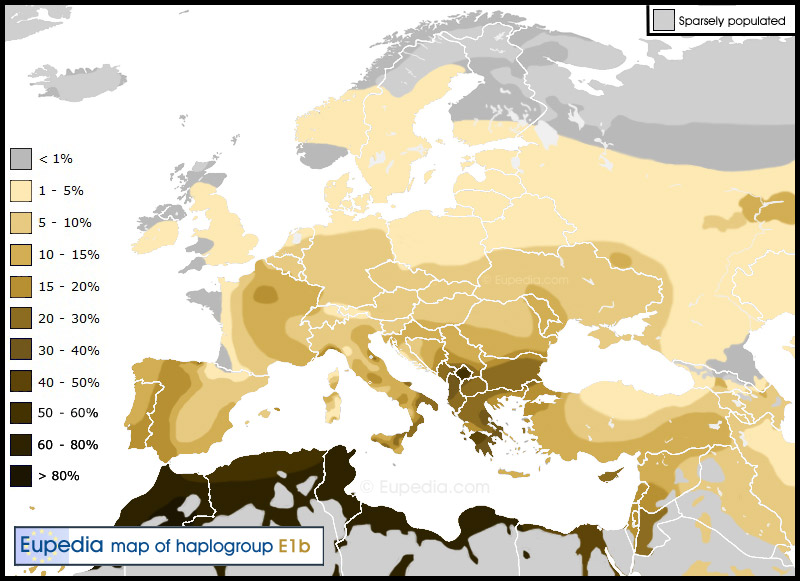
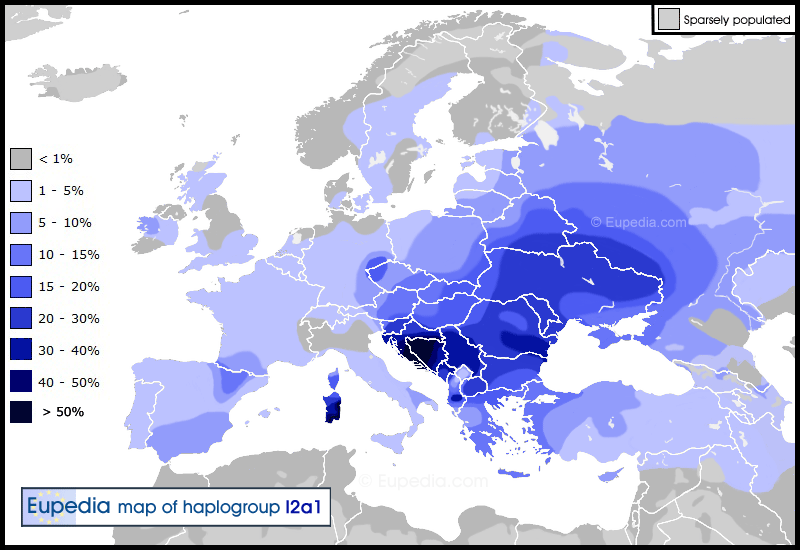
According to IGena official DNA research,the most frequent haplogroup in Greek DNA is E1b1b (32%),which originates some 22 000 years ago in East Africa.Meaning,those East African tribes migrated to the north in the territory of present-day Greece and on the way (and in time) mixed with other nations to form modern Greek DNA.On the other hand,the most frequent haplogroup in Macedonian DNA is I2a (39%),which originates some 17 000 years ago in the Balkan peninsula.Meaning,our ancestors lived here since ages,they were indigenous to this area,and in time also mixed with settlers and conquerors to form modern Macedonian DNA.Interestingly enough,the so-called "Slavic haplogroup" - R1a (found in 50%> in Russians,Ukrainians,Slovenes,Poles and other Slavic nations) is found in both Macedonian (20%) AND Greek (15%) DNA.So basically by insulting Slavs they're insulting themselves too.Oh, the irony of it :)
 
Last edited:
According to IGena official DNA research,the most frequent haplogroup in Greek DNA is E1b1b (32%),which originates some 22 000 years ago in East Africa.Meaning,those East African tribes migrated to the north in the territory of present-day Greece and on the way (and in time) mixed with other nations to form modern Greek DNA.On the other hand,the most frequent haplogroup in Macedonian DNA is I2a (39%),which originates some 17 000 years ago in the Balkan peninsula.Meaning,our ancestors lived here since ages,they were indigenous to this area,and in time also mixed with settlers and conquerors to form modern Macedonian DNA.Interestingly enough,the so-called "Slavic haplogroup" - R1a (found in 50%> in Russians,Ukrainians,Slovenes,Poles and other Slavic nations) is found in both Macedonian (20%) AND Greek (15%) DNA.So basically by insulting Slavs they're insulting themselves too.Oh, the irony of it :)
Distribution of haplogroup E1b1b:
Haplogroup-E1b1b.jpg


Distribution of haplogroup I2a:
Haplogroup_I2a.gif
 
Last edited:
Back
Top