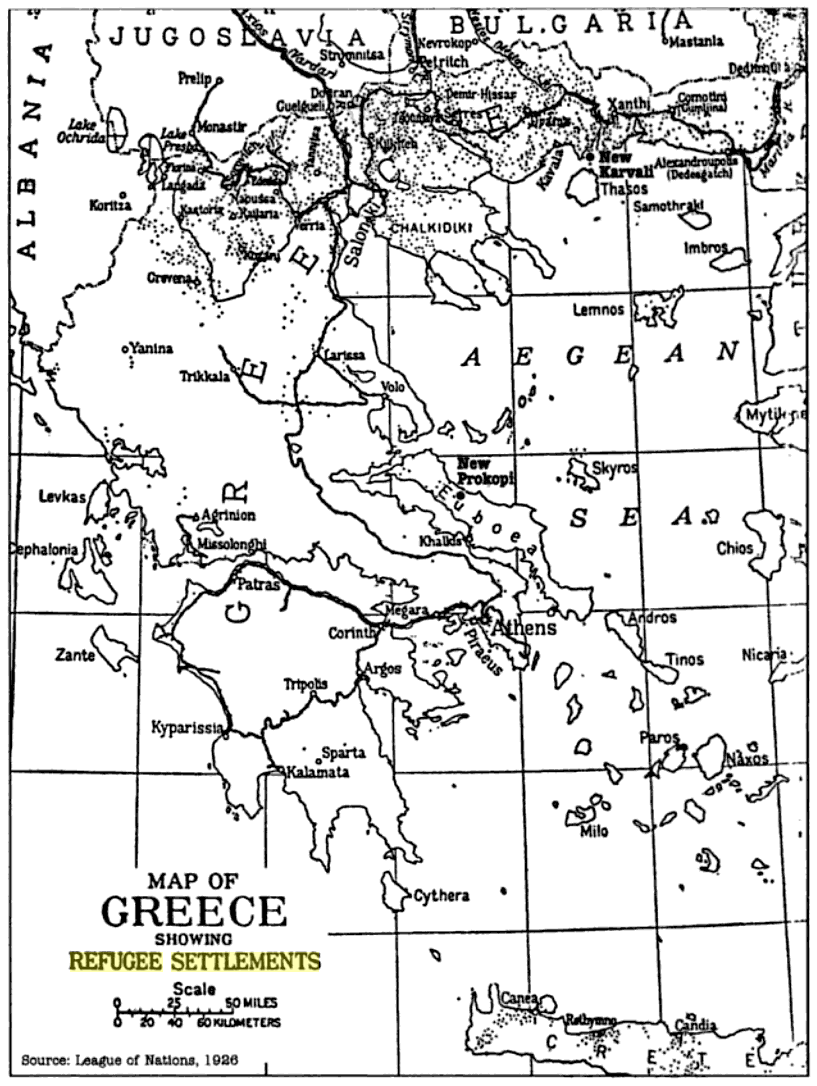
The resettlement of refugees in Macedonia data for each refugee settlement
The official census data on refugees for the period 1912-1924 are divided into two categories. Refugees came to Greece prior to and after the Asia Minor Catastrophe (beginning September 1922).
Note that counted as refugees and children of refugees born in Greece.
The total number of refugees in the 1928 census was 1,221,849 people (589,418 or 48.24% males and 632,431 or 51.76% females). As for the actual population of the country, which stood at 6,204,684 persons, refugees accounted for 19.68% of the total.
The refugees who came before the catastrophe in Asia Minor was 151.892 (79.601 or 52.41% males and 72,291 or 47.59% females). The refugees who came after the Asia Minor Catastrophe was 1,069,957 (47.65% or 509,817 males and 560,140 or 52.35% females). It seems to say that the refugees in the first group, men outnumber women. The opposite happens in the second category. Pre Asia Minor refugees constituted 12.43% of the refugee population.
In the country (region) of origin, the refugees had come:
From Asia Minor 626 954 (293 086 males and 333,868 females). Of these, 37,728 (19,777 males and 17,951 females) came before and 589.226 (273.309 males and 315,917 females) after the Asia Minor Catastrophe.
From Thrace 256 635 (126 837 males and 129 798 females). Of these, 27,057 (14,155 males and 12,902 females) came before and 229.578 (112.682 males and 116,896 females) after the Asia Minor Catastrophe.
From Sea 182.169 (88.271 males and 93,898 females). Of these, 17,528 (8979 males and 8549 females) came before and 164.641 (79.292 males and 85,349 females) after the Asia Minor Catastrophe.
From Bulgaria 49 027 (25,070 males and 23,957 females). Of these, 20,977 (10,860 males and 10,117 females) came before and 28,050 (14,210 males and 13,840 females) after the Asia Minor Catastrophe.
From the Caucasus 47.091 (24.410 males and 22,681 females). Of these, 32,421 (17,003 males and 15,418 females) came before and 14 670 (7407 males and 7263 females) after the Asia Minor Catastrophe.
From Constantinople 38,458 (20,234 males and 18,224 females). Of these, 4019 (2449 males and 1660 females) and came before 34,349 (17,785 males and 16,564 females) after the Asia Minor Catastrophe.
From Russia 11.435 (6359 males and 5076 females). Of these, 5214 (2828 males and 2386 females) and came before 6221 (3531 males and 2690 females) after the Asia Minor Catastrophe.
From Serbia, 6057 (3004 males and 3053 females). Of these, 4611 (2.365 males and 2246 females) and came before 1446 (639 males and 807 females) after the Asia Minor Catastrophe.
From Albania 2498 (1438 males and 1060 females). Of these, 1600 (852 males and 748 females) came before and 898 (586 males and 312 females) after the Asia Minor Catastrophe.
From the Dodecanese 738 (394 male and 344 female). Of these, 355 (188 males and 167 females) came before and 383 (206 males and 177 females) after the Asia Minor Catastrophe.
From Romania 722 (274 males and 448 females). Of these, 266 (127 males and 139 females) came before and 456 (147 males and 309 females) after the Asia Minor Catastrophe.
From Cyprus 57 (37 males and 20 females). Of these, 25 (17 males and 8 females) came before and 32 (20 males and 12 females) after the Asia Minor Catastrophe.
From Egypt 8 (4 males and 4 females). Of these, (one male and one female) came before and seven (three males and four females) after the Asia Minor Catastrophe.
The settlement of refugees in different geographical regions of the country was based on a national planning aimed at linguistic and cultural change in composition of the population. Was preceded by religious cleansing by "voluntary"population exchanges at Neuilly (exarchikoi in Bulgaria) and the mandatory exchange of Lausanne (Muslims in Turkey). The consolidation of national morale will then take over the ideological mechanisms of the state.
This was at the national interest in the settlement of refugees from the Refugee Resettlement Committee (EAP) is shown by the numbers of refugees egkatastathenton geographically.
Of the total of 1,221,849 refugees in 1928, counted:
In Macedonia the 1,407,477 inhabitants, 638,253 refugees, or 45.18% of the population.
Thrace (not included in the compulsory exchange) of 303 171 inhabitants, 107 607 refugees and 35.49% of the population.
In Attikovoiotia (to ensure cheap labor companies in the city) of 1,024,667 people, 281,989 refugees, or 27.52% of the population.
In the rest of the country of 3,464,369 people, 194,000 refugees, or 5.59 of the population!
Of the 638 253 (49.26% or 314,423 males and 323,830 or 50.74% females) refugees who settled in Macedonia, 99,658 (52.21% or 52,031 males and 47,627 or 47.79% females) came before the Asia Minor Catastrophe and 538.595 (262.392 or 276.203 males and 48.72 and 51.28% female) came after the Asia Minor Catastrophe.
The following table below appear in county and province of the refugees who settled in Macedonia before and after the Asia Minor Catastrophe.
In the census of 1928, Macedonia was 2.062 settlements (villages). The number of settlements by county were: Drama 196, 571 in Thessaloniki, Kavala 151, 351 in Kozani, Pella 158, 253 in Serres. Florina 213, 148 21 Halkidiki and Mount Athos.
According to details of the Committee on Refugee Resettlement (EAP) by the end of 1926, had settled in Macedonia 111 001 refugee families, with a total population of 419,662 people.
In EAP, 69,775 refugee families, with a total population of 258,967 people, have been installed in 934 settlements identified by the committee as a purely refugee.
A number of 41 226 refugee families, with a total population of 160 695 people had settled in 442 camps where there were indigenous people, so, punctuated by the committee as mixed settlements.
From the above data indicate that there were 686 settlements in Macedonia, which could be described as the period 1926-1928, as settlements with a purely indigenous population.
The outermost record data for each village, not a provincial but Settlements Office. These data, prepared by me, are centralized in the Office the following pattern:
In the following chapters present detailed information on the settlement of settlement (number of families and individuals), by colonizing the EAP office at the end of 1926.