• Welcome to the new Macedonian Truth Forum. All posts, members and private messages have been moved over from the old forum.

    Passwords from the old forum could not be carried over, so please use Forgot your password? to set a new one. The reset link is emailed to the address on your account.

  • Rules and Regulations at the forum of the Macedonian Truth Organisation (MTO)

    (1) The national-ethnic and cultural-linguistic identity of the Macedonian people is historically Macedonian, and derives its character from the native, indigenous and geographic homeland of the Macedonians, which is called Macedonia. To ensure that their human rights, integrity and heritage are appropriately respected, the only nouns and adjectives acceptable when reference is made to the above character and identity markers is Macedon, Macedonia, Macedonian and Macedonians.

    (2) The nation-state of the Macedonian people is the Republic of Macedonia, and is to be referred to by this official title so long as the 'republic' prefix is consistently applied to other states. Alternative references are the Macedonian Republic, or simply, Macedonia.

    (3) The 'ethnic' prefix is only acceptable for Macedonians in cases where differentiation is specifically required - so long as it is in context and consistent where it concerns its application to other ethnic groups.

    (4) Should any other differentiation be specifically required, the names of other ethnic groups that reside with Macedonians in either the Republic of Macedonia or the occupied Macedonian regions in Greece, Bulgaria, Serbia or Albania, are to be given a prefix.

    (5) Negating the identity, language and culture of the Macedonian people by deliberate avoidance of the terms Macedonia, Macedonian and Macedonians, or by any other means, is not permitted.

    (6) Systematic anti-Macedonian propaganda and rhetoric are not permitted.

    (7) Threads irrelevant to the Macedonian Cause, the community at the Macedonian Truth Organisation or the Macedonians in general may be considered as spam or not in the spirit of the forum. In such cases they are not permitted.

    (8) Continual posting of messages in threads with the sole purpose of deviating from the initial topics with the use of unrelated and unnecessary information is not permitted.

    (9) All posts, external articles, reports, etc that are cited in languages other than Macedonian or English, must be accompanied with a translation in one or both of the said languages.

    (10) Despite the possibility of some conversations and debates becoming heated, extreme abuse and/or racism, vulgar language and/or terminology, threats, revelation of personal information about others, harassment, and other such behavior will not be permitted. If deemed necessary all relevant information including member details will be reported to the appropriate authorities for investigation which may result in legal action.

    (11) Threads that are created must have a summary of a topic or excerpt of an article found in pertinent link(s) that have been included. One line threads will be considered unaccetable spam and are therefore not permitted.

    (12) Compulsive and deliberate lies, irrespective of the topic, are not permitted.

    (13) Any symbols or avatars found to be perceived as offensive to Macedonians are not permitted.

    (13) Any explicit or extreme material is not permitted.

    Failure to adhere to the above rules and regulations will result in a ban after 3 breaches. This may be reconsidered in some cases should the circumstances be of an unorthodox nature and/or require special consideration. To assure an effective deterrent against an individual or individuals with the sole purpose of causing dissent through spamming, racism or other improper means, the above rules will be strictly enforced.

    The MTO administration will monitor all discussions as reasonably practical and reserve the right to remove any post and/or member from the forum, and update the rules and regulations as required. Members are encouraged to immediately report any post and/or member to the MTO administration if they feel that these rules have not been abided by.

    The views expressed on this forum are those of the individuals. The only official representation of the MTO is made by the "Macedonian Truth Organisation (Site Owner)" username, and no other.

  • Macedonian Cause

    The Macedonian Truth Organisation calls on God in Heaven to protect, bless and guide the endeavour it is committing to undertake, and that is to work towards:

    Securing Macedonia as a free, independent and democratic republic in which sovereignty lies with the Macedonian citizens; as the nation-state of the Macedonian people in which they can preserve their culture, language and identity; as a state in which the Macedonian language and culture form the basis of public life and act as important unifying elements of Macedonian society; as the home of all its citizens to which it guarantees and obliges their inalienable natural rights and corresponding responsibilities;

    The acknowledgment as self-evident and irrefutable the existence of the:

    1) Indigenous, ethnonational name of Macedonia;
    2) Macedonian people, language and identity;
    3) Macedonian culture, symbols and folklore;
    4) Macedonian ancestry, heritage and history in its entirety; and
    5) Macedonian Orthodox Church;

    Securing recognition by the International Community of the tragedies endured by the Macedonian people, of the division of Macedonia with the signing of the Treaty of Bucharest on August 10, 1913, and the genocide committed against the Macedonian people at the hands of the Greek, Bulgarian and Serbian states and their respective churches during the 19th and 20th centuries;

    Ensuring that the Interim Accord is declared ‘null and void’ and that all constitutional provisions, acts, commitments, agreements, legislation, regulations, policies or programs emanating from, supporting or consequential to the Interim Accord are also declared ‘null and void’, including the use of any symbols and the completion of any acts imposed by, or originating from, the Interim Accord.

    Ensuring that the Framework Agreement is abolished and that all constitutional provisions, acts, commitments, agreements, legislation, regulations, policies and programs emanating from, supporting or consequential to the Framework Agreement are also abolished and replaced by a framework of constitutional and statutory law based on inalienable natural rights and corresponding responsibilities and universally codified human rights mechanisms.

    Securing the abolishment of any existing constitutional provisions, acts, agreements, legislation, regulations, policies and programs that discriminate against the Macedonian people, in any international organisation or any of the countries of the International Community where such constitutional provisions, acts, agreements, legislation, regulations, policies and programs exist, and thereby ensuring the freedom for Macedonians to exercise their inalienable natural rights and fulfil their corresponding responsibilities, and practice their culture, language and religious faiths in all the countries of the International Community without hindrance;

    The empowerment of Macedonians to undertake a moral revolution and to instil and/or reinvigorate within themselves a deep-rooted national, cultural, linguistic and historical dignity and a commitment to the exercise of freedom based on inalienable natural rights and corresponding responsibilities;

    The recognition of the Macedonian minorities in the neighbouring states of Macedonia as well as the respect for the inalienable rights and freedoms of the Macedonian minorities, as provided for by natural law and as codified by the United Nations Charter, the Universal Declaration of Human Rights and other universally codified human rights mechanisms;

    The full and unreserved respect of, and the support for, the rights of all people of non-Macedonian descent living in Macedonia and around the world, who share a reciprocal full and unreserved respect for the Macedonian people, their homeland and their state;

    The cultural unification and solidarity of the Macedonian people living in all parts of historical Macedonia and adjacent territories, as well as Macedonians throughout the world;

    The unity of all Macedonians on the principles, objectives and achievement of the Macedonian cause as defined by this declaration.

The Greek colonization of Macedonia since 1913!

Daskalot

New member
Let us all add the information we have available about the Greek colonization of Aegean Macedonia since 1913.

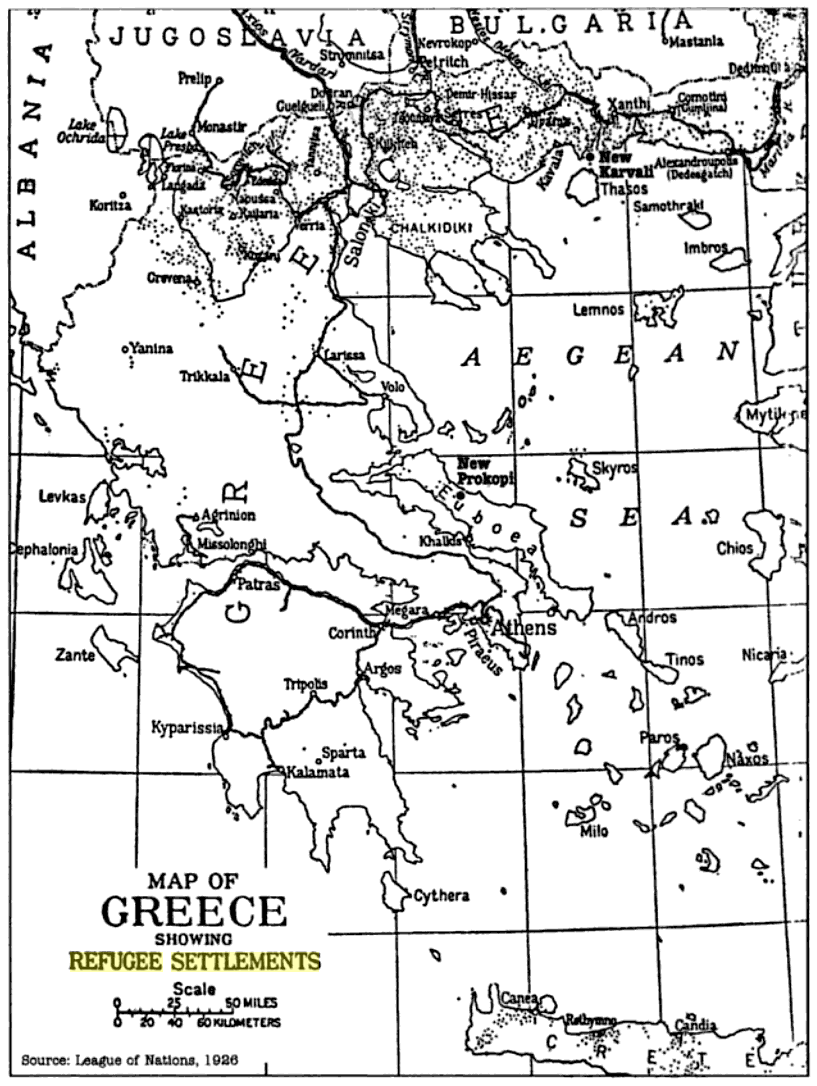
Here are some maps related to the largest influx of colonizers, the Christian Refugees from Turkey that arrived on Macedonian soil for the first time in 1923. They were what Greece needed to make Aegean Macedonia Greek. Today their descendants form the bulk of the 2.5 million national Greeks that live in Aegean Macedonia.

181-6.png

Source: “Crossing the Aegean: The Consequences of the 1923 Greek-Turkish Population Exchange” by Renee Hirschon, 2003, page 181.

mapofgreecerefugeesettlements-1926.jpg

Source: League of Nations, Economic and Financial. 1926. II. 32. (Geneva: 1926)

105-2.png

Source: “A Concise History of Greece” by Richard Clogg, 1992, page 105.

Please add all relevant information to this topic.
:rmacedonia
 
I am concerned that we would be including many people who are not ethnically Greek. What do we mean by Greeks? Should we define this first?
 
Colonization of the Macedonian "space".

We have physical removal of Macedonians by murder.

Wasn't the purpose of this demographic thrust of Turkish speaking Christians to water down the Macedonian ethnic block ?

We have the physical removal of cultural signs.

Only after it has been Hellenized, to the New Greeks make a grab for the name.
 
Here is an interesting map showing the area which is inhabited by ethnic Macedonians, the map is from the Greek Civil war.
jegejska-makedonija-etnichka-granica.jpg

Please notice the thick black line, which according to the legend corresponds to the ETHNIC BORDER OF THE MACEDONIANS.

Source: The map was published in the Yugoslav newspaper Borba, August 26th 1946.
 
msonce.jpg


Map of Aegean Macedonia showing the areas where Macedonians live
http://www.historyofmacedonia.org/MacedonianMinorities/MapMacedoniansinGreece.html
Compiled and submitted to the European Parliament by the Macedonians in Aegean Macedonia in Greece
On July 6, 2000 in its 310th edition, the Macedonian weekly magazine Macedonian Sun (Makedonsko Sontse), under the title "Where are the Macedonians?", published on its front page the map of Aegean Macedonia which became part of Northern Greece after the partition of Macedonia in 1913. The map depicts the areas where the ethnic Macedonians today live in Greece. It was compiled by the Macedonians in Greece and submitted to the European Parliament. In the cities, towns, and villages in the yellow areas, the Macedonians make up 100% of the population, while in the red are marked the areas where they make between 50 and 100%. The rest of the uncolored areas, the Macedonians are minority among the Greeks with less then 50% of the population.

Taking in consideration this map made by the Macedonians of Greece, we put the data of the approximate area and marked with red where the Macedonians make a majority in Aegean Macedonia (50% to 100%) and where they make minority we used red stripes while in the same time representing the Greeks with blue stripes.

One can easily see that the Macedonians make up majority in the northern half of Aegean Macedonia, bordering the Republic of Macedonia and the Pirin part of Macedonia in Bulgaria where Macedonians also live. In the other southern half of Aegean Macedonia the Macedonians are minority. The population of Aegean Macedonia is about 2,000,000 which would result that the Macedonian minority in Greece numbers about 1,000,000 people.
The Greek government claims that in Greece live 98% Greeks and that there is not one national minority in the country. These claims are clearly an exaggeration as every country in Europe has national minorities. Therefore Human Rights Watch was correct when after visiting Aegean Macedonia concluded that the "large Macedonian minority" in Greece is under daily oppression, and urged Greece to end its discrimination.
 
Here is a map depicting where the Christians in Turkey lived, most of them were later deported and settled en masse in the part of Macedonia which Greece annexed since the Balkan Wars.

The Ottoman Empire archive document regarding the official census of 1914, first column "musulman" (Muslims), second "grecs" (Christian adherents to the Greek Patriarchate of Istanbul), third "arménien" (Christian adherents to the Armenian Patriarchate of Istanbul). The census is divided according to religious affiliation in regards to the Ottoman Millet system.

Proportions_des_populations_en_Asie_Mineure_statistique_officielle_d1914.png

Source: The Republic of Turkey, Ottoman Archives. The document is published in electronic form as "Arsiv_Belgeleriyle_Ermeni_Faaliyetleri_Cilt_1.pdf" also the values are presented in the Stanford Jay Shaw, Ezel Kural Shaw "History of the Ottoman Empire and Modern Turkey" Cambridge University page 239-241
 
Here are the statistics of the Greek colonization of the annexed part of Macedonia.
I will begin with the Lerin(Florina) and Voden(Edessa) regions.

If someone notes any mistakes in the names of the villages/towns/cities new or old, please let me know. I would like to have the correct names both new and old.

Lerin(Florina) region:
colonization_of_aegean_macedonia-florina.png

The EAP has installed 3144 refugee families / 12,353 persons in 42 villages (settlements). In 20 of these settlements, which were described as purely refugee, settled 1981 families / 7617 people. In 22 mixed villages (indigenous and refugees) settled 1163 families / 4682 people.

Voden(Edessa) region:
colonization_of_aegean_macedonia-edessa.png

The EAP has installed 5949 refugee families / 23,507 persons in 72 villages (settlements). In 23 of these settlements, which were described as purely refugee, settled 2143 families / 8460 people. In 49 mixed villages (indigenous and refugees) settled 3806 families / 15,047 persons.
*EAP=Committee on Refugee Resettlement

Source: http://lithoksou.net/prosfighes.html
 
The resettlement of refugees in Macedonia data for each refugee settlement

The official census data on refugees for the period 1912-1924 are divided into two categories. Refugees came to Greece prior to and after the Asia Minor Catastrophe (beginning September 1922).

Note that counted as refugees and children of refugees born in Greece.

The total number of refugees in the 1928 census was 1,221,849 people (589,418 or 48.24% males and 632,431 or 51.76% females). As for the actual population of the country, which stood at 6,204,684 persons, refugees accounted for 19.68% of the total.

The refugees who came before the catastrophe in Asia Minor was 151.892 (79.601 or 52.41% males and 72,291 or 47.59% females). The refugees who came after the Asia Minor Catastrophe was 1,069,957 (47.65% or 509,817 males and 560,140 or 52.35% females). It seems to say that the refugees in the first group, men outnumber women. The opposite happens in the second category. Pre Asia Minor refugees constituted 12.43% of the refugee population.


In the country (region) of origin, the refugees had come:

From Asia Minor 626 954 (293 086 males and 333,868 females). Of these, 37,728 (19,777 males and 17,951 females) came before and 589.226 (273.309 males and 315,917 females) after the Asia Minor Catastrophe.

From Thrace 256 635 (126 837 males and 129 798 females). Of these, 27,057 (14,155 males and 12,902 females) came before and 229.578 (112.682 males and 116,896 females) after the Asia Minor Catastrophe.

From Sea 182.169 (88.271 males and 93,898 females). Of these, 17,528 (8979 males and 8549 females) came before and 164.641 (79.292 males and 85,349 females) after the Asia Minor Catastrophe.

From Bulgaria 49 027 (25,070 males and 23,957 females). Of these, 20,977 (10,860 males and 10,117 females) came before and 28,050 (14,210 males and 13,840 females) after the Asia Minor Catastrophe.

From the Caucasus 47.091 (24.410 males and 22,681 females). Of these, 32,421 (17,003 males and 15,418 females) came before and 14 670 (7407 males and 7263 females) after the Asia Minor Catastrophe.

From Constantinople 38,458 (20,234 males and 18,224 females). Of these, 4019 (2449 males and 1660 females) and came before 34,349 (17,785 males and 16,564 females) after the Asia Minor Catastrophe.

From Russia 11.435 (6359 males and 5076 females). Of these, 5214 (2828 males and 2386 females) and came before 6221 (3531 males and 2690 females) after the Asia Minor Catastrophe.

From Serbia, 6057 (3004 males and 3053 females). Of these, 4611 (2.365 males and 2246 females) and came before 1446 (639 males and 807 females) after the Asia Minor Catastrophe.

From Albania 2498 (1438 males and 1060 females). Of these, 1600 (852 males and 748 females) came before and 898 (586 males and 312 females) after the Asia Minor Catastrophe.

From the Dodecanese 738 (394 male and 344 female). Of these, 355 (188 males and 167 females) came before and 383 (206 males and 177 females) after the Asia Minor Catastrophe.

From Romania 722 (274 males and 448 females). Of these, 266 (127 males and 139 females) came before and 456 (147 males and 309 females) after the Asia Minor Catastrophe.

From Cyprus 57 (37 males and 20 females). Of these, 25 (17 males and 8 females) came before and 32 (20 males and 12 females) after the Asia Minor Catastrophe.

From Egypt 8 (4 males and 4 females). Of these, (one male and one female) came before and seven (three males and four females) after the Asia Minor Catastrophe.


The settlement of refugees in different geographical regions of the country was based on a national planning aimed at linguistic and cultural change in composition of the population. Was preceded by religious cleansing by "voluntary"population exchanges at Neuilly (exarchikoi in Bulgaria) and the mandatory exchange of Lausanne (Muslims in Turkey). The consolidation of national morale will then take over the ideological mechanisms of the state.

This was at the national interest in the settlement of refugees from the Refugee Resettlement Committee (EAP) is shown by the numbers of refugees egkatastathenton geographically.

Of the total of 1,221,849 refugees in 1928, counted:

In Macedonia the 1,407,477 inhabitants, 638,253 refugees, or 45.18% of the population.


Thrace (not included in the compulsory exchange) of 303 171 inhabitants, 107 607 refugees and 35.49% of the population.

In Attikovoiotia (to ensure cheap labor companies in the city) of 1,024,667 people, 281,989 refugees, or 27.52% of the population.

In the rest of the country of 3,464,369 people, 194,000 refugees, or 5.59 of the population!


Of the 638 253 (49.26% or 314,423 males and 323,830 or 50.74% females) refugees who settled in Macedonia, 99,658 (52.21% or 52,031 males and 47,627 or 47.79% females) came before the Asia Minor Catastrophe and 538.595 (262.392 or 276.203 males and 48.72 and 51.28% female) came after the Asia Minor Catastrophe.

The following table below appear in county and province of the refugees who settled in Macedonia before and after the Asia Minor Catastrophe.


In the census of 1928, Macedonia was 2.062 settlements (villages). The number of settlements by county were: Drama 196, 571 in Thessaloniki, Kavala 151, 351 in Kozani, Pella 158, 253 in Serres. Florina 213, 148 21 Halkidiki and Mount Athos.


According to details of the Committee on Refugee Resettlement (EAP) by the end of 1926, had settled in Macedonia 111 001 refugee families, with a total population of 419,662 people.

In EAP, 69,775 refugee families, with a total population of 258,967 people, have been installed in 934 settlements identified by the committee as a purely refugee.

A number of 41 226 refugee families, with a total population of 160 695 people had settled in 442 camps where there were indigenous people, so, punctuated by the committee as mixed settlements.

From the above data indicate that there were 686 settlements in Macedonia, which could be described as the period 1926-1928, as settlements with a purely indigenous population.

The outermost record data for each village, not a provincial but Settlements Office. These data, prepared by me, are centralized in the Office the following pattern:


In the following chapters present detailed information on the settlement of settlement (number of families and individuals), by colonizing the EAP office at the end of 1926.

Source: http://lithoksou.net/prosfighes.html
 
Land from the indigenous "Greeks" was expropriated where landholdings were considered to be excessive. Sorry, if there were indigenous Greeks there, they must have stolen the land from Macedonians 15 years earlier. More likely it was Macedonians that had to give up their lands for the imported christian Turks.

Hence the AMHRC court case.
 
Btw, don't think that Turcophone Christians only came from Anatolia("Asia minor" in Greek article).


From Russia 11.435 (6359 males and 5076 females). Of these, 5214 (2828 males and 2386 females) and came before 6221 (3531 males and 2690 females) after the Asia Minor Catastrophe.

From the Caucasus 47.091 (24.410 males and 22,681 females). Of these, 32,421 (17,003 males and 15,418 females) came before and 14 670 (7407 males and 7263 females) after the Asia Minor Catastrophe.


It says Russia and Caucasus in the Greek article but these ~82.000 people came from north of Blacksea, Crimea to today`s Georgia, Azerbaijan. In 19th century, these people called as "Urums" but today the scholars usually calls them "Graeco-Tatars". These were Tatar Turkish speaking Christians who were totally alien to Greek language. Actually the term "Graeco-Tatars" is kinda weird because Tatar people had no relation whatsoever with the Greeks throughout the history. Only relation between them was; these Urums was the member of Istanbul patriarchy because they were Christians. That was it, nothing else!

After Russian-Turkish war at 1877, Russians invaded whole Crimea, Ukraine, Georgia and surroundings. After that, they expelled 100.000s of Tatars by force, both Christians(Urums) and Muslim Tatars because all of them was Turkish speaking people. Most of them migrated to Anatolia and thats when the first Tatars came to today`s Turkey. Some of them gone to Aegean Macedonia as the article states.

After the 1924 population exchange, the assimilation process undergone and they became descendants of ancient Greeks like all other immigrants of Greece!
 
Last edited:
First of all i d like to greet the forum..since this is my first post here:)

I ll contribute my 2 cents for this topic.
The following is a charter of the population of the Greek part of Macedonia in 1925:
ethnologicalcomposition.jpg


Unfortunately i didnt find a translated in English version.
The numbers almost agree with the above estimations -

The Greek Refugees seem to constitute 44.15% (607.000) of the total population.
Local Greeks of Macedonia (listed simply as "Greeks" ) are counted to 480.000 -35%.

The 3 following categories are listed as "Slavophones ex Patriarchics" (76.100 -5.53%) ,"Slavophones ex Exarchics" (97.800-7.11%) and "Slavophones under migration to Bulgaria" (11.000)


Then come the Vlachs 34.500 "Hellenizontes"(=Greek feeling) -2.5% ,and 11.300 "Rumazinontes"(=Romanian feeling) -0.8%

65.000 Jews and 1.800 Albanians.


Sources are listed below.
 
Last edited:
After Russian-Turkish war at 1877, Russians invaded whole Crimea, Ukraine, Georgia and surroundings. After that, they expelled 100.000s of Tatars by force, both Christians(Urums) and Muslim Tatars because all of them was Turkish speaking people. Most of them migrated to Anatolia and thats when the first Tatars came to today`s Turkey. Some of them gone to Aegean Macedonia as the article states.

After the 1924 population exchange, the assimilation process undergone and they became descendants of ancient Greeks like all other immigrants of Greece!

From Russia ,means exactly this : "from Russia"-not from Anatolia .

You speak about some Tatar or Caucasian ppl who migrated from Russian territory to Anatolia.
(I have a Turkish friend who lives in Souther Turkey but descends from Russian part of the Black Sea.)

The Greek refugees from Russia at that period were at the most Greeks who were expelled -themselves,or at least not further back than their parents- some years before from Trebizond,Samsous,and other parts of Pontus by the Ottoman empire.
The expulsions begun in the late 19th century ,and the most were driven out during the 1st WW -1914-1918.
So..they moved from southern Black Sea ,were their ancestors lived for centuries..to the Northern Black Sea (Russia)

From Russia ,they migrated to Greece after the Communist Revolution and the consequent civil war (1917-1923)

These are the 11.500 people mentioned -nothing to do with some kind of Tatars.
 
Last edited:
First of all i d like to greet the forum..since this is my first post here:)

I ll contribute my 2 cents for this topic.
The following is a charter of the population of the Greek part of Macedonia in 1925:
ethnologicalcomposition.jpg


Unfortunately i didnt find a translated in English version.
The numbers almost agree with the above estimations -

The Greek Refugees seem to constitute 44.15% (607.000) of the total population.
Local Greeks of Macedonia (listed simply as "Greeks" ) are counted to 480.000 -35%.

The 3 following categories are listed as "Slavophones ex Patriarchics" (76.100 -5.53%) ,"Slavophones ex Exarchics" (97.800-7.11%) and "Slavophones under migration to Bulgaria" (11.000)


Then come the Vlachs 34.500 "Hellenizontes"(=Greek feeling) -2.5% ,and 11.300 "Rumazinontes"(=Romanian feeling) -0.8%

65.000 Jews and 1.800 Albanians.


Sources are listed below.

On another thread Mr Coastal was trying to convince everyone that he was not relying on data collected by nationalists( like the Bulgarian Kanchov), but here we see him presenting data collected from Greek officials about the ethnicity of the people living in their recently annexed territory of Macedonia. I’m sure that he thinks that these Greek officials were not subjective in their presentations and that the data reflects the real situation at the time. Of course if one looks at the statistics at the time, the overall opinion is that the number of Greek speakers doesn’t amount to more then 10% of the population in Macedonia, which in numbers is around 200 000 – 250 000 people. The nationalistic Greeks managed to inflate those number to 480 000(not that it was their first time, some Greeks have inflated them to 600 000)! That’s double from the real numbers! Kanchov was surely subjective and counted less Greek speakers, but he was not so ridiculous to do what these Greek nationalists did. I don’t even want to start about the background of those ``Greek speakers`` in the past.
One more thing – I’m really interested to know how did the Greek authorities knew which Vlachs were pro-Greek and which were pro-Romanian in 1925? Did they went from door to door and asked?
 
Back
Top