• Welcome to the new Macedonian Truth Forum. All posts, members and private messages have been moved over from the old forum.

    Passwords from the old forum could not be carried over, so please use Forgot your password? to set a new one. The reset link is emailed to the address on your account.

  • Rules and Regulations at the forum of the Macedonian Truth Organisation (MTO)

    (1) The national-ethnic and cultural-linguistic identity of the Macedonian people is historically Macedonian, and derives its character from the native, indigenous and geographic homeland of the Macedonians, which is called Macedonia. To ensure that their human rights, integrity and heritage are appropriately respected, the only nouns and adjectives acceptable when reference is made to the above character and identity markers is Macedon, Macedonia, Macedonian and Macedonians.

    (2) The nation-state of the Macedonian people is the Republic of Macedonia, and is to be referred to by this official title so long as the 'republic' prefix is consistently applied to other states. Alternative references are the Macedonian Republic, or simply, Macedonia.

    (3) The 'ethnic' prefix is only acceptable for Macedonians in cases where differentiation is specifically required - so long as it is in context and consistent where it concerns its application to other ethnic groups.

    (4) Should any other differentiation be specifically required, the names of other ethnic groups that reside with Macedonians in either the Republic of Macedonia or the occupied Macedonian regions in Greece, Bulgaria, Serbia or Albania, are to be given a prefix.

    (5) Negating the identity, language and culture of the Macedonian people by deliberate avoidance of the terms Macedonia, Macedonian and Macedonians, or by any other means, is not permitted.

    (6) Systematic anti-Macedonian propaganda and rhetoric are not permitted.

    (7) Threads irrelevant to the Macedonian Cause, the community at the Macedonian Truth Organisation or the Macedonians in general may be considered as spam or not in the spirit of the forum. In such cases they are not permitted.

    (8) Continual posting of messages in threads with the sole purpose of deviating from the initial topics with the use of unrelated and unnecessary information is not permitted.

    (9) All posts, external articles, reports, etc that are cited in languages other than Macedonian or English, must be accompanied with a translation in one or both of the said languages.

    (10) Despite the possibility of some conversations and debates becoming heated, extreme abuse and/or racism, vulgar language and/or terminology, threats, revelation of personal information about others, harassment, and other such behavior will not be permitted. If deemed necessary all relevant information including member details will be reported to the appropriate authorities for investigation which may result in legal action.

    (11) Threads that are created must have a summary of a topic or excerpt of an article found in pertinent link(s) that have been included. One line threads will be considered unaccetable spam and are therefore not permitted.

    (12) Compulsive and deliberate lies, irrespective of the topic, are not permitted.

    (13) Any symbols or avatars found to be perceived as offensive to Macedonians are not permitted.

    (13) Any explicit or extreme material is not permitted.

    Failure to adhere to the above rules and regulations will result in a ban after 3 breaches. This may be reconsidered in some cases should the circumstances be of an unorthodox nature and/or require special consideration. To assure an effective deterrent against an individual or individuals with the sole purpose of causing dissent through spamming, racism or other improper means, the above rules will be strictly enforced.

    The MTO administration will monitor all discussions as reasonably practical and reserve the right to remove any post and/or member from the forum, and update the rules and regulations as required. Members are encouraged to immediately report any post and/or member to the MTO administration if they feel that these rules have not been abided by.

    The views expressed on this forum are those of the individuals. The only official representation of the MTO is made by the "Macedonian Truth Organisation (Site Owner)" username, and no other.

  • Macedonian Cause

    The Macedonian Truth Organisation calls on God in Heaven to protect, bless and guide the endeavour it is committing to undertake, and that is to work towards:

    Securing Macedonia as a free, independent and democratic republic in which sovereignty lies with the Macedonian citizens; as the nation-state of the Macedonian people in which they can preserve their culture, language and identity; as a state in which the Macedonian language and culture form the basis of public life and act as important unifying elements of Macedonian society; as the home of all its citizens to which it guarantees and obliges their inalienable natural rights and corresponding responsibilities;

    The acknowledgment as self-evident and irrefutable the existence of the:

    1) Indigenous, ethnonational name of Macedonia;
    2) Macedonian people, language and identity;
    3) Macedonian culture, symbols and folklore;
    4) Macedonian ancestry, heritage and history in its entirety; and
    5) Macedonian Orthodox Church;

    Securing recognition by the International Community of the tragedies endured by the Macedonian people, of the division of Macedonia with the signing of the Treaty of Bucharest on August 10, 1913, and the genocide committed against the Macedonian people at the hands of the Greek, Bulgarian and Serbian states and their respective churches during the 19th and 20th centuries;

    Ensuring that the Interim Accord is declared ‘null and void’ and that all constitutional provisions, acts, commitments, agreements, legislation, regulations, policies or programs emanating from, supporting or consequential to the Interim Accord are also declared ‘null and void’, including the use of any symbols and the completion of any acts imposed by, or originating from, the Interim Accord.

    Ensuring that the Framework Agreement is abolished and that all constitutional provisions, acts, commitments, agreements, legislation, regulations, policies and programs emanating from, supporting or consequential to the Framework Agreement are also abolished and replaced by a framework of constitutional and statutory law based on inalienable natural rights and corresponding responsibilities and universally codified human rights mechanisms.

    Securing the abolishment of any existing constitutional provisions, acts, agreements, legislation, regulations, policies and programs that discriminate against the Macedonian people, in any international organisation or any of the countries of the International Community where such constitutional provisions, acts, agreements, legislation, regulations, policies and programs exist, and thereby ensuring the freedom for Macedonians to exercise their inalienable natural rights and fulfil their corresponding responsibilities, and practice their culture, language and religious faiths in all the countries of the International Community without hindrance;

    The empowerment of Macedonians to undertake a moral revolution and to instil and/or reinvigorate within themselves a deep-rooted national, cultural, linguistic and historical dignity and a commitment to the exercise of freedom based on inalienable natural rights and corresponding responsibilities;

    The recognition of the Macedonian minorities in the neighbouring states of Macedonia as well as the respect for the inalienable rights and freedoms of the Macedonian minorities, as provided for by natural law and as codified by the United Nations Charter, the Universal Declaration of Human Rights and other universally codified human rights mechanisms;

    The full and unreserved respect of, and the support for, the rights of all people of non-Macedonian descent living in Macedonia and around the world, who share a reciprocal full and unreserved respect for the Macedonian people, their homeland and their state;

    The cultural unification and solidarity of the Macedonian people living in all parts of historical Macedonia and adjacent territories, as well as Macedonians throughout the world;

    The unity of all Macedonians on the principles, objectives and achievement of the Macedonian cause as defined by this declaration.

Who are the Slavs? - Citations and Sources

Who are the Slavs? - Citations and Sources

We should create a chronology here with all citations of when people and groups are first referred to as 'Sklave/Sclave' and 'Sloven' so we can get a better picture of what exactly happened, when, where it took place, and the circumstances in which the author's wrote their works. If anybody has quotes to contribute, please do so, and if possible cite the year of the event and/or year of writing. Where this cannot be provided then the year of the writer's passing will be used.

The timeframe of sources and events sought is from the 6th century onwards, and anything up to the 18th century, however, if there are quotes previous to this period that can be useful, they are also welcome. I will start a list with some quotes and update it with each new reference brought forth.


550 AD: Procopius, Secret History, 18.
Illyria and all of Thrace, that is, from the Ionian Gulf to the suburbs of Constantinople, including Greece and the Chersonese, were overrun by the Huns, Sklaves and Antes, almost every year, from the time when Justinian took over the Roman Empire; and intolerable things they did to the inhabitants. For in each of these incursions, I should say, more than two hundred thousand Romans were slain or enslaved, so that all this country became a desert like that of Scythia................neither the Persians nor the Saracens, the Huns or the Sklaves or the rest of the barbarians, were able to withdraw from Roman territory undamaged. In their inroads, and still more in their sieges of cities and in battles, where they prevailed over opposing forces, they shared in disastrous losses quite as much.
551 AD: Jordanes, Getica, 34-35.
........beginning at the source of the Vistula, the populous race of the Venethi dwell, occupying a great expanse of land. Though their names are now dispersed amid various clans and places, yet they are chiefly called Sclaveni and Antes. The abode of the Sclaveni extends from the city of Noviodunum and the lake called Mursianus to the Danaster, and northward as far as the Vistula. They have swamps and forests for their cities. The Antes, who are the bravest of these peoples dwelling in the curve of the sea of Pontus, spread from the Danaster to the Danaper, rivers that are many days' journey apart.
557 AD: Procopius, Buildings, 4-1-1.
For these works have been executed with due regard for the nearness of the Ister River and for the consequent necessity imposed by the barbarians who threaten the land. For it has as neighbours nations of Huns and of Goths, and the regions of Taurus and of Scythia rise up again it, as well as the haunts of the Sclaveni and of sundry other tribes — whether they are called by the writers of the most ancient history Hamaxibian or Metanastic Sauromatae, and whatever other wild race of men really either roams about or leads a settled life in that region.
584 AD: John of Ephesus, Ecclesiastical History, III.25, VI. 25.
.......barbarian tribes which had risen up against the powerful empire of the Romans: and after the death of Justin, they pressed upon him with still greater violence, especially the accursed tribes of the Sclavonians, and those who, from their long hair, are called Avars..........being the third after the death of king Justin, was famous also for the invasion of an accursed people, called Sclavonians, who overran the whole of Greece, and the country of the Thessalonians, and all Thrace, and captured the cities, and took numerous forts, and devastated and burnt, and reduced the people to slavery, and made themselves masters of the whole country, and settled in it by main force, and dwelt in it as though it had been their own without fear. And four years have now elapsed, and still, because the king is engaged in the war with the Persians, and has sent all his forces to the East, they live at their ease in the land, and dwell in it, and spread themselves far and wide as far as God permits them, and ravage and burn and take captive. And to such an extent do they carry their ravages, that they have even ridden up to the outer wall of the city, and driven away all the king's herds of horses, many thousands in number, and whatever else they could find.
630 AD: Theophylact Simocatta, History.
….the emperor enquired what was their nation, where was their allotted abode, and the cause of their presence in the Roman lands. They replied that they were Sclavenes by nation and that they lived at the boundary of the western ocean…...….....the Getae, that is to say the herds of Sclavenes, they were fiercly ravaging the regions of Thrace………….this is the older name for the barbarians.....
689 AD: Theophanes, Anni Mundi 6095-6305.
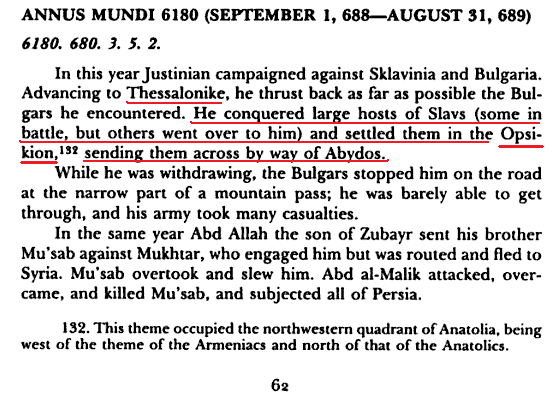
In this year Justinian campaigned against the Sklavinia and Bulgaria. Advancing to Thessalonike, he thrust back as far as possible the Bulgars he encountered. He conquered large hosts of Sklavenes (some in battle, but others went over to him) and settled them in the Opsikion, sending them across by way of Abydos.
692 AD: Theophanes, Anni Mundi 6095-6305.
In this year, Justinian made a selection from the Sklavenes he had resettled. He levied 30,000 men, armed them, and named them the "special army". Their commander was named Neboulos.....but Muhammad suborned the general of the Sklavenes allied to the Romans....deceiving him with many promises, persuaded him to desert to the Arabs with 20,000 Sklavenes. Then Justinian massacred the remaining Sklavenes (and their wives and children) at Leukate, a precipitous place by the sea on the gulf of Nicomedia.
694 AD: Theophanes, Anni Mundi 6095-6305.
Muhammad attacked Romania; he had with him the Sklavenes who had fled, as they had experience of Romania.
754 AD: Theophanes, Anni Mundi 6095-6305.
The Persians opposed Abd Allah, but the inhabitants of Syria were devoted to him and fought on his side. Abu Muslim raised his army and engaged Abd Allah near Nisibis, where he defeated him and killed many of his men. Most of them were Sklavenes and Antiochenes.
758 AD: Theophanes, Anni Mundi 6095-6305.
In this year Constantine captured the Macedonian Sklavinias and subjected the rest of them.
871 AD: Anastasius the Librarian, Miracles, 9.
There was a certain bishop from the country of the Africans, Cyprian by name, who cared for the true priesthood and led a life most deserving of God. He arranged to journey to the queen of cities, Byzantium, on a pressing matter of necessity. And when they had sailed for many days and had already drawn near to the regions of Greece, he was captured by the most fierce Sclavenes together with all his [companions]. When they had divided these captives among themselves, the [Sclavenes] enslaved the aforementioned bishop together with his [companions]. When these things had been done in this way, they returned to their native places, and each barbarian placed the burden of slavery upon his captive according as he wished.
899 AD: St Clement, Life of Methodius (Emperor Michael III to SS Cyril and Methodius.
You are both Salonikans, and all Salonikans speak pure Slavonic.
905 AD: John Cametinae, On the Capture of Salonika (By Muslim forces).
I introduce you to the same, the great and the first city of the Macedonians.......The citizens, in fact, were anything but remiss in their use of archery, and used it to great and conspicuous effect by stationing all the Sklavenes gathered from the neighbouring regions at those points from which it was easiest to shoot accurately and where there was nothing to deflect the momentum of their missiles.
 
I think the title thread should read "Who are the Sklavoi" even though you make it clear that we are talking about the Sklavoi/Sklavenoi in the opening lines.

The reason why I suggest that is because "Slav" when used today is too vague - and could in the mind of any given reader mean very different things.

I am sick of the way so called "scholars" like Vryonis use it in an ethnic sense. Strictly speaking today "Slavic" referes to a language. The "Sklavoi" of the early middle-ages, could have been anyone or anything - so a distinction needs to be made in the classification from the begginning.

The way things a going every time the term "Slav" is mentioned, some people might immediately think "Macedonians".

Hopefully I can contribute a bit to this. I just took out the Florin Curta book.
 
I appreciate where you are coming from Pelister and the negativity that many of you have towards the term, and everything you stated above I considered prior to deciding on the title. Ultimately, I came to the conclusion that because 'Slav' is so commonly yet vaguely used and not properly understood, and given that it is this term and not 'Sklave/Sclave' that is being used today to refer to this 'elusive' and 'fluid' group, it would be the best option. At least this way, when people search for 'Slavs' they will eventually come across this thread, which will document, detail and eventually explain away the vagueness and negativity concerning the term, in the context of all its various meanings and derivatives. We can also discard any inconsistencies relating the term and its history, whereas leaving it at 'Sklave/Sclave' will mean limited this little project to between the 6th and 9th century, which would not do the topic justice. We have nothing to hide, let's study, criticize and inspect this topic as thoroughly as can be, and show the world the truth.
 
A good source would be Constantine Porphyrogenitus. I cannot find what he said exactly from his memoirs (Constantine Porphyrogenitus: De Administrando Imperio By Constantine Porphyrogenitus, Gyula Moravcsik, Romilly J. H. Jenkins 2009) but I do recall him saying something to the extent that 'all of greece is Slav' etc etc. I am going to get the above book and post the exact words he used. Also I think he relates pechenegs and the slavs??? I may be wrong on this but I think I remember reading this somewhere.
 
I appreciate where you are coming from Pelister and the negativity that many of you have towards the term, and everything you stated above I considered prior to deciding on the title. Ultimately, I came to the conclusion that because 'Slav' is so commonly yet vaguely used and not properly understood, and given that it is this term and not 'Sklave/Sclave' that is being used today to refer to this 'elusive' and 'fluid' group, it would be the best option. At least this way, when people search for 'Slavs' they will eventually come across this thread, which will document, detail and eventually explain away the vagueness and negativity concerning the term, in the context of all its various meanings and derivatives. We can also discard any inconsistencies relating the term and its history, whereas leaving it at 'Sklave/Sclave' will mean limited this little project to between the 6th and 9th century, which would not do the topic justice. We have nothing to hide, let's study, criticize and inspect this topic as thoroughly as can be, and show the world the truth.

My concern is the confusion caused by the use of the term "Slav". I don't think its accurate to be calling the 5th and 6th century invaders by that term, even though Western writers do just that. It would be better to investigate who the Roman writers and later writers were referring to - that is identifying them. I would be less concerned about convincing Western writers that they do not know Who they are talking about - and more concerned with getting the terminology right, because I feel that much of the confusion stems from poor translations and poor classifications. I would argue that "Sklavonoi" and the later use of the term "Sklavoi" which are direct translations from the Greek, are not the same as "Slav". I would argue that the use of the term "Slav" is simply a distortion. The wrong classification/mispelling of the names given to these tribes - is where the problem begins because the term "Slav" has OTHER uses in the modern age. I thought that a good way to begin - and its only a begginning - would be to first of all accurately study these tribes by the names given to them by their contemporaries, not us. It is only a suggestion though. Any connection to the "Slavic speakers" of today will come later, once we find out Who the Sklavoi were. One reason I would argue for using the term conteporaries used, is because it clears up befuddled classifications. I think a correction probably needs to start here. I think it is important to discuss this and I am glad I am having this talk with you about it because "Who are the Sklavoi"? rather than "Who are the Slavs?" is a far more accurate and more focused study. Furthermore, it opens up the possibility (perhaps) that the term Sklavoi - was eventually used to describe other groups of people, other cultures, perhaps some native? But this suggestion needs to be focused within the Roman/Byzantine period - using "their" terms, not ours before any connections (if at all) can be made with 'Slavic speakers' today. I think that this shift in how they are classified should start with us to tell the world the truth yet to be revealed. You see I think this is where Florin Curta has it wrong.

Looking forward to your thoughts.
 
Last edited:
Pelister said:
My concern is the confusion caused by the use of the term "Slav".
That's the point mate, we cannot deny that this is the term, 'Slav', that is used today for whatever matters as opposed to 'Sklave/Sclave'. Therefore, let us clear that confusion with this thread, and expose when they are connected and when they are not, as the years go by.

Naming the title 'Sklave' would put limits on the period of time, and will also restrict matters concerning the connection (later or otherwise) to 'Slav'. Perhaps what you are suggesting is for a separate topic where we could research and detail the term 'Sklave' specifically. With this thread I was hoping to highlight the terms in light of their relation to each other and how they developed throughout the years.

How do we clear the confusion ? I have thought about that question alot.

The first step is to drop the term "Slav". To beat the liberal and loose use of the term "Slav" by Westerners - we need to be specific about "Who" the "Sklavenoi/Sklavoi" were, what language they spoke before any connections can be made between them, and modern day "Slavic speakers".

Are you asking who the descendants of present day "Slavic speakers" were, or are you asking Who was behind the term "Sklavenoi/Sklavoi"? That would be far more effective. The term "Slav" the way you are using it is neither here nor there - it is neither a linguistic group, nor a tribe - it connects nothing, because it is nothing. I would suggest you define your group, before you start asking questions about "Who they are"?.If you answer that you are talking about "The Slavs?" - well, who do you mean ? I think its best to avoid vague connections across groups spanning over a thousand years. If we do not know what the language of the Sklavenoi was - we do not know. But at least then we can say there is no material evidence that are connected to modern Slavic speakers. If modern Slavic speakers use a language identical to the ancient Thracians, and the ancient Sklavenoi can be shown to be a Thracian tribe, then there is a connection.

I think this is the most effective way to hit back.

I have noticed that some Greek historians like to replace the term "Roman" with the term "Greek" because some of them used the Greek language. Kaldellis exposes it best in his book "Hellenism in Byzantium ...see footnote 220".

If you were trying to find out where the term "Slav" sits in the literature, I can understand why you would use it, but if you are assuming that there is a real material/linguistic connection between the tribe "Sklavenoi" and the term "Slav" (how would you know that? You do not know who the "Sklavenoi" were, and "Slav" is neither an ethnic group, nor a national group, even though it is wrongly referred to as such). When Westerners use the term "Slav" what do they mean by it , and how can we correct them ?

The term "Slav" cannot be used scientifically to refer to both 6th century invaders (firstly because they were NOT called "Slavs" by their contemporaries) and at the same time to be used to describe modern day "Slavic speakers", because there is no evidence of a material and/or linguistic connection between the two groups.
 
Last edited:
TrueMacedonian said:
I'm just wondering if any of you have the book by Barford called 'The Early Slavs'?
I have heard of it, but don't have it. I have meaning to get Florin Curta's book for a while but haven't got around to it yet. Have any of you read it thoroughly?
 
Pelister said:
The term "Slav" the way you are using it is neither here nor there - it is neither a linguistic group, nor a tribe - it connects nothing, because it is nothing.
Thanks Pelister, but I beg to differ for the reasons already outlined in my previous posts on this and the 'Slav Macedonians' thread, and I don't see the necessity in repeating the same thing again. I think by now you should be able to appreciate my position and what I mean by the title.
If we do not know what the language of the Sklavenoi was - we do not know.
I wouldn't settle at that, there is more to know, that is one of the points of this thread.
You do not know who the "Sklavenoi" were.........
It's not always black and white, but in some cases we do know.
The term "Slav" cannot be used scientifically to refer to both 6th century invaders (firstly because they were NOT called "Slavs" by their contemporaries) and at the same time to be used to describe modern day "Slavic speakers", because there is no evidence of a material and/or linguistic connection between the two groups.
But unfortunately, as wrong as it may be, it is used in such a way today by the mainstream. Along with the citing of sources, I aim to expose why this is so and any falsities accompanied with it.
 
I have heard of it, but don't have it. I have meaning to get Florin Curta's book for a while but haven't got around to it yet. Have any of you read it thoroughly?

I have to admit that I haven't read Curta's book either. However I think someone once created a pdf file of the entire book so you could get it for free online. Maybe Daskalot would know about this or I of Macedon who I believe has read Curta's book in and out.
 
Considering the increased discussions on the whole Slav notion I thought I would bump this thread upward - to add to the discussions if needed
 
Good thinking IOM, this is what Pelister was talking about concerning the term 'Sklave', information that is best used to bring into perspective the scenario and make sense of the varied sources.

These parts I find interesting:
Horace G. Lunt suggested that common Slavic was used as a lingua franca within and outside the Avar qagnate. Building upon an earlier suggestion by Omeljan Pritsak, Lunt argues that only as a lingua franca could Slavic have spread throughout most of Eastern Europe, obliterating old dialects and languages, while at the same time remaining fairly stable and remarkably uniform through the ninth century. (pg 9)
I think, if this really took place, it would have been at a developing stage prior to the Avar Khaganate, probably during the time of the Huns and Goths.
Gradually a Slavic lingua franca developed in the military camps of the Avar pax, a language more sophisticated than the «hamlet idioms» and capable of conveying military orders, recording bureaucratic reports, and expressing ideas in the emerging, if limited, cultural life of the pax.
This is plausable.
Βαϊουνητ-
Βελεγεζητ-
Βερζητ-
Δρουγουβιτ-
Σαγουδατ-

.......the five names preserved in Mir II are not «Slavic tribal names», but self-designations of Proto-Bulgarian Sklavin bands; accordingly they have clear Hunnic or Iranian etymologies.
This also sounds plausable, but how do we fit in the tradition of the Brsjak in all of this? Would this mean that the Brsjaci are not connected to the Berzites?

Also, what about the invasions in the Peloponnese? While some archaeological evidence suggests that Avar types also reached that far south, the Slavic placenames in the regions proves beyond doubt that Slavic-speaking types did reach that area and made a significant impact.

Could the Hunnic-Avar-Bulgar ravaging around the Danube and the Balkans have triggered a movement of Macedonians, Illyrians and Thracians south into the Peloponnese? That could be one explanation of the below, which was posted on another thread:

http://www.macedoniantruth.org/forum/showthread.php?t=435&page=3

Going back to the relations between the various Balkan tribes, there was an Illyrian tribe called the Dassaretae, that lived within the vicinity of Lake Ohrid. The Illyrian word for 'lake' is Oseriates, very close to OCS Ozero and Macedonian Ezero.


Oseriates (Lake, Illyrian)
Ozero (Lake, Slavonic)
Ezeritai (Slavic tribe, Peloponnese)

Dassaretae (Tribe living close to lake, Illyrian)
Do ezero (Next to lake, Macedonian)


These hydronyms and subsequent tribal name bear a striking similarity to the name of a Slavic-speaking tribe from the Peloponnese, that went by the name of Ezeritai. Are there possible links between these tribes? Could the Ezeritai in the Peloponnese be descended from tribes around Lake Ohrid?


What do you guys reckon of such a scenario taking place?
 
Something interesting from Curta concerning the sources of Sclavenes in different decades during the 6th century, and the Roman perception.

It is hard to understand, however, why Procopius should invent the “Slavic democracy” if nothing justified the use of this concept for contemporary Slavic society. It is interesting to note that, with the exception of the quasi-legendary King Boz of the Antes, Procopius’ contemporary, Jordanes, also ignores any Slavic leaders. I am inclined, therefore, to take Procopius’ evidence as a strong argumentum ex silentio. Something had radically changed in Slavic society as the Slavic raiding activity resumed in the late 570s. A detailed discussion of this change is to be found in Chapter 7. For the moment, it is important to note that in terms of their social organization, the Sclavenes of the 580s were different from those of the 540s. Pages 115-118.
What all this suggests, in my opinion, is that the name ‘Sclavene’ was a purely Byzantine construct, designed to make sense of a complicated configuration of ethnies on the other side of the northern frontier of the empire........It might be that ‘Sclavene’ was initially the self-designation of a particular ethnic group. In its most strictly defined sense, however, the “Sclavene ethnicity” is a Byzantine invention. Pages 118-119.
 
neboulos62.png

page 64
neboulos64.png

page 65
neboulos65.png

neboulos117.jpg


These pages are taken from The Chronicles of Theophanes.
 
Back
Top