• Welcome to the new Macedonian Truth Forum. All posts, members and private messages have been moved over from the old forum.

    Passwords from the old forum could not be carried over, so please use Forgot your password? to set a new one. The reset link is emailed to the address on your account.

  • Rules and Regulations at the forum of the Macedonian Truth Organisation (MTO)

    (1) The national-ethnic and cultural-linguistic identity of the Macedonian people is historically Macedonian, and derives its character from the native, indigenous and geographic homeland of the Macedonians, which is called Macedonia. To ensure that their human rights, integrity and heritage are appropriately respected, the only nouns and adjectives acceptable when reference is made to the above character and identity markers is Macedon, Macedonia, Macedonian and Macedonians.

    (2) The nation-state of the Macedonian people is the Republic of Macedonia, and is to be referred to by this official title so long as the 'republic' prefix is consistently applied to other states. Alternative references are the Macedonian Republic, or simply, Macedonia.

    (3) The 'ethnic' prefix is only acceptable for Macedonians in cases where differentiation is specifically required - so long as it is in context and consistent where it concerns its application to other ethnic groups.

    (4) Should any other differentiation be specifically required, the names of other ethnic groups that reside with Macedonians in either the Republic of Macedonia or the occupied Macedonian regions in Greece, Bulgaria, Serbia or Albania, are to be given a prefix.

    (5) Negating the identity, language and culture of the Macedonian people by deliberate avoidance of the terms Macedonia, Macedonian and Macedonians, or by any other means, is not permitted.

    (6) Systematic anti-Macedonian propaganda and rhetoric are not permitted.

    (7) Threads irrelevant to the Macedonian Cause, the community at the Macedonian Truth Organisation or the Macedonians in general may be considered as spam or not in the spirit of the forum. In such cases they are not permitted.

    (8) Continual posting of messages in threads with the sole purpose of deviating from the initial topics with the use of unrelated and unnecessary information is not permitted.

    (9) All posts, external articles, reports, etc that are cited in languages other than Macedonian or English, must be accompanied with a translation in one or both of the said languages.

    (10) Despite the possibility of some conversations and debates becoming heated, extreme abuse and/or racism, vulgar language and/or terminology, threats, revelation of personal information about others, harassment, and other such behavior will not be permitted. If deemed necessary all relevant information including member details will be reported to the appropriate authorities for investigation which may result in legal action.

    (11) Threads that are created must have a summary of a topic or excerpt of an article found in pertinent link(s) that have been included. One line threads will be considered unaccetable spam and are therefore not permitted.

    (12) Compulsive and deliberate lies, irrespective of the topic, are not permitted.

    (13) Any symbols or avatars found to be perceived as offensive to Macedonians are not permitted.

    (13) Any explicit or extreme material is not permitted.

    Failure to adhere to the above rules and regulations will result in a ban after 3 breaches. This may be reconsidered in some cases should the circumstances be of an unorthodox nature and/or require special consideration. To assure an effective deterrent against an individual or individuals with the sole purpose of causing dissent through spamming, racism or other improper means, the above rules will be strictly enforced.

    The MTO administration will monitor all discussions as reasonably practical and reserve the right to remove any post and/or member from the forum, and update the rules and regulations as required. Members are encouraged to immediately report any post and/or member to the MTO administration if they feel that these rules have not been abided by.

    The views expressed on this forum are those of the individuals. The only official representation of the MTO is made by the "Macedonian Truth Organisation (Site Owner)" username, and no other.

  • Macedonian Cause

    The Macedonian Truth Organisation calls on God in Heaven to protect, bless and guide the endeavour it is committing to undertake, and that is to work towards:

    Securing Macedonia as a free, independent and democratic republic in which sovereignty lies with the Macedonian citizens; as the nation-state of the Macedonian people in which they can preserve their culture, language and identity; as a state in which the Macedonian language and culture form the basis of public life and act as important unifying elements of Macedonian society; as the home of all its citizens to which it guarantees and obliges their inalienable natural rights and corresponding responsibilities;

    The acknowledgment as self-evident and irrefutable the existence of the:

    1) Indigenous, ethnonational name of Macedonia;
    2) Macedonian people, language and identity;
    3) Macedonian culture, symbols and folklore;
    4) Macedonian ancestry, heritage and history in its entirety; and
    5) Macedonian Orthodox Church;

    Securing recognition by the International Community of the tragedies endured by the Macedonian people, of the division of Macedonia with the signing of the Treaty of Bucharest on August 10, 1913, and the genocide committed against the Macedonian people at the hands of the Greek, Bulgarian and Serbian states and their respective churches during the 19th and 20th centuries;

    Ensuring that the Interim Accord is declared ‘null and void’ and that all constitutional provisions, acts, commitments, agreements, legislation, regulations, policies or programs emanating from, supporting or consequential to the Interim Accord are also declared ‘null and void’, including the use of any symbols and the completion of any acts imposed by, or originating from, the Interim Accord.

    Ensuring that the Framework Agreement is abolished and that all constitutional provisions, acts, commitments, agreements, legislation, regulations, policies and programs emanating from, supporting or consequential to the Framework Agreement are also abolished and replaced by a framework of constitutional and statutory law based on inalienable natural rights and corresponding responsibilities and universally codified human rights mechanisms.

    Securing the abolishment of any existing constitutional provisions, acts, agreements, legislation, regulations, policies and programs that discriminate against the Macedonian people, in any international organisation or any of the countries of the International Community where such constitutional provisions, acts, agreements, legislation, regulations, policies and programs exist, and thereby ensuring the freedom for Macedonians to exercise their inalienable natural rights and fulfil their corresponding responsibilities, and practice their culture, language and religious faiths in all the countries of the International Community without hindrance;

    The empowerment of Macedonians to undertake a moral revolution and to instil and/or reinvigorate within themselves a deep-rooted national, cultural, linguistic and historical dignity and a commitment to the exercise of freedom based on inalienable natural rights and corresponding responsibilities;

    The recognition of the Macedonian minorities in the neighbouring states of Macedonia as well as the respect for the inalienable rights and freedoms of the Macedonian minorities, as provided for by natural law and as codified by the United Nations Charter, the Universal Declaration of Human Rights and other universally codified human rights mechanisms;

    The full and unreserved respect of, and the support for, the rights of all people of non-Macedonian descent living in Macedonia and around the world, who share a reciprocal full and unreserved respect for the Macedonian people, their homeland and their state;

    The cultural unification and solidarity of the Macedonian people living in all parts of historical Macedonia and adjacent territories, as well as Macedonians throughout the world;

    The unity of all Macedonians on the principles, objectives and achievement of the Macedonian cause as defined by this declaration.

Who are the Slavs? - Citations and Sources

neboulos62.png

page 64
neboulos64.png

page 65
neboulos65.png

neboulos117.jpg


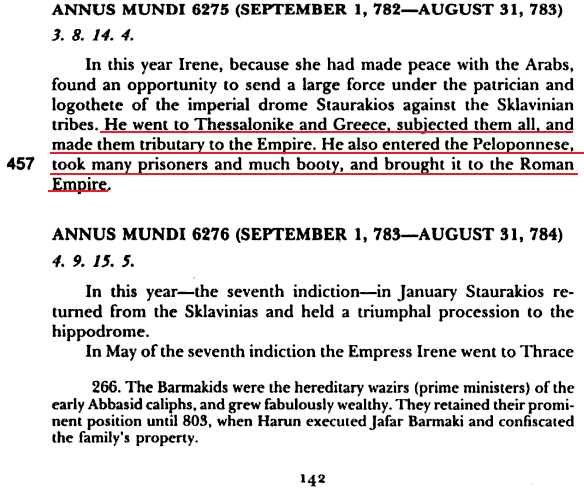
These pages are taken from The Chronicles of Theophanes.
Good stuff TM! I will add some of them on the first post.
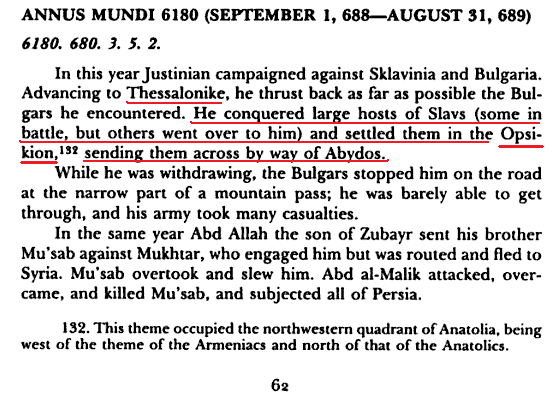
 
Here's more from Theophanes;

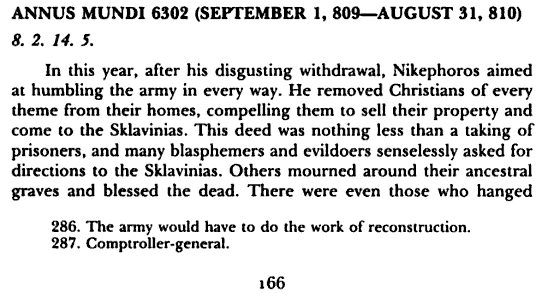
theophanes166.png


It seems that Nikephoros had a problem with keeping Roman citizens in the 'Sklavinias' and in turn tried to make them all move their.
 
Basilitzes whom at one time the emperor Alexander had thought of raising to the throne was doubtless a highly hellenized Slav.

Source: Byzantion by Société belge d'Études byzantines, Centre national de recherches byzantines, Byzantine Institute of America (1948).

I don't agree with "hellenized" part but I would agree that this Basilitzes was Chritianized and Romanized.
 
I found something that prooves as far back as middle of the first century macedonians existed in the Agean Macedonia.

Don't know if anyone is aware of St Irene who was born in solun macedonia. There are some contentious issues though.

A) serbs claim she is a serb (but born in macedonia go figure)

B) A document from the russian orthadox church say she was born mid 1st century but some articals quote she was around middle of the 3rd century. Ither way lond time ago.

C) again, writers say she was a slav, what the heck is a slav? :mad1: But thats modern writers for yah.

Here is the page from the russian orthadox church. use google translate to understand it. Be aware this church make it sound a bit of a fairytale. lol But
http://hramnagorke.ru/life/549

Here is a english version from a russian orth church in the usa
http://www.fatheralexander.org/booklets/english/saints/irina_martyr.htm
 
I hate this title.

There are a couple of ways of approaching this problem of "Slavs". One is to accept the term as valid currency, but find out who is behind it. The other is to reject the term, on the basis of academic dishonesty and deliberate distortion. The fact is that there never were any "Slavs" ! This is the first point. The fact that the term is widely used, does not mean it is honest, or accurate. Two, the various invading tribes were not called "Slavs" by their contemporaries !! I can't stress that enough. A closer reading of the terminology, in Greek and in Latin, shows a completely different word to the one used in this title, or thrown around by various Western writers and academics. Three, if we jump foward by 1,500 years the term "Slav" still has no meaning, except as a political tool. It is not a nation, it is not an ethnic group. It is a linguistic group - and the linguistic group is not called "Slav" rather "Slavic". Four there is no connection between the "Slavic speakers" of today and 6th century invaders, because contemporaries told us nothing about the 6th century invaders - i.e., what language they used ...etc. We assume that these 6th century invaders use the same langauge we do today, and we assume that the natives of the region did not. We assume that natives we wiped out, even though we barely have any evidence of that native languages of the balkans, and NO evidence of the language spoken by 6th century invaders.

What I would find interesting is how the term "Sklavenoi" morphed in the old literature (if it in fact did at all).
 
Guys the word slav became more prominent when Macedonia joined with yugoslavia.All it's neighbours were peddling their little propaganda trying to teach the macedonian nation to be proud of its slavic roots & not to take pride in the ancient macedonian roots.Both serbia & greece used it extensively to coverup the fact that the macedonian people had links to their ancient heritage.The slavs had the same impact on the other countries such as greece,turkey,bulgaria,& Albania.Do they identify as SLAVIC NO!!
To label macedonia as slavic is utterly false as the slavs adopted the macedonian language because they were illiterate.
THey the SLAVS became macedonised and anyone saying they didn;t is wrong.THe macedonians have always been macedonian it's only through heavy duty propaganda that during the 20th century such as the greeks & serbs have been trying to brainwash the macedonian population into believing that they are just slavs which is not true.WE are MACEDONIANS if you think you are SLAVS then go back & call yourself YUGOSLAV
 
Last edited:
I think westerners (probably also many slavists) believe that if people don’t call themselves today let say Thracian or Dacian; therefore it must mean that the Thracian or Dacian people must be extinct. Yet they don’t know how, when, or can’t provide proof of such a vast extinction of people and at the same time strangely believe in the theory of an unprecedented demographic explosion (bound to the realms of impossibility) of the “Slavs” encompassing half of Europe and in such a short time history. Thus “Slav” people today are just “Slavs” and nothing else, no history and some how the only people in the world with no ancient descendents before the sixth century, As laughable as that is, that how many like to think of all the Slavonic speakers today.

Yet what of the ancient sources (this for just one example) that tell us of the Thracians that take many names depending on where they reside and so on. I guess the dots can’t be connected here, perhaps because it would be too inconsistent with the Slavic migration theory. Obviously people do move, migrate etc, but some theories like to stretch the imagination just a bit too much.

Therefore what is more logical the mass extinction of half of Europe (with no evidence of such only theories and assumptions) and likewise the impossible theory of the demographic explosion that followed, or that people, tribes etc had taken on new names depending on their surroundings, politics, change of empires, religion etc.
 
I see that you are forgeting (or not knowing) the most important aspect about the Slavs issue: the aspect that they had existed on the Balkans in the times before Christ.

Here some statements from the author Petar Popovski:

-----------------------------------------------------------------------------------------------------------------------------------
Светската наука ги дефинира и ги третира Пелазгите како ПРОТО-СЛОВЕНИ, т.е. како предци на првите Словени. Тие први жители, во прво време, ги населувале приморските делови и островите на најјужниот дел од Балканот, просторите кои денес ги населуваат Грците, денешна Мореја, Атика, Пиреја, Пелопонез и Епир.

-----------------------------------------------------------------------------------------------------------------------------------
Според тоа, врз основа на постојниот доказен материјал, со кој располага македонската наука, присуството на Антите, Венетите и Феникијците т.е. на древните Македонци, кои меѓу третиот и првиот милениум пр.н.е. биле наречени Антички Македонци, на балканските простори датира меѓу 13 и 11 милениум пр.н.е. Што се однесува, пак, до Грците, на Балканот тие се јавуваат дури во периодот меѓу VIII и VI век пр.н.е., што значи десет до дванаесет милениуми подоцна од Античките Македонци.
И како тогаш е можно да постои некаква генетска врска меѓу тие два ентитета. Во никој случај. Подоцна, од Антите и Венетите се развиле уште десеттина други племенски гранки: Скити, Мизи, Бриги, Фриги, Миони, Пелагонци, Московити, Руси, Траки, Илири,
Дарданци и Трибали. Во егзактната наука сите тие се дефинирани како СЛОВЕНИ.
-------------------------------------------------------------------------------------------------------------------------------------

Кај нашиот народ постои уверување дека современите Македонци немаат никаква врска со античките и дека потекнуваат од зад Карпатите. Таквото сфаќање треба конечно и дефинитивно да се избрише од нашата меморија.

Таа теорија ја измислија и ја лансираа Англосаксонците, со цел да ја задушат македонската национална мисла, а да ја издигнат хеленската. За жал, тие тоа го прават и
денес. Нема автор од тој период, од крајот на VI и почетокот на VII век, кој во своето дело спомнува некакви Карпати.

Тоа е ноторна лага и измислица. Од најстари времиња Македонците биле и останале на своите древни македонски етнички простори. Македонија била и останала татковина на Македонците и прататковина на сите СЛОВЕНСКИ НАРОДИ. Сите тие народи потекнуваат од Балканот, од македонските простори.
Силна потврда на тој факт претставува наративниот споменик "Московски анали" од VIII век, кој денес се чува во централната библиотека во Москва.
Во него е напишано: "Ние, Русите – Московитите сме потомци на Античките Македонци.
Ние го зборуваме јазикот на Античките Македонци". Како што гледаме, сведоштво со кое се потврдува македонскиот карактер на сите СЛОВЕНСКИ НАРОДИ.
-------------------------------------------------------------------------------------------------------------------------------------
 
Last edited:
I think westerners (probably also many slavists) believe that if people don’t call themselves today let say Thracian or Dacian; therefore it must mean that the Thracian or Dacian people must be extinct. Yet they don’t know how, when, or can’t provide proof of such a vast extinction of people and at the same time strangely believe in the theory of an unprecedented demographic explosion (bound to the realms of impossibility) of the “Slavs” encompassing half of Europe and in such a short time history. Thus “Slav” people today are just “Slavs” and nothing else, no history and some how the only people in the world with no ancient descendents before the sixth century, As laughable as that is, that how many like to think of all the Slavonic speakers today.

Yet what of the ancient sources (this for just one example) that tell us of the Thracians that take many names depending on where they reside and so on. I guess the dots can’t be connected here, perhaps because it would be too inconsistent with the Slavic migration theory. Obviously people do move, migrate etc, but some theories like to stretch the imagination just a bit too much.

Therefore what is more logical the mass extinction of half of Europe (with no evidence of such only theories and assumptions) and likewise the impossible theory of the demographic explosion that followed, or that people, tribes etc had taken on new names depending on their surroundings, politics, change of empires, religion etc.

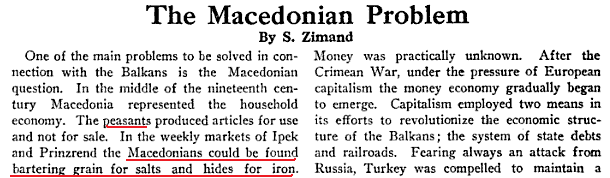
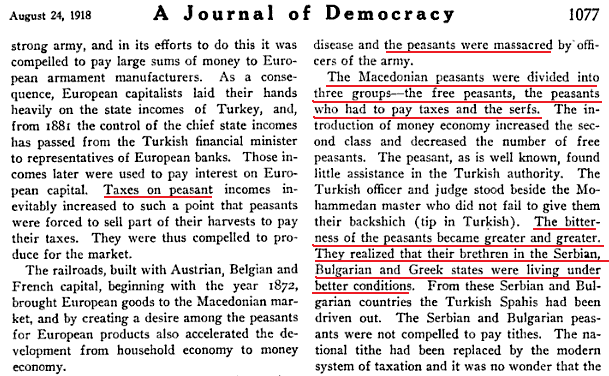
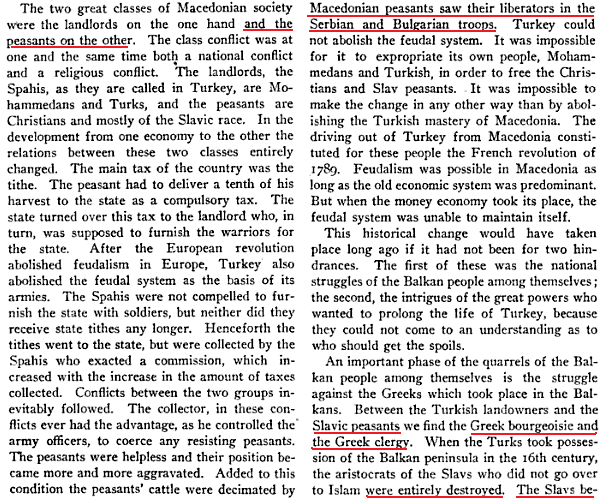
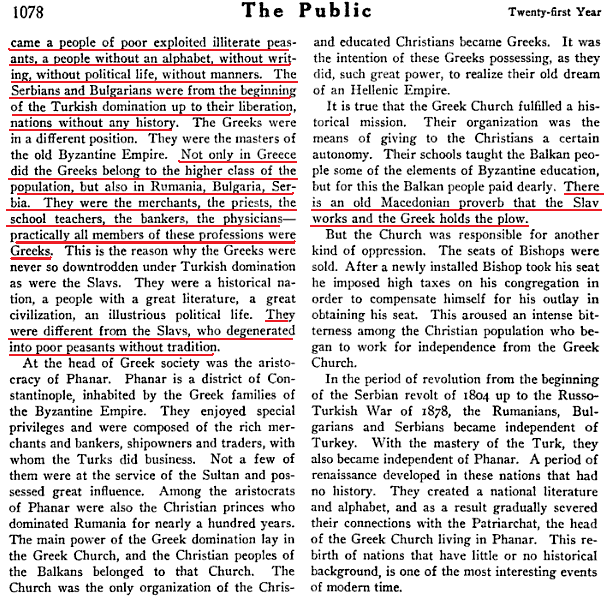
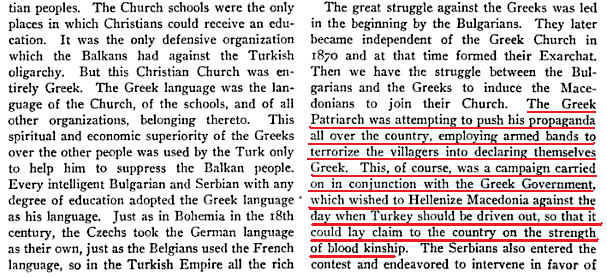
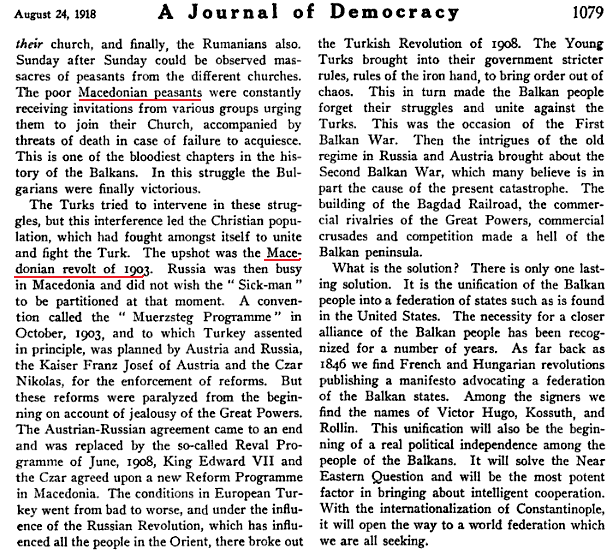
You are very right on what I made bold in your comment. Here's something from 1918 about Macedonia. This is where historians and observers confuse things.

zimand.png

page 1076
zimand1076.png

zimand1077.png

zimand1077a.png

zimand1078.png

zimand1078a.png

zimand1079.png


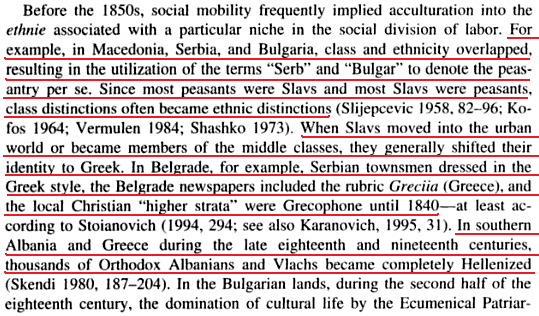
Now this is what Victor Roudometof said about this whole situation about "Serbs-Bulgars-Slavs-Peasants-No History" and "Greeks-Merchants-Bourgeosie-Upper Class"

nog48.png
 
I see that you are forgeting (or not knowing) the most important aspect about the Slavs issue: the aspect that they had existed on the Balkans in the times before Christ.

Here some statements from the author Petar Popovski:

-----------------------------------------------------------------------------------------------------------------------------------
Светската наука ги дефинира и ги третира Пелазгите како ПРОТО-СЛОВЕНИ, т.е. како предци на првите Словени. Тие први жители, во прво време, ги населувале приморските делови и островите на најјужниот дел од Балканот, просторите кои денес ги населуваат Грците, денешна Мореја, Атика, Пиреја, Пелопонез и Епир.

-----------------------------------------------------------------------------------------------------------------------------------
Според тоа, врз основа на постојниот доказен материјал, со кој располага македонската наука, присуството на Антите, Венетите и Феникијците т.е. на древните Македонци, кои меѓу третиот и првиот милениум пр.н.е. биле наречени Антички Македонци, на балканските простори датира меѓу 13 и 11 милениум пр.н.е. Што се однесува, пак, до Грците, на Балканот тие се јавуваат дури во периодот меѓу VIII и VI век пр.н.е., што значи десет до дванаесет милениуми подоцна од Античките Македонци.
И како тогаш е можно да постои некаква генетска врска меѓу тие два ентитета. Во никој случај. Подоцна, од Антите и Венетите се развиле уште десеттина други племенски гранки: Скити, Мизи, Бриги, Фриги, Миони, Пелагонци, Московити, Руси, Траки, Илири,
Дарданци и Трибали. Во егзактната наука сите тие се дефинирани како СЛОВЕНИ.
-------------------------------------------------------------------------------------------------------------------------------------

Кај нашиот народ постои уверување дека современите Македонци немаат никаква врска со античките и дека потекнуваат од зад Карпатите. Таквото сфаќање треба конечно и дефинитивно да се избрише од нашата меморија.

Таа теорија ја измислија и ја лансираа Англосаксонците, со цел да ја задушат македонската национална мисла, а да ја издигнат хеленската. За жал, тие тоа го прават и
денес. Нема автор од тој период, од крајот на VI и почетокот на VII век, кој во своето дело спомнува некакви Карпати.

Тоа е ноторна лага и измислица. Од најстари времиња Македонците биле и останале на своите древни македонски етнички простори. Македонија била и останала татковина на Македонците и прататковина на сите СЛОВЕНСКИ НАРОДИ. Сите тие народи потекнуваат од Балканот, од македонските простори.
Силна потврда на тој факт претставува наративниот споменик "Московски анали" од VIII век, кој денес се чува во централната библиотека во Москва.
Во него е напишано: "Ние, Русите – Московитите сме потомци на Античките Македонци.
Ние го зборуваме јазикот на Античките Македонци". Како што гледаме, сведоштво со кое се потврдува македонскиот карактер на сите СЛОВЕНСКИ НАРОДИ.
-------------------------------------------------------------------------------------------------------------------------------------


“Slavs” did not exist before Christ, because no one identified themselves as “Slav” nor were there others that identified such particular people before Christ’s time.

However, there are the descendants of what would become “slavs” or slav speakers to todays time, they be a combination of all ancient people whether they be Illyrians, thracians, dacians, macedonians, greeks, romans, germanic tribes etc etc. Obviously some more predominant than others.

“Slavs” as identified of course evolved from various ancient people (as mentioned above), but those ancients had specific identities or tribal names, whilst “Slav” is a term coined much later, predominantly utilised by the Byzantines for those initially in contact with the Byzantine frontier.

As such it’s incorrect to say that “Slavs” had existed before such time (that is before Christ)and likewise loosely apply it to ancient people because the circumstances weren’t yet created for them to be identified as such (Slav), whether that be by others or themselves.
 
I would like to see examples of this:

Во егзактната наука сите тие се дефинирани како СЛОВЕНИ.

Or are this sciences exact as the quote above?

Gj. Puleski, do you have any copy of the original, or at least some Russian or other source to confirm this:

Силна потврда на тој факт претставува наративниот споменик "Московски анали" од VIII век, кој денес се чува во централната библиотека во Москва.
Во него е напишано: "Ние, Русите – Московитите сме потомци на Античките Македонци.
Ние го зборуваме јазикот на Античките Македонци".
 
Last edited:
I would like to see examples of this:


Or are this sciences exact as the quote above?

Gj. Puleski, do you have any copy of the original, or at least some Russian or other source to confirm this:


II Regno de gli Slavi , Mavro Orbini:

In one library in Tsarigrad(Constantinopel) , there is a charter about the privilegies that Alexander the Great gave to the Illyrians or " the nobel stock of Slavs" in his 12th years of rule. Its becoming quite understandable if we know that Macedonians of Alexander the Great were Slavs and they have spoken same language that todays inhabitants of macedonia speak. Alexander the Great is considered to be a Greek by many, but for no reason. The reason for that delusion lies in the fact that Greeks who fought people of east, were the most known people of the europe, the same way like nowdays Greeks and Turks belive that all european catholic people are French. Nevertheless, Moscow annals strictly confirm that Russians, or Moskovity spoke same language as Ancient Macedonians, that, beside other countires, ruled Egypt for 276 years.

Download the PDF File of the Book on Mavro Orbini


The Ancient Macedonians were A Tribe with Greek culture. Provide prove of those you wrote. I really think that you are dangerous for the exist of your own country.


these are the inscription found in the holy Macedonian soil with Slavic routes.

Zero


The Macedonian
 
The Ancient Macedonians were A Tribe with Greek culture. Provide prove of those you wrote. I really think that you are dangerous for the exist of your own country.


these are the inscription found in the holy Macedonian soil with Slavic routes.

Zero


The Macedonian

Guytona the Thracian royalty practiced ancient Hellene culture as well. Does this imply that they were in fact Hellenes as well? Alexander the Great worshipped many cultures. http://www.macedoniantruth.org/forum/showthread.php?t=1809

http://www.macedoniantruth.org/forum/showthread.php?t=1759

Gotina I don't think you are of age to really hold debate here. Maybe the experience you gain in this forum you can use to your benefit to remove shallow downloads you received at birth and to further think for yourself.
 
The Ancient Macedonians were A Tribe with Greek culture. Provide prove of those you wrote. I really think that you are dangerous for the exist of your own country.


these are the inscription found in the holy Macedonian soil with Slavic routes.

Zero


The Macedonian


Herodotus’ theory, much criticised by subsequent historians, states that the Etruscans emigrated from the ancient region of Lydia, on what is now the southern coast of Turkey, because of a long-running famine. Half the population was sent by the king to look for a better life elsewhere, says his account, and sailed from Smyrna (now Izmir) until they reached Umbria in Italy.

“We think that our research provides convincing proof that Herodotus was right”, says Professor Piazza, “and that the Etruscans did indeed arrive from ancient Lydia. However, to be 100% certain we intend to sample other villages in Tuscany, and also to test whether there is a genetic continuity between the ancient Etruscans and modern-day Tuscans. This will have to be done by extracting DNA from fossils; this has been tried before but the technique for doing so has proved to be very difficult.”

http://www.eurekalert.org/pub_releas...-aew061307.php


Homer (9th century B. C.) records in Iliad[1] the Veneti in Paphlagonia as Enetoi (the Greek did not know the letter v).

Herodotus, historian (5th century B. C.), writes about Illyrian Veneti, about Veneti living around the lower stream of the Danube, and finally about Veneti inhabiting the Northern Adriatic territory.[2]

Polibus (2th century B. C.) added to the description of events during the years 219 to 146 B. C., following: »The land to the Adriatic coast was mastered by another, very old folk, named Veneti ... They speak a different language as the Celts, but what their habbits and their clothing is concearned, they differ from them only slightly /.../ Veneti and Gonomani were persuaded by Roman representatives, to join the Romans«.[3]

Demetrius of Scepsis, grammarian, archeologist (2nd century B. C.), mentions the capital of the Veneti (Enea) in Troas (Asia Minor).[4]
Strabo, historian, geographer (1st century B. C.), designates the (V)eneti in Paphlagonia as the major tribe moving towards Thrace (nowadays territory of Bulgaria) after the fall of Troy (Asia Minor).[5]
Julius Caesar, historian (1st century B. C.), reports about the Veneti living in Gaul (Brittany).[6]
Titus Livy, historian (1st century B. C.), describes how Veneti came up to the coasts of the (northern) Adriatic, also mentioning the river "Timava", which flows through the duskiness of the Škocjan caves (Slovene Ti(e)ma means the darkness).[7]
Pliny the Elder (1st century B. C.) talks about an extensive land, named Eningia, where Sarmatians, Venedi, etc. lived. He also mentions the Venetulani in central Italy.[8]
Tacitus, historian (1st century C. E.), places Veneti on the border of Suebia together with Peucinians, Sarmatians and Fenns.[9]
Ptolemy, geographer (2nd century), mentions exceedingly large nations - the (O)venedi on the whole coastal region of the Venetic gulf (The Baltic sea).[10]
Emperor Julian (4th century) presents evidence of Veneti, who settled in the proximity of Aquilea (Italy).[11]
Jordanes, historian (6th century), notes a numerous nation of Veneti, populating the area between north of Dacia (now Romania) and up to the Visla delta (the Baltic sea), who call themselves Slavs and Ants. (»termini Venetorum qui et Sclavi dic**tur.«)[12]
In Vita s. Columbani[13]
(7th century) (the Alpine) Veneti, who call themselves Slavs, are recorded.
In the Fredegarius Chronicle (7th century) we can read about the Slavs designated as Vinedi.[14]

Adam of Bremen, chronicler (11th century), mentions an extensive land Sclavania, settled by Winulians, who used to be called Vandals. The land could have been ten times bigger then Sachsen, especially if we include Bohemians (Czechs) and Polians, since they are not distinguishable from each other, nor by their appearance, or by their language.[15]

In Denmark (from latest 12th century and until the year 1972) the title "King of the Vends" (Latin Vandals) was used for enthroning Danish kings.
Helmold, historian (12th century), records a vast Slavic country, where the ancient Vandals are now named Wends or Winulians.[16]

Wincenty Kadłubek / Vincent of Cracow, historian (12th century), affirms that Poles used to be called Vandals.[17]

Heimskringla, the Chronicle of Norwegian kings(12th century) mentions, that the Black Sea »divides three parts of the earth, from which is the eastern part called Asia, whereas the western part is by some called Europe, and by others Enea.«[18]

Miersuae Chronicon (13th century) equates Vandals with Slavs.[19]

Albert Crantz, historian (15th century), reports about Wandals or Wends, and says that they are Slavs, living as a single nation from Poland to Dalmatia. According to him, the mighty acts in France, Spain and Africa are ascribed to the Wends.[20]

Marcin Bielski (16th century) says that Wandals was once the name for Slavs.[21]
The Pomeranian chronicler Thomas Kantzow (1505-1542) writes that the »Slau(v)s and Wandals are the same thing / .../ just like the Germans are called differently - Germani, Teuthones, Alemanni.«: Original text: »Dan Slaui und Wandali ist ein Dinck / .../ gleich wie die Teutzschen werden oft on Unterschied geheissen Germani, Teuthones, Alemanni.«[22]

Christophorum Entzelt von Saluelt (16. century) records ancient populousness of the lands east from the Elbe (Laba) river with Wends. At the same time he equates Veneti and Sclavenes.[23]

Sebastian Münster, cartographer (16th century), mentions a once mighty nation on the East sea (Ostsee) named Vandals or Wends. He also reports on Wandals who settled regions in eastern Germany, where inhabitants are called Sclavs or Wends. Original text: »Mecklenburg-Pommern-Preussen: jtem Brandenburg und was dem Polenland zugelegen, alles Wandali geheißen und ihre Einwohner haben auch Sclaven oder Wenden geheißen.«[24]

Antol Vramec, chronicler (16th century), writes in his chronicle for the year 928 the following: The Heneti, who name themselves Sloveni, were at that time knocked down in Germany.[25]

Adam Bohorič, linguist (16th century), links Heneti, Vene(d)ti, Vinds, Vandals and Slavs together as a single nation.[26]

Mavro Orbin (16th century) numbers Veneti, Vends, Vandals, Illyrians, Sarmatians ... among Slavs.[27]

The Chronicle of Brandenburg (16. century) emphasizes the mighty predecessors of Wends, the Vandals, who sacked Rome and Carthage, and mentions their king Genserich as the king of Vandals.[28]

Johann Weichard Baron von Valvasor, historian, geographer (1689), wrote: »Wends and Sclavenes are one folk, Wandals and Wends one and the same nation.« (»Wenden und Sclaven seynd ein Volk, Wandalen und Wenden einerley Nation.[29]

V. N. Tatiščev, ethnographer (17th -18th century), classifies the Heneti as Slavs, as well as the Vandalic or Vendenic state as the first known Slavic state.[30]

A. L. Schlözer, historian (18th century), defended his thesis about Slavs originating from Illyrians and the Veneti.[31]

Vasilij Trediakovski (18th century) classifies Dalmatians, Serbians, Bulgarians ... among Vandals.[32]

Davorin Trstenjak (19th century) wrote about the ancient Adriatic Veneti, who belonged to a Vindish-Slavic family. He accented their affinity with the Aremoric (Brittany) and Baltic Veneti.[33]

In Helmolts Weltgeschichte (end of the 19th century) it is indicated, that the Veneti, Wends and Winds were actually ancestors of Slovenes, and that they used to settle the old roman provinces Vindelitia, Raetia, Noricum, Pannonia.[34]

http://www.veneti.info/mk/home/venetipedia/historical-quotes


The ppl who occupied the territory from Alpen mountains to Volga and from Baltic to Aegean, were known as Veneti, mentioned by various historians.

Their origin is from Paphlagonia, Minor Asia, same as for Etruscans, for which I gave you a link.

The same Veneti ppl from the 6 century are known as Slaveni.

Anc. Macedonians origin from the Veneti-Phrygians/Brygians-Etruscans.

Thats why the cult of the Goddes Bsefa/Vesta is found on Macedonian soil before she was known as Roman Goddess, after the Etruscans settled down in Italy.

Capisce?


And if you are looking for alphabet, try with the Vinca culture, thousands years before the Hellenes appeared in the world history.
 
The Ancient Macedonians were A Tribe with Greek culture. Provide prove of those you wrote. I really think that you are dangerous for the exist of your own country.

Define Greek culture. You are sounding like a little schoolboy with your statements. Now is your chance to prove your substance.
 
Back
Top