• Welcome to the new Macedonian Truth Forum. All posts, members and private messages have been moved over from the old forum.

    Passwords from the old forum could not be carried over, so please use Forgot your password? to set a new one. The reset link is emailed to the address on your account.

  • Rules and Regulations at the forum of the Macedonian Truth Organisation (MTO)

    (1) The national-ethnic and cultural-linguistic identity of the Macedonian people is historically Macedonian, and derives its character from the native, indigenous and geographic homeland of the Macedonians, which is called Macedonia. To ensure that their human rights, integrity and heritage are appropriately respected, the only nouns and adjectives acceptable when reference is made to the above character and identity markers is Macedon, Macedonia, Macedonian and Macedonians.

    (2) The nation-state of the Macedonian people is the Republic of Macedonia, and is to be referred to by this official title so long as the 'republic' prefix is consistently applied to other states. Alternative references are the Macedonian Republic, or simply, Macedonia.

    (3) The 'ethnic' prefix is only acceptable for Macedonians in cases where differentiation is specifically required - so long as it is in context and consistent where it concerns its application to other ethnic groups.

    (4) Should any other differentiation be specifically required, the names of other ethnic groups that reside with Macedonians in either the Republic of Macedonia or the occupied Macedonian regions in Greece, Bulgaria, Serbia or Albania, are to be given a prefix.

    (5) Negating the identity, language and culture of the Macedonian people by deliberate avoidance of the terms Macedonia, Macedonian and Macedonians, or by any other means, is not permitted.

    (6) Systematic anti-Macedonian propaganda and rhetoric are not permitted.

    (7) Threads irrelevant to the Macedonian Cause, the community at the Macedonian Truth Organisation or the Macedonians in general may be considered as spam or not in the spirit of the forum. In such cases they are not permitted.

    (8) Continual posting of messages in threads with the sole purpose of deviating from the initial topics with the use of unrelated and unnecessary information is not permitted.

    (9) All posts, external articles, reports, etc that are cited in languages other than Macedonian or English, must be accompanied with a translation in one or both of the said languages.

    (10) Despite the possibility of some conversations and debates becoming heated, extreme abuse and/or racism, vulgar language and/or terminology, threats, revelation of personal information about others, harassment, and other such behavior will not be permitted. If deemed necessary all relevant information including member details will be reported to the appropriate authorities for investigation which may result in legal action.

    (11) Threads that are created must have a summary of a topic or excerpt of an article found in pertinent link(s) that have been included. One line threads will be considered unaccetable spam and are therefore not permitted.

    (12) Compulsive and deliberate lies, irrespective of the topic, are not permitted.

    (13) Any symbols or avatars found to be perceived as offensive to Macedonians are not permitted.

    (13) Any explicit or extreme material is not permitted.

    Failure to adhere to the above rules and regulations will result in a ban after 3 breaches. This may be reconsidered in some cases should the circumstances be of an unorthodox nature and/or require special consideration. To assure an effective deterrent against an individual or individuals with the sole purpose of causing dissent through spamming, racism or other improper means, the above rules will be strictly enforced.

    The MTO administration will monitor all discussions as reasonably practical and reserve the right to remove any post and/or member from the forum, and update the rules and regulations as required. Members are encouraged to immediately report any post and/or member to the MTO administration if they feel that these rules have not been abided by.

    The views expressed on this forum are those of the individuals. The only official representation of the MTO is made by the "Macedonian Truth Organisation (Site Owner)" username, and no other.

  • Macedonian Cause

    The Macedonian Truth Organisation calls on God in Heaven to protect, bless and guide the endeavour it is committing to undertake, and that is to work towards:

    Securing Macedonia as a free, independent and democratic republic in which sovereignty lies with the Macedonian citizens; as the nation-state of the Macedonian people in which they can preserve their culture, language and identity; as a state in which the Macedonian language and culture form the basis of public life and act as important unifying elements of Macedonian society; as the home of all its citizens to which it guarantees and obliges their inalienable natural rights and corresponding responsibilities;

    The acknowledgment as self-evident and irrefutable the existence of the:

    1) Indigenous, ethnonational name of Macedonia;
    2) Macedonian people, language and identity;
    3) Macedonian culture, symbols and folklore;
    4) Macedonian ancestry, heritage and history in its entirety; and
    5) Macedonian Orthodox Church;

    Securing recognition by the International Community of the tragedies endured by the Macedonian people, of the division of Macedonia with the signing of the Treaty of Bucharest on August 10, 1913, and the genocide committed against the Macedonian people at the hands of the Greek, Bulgarian and Serbian states and their respective churches during the 19th and 20th centuries;

    Ensuring that the Interim Accord is declared ‘null and void’ and that all constitutional provisions, acts, commitments, agreements, legislation, regulations, policies or programs emanating from, supporting or consequential to the Interim Accord are also declared ‘null and void’, including the use of any symbols and the completion of any acts imposed by, or originating from, the Interim Accord.

    Ensuring that the Framework Agreement is abolished and that all constitutional provisions, acts, commitments, agreements, legislation, regulations, policies and programs emanating from, supporting or consequential to the Framework Agreement are also abolished and replaced by a framework of constitutional and statutory law based on inalienable natural rights and corresponding responsibilities and universally codified human rights mechanisms.

    Securing the abolishment of any existing constitutional provisions, acts, agreements, legislation, regulations, policies and programs that discriminate against the Macedonian people, in any international organisation or any of the countries of the International Community where such constitutional provisions, acts, agreements, legislation, regulations, policies and programs exist, and thereby ensuring the freedom for Macedonians to exercise their inalienable natural rights and fulfil their corresponding responsibilities, and practice their culture, language and religious faiths in all the countries of the International Community without hindrance;

    The empowerment of Macedonians to undertake a moral revolution and to instil and/or reinvigorate within themselves a deep-rooted national, cultural, linguistic and historical dignity and a commitment to the exercise of freedom based on inalienable natural rights and corresponding responsibilities;

    The recognition of the Macedonian minorities in the neighbouring states of Macedonia as well as the respect for the inalienable rights and freedoms of the Macedonian minorities, as provided for by natural law and as codified by the United Nations Charter, the Universal Declaration of Human Rights and other universally codified human rights mechanisms;

    The full and unreserved respect of, and the support for, the rights of all people of non-Macedonian descent living in Macedonia and around the world, who share a reciprocal full and unreserved respect for the Macedonian people, their homeland and their state;

    The cultural unification and solidarity of the Macedonian people living in all parts of historical Macedonia and adjacent territories, as well as Macedonians throughout the world;

    The unity of all Macedonians on the principles, objectives and achievement of the Macedonian cause as defined by this declaration.

Who are the Slavs? - Citations and Sources

The Ancient Macedonians were A Tribe with Greek culture. Provide prove of those you wrote. I really think that you are dangerous for the exist of your own country.


The Macedonian
There was Greek culture and influence in many parts of the world not just Macedonia. Just like there is curently Turkish and Albanian culture and language in Modern Greece.

Don't forget, Apart from Macedonians and others in the ancient times were called Barbarians (Meaning anyone who is not Greek) we Macedonians were also stereotyped as "Philhellene". (friend of the Greeks).

Now this is kind of odd to call a Greek a "friend of the Greeks". This title, is normally reserved for non-Greeks.
 
Hang on Bill, all assumptions need to be revisited.
Greeks did not exist at the time so that needs to banished from terminology immediately.
Hellenes existed, but what culture are we specifically assuming existed?

Gintano might care to fill us in.
 
Hang on Bill, all assumptions need to be revisited.
Greeks did not exist at the time so that needs to banished from terminology immediately.
Hellenes existed, but what culture are we specifically assuming existed?

Gintano might care to fill us in.
Good point Risto.:thumbup1:
 
In answer to True Macedonian on book from Barford on The Early SlaVS.I don't have the book but i found a book review of it.Pretty interesting.
The early Slavs, as Barford points out, have been ill-served by history. Work done in the West tends to dismiss them rather as barbarians, writing off at a stroke the history of half of Europe. This is made easier to do by the absence of written sources, compared to western Europe where writing became widespread earlier, and the frequent ignorance of Western historians of work written in Eastern European languages. Work in the East has been subject to other constraints, most notably pressure from the prevailing political orthodoxies of the time and place of writing - for example, work on the Slavs in Greece is hampered by Greek nationalism refusing to countenance the idea of modern Greece being an ethnic mixture, whilst in the Soviet Union it was difficult to write about foreign, Scandinavian influences in the formation of the Russian state not merely because of nationalist resistance, but because orthodox Marxist thought saw state-formation as the dialectical result of internal developments, not something provoked by outside factors.

Barford's work here, then, is in effect to bring the Western reader up to speed with the work already done on the subject and to put that in context. What we know about different Slav cultures - more than Western stereotype would have it - is set out in detail, existing works in Eastern European languages synthesised, and the distortions visited on the evidence by political pressures stripped away. It is, perhaps inevitably, something of a dry read for the non-specialist. As Barford points out, for a pre-literate society we are dependent on archeological study of material remains, and there are whole areas of human experience for which these cannot help. Stripping off nationalist or political myth-making, too, means that whole areas of history become more tentative, and what we make of scattered bits of evidence is far less certain. This is unlikely to be a favourite with the general reader - anything about analysis of pottery types is probably a turn-off - but it sums up the debate so far for the Western reader, and provides an intriguing insight into the ill-known history of areas of Europe now, as they were a thousand years ago, integrating with the West after years either of isolation or of facing in another direction.
 
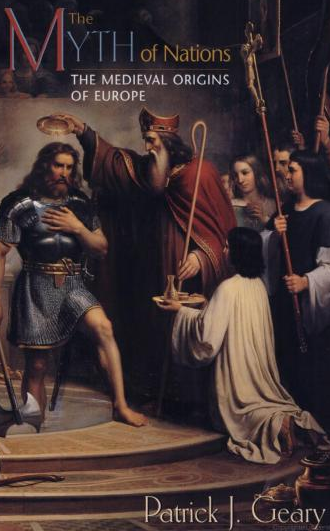
geary.png

geary145.png


and check out who Professor Geary states for suggested reading when it concerns the Slavs;

geary187.png


None other than Florin Curta. I recommend people pick up Geary's book. It is an eye opener to say the least.
 
Catholic Encyclopedia 1912 - Original home is in the countries along the Danube....

Catholic Encyclopedia 1912 - Original home is in the countries along the Danube....

Consequently if we were to follow strictly the written historical authorities, of which a number are very trustworthy, we would be obliged to support the theory that the original home of the Slavs is in the countries along the Danube and on the Adriatic coast.
http://www.newadvent.org/cathen/14042a.htm


Original home and migrations

There are two theories in regard to the original home of the Slavs, and these theories are in sharp opposition to each other. One considers the region of the Danube as the original home of the Slavs, whence they spread northeast over the Carpathians as far as the Volga River, Lake Ilmen, and the Caspian Sea. The other theory regards the districts between the Vistula and the Dnieper as their original home, whence they spread southwest over the Carpathians to the Balkans and into the Alps, and towards the west across the Oder and the Elbe.

The ancient Kiev chronicle, erroneously ascribed to the monk Nestor, is the earliest authority quoted for the theory that the original home of the Slavs is to be sought in the region of the Danube. Here in detail is related for the first time how the Slavs spread from the lower Danube to all the countries occupied later by them. The Noricans and Illyrians are declared to be Slavs, and Andronikos and the Apostle Paul are called Apostles to the Slavs because they laboured in Illyria and Pannocia. This view was maintained by the later chroniclers and historical writers of all Slavonic peoples, as the Pole Kadlubek, "Chronika pol." (1206), Boguchwal (d. 1253), Dlugos, Matej Miechowa, Decius, and others. Among the Czechs, this theory was supported by Kozmaz (d. 1125), Dalimir (d.1324), Johann Marignola (1355-1362), Pribik Pulkava (1374), and V. Hajek (1541). The Russians also developed their theories from the statements of their first chronicler, while the Greek Laonikos Harkondilos of the fifteenth century did not commit himself to this view. The southern Slavs have held this theory from the earliest period up to the present time with the evident intention to base on it their claims to the Church Slavonic in the Liturgy. At an early period, in the letter of Pope John X (914-29) to the Croatian Ban Tomislav and the Sachlumian ruler Mihael, there is a reference to the prevalent tradition that St. Jerome invented the Slavonic alphabet. This tradition maintained itself through the succeeding centuries, finding supporters even outside these countries, and was current at Rome itself. Consequently if we were to follow strictly the written historical authorities, of which a number are very trustworthy, we would be obliged to support the theory that the original home of the Slavs is in the countries along the Danube and on the Adriatic coast.

http://www.newadvent.org/cathen/14042a.htm
 
Herodotus’ theory, much criticised by subsequent historians, states that the Etruscans emigrated from the ancient region of Lydia, on what is now the southern coast of Turkey, because of a long-running famine. Half the population was sent by the king to look for a better life elsewhere, says his account, and sailed from Smyrna (now Izmir) until they reached Umbria in Italy.

“We think that our research provides convincing proof that Herodotus was right”, says Professor Piazza, “and that the Etruscans did indeed arrive from ancient Lydia. However, to be 100% certain we intend to sample other villages in Tuscany, and also to test whether there is a genetic continuity between the ancient Etruscans and modern-day Tuscans. This will have to be done by extracting DNA from fossils; this has been tried before but the technique for doing so has proved to be very difficult.”


I know the studies and the notes of Heredotus about this since "Izmir" is my hometown :)

I had this link on my bookmaks;
For modern day DNA samples, we chose the Basques as representative of western Europe, the Turks as representative of the eastern Mediterranean region, Karelians and Volga Finns as representative of northeastern Europe, and Egyptians and Algerians as representative of North Africa. Etruscan specimens in this study are ∼2,500 years old.

The shortest genetic distances between the Etruscan and modern populations are with Tuscans (FST=0.036; P=.0017) and Turks (FST=0.037; P=.0001). Other southern and eastern Mediterranean populations also showing relatively close genetic relationships. In the MDS plot, the Etruscans fall out of an unstructured cluster comprising most European and Caucasus populations, including the Turks. In particular, the Turkish component in their gene pool appears three times as large as in the other populations.

http://www.ncbi.nlm.nih.gov/pmc/articles/PMC1181945/


Also the famous Roman legend concerning the foundation of Rome "Romulus and Remus" which traditionally believed to be an Etruscan legend shows similarity with the legend of "Asena" of Caucasus people.


http://en.wikipedia.org/wiki/Romulus_and_Remus

http://en.wikipedia.org/wiki/Asena
 
Last edited:
...

Also the famous Roman legend concerning the foundation of Rome "Romulus and Remus" which traditionally believed to be an Etruscan legend shows similarity with the legend of "Asena" of Caucasus people.


http://en.wikipedia.org/wiki/Romulus_and_Remus

http://en.wikipedia.org/wiki/Asena

also with the story of Zeus and Amalthea / AdaManthea :chinese:

and the stories of Asena are perfect "Metafora" for what realy happened many times ^^

the wounded / ill / tired Macedonian Soldiers were "addopted" by female Turkish and other Asiatic "Wolverines" :)

The Slavic speakers of today are the descendants of the "barbarians" of the ancient Roman and Greek world.

well, particulary.

the "south slavs" , including us, the Macedonians, speak language that is very close / very related with many slavic languages.

And we were surely not "barbarians" for the Greeks and the Romans :)
 
Last edited:
also with the story of Zeus and Amalthea / AdaManthea :chinese:

and the stories of Asena are perfect "Metafora" for what realy happened many times ^^

the wounded / ill / tired Macedonian Soldiers were "addopted" by female Turkish and other Asiatic "Wolverines" :)


Yeah maybe :)

but similarity between "Asena" legend is higher since "Nurturing, caring" object in both legends was a female wolf, not a human.

Also the wolves being regarded as "bad, evil animals" in medieval European religious literature, probably because of their struggle between shamanistic Caucasus people who regards wolves as a sacred animal.

Also the term "Barbarian" used mostly for everyone who is not Christian, mostly directed to these shamanistic Caucasus societies. For example, Romans was calling German tribes as "barbarians" too before their Christian conversion. Some Europeans today, still calls Turks as "Barbarians" maybe because most of them never converted into Christianity unlike the example of German tribes.
 
Last edited:
about the "Slavs":

for those "slav" Christians, who were dislocated / expelled by the Bulgars, meaning 6th, 7th, 8th and 9th century, it is said that they "originate from Macedonia"

Risjani, rodom Slavjani, proizhodili iz Makedonii <--- click

Also the term "Barbarian" used mostly for everyone who is not Christian, mostly directed to these shamanistic Caucasus societies. For example, Romans was calling German tribes as "barbarians" too before their Christian conversion.


nice1 on "barbarian" , yes, Germani were called oft barbarians from the romans.

btw, about Amalthea and Zeus, Amalthea is a Goat , not a Woman.


sometimes there is a diference, but only sometimes :001_tongue: (without disrespect toward our females, just a joke :))
 
Last edited:
550 AD: Procopius, Secret History, 18.

Quote:
Illyria and all of Thrace, that is, from the Ionian Gulf to the suburbs of Constantinople, including Greece and the Chersonese, were overrun by the Huns, Sklaves and Antes, almost every year, from the time when Justinian took over the Roman Empire; and intolerable things they did to the inhabitants. For in each of these incursions, I should say, more than two hundred thousand Romans were slain or enslaved, so that all this country became a desert like that of Scythia................neither the Persians nor the Saracens, the Huns or the Sklaves or the rest of the barbarians, were able to withdraw from Roman territory undamaged. In their inroads, and still more in their sieges of cities and in battles, where they prevailed over opposing forces, they shared in disastrous losses quite as much.

One thing is noticeable in Procopius' The Secret History and that is that he never once mentions any Slavs moving into Macedonia. Strange isn't it?
I recently read The Secret History (haven't read any of his other works,,, yet) and I do notice that he mentions Justin's wife was a Barbarian (what kind of 'Barbarian'?) and her real name was Lupecina. Any ideas on this name and what kind of origins it may entail?

http://www.roman-emperors.org/euphem.htm

Very little is known of the life of Justin I's wife Euphemia. Her original name was Lupicina, a name which may have been associated with the occupation of prostitute.[[1]] Certainly her origins were humble: as Procopius relates (Anecdota/Secret History 6.17), she had been born a barbarian and a slave. Before marrying Justin she had been the concubine of her previous owner.2]]

and the footnotes state the following;

[[1]] Vasiliev, Justin I, p.61 and n.39, connecting the name with the Latin lupa (she-wolf) and lupanar (a brothel).

[[2]]As Daube, `The marriage of Justinian and Theodora', pp.385-6 notes, there were legal obstacles to a member of the aristocracy marrying a former slave. He suggests therefore that Lupicina was granted the status of freeborn in order to legitimise their union. This must have occurred during the reign of Anastasius, when Justin's career prospered.

I don't think Lupecina or Lupicina had something to do with a brothel or prostitution. What do you guys think?
 
551 AD: Jordanes, Getica, 34-35.

Quote:
........beginning at the source of the Vistula, the populous race of the Venethi dwell, occupying a great expanse of land. Though their names are now dispersed amid various clans and places, yet they are chiefly called Sclaveni and Antes. The abode of the Sclaveni extends from the city of Noviodunum and the lake called Mursianus to the Danaster, and northward as far as the Vistula. They have swamps and forests for their cities. The Antes, who are the bravest of these peoples dwelling in the curve of the sea of Pontus, spread from the Danaster to the Danaper, rivers that are many days' journey apart.

More from Jordanes' work;

Jordanes52-1.jpg

jordanes53.jpg
 
http://www.fordham.edu/halsall/source/nestor.html

The Chronicle of Nestor

[from Walsh] The earliest written records of Rus seem to date from the 11th century. The most authoritative, complete and earliest of the Chronicles to have survived is The Lavrentyesky Spisok, dating from 1377 and so called after the Monk Lawrence who copied it, The second oldest is called Ipatsky Spisok, after the Ipatsky Monastery where it was found. The main part of both these Chronicles is an historical compilation, "The Tale of By-gone Years" which was long thought to be the work of the Monk Nestor and was known as The Chronicle of Nestor. It is now generally held to be a compilation of the work of many men.


THE BEGINNINGS. Let us begin our story. After the flood the three children of Noah: Sem, Cham, and Japhat divided the world among them. Sem occupied the East: Cham, the middle part; and Japhat received the North and the Southwest. In the portion belonging to Japhat there lived the Russian, the Chuder,, and many other people.

After the fall of the tower of Babel and the confusion of tongues, the sons of Japhat occupied the countries of the West and North. From the descendants of Japhat came those who took the name of Slavs. They established themselves near the Danube in the countries of the Egri and the Bulgars. Some of these Slavs were scattered over the earth, and they have taken the names of those places where they established themselves, for example, those who populated the frontiers of Moravia call themselves Moravians; others, Czechs. The Serbs and the Kroats are also Slavs. Among those Slavs who lived along the Dnieper, some took the name of Poles, others that of Dreviliens (because they lived in the forest) others that of Dregovich (who established themselves between the Pripet and the Dvina) thus the language of the Slavs was dispersed. As to the alphabet, that was not born until later.
 
i am convinced the slavs are the thracians and probably illyrians renamed at some point in roman history. there is no other logical explanation of their supposed emergence at the smae time as the thracians and illyrians disappeared lets not forget that one titos proposed names for sfry was illyria
 
Back
Top