
-
Welcome to the new Macedonian Truth Forum. All posts, members and private messages have been moved over from the old forum.
Passwords from the old forum could not be carried over, so please use Forgot your password? to set a new one. The reset link is emailed to the address on your account.
-
Rules and Regulations at the forum of the Macedonian Truth Organisation (MTO)
(1) The national-ethnic and cultural-linguistic identity of the Macedonian people is historically Macedonian, and derives its character from the native, indigenous and geographic homeland of the Macedonians, which is called Macedonia. To ensure that their human rights, integrity and heritage are appropriately respected, the only nouns and adjectives acceptable when reference is made to the above character and identity markers is Macedon, Macedonia, Macedonian and Macedonians.
(2) The nation-state of the Macedonian people is the Republic of Macedonia, and is to be referred to by this official title so long as the 'republic' prefix is consistently applied to other states. Alternative references are the Macedonian Republic, or simply, Macedonia.
(3) The 'ethnic' prefix is only acceptable for Macedonians in cases where differentiation is specifically required - so long as it is in context and consistent where it concerns its application to other ethnic groups.
(4) Should any other differentiation be specifically required, the names of other ethnic groups that reside with Macedonians in either the Republic of Macedonia or the occupied Macedonian regions in Greece, Bulgaria, Serbia or Albania, are to be given a prefix.
(5) Negating the identity, language and culture of the Macedonian people by deliberate avoidance of the terms Macedonia, Macedonian and Macedonians, or by any other means, is not permitted.
(6) Systematic anti-Macedonian propaganda and rhetoric are not permitted.
(7) Threads irrelevant to the Macedonian Cause, the community at the Macedonian Truth Organisation or the Macedonians in general may be considered as spam or not in the spirit of the forum. In such cases they are not permitted.
(8) Continual posting of messages in threads with the sole purpose of deviating from the initial topics with the use of unrelated and unnecessary information is not permitted.
(9) All posts, external articles, reports, etc that are cited in languages other than Macedonian or English, must be accompanied with a translation in one or both of the said languages.
(10) Despite the possibility of some conversations and debates becoming heated, extreme abuse and/or racism, vulgar language and/or terminology, threats, revelation of personal information about others, harassment, and other such behavior will not be permitted. If deemed necessary all relevant information including member details will be reported to the appropriate authorities for investigation which may result in legal action.
(11) Threads that are created must have a summary of a topic or excerpt of an article found in pertinent link(s) that have been included. One line threads will be considered unaccetable spam and are therefore not permitted.
(12) Compulsive and deliberate lies, irrespective of the topic, are not permitted.
(13) Any symbols or avatars found to be perceived as offensive to Macedonians are not permitted.
(13) Any explicit or extreme material is not permitted.
Failure to adhere to the above rules and regulations will result in a ban after 3 breaches. This may be reconsidered in some cases should the circumstances be of an unorthodox nature and/or require special consideration. To assure an effective deterrent against an individual or individuals with the sole purpose of causing dissent through spamming, racism or other improper means, the above rules will be strictly enforced.
The MTO administration will monitor all discussions as reasonably practical and reserve the right to remove any post and/or member from the forum, and update the rules and regulations as required. Members are encouraged to immediately report any post and/or member to the MTO administration if they feel that these rules have not been abided by.
The views expressed on this forum are those of the individuals. The only official representation of the MTO is made by the "Macedonian Truth Organisation (Site Owner)" username, and no other.
-
Macedonian Cause
The Macedonian Truth Organisation calls on God in Heaven to protect, bless and guide the endeavour it is committing to undertake, and that is to work towards:
Securing Macedonia as a free, independent and democratic republic in which sovereignty lies with the Macedonian citizens; as the nation-state of the Macedonian people in which they can preserve their culture, language and identity; as a state in which the Macedonian language and culture form the basis of public life and act as important unifying elements of Macedonian society; as the home of all its citizens to which it guarantees and obliges their inalienable natural rights and corresponding responsibilities;
The acknowledgment as self-evident and irrefutable the existence of the:
1) Indigenous, ethnonational name of Macedonia;
2) Macedonian people, language and identity;
3) Macedonian culture, symbols and folklore;
4) Macedonian ancestry, heritage and history in its entirety; and
5) Macedonian Orthodox Church;Securing recognition by the International Community of the tragedies endured by the Macedonian people, of the division of Macedonia with the signing of the Treaty of Bucharest on August 10, 1913, and the genocide committed against the Macedonian people at the hands of the Greek, Bulgarian and Serbian states and their respective churches during the 19th and 20th centuries;
Ensuring that the Interim Accord is declared ‘null and void’ and that all constitutional provisions, acts, commitments, agreements, legislation, regulations, policies or programs emanating from, supporting or consequential to the Interim Accord are also declared ‘null and void’, including the use of any symbols and the completion of any acts imposed by, or originating from, the Interim Accord.
Ensuring that the Framework Agreement is abolished and that all constitutional provisions, acts, commitments, agreements, legislation, regulations, policies and programs emanating from, supporting or consequential to the Framework Agreement are also abolished and replaced by a framework of constitutional and statutory law based on inalienable natural rights and corresponding responsibilities and universally codified human rights mechanisms.
Securing the abolishment of any existing constitutional provisions, acts, agreements, legislation, regulations, policies and programs that discriminate against the Macedonian people, in any international organisation or any of the countries of the International Community where such constitutional provisions, acts, agreements, legislation, regulations, policies and programs exist, and thereby ensuring the freedom for Macedonians to exercise their inalienable natural rights and fulfil their corresponding responsibilities, and practice their culture, language and religious faiths in all the countries of the International Community without hindrance;
The empowerment of Macedonians to undertake a moral revolution and to instil and/or reinvigorate within themselves a deep-rooted national, cultural, linguistic and historical dignity and a commitment to the exercise of freedom based on inalienable natural rights and corresponding responsibilities;
The recognition of the Macedonian minorities in the neighbouring states of Macedonia as well as the respect for the inalienable rights and freedoms of the Macedonian minorities, as provided for by natural law and as codified by the United Nations Charter, the Universal Declaration of Human Rights and other universally codified human rights mechanisms;
The full and unreserved respect of, and the support for, the rights of all people of non-Macedonian descent living in Macedonia and around the world, who share a reciprocal full and unreserved respect for the Macedonian people, their homeland and their state;
The cultural unification and solidarity of the Macedonian people living in all parts of historical Macedonia and adjacent territories, as well as Macedonians throughout the world;
The unity of all Macedonians on the principles, objectives and achievement of the Macedonian cause as defined by this declaration.
You should upgrade or use an alternative browser.
Origins of Albanian language and ethnos
- Thread starter TrueMacedonian
- Start date

Epirot
New member
According to the link Bushati was alive during the second half of the 18th century, around the same time that the German writer first proposed the idea of an Illyrian connection for the Albanians. These two events may or may not be related.
They aren't related since Bushati has no clue what a German historian (like Thumman) did write at the same time.
Originally Posted by Soldier of Macedon
However, there is not a single citation or source in the Wikipedia link to the article. Is there any evidence that Bushati claimed to be an Illyrian himself, which is recorded in documents and such? Any record of an 'Illyrian confederacy'?
I brought up a link of Wiki in order to present his biography. Here is an article regarding Illyrian confederacy orchestrated by Bushati:
http://vargmal.org/dan5230
I guess you can use 'Google translator' for a translation since in its current form the article is in Albanian.
Originally Posted by Soldier of Macedon
The name wouldn't suprise me too much in this regard, as the majority of Bushati's realm appears to be Montenegrin and Bosnian rather than Albanian. We both know that the former, along with the Serbs and particularly the Croats, fashioned an Illyrian tradition and heritage that is recorded in a number of medieval documents.
You're right when you say that most of Bushati's realm encompassed what is today Montenegro and a little strip of Southern Bosnia.
By the early fourteenth century there are also signs of a long-established Albanian presence in the mountains of Montenegro, and as far north as the Ragusan hinterland.
KOSOVO A SHORT HISTORY, Noel Malcolm, 1999, pg. 28
The Gheghides, who boast of having numbered among them such a hero as Scanderbeg, unite, according to the learned topographer of Greece (Colonel Leake), “the cruelty of the Albanian to the dulness of the Bulgarian.” They have long enjoyed a greater share of independence, under the Pashas of Scodra, than any other of the Albanian tribes. They are equally good soldiers with the latter, and have preserved more of their natural stubbornness, from the fact of their having been less often employed as such by the Turks. Their country extends from the frontier of the Austrian territory of Cattaro round the Montenegro, which may be considered an independent state; and, following the ridges which unite it to Mount Scardus, it reaches the Herzegovina, while it is bounded on the south by the river Drino. Scutari, or Scodra, is their chief town, and Dulcigno, Alessio, and Durazzo belong to them.
1848
James Henry Skeene:
The Albanians
http://www.albanianhistory.net/texts19/AH1848_2.html
...Skeene emphasized that northern Albanian boundaries reaches as far as Hercegovina.
M.E. Durham (1863-1944), who travelled widely in Albania and Montenegro and devoted much time to the study of Montenegrin and Albanian tribes, came to the conclusion that the Montenegrin is not so much a Slav as a Slavized descendant of the older inhabitants, i.e., of Vlachs, and Albanians (see Some Tribal Origins, Laws, and Customs in the Balkans, London, 1928, PP. 13-59).
That the Montenegrin tribes were originally Albanian tribes was already indicated by K. Jirecek, "Albanien in der Vergangenheit," Illyrisch-Albanische Forschungen, (Munchen und Leipzig 1916, p. 69).
The marked distinction between the Serbs and the Montenegrins was pointed out by Prof. Savo Birkovic in a recent work: 0 postanku i rasvoju Crnogorske nacje, Graficki Zavod, Titograd, 1980.
http://www.home.no/dukagjin/Footnotes.html
So not in the all cases when Byzantine authors recorded Illyrians in Croatia, Bosnia and Montenegro were referencing to Slavs since the above proofs affirms strongly for a well-established presence of Albanians in these regions. I am going to say that Illyrian term might been used to denote the Albanians.
Originally Posted by Soldier of Macedon
Which writers? Can you cite the sources and quotations?
For the moment I haven't the quotes since I am not writing from my house. I promise that I'll post here some Byzantine sources regarding Albanians as Illyrians. In the following passage are thoughts of Fallmerayer (who was based entirely on Byzantine chroniclers):
For not a single drop of real pure Hellenic blood flows in the veins of the Chrisitian population of modern Greece. A terrific hurricane has dispersed throughout the space between the Ister and most distant corner of the Peloponnesus a new tribe akin to the great Slavonic race. The Scythian Slavs, the Illyrian Arnauts, children of Northern lands, the blood relations of the Serbs and Bulgars, the Dalmatians and Moscovites – those are the people whom we call Greeks at present…
History of the Peninsula of Morea in the Middle Ages
http://books.google.com/books?id=Rt...&resnum=1&ved=0CCUQ6AEwAA#v=onepage&q&f=false
Originally Posted by Soldier of Macedon
In my opinion, from what I have seen, references to an Epirot/Albanian connection appear more frequent than those with Illyrians. Would you agree? What does Barletti say?
It's true that Medieval sources linked Albanians more with Epirots rathern than Illyrians. As you said Barletti used very often 'Epirus' to describe Albania and 'Epirots' for Albanians. But this does not reject Illyrians as forefathers of Albanians because Epirots were nothing else but a close cognates of Illyrians.
Epirot
New member
Of the Thesprotians and Molossians after the great inundation, the first king, according to some historians, was Phaethon, one of those who came into Epirus with Pelasgus. Others tell us that Deucalion and Pyrrha, having set up the worship of Jupiter at Dodona, settled there among the Molossians. In after time, Neoptolemus, Achilles's son, planting a colony, possessed these parts himself, and left a succession of kings, who, after him, was named Pyrrhidae, as he in his youth was called Pyrrhus, and of his legitimate children, one was born of Lanassa, daughter of Cleodaeus, Hyllus's son, had also that name. From him Achilles came to have divine honours in Epirus,under the name of Aspetus, in the language of the country. After these first kings, those of the following intervening times becoming barbarous, and insignificant both in their power and their lives, Tharrhypas is said to have been the first who, by introducing Greek manners and learning, and humane laws into his cities, left any fame of himself. Alcetas was the son of Tharrhypas, Arybas of Alcetas, and of Arybas and Troas his queen, Aeacides; he married Phthia, the daughter of Menon, the Thessalian, a man of note at the time of the Lamiac war, and of highest command in the confederate army next to Leosthenes. To Aeacides were born of Phthia, Deidamia and Troas, daughters, and Pyrrhus, a son.
http://www.greektexts.com/library/Pl...s/eng/824.html
a) Plutarch pointed out that king Tharrypas was the first who introduced 'Greek manners and learning'. Again I persist on the frequently asked question: If Epirus was the 'heart of Greece' mean that Epirotes were somehow the 'nucleus' of all Greeks. If Epirotes were being of 'central Greeks' then Plutarch would not say that Tharrypas introduced 'Greek learning' on Epirus? It does not make sense to introduce 'Greek manners and learning' in the centre of all Hellenes!
b) Again if Epirotes spoke any tongue close to the Greek, then Plutarch would not need to emphasize 'the language of the country' that mean obviously a entirely different language from Greek. Achilles himself never is related in 'Iliad' with the word 'Aspetos'. The only one who called Achilles as 'Aspetos' is Plutarch. The official etymology of 'Aspetos' related with 'unspeakable,unspeakably great,endless,' is not well-attested because it contains somehow some primaries logic mistakes. Plutarch said clearly that Achilles has divine status among Epirotes; if Epirotes honored someone as 'Divine' they could not attribute this 'divine status' to someone which is 'unspeakable'.
1. Aspetos = A + Spet(os); 'A' is the short trait of 'asht' (mean "is" in Alb.). Even in modern times, specifically in Gheg dialect is preserved a such trait short of 'Asht' in 'A'. What's about 'Spetos'. If we drop out the last suffix 'os' the word become on 'Spet' which is an earlier form of Alb. 'Shpejtë' mean 'fast, quick' because again in Gheg dialect we find an another variation from standard form of Albanian 'Shpejtë' in 'Shpetë'. Suma Summarum after this summarized explanation we come to the central point: Aspetos is transparently equivalent with Alb. 'A shpetë',
Aspetos = A shpetë mean 'He is fast/quickly'.
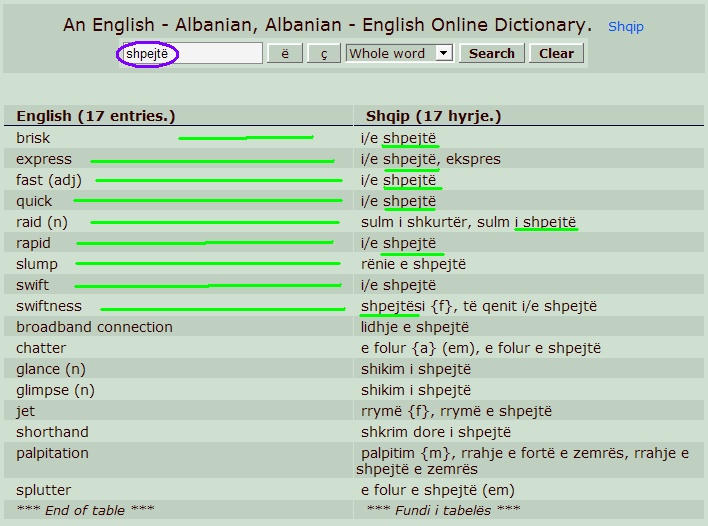
2. This version of explanation has a sufficient logic base since Homer like to use for Achilles the epithet as 'swift-footed' (podas ôkus), a clear indication of swiftness of every action of Achilles.
A characteristic of Homer's style is the use of epithets, as in "rosy-fingered" dawn or "swift-footed" Achilles. These epithets were metric stop-gaps as well as mnemonic devices for the aoidos (singer) — both, signs of the deep oral tradition that preceded the written codification of the Iliad and Odyssey.
Moreover, epithets in epic poetry from various Indo-European traditions may be traced to a common tradition going much deeper into prehistory. For example, the phrase approximating "everlasting glory" or "undying fame" can be found in the Homeric Greek kleos aphthiton and the Sanskrit śrávo ákşitam. They "were, in terms of historical linguistics, equivalent in phonology, accentuation, and quantity (syllable length). In other words, they are descendants from a fragment of poetic diction (reconstructable as Proto-Indo-European *klewos ņdhgwhitom) which was handed down in parallel over many centuries, in continually diverging forms, by generations of singers whose ultimate ancestors shared an archetypal repertoire of poetic formulae and narrative themes."[1]
A name plus an epithet constitute a formula which exactly fits the metric structure of the verse. The use of formulas is characteristic of ancient epic poetry.
Homer used epithets not merely to complete rhythm patterns. Epithets increase the meaning of each noun that they alter. Epithets can tell of the character’s origin, parentage, appearance or state, skill-set, position, or heroic quality. At the same time, he distinguishes between Homer’s two different types of epithets: the special and the generic. Special epithets are used exclusively for a particular character, while generic epithets are used repeatedly for a class of characters. Yet this distinction is not always clear; thus, the epithet “master of the war-cry” is used predominantly with Menelaus, yet on occasion also to describe Diomedes.[2]
Then answered him Achilles swift of foot: "Most noble son of Atreus, Agamemnon king of men, for the gifts, to give them as it beseemeth, if so thou wilt, or to withhold, is in thy choice. But now let us bethink us of battle with all speed; this is no time to dally here with subtleties, for a great work is yet undone. Once more must Achilles be seen in the forefront of the battle, laying waste with his brazen spear the battalions of the men of Troy. Thereof let each of you think as he fighteth with his man."
http://homer.classicauthors.net/illiad/illiad19.html
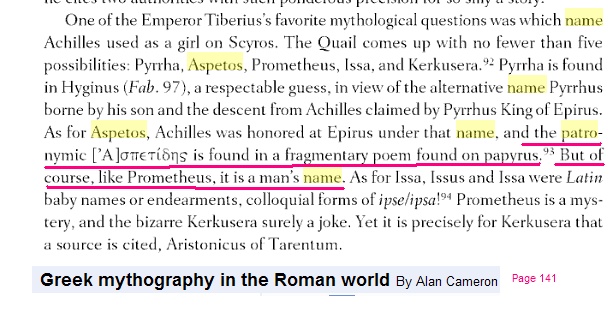
Alan Cameron raises two important conclusions:
i) 'Aspetos' is a patronym (as is it proofed by a fragmentary poem found on papayrus
ii) 'Aspetos' like Prometheus is a man's name
What's wrong with Greek explanation versions?
Finally, 'unspeakable,unspeakably great,endless' cannot be attested neither as patronym nor as man's name, because it does not make sense to have patronyms like this: 'unspeakable,unspeakably great,endless' or even worst as man's name.
Epirot
New member
Illyrian culture is believed to have evolved from the Stone Age and to have manifested itself in the territory of Albania towardthe beginning of the Bronze Age, about 2000 BC. The Illyrians were not a uniform body of people but a conglomeration of many tribes that inhabited the western part of the Balkans, from what is now Slovenia in the northwest to and including the region of Epirus, which extends about halfway down the mainland of modern Greece. In general, Illyrians in the highlands of Albania were more isolated than those in the lowlands, and their culture evolved more slowly--a distinction that persisted throughout Albania's history.
Encyclopedia Britannica
Many tumuli (burial mounds) containing Illyrian objects made of bronze and iron were discovered at Glasinac (Bosnia), Koman (Albania), and other parts of southeastern Europe. At the height of their expansion the Illyrians extended their frontiers from the Danube River to the Gulf of Ambracia and from the Adriatic Sea to the Shar Mountains.
The New Encyclopaedia Britannica, Volume 1, 1987, pg. 212
At the height of its dominance in the region,Illyria extended from the Danube River to the Gulf of Ambracia on the Adriatic, to the Sar mountains.
Women rulers throughout the ages: an illustrated guide, Guida Myrl Jackson-Laufer - 1999, pg. 382
"Philip contracted an alliance with Neoptolemos, king of the Illyrian Molossians, and married his daughter Olympias in 357 B.C".
(~The McGraw-Hill encyclopedia of world biography~ pg.409)
I think that is enough to confirm the Illyrian ethnic essence of Epirots.
Epirot
New member
In his book, "The Illyrians", John Wilkes states on pg: 219:
"NOT MUCH RELIANCE SHOULD PERHAPS BE PLACED ON ATTEMPTS TO IDENTIFY AN ILLYRIAN ANTHROPOLOGICAL TYPE AS SHORT AND DARK SKINNED SIMMILAR TO MODERN ALBANIANS."
Wilkes, having published this work in the early 90s ruined the earlier accepted theory that Albanians were the descendants of the Illyrians. Wilkes is the foremost authority on Illyrians in the world today. An anthropologist, archeologist, a published historian and Professor of History whose familiarity with Balkan archeology is first hand, Wilkes' conclusions lead to the conclusion that the modern descendants of the Illyrians may in fact lie in Bosnia, Serbia and Dalmatia.
Wilkes do not ruined the theory of Illyrian origin of Albanians. Citing just a truncated passage of Wilkes does not give any proof of generalizing his conceptions. Citing in such way (of Wilkes) I met in some "Greek" sites who proclaim the Hellenism of everything! For the sake of truth I shall cite another passages of the same author that affirm the opposite of your beloved quotes. Follow me:
The Albanian language which belongs to the Indo-European group, has a distinctive vocabulary, morphology and phonetic rules which have engaged the attention of many philologists, of whom the majority have confidently proclaimed its origin from ancient Illyrian'
J.Wilkes 'Illyrians' page 278
'It is not doubted whether or not Albs are indigenous, its whether they were directly from Albania or from some northern part. For instance, it is argued, that Albanians have their origins in Southern Serbia ' (Wilkes: 224
Let's turn for a while at your beloved quote:
NOT MUCH RELIANCE SHOULD PERHAPS BE PLACED ON ATTEMPTS TO IDENTIFY AN ILLYRIAN ANTHROPOLOGICAL TYPE AS SHORT AND DARK SKINNED SIMMILAR TO MODERN ALBANIANS
The quote on modern Albanians being "short and dark skinned" is not his. It was taken from the book 'Skeletal evidence' of Alexander Stipcevic, page 262, published over thirty years ago (in 1977). Stipcevic himself claims that Albanians are the descendants of Illyrians !!!!
After all Wilkes isn't anthropologist or he hasn't make any specific research on the physical stature of Albanians. Instead of citing an inaccurate statement, it's time to ask from authorities on that matter.
'The stature of the Geghs is extremely variable geographically. the tribes which touch Montenegro have means of 173 cm, and 174 cm ... On the south side of the Drin the means fall to 169 cm, and continues to the level of 167 cm, in Mati and Mirdita...Almost all of the Geghs are light-skinned'.
(Coon 1939 http://www.snpa.nordish.net/chapter-XII13.htm)
.'At last I asked him on what he based his judgment, "Well" was the answer " look at my servant" The man turned out to be a characteristic Albanian - tall, handsome, and doubtless as honest and brave as his eyes were frank and fearless, while his whole bearing conveyed that suggestion of mingled courtesy and independence which makes the peculiar charm of his race' (BRAILSFORD 1903:223)
'Macedonia and its races' - http://kroraina.com/knigi/en/hb/hb_8_1.html
2. 'But here are men of distinction, tall, swarthy, proud in their carriage. These are Albanians with quilted white peticoats, black caps, silver-braced coats and a couple of revolvers stuck in the gridle.'
(FOSTER 1906:185) 'Pictures from the Balkans'
www.promacedonia.org/en/jf/jf_18.html
4. 'Do Albanians look like Serbs ?. No, The Serbs often have black or dark brown hair and are generally darker and more heavily built than Albanians. Their appearance is fairly typical of Southern Slavs. By contrast Kosovars look Celtic to a British eye. They have curly hair, which is often blonde or rust, and their skin tends to be very pale and covered in freckles. Their eyes are often green or blue and their built is much more slender than that of Serbs'.
MARCUS TANNER - 'INDEPENDENT' - 11 May 1999
5. 'It has been all the more painful to witness the suffering of the people of Kosovo because they look and live so much like us.
TOM UTLEY - 'DAILY TELEGRAPH' - 26 March 1999
Epirot
New member
Are you implying that the Illyrian name was a synonym for 'West Balkan Christians'? If so, in what era was this the case? Can you clarify and corroborate with some examples and sources?
Have you ever heard of "Illyrian Bulgaria"?
In 904-930 it seems that even a Byzantine and Slavonic-Byzantine stronghold like Sardica was falling under the Moesian Turkish presence and union or influence, though the local Slavinias sure were always keeping their power – recognizing formally some alliance or union with Moesian Turkihs principality, and those Slavinias were after 927-930 originating the great Illyrian empire of the Comitopouls, under Moesian Turkish king Peter I Moesian Turkish state is losing the conquests of prince Simeon, Rassa-Serbia is so separating in 927-930 and so is the neighboring Shopeskho.
It is notable that the Byzantine sources were always naming the four brothers – Slavonic-Byzantine Shope princes as “Comitopouls” that is as sons of a comita or comes-count but not being a comita for some of them, meaning that their father “the mighty comes-count of Sredets-Sofia Nikola” was losing its title long ago (before transferring it to some of his sons) – as a Byzantine either as Moesian Turkish comes-count – as his lands were since long ago losing their union with one of both monarchies and he couldn’t be succeeded from his sons as his title was lost before that. Thus the anti-Byzantine revolt of Comitopouls was started in one staying formally Byzantine land from long separated from Turkish Moesia (after Byzantine and Russian attacks over Turkish Moesia Comitopolus were starting pretending also on lands of the quickly and inevitably disappearing Moesian Turkish state).
If Moesian Turkish prince Peter I was receiving from Byzantine emperor title of Caesar or Kaiser (highest court title after imperial one in Byzantium, already received from a Moesian Turkish khan Tervel in 705) with title as patriarch for Moesian Turkish archbishop – which though staying canonically submitted to the patriarch in Constantinople (same as for example the Abkhazian patriarch-Catholicos was staying submitted to one of Georgia), great Illyrian Bulgarian Slavonic-Byzantine empire was first time establishing later known and used imperial Slavonic title as “tsar” – documented for Illyrian Bulgarian tsars Samuel and John-Vladislav (first named as “Autocrat”), and with its independent patriarchate was giving birth to first independent European national Church recognized from emperor Basil with three imperial charters in 1019-20 – the Church transferred from him important part of power over principal territories of Illyrian Bulgarian empire (that is the Illyrian Bulgaria proper) now in union with great Byzantium, the reformed from Basil “autocephalous” that is independent archbishopric of Ohrid and of “Bulgaria” was transferred the official great state seal of the Illyrian Bulgarian empire.
With its enormous territory reaching from Illyria with North Greece and Bosnia or Dalmatia to Slovakia, South Poland and South Russia or Black sea – it was first great Slavonic empire with the first Slavonic-Byzantine culture, centers and schools and Church, and which playing principal role in Christianization of neighbors Poland and Russia, strategic alliance is established with powerful Hungarian neighbor (later playing important role in Illyrian Bulgarian history, policy, directions), and empire becoming later united in a monarchical union with great Byzantium (in 1018-1204).
Union with Illyrian Bulgaria was greatest victory and success of greatest Byzantine Medieval emperor Basil II, like his contemporaries and himself are rightfully considering – for fighting Illyrian Bulgaria the empire is concentrating on Balkans after the year 1000 its principal military forces of more than 100 thousand soldiers. Byzantine attacks are ravaging principally the Slavonic-Byzantine Macedonia whose Slavinias are the traditional opposers of Byzantium.
However, John Van Antwerp Fine's book gives answer to many of your questions:
Epirot
New member
Is it a mere coincedence that a aptly named Illyrian language is spoken amogst most Slavic speaking Nations
The doesnt work out well for Albanian Nationlism
Actually it does not work out well for Pan-Slavic Nationalism because:
Albanian Ties with Illyrian
Many lines of reasoning convince linguistic scholars that the Albanian people and language originated with the ancient lllyrians.
1. The national name Albania is the name Albanoi, an Illyrian tribe mentioned by the geographer Ptolemy of Alexandria about A.D 150.
2. The Albanoi territory then centered at Albanopoli, between Durrës and Kruja, the heartland of modern Albania.
3. Four peoples speaking their own languages lived in the Balkans in ancient times: the Greeks in the south, the Macedonians in the center, the Thracians in the east and the lllyrians in the west. Today Albanian is spoken in most of the same region where Illyrian was spoken in ancient times.
4. Those few language elements which are known as Illyrian can be explained through the Albanian language, and no other.
5. A linguistic comparison of Albanian with ancient Greek and Latin indicates that Albanian was formed as a language at an earlier period than those other ancient languages.
6. Archeological and historical data witness to the cultural continuity from the lllyrians to the Albanians. Continual contact with other peoples and languages has left its traces in the Albanian vocabulary. Foreign words have been borrowed from Greek, Latin, Slavic and Turkish, yet Albanian has been preserved as a separate language, its grammatical system remaining virtually unchanged.
7. Linguists point out many technical similarities between Illyrian and Albanian words.
8. Borrowings from northern Greek and from Latin incorporated in the Albanian language reflect the well-known political and cultural pressures on Illyrian territory. Linguistic studies indicate that Albanian developed from Illyrian as a distinct language between the fourth and sixth centuries A.D. Thus ancient borrowings of Greek and Latin vocabulary could not have moved directly into Albanian, but into Illyrian, through which these words entered into Albanian. Historical linguists point out that these borrowings from ancient Greek were in the Dorian dialect and penetrated into Illyrian through Corinthian commercial colonies in Corfu, along the Adriatic coast, and through border towns. Latin borrowings came later during the lengthy Roman occupation (NAlb 1986, 3:32). These ancient Greek and Roman contacts occurred precisely in the territory of old Illyria, leaving their traces in the Illyrian language from which they later passed into the Albanian language.
9. Illyrian toponyms, ancient Illyrian place names for cities, rivers and mountains, are preserved today in the Albanian language, and only in Albanian. The names of Balkan villages usually lasted only a few centuries,
for villages were often destroyed altogether during wartime. Cities lasted longer, so their names were usually older. But rivers, lakes and mountains endured through the centuries, and their ancient names usually continued in use. Even new inhabitants usually adopted the old names, just as American colonists adopted many old Indian place names in the United States. Accordingly, Albanian linguists have found more than 300 names of ancient cities like Shkodra, rivers like the Drin and mountains like Tomor which were mentioned by ancient Greek and Roman geographers or historians and which are still in use in Albania. Scholars show how the rules of historical phonetics explain any changes of spelling over the centuries from Illyrian to Albanian, as Scupi to Shkup, Scodra to Shkodra, Lissus to Lezha, Durrachium to Durrës, Drinus to Drin, Mathis to Mat. Certainly the Albanian language is derived from the Illyrian (Cabej 1985, 42-62).
10. Illyrian proper names continue in use among present-day Albanians. Many of the individual Illyrian names of persons were preserved on epitaphs and inscriptions on coins. Then the names of other people like the Illyrian rulers Agron and Teuta were mentioned by Greek or Roman historians. The Albanian scholar Mahri Domi claims to have identified 800 of these (Liria 15 October 1982; 1 November 1983).
11. The numerous marine terms for sea plants and animals in the Albanian language show that these people lived along the coast on what would correspond with Illyrian territory (AT 1983, 1:44-45).
12. Then there are other words in Albanian which Greek or Roman writers long ago explicitly identified as Illyrian in origin.
Down through the centuries many once great peoples have been either destroyed or assimilated by others so as to disappear altogether. But the Illyrian people with their distinctive dress, music, customs and especially their language have persisted in their shrinking territory along the western shore of the Balkan Peninsula. With no record or tradition even hinting at their extermination or assimilation or migration, one can only assume their unbroken historical continuity. There seems to be no question but that the present-day Albanians are the historically uninterrupted descendants of the lllyrians who were known to have inhabited that same region in early Greek and Roman times.
Taken from: The Albanians: an ethnic history from prehistoric times to the present, Edwin E. Jacques – 1995, pg.37 – 38.

Dejan
New member

Onur
New member
The Albanian language which belongs to the Indo-European group, has a distinctive vocabulary, morphology and phonetic rules which have engaged the attention of many philologists, of whom the majority have confidently proclaimed its origin from ancient Illyrian'
J.Wilkes 'Illyrians' page 278
While i believe this Albanian-Illyrian connection is nothing more than an Antiquity phenomenon created by nationalistic ideas of post 18th century but i read several articles about Albanian language`s distinctive features than other languages used by surrounding cultures.
I posted an article about languages here b4;
http://www.macedoniantruth.org/forum/showthread.php?t=3389
Both vocabulary and grammar features of several languages gets calculated by computer software program here and Albanian shows it`s distinction to a certain degree than other Indo-European languages, like the Irish.
But i checked the wikipedia for earliest text in Albanian. It says that the earliest Albanian text is dated at 1462!!! This is really weird. If Albanian is really descended from Illyrian language and if it shows some distinctive features then how come it`s earliest text is that recent date? If it`s an ancient language, there should have been a written text much earlier than 1462.

Soldier of Macedon
Senior Member
Epirot, can you produce a copy of a charter, document, currency, etc or anything else that says "Illyrian Confederacy" from the time and realm of Bushati?Epirot said:I brought up a link of Wiki in order to present his biography. Here is an article regarding Illyrian confederacy orchestrated by Bushati:
http://vargmal.org/dan5230
I guess you can use 'Google translator' for a translation since in its current form the article is in Albanian.
What signs?By the early fourteenth century there are also signs of a long-established Albanian presence in the mountains of Montenegro, and as far north as the Ragusan hinterland.
KOSOVO A SHORT HISTORY, Noel Malcolm, 1999, pg. 28
Who else speaks of Albanians all the way up to Hercegovina? In the same link you provided http://www.albanianhistory.net/texts19/AH1848_2.html - Skene also says the following:Skeene emphasized that northern Albanian boundaries reaches as far as Hercegovina.
The tribe of the Ghegs and Mirdites are of lofty stature and athletic frame; and their swarthy complexion and black eyes still retain the characteristics of their supposed Caucasian origin.
The Toskides are the most handsome of the Albanians. They have noble features, with fair hair and blue eyes, indicating the mixture of Georgian blood, which probably flows in their veins.....
Do you agree with Skene in this regard?The Albanian language being merely oral, the want of written documents renders their history exceedingly obscure, and the silence preserved by the Greek and Byzantine writers on the subject has reduced the data within a very narrow compass. They are called Arvaniti by the Greeks, and Arnaout by the Turks, both names being derived, along with that of Albanians, from the Albanes, an ancient people of the shores of the Caspian Sea, which may have incorporated itself with the Illyrians.
Which ancient authors specifically speak of the Epirotes as an Illyrian tribe?Epirot said:Being linked with Epirots, as I said before, do not reject our Illyrian lineage because Epirots are nothing but southern Illyrian group of tribes.
Yes I have, but that doesn't answer the question I posed. The text you provided merely indicates that the Illyrian region was under an empire or archbishopric labelled 'Bulgarian', it does not indicate that the Illyrian name was a synonym for all 'West Balkan Christians'.Have you ever heard of "Illyrian Bulgaria"?
That's a lie mate. Illyrians have the word 'Osseriates' for a lake. In Macedonian a lake is 'Ezero', in Albanian it is 'Liqen'. Which one looks closer to you?4. Those few language elements which are known as Illyrian can be explained through the Albanian language, and no other.
Can you cite some examples of this?5. A linguistic comparison of Albanian with ancient Greek and Latin indicates that Albanian was formed as a language at an earlier period than those other ancient languages.
What archaeological and historical data of continuity? Can you be more specific? If there is no record of an Illyrian sentence or paragraph, how could you possibly know that the grammatical system has remained virtually unchanged? Unchanged since when?6. Archeological and historical data witness to the cultural continuity from the lllyrians to the Albanians. Continual contact with other peoples and languages has left its traces in the Albanian vocabulary. Foreign words have been borrowed from Greek, Latin, Slavic and Turkish, yet Albanian has been preserved as a separate language, its grammatical system remaining virtually unchanged.
That's another lie, several ancient Illyrian placenames are still preserved by other people in the Balkans. The word 'Bosnia' itself is of Illyrian origin and is still used today.9. Illyrian toponyms, ancient Illyrian place names for cities, rivers and mountains, are preserved today in the Albanian language, and only in Albanian.
Tell me, how many Agron's and Teuta's were there among Albanians prior to the 19th century?10. Illyrian proper names continue in use among present-day Albanians. Many of the individual Illyrian names of persons were preserved on epitaphs and inscriptions on coins. Then the names of other people like the Illyrian rulers Agron and Teuta were mentioned by Greek or Roman historians. The Albanian scholar Mahri Domi claims to have identified 800 of these (Liria 15 October 1982; 1 November 1983).
Not all, but the majority of marine terms in Albanian derive from a Latin source, be it Italian, Venetian, or in some cases Vulgar Latin. Even the word for 'fisherman' in Albanian (Peshkatar) is taken from Italian - Pescatore.11. The numerous marine terms for sea plants and animals in the Albanian language show that these people lived along the coast on what would correspond with Illyrian territory (AT 1983, 1:44-45).
With regard to John Wilkes, see my below responses:
Whoever supplied you this quote has manipulated the words of John Wilkes. The original passage says the following:Epirot said:The Albanian language which belongs to the Indo-European group, has a distinctive vocabulary, morphology and phonetic rules which have engaged the attention of many philologists, of whom the majority have confidently proclaimed its origin from ancient Illyrian'
J.Wilkes 'Illyrians' page 278
Why was the word "several" changed with "majority"? I trust that this is not your doing, is it? If you need further corroboration from my end, I am more than happy to scan and post the page up here, which will prove that your quote is distorted. A simple change of words changes the meaning of the text, and with the version that you have supplied it suggests that Albanian has been accepted as Illyrian by almost everyone, which is clearly not the case.........which have engaged the attention of many philologists, of whom several have confidently proclaimed its origin from ancient Illyrian.
Epirot, I have the book in front of me right now. Nowhere on page 224 does it have the above which you quoted. Can you please clarify the page number or if this is another distortion?Epirot said:'It is not doubted whether or not Albs are indigenous, its whether they were directly from Albania or from some northern part. For instance, it is argued, that Albanians have their origins in Southern Serbia ' (Wilkes: 224
Hang on second mate, there is no citation of an inaccurate statement, this is exactly what it writes in Wilkes' book, page 219, Chapter 8 - Life and Death among Illyrians. Furthermore, the reference point (1) to Stipcevic is for the sub-title "ways of life", and not for the specific statement. Granted, this may have been taken directly from Stipcevic, but Wilkes has used it to emphasis the weakness of those claiming that there is a direct genetical link between Albanians and Illyrians. John Wilkes is considered an authority on the Illyrians, and his works are objective enough to be considered more plausable than most others where it concerns this topic.The quote on modern Albanians being "short and dark skinned" is not his. It was taken from the book 'Skeletal evidence' of Alexander Stipcevic, page 262, published over thirty years ago (in 1977). Stipcevic himself claims that Albanians are the descendants of Illyrians !!!!
After all Wilkes isn't anthropologist or he hasn't make any specific research on the physical stature of Albanians. Instead of citing an inaccurate statement, it's time to ask from authorities on that matter.
You have obviously misinterpreted what John Wilkes was making reference to, and that much is obvious by your subsequent list of quotations that speak of tall and blonde Albanians. If you have read Wilkes' book adequately, you will realise that he too states that the average Illyrian male was about 1.65 metres, hardly 'tall' by any means. However, just because Albanians tend to be short and dark-skinned (not my words), this does not mean they are related to the Illyrians. That was what he was saying. So, retrospectively, going back to what you have just said about the tall and blonde Albanians, your suggestion works against you.
Soldier of Macedon
Senior Member
One would think so, although many languages only began to employ a properly codified alphabet from the medieval period, such as the Macedonians and the other Slavic-speaking people of Europe, resulting from the need for literature and biblical translations. Until then, other alphabets were used, and even other languages for official purposes.Onur said:If it`s an ancient language, there should have been a written text much earlier than 1462.
I guess one of my questions would be, if the Albanians were in the Balkans before records began to refer to the locals as 'Slavs', then why isn't there an Albanian literature prior to that point?

Prolet
New member
if the Albanians were in the Balkans before records began to refer to the locals as 'Slavs', then why isn't there an Albanian literature prior to that point?
Good Point SOM
The Albanians are divided into two tribes, Gegite and Toskite. The Gegi were in the mountains are were not educated (Ne Pismeni) so they are using the Tosk alphabet.
Soldier of Macedon
Senior Member
I have also seen a connection proposed to the word for 'sword' in Albanian, which I will just highlight that, from the dictionaries I have seen, it is not "shpete" in Albanian, but "shpate". It is an interesting example, and it does seem possible. However, let's look at some other similarly formed words to compare. The word "shpate" looks very close to the English word 'spade', and if we look at the Albanian word for 'spade', it is a borrowing from either Macedonian, Serbian or another related language (as most Slavic langauges have a similar word for spade or shovel):Epirot said:1. Aspetos = A + Spet(os); 'A' is the short trait of 'asht' (mean "is" in Alb.). Even in modern times, specifically in Gheg dialect is preserved a such trait short of 'Asht' in 'A'. What's about 'Spetos'. If we drop out the last suffix 'os' the word become on 'Spet' which is an earlier form of Alb. 'Shpejtë' mean 'fast, quick' because again in Gheg dialect we find an another variation from standard form of Albanian 'Shpejtë' in 'Shpetë'. Suma Summarum after this summarized explanation we come to the central point: Aspetos is transparently equivalent with Alb. 'A shpetë',
Aspetos = A shpetë mean 'He is fast/quickly'.
Lopata (Macedonian)
Lopate (Albanian for spade)
Shpate (Albanian for sword)
Important also is the fact that items that resemble a 'spade' have been used as weapons. If 'shpate' is an Albanian word, yet looks similar to and shares the same word ending as 'lopate', which is not an Albanian word (by origin), then how did 'shpate' come about?

makedonin
New member
Osseriates> Ozero (Озеро) > Ezero is quitre reasonable phonetic development, taken that the meaning is the same. It means lake! There are many morphologic examples where, the 's' character morphes to 'z'. Also the 'Osseriates' fragment is present in Macedonian language, the modern form taken 'Ezeroto' and 'Ezerata' wich denotes if plural or singular when relation to the word is builded. Example, 'Ezeroto e mirno' or 'Ezerata se mirni'.
As for the Albanian word 'Asht' meaning 'is', I know that this word is only a variation used by some educated people in Albania. The original word is 'është', where 'ë' is the dark silable similar as in Macedonian " ' " or the old Church slavonic character 'Ъ' it is a stress sighn, it is a throat voice, a form of depressed short 'E'.
It is rare to hear somebody saying 'sa asht ora?' instead you will only hear 'sa është ora?' meaning 'What time is it?'
So the whole method of explaining in the
Aspetos = A + Spet(os); 'A' is the short trait of 'asht' (mean "is" in Alb.).
is erroneous and missleading. The 'A' represented as short trait of 'asht' is not 'waterproof' also for other reason. There is no valuable example in Albanian where 'Asht' morphes in only 'A', as far as I am aware. The root of the word is 'sht' where the 'sh' sound is development of 's' sound. It is easier to prove that 'është' can be related to the Serbian 'jeste', or the morphed Misirkov 'iетъ' which means the same, and has the same root with the German 'ist' and ultimately with the Latin 'est' which also means 'is', and can be separated as (j)este<>est<>është. The 'A' in 'asht' is only coincidence and corruption, as are the 'J' in 'jeste' etc.
Epirot
New member
Can someone please tell me - what significant marks have the illyrians left in history? We know what the ancient Macedonians have done, and we know alot about the Roman empire, but how do the illyrians fit in the picture? Have they left a language/culture? Were they conquerers? I'm not bagging them out or anything, but I find it hard to see how they are as important/influential/relevant as other ancient civilisations who left huge traces of their culture behind. I don't know much about the history of the illyrians, but to me it sounds as though some modern nations are trying hard to find a connection to antiquity when they mention their ties with illyrians. And seeing as though not many people know about the history of the illyrians, these nations can make up whatever suits their agenda about the illyrians.
It is not fair to minimize the role of Illyrians in the civilization. Of course Illyrian text does not exist as well as in Macedonian, Epirotic, Dacian etc but this cannot serve as a validate proof that both these people were backward culturally and economically. We know for sure that if those people did not exist, the "hellenic" civilization would not be such as we know.
Now Hecataeus of Miletus says of the Peloponnesus that before the time of the Greeks it was inhabited by barbarians. Yet one might say that in the ancient times the whole of Greece was a settlement of barbarians, if one reasons from the traditions themselves: Pelops brought over peoples from Phrygia to the Peloponnesus that received its name from him; and Danaüs from Egypt; whereas the Dryopes, the Caucones, the Pelasgi, the Leleges, and other such peoples, apportioned among themselves the parts that are inside the isthmus — and also the parts outside, for Attica was once held by the Thracians who came with Eumolpus, Daulis in Phocis by Tereus, Cadmeia by the Phoenicians who came with Cadmus, and Boeotia itself by the Aones and Temmices and Hyantes. According to Pindar, there was a time when the Boeotian tribe was called "Syes." Moreover, the barbarian origin of some is indicated by their names — Cecrops, Codrus, Aïclus, Cothus, Drymas, and Crinacus. And even to the present day the Thracians, Illyrians, and Epeirotes live on the flanks of the Greeks (though this was still more the case formerly than now); indeed most of the country that at the present time is indisputably Greece is held by the barbarians — Macedonia and certain parts of Thessaly by the Thracians, and the parts above Acarnania and Aetolia by the Thesproti, the Cassopaei, the Amphilochi, the Molossi, and the Athamanes — Epeirotic tribes.
http://penelope.uchicago.edu/Thayer/E/Roman/Texts/Strabo/7G*.html
Strabo based into an earlier account of Hecateus makes known that the pre-greek Greece was held by certain 'barbarian' tribes such as: Illyrians, Epirots, Thracians, Leleges, Pelasgians, Phrygians, etc. Later on after the dark age such peoples were diminished and pushed mainly northwards in the flanks of 'Greeks' which mean the line marked by Gulf of Ambracia up to the Peneus river was inhabited by Barbarians. That's the real meaning of: "though this was still more the case formerly than now".
The Illyrians and Thracians proper all tattooed, as did the ancient Mycenians; there is evidence to show that there was a large Illyrian element in Epirus, where, as we saw above (p.94), there were many tribes which called themselves Pelasgian…We have seen that there was no sharp line between the speech of Illyrians and Thesprotians or Thessalians|
http://books.google.com/books?id=kXA...eneans&f=false
"the Pelasg that is the people before the Hellas Greeks, were Illyrian. Their language would have been Indo-Germanic, a dialect of the Illyrian-Thracian language, and Etruskan was a later dialect of the latter. The Thracians and Illyrians would have been
the link between the central (Italic, Greek, Aryan)
and the southern (Pelasg, Luwiy, Hittite) Indo-Germanic groups".
Vladimir Ivanov Georgiev
Even Alexander the Great was conscious of the importance of these 'Barbarians':
...Thracians, Paeonians, Illyrians, Agrianes they are the best and stoutest soldiers in Europe" (Arrian, ALEXANDRI ANABASIS, BOOK II, 7,3)
Due them Alexander's campaigns were entirely fierce and successful!
Epirot
New member
But i checked the wikipedia for earliest text in Albanian. It says that the earliest Albanian text is dated at 1462!!! This is really weird. If Albanian is really descended from Illyrian language and if it shows some distinctive features then how come it`s earliest text is that recent date? If it`s an ancient language, there should have been a written text much earlier than 1462.
The oldness of a language is not determined necessary by the written document since many written languages of antiquity are extincted because of many factors. Imagine if written documents of Alexandria's library would exists in nowadays... our knowledge and conceptions about languages would be entirely different.
In 3200 BC, there were many, many languages spoken besides Sumerian and Egyptian, but they weren't fortunate enough to have a writing system. These languages are just as old. To take one interesting case, the Albanian language (spoken north of Greece) was not written down until about the 15th century AD, yet Ptolemy mentions the people in the first century BC.* The linguistic and archaeological evidence suggests that Albanians were a distinct people for even longer than that. So Albanian has probably existed for several millennia, but has only been written down for 500 years. With a twist of fate, Albanian might be considered very "old" and Greek pretty "new".
Elizabeth Pyatt , Pennsylvania State University.
http://linguistlist.org/ask-ling/oldest.cfm
Epirot
New member
Epirot, can you produce a copy of a charter, document, currency, etc or anything else that says "Illyrian Confederacy" from the time and realm of Bushati?
All what I posses for the moment aren't available online in net libraries and archives. Documents and references about 'Illyrian Confederacy' established by Bushati is in Albanian...so it need some time to get a proper translation that actually I am not able to do.
1786
"An assemly of Albanian, Montenegrin and Bosnian chiefs is held in Podgorica. They decide to unite against Turks in a league called "Illyrian Confederacy" with Karamahmud Bushati Pasha as a president."
http://www.dardania.de/vb/upload/showthread.php?t=17585
Originally posted by SoM
What signs?
Both ethnically and culturally... I guess that it is enough to remind just some glimpses.
Many maps shows a compact Albanian presence through the hinterland of Montenegro to the outskirts of Dubrovnik.

The epic songs of southern Bosnia, Montenegro and Sandjak of Novi Pazar bears a strong influence of Albanian epic songs.
-The Albanian song has in Lika the place name of Kotorret e reja, while Boshnjak or Croatian one do not, meaning that the Albanian singer was himself in Lika.
-The Croatian poet Andrea Kaciq Mioshiq sings for indeqinous Albanian units Croats in Bosnia; most probably these units also had had their own singers.
-Serbo-Croatian studies accept that Boshnjak songs originated in the 17th century in Lika, and from there came to Bosnia, and corresponds withg the existence of Ceta of Muji and Halili there*, meaning that the Boshnjak song was created under the influence of Albanian epic song.
-The most enthusiastic s/c authors could only rationalize the spread of Boshnjak to Albania by attributing it to “boza’ and “hallva’ makers or soldiers; it is doubtful if the letter were in Bosnia, but even if they had been they had to have been from Albanian cities where no Kreshnik epic existed. With no other facts, the claim has to be considered naïve.
-The fact the Albanian cycle is cultivated in villages, and not in any village, but in Malsia, means that it had always a specific purpose, as is revealed to be the resistance against foreign occupiers.
-The fact that the Boshnjak epic is pro-Sultan and is devoted to Islam, where as the Albanian epic songs of Malsi are predominantly against Sultan points to a basic difference between the two epic song traditions.
-The fact that the Albanian epic song is motivated against kraals of Midieval Serbia some hundred years earlier than the Boshnjak epic, in reality points to the Albanian song being some hundred years older than the Boshnjak epic.
-The fact that Albanian language words are traced in Boshnjak and Croat epic songs, means that the seed of the latter come from Albanian singers, who still sing songs(at least up to the 1950’s) from the Boshnjak cycle in the Valley of Novi Pazar.
-The fact the Boshnjak epic song has an Albanian protagonist named Arnaut Osmani who is a nephew of Mui affirms that Bosnian Mui is also Albanian.
-The fact that the Serbo-Croatians have in their epic many songs, legends, ballads and motives which are common with the Arbresh of Italy, a proof that these elements are cultivated in the Albanian popular poetry before 15th century, at a time during which popular poetry was not known by the S/C.
The Montenegrins, who are the tallest people in Europe… are linguistically Serbs, but there can be no question that they are to a large extent Slavicized Albanians; the cultural continuity between the two peoples is striking, the only real differences being those of language and religion
`Races of Europe’ Carlton S. Coon Chapter 14:The Greeks 1939
Medieval chronicles speak of a Albanian nation stretching from highlands of Herzegovina and up to Aetolia in south. A large number of foreign geographers have specified that the border of Albania touched present day Herzegovina. Thus, the prominent Danish geographer Condrad Malte Brun (1755-1826) writes that: “No geographer has determined the extent of Arnaoutlik, a country that borders on Rascia, Macedonia and Bosnia”.
Edmund Spencer says:
‘In personal appearance the mountaineers of Tchernegora rather resemble their neighbors in Albania, than their brethren in Servia; there is the same nervous, lofty form, animated expression, and a certain degree of saucy audacity in their manners and bearing; they have also imbibed from their neighbors many of their customs and manners, particularly the belief in retributive justice, and that blood can only be expiated by blood, consequently sanguinary conflicts frequently break out between different tribes‘.
Originally posted by SoM
Do you agree with Skene in this regard?
No I don't agree! The supposed Caucasian origin of Albanians it is just an obsolete and out-dated hypothesis that took places among some Romantic writers that thought coincidence of names as a validate proof of origin of Albanians. History afford no record of any arrival of Albanians in Balkans.
Originally posted by SoM
Which ancient authors specifically speak of the Epirotes as an Illyrian tribe?
Not directly but implicitly many ancients emphasize the kinship between Illyrians and Epirots. There is no clear frontier between Epirus and Illyria or all "distinctions" of Illyria from Epirus is geographical rather then ethnical. Many Illyrian tribes were in some cases are recognized as Epirotic.
The Illyrians and Thracians proper all tattooed, as did the ancient Mycenians; there is evidence to show that there was a large Illyrian element in Epirus, where, as we saw above (p.94), there were many tribes which called themselves Pelasgian…We have seen that there was no sharp line between the speech of Illyrians and Thesprotians or Thessalians|
http://books.google.com/books?id=kXA...eneans&f=false
The penetration of the Illyrians into northern Greece in the twelfth century BC led to the decay of the flourishing Mycenaean culture and to a complete upheaval in Greek political history. First, Epirus and Aetolia were engulfed by the wave of the Illyrian invasion.
Epirus which had been in greater part Hellenized and whose religious center was the sanctuary of Zeus in Dodona, became once more Illyrian. Aetolia, a flourishing land in Homeric times, lapsed into almost complete barbarism. A great many of the Aetolians crossed the Corinthian Gulf, subjected the native Greek population, and settled in the land which became known as Elis.
(~Early Christian and Byzantine political philosophy ~ Francis Dvorník - 1966)
Epirot
New member
It is rare to hear somebody saying 'sa asht ora?' instead you will only hear 'sa është ora?' meaning 'What time is it?'
The 'A' represented as short trait of 'asht' is not 'waterproof' also for other reason. There is no valuable example in Albanian where 'Asht' morphes in only 'A', as far as I am aware.
In the Tosc dialect the respective word for "is" is 'është' but in Gheg dialect (that bears more archaic traits) is 'asht'. As I expanded previously in some remote northern regions (Shkoder, Pukë, Mirditë) even in Kosova (Drenicë region) 'asht' is contracted in 'a'. They do not say for instance 'Sa asht ora' (What time is it?) but 'Sa a ora'.
makedonin
New member
As I expanded previously in some remote northern regions (Shkoder, Pukë, Mirditë) even in Kosova (Drenicë region) 'asht' is contracted in 'a'. They do not say for instance 'Sa asht ora' (What time is it?) but 'Sa a ora'.
Words regression is known to be modern version of archaic words. So, even if I take your word that it is 'Sa a ora' in some remote regions, that would still be a new corruption and regression of 'ashtë' which again is corruption or dialectial feature of 'është'.
It is rather simple to follow it.
The root of the word is 'st' as in Latin 'est', German 'ist', Serbian 'Jeste', Romanian 'este', French 'est' even the corrupted Spanish 'es' or the corrupted English 'is', all meaning the same, 'is'. Even the Macedonian 'e' is corrupted version of the same root 'st' and comes from the old church slavonic version of it, as 'jes-' for the verb 'be'.
Since Latin can be dated through sources the other words can be compared and their corruption and development can be followed. That is why they are called IE languages. They share same roots. So you compare relative new regression of the word and take it as if being ancient, wich is achronological and bears no logic.
There are two possibilities for the puzzling 'A' in your word, either it is the Greek negation as in the words 'asynchronus' , 'achronological ' etc.
Or
Alpha may be long or short and is pronounced O as in "not." as proposed here:
http://www.cs.utk.edu/~Mclennan/BA/pronunciation.html
According to that pronounciation preposition, your word 'Aspetos' will be pronounced something like 'Ospetos'.
Soldier of Macedon
Senior Member
Epirot, in the absence of such evidence or a credible citation that makes reference to such evidence, how are we to confirm the validity of your statement?Epirot said:All what I posses for the moment aren't available online in net libraries and archives. Documents and references about 'Illyrian Confederacy' established by Bushati is in Albanian...so it need some time to get a proper translation that actually I am not able to do.
Unfortunately, the statement on its own is not enough without corroboration.Both ethnically and culturally... I guess that it is enough to remind just some glimpses.
But Skene is the source you initially used to indicate Albanian living space in Hercegovina, is it not? In fact, he bases the 'look' of the Albanians on people from the Caucasus. I don't necessarily subscribe to that theory for your people, but this is coming from your own source, for which you should have had counter-arguments already prepared.No I don't agree! The supposed Caucasian origin of Albanians it is just an obsolete and out-dated hypothesis that took places among some Romantic writers that thought coincidence of names as a validate proof of origin of Albanians. History afford no record of any arrival of Albanians in Balkans.
Which tribes?Many Illyrian tribes were in some cases are recognized as Epirotic.
This quote seems to be suggesting that the Dorians were in fact Illyrians. Do you agree with that suggestion?The penetration of the Illyrians into northern Greece in the twelfth century BC led to the decay of the flourishing Mycenaean culture and to a complete upheaval in Greek political history. First, Epirus and Aetolia were engulfed by the wave of the Illyrian invasion.
Epirus which had been in greater part Hellenized and whose religious center was the sanctuary of Zeus in Dodona, became once more Illyrian. Aetolia, a flourishing land in Homeric times, lapsed into almost complete barbarism. A great many of the Aetolians crossed the Corinthian Gulf, subjected the native Greek population, and settled in the land which became known as Elis.
(~Early Christian and Byzantine political philosophy ~ Francis Dvorník - 1966)
Epirot, what is your opinion on why Macedonians use a cognate for the Illyrian word 'osseriates'? It cannot possibly be a loanword because the Russians and Czechs also use the same word. So how is this possible, unless Illyrian is a tongue related to those later known as 'Slavic'?