• Welcome to the new Macedonian Truth Forum. All posts, members and private messages have been moved over from the old forum.

    Passwords from the old forum could not be carried over, so please use Forgot your password? to set a new one. The reset link is emailed to the address on your account.

  • Rules and Regulations at the forum of the Macedonian Truth Organisation (MTO)

    (1) The national-ethnic and cultural-linguistic identity of the Macedonian people is historically Macedonian, and derives its character from the native, indigenous and geographic homeland of the Macedonians, which is called Macedonia. To ensure that their human rights, integrity and heritage are appropriately respected, the only nouns and adjectives acceptable when reference is made to the above character and identity markers is Macedon, Macedonia, Macedonian and Macedonians.

    (2) The nation-state of the Macedonian people is the Republic of Macedonia, and is to be referred to by this official title so long as the 'republic' prefix is consistently applied to other states. Alternative references are the Macedonian Republic, or simply, Macedonia.

    (3) The 'ethnic' prefix is only acceptable for Macedonians in cases where differentiation is specifically required - so long as it is in context and consistent where it concerns its application to other ethnic groups.

    (4) Should any other differentiation be specifically required, the names of other ethnic groups that reside with Macedonians in either the Republic of Macedonia or the occupied Macedonian regions in Greece, Bulgaria, Serbia or Albania, are to be given a prefix.

    (5) Negating the identity, language and culture of the Macedonian people by deliberate avoidance of the terms Macedonia, Macedonian and Macedonians, or by any other means, is not permitted.

    (6) Systematic anti-Macedonian propaganda and rhetoric are not permitted.

    (7) Threads irrelevant to the Macedonian Cause, the community at the Macedonian Truth Organisation or the Macedonians in general may be considered as spam or not in the spirit of the forum. In such cases they are not permitted.

    (8) Continual posting of messages in threads with the sole purpose of deviating from the initial topics with the use of unrelated and unnecessary information is not permitted.

    (9) All posts, external articles, reports, etc that are cited in languages other than Macedonian or English, must be accompanied with a translation in one or both of the said languages.

    (10) Despite the possibility of some conversations and debates becoming heated, extreme abuse and/or racism, vulgar language and/or terminology, threats, revelation of personal information about others, harassment, and other such behavior will not be permitted. If deemed necessary all relevant information including member details will be reported to the appropriate authorities for investigation which may result in legal action.

    (11) Threads that are created must have a summary of a topic or excerpt of an article found in pertinent link(s) that have been included. One line threads will be considered unaccetable spam and are therefore not permitted.

    (12) Compulsive and deliberate lies, irrespective of the topic, are not permitted.

    (13) Any symbols or avatars found to be perceived as offensive to Macedonians are not permitted.

    (13) Any explicit or extreme material is not permitted.

    Failure to adhere to the above rules and regulations will result in a ban after 3 breaches. This may be reconsidered in some cases should the circumstances be of an unorthodox nature and/or require special consideration. To assure an effective deterrent against an individual or individuals with the sole purpose of causing dissent through spamming, racism or other improper means, the above rules will be strictly enforced.

    The MTO administration will monitor all discussions as reasonably practical and reserve the right to remove any post and/or member from the forum, and update the rules and regulations as required. Members are encouraged to immediately report any post and/or member to the MTO administration if they feel that these rules have not been abided by.

    The views expressed on this forum are those of the individuals. The only official representation of the MTO is made by the "Macedonian Truth Organisation (Site Owner)" username, and no other.

  • Macedonian Cause

    The Macedonian Truth Organisation calls on God in Heaven to protect, bless and guide the endeavour it is committing to undertake, and that is to work towards:

    Securing Macedonia as a free, independent and democratic republic in which sovereignty lies with the Macedonian citizens; as the nation-state of the Macedonian people in which they can preserve their culture, language and identity; as a state in which the Macedonian language and culture form the basis of public life and act as important unifying elements of Macedonian society; as the home of all its citizens to which it guarantees and obliges their inalienable natural rights and corresponding responsibilities;

    The acknowledgment as self-evident and irrefutable the existence of the:

    1) Indigenous, ethnonational name of Macedonia;
    2) Macedonian people, language and identity;
    3) Macedonian culture, symbols and folklore;
    4) Macedonian ancestry, heritage and history in its entirety; and
    5) Macedonian Orthodox Church;

    Securing recognition by the International Community of the tragedies endured by the Macedonian people, of the division of Macedonia with the signing of the Treaty of Bucharest on August 10, 1913, and the genocide committed against the Macedonian people at the hands of the Greek, Bulgarian and Serbian states and their respective churches during the 19th and 20th centuries;

    Ensuring that the Interim Accord is declared ‘null and void’ and that all constitutional provisions, acts, commitments, agreements, legislation, regulations, policies or programs emanating from, supporting or consequential to the Interim Accord are also declared ‘null and void’, including the use of any symbols and the completion of any acts imposed by, or originating from, the Interim Accord.

    Ensuring that the Framework Agreement is abolished and that all constitutional provisions, acts, commitments, agreements, legislation, regulations, policies and programs emanating from, supporting or consequential to the Framework Agreement are also abolished and replaced by a framework of constitutional and statutory law based on inalienable natural rights and corresponding responsibilities and universally codified human rights mechanisms.

    Securing the abolishment of any existing constitutional provisions, acts, agreements, legislation, regulations, policies and programs that discriminate against the Macedonian people, in any international organisation or any of the countries of the International Community where such constitutional provisions, acts, agreements, legislation, regulations, policies and programs exist, and thereby ensuring the freedom for Macedonians to exercise their inalienable natural rights and fulfil their corresponding responsibilities, and practice their culture, language and religious faiths in all the countries of the International Community without hindrance;

    The empowerment of Macedonians to undertake a moral revolution and to instil and/or reinvigorate within themselves a deep-rooted national, cultural, linguistic and historical dignity and a commitment to the exercise of freedom based on inalienable natural rights and corresponding responsibilities;

    The recognition of the Macedonian minorities in the neighbouring states of Macedonia as well as the respect for the inalienable rights and freedoms of the Macedonian minorities, as provided for by natural law and as codified by the United Nations Charter, the Universal Declaration of Human Rights and other universally codified human rights mechanisms;

    The full and unreserved respect of, and the support for, the rights of all people of non-Macedonian descent living in Macedonia and around the world, who share a reciprocal full and unreserved respect for the Macedonian people, their homeland and their state;

    The cultural unification and solidarity of the Macedonian people living in all parts of historical Macedonia and adjacent territories, as well as Macedonians throughout the world;

    The unity of all Macedonians on the principles, objectives and achievement of the Macedonian cause as defined by this declaration.

The Real Ethnic Composition of Modern Greece

voltron the cyrillic is not all greek they used cyrillic as it was more appropriate.So because they borrowed a few letters doesn't mean the whole thing is greek.Just remember there is no such thing as greek as it was the phonecian alphabet which the greeks adopted.
 
We still retain the language, location and shared culture and to me that is enough.

All artificially constructed in the last ~200 years. Your modern Greek language has gone thru so many revisions that it was not finalized until the 1970s.
Speaking of language why is it mandatory for Greek students to study Ancient Greek?
You share the same location due to the influx of immigration to the Greek kingdom since its establishment in the 19th century and continues till this day.
And the culture has been handed to you by the Hellenizing force of the Greek Orthodox Church and your educational system.

Quite simple really.
 
greek easteris a misnomer for a start the orthodox easter is celebrated by a number of different branches of the orthodox faith.
 
If you think the current inhabitants of Crete are of "pure ancient Hellenic" origin, think again.

Source - "The Making of the Cretan Landscape", By Oliver Rackham, Jennifer Alice Moody.

On page 88 we read as follows:

"Cretans are descended, to varying degrees, from Albanians, Argives, Armenians, Bulgars, Dorians, Eteocretans, French, Germans, Hebrews, Minoans, Negroes, Pelasgians, Romans, Saracens, Serbs, Spaniards, Tartars, Turks, Venetians, and Vlachs. Crete is a fine example of how the distinctive culture and identity of a land do not depend on its people having any specific origin."

Please see attached.
 

Attachments

  • Crete.jpg
    Crete.jpg
    22.7 KB · Views: 0
If you think the current inhabitants of Crete are of "pure ancient Hellenic" origin, think again.
Good find Carlin and i can say that we can extend this mixture of peoples phenomenon to all the aegean and mediterranean islands like Cyprus, Rhodes and all the others.

For example, not many people remembers today but in fact, the island of Cyprus has been ruled by the Arabs from 650s to 1000 AD. They occupied it during whole islamic expansion era. As you know, they were also ruling in Spain from 700s to 1500 AD, pretty much sharing the control of whole mediterranean with eastern Romans and Latins but always under the conflicts, constantly changing rulers.

All these conflicts ended with Ottoman control and thats exactly when the hellenisation of the islanders begun. So, Istanbul patriarch knew what he was doing when he personally joined all the campaigns for mediterranean islands in 1500s.
 
Last edited:
I already posted this in another thread, but it's worth repeating again. :)

Cyprus: historical and descriptive. From the earliest times to the present day; Franz von Löher (W.H. Allen, 1878).

Pages 84, 85:
"...those in the open country and on the sea coast are descended from a mixed race of Italians, Syrians, and Negroes. In the more frequented parts of the island, traces of successive races were rapidly swept away..."

FYI:
- The Emirate of Crete was a Muslim state that existed on the Mediterranean island of Crete from the late 820s to the Byzantine reconquest of the island in 961.
- Crete was conquered by a group of Andalusian exiles, who landed on the island in ca. 824 or in 827/828 and quickly established an independent state there.
 
Let's not forget about the historical presence of Armenians in Cyprus. Many Greek Cypriots are in fact of Armenian descent (the process of hellenization started only in the 19th century).

Source: The Armenian Kingdom in Cilicia During the Crusades, By Jacob G. Ghazarian. See Attached.

Page 133: "...there must have been a large Armenian community in Cyprus in the 12th century. Furthermore, the entire population of an area in Cilician Armenia known as Tell Hamdun was transplanted to Cyprus by the island's Byzantine governor John Comnenus.."

http://en.wikipedia.org/wiki/Armenian_Kingdom_of_Cilicia

Mass Armenian migration under the Byzantine Empire

After the 395 AD partition of the Roman Empire into halves, Cilicia became incorporated into the Eastern Roman Empire, also called the Byzantine Empire. In the sixth century AD, Armenian families relocated to Byzantine territories. Many served in the Byzantine army as soldiers or as generals, and rose to prominent imperial positions.[10]

Situation in the Armenian Highland during the Seljuk Empire.

Cilicia fell to Arab invasions in the seventh century and was entirely incorporated into the Rashidun Caliphate.[9] However, the Caliphate failed to gain a permanent foothold in Anatolia, as Cilicia was reconquered in the year 965 by Byzantine Emperor Nicephorus II Phocas. The Caliphate's occupation of Cilicia and of other areas in Asia Minor led many Armenians to seek refuge and protection further west in the Byzantine Empire, which created demographic imbalances in the region.[9] In order to better protect their eastern territories after their reconquest, the Byzantines resorted largely to a policy of mass transfer and relocation of native populations within the Empire's borders.[9] Nicephorus thus expelled the Muslims living in Cilicia, and encouraged Christians from Syria and Armenia to settle in the region. Emperor Basil II (976–1025) tried to expand into Armenian Vaspurakan in the east and Arab-held Syria towards the south. As a result of the Byzantine military campaigns, the Armenians spread into Cappadocia, and eastward from Cilicia into the mountainous areas of northern Syria and Mesopotamia.[11]

Dispersion of the Armenian population of Cilicia

Although the Mamluks had taken over Cilicia, they were unable to hold it. Turkic tribes settled there, leading to the conquest of Cilicia led by Timur. As a result, 30,000 wealthy Armenians left Cilicia and settled in Cyprus, still ruled by the Lusignan dynasty until 1489.[34]


30,000 people is such a massive number that it boggles the mind. As a reminder, Cyprus had approximately 100,000 to 150,000 inhabitants in the early to mid 19th century (of which Turks were roughly 30%).

Modern Cypriot Greeks are of mixed and diverse ethnic origins.
 

Attachments

  • Armenians Cyprus.jpg
    Armenians Cyprus.jpg
    20.2 KB · Views: 0
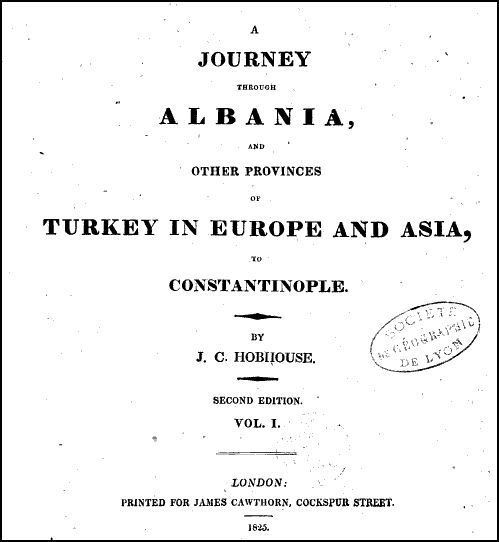
Something I think this topic could us:

Hobhouse.jpg

Hobhouse596.jpg
 
Last edited:
I can even see the teardrops on these pages.

Literally 100s of philhellenes from western Europe traveled all around Greece after 1821 to find a Greek in Greece but their disappointments are beyond words because of the people they saw in Greece comparing to their ancient Greece which was fantasized in their minds. They managed to create a Greek nation tough, so it was such a accomplishment at start but we see the result of it today, a nation which gone bankrupt 5-6 times in it`s relatively short history and constantly on life support from western Europe.
 
Last edited:
THey try to live of the myths & legends.If they can't acknowledge of who they are.Then how can they acknowledge us macedonians.These finds are like gems of music when they mention that macedonians & greeks were not the same.
 
Last edited:
Travels in Greece and Russia
By Bayard Taylor - G.P. Putnam, 1871


http://books.google.ca/books?id=UdFDAAAAYAAJ&printsec=frontcover&dq=Bayard+Taylor+Greece&hl=en&sa=X&ei=3d76T8m_EqrL6wHJ5LjPBg&ved=0CDQQ6AEwAA#v=onepage&q=Bayard%20Taylor%20Greece&f=false

PREFACE.
Owing to the pressure of other literary labors, this volume has been too rapidly prepared for the press, to allow me to add a special chapter on the Ethnology of Greece, as I had originally designed. I can only record my complete conviction of the truth of the views entertained by Fallmerayer, that the modern Greeks are a mongrel race, in which the Slavic element is predominant, and that the pure Hellenic blood is to found only in a few localities.

Page 262:
I have already said, and I repeat it, that not one-fifth of the present population can with justice be called Greeks. The remainder are Slavonians, Albanians, Turks, with a slight infusion of Venetian blood. Only in Maina, on the slopes of Parnassus, and in parts of Doris, did I find the ancient type in any considerable amount. In the war, the Albanian blood - the Suliotes, Hydriotes, and Spetziotes - achieved the greatest distinction.


Travelers and scholars in the 19th century clearly "confused" Vlachs for Greeks, Albanians for certain Vlach tribes, etc. For example, Bayard Taylor states that he found the "ancient type" only in Maina, on the slopes of Parnassus, and in Doris: regions held by Vlachs as per other Western travelers and other documents (some considered Maina/Mainiotes to be of Slavonian and Albanian origin). It's also interesting that Bayard Taylor didn't "find" Vlachs at all, only Greeks, Slavonians, Albanians, Turks, Venetians - which only proves that Greeks are Vlachs (or at best Greek-speaking Vlachs, Albanians, Slavs). I am reminded of the 19th century French traveler Cousinery; Taylor never "found" Vlachs, but Cousinery makes mention of Vlach-speakers in Argos, Peloponnesus. The London Quarterly Review, back in 1895, also found "Wallachians to be numerous in the Peloponnesus".

Whatever the confusion and case may be, the myth of Hellenic ethnic or national continuity can be swept away in a great tidal wave.
 
A noteworthy remark about "Arvanites, Vlachs and Slavs" by the President of National Council of Education in Greece.

http://maillists.uci.edu/mailman/public/mgsa-l/2008-August/009689.html
http://news.kathimerini.gr/4dcgi/_w_articles_politics_2_10/08/2008_280821


Professor Thanos Veremis, President of Greece's National Council of Education and founding member of the influential think-tank Hellenic Foundation for Defence and Foreign Policy (better known by its Greek acronym, ELIAMEP) made the following statement:

"Unfortunately, we (Greeks) are deeply conservative as a society. This (ethnic) homogeneity has been harmful (to us). The situation during the 19th century was different. It was rather fortunate that at that time Koraes and others had the inspiration to connect us with Ancient Hellas (an undertaking) which became the main (pre)occupation of the newly born State. In those days, there were Arvanites, Vlachs and Slavs. All of them had to become (part of) one (national body). And so they became. But this is not to say that in this day and age (we/they) should be under the illusion that (we/they) are descendants of Pericles. This (assimilating process of ethnic/national homogenization) might have been helpful before -even though we could not avoid a civil war- but it does not help us nowadays. Today we are not alone. We are surrounded by many neighbors. The (Greek) society must adapt (?to new realities) instead of remaining insular and introvert."
 
Albanians in Thessaly, Euboea, Andros and various other islands.


The earliest evidence for descent Albanians in Thessaly is a letter from Marino Sanudo, written in 1325 and referred to the Albanians, Vlachs who displaced them from Thessaly. Another testimony documents tyrant of Fener (Thessaly) dated 1342. From what writes Katakouzinos coming out, that the first Albanians settled in the mountains of Thessaly, came around in 1315. (See Jn. Chr. Poole: "The Albanians epoikisis at Corinth," page 14).


Within 30 years the Albanians, who came and settled in Thessaly,
not only multiply much, but with hard work, they became sought after. Hermit was unpretending and wages. So it offered almost free work bosses - landowners.

In Thessaly, in these years, the Vlachs were the majority of the population. However, when the Albanians increase, began to displace the plain of Thessaly Vlachs. Yet we must have into account, that the Venetians, who held then Pteleos (Ftelio) in the southeastern part of Thessaly, were pleased by the Albanian migration, because the Albanians served as a prison of eastern Thessaly by the Catalan raids, which was established in Salona (Amfissa). [" Except not these pretenders of varying heritage of Angels (continent) enafanisthisan then the first in the plain of Thessaly and large crowds of Albanian immigrants apotelesanton neon and thriving element of this population. Albanians edioun whole activity of the outdoor place and because meth brought themselves wives, the number was increased rapidly and began antikathistanontes Vlachs, oitines until that time have received the maximum number of egkatoikon of Thessaly, itis of them had called Megalovlachia. And the Venetians (Pteleos him), Efron, that provide migration of Albanian This was the great gain, that by this apischolounto the Catalans so to ifkairoun to attack against the neighbors. "Miller - brilliant" The Franks in Greece » , v. A, 354.]

Both of the Vlachs, as well as by the Arvanites are distinguished Karagounides of Thessaly, whose language contains Latin, Romanian and Arvanitic elements. From old was pronounced Albanian element in Dacia (Romania at present about) who homing and then promoted to Thessaly. This race, which is miscegenation Albanians and Romanians are probably the Karagounides. The Alvanoroumanoi is also known as Arvanitovlachs.


The Venetians brought many Albanians in Euboea, where some points were devastated by plague. Ceded to them to cultivate fallow provided to keep horses and ranked them by the young in the army and defend your country from Evia listopeirates and other enemies. 1363 (June 8), the Venetian Senate finds that " the Negroponte (the city) and the entire island (Evia) have colonized and income taxes are too high "; (see Thiriet, Regestes, I, pp. . 105, No. 408). From Evia Albanians immigrated to Andros and other islands.

http://www.freeinquiry.gr/pro.php?id=1631&PHPSESSID=5d193ffd12efd8d694a6ac948f26654b
 
Last edited:
Back
Top