• Welcome to the new Macedonian Truth Forum. All posts, members and private messages have been moved over from the old forum.

    Passwords from the old forum could not be carried over, so please use Forgot your password? to set a new one. The reset link is emailed to the address on your account.

  • Rules and Regulations at the forum of the Macedonian Truth Organisation (MTO)

    (1) The national-ethnic and cultural-linguistic identity of the Macedonian people is historically Macedonian, and derives its character from the native, indigenous and geographic homeland of the Macedonians, which is called Macedonia. To ensure that their human rights, integrity and heritage are appropriately respected, the only nouns and adjectives acceptable when reference is made to the above character and identity markers is Macedon, Macedonia, Macedonian and Macedonians.

    (2) The nation-state of the Macedonian people is the Republic of Macedonia, and is to be referred to by this official title so long as the 'republic' prefix is consistently applied to other states. Alternative references are the Macedonian Republic, or simply, Macedonia.

    (3) The 'ethnic' prefix is only acceptable for Macedonians in cases where differentiation is specifically required - so long as it is in context and consistent where it concerns its application to other ethnic groups.

    (4) Should any other differentiation be specifically required, the names of other ethnic groups that reside with Macedonians in either the Republic of Macedonia or the occupied Macedonian regions in Greece, Bulgaria, Serbia or Albania, are to be given a prefix.

    (5) Negating the identity, language and culture of the Macedonian people by deliberate avoidance of the terms Macedonia, Macedonian and Macedonians, or by any other means, is not permitted.

    (6) Systematic anti-Macedonian propaganda and rhetoric are not permitted.

    (7) Threads irrelevant to the Macedonian Cause, the community at the Macedonian Truth Organisation or the Macedonians in general may be considered as spam or not in the spirit of the forum. In such cases they are not permitted.

    (8) Continual posting of messages in threads with the sole purpose of deviating from the initial topics with the use of unrelated and unnecessary information is not permitted.

    (9) All posts, external articles, reports, etc that are cited in languages other than Macedonian or English, must be accompanied with a translation in one or both of the said languages.

    (10) Despite the possibility of some conversations and debates becoming heated, extreme abuse and/or racism, vulgar language and/or terminology, threats, revelation of personal information about others, harassment, and other such behavior will not be permitted. If deemed necessary all relevant information including member details will be reported to the appropriate authorities for investigation which may result in legal action.

    (11) Threads that are created must have a summary of a topic or excerpt of an article found in pertinent link(s) that have been included. One line threads will be considered unaccetable spam and are therefore not permitted.

    (12) Compulsive and deliberate lies, irrespective of the topic, are not permitted.

    (13) Any symbols or avatars found to be perceived as offensive to Macedonians are not permitted.

    (13) Any explicit or extreme material is not permitted.

    Failure to adhere to the above rules and regulations will result in a ban after 3 breaches. This may be reconsidered in some cases should the circumstances be of an unorthodox nature and/or require special consideration. To assure an effective deterrent against an individual or individuals with the sole purpose of causing dissent through spamming, racism or other improper means, the above rules will be strictly enforced.

    The MTO administration will monitor all discussions as reasonably practical and reserve the right to remove any post and/or member from the forum, and update the rules and regulations as required. Members are encouraged to immediately report any post and/or member to the MTO administration if they feel that these rules have not been abided by.

    The views expressed on this forum are those of the individuals. The only official representation of the MTO is made by the "Macedonian Truth Organisation (Site Owner)" username, and no other.

  • Macedonian Cause

    The Macedonian Truth Organisation calls on God in Heaven to protect, bless and guide the endeavour it is committing to undertake, and that is to work towards:

    Securing Macedonia as a free, independent and democratic republic in which sovereignty lies with the Macedonian citizens; as the nation-state of the Macedonian people in which they can preserve their culture, language and identity; as a state in which the Macedonian language and culture form the basis of public life and act as important unifying elements of Macedonian society; as the home of all its citizens to which it guarantees and obliges their inalienable natural rights and corresponding responsibilities;

    The acknowledgment as self-evident and irrefutable the existence of the:

    1) Indigenous, ethnonational name of Macedonia;
    2) Macedonian people, language and identity;
    3) Macedonian culture, symbols and folklore;
    4) Macedonian ancestry, heritage and history in its entirety; and
    5) Macedonian Orthodox Church;

    Securing recognition by the International Community of the tragedies endured by the Macedonian people, of the division of Macedonia with the signing of the Treaty of Bucharest on August 10, 1913, and the genocide committed against the Macedonian people at the hands of the Greek, Bulgarian and Serbian states and their respective churches during the 19th and 20th centuries;

    Ensuring that the Interim Accord is declared ‘null and void’ and that all constitutional provisions, acts, commitments, agreements, legislation, regulations, policies or programs emanating from, supporting or consequential to the Interim Accord are also declared ‘null and void’, including the use of any symbols and the completion of any acts imposed by, or originating from, the Interim Accord.

    Ensuring that the Framework Agreement is abolished and that all constitutional provisions, acts, commitments, agreements, legislation, regulations, policies and programs emanating from, supporting or consequential to the Framework Agreement are also abolished and replaced by a framework of constitutional and statutory law based on inalienable natural rights and corresponding responsibilities and universally codified human rights mechanisms.

    Securing the abolishment of any existing constitutional provisions, acts, agreements, legislation, regulations, policies and programs that discriminate against the Macedonian people, in any international organisation or any of the countries of the International Community where such constitutional provisions, acts, agreements, legislation, regulations, policies and programs exist, and thereby ensuring the freedom for Macedonians to exercise their inalienable natural rights and fulfil their corresponding responsibilities, and practice their culture, language and religious faiths in all the countries of the International Community without hindrance;

    The empowerment of Macedonians to undertake a moral revolution and to instil and/or reinvigorate within themselves a deep-rooted national, cultural, linguistic and historical dignity and a commitment to the exercise of freedom based on inalienable natural rights and corresponding responsibilities;

    The recognition of the Macedonian minorities in the neighbouring states of Macedonia as well as the respect for the inalienable rights and freedoms of the Macedonian minorities, as provided for by natural law and as codified by the United Nations Charter, the Universal Declaration of Human Rights and other universally codified human rights mechanisms;

    The full and unreserved respect of, and the support for, the rights of all people of non-Macedonian descent living in Macedonia and around the world, who share a reciprocal full and unreserved respect for the Macedonian people, their homeland and their state;

    The cultural unification and solidarity of the Macedonian people living in all parts of historical Macedonia and adjacent territories, as well as Macedonians throughout the world;

    The unity of all Macedonians on the principles, objectives and achievement of the Macedonian cause as defined by this declaration.

Indigen's theory of indigenous culture

http://www.historyofmacedonia.org/AncientMacedonia/arrian.html

Arrian

[4] [Book II - Battle of Issus] "Darius' Greeks fought to thrust the Macedonians back into the water and save the day for their left wing, already in retreat, while the Macedonians, in their turn, with Alexander's triumph plain before their eyes, were determined to equal his success and not forfeit the proud title of invincible, hitherto universally bestowed upon them. The fight was further embittered by the old racial rivalry of Greek and Macedonian." [p.119]

http://www.classicpersuasion.org/pw/isocrates/pwisoc4.htm

Isocrates (also seen on Makedonin's signature)

So far has Athens left the rest of mankind behind in thought and expression that her pupils have become the teachers of the world, and she has made the name of Hellas distinctive no longer of race but of intellect, and the title of Hellene a badge of education rather than of common descent.

As for culture ancient Macedonians had their own culture but also shared some cultural aspects with their neighbors. I read somewhere how ancient Macedonians, Thracians, and Illyrians would tattoo themselves and how ancient Hellenes would view this as barbaric. And it's obvious that ancient Macedonians like Polyaenus wrote their works using greek. But he also distinguished Macedonians from Hellenes.

I don't mean to be a pain, but that doesn't really answer my very specific questions. I was hoping that you would apply the same sort of intellectual rigour in testing assumptions about the existence of an ancient "Hellenic RACE", as you do in relation to what you call "Indigen's theory of indigenous culture".
 
Last edited:
Sorry SOM, I should have edited my original post instead of being satisfied with explaining the same to Osiris, who ask exactly same question. :-)
As a rule, I find being accurate and clinical in statements a virtue for reasons I have already explained, be mindful of the advice and you will receive less critics.
 
True Macedonian,

Since I don't have much time for ancient history research these days, could I ask you what the evidence is that there was ever such an ancient RACE as "hellenes"?

How do you define the term 'race' as applied to the relevant period and context?

Who belonged to this ancient 'race' of 'hellenes'?

Was the term 'hellenes' or any variation of it used to describe this 'race' in its own time, or is the term 'hellenes' merely one used by more contemporary translators, who (perhaps with thin foundations) equate 'race' with culture, like some historian in 1,000 years time might decide to speak of the European or Western 'race' of today?

I'll try and answer your question again.
How do you define the term 'race' as applied to the relevant period and context? Who belonged to this ancient 'race' of 'hellenes'?
The ancient Hellenic race may be defined as a people who shared the same cultural aspects, religion, and to some extent (not necessarily the biggest or accurate) language, as well as common descent of being born within the city-state periphery. The ancient Olympic games were designated only for people of Hellenic descent. Those born in the periphery of the city-states that shared these cultural, religious, and not so important linguistic aspects were considered Hellenes and considered each other as such. When Alexander I of Macedon wanted in the games he was rejected on account that he was not a Hellene.
Was there a race of ancient Hellenes? Yes there was. Ancient sources can vouch for that.

Was the term 'hellenes' or any variation of it used to describe this 'race' in its own time, or is the term 'hellenes' merely one used by more contemporary translators, who (perhaps with thin foundations) equate 'race' with culture, like some historian in 1,000 years time might decide to speak of the European or Western 'race' of today?

I don't have original works of antiquity in front of me but assuming that many historians today like Borza, Green, Grant and etc have translated Isocrates correctly for writing the following(just an example);

So far has Athens left the rest of mankind behind in thought and expression that her pupils have become the teachers of the world, and she has made the name of Hellas distinctive no longer of race but of intellect, and the title of Hellene a badge of education rather than of common descent.

then we know that the term Hellene started to become a term which was more of a cultural aspect rather than an aspect of common descent i.e. "Hellene by Blood" type of deal. There may be some cases that the term 'Hellene' used to describe non-hellenic peoples was employed due to religious or cultural similarities. Here's a topic that was started recently on Maknews about 1 Maccabees http://www.maknews.com/forum/macedonian-history/1-maccabees-t19086.html where it seems like the Jews associated pagan traditions with the ancient hellenes when describing ancient Macedonians.

If I haven't been more specific please tell me and point out where.
 
I'll try and answer your question again.

The ancient Hellenic race may be defined as a people who shared the same cultural aspects, religion, and to some extent (not necessarily the biggest or accurate) language, as well as common descent of being born within the city-state periphery....

What is the authoritative source of this definition of 'race', TM?

Is it an ancient definition or a modern one?

Did everybody agree on its meaning in ancient times?

What does the term 'race' mean today?

Was 'race' the word used in the ancient texts or is it a more modern word used to translate an ancient concept?

The ancient Olympic games were designated only for people of Hellenic descent...

Do the source texts about this story use the term "Hellenic" or "Greek" or some other word? If they use the term "Hellenic", would you say that there was universal agreement as to what it meant to be "Hellenic" in those days?

Those born in the periphery of the city-states that shared these cultural, religious, and not so important linguistic aspects were considered Hellenes and considered each other as such. When Alexander I of Macedon wanted in the games he was rejected on account that he was not a Hellene.

So why did they not consider him a Hellene for the purpose of participating in the games? Because he wasn't born on the periphery of the city states and/or didn't share the cultural and religious aspects and/or because he didn't share the linguistic aspects as well?

And did Alexander I consider himself a Hellene?

Was there a race of ancient Hellenes? Yes there was. Ancient sources can vouch for that.


I don't have original works of antiquity in front of me but assuming that many historians today like Borza, Green, Grant and etc have translated Isocrates correctly for writing the following(just an example);

So far has Athens left the rest of mankind behind in thought and expression that her pupils have become the teachers of the world, and she has made the name of Hellas distinctive no longer of race but of intellect, and the title of Hellene a badge of education rather than of common descent.

The correctness of translations is hardly every absolute, especially when one is translating material that is supposed to be over 2,000 years old. It often depends on certain popular assumptions, which translators might not bother to question too much, depending on their objective. But to the extent that the translation is correct, it would suggest that by the time of Isocrates, Hellenism, even in the eyes of some Athenians, was no longer a 'race', but a cultural status. So what period were you referring to previously when you spoke of the "Hellenic race"?

Btw, have Borza, Green and Grant translated the original "Greek" texts themselves, or did they perhaps rely on other people's translations, at least partially?
 
What is the authoritative source of this definition of 'race', TM?

Is it an ancient definition or a modern one?

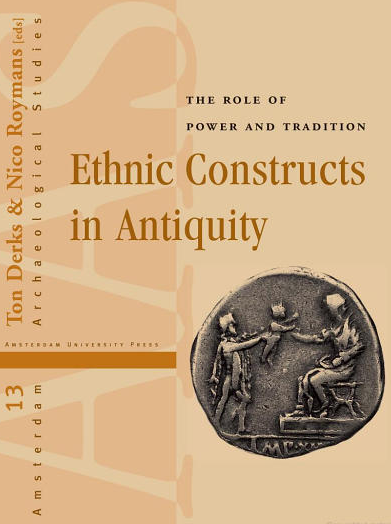
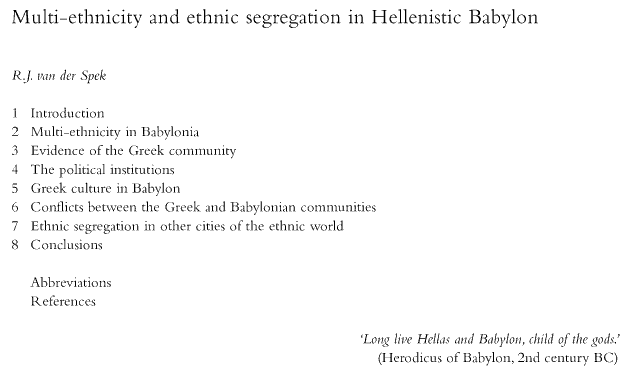
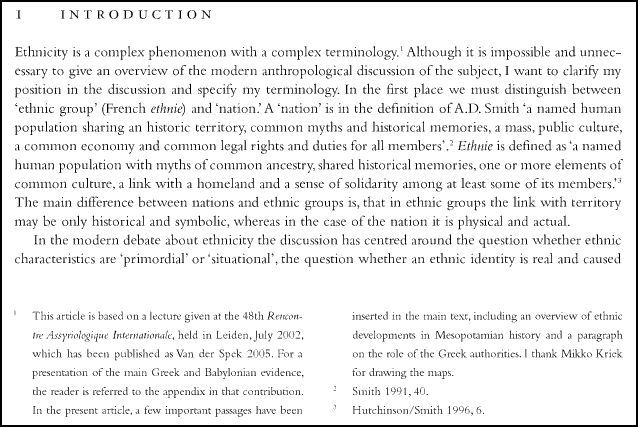
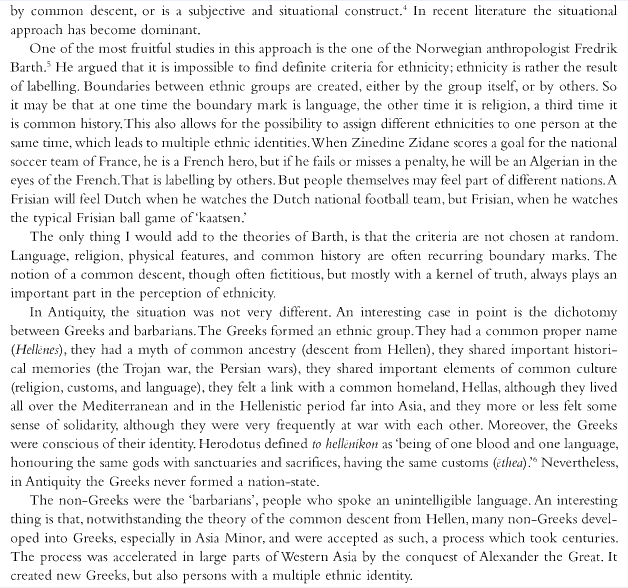
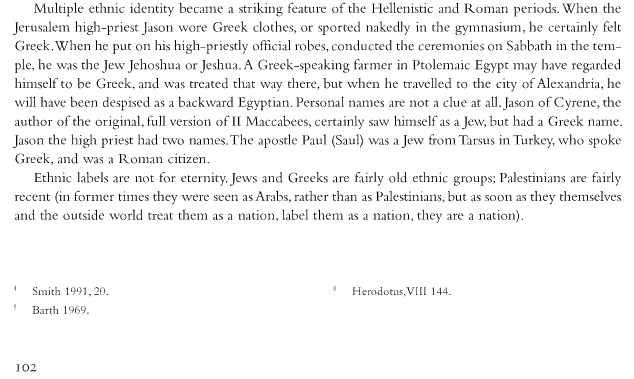
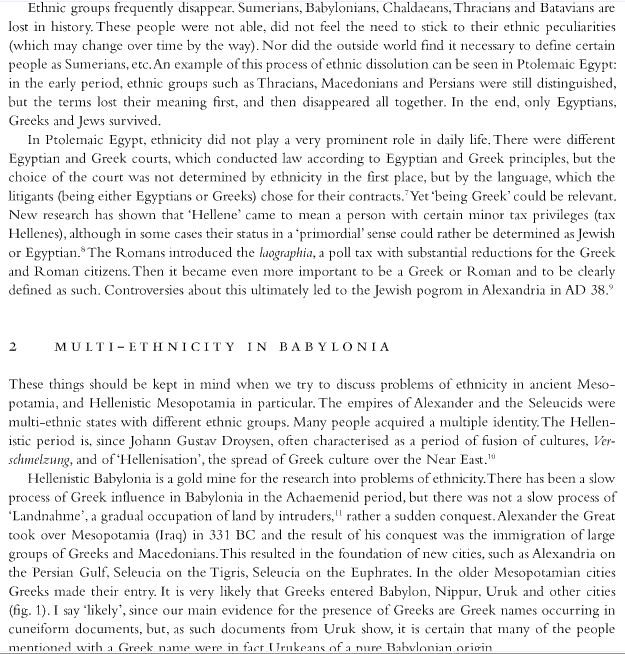
Aleksandrov you have peeked my curiosity to delve further into this topic. So I did a little bit of research and found something that interests me and at the same time may even answer you at the same time. As for an authoritative source for the definition of race I don't believe that there even is one. However the source below will explain what some ancient Hellenes felt;

VanDerSpek.png

VanDerSpek101.png

VanDerSpek101a.jpg

VanDerSpek102.png

VanDerSpek102a.png

VanDerSpek103.png


Did everybody agree on its meaning in ancient times?
Impossible to answer.

What does the term 'race' mean today?
I don't think anyone can answer this and be 100% accurate. Too many factors (political, cultural, religious) affect this meaning today. An example is the newly made "Greek Race" from the 19th century. They were ultimately the brainchild of Western Philhellenes. Politically invented and then they themselves branched out with religion being a main factor and some suggested that language or simply "living on greek soil" was enough to make someone a grk.

Was 'race' the word used in the ancient texts or is it a more modern word used to translate an ancient concept?

According to todays 'expert' and their translations (however accurate) the literal translation to modern languages would be "race".

Do the source texts about this story use the term "Hellenic" or "Greek" or some other word? If they use the term "Hellenic", would you say that there was universal agreement as to what it meant to be "Hellenic" in those days?

No Hellenic was more than likely not used. I wouldn't know what ancient Hellene word was used.

So why did they not consider him a Hellene for the purpose of participating in the games? Because he wasn't born on the periphery of the city states and/or didn't share the cultural and religious aspects and/or because he didn't share the linguistic aspects as well?

Because Macedonians were viewed as Barbarians by the Hellenes. All the things that would qualify for a "hellene" were not seen in an ancient Macedonian.

And did Alexander I consider himself a Hellene?
Yes, but the explanation as to why is way to complicated to get into now. I recommend you read Borza, Grant, or Green for the reasons why Alexander I tried proving he was a Hellene and claiming a certain ancestry.

The correctness of translations is hardly every absolute, especially when one is translating material that is supposed to be over 2,000 years old. It often depends on certain popular assumptions, which translators might not bother to question too much, depending on their objective. But to the extent that the translation is correct, it would suggest that by the time of Isocrates, Hellenism, even in the eyes of some Athenians, was no longer a 'race', but a cultural status. So what period were you referring to previously when you spoke of the "Hellenic race"?

Hellenism is a 19th century terminology that was defined and invented by a German named Droysen. Hellenistic - http://www.macedoniantruth.org/forum/showthread.php?t=1088

is also a newly invented term. The period of the "hellenic race" that I refer to is pre-Isocrates, i.e. what some might call "Periclean".

As for translations I think that the entire academic world would shit themselves silly if these translations have only been observed by a handful of people. I don't doubt that someone like Borza with his credentials has seen the original antique sources. However we have to be careful of when and how the term Hellene was being used after Isocrates infamous paraphrase (if that's even reliable in itself).
 
Is it an ancient definition or a modern one?

Did everybody agree on its meaning in ancient times?

What does the term 'race' mean today?

Was 'race' the word used in the ancient texts or is it a more modern word used to translate an ancient concept?

about "race"

Several times when is spoken about Macedonians, like example

Diodorus Siculus

The commandant of the garrison of that city, Archelaus, who was a Macedonian by race, welcomed Attalus and surrendered the city to him

In the "ancient greek" text is used "Makedon to Genos" , Macedonian by Genetics, Birth / Rod , naRod, tribe, what is clear proove that the Ancient Macedonians and the population south of Olimp were MAYBE in some blood relations*, but enough diferent to be on so many places mentioned as diferent Races, Nations, Cultures.

Than, further, about the concept of Nation and Race, and their possible definitions / meanings thrue the ages.

You can see on many places, that people are using phrases as

- Macedonis (meaning Macedonian)
- Makedonec po Rod
- Makedonski (unnumbered examplex)
- Makedonskaja (not from Macedonia, but the Macedonian, Makedon(s)kata, Sveti Velikomachenica Irina Makedonska(ja)
- "born as Macedonian"
- Makedonjanin
- od roda Makedonskago
- rodom Makedonec
- many other examples where it is clear that the people not only originated from Macedonia and had roots or strong connections with the Term and the Land - Culture of Macedonia, but felt - described themself as Macedonians / Makedonci / Makedonski

Whatever the curent definition was, it is clear that the people identified themself with Macedonia and its past and Culture.

To me it is not known a single example where some Macedonian identified himself with the Bulgarian KhAGGAns, but unnumbered examples where they identified themself with many of the Macedonian Kings and heroes. (from the Kings, Faraos and Emperors to the Macedonian Saints , Schollars, etc...)

for end, take note on this quote:

Diodorus Siculus

- For many days the king lay helpless under his treatment, and the Greeks who had been settled in Bactria and Sogdiana, who had long borne unhappily their sojourn among peoples of another race and now received word that the king has died of his wounds, revolted against the Macedonians. They formed a band of 3000 men and underwent great hardship on their homeward route. Later they were massacred by the Macedonians after Alexander’s death. [17.99.5-6.]

edit:

i am very sure i already wrote about this on this forum, or bratot did.

http://de.wikipedia.org/wiki/Friedrich_Neubauer

Friedrich Neubauer, Bernhard Seyfert, Lehrbuch der Geschichte 1. Teil (1922) (used on universities and other schools)
„Charakter der griechischen Kolonisation. Indessen hatte seit dem achten Jahrhundert eine neue Periode in der griechischen Entwicklung eingesezt. Griechenland, bisher ein Bauernland, in dem die Interessen des Ackerbaus und der Viehzucht alle anderen überwogen, wurde ein Land der SEEFAHRT und des HANDELS.

not so good english translation

Character of Greek colonization. However, since the eighth century a new period in Greek development had begun / established. Greece, formerly a peasant country in which outweighed the interests of agriculture and cadle , turned into "country of See-Travel and the See-trade"

better Macedonian translation

„Карактер на Грчката Колонизација. Од осмиот век се воспостави една нова ера во Грчкото развивање. Грција, до тогаш една рурална земја, каде преовладуваше обработување на почвата и одгледување на домашни животни, стана една земја на морепловството и трговијата“

http://img149.imageshack.us/img149/2458/neubauer02.th.jpg
http://img6.imageshack.us/img6/353/neubauer03.th.jpg
http://img100.imageshack.us/img100/8687/neubauer01.th.jpg


this book and the big number of other sources where is cleared the "greek colonisation", or with other words the "creation" of the Ancient Greeks, can not be ignored just like that.

they are too many, even most of the Ancient Greek sources speak the same story:

- diferent race (logic if the Ancient Greeks were a mixure of afro-asiatic settlers / colonist / traders with some part of the Natives)
- enough diferent language, to be mentioned in several sources
- many other details who help to answer few questions
 
Last edited:
Back
Top