• Welcome to the new Macedonian Truth Forum. All posts, members and private messages have been moved over from the old forum.

    Passwords from the old forum could not be carried over, so please use Forgot your password? to set a new one. The reset link is emailed to the address on your account.

  • Rules and Regulations at the forum of the Macedonian Truth Organisation (MTO)

    (1) The national-ethnic and cultural-linguistic identity of the Macedonian people is historically Macedonian, and derives its character from the native, indigenous and geographic homeland of the Macedonians, which is called Macedonia. To ensure that their human rights, integrity and heritage are appropriately respected, the only nouns and adjectives acceptable when reference is made to the above character and identity markers is Macedon, Macedonia, Macedonian and Macedonians.

    (2) The nation-state of the Macedonian people is the Republic of Macedonia, and is to be referred to by this official title so long as the 'republic' prefix is consistently applied to other states. Alternative references are the Macedonian Republic, or simply, Macedonia.

    (3) The 'ethnic' prefix is only acceptable for Macedonians in cases where differentiation is specifically required - so long as it is in context and consistent where it concerns its application to other ethnic groups.

    (4) Should any other differentiation be specifically required, the names of other ethnic groups that reside with Macedonians in either the Republic of Macedonia or the occupied Macedonian regions in Greece, Bulgaria, Serbia or Albania, are to be given a prefix.

    (5) Negating the identity, language and culture of the Macedonian people by deliberate avoidance of the terms Macedonia, Macedonian and Macedonians, or by any other means, is not permitted.

    (6) Systematic anti-Macedonian propaganda and rhetoric are not permitted.

    (7) Threads irrelevant to the Macedonian Cause, the community at the Macedonian Truth Organisation or the Macedonians in general may be considered as spam or not in the spirit of the forum. In such cases they are not permitted.

    (8) Continual posting of messages in threads with the sole purpose of deviating from the initial topics with the use of unrelated and unnecessary information is not permitted.

    (9) All posts, external articles, reports, etc that are cited in languages other than Macedonian or English, must be accompanied with a translation in one or both of the said languages.

    (10) Despite the possibility of some conversations and debates becoming heated, extreme abuse and/or racism, vulgar language and/or terminology, threats, revelation of personal information about others, harassment, and other such behavior will not be permitted. If deemed necessary all relevant information including member details will be reported to the appropriate authorities for investigation which may result in legal action.

    (11) Threads that are created must have a summary of a topic or excerpt of an article found in pertinent link(s) that have been included. One line threads will be considered unaccetable spam and are therefore not permitted.

    (12) Compulsive and deliberate lies, irrespective of the topic, are not permitted.

    (13) Any symbols or avatars found to be perceived as offensive to Macedonians are not permitted.

    (13) Any explicit or extreme material is not permitted.

    Failure to adhere to the above rules and regulations will result in a ban after 3 breaches. This may be reconsidered in some cases should the circumstances be of an unorthodox nature and/or require special consideration. To assure an effective deterrent against an individual or individuals with the sole purpose of causing dissent through spamming, racism or other improper means, the above rules will be strictly enforced.

    The MTO administration will monitor all discussions as reasonably practical and reserve the right to remove any post and/or member from the forum, and update the rules and regulations as required. Members are encouraged to immediately report any post and/or member to the MTO administration if they feel that these rules have not been abided by.

    The views expressed on this forum are those of the individuals. The only official representation of the MTO is made by the "Macedonian Truth Organisation (Site Owner)" username, and no other.

  • Macedonian Cause

    The Macedonian Truth Organisation calls on God in Heaven to protect, bless and guide the endeavour it is committing to undertake, and that is to work towards:

    Securing Macedonia as a free, independent and democratic republic in which sovereignty lies with the Macedonian citizens; as the nation-state of the Macedonian people in which they can preserve their culture, language and identity; as a state in which the Macedonian language and culture form the basis of public life and act as important unifying elements of Macedonian society; as the home of all its citizens to which it guarantees and obliges their inalienable natural rights and corresponding responsibilities;

    The acknowledgment as self-evident and irrefutable the existence of the:

    1) Indigenous, ethnonational name of Macedonia;
    2) Macedonian people, language and identity;
    3) Macedonian culture, symbols and folklore;
    4) Macedonian ancestry, heritage and history in its entirety; and
    5) Macedonian Orthodox Church;

    Securing recognition by the International Community of the tragedies endured by the Macedonian people, of the division of Macedonia with the signing of the Treaty of Bucharest on August 10, 1913, and the genocide committed against the Macedonian people at the hands of the Greek, Bulgarian and Serbian states and their respective churches during the 19th and 20th centuries;

    Ensuring that the Interim Accord is declared ‘null and void’ and that all constitutional provisions, acts, commitments, agreements, legislation, regulations, policies or programs emanating from, supporting or consequential to the Interim Accord are also declared ‘null and void’, including the use of any symbols and the completion of any acts imposed by, or originating from, the Interim Accord.

    Ensuring that the Framework Agreement is abolished and that all constitutional provisions, acts, commitments, agreements, legislation, regulations, policies and programs emanating from, supporting or consequential to the Framework Agreement are also abolished and replaced by a framework of constitutional and statutory law based on inalienable natural rights and corresponding responsibilities and universally codified human rights mechanisms.

    Securing the abolishment of any existing constitutional provisions, acts, agreements, legislation, regulations, policies and programs that discriminate against the Macedonian people, in any international organisation or any of the countries of the International Community where such constitutional provisions, acts, agreements, legislation, regulations, policies and programs exist, and thereby ensuring the freedom for Macedonians to exercise their inalienable natural rights and fulfil their corresponding responsibilities, and practice their culture, language and religious faiths in all the countries of the International Community without hindrance;

    The empowerment of Macedonians to undertake a moral revolution and to instil and/or reinvigorate within themselves a deep-rooted national, cultural, linguistic and historical dignity and a commitment to the exercise of freedom based on inalienable natural rights and corresponding responsibilities;

    The recognition of the Macedonian minorities in the neighbouring states of Macedonia as well as the respect for the inalienable rights and freedoms of the Macedonian minorities, as provided for by natural law and as codified by the United Nations Charter, the Universal Declaration of Human Rights and other universally codified human rights mechanisms;

    The full and unreserved respect of, and the support for, the rights of all people of non-Macedonian descent living in Macedonia and around the world, who share a reciprocal full and unreserved respect for the Macedonian people, their homeland and their state;

    The cultural unification and solidarity of the Macedonian people living in all parts of historical Macedonia and adjacent territories, as well as Macedonians throughout the world;

    The unity of all Macedonians on the principles, objectives and achievement of the Macedonian cause as defined by this declaration.

The Khalsa - Welcome to the Macedonian Truth!

Soldier of Macedon

Senior Member
Ladies and gentlemen, allow me to introduce our newest member at the MTO, who goes by the username, THE KHALSA. This individual and I have been close friends for a number of years, and I guess the discussions we have had about Macedonia, India, Sanskrit languages, Indo-Aryans, etc were enough for him to consider joining our forum and getting to know some more about the Macedonians, and helping us understand some more about the history and culture of India. We have had many interesting conversations, and have often been amazed at some of the words that we share as Macedonians and Indians, one of those words being 'Ogan' (Ognovi, Ognoi - plural) in Macedonian, and 'Agni' in Punjabi, Hindi, etc.

The MTO is becoming international, and how wonderful it is to see all of these different nations, from Macedonian, to Greek, Turk, Slovene, Indian, etc all coming together and engaging in discussions under the Macedonian umbrella, an MTO umbrella no less!

I will allow him to fill you in about what his username means, and about his own history as a proud Sikh from the Punjab region of India. The Sikhs of Punjab are in my view, the lions of India, and the Punjabi language and culture are known throughout India and the world. Plus, these guys are quite often much (much!) bigger in frame and stature than the other Indians, lol.

Brother, welcome mate, good to have you here.
 
The Khalsa
Indeed a very warm welcome to the MTO, I look forward to your posts and sharing of information!:welcome
 
Thanks for that introduction SoM!

Welcome The Khalsa.

I look forward to reading about the similarities our two cultures appear to share.
 
Welcome Khalsa

A Sikh friend/colleague of mine many years ago introduced me to a Sikh temple here in Perth, I met with many of his friends and family, I must say it was a real pleasure to meet them, and found the whole experience fascinating

From then on, I have always had a special interest in the Sikh

Once again welcome

BC
 
The Sikhs of Punjab are in my view, the lions of India, .

Yes indeed, going by their rich history the Sikh of Punjab are great warriors.

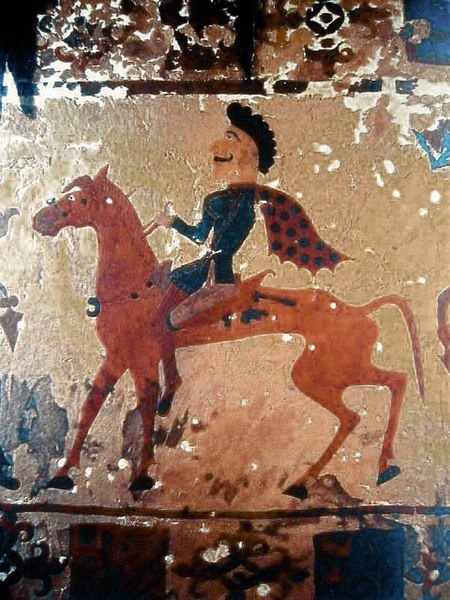
Pazyrik horseman in 300BC
450px-PazyrikHorseman.JPG


And Raja Lal Singh, taking on the British forces in 1846 AD.
741px-Raja_Lal_Singh%2C_of_First_Anglo-Sikh_War%2C_1846.jpg


Welcome aboard Mr KHALSA. Looking forward in reading you’re post.
 
http://en.wikipedia.org/wiki/Battle_of_Saragarhi

The Battle of Saragarhi, one of history's most famous last stands, was fought during the Tirah Campaign on 12 September 1897 between twenty-one Sikhs of the 4th Battalion (then 36th Sikhs) of the Sikh Regiment of British India, defending an army post, and 10,000 Afghan and Orakzai tribesmen. The battle occurred in the North-West Frontier Province, now a part of Pakistan, which then formed part of British India.

The contingent of the twenty-one Sikhs from the 36th Sikhs was led by Havildar Ishar Singh. They all chose to fight to the death. Sikh military personnel and Sikh civilians commemorate the battle every year on 12 September, as Saragarhi Day..........

British parliament

When the gallantry of Saragarhi was recounted to the Parliament of the United Kingdom, the recitation drew a standing ovation from the members. The saga of Saragarhi was also brought to the notice of Queen Victoria.

"The British, as well as the Indians, are proud of the 36th Sikh Regiments. It is no exaggeration to record that the armies which possess the valiant Sikhs cannot face defeat in war" - Parliament of the United Kingdom
"You are never disappointed when you are with the Sikhs. Those 21 soldiers all fought to the death. That bravery should be within all of us. Those soldiers were lauded in Britain and their pride went throughout the Indian Army. Inside every Sikh should be this pride and courage. The important thing is that you must not get too big-headed it is important to be humble in victory and to pay respect to the other side." - Field Marshal William Joseph Slim, 1st Viscount Slim

This is an epic battle, hopeless yet hopeful at once, this an epic battle, and engraved in legend, similar to the battle at Krushevo during the Ilinden Uprising in Macedonia.
 
Sho Praish All!

Thanks SoM and all my other Macedonian Brachkos for a warm-2 welcome. It feels great to be a part of this informational and cultural association and hopefully i can contribute to this prestigious forum by sharing some useful information, through my posts. I got into the Macedonian culture when i met SoM for the first time , as he elaborated me on the life of "Alexander the Great". As i started digging deep into the achchievements of this great warrior, i found some atnoshing facts which amazed me to a extent that i had to read a couple of books to elucidate myself; e.g. major battles against the likes of Darius, Voyage to India and many-2 more.

Macedonians in my view, are an old and proud nation like my people are, and they need no introduction, Macedonians are Macedonians!

I have now attached some useful paragraphs to elucidate everyone on the meaning and origin of the KHALSA. Hopefully, this will answer all the FAQ. If not, please give me a opportunity to provide some further information.

Thanks once again for giving me a great reception and for having me on MTO.
Regards:
The KHALSA


History:
The Khalsa (Meaning: Pure) is an organization of especially devout Sikhs created by the Tenth Guru, Gobind Singh, as a means to help unite the Sikhs and encourage devotion to Sikh ideals. The group is quasi-military in nature and its members are regarded as something akin to a Sikh army.

Gobind Singh invited Sikhs from all over India to attend a special festival at Anandpur Sahib, but not informing them of what his real intentions were. While there, he asked for volunteers to step forward and die for their faith. Eventually, a few stepped forward - they were taken into a tent and, by all appearances, beheaded by Gobind Singh. This horrified those in attendance and some even left in disgust, but after the fifth Gobind emerged with the volunteers, still alive, but dressed as soldiers

Gobind Singh announced that he had been testing the Sikhs and becuase those five were willing to die for their faith, they would constitute the leadership of the Sikh community. He called them his Panj Piare ("Five Beloved Ones") and they were the first initiates into the Khalsa.

Today when someone is initiated into the Khalsa, men are encouraged to adopt the surname Singh (Lion) and women are encouraged to adopt the surname Kaur (Princess). This change in name represents the fact that they are essentially born into a new life, abandoning their old caste, and are part of new family.

Initiation involves taking a vessel of fresh water mixed with sugar and transforming it into nectar by reciting hymns of the Gurus over it and stirring it with a double-edged sword. This becomes known as amrit nectar and the process is sometimes referred to as a baptism in analogy to the Christian rite.

Beliefs:
Members of the Khalsa follow a strict code of conduct based upon the beliefs common to Sikhs generally. In essence, they don't have separate beliefs, but are expected to follow the Sikh beliefs more strictly. They do not: smoke, drink alochol, or use mind-altering drugs. They are supposed to meditate and prayer every morning and every evening. They are also expected to take up arms and fight in the defense of oppressed people - even if they aren't Sikhs. Because of this combination of ideals of militancy and moral perfection, members of the Khalsa are sometimes referred to as Sant Sipahi, which means "Saint Soldiers".

The beliefs of the Khalsa are represented by the "Five Ks":

kesh: uncut hair;
kanga: a wooden comb;
kaccha: short baggy undergarment;
kara: a steel bracelet;
kirpan: a short sword

Maintenance of uncut hair symbolizes a person's acceptance of the natural form which God has given humanity. The wooden comb represents not just the duty to keep oneself clean and tidy (especially with long hair), but also the principle of disciplined living generally. Baggy undergarments represent the requirement of sexual chastity. The steel bracelet, used to protect the wrist in battle, also represents God's power and protection. Finally, the sword symbolizes the need for the Khalsa to always be ready to defend the oppressed (although the sword itself is not to be used in acts of violence).

The turban, which many people think of as being characteristic of Sikhs generally, is not required either for Sikhs or for the Khalsa. However, it is traditional for members of the Khalsa to wear a turban - it both covers their uncut hair and it causes them to stand out in crowds.

It should be noted that someone wearing the symbols of the Khalsa, including the bracelet and the turban, is not necessarily a members. Many Sikhs who have not gone through the Khalsa initiation ceremony also wear these as symbols of their faith.
 
Last edited:
That's very interesting Khalsa. Thank you for that explanation. You have given me an understanding and now, an appreciation of your customs and beliefs.

I look forward to hearing what you have learned about Alexander the great. It is important we to see how he is seen from a Sikh's perspective, as Alexanders empire stretched out to your lands.

We learn history in the western world from a British perspective. The Brits rely heavily on Roman sources to gain that perspective. These are biased accounts when it comes to Macedonian history.
 
Welcome Khalsa. Its good to have a neutral on board.

What a great first post. I am definetly looking forward to all your future contributions. :thumbup:
 
Welcome Khalsa ..!!!!

Could you give us yours and the Indian view of Alexander the Macedonian..?

Also I remember talking to a knowledgeable Indian (Doctor) afew years back and he mention that his son was called Alexander, but just a different way of pronouncing it...he said that many Indians are called by that name after Alexander the Great... Is this correct..?
 
^^Iskander they call him I think??


You could be right spartan.. but from memory it sounded different...
here is what i found
Skanda: The Alexander Romance in India
http://murugan.org/research/gopalapillai.htm

Quote:
In Persian and Arabic and in Eastern languages generally, it is a well-known fact that Alexander is known under the name of Iskandar. And it is natural, if Indian languages have used his name, it might be a variant of its Asiatic form. What form could it normally assume in the ancient Sanskrit language? We are familiar, through Buddhist sources with the Indianization of the name of the Graeco-Bactrian King, Menander.[9] It occurs as Melinda. On the same analogy, Iskander regularly becomes ‘Iskanda.’ It is next an easy step to treat the initial ‘I’ as a case of prosthesis[10] as it obtains regularly in Prakrits, and arrive at the Sanskrit form ‘Skanda’. But a suspicion might lurk whether it is not a case of philological legerdemain. The name of Skanda is familiar in Sanskrit, in Indian languages and literature in general. But has it anything to do with Alexander the Great? Is it not an isolated case of accidental coincidence? It behoves us to examine it further.
 
Welcome Khalsa, I enjoyed your first post.
I had lovely neighbours from Vellore in India , they were doctors who returned to CMC hospital there and I miss them very much, a very rich culture and I look forward to learning more about the Khalsa

Malayalam
 
Back
Top