• Welcome to the new Macedonian Truth Forum. All posts, members and private messages have been moved over from the old forum.

    Passwords from the old forum could not be carried over, so please use Forgot your password? to set a new one. The reset link is emailed to the address on your account.

  • Rules and Regulations at the forum of the Macedonian Truth Organisation (MTO)

    (1) The national-ethnic and cultural-linguistic identity of the Macedonian people is historically Macedonian, and derives its character from the native, indigenous and geographic homeland of the Macedonians, which is called Macedonia. To ensure that their human rights, integrity and heritage are appropriately respected, the only nouns and adjectives acceptable when reference is made to the above character and identity markers is Macedon, Macedonia, Macedonian and Macedonians.

    (2) The nation-state of the Macedonian people is the Republic of Macedonia, and is to be referred to by this official title so long as the 'republic' prefix is consistently applied to other states. Alternative references are the Macedonian Republic, or simply, Macedonia.

    (3) The 'ethnic' prefix is only acceptable for Macedonians in cases where differentiation is specifically required - so long as it is in context and consistent where it concerns its application to other ethnic groups.

    (4) Should any other differentiation be specifically required, the names of other ethnic groups that reside with Macedonians in either the Republic of Macedonia or the occupied Macedonian regions in Greece, Bulgaria, Serbia or Albania, are to be given a prefix.

    (5) Negating the identity, language and culture of the Macedonian people by deliberate avoidance of the terms Macedonia, Macedonian and Macedonians, or by any other means, is not permitted.

    (6) Systematic anti-Macedonian propaganda and rhetoric are not permitted.

    (7) Threads irrelevant to the Macedonian Cause, the community at the Macedonian Truth Organisation or the Macedonians in general may be considered as spam or not in the spirit of the forum. In such cases they are not permitted.

    (8) Continual posting of messages in threads with the sole purpose of deviating from the initial topics with the use of unrelated and unnecessary information is not permitted.

    (9) All posts, external articles, reports, etc that are cited in languages other than Macedonian or English, must be accompanied with a translation in one or both of the said languages.

    (10) Despite the possibility of some conversations and debates becoming heated, extreme abuse and/or racism, vulgar language and/or terminology, threats, revelation of personal information about others, harassment, and other such behavior will not be permitted. If deemed necessary all relevant information including member details will be reported to the appropriate authorities for investigation which may result in legal action.

    (11) Threads that are created must have a summary of a topic or excerpt of an article found in pertinent link(s) that have been included. One line threads will be considered unaccetable spam and are therefore not permitted.

    (12) Compulsive and deliberate lies, irrespective of the topic, are not permitted.

    (13) Any symbols or avatars found to be perceived as offensive to Macedonians are not permitted.

    (13) Any explicit or extreme material is not permitted.

    Failure to adhere to the above rules and regulations will result in a ban after 3 breaches. This may be reconsidered in some cases should the circumstances be of an unorthodox nature and/or require special consideration. To assure an effective deterrent against an individual or individuals with the sole purpose of causing dissent through spamming, racism or other improper means, the above rules will be strictly enforced.

    The MTO administration will monitor all discussions as reasonably practical and reserve the right to remove any post and/or member from the forum, and update the rules and regulations as required. Members are encouraged to immediately report any post and/or member to the MTO administration if they feel that these rules have not been abided by.

    The views expressed on this forum are those of the individuals. The only official representation of the MTO is made by the "Macedonian Truth Organisation (Site Owner)" username, and no other.

  • Macedonian Cause

    The Macedonian Truth Organisation calls on God in Heaven to protect, bless and guide the endeavour it is committing to undertake, and that is to work towards:

    Securing Macedonia as a free, independent and democratic republic in which sovereignty lies with the Macedonian citizens; as the nation-state of the Macedonian people in which they can preserve their culture, language and identity; as a state in which the Macedonian language and culture form the basis of public life and act as important unifying elements of Macedonian society; as the home of all its citizens to which it guarantees and obliges their inalienable natural rights and corresponding responsibilities;

    The acknowledgment as self-evident and irrefutable the existence of the:

    1) Indigenous, ethnonational name of Macedonia;
    2) Macedonian people, language and identity;
    3) Macedonian culture, symbols and folklore;
    4) Macedonian ancestry, heritage and history in its entirety; and
    5) Macedonian Orthodox Church;

    Securing recognition by the International Community of the tragedies endured by the Macedonian people, of the division of Macedonia with the signing of the Treaty of Bucharest on August 10, 1913, and the genocide committed against the Macedonian people at the hands of the Greek, Bulgarian and Serbian states and their respective churches during the 19th and 20th centuries;

    Ensuring that the Interim Accord is declared ‘null and void’ and that all constitutional provisions, acts, commitments, agreements, legislation, regulations, policies or programs emanating from, supporting or consequential to the Interim Accord are also declared ‘null and void’, including the use of any symbols and the completion of any acts imposed by, or originating from, the Interim Accord.

    Ensuring that the Framework Agreement is abolished and that all constitutional provisions, acts, commitments, agreements, legislation, regulations, policies and programs emanating from, supporting or consequential to the Framework Agreement are also abolished and replaced by a framework of constitutional and statutory law based on inalienable natural rights and corresponding responsibilities and universally codified human rights mechanisms.

    Securing the abolishment of any existing constitutional provisions, acts, agreements, legislation, regulations, policies and programs that discriminate against the Macedonian people, in any international organisation or any of the countries of the International Community where such constitutional provisions, acts, agreements, legislation, regulations, policies and programs exist, and thereby ensuring the freedom for Macedonians to exercise their inalienable natural rights and fulfil their corresponding responsibilities, and practice their culture, language and religious faiths in all the countries of the International Community without hindrance;

    The empowerment of Macedonians to undertake a moral revolution and to instil and/or reinvigorate within themselves a deep-rooted national, cultural, linguistic and historical dignity and a commitment to the exercise of freedom based on inalienable natural rights and corresponding responsibilities;

    The recognition of the Macedonian minorities in the neighbouring states of Macedonia as well as the respect for the inalienable rights and freedoms of the Macedonian minorities, as provided for by natural law and as codified by the United Nations Charter, the Universal Declaration of Human Rights and other universally codified human rights mechanisms;

    The full and unreserved respect of, and the support for, the rights of all people of non-Macedonian descent living in Macedonia and around the world, who share a reciprocal full and unreserved respect for the Macedonian people, their homeland and their state;

    The cultural unification and solidarity of the Macedonian people living in all parts of historical Macedonia and adjacent territories, as well as Macedonians throughout the world;

    The unity of all Macedonians on the principles, objectives and achievement of the Macedonian cause as defined by this declaration.

Washington Post (Salonika 1977): "sign in shop window anounces...Macedonian is spoken

indigen

New member
Washington Post (Salonika 1977): "sign in shop window anounces...Macedonian is spoken

A sign in his window announces that Macedonian, the language of
Yugoslavia's southernmost republic, is spoken. The language is now a
requirement for all of his clerks.


---------------

DATELINE: SALONIKA, Greece
Date: 24 Oct 1998
milo_ch...@my-dejanews.com
alt.news.macedonia

The Washington Post
June 14, 1977, Tuesday, Final Edition

Affluent Yugoslavs Crowd Shops Across Border in Greece
By Mary Anne Weaver, Special to The Washington Post

DATELINE: SALONIKA, Greece

Times have changed at the border between Greece and Yugoslavia.
Twenty-five years ago it was a formidable barrier, closed to prevent
Greece's defeated Communist armies from fleeing north.

Today it is open and thriving. Now, the Yugoslavs are heading south.
Every weekend they spill across the border, well-dressed, driving
private cars. One of the most talked about phenomena in this northern
Greek city, known to Greeks as Thessaloniki, is the affluent Yugoslav.
They come here, and to the Florina area of Greece's Macedonia region, as
tourists, as young lovers, but more often, on Fridays and Saturdays, to
shop.

Last year some 700,000 Yugoslavs crossed the border of their
Communist-ruled nation, loaded with American dollars, French francs and
West German marks.

"They're spending a fortune," said one diplomatic official, "But it's
impossible to compile figures. There is no currency control in
Yugolsavia, and every Yugoslav has both a dinar (the Yugoslav currency)
and a foreign currency account. But, presuming that they all spend one,
two, three hundred dollars on each shopping expedition, this is an
extraordinary amount."

Figures of the Greek National Tourist Organization indicate that in 1976
Yugoslav tourists spent $11 million in Greece. But officials caution
that the real figure is much higher.

"This accounts for transport, lodging," said one tourist official, "not
for all their shopping sprees."

They crowd the hotels of one of Salonika's main shopping areas, the
bustling Egnatia Street. In the fashionable restaurants one hears a
babble of Slavic today.

The Yugoslavs has bought up thousands of cassettes, radios, and the
resplendent, often garish crystal chandeliers that are a trademark of
this city. They also buy textiles, shoes and leather products, fashion
items from Salonika's chic boutiques.

In the past, they have come individually, not in organized tour groups.
But, during Greece's annual February sales period, an enterprising
Yugoslav tour operator organized hundreds of busloads from Skopje and
Bitola, to do their shopping in Greece.

"I've been in business for two years," said Yiannis Alevropoulos, 24.
"They could make me a millionaire."

Outside his tiny shop on Egnatia, an American flag is emblazoned by
flashing lights. Alevropoulos's shop, "Unisex," specialized in
American blue jeans.

"Eighty per cent of my foreign customers are form Yugoslavia," he said.
"On weekdays, I take in about $1,000. When the Yugoslavs come on
Friday and Saturday, I gross three times that amount."

Alevropoulos's American and Italian blue jeans go for $33 a pair. They
come in all shapes and sizes, as do his Yugoslav buyers.

------------------------

A sign in his window announces that Macedonian, the language of
Yugoslavia's southermost republic, is spoken. The language is now a
requirement for all of his clerks.

------------------------
In the large department stores of Glaoudatos and Dimitriadis, price tags
are in both Greek drachmas and Yugoslav dinars. Clerks speaking
Macedonian are given preference in hiring. Some shops advertise a 10
per cent discount for the free-spending Yugoslavs.
-----------------------

"During last summer's economic crisis," said merchant Stavros Kassiadis,
"We were saved . . . we got rid of our entire stock of miniskirts to the
visiting Yugoslavs."

The queues have become so massive at the border crossing points of
Idomeni and Evzoni, 52 miles from here, that Yugoslav officials are now
negotiating with Greek authorities to open additional frontier
crossings. They are also urging the Athens government to eliminate
visas. In Europe Yugoslavia requires visas for only Albania, Spain and
Greece.

"It's become a fad," said one official. "Greece is now the 'in' place.
(President) Tito's been here, (Greek Prime Minister Constantine)
Karamanlis has visited Yugoslavia."

"It shows how things are changing in Europe and the eastern
Mediterranean today," said one analyst. "The threat is now considered
to be from the east, from NATO partner Turkey. It's no longer from the
north."

-----------

For fair use only.
 
What an excellent find Indigen, thanks for sharing this information. Yet another case of Greek amnesia;
Clerks speaking Macedonian are given preference in hiring.
I never thought I would see the day when Macedonian-speakers are given preference in Greece!! Just another piece of evidence that proves the Greek claim to Macedonia is a (recently) constructed absurdity.
 
What an excellent find Indigen, thanks for sharing this information. Yet another case of Greek amnesia;

I never thought I would see the day when Macedonian-speakers are given preference in Greece!! Just another piece of evidence that proves the Greek claim to Macedonia is a (recently) constructed absurdity.

It has been on internet for many years now and I know the anti-Macedonian Greek chauvinists then wanted to delude themselves that it was a forgery! :-)

I once checked the Washington Post archives and the article is available but needs to be purchased. If someone in USA has access to a good library and can get an image copy, it would be very good thing to have.
 
An excellent find indeed.

It is not only a glimpse at the past, but a potential vision of the not too distant future, as the economy of the Republic of Macedonia grows, whilst Greece's economy stagnates.

I have always held the belief that economics, trade and natural growth and progression, which initially led to the Macedonians being the main group populating all of Macedonia over the last couple of thousand years, is what will again result in Macedonians becoming the predominant group inhabiting all of Macedonia, not just the Republic of Macedonia.
 
This is Gold.. we need to get a copy of this..
I remember my older cousins use to tell me that in those days of Yugoslavia many where living the life, everyone had money and work..they always travelled to Greece to buy things because it was cheap and they use to say how the greeks were peasants back then..
WOW... How EU money can change people from goat herder peasants to Yerros shop owners...
 
An excellent find indeed.

It is not only a glimpse at the past, but a potential vision of the not too distant future, as the economy of the Republic of Macedonia grows, whilst Greece's economy stagnates.

I have always held the belief that economics, trade and natural growth and progression, which initially led to the Macedonians being the main group populating all of Macedonia over the last couple of thousand years, is what will again result in Macedonians becoming the predominant group inhabiting all of Macedonia, not just the Republic of Macedonia.

It is a very interesting article showing how realistic cooperation between the two peoples is and how Macedonians are willing to work with the Greek people. However, Rogi what you have written is equally as interesting. What exactly makes you think that Macedonians will once again become the majority group even outside of the RoM?, whereas virtually all commentators are saying the opposite basing their claims on statistical trends.
 
A sign in his window announces that Macedonian, the language of
Yugoslavia's southernmost republic, is spoken. The language is now a
requirement for all of his clerks.


---------------

DATELINE: SALONIKA, Greece
Date: 24 Oct 1998
milo_ch...@my-dejanews.com
alt.news.macedonia

The Washington Post
June 14, 1977, Tuesday, Final Edition

Affluent Yugoslavs Crowd Shops Across Border in Greece
By Mary Anne Weaver, Special to The Washington Post

DATELINE: SALONIKA, Greece

Times have changed at the border between Greece and Yugoslavia.
Twenty-five years ago it was a formidable barrier, closed to prevent
Greece's defeated Communist armies from fleeing north.

Today it is open and thriving. Now, the Yugoslavs are heading south.
Every weekend they spill across the border, well-dressed, driving
private cars. One of the most talked about phenomena in this northern
Greek city, known to Greeks as Thessaloniki, is the affluent Yugoslav.
They come here, and to the Florina area of Greece's Macedonia region, as
tourists, as young lovers, but more often, on Fridays and Saturdays, to
shop.

Last year some 700,000 Yugoslavs crossed the border of their
Communist-ruled nation, loaded with American dollars, French francs and
West German marks.

"They're spending a fortune," said one diplomatic official, "But it's
impossible to compile figures. There is no currency control in
Yugolsavia, and every Yugoslav has both a dinar (the Yugoslav currency)
and a foreign currency account. But, presuming that they all spend one,
two, three hundred dollars on each shopping expedition, this is an
extraordinary amount."

Figures of the Greek National Tourist Organization indicate that in 1976
Yugoslav tourists spent $11 million in Greece. But officials caution
that the real figure is much higher.

"This accounts for transport, lodging," said one tourist official, "not
for all their shopping sprees."

They crowd the hotels of one of Salonika's main shopping areas, the
bustling Egnatia Street. In the fashionable restaurants one hears a
babble of Slavic today.

The Yugoslavs has bought up thousands of cassettes, radios, and the
resplendent, often garish crystal chandeliers that are a trademark of
this city. They also buy textiles, shoes and leather products, fashion
items from Salonika's chic boutiques.

In the past, they have come individually, not in organized tour groups.
But, during Greece's annual February sales period, an enterprising
Yugoslav tour operator organized hundreds of busloads from Skopje and
Bitola, to do their shopping in Greece.

"I've been in business for two years," said Yiannis Alevropoulos, 24.
"They could make me a millionaire."

Outside his tiny shop on Egnatia, an American flag is emblazoned by
flashing lights. Alevropoulos's shop, "Unisex," specialized in
American blue jeans.

"Eighty per cent of my foreign customers are form Yugoslavia," he said.
"On weekdays, I take in about $1,000. When the Yugoslavs come on
Friday and Saturday, I gross three times that amount."

Alevropoulos's American and Italian blue jeans go for $33 a pair. They
come in all shapes and sizes, as do his Yugoslav buyers.

------------------------

A sign in his window announces that Macedonian, the language of
Yugoslavia's southermost republic, is spoken. The language is now a
requirement for all of his clerks.

------------------------
In the large department stores of Glaoudatos and Dimitriadis, price tags
are in both Greek drachmas and Yugoslav dinars. Clerks speaking
Macedonian are given preference in hiring. Some shops advertise a 10
per cent discount for the free-spending Yugoslavs.
-----------------------

"During last summer's economic crisis," said merchant Stavros Kassiadis,
"We were saved . . . we got rid of our entire stock of miniskirts to the
visiting Yugoslavs."

The queues have become so massive at the border crossing points of
Idomeni and Evzoni, 52 miles from here, that Yugoslav officials are now
negotiating with Greek authorities to open additional frontier
crossings. They are also urging the Athens government to eliminate
visas. In Europe Yugoslavia requires visas for only Albania, Spain and
Greece.

"It's become a fad," said one official. "Greece is now the 'in' place.
(President) Tito's been here, (Greek Prime Minister Constantine)
Karamanlis has visited Yugoslavia."

"It shows how things are changing in Europe and the eastern
Mediterranean today," said one analyst. "The threat is now considered
to be from the east, from NATO partner Turkey. It's no longer from the
north."

-----------

For fair use only.

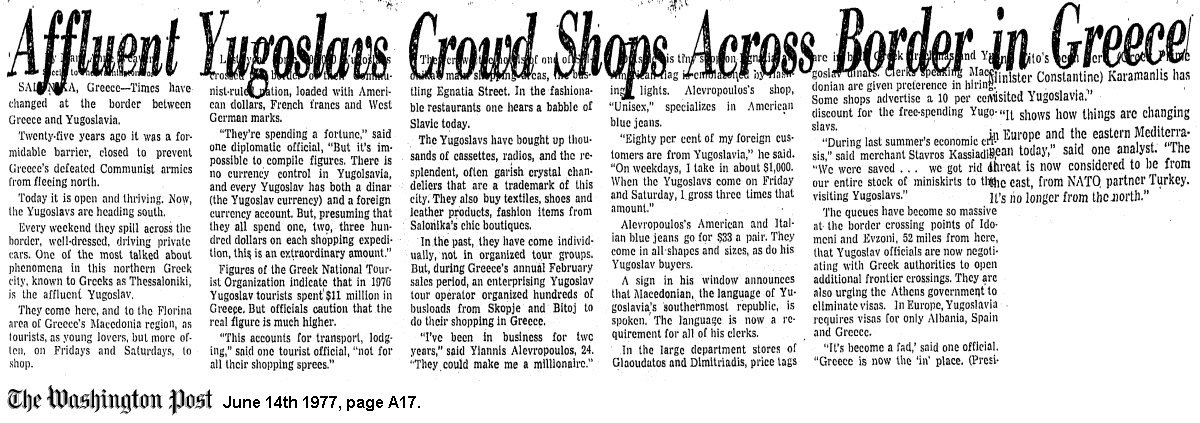
And here is the original article, I am sorry I do not have a better copy of it, I hope it will suffice.

the_washington_post-19770614-pagea17.png


This is now verbatim. :thumbup1:
 
I wonder where they found employees who spoke Macedonian? :innocent:

How soon the demented Greeks forget. It won't be long before they are reminded again.
 
Thank you, now lets send this article to every major Greek news outlet and the current Greek government.
 
Arna rabota, indeed, Daskalot! Do you have a means to send it to the Greek media and government? That would be perfect!
 
Thank you John. :)

Ι don't know if this is interested for you but I found that in the personal webpage of the prime minister there is a drop box for submitting opinions by the citizens. An email address is aslo mentioned there. The link is: http://www.papandreou.gr/papandreou/content/contact.aspx?l=2&citizen=1

[I know Google translator does quite a descent job, but if you need help in translating something, ask me]


Maybe you could also drop it there, in the meanwhile I'll search more.

PS- ministry of foreign affairs drop box: http://www.mfa.gr/www.mfa.gr/MailForm.aspx?UICulture=el-GR
 
By the way, i always look at SOLUN name, whats meens or something
Many says that its comes from Tesallonika, ALexanders sister, and i did wander myself, whats meen :

TE - SO - LUNKA or TE SO LUNKI

on macedonian :)
 
Back
Top