• Welcome to the new Macedonian Truth Forum. All posts, members and private messages have been moved over from the old forum.

    Passwords from the old forum could not be carried over, so please use Forgot your password? to set a new one. The reset link is emailed to the address on your account.

  • Rules and Regulations at the forum of the Macedonian Truth Organisation (MTO)

    (1) The national-ethnic and cultural-linguistic identity of the Macedonian people is historically Macedonian, and derives its character from the native, indigenous and geographic homeland of the Macedonians, which is called Macedonia. To ensure that their human rights, integrity and heritage are appropriately respected, the only nouns and adjectives acceptable when reference is made to the above character and identity markers is Macedon, Macedonia, Macedonian and Macedonians.

    (2) The nation-state of the Macedonian people is the Republic of Macedonia, and is to be referred to by this official title so long as the 'republic' prefix is consistently applied to other states. Alternative references are the Macedonian Republic, or simply, Macedonia.

    (3) The 'ethnic' prefix is only acceptable for Macedonians in cases where differentiation is specifically required - so long as it is in context and consistent where it concerns its application to other ethnic groups.

    (4) Should any other differentiation be specifically required, the names of other ethnic groups that reside with Macedonians in either the Republic of Macedonia or the occupied Macedonian regions in Greece, Bulgaria, Serbia or Albania, are to be given a prefix.

    (5) Negating the identity, language and culture of the Macedonian people by deliberate avoidance of the terms Macedonia, Macedonian and Macedonians, or by any other means, is not permitted.

    (6) Systematic anti-Macedonian propaganda and rhetoric are not permitted.

    (7) Threads irrelevant to the Macedonian Cause, the community at the Macedonian Truth Organisation or the Macedonians in general may be considered as spam or not in the spirit of the forum. In such cases they are not permitted.

    (8) Continual posting of messages in threads with the sole purpose of deviating from the initial topics with the use of unrelated and unnecessary information is not permitted.

    (9) All posts, external articles, reports, etc that are cited in languages other than Macedonian or English, must be accompanied with a translation in one or both of the said languages.

    (10) Despite the possibility of some conversations and debates becoming heated, extreme abuse and/or racism, vulgar language and/or terminology, threats, revelation of personal information about others, harassment, and other such behavior will not be permitted. If deemed necessary all relevant information including member details will be reported to the appropriate authorities for investigation which may result in legal action.

    (11) Threads that are created must have a summary of a topic or excerpt of an article found in pertinent link(s) that have been included. One line threads will be considered unaccetable spam and are therefore not permitted.

    (12) Compulsive and deliberate lies, irrespective of the topic, are not permitted.

    (13) Any symbols or avatars found to be perceived as offensive to Macedonians are not permitted.

    (13) Any explicit or extreme material is not permitted.

    Failure to adhere to the above rules and regulations will result in a ban after 3 breaches. This may be reconsidered in some cases should the circumstances be of an unorthodox nature and/or require special consideration. To assure an effective deterrent against an individual or individuals with the sole purpose of causing dissent through spamming, racism or other improper means, the above rules will be strictly enforced.

    The MTO administration will monitor all discussions as reasonably practical and reserve the right to remove any post and/or member from the forum, and update the rules and regulations as required. Members are encouraged to immediately report any post and/or member to the MTO administration if they feel that these rules have not been abided by.

    The views expressed on this forum are those of the individuals. The only official representation of the MTO is made by the "Macedonian Truth Organisation (Site Owner)" username, and no other.

  • Macedonian Cause

    The Macedonian Truth Organisation calls on God in Heaven to protect, bless and guide the endeavour it is committing to undertake, and that is to work towards:

    Securing Macedonia as a free, independent and democratic republic in which sovereignty lies with the Macedonian citizens; as the nation-state of the Macedonian people in which they can preserve their culture, language and identity; as a state in which the Macedonian language and culture form the basis of public life and act as important unifying elements of Macedonian society; as the home of all its citizens to which it guarantees and obliges their inalienable natural rights and corresponding responsibilities;

    The acknowledgment as self-evident and irrefutable the existence of the:

    1) Indigenous, ethnonational name of Macedonia;
    2) Macedonian people, language and identity;
    3) Macedonian culture, symbols and folklore;
    4) Macedonian ancestry, heritage and history in its entirety; and
    5) Macedonian Orthodox Church;

    Securing recognition by the International Community of the tragedies endured by the Macedonian people, of the division of Macedonia with the signing of the Treaty of Bucharest on August 10, 1913, and the genocide committed against the Macedonian people at the hands of the Greek, Bulgarian and Serbian states and their respective churches during the 19th and 20th centuries;

    Ensuring that the Interim Accord is declared ‘null and void’ and that all constitutional provisions, acts, commitments, agreements, legislation, regulations, policies or programs emanating from, supporting or consequential to the Interim Accord are also declared ‘null and void’, including the use of any symbols and the completion of any acts imposed by, or originating from, the Interim Accord.

    Ensuring that the Framework Agreement is abolished and that all constitutional provisions, acts, commitments, agreements, legislation, regulations, policies and programs emanating from, supporting or consequential to the Framework Agreement are also abolished and replaced by a framework of constitutional and statutory law based on inalienable natural rights and corresponding responsibilities and universally codified human rights mechanisms.

    Securing the abolishment of any existing constitutional provisions, acts, agreements, legislation, regulations, policies and programs that discriminate against the Macedonian people, in any international organisation or any of the countries of the International Community where such constitutional provisions, acts, agreements, legislation, regulations, policies and programs exist, and thereby ensuring the freedom for Macedonians to exercise their inalienable natural rights and fulfil their corresponding responsibilities, and practice their culture, language and religious faiths in all the countries of the International Community without hindrance;

    The empowerment of Macedonians to undertake a moral revolution and to instil and/or reinvigorate within themselves a deep-rooted national, cultural, linguistic and historical dignity and a commitment to the exercise of freedom based on inalienable natural rights and corresponding responsibilities;

    The recognition of the Macedonian minorities in the neighbouring states of Macedonia as well as the respect for the inalienable rights and freedoms of the Macedonian minorities, as provided for by natural law and as codified by the United Nations Charter, the Universal Declaration of Human Rights and other universally codified human rights mechanisms;

    The full and unreserved respect of, and the support for, the rights of all people of non-Macedonian descent living in Macedonia and around the world, who share a reciprocal full and unreserved respect for the Macedonian people, their homeland and their state;

    The cultural unification and solidarity of the Macedonian people living in all parts of historical Macedonia and adjacent territories, as well as Macedonians throughout the world;

    The unity of all Macedonians on the principles, objectives and achievement of the Macedonian cause as defined by this declaration.

Macedonians, Maedi, and the legend of Spartacus

Here's something more about Spartacus' people, the Maedi, and their often hostile 'relations' with Macedonia. The text is from Roman writer Titus Livius (Livy), who lived during the end of the 1st century BC and the beginning of the 1st century AD.
http://www.gutenberg.org/files/10907/10907-h/10907-h.htm

.........he (Phillip V of Macedon) marched his army into Macedonia, and thence into Thrace and Maedica. This nation had been accustomed to make incursions into Macedonia when they perceived the king engaged in a foreign war, and the kingdom left unprotected. Accordingly, he began to devastate the lands in the neighbourhood of Phragandae, and to lay siege to the city Jamphorina, the capital and chief fortress of Maedica.

http://www.gutenberg.org/files/12582/12582-h/12582-h.htm

Philip received accounts even from his own kingdom, that things were not in a state of tranquillity; that both Scerdilaedus and Pleuratus were in motion, and that some of the Thracians, and particularly the Maedians, would certainly make incursions on the contiguous provinces of Macedonia, should the king be occupied with a distant war.
 
The Bible is a good source for such references, where the epithet of 'Hellene' can mean either non-Jew (Heathen) or cultured/educated (when ranged against barbarians).

Indeed, also old German Encylopedia's have a similar view on it!

[590] Griechen, 1) Bewohner von Griechenland, s.d. (Gesch.); 2) im Neuen Testament so v.w. Heiden, weil die meisten heidnischen Völker um Palästina griechisch redeten; 3) (Hellenisten), die außerhalb Judäa wohnenden Juden, die fast alle griechisch redeten, im Gegensatz zu den Nationalgriechen u. jüdischen Proselyten, s.u. Griechische Sprache.

Translation by GoogleTr.

Greeks, 1) residents of Greece, s.d. (GP), 2) in the New Testament might be v.w. Heathen, pagan nations because most talked about Palestine in Greek; 3) (Hellenists), the Jews living outside Judea who spoke almost all Greek, in contrast to the National Jewish proselytes and Greeks, see Greek language.

Pierer's Universal-Lexikon, Band 7. Altenburg 1859, page 590
http://www.zeno.org/Pierer-1857/A/Griechen

more...

[220] Hellenisten, 1) gelehrte Kenner der Griechischen Sprache; 2) die Juden. in Ägypten, welche seit der Einwanderung nach Ägypten unter Ptolemäos Lagi griechische Bildung empfingen. Aus griechischen u. jüdischen Elementen bildete sich ein. eigner Dialekt, die Hellenistische Sprache (s. Griechische Sprache g), u. eine eigne Philosophie (s. Philosophie).


translation
[220] Hellenists, a scholarly) educated speaker of the Greek language, 2) the Jews. in Egypt, who received since the migration to Egypt under Ptolemy Lagi Greek education. From Greek and Jewish elements imagined. own dialect, the Hellenic language (see Greek language grams), and one's own philosophy (see Philosophy).

Pierer's Universal-Lexikon, Band 8. Altenburg 1859, S. 220.
http://www.zeno.org/Pierer-1857/A/Hellenisten?hl=hellenisten

Source: http://www.zeno.org
 
Maedi

http://www.absoluteastronomy.com/topics/Maedi

Note that this text reveals a Thracian word.

The Maedi (also Maidans, Maedans, or Medi),(Ancient Greek,"Μαίδοι") were a Thracian tribe who, in historic times, occupied the area between Paionia and Thrace, on the southwestern fringes of Thrace, along the middle course of the Strymon and the upper course of the Nestus rivers, (present-day south-western Bulgaria). Their capital city was Iamphorynna.

They were an independent tribe through much of their history, and the Thracian king Sitalkes recognized their independence, along with several other warlike "border" tribes such as the Dardani, Agrianes, and Paeonians, whose lands formed a buffer zone between the powers of the Odrysians on the east and of Illyrian tribes in the west, while Macedon was located to the south of Paeonia. The ancient historian and biographer Plutarch describes Spartacus as "a Thracian of nomadic stock", referring to the Maedi. Plutarch also says Spartacus' wife, a prophetess of the same tribe, was enslaved with him.

In 89–84 bc (during the First Mithridatic War), the Maedi overran Macedon, looted Dodona, and sacked Delphi as allies of Mithridates. It is said that they made a habit of raiding Macedon when a king of Macedon was away on a campaign .Sulla after this ravaged the land of the Maedi. Aristotle recorded that bolinthos was the Maedan word for a species of wild Aurochses or Wisents that lived in the region.

A number of Maedi emigrated to Asia minor and were called MaedoBythini.

Have we found our Thracian etymology for Mt, 'Olynthos' the mountain?
 
Last edited:
Hey SoM. You posted this in another thread.

Maedi

Titus Livius:

http://mcadams.posc.mu.edu/txt/ah/Livy/Livy28.html

The condition of his own kingdom was far from tranquil; reports were brought to him announcing that Scerdilaedus and Pleuratus were again active and that Thracian tribes, especially the Maedi, were prepared to invade Macedonia as soon as the king was involved in a distant war.

http://mcadams.posc.mu.edu/txt/ah/Livy/Livy42.html

Envoys also from Thrace, with the Maedi and Astii, came to ask for alliance and friendship. Their request was granted and each received a present of 2000 ases. The Romans were especially glad that these peoples had been received into alliance, because Thrace lay at the back of Macedonia.

http://www.macedoniantruth.org/forum/showpost.php?p=52416&postcount=49
 
Maedi (Меди) sounds very similar with:

copper - мед (med) in bulgarian

We know Filip have put much efforts to gain controle on the area around Chalkidiki and rivers Struma and Mesta where Maedi were living. This was important because those regions were rich in gold silver and copper mines.
Macedonian shields were made from silver and bronze (shield found in Bonche) consisting primarily of copper.
In fact, Chalkidiki (Chalcidice) was beffore the setllement of Greeks (700-400 b.c.) populated by Thracians.
Having on mind that Maedians are the closest thracian tribe living around Chalkidiki I could say they were once living there. More inteersting is that "chalkos" means copper ore.
 
http://www.dailymail.co.uk/tvshowbi...partacus-star-loses-battle-cancer-age-39.html
British-born actor Andy Whitfield, star of the TV series Spartacus: Blood and Sand, has died of non-Hodgkin lymphoma, it was confirmed today.

The star, who was born in Amlwch, Wales, but moved to Sydney in 1999, lost his 18-month battle with the disease on a 'sunny Sydney morning in the arms of his loving wife (Vashti),' she said in a statement. The actor, who was 39, was diagnosed with stage 1 of the disease in March 2010, but was declared cancer-free two months later after beginning treatment immediately in New Zealand.

Whitfield was a virtual unknown when he was cast as the legendary Thracian slave in Spartacus, a role made famous by Kirk Douglas in the 1960 Stanley Kubrick film. The series proved a break-out hit for the Starz network and made waves with its graphic violence and sexuality. Whitfield appeared in all 13 episodes of the first season that aired in 2010, and was preparing to shoot the second when he was diagnosed with cancer.

While waiting for Whitfield's treatment and expected recovery, the network produced a six-part prequel, Spartacus: Gods of the Arena, that aired earlier this year with only a brief voice-over from the actor.
But in January, after Whitfield's condition grew worse, the network announced that another Australian actor, Liam McIntyre, would take over the role.

McIntyre said at the time: 'Andy’s such a wonderful actor. I don’t want to follow that guy, and everybody hurts that he’s had to give up the role, myself included.' At the same time, Whitfield released his own statement acknowledging the decision: 'It's with a deep sense of disappointment that I must step aside from such an exceptional project as Spartacus and all the wonderful people involved,' he said. 'It seems that it is time for myself and my family to embark on another extraordinary journey.'

Whitfield's previous credits included appearances on the Australian TV shows Packed to the Rafters and McLeod's Daughters. Spartacus director Steve DeKnight took to Twitter to express his pain. 'No words to express the depth of such a loss. You will be deeply missed, my brother,' he wrote.

Spartacus co-star Lucy Lawless said on her website Whitfield was a "gentle man who never had a bad world about anyone".
She went on to say that Whitfield was a brilliant actor and a gifted photographer and engineer.

'Obviously, Andy Whitfield left an indelible mark on all of us in the Spartacus family,' she said. 'Andy's incandescent film presence made men want to be him and women want to marry him. 'Andy's two babies will always know that their Daddy cherished them and their mother, Vashti, above all things. 'How lucky we were to have him grace all our lives.'

Another person who spoke highly of the actor was Starz president and CEO Chris Albrecht who said: 'We were fortunate to have worked with Andy in Spartacus and came to know that the man who played a champion on-screen was also a champion in his own life.

'Andy was an inspiration to all of us as he faced this very personal battle with courage, strength and grace. 'Our thoughts and prayers are with his family during this difficult time. He will live on in the hearts of his family, friends and fans.'

Whitfield is survived by his wife Vashti and his two children.

A damn shame, may he rest in peace, he played the character of Spartacus extremely well. His memory will live on in the Spartacus series.
 
And he really played the role with style,damn shame.I watched season 1 on our own MTV(finally something worth watching there) and it just blew me away.Nash choek indeed.May he rest in peace.
 
Have you seen the intermediary series that was made while they waited for Andy Whitfield to recover? That was good also. The new series is OK, have only seen a few episodes, it is not as good as the first one though (at least not so far), but what keeps me watching is knowing how the story develops and waiting for the Thracian and his men to shake Rome to its foundations.
 
I just downloaded it,it's gonna be on my agenda the following days.As for the sequel with the new actor,I think I'm gonna wait the season to end so I can get the full picture.I did a great mistake with Prison Break's last season,the suspense was too much to handle:)
 
Rodan the Gladiator

Rodan the Gladiator

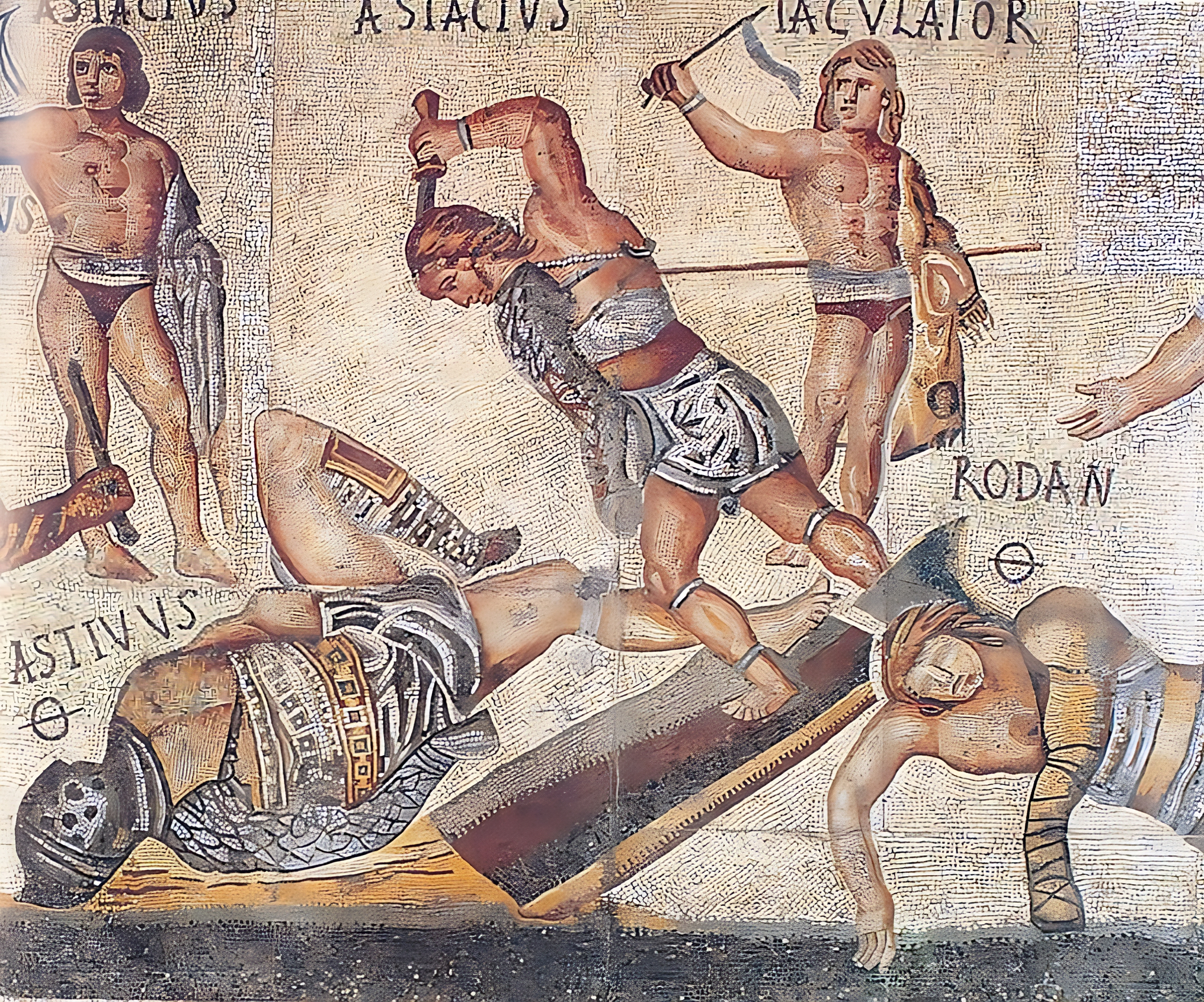
I felt this would be the most appropriate thread to share this intriguing photo in that I recently came across of a Roman mosaic (known as the Gladiator Mosaic) depicting a bunch of gladiators which has been dated to the first half of the 4th century (i.e. 300’s AD). What is intriguing about it is the name of the fallen blond, long-haired gladiator with the very Macedonian sounding name, Rodan. We know he has been killed by the Greek letter Θ placed next to his name which apparently stood for “Thanatos”, meaning dead. Would it be such a stretch of the imagination if this gladiator turned out to be a Macedonian? We know the Romans used many slaves from the conquered territories to fight as gladiators and Thracians and Macedonians would have featured prominently in these staged fights to the death. They even named a type of gladiator after the Thracians, the Thraex.

Retiarius_vs_secutor_from_Borghese_mosaic.jpg

That's interesting. I wonder if there is more info on this gladiator mosaic.

After doing some "research" on google I found that Rodan is a Slavonic name related to the adjective native, nativity. Rodán is also described as a Celtic-Gaelic name meaning hearty, lively.

https://themeaningofthename.com/rodan/
https://www.morebooks.de/store/gb/book/rodan-given-name/isbn/978-613-7-54324-5
https://www.thenamemeaning.com/rodan/
https://books.google.ca/books?id=mZ...DP8Q6AEIJzAA#v=onepage&q=Rodan Gaelic&f=false


------------------------------------------------------------------------------------------------------------------------------------------------------------------

The ancient historian and biographer Plutarch describes Spartacus as "a Thracian of nomadic stock", in a possible reference to the Maedi. [Nic Fields (2009). Spartacus and the Slave War 73-71 BC: A Gladiator Rebels Against Rome. Osprey Publishing. p. 28. ISBN 978-1-84603-353-7.]

A number of Maedi emigrated to Asia minor and were called MaedoBythini: The Cambridge Ancient History, Volume 3, Part 2: The Assyrian and Babylonian Empires and Other States of the Near East, from the Eighth to the Sixth Centuries BC by John Boardman, I. E. S. Edwards, E. Sollberger, and N. G. L. Hammond, ISBN 0-521-22717-8, 1992, page 601: "Earlier certain tribes of the Maedi emigrated to Asia minor where they were known by the name of the MaedoBythini..."


------------------------------------------------------------------------------------------------------------------------------------------------------------------

Since this thread is about Macedonians and Maedi, a Thracian tribe, I thought this should go here:
https://onlinelibrary.wiley.com/doi/abs/10.1002/9781118878248.ch22

Thracian and Macedonian Kingship, William S. Greenwalt

"This chapter focuses on elements of a shared royal ideology between the Argeads of Macedonia and at least some of their Thracian counterparts. The Thracians had a significant influence on the early Macedonian ideology of kingship. Argead kings appeared as heroes necessary for the preservation of the health and well‐being of all of their subjects, just as anecdotal evidence suggests was the prevailing thought among at least some of the Thracian kingdoms."
 
Last edited:
Back
Top