• Welcome to the new Macedonian Truth Forum. All posts, members and private messages have been moved over from the old forum.

    Passwords from the old forum could not be carried over, so please use Forgot your password? to set a new one. The reset link is emailed to the address on your account.

  • Rules and Regulations at the forum of the Macedonian Truth Organisation (MTO)

    (1) The national-ethnic and cultural-linguistic identity of the Macedonian people is historically Macedonian, and derives its character from the native, indigenous and geographic homeland of the Macedonians, which is called Macedonia. To ensure that their human rights, integrity and heritage are appropriately respected, the only nouns and adjectives acceptable when reference is made to the above character and identity markers is Macedon, Macedonia, Macedonian and Macedonians.

    (2) The nation-state of the Macedonian people is the Republic of Macedonia, and is to be referred to by this official title so long as the 'republic' prefix is consistently applied to other states. Alternative references are the Macedonian Republic, or simply, Macedonia.

    (3) The 'ethnic' prefix is only acceptable for Macedonians in cases where differentiation is specifically required - so long as it is in context and consistent where it concerns its application to other ethnic groups.

    (4) Should any other differentiation be specifically required, the names of other ethnic groups that reside with Macedonians in either the Republic of Macedonia or the occupied Macedonian regions in Greece, Bulgaria, Serbia or Albania, are to be given a prefix.

    (5) Negating the identity, language and culture of the Macedonian people by deliberate avoidance of the terms Macedonia, Macedonian and Macedonians, or by any other means, is not permitted.

    (6) Systematic anti-Macedonian propaganda and rhetoric are not permitted.

    (7) Threads irrelevant to the Macedonian Cause, the community at the Macedonian Truth Organisation or the Macedonians in general may be considered as spam or not in the spirit of the forum. In such cases they are not permitted.

    (8) Continual posting of messages in threads with the sole purpose of deviating from the initial topics with the use of unrelated and unnecessary information is not permitted.

    (9) All posts, external articles, reports, etc that are cited in languages other than Macedonian or English, must be accompanied with a translation in one or both of the said languages.

    (10) Despite the possibility of some conversations and debates becoming heated, extreme abuse and/or racism, vulgar language and/or terminology, threats, revelation of personal information about others, harassment, and other such behavior will not be permitted. If deemed necessary all relevant information including member details will be reported to the appropriate authorities for investigation which may result in legal action.

    (11) Threads that are created must have a summary of a topic or excerpt of an article found in pertinent link(s) that have been included. One line threads will be considered unaccetable spam and are therefore not permitted.

    (12) Compulsive and deliberate lies, irrespective of the topic, are not permitted.

    (13) Any symbols or avatars found to be perceived as offensive to Macedonians are not permitted.

    (13) Any explicit or extreme material is not permitted.

    Failure to adhere to the above rules and regulations will result in a ban after 3 breaches. This may be reconsidered in some cases should the circumstances be of an unorthodox nature and/or require special consideration. To assure an effective deterrent against an individual or individuals with the sole purpose of causing dissent through spamming, racism or other improper means, the above rules will be strictly enforced.

    The MTO administration will monitor all discussions as reasonably practical and reserve the right to remove any post and/or member from the forum, and update the rules and regulations as required. Members are encouraged to immediately report any post and/or member to the MTO administration if they feel that these rules have not been abided by.

    The views expressed on this forum are those of the individuals. The only official representation of the MTO is made by the "Macedonian Truth Organisation (Site Owner)" username, and no other.

  • Macedonian Cause

    The Macedonian Truth Organisation calls on God in Heaven to protect, bless and guide the endeavour it is committing to undertake, and that is to work towards:

    Securing Macedonia as a free, independent and democratic republic in which sovereignty lies with the Macedonian citizens; as the nation-state of the Macedonian people in which they can preserve their culture, language and identity; as a state in which the Macedonian language and culture form the basis of public life and act as important unifying elements of Macedonian society; as the home of all its citizens to which it guarantees and obliges their inalienable natural rights and corresponding responsibilities;

    The acknowledgment as self-evident and irrefutable the existence of the:

    1) Indigenous, ethnonational name of Macedonia;
    2) Macedonian people, language and identity;
    3) Macedonian culture, symbols and folklore;
    4) Macedonian ancestry, heritage and history in its entirety; and
    5) Macedonian Orthodox Church;

    Securing recognition by the International Community of the tragedies endured by the Macedonian people, of the division of Macedonia with the signing of the Treaty of Bucharest on August 10, 1913, and the genocide committed against the Macedonian people at the hands of the Greek, Bulgarian and Serbian states and their respective churches during the 19th and 20th centuries;

    Ensuring that the Interim Accord is declared ‘null and void’ and that all constitutional provisions, acts, commitments, agreements, legislation, regulations, policies or programs emanating from, supporting or consequential to the Interim Accord are also declared ‘null and void’, including the use of any symbols and the completion of any acts imposed by, or originating from, the Interim Accord.

    Ensuring that the Framework Agreement is abolished and that all constitutional provisions, acts, commitments, agreements, legislation, regulations, policies and programs emanating from, supporting or consequential to the Framework Agreement are also abolished and replaced by a framework of constitutional and statutory law based on inalienable natural rights and corresponding responsibilities and universally codified human rights mechanisms.

    Securing the abolishment of any existing constitutional provisions, acts, agreements, legislation, regulations, policies and programs that discriminate against the Macedonian people, in any international organisation or any of the countries of the International Community where such constitutional provisions, acts, agreements, legislation, regulations, policies and programs exist, and thereby ensuring the freedom for Macedonians to exercise their inalienable natural rights and fulfil their corresponding responsibilities, and practice their culture, language and religious faiths in all the countries of the International Community without hindrance;

    The empowerment of Macedonians to undertake a moral revolution and to instil and/or reinvigorate within themselves a deep-rooted national, cultural, linguistic and historical dignity and a commitment to the exercise of freedom based on inalienable natural rights and corresponding responsibilities;

    The recognition of the Macedonian minorities in the neighbouring states of Macedonia as well as the respect for the inalienable rights and freedoms of the Macedonian minorities, as provided for by natural law and as codified by the United Nations Charter, the Universal Declaration of Human Rights and other universally codified human rights mechanisms;

    The full and unreserved respect of, and the support for, the rights of all people of non-Macedonian descent living in Macedonia and around the world, who share a reciprocal full and unreserved respect for the Macedonian people, their homeland and their state;

    The cultural unification and solidarity of the Macedonian people living in all parts of historical Macedonia and adjacent territories, as well as Macedonians throughout the world;

    The unity of all Macedonians on the principles, objectives and achievement of the Macedonian cause as defined by this declaration.

Kolokotronis the Albanian

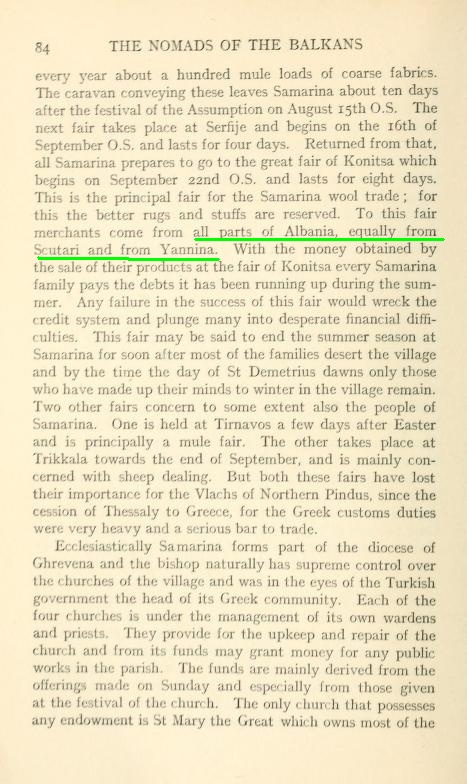
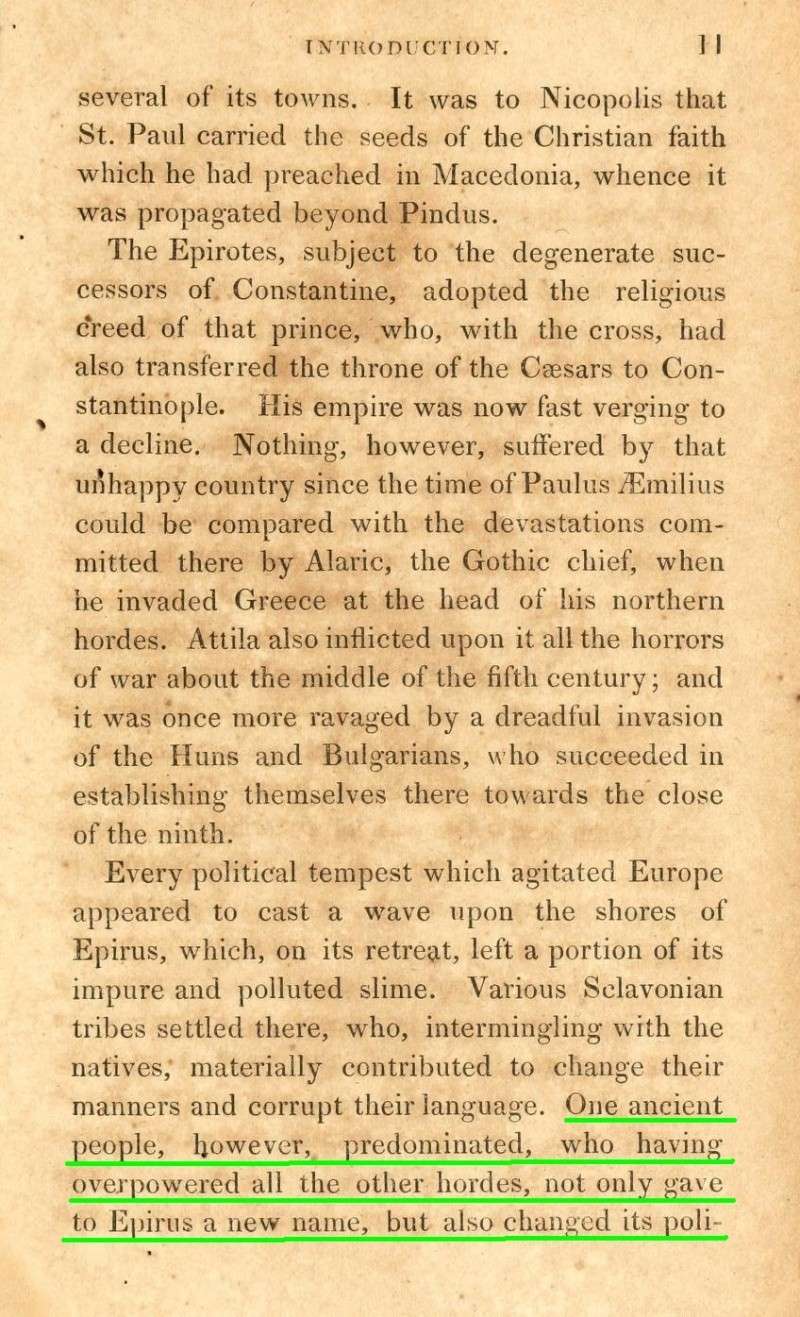
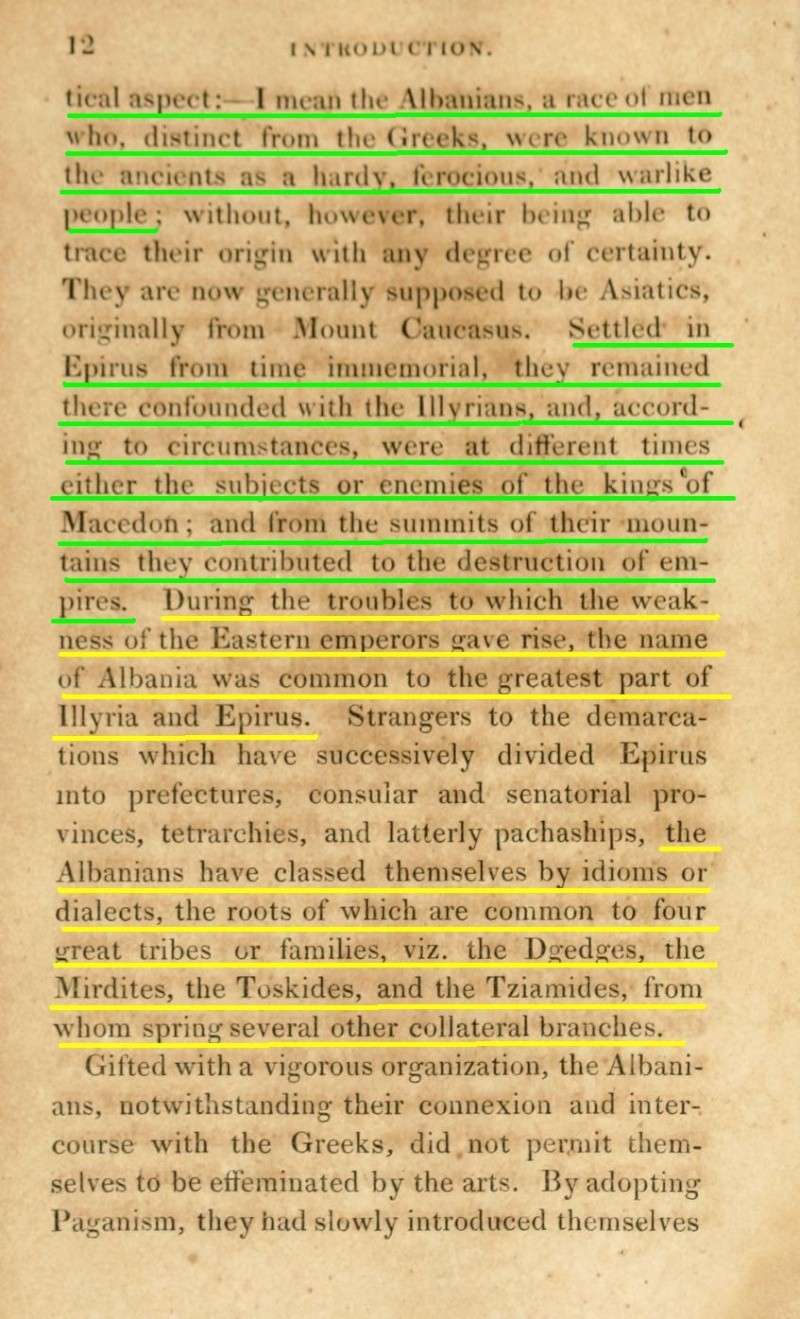
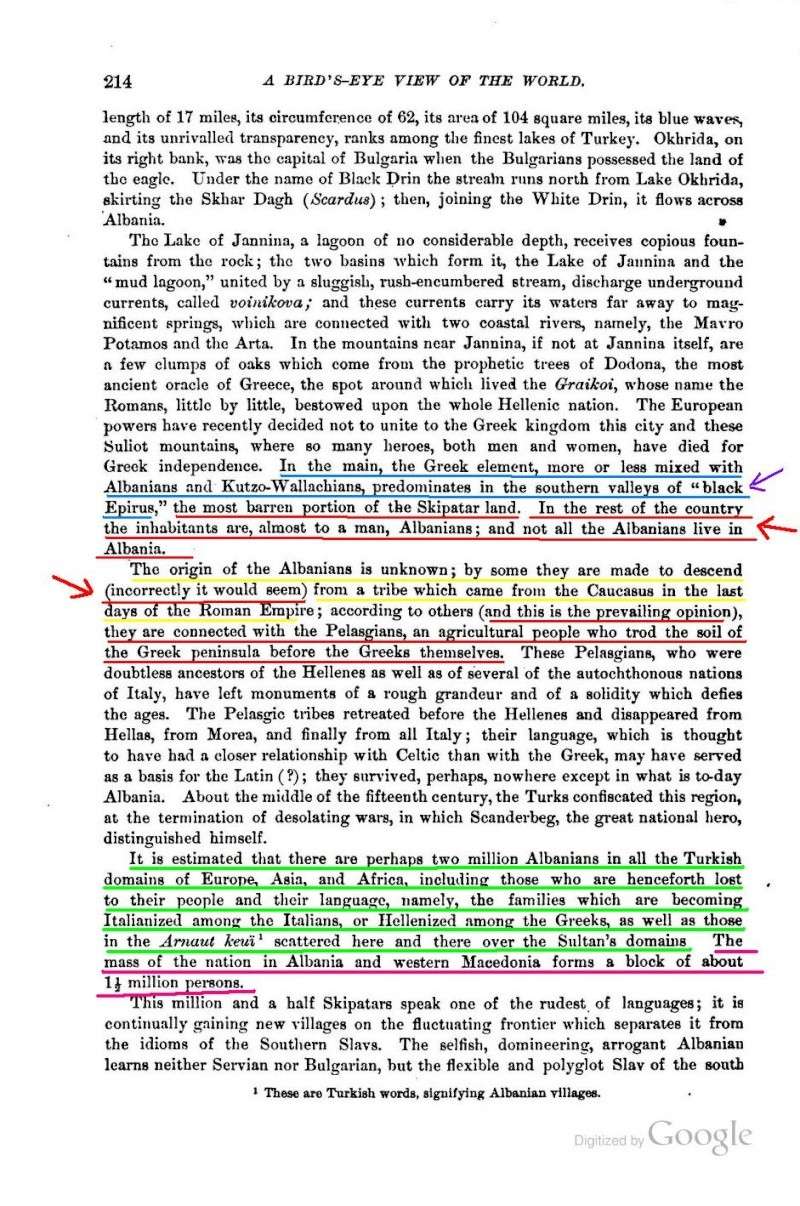
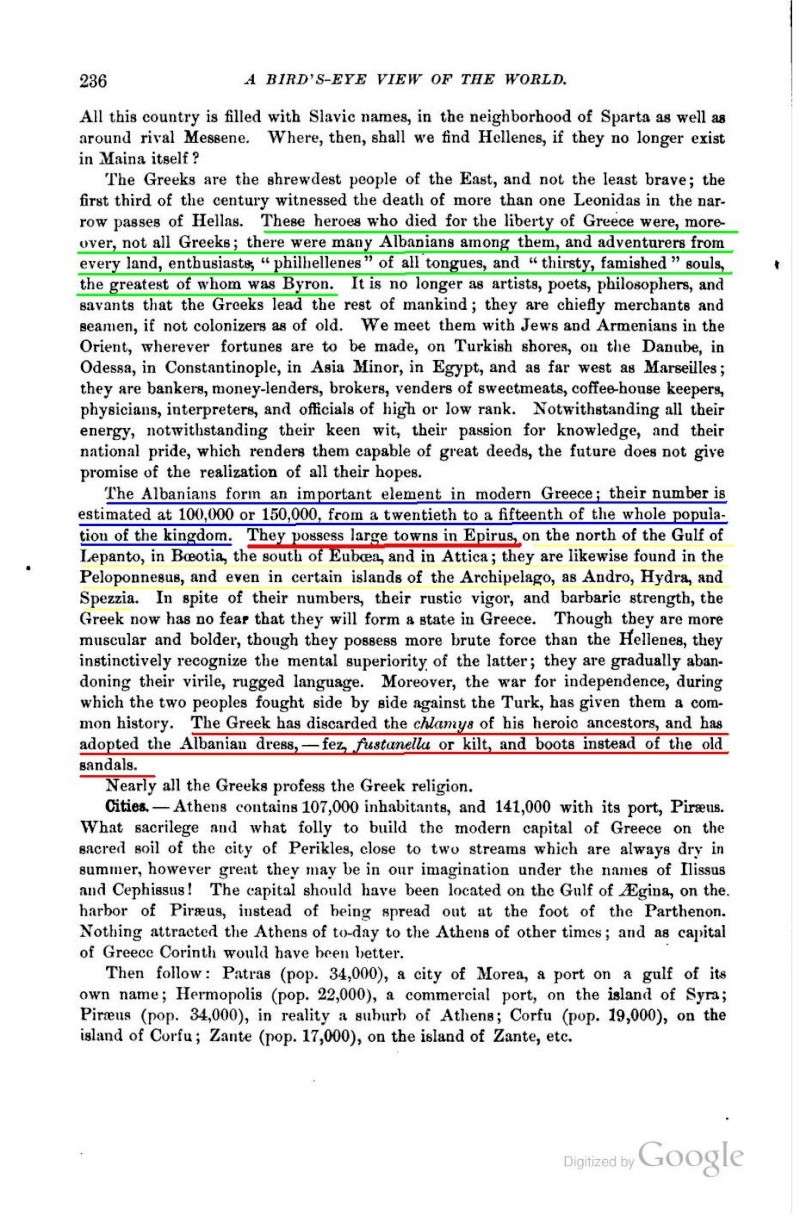
We can guess the same to happen in Epirus. Here Albanians as descendants of old Epirotes were well-established. The ephemeral Slavic military elites were easily absorbed by Albanians, and during all the time, Slavs were of minor importance in Epirus. All ethnographic accounts and maps of 18th and 19th century point out that Albanians prevailed numerically among all others.

In Epirus? In Greece? Which "all" accounts and maps?
Actually the link you just posted says different (speaks of Greek majority in Epirus, see Conclusions section at the end).
A previous source you gave spoke of 15% Arvanites (within 1830s Greece), but you forgot to mention this detail. Then you said Arvanites were 1/3 in Thessaly but posted a map (post#38) where there are none.
By the way, Slavs haven't been solely raiders. In (at least) one of the six surges of Thessaloniki by Avars/Slavs/Avaro-Slavs it is mentioned that their women and children had camped and waited outside the walls of the city during the battles.
 
Last edited:
In Epirus? In Greece?

Please, see my previous post. I was referring to Epirus. You Greeks are professionals in the art of derailing threads.

Originally posted by cultea

Which "all" accounts

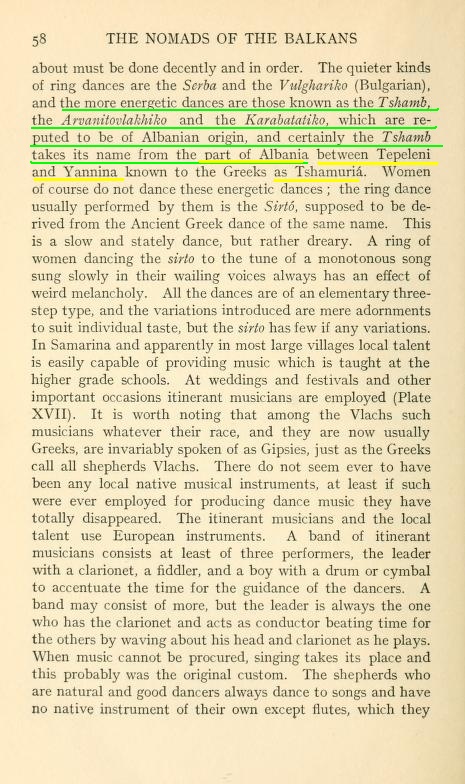
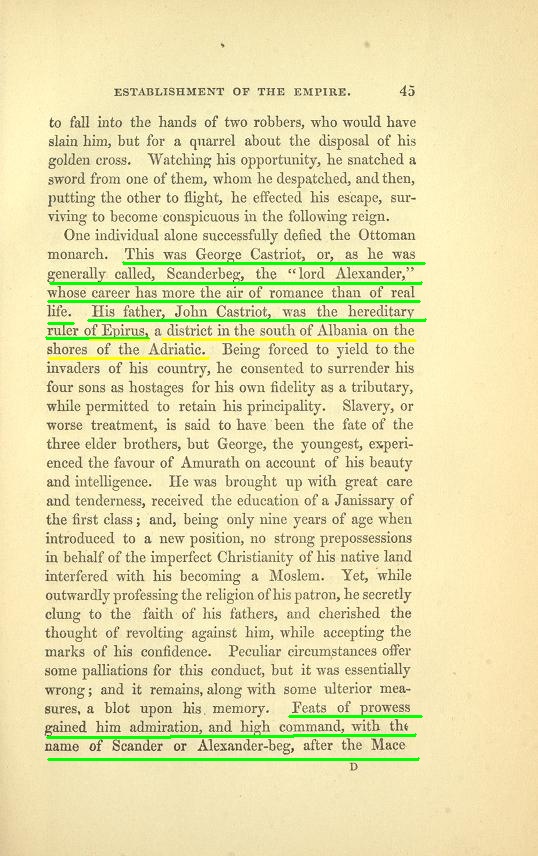
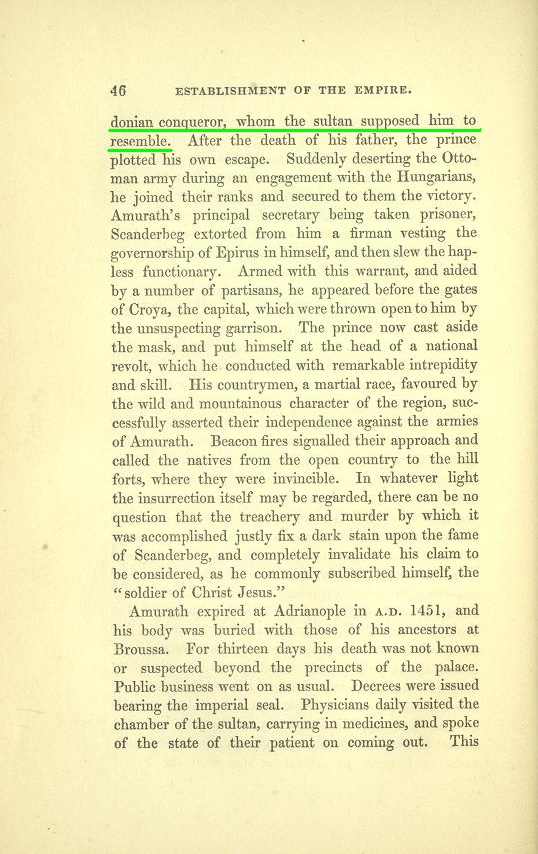
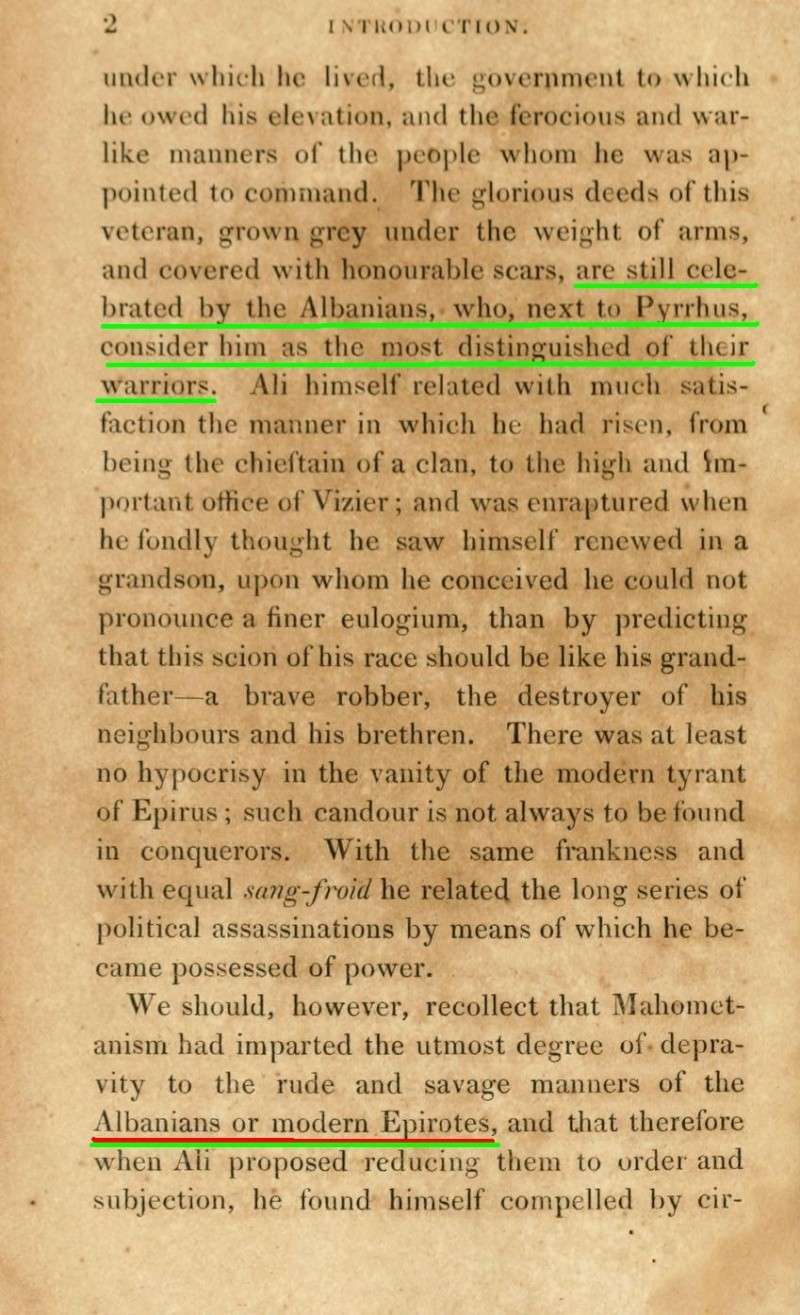
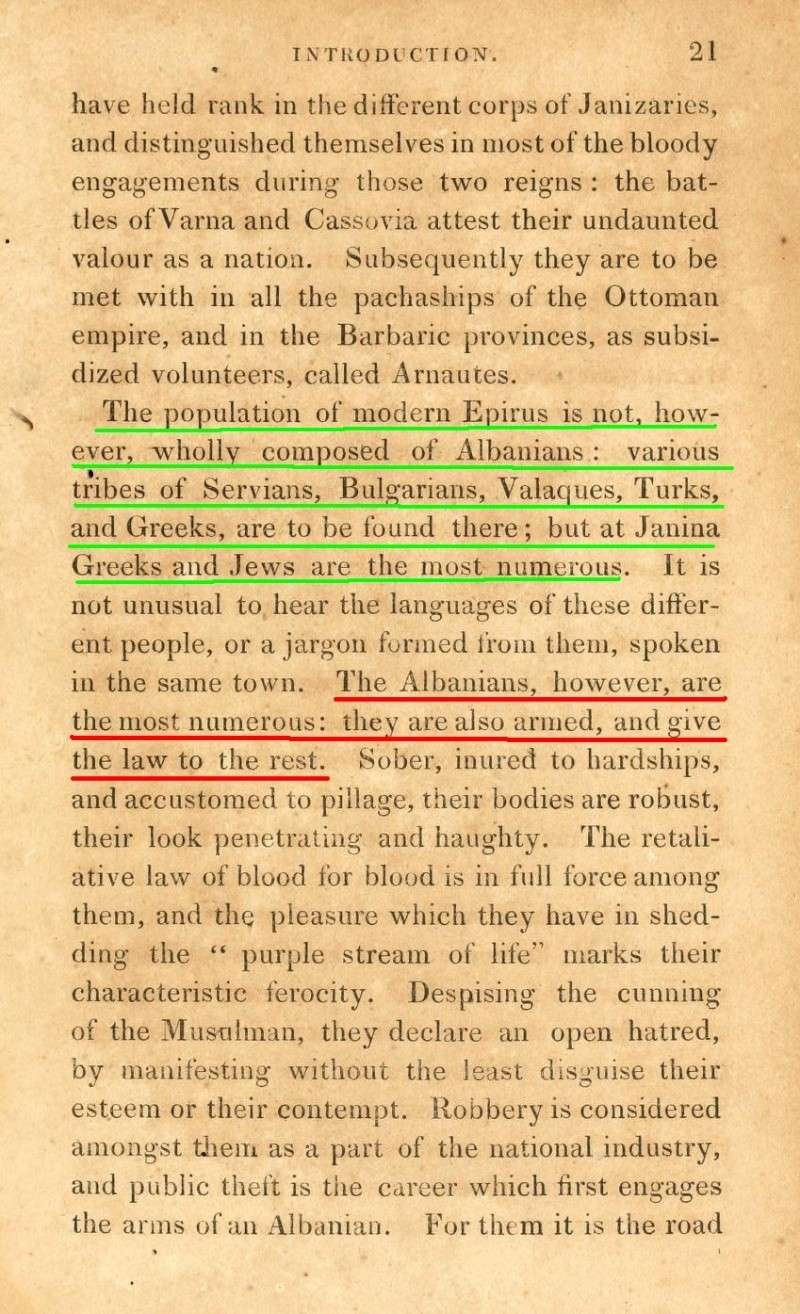
You're challenging my conclusion. Well, let us face with the light of these documents:

It was probably about this time that the Albanian name was extended to all those mountaineers of Illyricum and Epirus, who were united by community of language and manners ; and, as it should seem, they constituted a separate and independent community, which formed alliances at will with the Greek emperors, the Franks, or the despots of Epirus.

The Penny cyclopædia of the Society for the Diffusion of Useful ..., Volume, George Long, Society for the Diffusion of Useful Knowledge (Great Britain

As regards Epirus, there was another reason, perhaps, that nearly the whole of its population is now Albanian;

The Eclectic magazine: foreign literature, Volume 58
By John Holmes Agnew, Walter Hilliard Bidwell

untitl19.jpg

untitl20.jpg

untitl21.jpg

untitl22.jpg


untitl23.jpg

untitl24.jpg

untitl25.jpg

untitl27.jpg

untitl28.jpg

untitl29.jpg

The life of Ali Pacha, of Jannina: late vizier of Epirus, surnamed Aslan...by Alph. de Beauchamp, page 21, 1823

bookre10.jpg

bookre11.jpg


The scanned images I got from "rex362" at "illyria.proboards.com"

Originally posted by cultea

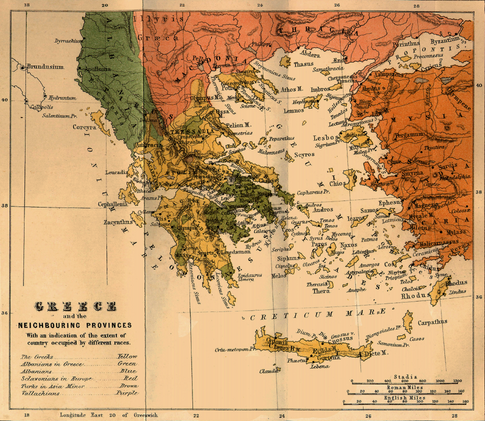
maps?

How many do you want, buddy?

july3dufour81.JPG


21septgreece4.jpg


dec11balkans2.JPG

dec11balkans4.JPG


aug24turkeyineurope2.JPG


jan28turkeyineurope2.JPG

jan28turkeyineurope3.JPG


jan28turkeyineurope.JPG


jan27turkeyineurope.JPG


jan28turkeyineurope-C2.JPG

jan28turkeyineurope-C3.JPG


jan28turkeyineurope-C.JPG


map_finlay.png


t62oea.png


7954.jpg


hartashqipe.jpg


O sir Bellin why do you put the name of Albania next to the Gulf of Arta?! Are you intentionally ignoring the North Epirus which is mainly populated by Albanians...oh sorry for my expression, by Albanized Hellenes? Therefore you have to correct your map by putting the boundary between Greece & Albania at least at Shkumbin river! :)

Originally posted by cultea

By the way, Slavs haven't been solely raiders. In (at least) one of the six surges of Thessaloniki by Avars/Slavs/Avaro-Slavs it is mentioned that their women and children had camped and waited outside the walls of the city during the battles.

Yes but you seem to ignore a small detail in my post. I was referring to Douglas Dakin's book. I do not much things about Thessaloniki and its environs but as far as Epirus is concerned, I am entirely certain that Slavs passed in Epirus just like military riders and could only establish themselves as barons in the time of Dushan's empire. Their rule lasted not long.
 
Last edited:
chameri005.jpg


doc1022.jpg


doc1015.jpg


O Albanians what are you doing in Janina, the capital of Albania? I even thought that Janina was one of the purest Greek city in Balkans :)

cultea are you that stupid as to try with an old riffle to handle a total attack from a B-52 bomber?

b52_07.jpg


and I am not sure if your maggotsontheweb can give any substantial aid. Or, maybe I am wrong. Last time I heard they are preparing their air-force against us:

images

Kapetan Donkey & Andreas Kyropoulos
 
Last edited:
By the way, Slavs haven't been solely raiders. In (at least) one of the six surges of Thessaloniki by Avars/Slavs/Avaro-Slavs it is mentioned that their women and children had camped and waited outside the walls of the city during the battles.
Thats true. The story of slavic raiders being a small military regiment is just an assumption and/or a propaganda.

All the nomadic equestrian people in the middle ages, including all the Hunnic and Germanic tribes was traveling along with their families, even when they raid somewhere. Their families behind them, was dealing with sheep flocks, providing food for the men at the war field. They had no giant buildings except few castles for the khans/kings. Their women also had much more privileged role in their society unlike Romans. Some women was joining raids too.

I ask these questions to anyone who claims that they were just a small military regiment. These questions are also valid for Bulgars who came to Balkans;
  • If they were small minority then how come they constantly defeated Roman armies? Roman armies was consisted around 20.000-50.000 manpower at that time. If nomads had beaten them, their army should be around this number. Add their families, this makes about ~50.000+ people for single raid.
  • What was the population of local people, the places where they have raided??? In that times, only the major capital cities population was above 200.000-300.000, like Rome or Istanbul. Maybe few more important centers like Salonika had like 100.000 population at most. Mountainous regions in Balkans was desolated in today`s terms. Already, most of the today`s Balkan cities has been founded during Ottoman reign, after 15th century, with the exception of few centers like Belgrade, Sofia, Salonika, Skopje, while whole of today`s Albania founded during the Turkish reign, including the capital city of Tirana.


For example, when Ottoman empire conquered Istanbul, there was only ~40.000 people in whole city and it`s estimated like ~10.000 already left the city shortly b4 the war. So, this makes that Istanbul`s population in 1450 around ~50.000 people.
 
Last edited:
The story of slavic raiders being a small military regiment is just an assumption and/or a propaganda.
.

A massive Slavic migration on Epirus can't sustain because their presence is so slight as disappeared with the collapse of Dushan's empire.

If they were small minority then how come they constantly defeated Roman armies?

You're right at least theoretically, but however there are some cases with provide the contrary. For instance, Goths were just military raiders when they firstly entered within Roman Empire's territory. At the beginning they were established into region of Scythia, which is why they were often confounded with the Scythians. Then they harrased Balkans only as raiders. Later on, when they were allowed to settle in North Western Balkans by the permission of Roman Emperor, they sporadically made incursions depth in Moesia and Thrace again as military raiders. The largest part of Goths (non-soldiers) did not followed the army, at least some of the written sources I had read, suggest so. I assume that this paradigm can also explain the case of Epirus during the Slavic migration. Slavs might have been established in adjacent regions, like southern Macedonia and from there made short incursions toward Epirus. We can't simply ignore the very fact that Epirus and its mountainous nature hardly attracted Slavs who were more interested in lowlands rather than highlands.
 
I was talking about in general, not specifically about the slavic raids to Epirus but i have to agree with you about the mountainous regions. For the equestrian nomads, mountainous areas was only useful for feeding the flocks, funerals and praying to the sky god(s) but not for living unless they were under threat.

Btw, i don't think that they ever raided somewhere without backup from their families. While women was only considered as worthless slaves in Roman society, the women in nomadic society was powerful, equally privileged as men and they were providing spiritual help to their people, as well as food and health service with their knowledge of herbalism.
 
Onur said:
The story of slavic raiders being a small military regiment is just an assumption and/or a propaganda.
Is that right? Why don't you and Cultea show us all of the references to women and children that apparently accompanied the 'raiders', and prove the assumption wrong?
Btw, i don't think that they ever raided somewhere without backup from their families.
They didn't need the back up of women and children to defeat Roman armies and establish their rule in the Balkans.
If they were small minority then how come they constantly defeated Roman armies? Roman armies was consisted around 20.000-50.000 manpower at that time. If nomads had beaten them, their army should be around this number.
Do you think the Romans had 50,000 soldiers just waiting on the banks of the Danube? They were constantly fighting wars in Western Europe, Northern Africa and Asia. Together with the plague of the 540's, their position was weakened and they weren't able to defend their imperial boundaries as well as they did in previous years. Furthermore, history has shown that numerically inferior armies can defeat larger armies in some circumstances. Use some logic.
What was the population of local people, the places where they have raided??? In that times, only the major capital cities population was above 200.000-300.000, like Rome or Istanbul. Maybe few more important centers like Salonika had like 100.000 population at most.
The way you dismiss the entire countryside is comical, especially given that if there wasn't a significant population in those areas there would be few people working the fields, farms, etc and generating the produce to feed those in the cities.
Mountainous regions in Balkans was desolated in today`s terms.
How do you know this? What are you comparing it to in today's terms?
Already, most of the today`s Balkan cities has been founded during Ottoman reign, after 15th century, with the exception of few centers like Belgrade, Sofia, Salonika, Skopje, while whole of today`s Albania founded during the Turkish reign, including the capital city of Tirana.
Founded? In Macedonia alone the most significant cities (aside from Solun and Skopje which you've already mentioned) such as Lerin, Voden, Kostur, Stip, Bitola, Ohrid and Prilep all predate Ottoman rule. Which cities are you talking about?
While women was only considered as worthless slaves in Roman society, the women in nomadic society was powerful, equally privileged as men and they were providing spiritual help to their people, as well as food and health service with their knowledge of herbalism.
While there may be some truth to this in some cases, you're making a generalisation that can't be taken seriously.
Epirot said:
A massive Slavic migration on Epirus can't sustain because their presence is so slight as disappeared with the collapse of Dushan's empire.
It was an invasion. A massive Slavic 'migration' never took place. After the 6th century, the region was a part of the autonomous enclaves that were governed by Slavic-speaking warriors, and later ruled by empires from Bulgaria, Macedonia and Serbia. You're delusional if you think that the Slavic-speaking presence in Epirus was 'slight'.
 
Why don't you and Cultea show us all of the references to women and children that apparently accompanied the 'raiders', and prove the assumption wrong? They didn't need the back up of women and children to defeat Roman armies and establish their rule in the Balkans.
If you would know the life and habits of equestrian nomads of middle ages, then you wouldn't ask these question to me. I suggest you to watch the documentaries i`ve posted in this forum b4, read some articles about the archeological findings, burials, mummies and read books about the naturalist, shamanistic, pagan people, their spiritual beliefs and the role of women in their society. It doesn't matter which society, the books about Goths, Saxons, Celts, Vikings, Huns, early Slavs are OK cuz they have pretty similar lifestyle.

Founded? In Macedonia alone the most significant cities (aside from Solun and Skopje which you've already mentioned) such as Lerin, Voden, Kostur, Stip, Bitola, Ohrid and Prilep all predate Ottoman rule. Which cities are you talking about?
If you are talking about the ancient ruins in these cities then i gotta remind you that these cities has been desolated due to wars, plague and other diseases. The ancient ruins has been buried underground and the cities was no more there for centuries. Most of these cities has been revived and founded again after 15th century and most of them has been populated in 16th century due to massive population increase at that time. After 16th century, the population of Balkans has been doubled quickly and overall lifetime increased due to easy accessibility and diversity of food and also due to pax-Ottomana of that era. This leaded to an enlargement of inhabitable territories and the creation of new villages, cities.

The proof for that is the appearance of Anatolian Turkish food varieties in Balkan cuisine after 15th century. Also go back to your own post;
http://www.macedoniantruth.org/forum/showpost.php?p=112352&postcount=270

Check the PDF there, the Turkish originated words for various vegetables and fruits exists not only in Albanian but in all Balkan languages. It`s because these vegetables, fruits and the all the meals prepared with these, has been brought by the Turks from Anatolia and introduced to the Balkan cuisine after 15th century.
 
most of the today`s Balkan cities has been founded during Ottoman reign, after 15th century, with the exception of few centers l

ancient ruins has been buried underground and the cities was no more there for centuries. Most of these cities has been revived and founded again after 15th century

Onur
These 2 generalisations I am hoping you are not speaking of Macedonia??
you are jesting!
Many towns have been populated going back to ancient times!
The 15th century Ottoman revival you speak of are whitewashing and destroying many of the churches murals, St Sophia Ohrid is a good example , painting over the religious murals centuries old, and placing ugly minarets which have been removed! By desecrating the churches as an example, you are stating that Ottomans founded the cities and towns? Churches built not by a minority of people but that date back over a thousand years? eg sveti mala Kliment ohridski 9th century church?
 
, St Sophia Ohrid is a good example , painting over the religious murals centuries old, and placing ugly minarets which have been removed!

julie, if the beauty of civilization is to be found in Orthodox churches or Muslim minarets, then I am almost sure that human civilization has produced nothing in terms of value.

Do not take this reply as an assault toward the religions, but Balkans culture is a treasure in itself and other influences had just downplay that glory.

I do not know what was the treatment of orthodox temples in Macedonia by the Ottomans, but I assure you that in Kosova Orthodox churches were never destroyed, pillaged or looted because Ottoman authorities with the cooperation of Albanians guarded them and kept them safe!
 
Many of our beautiful churches were whitewashed by the Ottomans, we have Italian experts trying to restore them, a painstaking process
The same whitewashing in Haga Sophia in Turkey we witnessed with hubby and the slow and difficult task of experts trying to bring them back
Unfortunately the Macedonians under the hand of the Ottoman Turk were unable to stop that desecration
I used the churches as an example to Onur's post implying they founded towns during the 15th century in Macedonia , where many churches as an example , in Ohrid were built hundreds of years beforehand
 
If you would know the life and habits of equestrian nomads of middle ages, then you wouldn't ask these question to me. I suggest you to watch the documentaries i`ve posted in this forum b4, read some articles about the archeological findings, burials, mummies and read books about the naturalist, shamanistic, pagan people, their spiritual beliefs and the role of women in their society. It doesn't matter which society, the books about Goths, Saxons, Celts, Vikings, Huns, early Slavs are OK cuz they have pretty similar lifestyle.
Like I said, show me references to women and children 'backing up' Slavic-speaking warriors during their raids and rebellions against the Romans. As for the role of women in ancient societies, there may be some examples of pagan cultures where they are equally privileged as men, but I doubt that was the norm for most peoples and classes of peoples. Just like I doubt all women in Roman society were "only considered as worthless slaves".
If you are talking about the ancient ruins in these cities then i gotta remind you that these cities has been desolated due to wars, plague and other diseases.
Do you think they remained as ancient ruins throughout the whole Roman/East Roman period and were only re-founded by the Ottomans? Be serious mate.
Most of these cities has been revived and founded again after 15th century and most of them has been populated in 16th century due to massive population increase at that time.
Again I will ask, which cities are you talking about?
After 16th century, the population of Balkans has been doubled quickly and overall lifetime increased due to easy accessibility and diversity of food and also due to pax-Ottomana of that era. This leaded to an enlargement of inhabitable territories and the creation of new villages, cities.
Are you suggesting that food in the Balkans wasn't easily accessible before the Ottomans? How did you come to that conclusion? Because the Turks introduced some new foods to them? How were Balkan peoples living for thousands of years before the Ottomans?
Check the PDF there, the Turkish originated words for various vegetables and fruits exists not only in Albanian but in all Balkan languages.
Over 50% of Albanian vocabulary is non-Albanian, so you can't compare them to other Balkan langauges like Macedonian. Exactly which fruit and vegetable names are you referring to where it concerns Macedonian? I don't doubt that there may be some, but to me, it is more the names of certain dishes rather than the actual ingredients which are of Turkish (or Persian/Arabic by way of Turkish) origin.
 
I do not know what was the treatment of orthodox temples in Macedonia by the Ottomans, but I assure you that in Kosova Orthodox churches were never destroyed, pillaged or looted because Ottoman authorities with the cooperation of Albanians guarded them and kept them safe!
I think I recall an example of some Albanian bey protecting an Orthodox shrine or something along those lines, but not sure where or how common-place that was. Do you have any references?
 
I think I recall an example of some Albanian bey protecting an Orthodox shrine or something along those lines

You just raised a good topic. It's very true that Albanian beys provided security to the Orthodox shrines in Kosova. Edith Durham who traveled throughout Kosova, wrote in her memoirs that Monastery of Deçan was guarded by Albanian nizams (most of them, if not all, were Muslim Albanians).

The monastery, which lies about 1500 feet above sea-level, appeared as a white church surrounded by outbuildings at the entrance of a magnificently wooded valley, through which flows a small river, the Dechanski Bistritza, the one slope rich with stately chestnuts and the other fir-clad. Robbed of its broad lands, which have been swooped on by the Albanians, who at the time of my visit made further progress up the valley impossible, it lies precariously on the bloody edge of things, and only the wonderful white marble church tells of its former glory. It was being used as a military outpost, and twenty-five Nizams and an officer were quartered on the monastery, which had also a guard of its own, a set of Mohammedan Albanians, who were said to be very loyal. They looked like a wild-beast show, spoke nothing but Albanian, had the most elegant manners, and I was never allowed outside the monastery gate without a couple of them. (Through the Land of the Serb, M.E. Durham 1904, London)

http://www.kosovo.net/edecani.html

Here's an original photo:

od9_y.jpg

od8_y.jpg


While this one I picked up from a Serbian page:

escrt.jpg


Originally posted by SoM

but not sure where or how common-place that was. Do you have any references?

The practice of guarding the Orthodox shrines was very common at least in Kosova. The guard-men were usually called as 'vojvodë' and their primarily function was to provide security of the monasteries and monks.

In a number of other important Orthodox monasteries in Kosova (Deçan, Deviç and the patrarchate of Peja) protection was formalized in the institution of the so-called manastirske vojvode (Serbian) or vojvodat e kishës (Albanian), i.e. monastery ‘dukes’ or guards. They were provided by powerful Muslim Albanian clans who posted one of their members in the monastery to guard it against outside attacks, and in return they received payments or certain privileges. This has probably saved these sanctuaries from destruction, especially in times of war and upheaval.

http://www.zeriyt.com/orthodox-monasteries-in-kosova-are-albanian-heritage-t87593.0.html

zujveseli.jpg

With my little knowledge in Serbian, I guess it say Zhujë Veseli, a vojvod of Monastery of Pejë.

od2_y.jpg

A crowd of Orthodox Albanians around Deçani's church

albman.jpg

An Albanian armed guard protecting one of Orthodox shrines.

“At Peć, as at nearby Dećani and elsewhere, the Albanian tribesmen agreed to consider it an honor to guard the Christian holy places, and to appoint one of their number as the “chieftain” (vojvoda, which also means “Duke”)… Ramë Nikçi is the latest in this long line of Albanian Muslim vojvodë of the Serbian Orthodox Patriarchate”[14].

http://www.zeriyt.com/orthodox-monasteries-in-kosova-are-albanian-heritage-t87593.0.html

P.S: I forgot to bookmark an important article which deals with the practice of 'vojvodi' in Kosova. It stated that a young Albanian "vojvod" killed one of his relatives during the time he was serving as protector of the church. A relative of him mocked one of the church's students but he was immediately killed by the vojvod.
 
Last edited:
From what I am aware of most of the words in the Turkish language are borrowed from Persian and others from Arabic.
 
Julie, all the christians and their private places, including churches had their own status in Ottoman era and the churches mostly preserved and protected. As Epirot gave examples here, the situation in Anatolia was no different. Despite all the quarrels between Turks and Armenians, most of the Armenian churches in eastern Anatolia are still intact today, except the ones collapsed due to earthquakes or wars.

Also, try to think the opposite case. As i posted in forum several times b4, there was about ~4000 important, big buildings from Ottoman era in today`s Greece. Where are they now? Most of the mosques in Greece was done by the Albanian muslims in there but Greeks destroyed all of them and some converted as church and still serves as such in Salonika. There are only few of them out of ~4000 in Greece anymore.

Serbia is worst. There is not even single Ottoman era monument in there. It was preserved in Bosnia but Serbs purposely destroyed the most in Bosnian war, including the famous Mostar bridge in 1990s. The situation is no different In whole middle-east either but Arabs destroyed Turkish buildings cuz they have no culture, but in Balkans, Serbs and Greeks destroyed it all because they were the enemies of culture.


So, while you are asking about few whitewashed churches, we are mourning about the destruction of 10.000+ ~600 year old monuments in whole Balkans (!!!) and now, today`s idiot Greeks asking to me here like "where is Ottoman era, i cant see anything but 600 years of emptiness".

Hopefully, the situation of these monuments in Macedonia is better than the rest and quite interestingly, Hungary protects the remaining Turkish buildings and they even use the Ottoman era thermal hot water health complex and hamams today.

Btw, can you explain what you mean by saying "whitewashed"?? Are these places converted to mosques and frescoes painted over??? or deliberately damaged? and do you know when? how many churches in that case?


P.S: Epirot, your example from Kosovo was a policy of the authority in Istanbul, as you can guess that wasn't specific to Kosovo only.
 
Last edited:
Onur you're absolutely right! Actually, I do criticize many things in Ottoman empire, but I accept that the religious tolerance was just perfect during all the time. Noel Malcolm has authored two capital histories, one for Kosova and the other one for Bosnia & Herzegovina. He stresses out that Ottoman empire had a good tradition in regards with the peaceful co-existence between different religions. According to him, the hostility between Christians and Muslims begun in the moment when Russia got involved in Balkans and Caucasus. The Russians expelled thousands of Circassians from their native lands and all of them fled in the European part of Ottoman empire. The Circassians were more disposed to revenge against native Christians because of their bad experience with the Russians. However, the mutual hostility ceased. But, everything became worst when Balkans expansionist states begun their invasion in Ottoman empire (the period of Balkans wars). Most of mosques were either desecrated or destroyed. Even the Catholic churches were partially damaged. Perhaps the best analysis can be found on Mark Mazower's book "Salonica, City of Ghosts: Christians, Muslims and Jews". When Greece captured Salonica, it ruined all the mosques and synagogues. That's their tolerance in regard with the other religions.

I said even earlier that I've no precise knowledge about the treatment of Orthodox churches in Macedonia. Maybe julie is right about the frescoes being whitewashed, but this does not mean that churches were desecrated in any way. It should be noted that when Byzantine Christians took the control of our peninsula they erased all of pagan shrines, symbols and objects. Greece is a perfect example for that.
 
Onur I have photographs, a prime one is St Sophia in Ohrid,
The murals painted over in white paint, the minarets converting the cathedral have now thankfully been removed and experts are trying to remove the paint
CHurches were looted from their artifacts and religious icons, other than ones the priests and monks had hidden
We witnessed icons for sale in Istanbul Grand Bazaar! In the antique section
I am not discussing the burning of churches in Aegean Macedonia Onur, and giving you an example of the disrespect of the Ottomans whom you state founded many towns in the Republic of Macedonia in the 15th century, I guess its akin to the stealing of the holy relics which are now on display in Topaki Palace in Istanbul
I attended countless churches throughout Macedonia and the Ottomans habitually painted the murals hundreds of years old and pillaged the old icons and relics from the churches
You cannot deny that, when you have Haga Sophia in Istanbul being restored back to a christian church on the order of Ataturk himself! Minarets are still there. Your blue mosque was modelled on St Sophia (am unsure of why its a wonder when Haga Sophia is amazing, minarets aside)
By white washing I mean they have been painted over, and crosses and altars removed (once again FOR SALE - how can religious old artifacts that belonged in our churches be allowed to be sold in back rooms in your antique markets?)
Once again I have photographs, i dont have the internet bandwith and my husband has these backed up as well, we were apalled to see looted items for sale, I know muslims place no significance on our holy artifacts, however, these do not belong in back rooms, but should be given back to our churches,
And I disagree with you the Ottomans founded the towns in the 15th century which is why I used the churches as an example, hundreds of years old throughout Macedonia, of which there are literally hundreds of them. The murals were not painted by rats from plagues Onur, seriously, sometimes you need to take a step back
 
P.S: Epirot, your example from Kosovo was a policy of the authority in Istanbul, as you can guess that wasn't specific to Kosovo only.

I object that! The practice of Albanian guard-men (alb. vojvodët e kishës) providing the security of the monasteries was not introduced from Ottomans. The Albanian tribesmen made a special agreement with the clerics of a monastery about the security issue. All I want to clarify is that the practice of "vojvodi" is an Albanian specific, and I've not yet found any proof that this has been practiced elsewhere. Only the "nizams" were ordered by Instambul authorities to provide security in times of general upheavals. For instance, when Russian consul pays a visit in Deçan, Ottomans engaged a squadron of nizams to protect him. There is a difference between these two practices!
 
Last edited:
Julie, you are talking about something else. I am talking about the religious tolerance and the preservation policy of christianity of Ottoman era but you are talking about thievery, individual crimes and illegal antique market.


I am gonna tell you one last thing about that;

You know the events in Macedonia whenever Albanians constructs new mosques or Macedonians constructs new churches. This is a good example of difference between Ottoman era and today`s mentality, level of tolerance;

As i said, Serbs destroyed everything we did there and i found an incomplete list of Serbian monasteries and churches;

http://en.wikipedia.org/wiki/List_of_Serbian_Orthodox_monasteries

Click here and see the dates of foundation/construction. About half of the Serbian churches in the list (about ~100 in the link) constructed in Ottoman era, by the allowance and funding of Ottoman authorities (probably Bosnian and Albanian officers in there). It was also a bosnian man, Mehmed Sokolovic who restored Serbian patriarchy in 16th century. What Bosnians took in turn? Genocide and destruction (!!!)

I am sure that the situation is similar in Bulgaria, Greece, Albania, Macedonia. About half of the churches in these places has either been founded or later restored during Ottoman era. There are many churches in Balkans restored by Mimar Sinan alone [including Hagia Sophia] and later by other Turkish architects. I saw Sofia 2 years ago and you saw Istanbul this summer. There is only one mosque still remains in Sofia [the one which constantly gets harassed by the ATAKA freaks]. Most likely 100s of buildings has been destroyed in there, including hamams, schools, hospitals etc. The city was pure ugliness with many communist era buildings all around the place. I am sure Sofia would look much better today if they would preserve and restore these, as we do in Istanbul and all over Turkey.

I can say that the Balkans never ever seen the level of religious tolerance neither before [bogomil and arian massacres] nor after the Ottoman era and probably never will in the future. Few churches out of 1000s has been whitewashed??? Well, i am sorry, sad to hear that but who will say sorry to us for the 10.000+ destroyed Ottoman era monuments all around the Balkans???


P.S: You are right Epirot, the vojvodis was freemen but they were also working together with the regular forces. So, that might be their own decision as you said.
 
Last edited:
Back
Top