• Welcome to the new Macedonian Truth Forum. All posts, members and private messages have been moved over from the old forum.

    Passwords from the old forum could not be carried over, so please use Forgot your password? to set a new one. The reset link is emailed to the address on your account.

  • Rules and Regulations at the forum of the Macedonian Truth Organisation (MTO)

    (1) The national-ethnic and cultural-linguistic identity of the Macedonian people is historically Macedonian, and derives its character from the native, indigenous and geographic homeland of the Macedonians, which is called Macedonia. To ensure that their human rights, integrity and heritage are appropriately respected, the only nouns and adjectives acceptable when reference is made to the above character and identity markers is Macedon, Macedonia, Macedonian and Macedonians.

    (2) The nation-state of the Macedonian people is the Republic of Macedonia, and is to be referred to by this official title so long as the 'republic' prefix is consistently applied to other states. Alternative references are the Macedonian Republic, or simply, Macedonia.

    (3) The 'ethnic' prefix is only acceptable for Macedonians in cases where differentiation is specifically required - so long as it is in context and consistent where it concerns its application to other ethnic groups.

    (4) Should any other differentiation be specifically required, the names of other ethnic groups that reside with Macedonians in either the Republic of Macedonia or the occupied Macedonian regions in Greece, Bulgaria, Serbia or Albania, are to be given a prefix.

    (5) Negating the identity, language and culture of the Macedonian people by deliberate avoidance of the terms Macedonia, Macedonian and Macedonians, or by any other means, is not permitted.

    (6) Systematic anti-Macedonian propaganda and rhetoric are not permitted.

    (7) Threads irrelevant to the Macedonian Cause, the community at the Macedonian Truth Organisation or the Macedonians in general may be considered as spam or not in the spirit of the forum. In such cases they are not permitted.

    (8) Continual posting of messages in threads with the sole purpose of deviating from the initial topics with the use of unrelated and unnecessary information is not permitted.

    (9) All posts, external articles, reports, etc that are cited in languages other than Macedonian or English, must be accompanied with a translation in one or both of the said languages.

    (10) Despite the possibility of some conversations and debates becoming heated, extreme abuse and/or racism, vulgar language and/or terminology, threats, revelation of personal information about others, harassment, and other such behavior will not be permitted. If deemed necessary all relevant information including member details will be reported to the appropriate authorities for investigation which may result in legal action.

    (11) Threads that are created must have a summary of a topic or excerpt of an article found in pertinent link(s) that have been included. One line threads will be considered unaccetable spam and are therefore not permitted.

    (12) Compulsive and deliberate lies, irrespective of the topic, are not permitted.

    (13) Any symbols or avatars found to be perceived as offensive to Macedonians are not permitted.

    (13) Any explicit or extreme material is not permitted.

    Failure to adhere to the above rules and regulations will result in a ban after 3 breaches. This may be reconsidered in some cases should the circumstances be of an unorthodox nature and/or require special consideration. To assure an effective deterrent against an individual or individuals with the sole purpose of causing dissent through spamming, racism or other improper means, the above rules will be strictly enforced.

    The MTO administration will monitor all discussions as reasonably practical and reserve the right to remove any post and/or member from the forum, and update the rules and regulations as required. Members are encouraged to immediately report any post and/or member to the MTO administration if they feel that these rules have not been abided by.

    The views expressed on this forum are those of the individuals. The only official representation of the MTO is made by the "Macedonian Truth Organisation (Site Owner)" username, and no other.

  • Macedonian Cause

    The Macedonian Truth Organisation calls on God in Heaven to protect, bless and guide the endeavour it is committing to undertake, and that is to work towards:

    Securing Macedonia as a free, independent and democratic republic in which sovereignty lies with the Macedonian citizens; as the nation-state of the Macedonian people in which they can preserve their culture, language and identity; as a state in which the Macedonian language and culture form the basis of public life and act as important unifying elements of Macedonian society; as the home of all its citizens to which it guarantees and obliges their inalienable natural rights and corresponding responsibilities;

    The acknowledgment as self-evident and irrefutable the existence of the:

    1) Indigenous, ethnonational name of Macedonia;
    2) Macedonian people, language and identity;
    3) Macedonian culture, symbols and folklore;
    4) Macedonian ancestry, heritage and history in its entirety; and
    5) Macedonian Orthodox Church;

    Securing recognition by the International Community of the tragedies endured by the Macedonian people, of the division of Macedonia with the signing of the Treaty of Bucharest on August 10, 1913, and the genocide committed against the Macedonian people at the hands of the Greek, Bulgarian and Serbian states and their respective churches during the 19th and 20th centuries;

    Ensuring that the Interim Accord is declared ‘null and void’ and that all constitutional provisions, acts, commitments, agreements, legislation, regulations, policies or programs emanating from, supporting or consequential to the Interim Accord are also declared ‘null and void’, including the use of any symbols and the completion of any acts imposed by, or originating from, the Interim Accord.

    Ensuring that the Framework Agreement is abolished and that all constitutional provisions, acts, commitments, agreements, legislation, regulations, policies and programs emanating from, supporting or consequential to the Framework Agreement are also abolished and replaced by a framework of constitutional and statutory law based on inalienable natural rights and corresponding responsibilities and universally codified human rights mechanisms.

    Securing the abolishment of any existing constitutional provisions, acts, agreements, legislation, regulations, policies and programs that discriminate against the Macedonian people, in any international organisation or any of the countries of the International Community where such constitutional provisions, acts, agreements, legislation, regulations, policies and programs exist, and thereby ensuring the freedom for Macedonians to exercise their inalienable natural rights and fulfil their corresponding responsibilities, and practice their culture, language and religious faiths in all the countries of the International Community without hindrance;

    The empowerment of Macedonians to undertake a moral revolution and to instil and/or reinvigorate within themselves a deep-rooted national, cultural, linguistic and historical dignity and a commitment to the exercise of freedom based on inalienable natural rights and corresponding responsibilities;

    The recognition of the Macedonian minorities in the neighbouring states of Macedonia as well as the respect for the inalienable rights and freedoms of the Macedonian minorities, as provided for by natural law and as codified by the United Nations Charter, the Universal Declaration of Human Rights and other universally codified human rights mechanisms;

    The full and unreserved respect of, and the support for, the rights of all people of non-Macedonian descent living in Macedonia and around the world, who share a reciprocal full and unreserved respect for the Macedonian people, their homeland and their state;

    The cultural unification and solidarity of the Macedonian people living in all parts of historical Macedonia and adjacent territories, as well as Macedonians throughout the world;

    The unity of all Macedonians on the principles, objectives and achievement of the Macedonian cause as defined by this declaration.

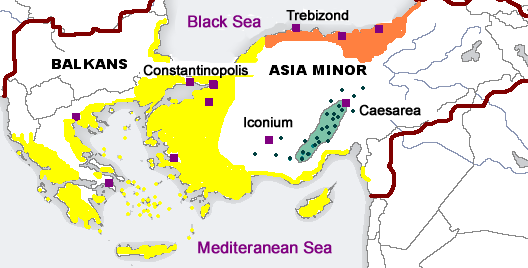
Map showing the distribution of Greek dialects in late Byzantine Empire!

Daskalot

New member
distribution_of_greek_dialects_in_late_byzantine_empire_en.png

Description

Distribution of Greek dialects during the late Byzantine Emptire, 12-15th centuries. Yellow, late Byzantine Koine Greek, which formed the foundation of Modern Greek; orange, Pontic Greek; green Cappadocian Greek.
Link to Wikipedia: http://en.wikipedia.org/wiki/File:Distribution_of_Greek_dialects_in_late_Byzantine_Empire_en.png

I found this map over at Wikipedia, I find it quite interesting.
Lets discuss the various aspects of it.

I have not obtained the original source of the map.

It seems as if ~90% of Macedonian territory did not have any Greek speakers. Wonder what language they used? Interesting is also that the largest territory inhabited by Greek speakers is not in the Balkans but rather in present day Turkey.
 
Like i said in "Kemal Atatürk was Macedonian!" thread, majority of Greek speakers was always in today`s Turkey `till 1924 population exchange. The Greek elite always lived around Izmir and Istanbul.

Also one more thing;
The Pontic and Cappadocian Greek most likely invented by Greek nationalists as late as 19th or 20th century. At 19th century, The language of the Christians in Pontic area was Turkish with considerable amount of Greek vocabulary. In the Cappadocia region, it was Turkish with few Greek words.


I did google search and i found this in wikipedia. It seems that some British scholars did a research about it at 1916 and here is the quote from the book;
Unfortunately, there are next to no written documents in Medieval or early Modern Cappadocian, as the language was and still is essentially without a written tradition. The earliest descriptions of Cappadocian date from the 19th century, but are generally not very accurate
...

Turkish influence appears at every level. The Cappadocian sound system includes the Turkish vowels ı, ö, ü, and the Turkish consonants b, d, g, š, ž, tš, dž. Turkish vowel harmony is found in forms such as düšündǘzu "I think", aor. 3sg düšǘntsü < düšǘntsi (Malakopi), from Turkish düşünmek, patišáxıs < patišáxis "king" (Delmeso), from Turkish padişah.

Agglutinative forms are also found in the verb system such as the pluperfect tense írta ton "I had come" (lit. "I came I was") (Delmeso) on the model of Turkish geldi idi (geldiydi). Although Cappadocian word order is essentially governed by discourse considerations such as topic and focus, there is a tendency towards the Turkish Subject Object Verb word order with its typological correlates (suffixation and pre-nominal grammatical modifiers).

http://en.wikipedia.org/wiki/Cappadocian_Greek_language


Inclusion of Turkish special vowels and consonants. Turkish vowel harmony. All the words they gave as example here are Turkish. Most importantly, "Subject-Object-Verb" word order and agglutinative features.

A language like this cant be Greek. It seems like they tried so hard to name their Turkish language as "Greek" at 1916. I didn't look for so-called "Pontic Greek" but i know, its Turkish again with some Byzantine Greek vocabulary.


So, like i said, if there was a language called "Pontic and Cappadocian Greek", its either mysteriously vanished without a record or it`s just a product of 19th and 20th century Hellenism ideas.

We also know that all Christians from central Anatolia(Cappadocia) and Black-sea(Pontus) regions couldn't speak Greek at all when they gone to Greece at 1924. Their language was this Turkish with some Byzantine Greek vocabulary. The reason of Greek vocabulary in their Turkish tongue was because they were Christians who were in contact with Greek patriarchy and their bibles and other books was published by them. Also they probably intermarried with Greek speaking Christians for 900+ years.
 
Last edited:
my problem with that map is that it can be misleading, while greek may have been spoken in those areas it certainly was not the only language nor was it the majority langauge in those areas.

greek was also a second language not a native one for many in the eastern roman empire
 
my problem with that map is that it can be misleading, while greek may have been spoken in those areas it certainly was not the only language nor was it the majority langauge in those areas.

greek was also a second language not a native one for many in the eastern roman empire
I agree osiris. If we were to draw a map of Australia and shade Melbourne, Sydney, Adelaide yellow, it would sugest there are Greek speakers in this area but does not mean it is Greek teritory or the main language is Greek.
 
my problem with that map is that it can be misleading, while greek may have been spoken in those areas it certainly was not the only language nor was it the majority langauge in those areas.


Ofc osiris. For example right before population exchange at 1923, Greece`s population was 2,1 million. They send 550.000 Muslim Turks to Turkey. So, there was only 1,5 million Christians in Greece, which includes Macedonians, Albanians, Gagauz Turks, Gypsies, Pomaks and others. One million Christians immigrated from Turkey to Greece but we know that about ~350.000(estimated) of these people could only speak Turkish.

On the other hand, Turkey`s population at 1927 was 14 million. AFAIK, Greek speaking people in Anatolia and current Greece was always minority after 14th century because of vast number of Turkish other settlers.
 
Last edited:
onur the modern turks bear very little physical resemblance to the other altaic speakers who look more asiatic can you explain how this came to be.
 
onur the modern turks bear very little physical resemblance to the other altaic speakers who look more asiatic can you explain how this came to be.


There are two reasons for this;

Like i explained here before, local people of Anatolia didn't vaporize after Turkish speaking people came here at 11th century. All of them intermarried with each other in time.

It`s widely accepted fact that the medieval Turkish language came to Europe with the Huns after 5th century then Cumans, Tatars, Oghuzs laters but no one can be %100 sure which chromosomes they bring here. Estimations are ""J2, G, N, Q".


Check my message below here;
"R1a, I, R1b, E1b1b" are typical DNA of Europeans, total of %34 in Turkey.

"J2, G, N, Q" are typical Eurasian DNA highest among Azerbaijani, Georgia to Finland, total of %41 in Turkey.

http://www.macedoniantruth.org/forum/showthread.php?p=53404#post53404


So, most probably %41 of Turkey`s current population has early medieval Turkish immigrant`s DNA and the other %34 carries ancient European people`s DNA. In Aegean side of Turkey some people still carries ~2500 year old DNA of Etruscan mummies. I saw a recent study few days ago, DNA test results shows that the people in Turkey with "Haplogroup R1B"(Primary haplogroup of current western Europeans) have oldest known, ~10.500 year old variety of it.


Second reason is, current Altaic/Turkish speakers at Caucasus like Turkmenistan, Uigurs, Tatars, Uzbekistan etc. mixed with Mongols after 13th century Genghis Khan era. Thats why they have slightly slant-eyes. Azerbaijani and Turks of Turkey didn't get effected much from the Mongol invasion because all of them escaped to Aegean Anatolia(maybe even further west) when Mongols came here. So, before the Mongol invasion, they were probably looking like us too, without any Asiatic slant-eyes appearance.


I saw this DNA study few days ago about Tatar population;

Mitogenomic diversity in Tatars from the Volga-Ural region of Russia

To investigate diversity of mitochondrial gene pool of Tatars inhabiting the territory of the middle Volga River basin, 197 individuals from two populations representing Kazan Tatars and Mishars were subjected for analysis of mitochondrial DNA (mtDNA) control region variation. In addition, 73 mitochondrial genomes of individuals from Mishar population were sequenced completely. It was found that mitochondrial gene pool of the Volga Tatars consists of two parts, but western Eurasian component prevails considerably (84% on average) over eastern Asian one (16%). Eastern Asian mtDNAs detected in Tatars belonged to a heterogeneous set of haplogroups (A, C, D, G, M7, M10, N9a, Y, Z), although only haplogroups A and D were revealed simultaneously in both populations. Complete mtDNA variation study revealed that the age of western Eurasian haplogroups (such as U4, HV0a and H) is less than 18,000 years, thus suggesting re-expansion of Eastern Europeans soon after the Last Glacial Maximum.

http://mbe.oxfordjournals.org/cgi/content/short/msq065v1?rss=1


Tatars was one of the most effected Turkish speaking group by Mongol invasion but it seems that they carry only %16 Mongoloid DNA but %84 of them still has Caucasoid DNA. So, even Tatars of Volga are primarily Caucasoid.

 
Last edited:
Wonder what language they spoke in Athens, it surely was not Greek, Albanian maybe? Funny that the capital of the modern Greek nation can not boast with '4000 years of Greek history'. What did they speak in Thessaly? Vlach perhaps? Does Megali Vlachia ring a bell?
 
At 19th century, The language of the Christians in Pontic area was Turkish with considerable amount of Greek vocabulary.
More 'mis-information'
Pontic is Turkish, with greek words?
Lets see how it is classified in reality -


http://multitree.linguistlist.org/codes/pnt


http://multitree.linguistlist.org/trees/15995@666029

As for Cappodocian, 2 results come up

First -


http://multitree.linguistlist.org/codes/cpg


http://multitree.linguistlist.org/trees/15995@666033

Second -


http://multitree.linguistlist.org/codes/cpg-wes


http://multitree.linguistlist.org/trees/15995@666036

Now I dont doubt that these languages/dialects are heavily influenced by Turkish, but they can hardly be considered 'Turkish with some Greek words".
These languages/dialects are clearly Greek at their root.


In the Cappadocia region, it was Turkish with few Greek words.

A language like this cant be Greek. It seems like they tried so hard to name their Turkish language as "Greek" at 1916. I didn't look for so-called "Pontic Greek" but i know, its Turkish again with some Byzantine Greek vocabulary.

So, like i said, if there was a language called "Pontic and Cappadocian Greek", its either mysteriously vanished without a record or it`s just a product of 19th and 20th century Hellenism ideas.

Their language was this Turkish with some Byzantine Greek vocabulary. The reason of Greek vocabulary in their Turkish tongue

Do you still stand by these statements Onur?
 
Last edited:
Do you still stand by these statements Onur?


Yes, I fully stand. I don't care if your nationalists managed to classify these languages as an extinct Greek dialect or not.

Read the quote of the British scholars in the book published at 1916. Is Greek agglutinative language with "Subject-Object-Verb" word order and has Turkish vowel harmony???


Read the book named "Karamalidika" written by Greek author and see if they had Greek or Turkish language or come to Turkey and see their Turkish bibles from 19th century. I think there are photos of these bibles in the book "Karamanlidika" too.


If you still deny, then show me one piece of paper written in Greek language by Cappadocians or even Pontic. You wont find any cuz there isn't exist. Like British and Germans couldn't find one evidence at 1916, you wont find either.

Unfortunately, there are next to no written documents in Medieval or early Modern Cappadocian, as the language was and still is essentially without a written tradition. The earliest descriptions of Cappadocian date from the 19th century, but are generally not very accurate
 
Last edited:
Yes, I fully stand.
Then you are a liar.
I don't care if your nationalists managed to classify these languages as an extinct Greek dialect or not.
My 'nationalists" !!??
:lol: :lol:
Did you even click the links!?
Go to the sites homepage, and check out their crudentials.
1 of their publishing partners is camebridge for gods sake!!

"My nationalists"??
Im embarassed for you :ninja::ninja:
 
Last edited:
Then you are a liar.

My 'nationalists" !!??
:lol: :lol:
Did you even click the links!?
Go to the sites homepage, and check out their crudentials.
Their publishing partner is camebridge for gods sake!!

"My nationalists"??
Im embarassed for you :ninja::ninja:


Yes, i clicked and i wonder how difficult it was, to make them classify non-existed Cappadocian Greek dialect as "extinct".

They probably needed that to cover up the fact that these people gone to Greece without knowing Greek language. You want me to look up my old posts and find the book quotes about their language???

There is another way; Go find an old man with descendants from Cappadocia in Greece and ask what kind of language his mother and father spoke. He will tell you exactly what i said if he is brave and honest enough.
 
Last edited:
Yes, i clicked and i wonder how difficult it was, to make them classify non-existed Cappadocian Greek dialect.
So all those univerities linguistic departments are mistaken on how they classify these languages/dialects, their origins/roots, and where they place them on the 'language trees'.....and you are in reality correct with the opposite stance?

hmmmmmmmmm

Seems like this is an easy one to figure out.
And you have the audacity to question other peoples educations.
Unreal
 
Last edited:
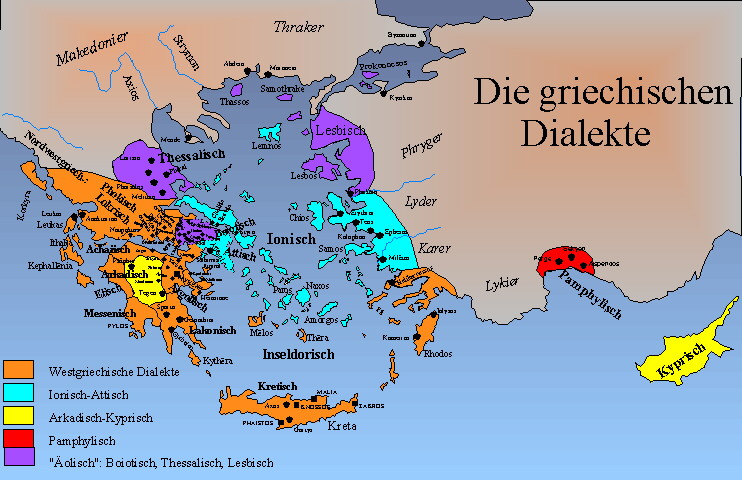
something similar from a German (university of Frankfurt) website

http://titus.fkidg1.uni-frankfurt.de/didact/karten/griech/grdialm.htm

grdia.jpg


Description:
Griechische Dialekte in der Antike
Greek dialects in ancient Times

Dialekte/dialects:
"Äolisch"
Achaiisch
Argolisch
Arkadisch-Kyprisch
Arkadisch
Attisch
Boiotisch
Elisch
Inseldorisch
Ionisch-Attisch
Ionisch
Kretisch
Kyprisch
Lakonisch
Lesbisch
Lokrisch
Messenisch
Nordwestgriechisch
Pamphylisch
Pamphylisch
Phokisch
Thessalisch
Westgriechische Dialekte

as we see, no "geek macedonian" dialect appears

same website also gives some informations about the use of so called "ancient greek alphabets"

http://titus.fkidg1.uni-frankfurt.de/didact/karten/griech/schrift/grabclm.htm

grabc.jpg
 
Like i said in "Kemal Atatürk was Macedonian!" thread, majority of Greek speakers was always in today`s Turkey `till 1924 population exchange. The Greek elite always lived around Izmir and Istanbul.

Also one more thing;
The Pontic and Cappadocian Greek most likely invented by Greek nationalists as late as 19th or 20th century. At 19th century, The language of the Christians in Pontic area was Turkish with considerable amount of Greek vocabulary. In the Cappadocia region, it was Turkish with few Greek words.


I did google search and i found this in wikipedia. It seems that some British scholars did a research about it at 1916 and here is the quote from the book;


Inclusion of Turkish special vowels and consonants. Turkish vowel harmony. All the words they gave as example here are Turkish. Most importantly, "Subject-Object-Verb" word order and agglutinative features.

A language like this cant be Greek. It seems like they tried so hard to name their Turkish language as "Greek" at 1916. I didn't look for so-called "Pontic Greek" but i know, its Turkish again with some Byzantine Greek vocabulary.


So, like i said, if there was a language called "Pontic and Cappadocian Greek", its either mysteriously vanished without a record or it`s just a product of 19th and 20th century Hellenism ideas.

We also know that all Christians from central Anatolia(Cappadocia) and Black-sea(Pontus) regions couldn't speak Greek at all when they gone to Greece at 1924. Their language was this Turkish with some Byzantine Greek vocabulary. The reason of Greek vocabulary in their Turkish tongue was because they were Christians who were in contact with Greek patriarchy and their bibles and other books was published by them. Also they probably intermarried with Greek speaking Christians for 900+ years.

In general I think you're right Onur. But, the first map was referring to the late Byzantine Empire (ie. 14th-15th century) and not in the 19th that you're referring to. What would be interesting is to know what was indeed happening in the late Byzantine Empire.

The map however clearly shows that only a part of the region of Macedonia was Greek speaking (which was conquered as far as I recall in the early 14th century).
 
The map however clearly shows that only a part of the region of Macedonia was Greek speaking (which was conquered as far as I recall in the early 14th century).

That is correct John. It was only coastal, it was the Ionian language and it was shared amongst trading partners around coastal regions nearby. I would hazard a guess and suggest the language of trade may quite easily have co-existed with other languages in the same regions e.g. Macedonian in Macedonia and Turkish in Turkey.
 
What would be interesting is to know what was indeed happening in the late Byzantine Empire.

The map however clearly shows that only a part of the region of Macedonia was Greek speaking (which was conquered as far as I recall in the early 14th century).


Byzantines kept a good record of the historical events, so we know who were these Turkish speaking Christians in Anatolia. Since 11th century, The armies of Byzantine Empire consisted with Turkish mercenary soldiers and they settled all of them in Balkans, Thrace and Anatolia. They were so many in numbers and they have been converted as Christians and some of them Hellenized. They intermarried with local Christian people and Byzantines called them as "Tourkopouloi".

This also bring their own destruction because most of these Turkish soldiers refused to fight vs Turkish army of Seljuk sultanate and Ottoman Empire and joined their side instead.

Probably after Mongol invasion at 13th century, there wasn't any Greek speakers left in Anatolia except Izmir and Istanbul.


You can read from these books;
http://books.google.com.tr/books?id=rUs-hHd89xAC&q=Tourkopouloi#v=snippet&q=Tourkopouloi&f=false

http://books.google.com.tr/books?id=jR-B1CnCft8C&q=Turkish#v=snippet&q=Turkish&f=false

http://books.google.com.tr/books?id=-FrplK7UVJYC&q=Turkish#v=snippet&q=Turkish&f=false
 
Last edited:
Probably after Mongol invasion at 13th century, there wasn't any Greek speakers left in Anatolia except Izmir and Istanbul.
Where in your links does it state that?
I apologize if ive missed it

How about the Pontic and Cappadocian speakers?
 
Back
Top