
• Welcome to the new Macedonian Truth Forum. All posts, members and private messages have been moved over from the old forum.

    Passwords from the old forum could not be carried over, so please use Forgot your password? to set a new one. The reset link is emailed to the address on your account.

  • Rules and Regulations at the forum of the Macedonian Truth Organisation (MTO)

    (1) The national-ethnic and cultural-linguistic identity of the Macedonian people is historically Macedonian, and derives its character from the native, indigenous and geographic homeland of the Macedonians, which is called Macedonia. To ensure that their human rights, integrity and heritage are appropriately respected, the only nouns and adjectives acceptable when reference is made to the above character and identity markers is Macedon, Macedonia, Macedonian and Macedonians.

    (2) The nation-state of the Macedonian people is the Republic of Macedonia, and is to be referred to by this official title so long as the 'republic' prefix is consistently applied to other states. Alternative references are the Macedonian Republic, or simply, Macedonia.

    (3) The 'ethnic' prefix is only acceptable for Macedonians in cases where differentiation is specifically required - so long as it is in context and consistent where it concerns its application to other ethnic groups.

    (4) Should any other differentiation be specifically required, the names of other ethnic groups that reside with Macedonians in either the Republic of Macedonia or the occupied Macedonian regions in Greece, Bulgaria, Serbia or Albania, are to be given a prefix.

    (5) Negating the identity, language and culture of the Macedonian people by deliberate avoidance of the terms Macedonia, Macedonian and Macedonians, or by any other means, is not permitted.

    (6) Systematic anti-Macedonian propaganda and rhetoric are not permitted.

    (7) Threads irrelevant to the Macedonian Cause, the community at the Macedonian Truth Organisation or the Macedonians in general may be considered as spam or not in the spirit of the forum. In such cases they are not permitted.

    (8) Continual posting of messages in threads with the sole purpose of deviating from the initial topics with the use of unrelated and unnecessary information is not permitted.

    (9) All posts, external articles, reports, etc that are cited in languages other than Macedonian or English, must be accompanied with a translation in one or both of the said languages.

    (10) Despite the possibility of some conversations and debates becoming heated, extreme abuse and/or racism, vulgar language and/or terminology, threats, revelation of personal information about others, harassment, and other such behavior will not be permitted. If deemed necessary all relevant information including member details will be reported to the appropriate authorities for investigation which may result in legal action.

    (11) Threads that are created must have a summary of a topic or excerpt of an article found in pertinent link(s) that have been included. One line threads will be considered unaccetable spam and are therefore not permitted.

    (12) Compulsive and deliberate lies, irrespective of the topic, are not permitted.

    (13) Any symbols or avatars found to be perceived as offensive to Macedonians are not permitted.

    (13) Any explicit or extreme material is not permitted.

    Failure to adhere to the above rules and regulations will result in a ban after 3 breaches. This may be reconsidered in some cases should the circumstances be of an unorthodox nature and/or require special consideration. To assure an effective deterrent against an individual or individuals with the sole purpose of causing dissent through spamming, racism or other improper means, the above rules will be strictly enforced.

    The MTO administration will monitor all discussions as reasonably practical and reserve the right to remove any post and/or member from the forum, and update the rules and regulations as required. Members are encouraged to immediately report any post and/or member to the MTO administration if they feel that these rules have not been abided by.

    The views expressed on this forum are those of the individuals. The only official representation of the MTO is made by the "Macedonian Truth Organisation (Site Owner)" username, and no other.

  • Macedonian Cause

    The Macedonian Truth Organisation calls on God in Heaven to protect, bless and guide the endeavour it is committing to undertake, and that is to work towards:

    Securing Macedonia as a free, independent and democratic republic in which sovereignty lies with the Macedonian citizens; as the nation-state of the Macedonian people in which they can preserve their culture, language and identity; as a state in which the Macedonian language and culture form the basis of public life and act as important unifying elements of Macedonian society; as the home of all its citizens to which it guarantees and obliges their inalienable natural rights and corresponding responsibilities;

    The acknowledgment as self-evident and irrefutable the existence of the:

    1) Indigenous, ethnonational name of Macedonia;
    2) Macedonian people, language and identity;
    3) Macedonian culture, symbols and folklore;
    4) Macedonian ancestry, heritage and history in its entirety; and
    5) Macedonian Orthodox Church;

    Securing recognition by the International Community of the tragedies endured by the Macedonian people, of the division of Macedonia with the signing of the Treaty of Bucharest on August 10, 1913, and the genocide committed against the Macedonian people at the hands of the Greek, Bulgarian and Serbian states and their respective churches during the 19th and 20th centuries;

    Ensuring that the Interim Accord is declared ‘null and void’ and that all constitutional provisions, acts, commitments, agreements, legislation, regulations, policies or programs emanating from, supporting or consequential to the Interim Accord are also declared ‘null and void’, including the use of any symbols and the completion of any acts imposed by, or originating from, the Interim Accord.

    Ensuring that the Framework Agreement is abolished and that all constitutional provisions, acts, commitments, agreements, legislation, regulations, policies and programs emanating from, supporting or consequential to the Framework Agreement are also abolished and replaced by a framework of constitutional and statutory law based on inalienable natural rights and corresponding responsibilities and universally codified human rights mechanisms.

    Securing the abolishment of any existing constitutional provisions, acts, agreements, legislation, regulations, policies and programs that discriminate against the Macedonian people, in any international organisation or any of the countries of the International Community where such constitutional provisions, acts, agreements, legislation, regulations, policies and programs exist, and thereby ensuring the freedom for Macedonians to exercise their inalienable natural rights and fulfil their corresponding responsibilities, and practice their culture, language and religious faiths in all the countries of the International Community without hindrance;

    The empowerment of Macedonians to undertake a moral revolution and to instil and/or reinvigorate within themselves a deep-rooted national, cultural, linguistic and historical dignity and a commitment to the exercise of freedom based on inalienable natural rights and corresponding responsibilities;

    The recognition of the Macedonian minorities in the neighbouring states of Macedonia as well as the respect for the inalienable rights and freedoms of the Macedonian minorities, as provided for by natural law and as codified by the United Nations Charter, the Universal Declaration of Human Rights and other universally codified human rights mechanisms;

    The full and unreserved respect of, and the support for, the rights of all people of non-Macedonian descent living in Macedonia and around the world, who share a reciprocal full and unreserved respect for the Macedonian people, their homeland and their state;

    The cultural unification and solidarity of the Macedonian people living in all parts of historical Macedonia and adjacent territories, as well as Macedonians throughout the world;

    The unity of all Macedonians on the principles, objectives and achievement of the Macedonian cause as defined by this declaration.

The Bulgarian ethnographer Vasil Kanchov, who was he?

Daskalot

New member
I am starting this thread so we can accumulate documents in regards to the Bulgarian ethnographer Vasil Kanchov.

He published a book in 1900 called "Macedonia — ethnography and statistics". Albeit Macedonians were denoted as Bulgarians in this book and on the including map.

What is very interesting is that in 1911 he published a book called "Orohydrography of Macedonia" in which he himself refutes the fact that the Bulgarians of Macedonia did not consider themselves Bulgarians but rather Macedonians only.

Title page.
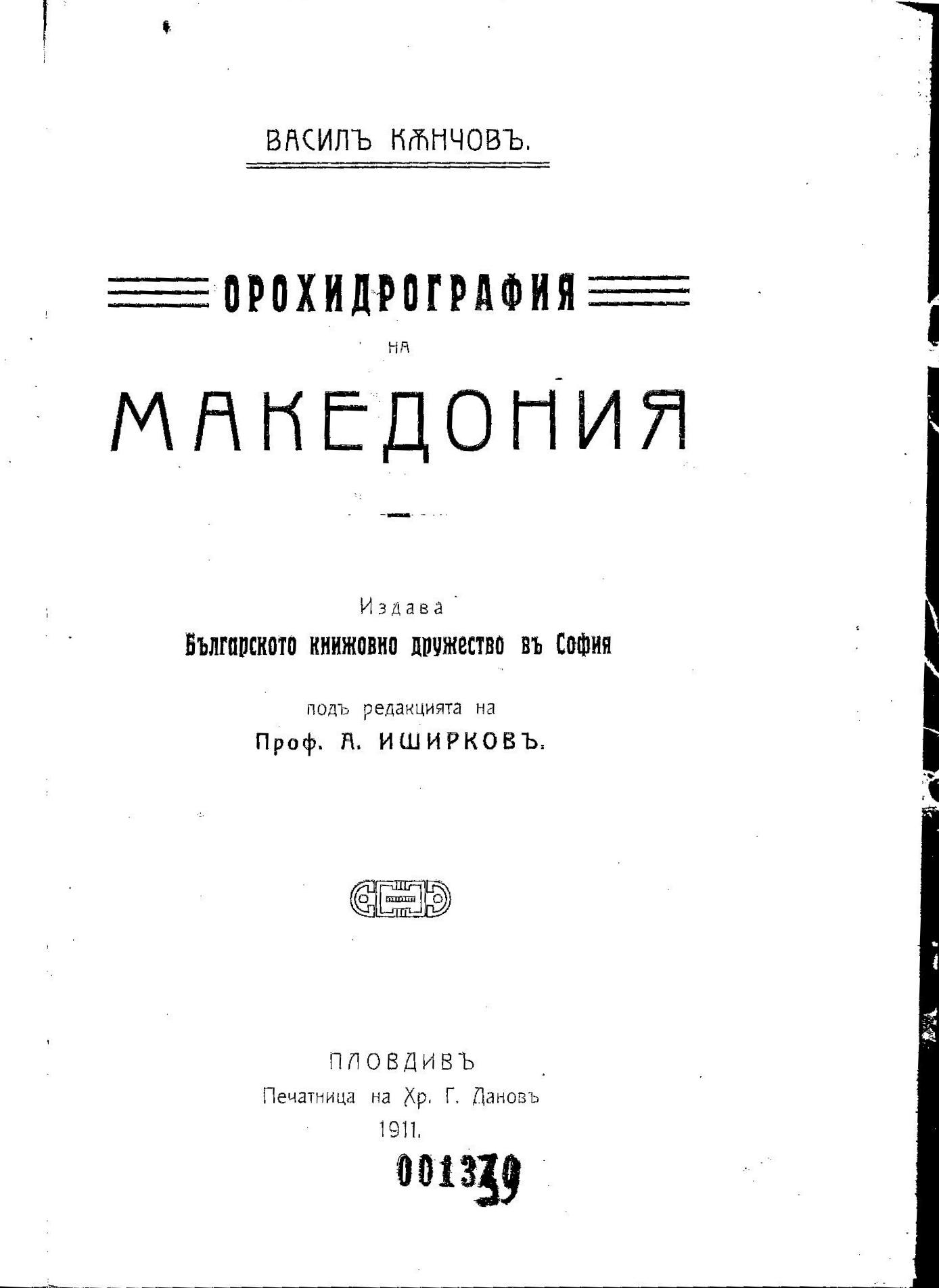
OrohidrografijaNaMakedonijaStrana1.jpg

First page.
OrohidrografijaNaMakedonijaStrana6.jpg


Here is the important passage on page one translated into English:
It is impossible to give precise borders of the area of Macedonia, since this country is not limited with some strict geographic features, nor is it administratively separated by the other countries. Only in the ethnographic sense Macedonia has defined borders, since the Bulgarian tribe is settled in the entire country, and rarely exits its limits. The areas to the north, west and south of Macedonia have predominantly other population. To determine its borders we will follow mainly the main perception of the population and the determination given by the most skilled recent travelers. The local Bulgarians and Kucovlachs who live in the area of Macedonia call themselves Macedonians, and the surrounding nations call them Macedonians. Turks and Albanians from Macedonia do not call themselves Macedonians, but when asked where they are from, they respond: from Macedonia... also Greeks who live in the southern area of Macedonia, do not call themselves Macedonians...

Greeks form Macedonia do not call themselves Macedonians........ :smartass:
 
hehe, nice1 Daskale, i know the begining of the quoted material, but never searched for the book to check it completely.

and the vulgaroi always used short quotes "prooving" their stupid theories.
----------

btw, he is very big enigma for me, couse in his biografy it writes he used to travel a lot in Macedonia, but his descriptions...

like example, in his first publications, the City of Bitola has 1 river, Dragora...

The problem is Bitola had 2 rivers, Dragor and Kurdelec. Kurdelec was covered - destroed by the communist after the ww2, actualy i think it was the 70s.

Someone gives in his work the number of the houses of some city, but fail to notice the city has 2 rivers?

So i guess i have to find and read more of his works, to have better picture about him.
 
Keep up the good work Daskalot!

Is there anything more about Albanians by Vasil Kanchov?

I ask because a friend of mine who know Macedonian translate to me some passages of G. Pulevski. If I am correct Pulevski did not see Albanians and Macedonians (of his time) as two distinct people. He noticed some similarity between two ethnic groups. Is that true?

Vasil Kanchov has written approx. 16 pages worth of Information about Albanians (Arnauts as he calls them) in his book Macedonia Ethnography and Statistics. He gives statistics of where the Albanians lived 100 years ago and gives some details regarding the colonisation of many parts of Macedonia by Albanians during the centuries long Ottoman Rule.

He doesn't shy away from history, he mentions the expulsion of Macedonians from the region south of Ohrid by Ali Pasha at the turn of the 19th century. he also talks about the Devoll region of Albania, which 150 years ago was full of both Macedonian and Albanian villages. All of the Macedonians were assimilated/fled due to conflict. His early history about the Albanians supports the idea that the ethnic boundary between the two peoples has slowly been moving East across the centuries. Once upon a time the ethnic boundary was West of Korca, by 1900 Albanians were on all sides of the Prespa and Ohrid lakes. Some even on the other sides near Lerin and Bitola, however these Albanians originate from Colonists from Albania.

For example, In his time the Macedonians and Macedonians Muslims near Peshkopia were already begginging to speak Albanian and identify as such.

He actually has written a lot about them, it depends on what you are looking for i guess. As always you have to look for the bias, which it is rife with.
 
From: http://en.wikipedia.org/wiki/Vasil_Kanchov

Vasil Kanchov was born in Vratsa. Upon graduating from High school in Lom, Bulgaria, he entered the University of Harkov, then in Russia. During the Serbo-Bulgarian War 1885 he suspended his education and took part in the war. Later, he went on to pursue studies at universities in Munich and Stuttgart, but in 1888 he interrupted his education again due to an illness.

In the following years Kanchov was a Bulgarian teacher in Macedonia. He was a teacher in the Bulgarian Men's High School of Thessaloniki (1888–1891), a director of Bulgarian schools in Serres district (1891–1892), a headmaster of Bulgarian Men's High School of Thessaloniki (1892–1893), а chief school inspector of the Bulgarian schools in Macedonia (1894–1897).

After 1898 Kanchov returned to Bulgaria and went into politics. In the beginning of 1902 he became an educational minister of Bulgaria, but was killed in his office by psychopath.


He travelled extensively after 1888, visiting and researching all over Macedonia.

So he was extremely well informed on the situation in Macedonia, since he visited each and every town, and many if not all, villages in Macedonia during his School Inspectorship. He naturaly was compelled to label all Macedonians as Bulgarians. It may have been his personal conviction, or it may have been just his obligation as an employee of the Bulgarian Exachate. But as a scientists, he was honest enough to admit that Macedonians do not self identify themselves as Bulgarians (or Serbs or Greeks) but simply as Macedonians (wihouth any additions or substrations), and that all the surrounding nations identify them as Macedonians. (He also mentioned that Greeks in Macedonia do not self identify themselves as Macedonians).

This is a remarkable find, and the credit goes to our brothers from Pirin Macedonia, form the newspaper www.narodnavolja.com, who discovered and published this few years ago. This is so big that it undermines the entire bulgarian propaganda. The leading bulgarian propagandist (thats who Kanchov was, since he was the Chief School Inspector in Macedonia for four years, in the most delicate period of the Macedonian Revival 1894–1897) admits that in spite of all his and Exarchate's efforst, and many milions of levs, drachmas and denars spent on propaganda, Macedonians still prefer to self identify themselves as Macedonians.

As to Epirotes question, Kanchov does mention Albanians as a separate nation, and they are included in his census. I can dig up some data for you if you want. But you are correct that the real ethnic border between Albanians and Macedonians was somewhat blurred. There were a number of people (villages) that were bilingual. By the toponims it looks like the Albanian language and culture was steadily advancing into the Macedonian (slavic speaking) teritory since the medieval times. The area of Matia, for example, now deeply in Albania, was known to be Slavic speaking.
 
Compliments to the Daskale and the people of www.narodnavolja.com.

I ask because a friend of mine who know Macedonian translate to me some passages of G. Pulevski. If I am correct Pulevski did not see Albanians and Macedonians (of his time) as two distinct people. He noticed some similarity between two ethnic groups. Is that true?

He was distinguishing between those who today are known as Albanians.

The Tosks he saw as some Fokians, the Arnauts he saw as shqipers, and the Ghegs from Macedonia who he saw as muslimized Mijaks. He says that the language of the Arnauts and the Tosks is very different, and this difference is even greater cause the Tosks have greek loan words.

He tells that the muslimized Mijaks came from Dolna Reka in Debar vicinity, and at the beginning they had two leaders, Suljo Garne from Vele Brdo and Shaban Gega from Pristojnica, from 1820 till 1835.

They were acctually leaders of the Gegi bashibouzuk. He also states that this Gegi bashibouzuk have plundered the churches of the Sveta Gora (Hilendar) and the holy items were all handed over to the Mijaks, their brothers.

How much that all is true is uncertain!
 
He gives statistics of where the Albanians lived 100 years ago and gives some details regarding the colonisation of many parts of Macedonia by Albanians during the centuries long Ottoman Rule.

Anyway, not all of his statements should be taken seriously since he saw things from Bulgarian angle. Albanian colonisation as an expression is it hard to sustain since no literary record speaks of any influx en masse of Albanians into Macedonia. If modern Albanians represent some remnants of ancient Illyrians (Ghegs) and Epirots (Tosks) there is no room for inventing an Albanian "colonisation" of Macedonia.
It is well-attested Illyrian presence in most of western territories in Macedonia. The only "colonisation" that can be taken seriously is moving of some Albanians in some North-Western districts of today's Bulgaria.
There are some traces of an Albanian immigration toward Bulgaria as many indications proof it:

Catholic settlers

Some of the earliest Albanian settlers in modern Bulgaria were the Roman Catholic ore miners in Kopilovtsi, Montana Province, a village in the vicinity of the larger mining centre Chiprovtsi. Kopilovtsi was settled between the 15th and the 17th century; a Catholic church was built in the early 17th century. Unlike the Catholic population in other villages of the region, Kopilovtsi's residents were of Albanian origin. In 1626, the Archbishop of Bar Pietro Masarechi claims that part of the Bulgarian Catholics are Albanians (Albanesi), Saxons and Paulicians. According to Bulgarian bishop Petar Bogdan, Kopilovtsi had 1,200 Catholics of Albanian origin who were still speaking the Albanian language in 1640. In another report from 1647, Petar Bogdan also lists 1,200 Albanian Catholics in Kopilovtsi, but notes that they have started using Slavic instead. By 1658, Petar Bogdan notes that the over 1,500 Albanians in Kopilovtsi spoke Bulgarian and only retained some traces of their original language. Kopilovtsi, along with Chiprovtsi, was depopulated with the crushing of the Chiprovtsi Uprising in 1688.[2]


Orthodox settlers
Albanian settlement in northern Bulgaria was not limited to Catholics—in a 1595 letter to the Prince of Transylvania, Ragusan merchant Pavel Đorđić notes that "in Bulgaria there are many villages inhabited by Albanians, from where 7,000 brave and well-trained men can be rallied". In the same letter, Đorđić claims that 1,500 of those Albanians lived near Tarnovo.[3]
Indeed, the toponym Arbanasi, a village near the city of Tarnovo, is a hint at Albanian settlement in the region. Arbanasi was populated (or repopulated) in the late 15th century and as an administratively autonomous village in the Ottoman Empire attracted many settlers. It is theorized that the first settlers were around 100–200 Albanians who were brought there during Bayezid II's campaigns in Albania. These settlers were gradually Hellenized and Bulgarianized in the following centuries.[4]
Other places in northern Bulgaria where an Albanian presence has been strongly suggested are Chervena Voda near Rousse, Poroishte near Razgrad, Dobrina near Provadia and Devnya near Varna.[5] Albanians have been registered in the modern Bulgarian capital Sofia since the early 17th century; other possible colonies south of the Balkan Mountains included Gorno Arbanasi and Dolno Arbanasi near Asenovgrad.[6] The most notable Albanian village in Bulgarian Thrace is Mandritsa near Ivaylovgrad, which was settled in the first half of the 17th century by settlers from near Korçë. A church was built in 1718.[7] The village reached its demographic peak before the Balkan Wars; in 1912, it was inhabited by 1,879 people.[8]

Originally posted by Mastika

He doesn't shy away from history, he mentions the expulsion of Macedonians from the region south of Ohrid by Ali Pasha at the turn of the 19th century. he also talks about the Devoll region of Albania, which 150 years ago was full of both Macedonian and Albanian villages. All of the Macedonians were assimilated/fled due to conflict.

I am somehow dubious for such occurrence since as far I know for Ali Pasha's period there is no expulsion of Macedonians. It is true that there were some conflicts between some Vlachs pastoral communities and Ali Pasha's government but this was true as well as for Albanians since Ali Pasha's cruelty had no boundary. He behaved bad even to his Albanian followers. There are many cases when Albanian villages were forced to move on in order to safe from Ali's repercussions.

Originally posted by Mastika

Once upon a time the ethnic boundary was West of Korca, by 1900 Albanians were on all sides of the Prespa and Ohrid lakes. Some even on the other sides near Lerin and Bitola, however these Albanians originate from Colonists from Albania.

This cannot be sustain since earlier Byzantine accounts makes known that Albanians lived in Ohrid and some regions in upper Haliacmon.

Originally posted by Mastika

For example, In his time the Macedonians and Macedonians Muslims near Peshkopia were already begginging to speak Albanian and identify as such.

Reference please?
 
The local Bulgarians and Kucovlachs who live in the area of Macedonia call themselves Macedonians, and the surrounding nations call them Macedonians. Turks and Albanians from Macedonia do not call themselves Macedonians, but when asked where they are from, they respond: from Macedonia... also Greeks who live in the southern area of Macedonia, do not call themselves Macedonians...


This should be the truth. My grandmother always told us same for Petrich at pre-1913 era. She was always telling us that the christians in that town was Macedonians. She never told us like they were Bulgars. If these people would identify themselves as Bulgars, then my grandmother would say us that they were Bulgars. Also whenever someone asked her about where she was from, she was telling us that she is from Macedonia. And you know, Petrich is in far north, so close to Bulgar populated areas. So, if the people in Petrich considered themselves as Macedonians, then there is no way that the people at southern sides would have been identified themselves as Bulgars either.

Also whenever she gets a bit nervous or joyous, she was starting to speak in a language which was foreign to me or speaking in Turkish with foreign words. When i asked her like "what are you telling me, i don't understand. Whats this language?". Then she was responding like "Makedonca" in Turkish, so "Macedonian language".


It is true that there were some conflicts between some Vlachs pastoral communities and Ali Pasha's government but this was true as well as for Albanians since Ali Pasha's cruelty had no boundary. He behaved bad even to his Albanian followers. There are many cases when Albanian villages were forced to move on in order to safe from Ali's repercussions.


You guys talking about the rebellious Albanian Ali pasha? Later killed by the Sultan`s order because of his actions?
 
Also whenever she gets a bit nervous or joyous, she was starting to speak in a language which was foreign to me or speaking in Turkish with foreign words. When i asked her like "what are you telling me, i don't understand. Whats this language?". Then she was responding like "Makedonca" in Turkish, so "Macedonian language".

Do you remember any of the words? If your grandmother is alive, could you ask her to tell you some words in Makedonca?
 
Do you remember any of the words? If your grandmother is alive, could you ask her to tell you some words in Makedonca?


She passed away at 1993 but i remember few words;

draska; for something big, huge(and she was saying "Drazman" for tall and fat men, "katana" for tall and fat women :))
gushtiri OR gushturi; lizard like animal
pisha; pee, piss
kopcha; pants or shirt button
neshmasha OR neshmishi; for clumsy person
selenka OR selanka; villager, hick
sedankah; she was using this when we were going to visit our relatives. Probably it`s something like "meeting, visit", not sure.


Thats all i remember atm. I still use draska and kopcha myself and my brother and sister too :) I tried to write those with english pronunciation but maybe it`s wrong, i am not sure... My uncle knows many more words and expressions than me, i gotta ask him when i see :)
 
Last edited:
Onur,

You remembered them well. That is exactly how you would say lizard or button or clumsy in South-Eastern dialect of Macedonian:

Here is the standard Macedonian (almost the same):

gushter - lizard
kopche - button
nesmasen - clumsy
selanka - female villager (often derogatory)
draska though is a scratch. It may be a local word of the Pirin dialects that I'm not familiar with.
Pisha is a common word for Pirin dialects and it does mee pee. Standard word is mocha.

Good memory. May your grandma rest in peace, and God bless her for remembering these Macedonian words and teaching her offspring of their past and culture...
 
Onur,

Good memory. May your grandma rest in peace, and God bless her for remembering these Macedonian words and teaching her offspring of their past and culture...


Thanks for your kind words GStojanov. I remember these words cuz we still use it and my grandparents was from the first wave of immigrants who escaped because of Balkan war but most of 1960s immigrants and their kids can speak Macedonian.


I remembered one more word :);

Pishkir; for a piece of cloth to clean something
 
Yea, peshkir (or piskir in the south-western Macedonian dialect) means a towel.

My father has a close friend that moved to Izmir. They actually came and visited us. They used to teach in the same school (my father was a math teacher, and afterwards the pricipal of the school, and this man was teaching Turkish, the school was multiethnic as many schools in Macedonia still are).

We still have a Turkish minority, it is second only to Albanians, and unlike Albanians (which I must say are often unloyal) the Turkish minority is very well integrated and extremely loyal. I remember when I was in High School they asked us to volunteer to dig ditches to bring water for two turkish villages that were high in the mountains. We volunteered for five Sundays, until we completed the project (around 8 miles of ditches).

I also remember that the best looking girl in my generation (High School) was also Turkish.
 
Anyway, not all of his statements should be taken seriously since he saw things from Bulgarian angle.

Of course, we should all be aware of bias. By labelling Macedonians as Bulgarians, Kanchov is presenting bias, however this does not mean that the statistics cannot be used effectively.


There are some traces of an Albanian immigration toward Bulgaria as many indications proof it:

This is true, however this was only a fraction of Albanian emigration to other parts of the Ottoman Empire. For example, the former Albanian villages around Ibrik Tepe, in Thrace, were also formed directly as a result of emigration from Albania.

I am somehow dubious for such occurrence since as far I know for Ali Pasha's period there is no expulsion of Macedonians. It is true that there were some conflicts between some Vlachs pastoral communities and Ali Pasha's government but this was true as well as for Albanians since Ali Pasha's cruelty had no boundary. He behaved bad even to his Albanian followers. There are many cases when Albanian villages were forced to move on in order to safe from Ali's repercussions.

Macedonia, Ethnography and Statistics ,page 84.

"Неговата власть отъ 1788 до 1820 год. е съдѣйствувала на арнаутското население да се укрѣпи въ Корченско и да захване южния брѣгъ на Охридското Езеро, отъ дѣто останалото българско население или избѣгало, или било избито въ врѣме на междуособицитѣ."

Translation: Ali Pasha's rule from 1788 until 1820 strengthened the Albanian population in Korca and allowed it to spread to the southern shores of Lake Ohrid, where the Macedonian population either fled or was killed in the fighting.

Reference please?

Albanisation of Macedonian’s villages was extremely Rampant during the 19th century.

Macedonia - Ethnography and Statistics, page 90.

"Цѣлиятъ Горни Дебъръ е заплашенъ отъ поарнаутчанье. Българо-мухамеданскитѣ села, които допиратъ до арнаутски села, сѫ вече двуезични. Жителитѣ на селата Острени, Търново, Кленье, Летенъ, Джепища, Ѫрбеле, Обоки, Макелари и др. прѣдпочитатъ да се казватъ арнаути и да говорятъ арнаутски. Торбешитѣ отъ с. Рàица, най-южно отъ подримскитѣ потурчени села, говорятъ повечето арнаутски и се броятъ вече като арнаути. Отъ друга страна християнското българско население се изселва много бързо отъ мѣстноститѣ Голо Бърдо, Пòле и Жупа. Селата Вичища, Голейща и Писанки сѫ били въ началото на XIX. вѣкъ български, прѣди 30 години били наполовинъ български, а сега сѫ заселени отъ арнаути. Арнаутитѣ идатъ отъ сѣверни мѣста."

Translation: All Upper Debar is at risk of being Albanised. The Macedonian Muslims living next to the Albanian villages are already bilingual. The inhabitants of Dzepishte, Ostreni, Trnovo, Klenje, Leten, Erbele, Oboki, Makelari and others; prefer to call themselves Albanians and to speak Albanian. The Torbeshi from Village Rajca, the most Southern of the Islamise Drimkol villages, speak more Albanian and count themselves as Albanians. However, the Christian Macedonian population very quickly is emigrating from Golo Brdo, Debarsko Pole and Zhupa. The villages of Vichishta, Goleishta and Pisanki, were, at the beginning of the 19th century purely Macedonian, 30 years ago they were only half Macedonian, however, now they are inhabited only by Albanians. The Albanians have come from the North" Note: the village of Erbele is only about 6km's from Peshkopi.

Page 89.
“Докторъ Мюлеръ, който е пѫтувалъ по тия мѣста прѣзъ 1837—38 год., свидѣтелствува, че село Фердово (Фъргово) имало смѣсено население отъ арнаути и славѣни, и село Калище било чисто славѣнско. [4] Сега Фъргово е чисто арнаутско село, а въ Калище има само 1 останала българска кѫща.”

Translation: Doctor Muller, who visited Macedonia in 1837-38, witnessed that Frangovo had a mixed Macedonian/Albanian population, whilst Kalishta was purely Macedonian. Now, Frangovo Is completely Albanian, whilst in Kalishta only one household of Macedonians remain.

Page 93.
“Отъ половината на XIX. столѣтие много бързо изчезва българското население изъ Гостиварската Нахия и се замѣстя съ арнаути, или пъкъ селата запустяватъ.”

Translation: During the second half of the 19th century the Macedonian population in the Gostivar nahiya began to leave en masse, Albanians settled in the former Macedonian villages or the village went empty.

Albanian colonisation as an expression is it hard to sustain since no literary record speaks of any influx en masse of Albanians into Macedonia. If modern Albanians represent some remnants of ancient Illyrians (Ghegs) and Epirots (Tosks) there is no room for inventing an Albanian "colonisation" of Macedonia.
It is well-attested Illyrian presence in most of western territories in Macedonia. The only "colonisation" that can be taken seriously is moving of some Albanians in some North-Western districts of today's Bulgaria.

I have already mentioned the Albanian colonisation of Eastern Thrace, but let's see what else Kanchov has to say on the matter. There was mass Albanian colonisation of many parts of todays Macedonia.

Page 86.
"Въ Костуръ има около 50 кѫщи християни арнаути, прѣселени прѣзъ XIX. в. откъмъ Епиръ."

Translation: In Kostur there are 50 Christian Albanian houses, Epirotes who arrived in the 19th century.

Page 88.

"Послѣднитѣ двѣ села сѫ прѣселени изъ Епиръ изъ голѣмото село Пилкадесъ въ Коницка Каза. Около 1840 год. сѫ дошли тукъ бѣлъ-каменци, а около 1860 год. негованци."

Translation: The Last two villages (Bel Kamen and Negovan, Lerin region) are populated by emigrants from the Epir, from the big villages of Plikades in the Konica kaza. Those in Bel Kamen arrived in the 1840s whilst those in Negovan arrived in 1860.

page 91.

"Още по-силенъ е напрѣдъкътъ на арнаутитѣ въ Пóле... Село Граждани е било до скоро българско. Арнаути дошли малко прѣди 50 год. и сега тѣ сѫ болшинство."

Translation: The Albanians have been even more successful on the Debar Pole. Until recently, Grazdani was Macedonian. The Albanians arrived 50 years ago, and now they are the majority there.

Page 93.

“Особно се усилила арнаутската колонизация въ Пологъ къмъ края на XVIII. в., когато въ Тетово владѣли самовластни паши отъ арнаутско потекло, които нарочно докарвали арнаути изъ Албания…. Сѫщото е и съ Флорино и Чаиле. Арнаутитѣ въ с. Корито сѫ доведени на мѣстото на напустено българско селище въ началото на XIX. в. отъ тетовскитѣ паши изъ близосѣдната Рѣка.”

Translation: The Albanian colonisation of the Polog valley began to exacerbate at the end of the 18th century. During this time in Tetovo the local pasha’s, who were of Albanian origin, brought in workers from Albania to work the fields… The same with the villages of Florina and Chajle, as Alabanians from Korito village were brought in to settle the newly vacated Macedonian villages around the turn of the 19th century, on the request of the pasha’s in Tetovo.

Page 94.

“Арнаутитѣ въ с. Яголъ сѫ прѣселени отъ албалско село Блаце около 1830 год…. Въ с. Поповяни арнаути сѫ дошли около 1840 год. изъ Дебъръ”

Translation: The Albanians in the village Jagol resettled in 1830 from the Albanian village of Blace…. In Popovjani the Albanians arrived around 1840 from Debar.

Page 87.

“Пó на сѣверъ арнаутски колонии има въ Долна Прѣспа. Тѣ сѫ дошли тукъ изъ Корченско въ по-ново врѣме и държатъ западния брѣгъ на двѣтѣ прѣспански езера. Споредъ събиранитѣ свѣдѣния отъ Пукевила въ началото на XIX. в. Прѣспа е била населена само съ българи.”

Translation: To the north there are Albanian colonies in lower prespa. They are recent arrivals from the Korca kaza and they occupy the Western shore on both the large and small Prespa lakes. According to F. Pouqueville at the beginning of the 19th century, prespa was populated by only Macedonians.

As You can see there is strong evidence showing the graudal Colonisation of Macedonia by Albanians, coupled with the Albanisation of Macedonian people. Do you deny that either one/both happened?

Btw. I have only used the word "българско" because the quotes are directly from Kanchov, for no other reasons. I will not respond if i am attacked on this issue.
 
Last edited:
Epirot said:
This cannot be sustain since earlier Byzantine accounts makes known that Albanians lived in Ohrid and some regions in upper Haliacmon.
Epirot, which 'Byzantine' accounts make reference to Albanians living in Ohrid?
 
First, there is no mention of 'Albanians'.

Second, there is no indication they lived on the territory of RoM before 14th century.


Заселването на албанците в Долни Дебър е позволило тяхното пнататъшно придвижване в източна посока.

В съседната област Горна Река, лежаща около поречието на р. Радика, албанците вероятно са се установили трайно още през XIV в. Може да се приеме, че Горна Река и Полог са първите западномакедонски области, в който още през XIV в. е имало масови заселвания на албанци.

Първото свидетелство за наличието на албанци в Горна Река е гореспоменатият османски данъчен регистър от 1467 г.

Тук албански лични имена преобладават в села със славянски названия като Вълковия, Търница, Кракорница, Стрезимир, Рибничица(121). Смесеният етнически характер на вилает Река не е убегнал от погледа на османския данъчен регистратор.
http://www.imir-bg.org/imir/books/albanci_v_iztochnite_balkani.pdf


Third, the 'Albanians' were nomadic migrants, they often removed from one to another place and this doesn't imply their authochtonous existance in the regions they migrated.

n.
1.A member of a group of people who have no fixed home and move according to the seasons from place to place in search of food, water, and grazing land.
2.A person with no fixed residence who roams about; a wanderer.
[French nomade, from Latin nomas, nomad-, from Greek nomas, wandering in search of pasture.]

Fourth, one Arvanite rich family is known to live in Ohrid, not 'Albanians' in plural.

There is another place called ?the town of Ohrid which is also called Dibra ?and which is an archbishopric. This town of Ohrid has a fine countryside, which earns it well over twelve thousand ducats of gold. This region belonged to Lord Groppa who was married to Lady Chiranna, the second daughter of Lord Andrew Muzachi the Despot, and since he had no heirs, it belongs to us.


Во отоманскиот попис од 1452 - 1453 година, се забележани само 32 албански семејства на територијата на цела Македонија и тоа 31 семејство во вилаетот Калканделен (Полог) и 1 католичко семејство во Скопје.

The Ottoman census from 1452 - 1453 year, recorded only 32 Albanian families throughout Macedonia, 31 family in the vilayet Kalkandelen (Polog) and a Catholic family in Skopje.

http://mk.wikipedia.org/wiki/Македонски_Албанци
 
Last edited:
Keep up the good work Daskalot!

Is there anything more about Albanians by Vasil Kanchov?

I ask because a friend of mine who know Macedonian translate to me some passages of G. Pulevski. If I am correct Pulevski did not see Albanians and Macedonians (of his time) as two distinct people. He noticed some similarity between two ethnic groups. Is that true?


Vasil Kanchov had this to say about the Albanians:

"The Arnaut inhabitants in Macedonia are rude forces that terrorize, hurt and depersonalize the Macedonian Christian people. Arnauts present something that causes horror in the Macedonian country." - Vasil Kancov, Selected Works pg 379.
 
Epirot, which 'Byzantine' accounts make reference to Albanians living in Ohrid?

In a collection of Byzantine accounts for Albanians (published in Albania 'Byzantine sources about Albanians from X-XV century) are listed all Byzantine chroniclers who wrote for Albanians. One of them, L.Chalcocondyles makes known that Albanians used to live in outskirts of Aegean Sea.

Indeed, the center of the Albanians remained the river Mat, and in 1079 AD they
are recorded in the territory between Ohrid and Thessalonika as well as in Epirus.


http://www.101languages.net/albanian/history.html
 
Vasil Kanchov had this to say about the Albanians:

"The Arnaut inhabitants in Macedonia are rude forces that terrorize, hurt and depersonalize the Macedonian Christian people. Arnauts present something that causes horror in the Macedonian country." - Vasil Kancov, Selected Works pg 379.

It is an extremely biased statement since Albanians at the time were human being not aliens. Albanians suffered the same fate as Macedonians. Those who try to depersonalize and dehumanize us were Bulgars, Greeks and Serbs.
While Albanians did their best to liberate Macedonia from Ottomans, Serbs and Nazi-Fascists.

1. Struggles against Nazi-Fascism

The expanding effort of the Macedonian people and nationalities — the Albanians, Turks, Vlachs, Serbs, Romanies, Jews and others — anticipated the massive anti-fascist and liberation insurrection.

~ Macedonian review~ Kulturen Život - 1995

Part of the Albanians in western Macedonia joined the armed resistance led by the CPY, and later by the Communist Party of Macedonia (CPM). The first partisan company consisting solely of Albanians was formed in the middle of July 1943. It strongly agitated the Albanian population, leading to the influx of new Albanian fighters. This number increased further after the capitulation of Italy, when entire Albanian carbine companies, which used to act within the Italian occupational system, defected to the resistance. Some of their fighters became distinguished commanders of large military units, as is the case with Hamdi Dema and Tom Gjela. The commander of the Debar partisan detachment, Hadzi Leshi (also known as Captain Leshi) was particularly respected and popular with the Albanian population.

With the anti-fascist resistance in Macedonia flaring up, several Albanian brigades were formed. The Albanian detachments from Debar and Kichevo were known as the 4th Albanian Brigade, led by Nejat Agoli and Jafer Kodra. Later this brigade was renamed the 7th Albanian Assault Brigade, with around 2,500 fighters, who participated in the liberation of Struga, Kichevo, Gostivar and Tetovo.

The Albanians from Macedonia contributed greatly not only to the liberation of Macedonia, but also to the final operations in the liberation of Yugoslavia. Famous Albanians - national heroes that died during the anti-fascist struggle - include Bajram Shabani, born in Lipkovo, and Ibe Palikukja and Liman Kaba, from Debar.

http://www.lobi.com.mk/default.asp?ItemID=4532C7571730FD40A2295AFA303687C8

2. Struggles against Ottomans

For twenty-five years these Macedonians had been organized into revolutionary fighting bands, the ‘Macedonian Committee’ for the liberation of Macedonia and Albanians from the Turks, and had struggled, not only against the Turks, but against foreign armed bands of propagandists.

http://books.google.com/books?id=su...&resnum=5&ved=0CDgQ6AEwBA#v=onepage&q&f=false

3. Struggles against Serbian occupation

Охридско-Дебaрско вoстание

The Ohrid-Debar uprising (Macedonian: Охридско-Дебaрско вoстание; Bulgarian: Охридско-Дебърско въстание) was an uprising in Western Macedonia in September 1913. It was organized by the Internal Macedonian Revolutionary Organization (IMRO) and by local Albanian leaders against the Serbian occupation of the regions of Ohrid, Debar and Struga.
The rebellion started only two months after the end of the Second Balkan War. Local Albanians and Macedonians, led by Petar Chaulev, Milan Matov and Pavel Hristov expelled the Serbian army and officials, creating a front line 15 km east of Ohrid. A local administration was set up in Ohrid under the leadership of Lev Ognenov.[1]
After a fortnight of fierce fighting, a Serbian army of 100,000 regulars suppressed the uprising.

I cannot realize why some Macedonians today are having pro-Serbian sympathies!? Have they forgotten their history? How could they consider Serbs as a friends of Macedonian people when Milloshevic publicly attempted to annex North-Eastern Macedonia, specifically Skopje-Crna Gora in his attempts for so called 'Republic of Karadak'.

Inspired by his promptings, Macedonia's Democratic Serbian Party, formed after the republic declared its indipedence, set about trying to establish a separate 'Karadag Republic' in the northern parts of the country where most Serbs live: Skopska Crna Gora (Skopje Black Moutain) and KUmanovska Dolina (Kumanovo Valley)

Burimi: http://books.google.com/books?id=BYa...dolina&f=false

Therefore stop seeing Albanians as enemies of Macedonian people. We have common interests and common enemies!
 
Last edited:
It is an extremely biased statement since Albanians at the time were human being not aliens. Albanians suffered the same fate as Macedonians. Those who try to depersonalize and dehumanize us were Bulgars, Greeks and Serbs.
While Albanians did their best to liberate Macedonia from Ottomans, Serbs and Nazi-Fascists.

1. Struggles against Nazi-Fascism


2. Struggles against Ottomans


3. Struggles against Serbian occupation

Охридско-Дебaрско вoстание


I cannot realize why some Macedonians today are having pro-Serbian sympathies!? Have they forgotten their history? How could they consider Serbs as a friends of Macedonian people when Milloshevic publicly attempted to annex North-Eastern Macedonia, specifically Skopje-Crna Gora in his attempts for so called 'Republic of Karadak'.


Therefore stop seeing Albanians as enemies of Macedonian people. We have common interests and common enemies!


I think he is referring to the outlaw bands that terrorized the villages in Macedonia, not the Albanian people in general.
 
Back
Top