• Welcome to the new Macedonian Truth Forum. All posts, members and private messages have been moved over from the old forum.

    Passwords from the old forum could not be carried over, so please use Forgot your password? to set a new one. The reset link is emailed to the address on your account.

  • Rules and Regulations at the forum of the Macedonian Truth Organisation (MTO)

    (1) The national-ethnic and cultural-linguistic identity of the Macedonian people is historically Macedonian, and derives its character from the native, indigenous and geographic homeland of the Macedonians, which is called Macedonia. To ensure that their human rights, integrity and heritage are appropriately respected, the only nouns and adjectives acceptable when reference is made to the above character and identity markers is Macedon, Macedonia, Macedonian and Macedonians.

    (2) The nation-state of the Macedonian people is the Republic of Macedonia, and is to be referred to by this official title so long as the 'republic' prefix is consistently applied to other states. Alternative references are the Macedonian Republic, or simply, Macedonia.

    (3) The 'ethnic' prefix is only acceptable for Macedonians in cases where differentiation is specifically required - so long as it is in context and consistent where it concerns its application to other ethnic groups.

    (4) Should any other differentiation be specifically required, the names of other ethnic groups that reside with Macedonians in either the Republic of Macedonia or the occupied Macedonian regions in Greece, Bulgaria, Serbia or Albania, are to be given a prefix.

    (5) Negating the identity, language and culture of the Macedonian people by deliberate avoidance of the terms Macedonia, Macedonian and Macedonians, or by any other means, is not permitted.

    (6) Systematic anti-Macedonian propaganda and rhetoric are not permitted.

    (7) Threads irrelevant to the Macedonian Cause, the community at the Macedonian Truth Organisation or the Macedonians in general may be considered as spam or not in the spirit of the forum. In such cases they are not permitted.

    (8) Continual posting of messages in threads with the sole purpose of deviating from the initial topics with the use of unrelated and unnecessary information is not permitted.

    (9) All posts, external articles, reports, etc that are cited in languages other than Macedonian or English, must be accompanied with a translation in one or both of the said languages.

    (10) Despite the possibility of some conversations and debates becoming heated, extreme abuse and/or racism, vulgar language and/or terminology, threats, revelation of personal information about others, harassment, and other such behavior will not be permitted. If deemed necessary all relevant information including member details will be reported to the appropriate authorities for investigation which may result in legal action.

    (11) Threads that are created must have a summary of a topic or excerpt of an article found in pertinent link(s) that have been included. One line threads will be considered unaccetable spam and are therefore not permitted.

    (12) Compulsive and deliberate lies, irrespective of the topic, are not permitted.

    (13) Any symbols or avatars found to be perceived as offensive to Macedonians are not permitted.

    (13) Any explicit or extreme material is not permitted.

    Failure to adhere to the above rules and regulations will result in a ban after 3 breaches. This may be reconsidered in some cases should the circumstances be of an unorthodox nature and/or require special consideration. To assure an effective deterrent against an individual or individuals with the sole purpose of causing dissent through spamming, racism or other improper means, the above rules will be strictly enforced.

    The MTO administration will monitor all discussions as reasonably practical and reserve the right to remove any post and/or member from the forum, and update the rules and regulations as required. Members are encouraged to immediately report any post and/or member to the MTO administration if they feel that these rules have not been abided by.

    The views expressed on this forum are those of the individuals. The only official representation of the MTO is made by the "Macedonian Truth Organisation (Site Owner)" username, and no other.

  • Macedonian Cause

    The Macedonian Truth Organisation calls on God in Heaven to protect, bless and guide the endeavour it is committing to undertake, and that is to work towards:

    Securing Macedonia as a free, independent and democratic republic in which sovereignty lies with the Macedonian citizens; as the nation-state of the Macedonian people in which they can preserve their culture, language and identity; as a state in which the Macedonian language and culture form the basis of public life and act as important unifying elements of Macedonian society; as the home of all its citizens to which it guarantees and obliges their inalienable natural rights and corresponding responsibilities;

    The acknowledgment as self-evident and irrefutable the existence of the:

    1) Indigenous, ethnonational name of Macedonia;
    2) Macedonian people, language and identity;
    3) Macedonian culture, symbols and folklore;
    4) Macedonian ancestry, heritage and history in its entirety; and
    5) Macedonian Orthodox Church;

    Securing recognition by the International Community of the tragedies endured by the Macedonian people, of the division of Macedonia with the signing of the Treaty of Bucharest on August 10, 1913, and the genocide committed against the Macedonian people at the hands of the Greek, Bulgarian and Serbian states and their respective churches during the 19th and 20th centuries;

    Ensuring that the Interim Accord is declared ‘null and void’ and that all constitutional provisions, acts, commitments, agreements, legislation, regulations, policies or programs emanating from, supporting or consequential to the Interim Accord are also declared ‘null and void’, including the use of any symbols and the completion of any acts imposed by, or originating from, the Interim Accord.

    Ensuring that the Framework Agreement is abolished and that all constitutional provisions, acts, commitments, agreements, legislation, regulations, policies and programs emanating from, supporting or consequential to the Framework Agreement are also abolished and replaced by a framework of constitutional and statutory law based on inalienable natural rights and corresponding responsibilities and universally codified human rights mechanisms.

    Securing the abolishment of any existing constitutional provisions, acts, agreements, legislation, regulations, policies and programs that discriminate against the Macedonian people, in any international organisation or any of the countries of the International Community where such constitutional provisions, acts, agreements, legislation, regulations, policies and programs exist, and thereby ensuring the freedom for Macedonians to exercise their inalienable natural rights and fulfil their corresponding responsibilities, and practice their culture, language and religious faiths in all the countries of the International Community without hindrance;

    The empowerment of Macedonians to undertake a moral revolution and to instil and/or reinvigorate within themselves a deep-rooted national, cultural, linguistic and historical dignity and a commitment to the exercise of freedom based on inalienable natural rights and corresponding responsibilities;

    The recognition of the Macedonian minorities in the neighbouring states of Macedonia as well as the respect for the inalienable rights and freedoms of the Macedonian minorities, as provided for by natural law and as codified by the United Nations Charter, the Universal Declaration of Human Rights and other universally codified human rights mechanisms;

    The full and unreserved respect of, and the support for, the rights of all people of non-Macedonian descent living in Macedonia and around the world, who share a reciprocal full and unreserved respect for the Macedonian people, their homeland and their state;

    The cultural unification and solidarity of the Macedonian people living in all parts of historical Macedonia and adjacent territories, as well as Macedonians throughout the world;

    The unity of all Macedonians on the principles, objectives and achievement of the Macedonian cause as defined by this declaration.

Names for Greece throughout history

tchaiku

New member
I am sure if this is what you were looking for but:
Both "Byzantine Empire" and "Eastern Roman Empire" are historiographical terms created after the end of the realm; its citizens continued to refer to their empire as the Roman Empire (Greek: Βασιλεία τῶν Ῥωμαίων, tr. Basileia tôn Rhōmaiōn; Latin: Imperium Romanum), or Romania (Ῥωμανία), and to themselves as "Romans".
 
I often read about 'Ancient Greece' and authors referring to the land south of Mt Olympus (sometimes this does unfortunately include Macedonia, as well as other lands) to the bottom of the Peloponnese. I am starting this thread to discuss as well as keep a collection of historical names used to refer to this space of geography. We all know that no such name as 'Greece' existed in ancient times to refer to this geographic region, so what names were used? Personally, I have read works that refer to this region as 'Helada'; the 'Hellenic city-states' is also a common term. Macedonia, Thrace, Epirus, Illyria, Paeonia, etc are all ancient names for regions of the Balkans, but what was what-is-now modern Greece called? Aside from subregional names such as Attica, Achaea, Thessaly, etc of course.
 
From what I've read the term Hellen refers to Deukalion's son Hellen. It originally primarily referred to Dorians before eventually becoming a blanket term for people primarily speaking the same language as them. IDK what the stuff about Graeci predating Hellen on that wikipedia page about. That one's definitely from the Romans when they lumped the city-states together into a province.

The Peloponnese was called Morea from the 14th century up to the early-modern period. I haven't looked into it in detail since I'm still sorting out the sheer number of tribe names pertaining to pre-historic migrations in the Balkans.

Since the city-states were never unified and were effectively a collection of separate but semi-related nations, they primarily referred to themselves by their city of origin (Ex: Spartans, Athenians, Corinthians) and regional names.

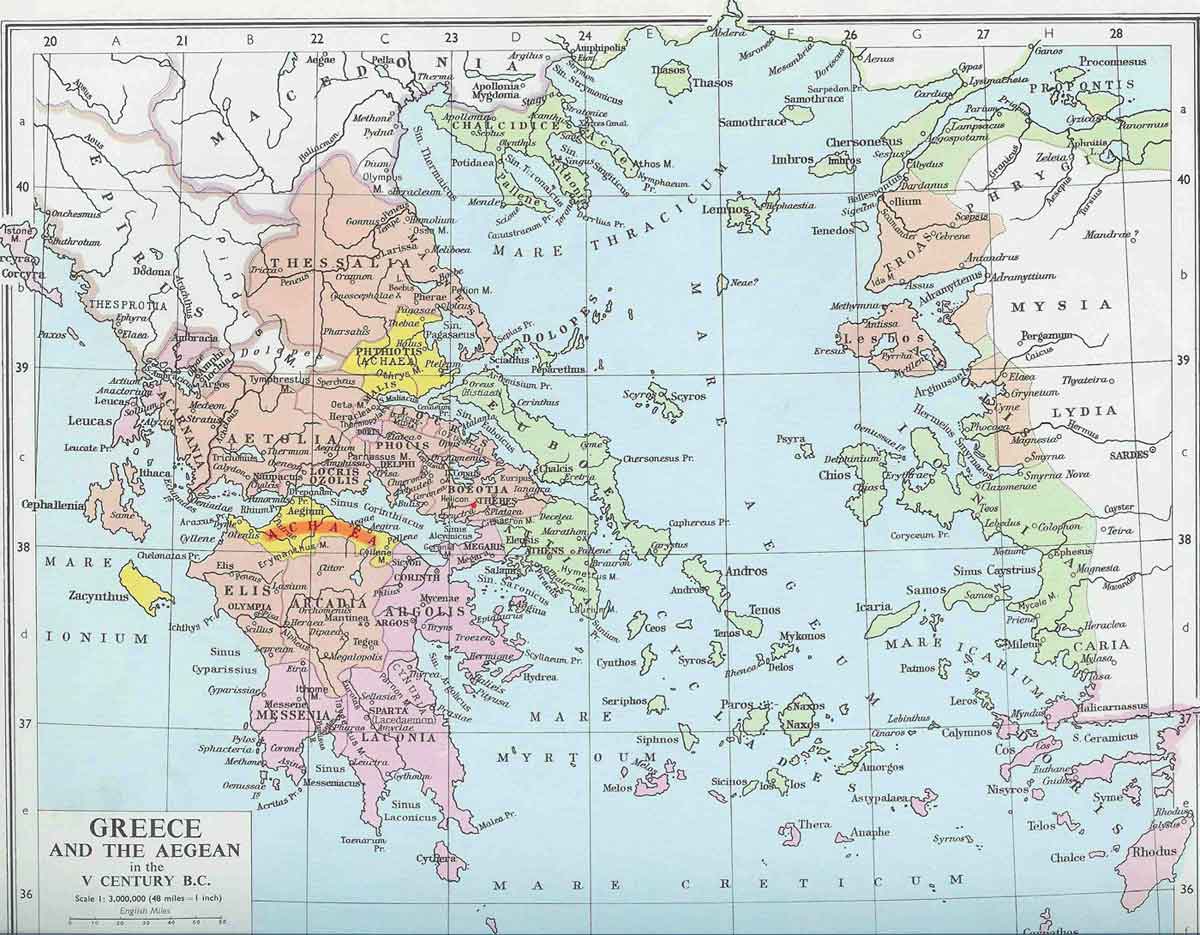
achaea.jpg


This map has about the same names I found so far, though I think Euboea was called Magnesia or something before. I'm still reading up on it. You can see the usual regional names like Achaea, Ellis, Messenia, Laconia, Arcadia and Argolis in the Peloponnese peninsula, Thessalia up north, Acarnania, Aetolia, Locris Ozolis, Phocis, Loeris, Euboea, Boeotia and Attica in between. Among colonial settlements outside of Ancient Greece are Chalcidice, Propontis, Troas, Aeolis, Ionia and Doris.
 
Notes on Herodotus, Thomas Gaisford.
https://www.google.com.au/search?q=...x-b&gfe_rd=cr&dcr=0&ei=UWzEWe__C8ju8weEg5LIBg

Of Greece. The Greek has ‘Hellas.’ Thucydides says the same. “the country now called Hellas.” The whole country, in the time of Herodotus, called Hellas or Greece, was known previous to the Trojan war, and even long afterwards only by the name of the different people that inhabited it. Homer speaks of the Danai, of the Argivi, of the Archivi &c. but he never applies a general or collective name to the Greeks in a body. Some of the lesser people of Thessalia were called Hellenes, from Hellen, son of Deucalion. Other little states in the same country, having invoked his aid, took his name, which being communicated from one to another, became, at length, extended to the whole nation.

Pg. 4-5
 
Last edited:
A smaller history of Greece, William Smith.
https://books.google.com.au/books?id=S4ceHPDTzCEC&printsec=frontcover#v=onepage&q&f=false

The Hellenes considered themselves the descendant of one common ancestor, Hellen the son of Deucalion and Pyrrha. To Hellen were ascribed three sons Dorus, Xuthus and Aeolus. Of these Doras and Aeolus gave their names to the Dorian and Aeolians; and Xuthus, through his two sons Ion and Aechus, became the fore farther of the Ionians and the Achaeans, Thus the Greeks accounted for the origin of the four great divisions of their race. The descent of the Hellenes from a common ancestor, Hellen, was a fundamental article in the popular faith. It was a general practice in antiquity to invent fictitious persons for the purpose of explaining names of which the origin was buried in obscurity. It was in this was that Hellen and his sons came into being; but though they never had any real existence, the tales about them may be regarded as the traditional history of the races to whom they gave their name.
Issuing from their mountain district between Thessaly, Locris, and Phocis, they overran the great part of the Peloponnesus, destroyed the ancient Achaean monarchies, and expelled or reduced to subjection the original inhabitants of the land, of which they became the undisputed masters.

The legendary account of the conquest of the Peloponnesus ran as follows: The Dorians were led by Heraclidae, or descendants of the mighty hero Hercules. Hence this migration is called the return of the Heraclidae.

This period had now expired; and the great grandsons of Hyllus – Temenus, Cresphontes, and Aristodemus – resolved to make a fresh attempt to recover their birthright. They were assisted in their enterprise by the Dorians.

The Heraclidae and the Dorians now divided between them the dominions of Tisamenus and of the other Achaean princes. The kingdom of Elis was given to Oxylus as a recompenses for his services as their guide: and it was agreed that Temenus, Cresphontes, and Eurysthenes and Procles, the infant sons of Aristodemus (who had died at Naupaetus), should draw lots for Argos, Sparta and Messenia. Argos fell to Temenus, Sparta to Eurythenes and Procles, and Messenis to Cresphontes.
 
This subject is obscure. Why is it common notion that the people that had assisted the Heraclidae in the invasion spoke the same language.

The return of the Heraclidae.The children of Hercules had long been fugitives upon the face of the earth. They wanted to claim their birthright, which was land in the Peloponnesus. After the Heraclidae invaded the Peloponnesus they divided the land amongst themselves. Temenus, Cresphontes, Eurysthenes and Procles they made themselves kings.

What evidence is there to suggest that the people that had assisted the Heraclidae were even literate? The Heraclidae ruled Argos, Sparta and Messenia their family members would have held high positions in society and where more likely to hold some form of office.

The dialect known as Dorian may be a result of the excommunication of the Heraclideae, could have it been their 100 years of exile that had created this difference.

What was the literacy rate of the people that had assisted the Heraclidea. When did these people that we refer to as Dorians actually start speaking Dorian?
 
There seems to be no clear answer. I would think due to the geography of the region (as well as close political and cultural ties) that there would be some collective name for the region. The region south of Macedonia appears to form a peninsula, was there no name for this region in ancient times?
 
The birthright thing is probably from trying to legitimize their claim to the land via mythical ancestry to the local gods.

This book has some more names predating the Dorian migration I don't think anyone ever bothered making a map for. Maybe it's because I've been reading the chapters out of order but I'm having a hard time keeping track of the group and place names. There was something about Thessaly being called Aeolia/Eolia, Laconia was called Lakedemonia and a place called Driopida that got renamed to Dorida by the Dorians. Some help getting the useful information out of it for both this thread and other topics would be appreciated.

Given pretty much everyone and their mother seems to have an origin myth tied to Hercules directly or otherwise I wouldn't give the term Heraclid much weight in terms of actual ethnic relation.

From the book I linked:

Hercules had a son named “Skit” (Scythian) with Echidna, queen of the Hileia. According to Herodotus (Херодот, Историја, IV, 6-10, Матица Српска, Београд, 1988) “all Scythian kings have descended from Skit, this Herculean son”. This includes king Karan, the entire Macedonian Argide dynasty and Alexander the Great of Macedonia.

The people from Kolhida who settled there named the peninsula “Istria” which was a personification of the river Istros (Danube) which the Argonauts sailed. The people of Istria then intermingled with a group of colonists who were moved there by Hil, son of Hercules and eponymous hero of the Illyrian Hilei. However the peninsula had two horonyms: “Histria” and “Hyllis”

We can surmise from all this that the Danaian Egyptian colonizing dynasty, with its many descendants, left deep traces in the Peloponnesus, especially in Argolida. Many cultural achievements were associated with Danai and his daughters. It is said that Danai, before his relative Cadmus, introduced literacy in Greece. He first introduced artificial land irrigation and his daughters, the Danaiditi, passed on the skill of digging wells. (Strabo, Geographia, I, 23, 8, Meineke, Lipsiae, I, II, III, 1913) Perseus, through his son Elektrion, was the ancestor of Hercules, the greatest hero of that time.

In Hellenic mythology, Hercules was the greatest, strongest and most glorious hero. The greatest legends told about Hercules were created by the Dorians. The Dorians were the third wave of people to arrive in the South Balkans, following the indigenous Pelasgians and Achaeans who arrived in the region during the 16th century BC. They migrated from the north to Pelasgia during the 12th century BC. The legends had a dual purpose:

1) They claimed Hercules, son of Zeus, as a Dorian hero in order to
emphasize that the Dorians too were of divine origin.

2) The legends of Hercules represented a synthesis between the indigenous Pelasgians, Danai, Achaeans, Pelopidi and the Herculean Dorians (Thomson, G.: I Arhaia Eilliniki Koinonia-to Proistoriko Algaio, p. 190, Athina, 1954) i.e. later Hellenes. The name Hercules ('Ηρακλης) is etymologically coined from the noun 'Hρα - Hera and the verb kληζω, κλεω – klezo, kleo – meaning to celebrate, to germinate, to be proud, i.e. “Hera’s celebration”. In mythology, Hercules was born in Boeotia but his native soil was Argolida in the Peloponnesus, the first place where the Dorians originally took residence before expelling the Achaeans.

Hercules was the son of Zeus and Amfitrion’s wife Alkmena. Amfitrion was king of Mikena (Mycenae) from the Danai Dynasty. Amfitrion’s mother Nikipa was Pelops’s daughter from the Pelopidi Dynasty. Hercules’s half-brother Ifikles was Alkmena and Amfitrion’s son but not of Zeus. Hercules’s original name was Alkevs (Αλκενς), named after his grandfather.

In the Roman legends, Latin was the son of the god Faun and nymph Marika, king of the Aborigini (not Borean by origin) or the son of Hercules and Faun’s daughter or widow. Best known is the genealogy
which connects Latin with the legend of Enei. Namely, Enei’s daughter Roma married Latin, son of Telemah and Kirkin and bore him the sons Romulus, Remus and Telegon. There is also the traditional thinking that Latin was the founder of Rome and named the city after his dead sister Roma.

The most famous of all so-called “Greek heroes” was Hercules, son of Zeus and Alkmeona, Amphitrion’s wife. He was Persei’s grandson from the Danai Egyptian dynasty and he had two sons, both named Hil (Yllos). The elder Hil, whose mother’s name was Deianira, married the beautiful Iola and settled in Marathon. The older Hil fought a war against his relative Evristei of Mycenae and won, but later was killed in a duel against Ehem. The younger Hil, son of Hercules and the nymph Melita, was the eponimic hero of the Illyrians and the town Hil in Korkira (Corfu), Homer’s Sheria, where the Phoenicians (Phaiekes) lived.
 
Back
Top