• Welcome to the new Macedonian Truth Forum. All posts, members and private messages have been moved over from the old forum.

    Passwords from the old forum could not be carried over, so please use Forgot your password? to set a new one. The reset link is emailed to the address on your account.

  • Rules and Regulations at the forum of the Macedonian Truth Organisation (MTO)

    (1) The national-ethnic and cultural-linguistic identity of the Macedonian people is historically Macedonian, and derives its character from the native, indigenous and geographic homeland of the Macedonians, which is called Macedonia. To ensure that their human rights, integrity and heritage are appropriately respected, the only nouns and adjectives acceptable when reference is made to the above character and identity markers is Macedon, Macedonia, Macedonian and Macedonians.

    (2) The nation-state of the Macedonian people is the Republic of Macedonia, and is to be referred to by this official title so long as the 'republic' prefix is consistently applied to other states. Alternative references are the Macedonian Republic, or simply, Macedonia.

    (3) The 'ethnic' prefix is only acceptable for Macedonians in cases where differentiation is specifically required - so long as it is in context and consistent where it concerns its application to other ethnic groups.

    (4) Should any other differentiation be specifically required, the names of other ethnic groups that reside with Macedonians in either the Republic of Macedonia or the occupied Macedonian regions in Greece, Bulgaria, Serbia or Albania, are to be given a prefix.

    (5) Negating the identity, language and culture of the Macedonian people by deliberate avoidance of the terms Macedonia, Macedonian and Macedonians, or by any other means, is not permitted.

    (6) Systematic anti-Macedonian propaganda and rhetoric are not permitted.

    (7) Threads irrelevant to the Macedonian Cause, the community at the Macedonian Truth Organisation or the Macedonians in general may be considered as spam or not in the spirit of the forum. In such cases they are not permitted.

    (8) Continual posting of messages in threads with the sole purpose of deviating from the initial topics with the use of unrelated and unnecessary information is not permitted.

    (9) All posts, external articles, reports, etc that are cited in languages other than Macedonian or English, must be accompanied with a translation in one or both of the said languages.

    (10) Despite the possibility of some conversations and debates becoming heated, extreme abuse and/or racism, vulgar language and/or terminology, threats, revelation of personal information about others, harassment, and other such behavior will not be permitted. If deemed necessary all relevant information including member details will be reported to the appropriate authorities for investigation which may result in legal action.

    (11) Threads that are created must have a summary of a topic or excerpt of an article found in pertinent link(s) that have been included. One line threads will be considered unaccetable spam and are therefore not permitted.

    (12) Compulsive and deliberate lies, irrespective of the topic, are not permitted.

    (13) Any symbols or avatars found to be perceived as offensive to Macedonians are not permitted.

    (13) Any explicit or extreme material is not permitted.

    Failure to adhere to the above rules and regulations will result in a ban after 3 breaches. This may be reconsidered in some cases should the circumstances be of an unorthodox nature and/or require special consideration. To assure an effective deterrent against an individual or individuals with the sole purpose of causing dissent through spamming, racism or other improper means, the above rules will be strictly enforced.

    The MTO administration will monitor all discussions as reasonably practical and reserve the right to remove any post and/or member from the forum, and update the rules and regulations as required. Members are encouraged to immediately report any post and/or member to the MTO administration if they feel that these rules have not been abided by.

    The views expressed on this forum are those of the individuals. The only official representation of the MTO is made by the "Macedonian Truth Organisation (Site Owner)" username, and no other.

  • Macedonian Cause

    The Macedonian Truth Organisation calls on God in Heaven to protect, bless and guide the endeavour it is committing to undertake, and that is to work towards:

    Securing Macedonia as a free, independent and democratic republic in which sovereignty lies with the Macedonian citizens; as the nation-state of the Macedonian people in which they can preserve their culture, language and identity; as a state in which the Macedonian language and culture form the basis of public life and act as important unifying elements of Macedonian society; as the home of all its citizens to which it guarantees and obliges their inalienable natural rights and corresponding responsibilities;

    The acknowledgment as self-evident and irrefutable the existence of the:

    1) Indigenous, ethnonational name of Macedonia;
    2) Macedonian people, language and identity;
    3) Macedonian culture, symbols and folklore;
    4) Macedonian ancestry, heritage and history in its entirety; and
    5) Macedonian Orthodox Church;

    Securing recognition by the International Community of the tragedies endured by the Macedonian people, of the division of Macedonia with the signing of the Treaty of Bucharest on August 10, 1913, and the genocide committed against the Macedonian people at the hands of the Greek, Bulgarian and Serbian states and their respective churches during the 19th and 20th centuries;

    Ensuring that the Interim Accord is declared ‘null and void’ and that all constitutional provisions, acts, commitments, agreements, legislation, regulations, policies or programs emanating from, supporting or consequential to the Interim Accord are also declared ‘null and void’, including the use of any symbols and the completion of any acts imposed by, or originating from, the Interim Accord.

    Ensuring that the Framework Agreement is abolished and that all constitutional provisions, acts, commitments, agreements, legislation, regulations, policies and programs emanating from, supporting or consequential to the Framework Agreement are also abolished and replaced by a framework of constitutional and statutory law based on inalienable natural rights and corresponding responsibilities and universally codified human rights mechanisms.

    Securing the abolishment of any existing constitutional provisions, acts, agreements, legislation, regulations, policies and programs that discriminate against the Macedonian people, in any international organisation or any of the countries of the International Community where such constitutional provisions, acts, agreements, legislation, regulations, policies and programs exist, and thereby ensuring the freedom for Macedonians to exercise their inalienable natural rights and fulfil their corresponding responsibilities, and practice their culture, language and religious faiths in all the countries of the International Community without hindrance;

    The empowerment of Macedonians to undertake a moral revolution and to instil and/or reinvigorate within themselves a deep-rooted national, cultural, linguistic and historical dignity and a commitment to the exercise of freedom based on inalienable natural rights and corresponding responsibilities;

    The recognition of the Macedonian minorities in the neighbouring states of Macedonia as well as the respect for the inalienable rights and freedoms of the Macedonian minorities, as provided for by natural law and as codified by the United Nations Charter, the Universal Declaration of Human Rights and other universally codified human rights mechanisms;

    The full and unreserved respect of, and the support for, the rights of all people of non-Macedonian descent living in Macedonia and around the world, who share a reciprocal full and unreserved respect for the Macedonian people, their homeland and their state;

    The cultural unification and solidarity of the Macedonian people living in all parts of historical Macedonia and adjacent territories, as well as Macedonians throughout the world;

    The unity of all Macedonians on the principles, objectives and achievement of the Macedonian cause as defined by this declaration.

Slovo -Jesus epithet

By questioning,lets have this enter .
When Jesus was named Christ ?

The answers laid down at Matthew 16:16
"Simon Peter answered, "You are the Christ, the Son of the living God.".."

But what about the chronology when that happen ?
Sentences above I have met are very logically :

"The Sinaiticus Codex of the NT with Acts of the Apostles and 1st Peter is evidence that people were not called Christians until after the Fall of the Jewish Temple.

Non-apologetic writings do not show that there was a person called Christ who was followed or worshiped as a God by anyone anywhere in or outside the Roman Empire up to at least the end of the 1st century..."
 
Last edited:
I would like to continue firstly with an analyze over words standing for Church and Cross symbol ,and then to move forward.


It is in my opinion that we could rich possibility of the word Church by analyzing Chi Ro symbols ..

So let me go ..
 
IMPERIUM ROMANUM ORIENTALE SIGNUM CRUCIS

ChiRo_Pure.jpg


IMPERIUM ROMANUM ORIENTALE SIGNUM CRUCIS
Eastern Roman Empire the Cross symbol


Historical sources:
According to Lactantius, Flavius Valerius Constantinus was visited by a dream the night before the battle, where in he was advised "to mark the heavenly sign of God on the shields of his soldiers ... by means of a slanted letter X with the top of its head bent round, he marked Christ on their shields."[1]


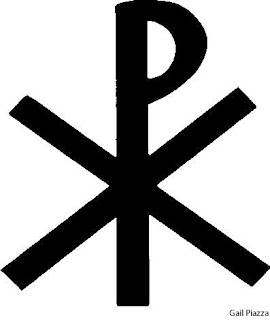
Explanation we read is that is about of superimposed ,not ordinary but Greek letters: "A monogram and symbol for Christ, consisting of the superimposed Greek letters chi (Χ) and rho (Ρ),often embroidered on altar cloths and clerical vestments. Also called Chrismon, Christogram..." [2]
[chi + rho, first two letters of Greek Khrīstos, Christ.] [3]
What is most than strange
Greeks today for the Cross will say ;Σταυρός
No need to add that Macedonian and all related modern languages of today for Cross will say:
Cross -Eng.
Krst -Maced.
Krst-Bulg.
Krst-Serb.
Kriz -Croat .


And no wonder because here is the root of that word .
Krs;
X-KS;
P-ro;
X + P ~> KS + Ro ~>
Ro in between K`S ~>
K Ro S...we read Kros .
Kros or Crossed ,because Ro is present crossed at the middle of dual K`S or X
two letters

Another words connected with word the Cross in Macedonian are and this :baptism baptize
Lets compare:
Macedonian :KRST- KRSTI KRSTENJE
English :The Cross, baptism baptize
Greek :STAVROS Váptisi vaftísei
Where the root for ever will be at letters
X Ro
KRoS
:)

Such a strange ..


___________

Ref:
1- Lactantius, De Mortibus Persecutorum 44.4–6, tr. J.L. Creed,Lactantius: De Mortibus Persecutorum (Oxford: Oxford University Press, 1984), qtd. in Lenski, "Reign of Constantine" (CC), 71.
2- American Heritage® Dictionary of the English Language, Fifth Edition. Copyright © 2011 by Houghton Mifflin Harcourt Publishing Company. Published by Houghton Mifflin Harcourt Publishing Company. All rights reserved.

Net links :
https://en.wikipedia.org/wiki/Constantine_the_Great#Early_life

http://www.thefreedictionary.com/Chi-Rho

http://www.thefreedictionary.com/_/...&url=http://www.thefreedictionary.com/Chi-Rho
 
"The Babylonians, Egyptians, Aztecs & others had cross symbols. However, there is no cross in Christianity. No cross at all! There is no cross anywhere in the bible. The words which have been translated "cross" & "crucify" in the New Testament are "stauross" or "stavross" & "stavrooh". All translators, even fundamentalists, agree that a they are not a cross. Liddell & Scotts A Greek-English Lexicon defines "stauross" or "stavross" as "upright pale or stake". W.E. Vines Expository Dictionary of New Testament words, another Christian resource, reports that "stauross" or "stavross" - "denotes, primarily, an upright pale or stake." 1
_________
Ref:

Barker, Dan (1992). Losing Faith in Faith: From Preacher to Atheist. Madison, WI: Freedom From Religion Foundation. ISBN 978-1877733130.... pp. 203-4
 
Although it is true that the Greek word σταυρός stauros, as used in the New Testament and elsewhere, means "stake," it is not true that it does not also mean "cross."

staurosblueletter.jpg


staurosthayerslexicon.jpg


The point here would be that the manner of crucifixion that most of us envision, with a man hanging on a cross after being nailed to through his hands/wrists and feet, was not the typical way in which people were executed when the word stauros is invoked. In other words, the execution by impalement with a stake is often denoted, ...
 
as in the imagery of Prometheus here:
prometheusstauroscross.gif

Prometheus bound to a wooden stake or stauros, i.e., a cross, on a Greek vase, c. late sixth to early seventh cents. BCE, http://www.theoi.com/Gallery/T21.5.html

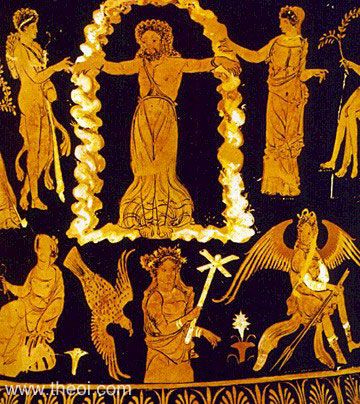
However, although here he is staked and not exactly in cruciform, Prometheus was also depicted, on a later vase dating to around 350 BCE, in cruciform, as crucified using chains:

T21.4Prometheus.jpg

When ancient writers (e.g., Lucian) describe the cruciform punishment of Prometheus or others, such as Diodorus's depiction of the king Lycurgus's crucifixion by the god Dionysus, they use the related verbs σταυρόω stauroó and ἀνασταυρόω anastauróo, meaning to "impale on a stake" or "affix to a cross." Derived from anastauróo, the term ἀνασταυρῶσαι anastaurosai is used by Diodorus (3.65.5) to depict the crucifixion of Dionysus’s enemy, Lycurgus:


καὶ τὸν Λυκοῦργον ζωγρήσαντα τυφλῶσαί τε καὶ πᾶσαν αἰκίαν εἰσενεγκάμενον ἀνασταυρῶσαι.

Diodorus recounts that, after Lycurgus cut the throats of the Bacchantes or followers of Dionysus, the god took the king prisoner, plucked out his eyes, tortured and abused him, and "nailed him to the cross."

During the Roman era, these texts were translated into Latin, and the various forms of σταυρόω stauroó were rendered with forms of the Latin verb crucifigere, meaning "to fix to a cross," crucifixum, etc. There is no question that the σταυρός stauros was taken to mean both a stake and a cross, as is also the case in the Greek and Latin editions of the early Church fathers' writings, including by Justin, Tertullian, Origen and Minucius, who discuss the "cross" using both the Latin crucifix and Greek stauros.

The bottom line is that both the impalement and crucifixion were described using the term σταυρός stauros or a related form. This same concept is described using terms for "stake," "cross," "tree" and "wood."
 
and once more :

Liddell & Scott

Now, if we look specifically at Liddell and Scott (1900:62), we will find the same definition of ἀνασταυρόω anastauroó:

anastauroo.jpg


As concerns the word stauros, while Liddell & Scott (1900:743) does not specify "cross" in its definition of stauros, other than in a Christian context, we need to continue to see that the verb stauroo is described as "to crucify":

staurooliddell.jpg


Vine's Expository Dictionary of New Testament Words

As concerns the commentary in Vine's Expository Dictionary of New Testament Words, the reference denoting the "primary" meaning as "an upright pale or stake" does not preclude the word's connotation as "cross." In the entry "Cross, Crucify," Vines further states:


stauroovines.jpg


The stauros denotes (a) "the cross, or stake itself," e.g., Matt. 27:32; (b) "the crucifixion suffered," e.g., 1 Cor. 1:17,18, where "the word of the cross," RV, stands for the Gospel; Gal. 5:11, where crucifixion is metaphorically used of the renunciation of the world, that characterizes the true Christian life; Gal. 6:12,14; Eph. 2:16; Phil. 3:18....

stauroovines.jpg


___________

Ref:

D.M. Murdock “A Pre-Christian 'God' on a Cross?’’,

Links:
from forum topic
http://freethoughtnation.com/forums/viewtopic.php?f=16&t=3014&start=45
from the book
http://stellarhousepublishing.com/prechristiancrucifix.html
 
Last edited:
And here we are reading all that stuff again and again


Stavros - searching possible origin of..
Σταυρός
Searching possible origin of this I guess famous Greek personal name.
Lets again check out those two letters Chi and Ro .pronounced as Ksi and Ro
Lets see the way of Cross symbol creation .
That creation been made very easy on the way that letter Ro been put at the middle of the letter X
Thus we have following symbol
http://www.thefreedictionary.com/_/...&url=http://www.thefreedictionary.com/Chi-Rho

Again for reminding .. we have splitting diftong situations where between K's phones letter P pronounced Ro been put at the middle of it or orthographically expressed P been put at the middle of X
Raised sounding situation we have got is :
X plus Ro
K`S plus Ro at the way that Ro is put at the middle or..

K Ro S
KrS
KRS
KRS or KRST is how we will say for Cross .
KRSTE is personal name out of it.
But lets check for Stavros possility


Connection of this letters with a name of Stavros can not be done at the easiest way as with our Macedon. language for the name KRSTE what is parallel on Greek name, but because of existence of illogical matter ,when talking over this abstraction ...

So, if we focused at the verb ..to put ...we might have something .

At Greek verb "to put" is translated as : να θέσει (na thései )
In Latin verb "to put " is tranlsated with :
loco :place, position, set, put, posit, dispose
jacio: cast, fling, throw, throw away, throw off, throw out
dido: distribute, disseminate, spread, divide, separate, put
disdo:distribute, disseminate, spread, divide, separate, put
obdo;expose, put, place, place before, shut, close
sisto:stop, set, present, arrest, place, put
addo: add, bring, give, append, apply, lay on
paro:set, prepare, procure, intend, plan, supply
colloco:quarter, place, place together, install, instal, establish
conloco:rank, place, place together, install, instal, establish
iacio: throw, scatter, cast, hurl, fling, throw away
adhibeo: use, apply, summon, make use, invite, put
quaero: miss, seek, inquire, ask, require, look for
repono :replace, lay, store, restore, place, put
constituo : fix, constitute, establish, appoint, set, set up
sepono: set apart, lay aside, banish, put, put apart, put aside
do : give, allocate, offer, bestow, grant, lend
coicio : fling, pile together, throw, conclude, devote, infer

Verb "To put " , lets continue as we are reading at previously examples does not matched personal name Stavros .
If we try with Macedon. language we will have this suggestion

"To put " is translated with "да стави" ( da stavi) because shortly
put means : стави (stavi)

You may check out for yourselves

https://translate.google.com/#en/mk/put


Stavros

What we have is a description of some verbal actions .
Those verbal actions are describing that letter P - Ro been PUT at the middle of letter X
Again :
To Put- da stave , from PUT stavi
Name is created with verb PUT and letter P -pronounced Ro
In Macedonian situation is this:

Stave + Ro ~> StaveRo* adding meaningless suffix s we have got
Stavros .
Stavi Ro between X ( K`Si )

or
K`+Stavi +Ro+SI
We read
Kstavirosi*
or its outlet
Stavros

 
Chrestians and Christians

We might have two different terms from the beginning
1.Cross and the cross followers
2. Christ and Christ followers

300 AD, or some,
Emperor Constantine has recognized the Cross as symbol of his Empire .


Eastern Roman Empire the Cross symbol

Historical sources
according to Lactantius, Flavius Valerius Constantinus was visited by a dream the night before the battle, where in he was advised "to mark the heavenly sign of God on the shields of his soldiers ... by means of a slanted letter X with the top of its head bent round, he marked Christ on their shields."[1]

Lets check ;
Here is that symbol :

Krste.jpg


Explanation we read is that is about of superimposed ,not ordinary but Greek letters: "A monogram and symbol for Christ, consisting of the superimposed Greek letters chi (Χ) and rho (Ρ),often embroidered on altar cloths and clerical vestments. Also called Chrismon, Christogram..." [2]
[chi + rho, first two letters of Greek Khrīstos, Christ.] [3]
What is most than strange
Greeks today for the Cross will say ;Σταυρός
No need to add that Macedonian and all related modern languages of today for Cross will say:


Cross -Eng.


Krs -Maced.
Krst-Bulg.
Krst-Serb.
Kriz -Croat .


And no wonder because here is the root of that word .
Krs;
X-KS;
P-ro;
X + P ~> KS + Ro ~>
Ro in between K`S ~>
K Ro S...we read Kros .
Kros or Crossed ,because Ro is present crossed at the middle of dual K`S or X
two letters

Another words connected with word the Cross in Macedonian are and this :baptism baptize
Lets compare:
Macedonian :KRST- KRSTI KRSTENJE
English :The Cross, baptism baptize
Greek :STAVROS Váptisi vaftísei
Where the root for ever will be at letters
X Ro
KRoS
:)

Such a strange ..

So,
when we have got a Cross symbol recognized as official state symbol we have to supposed its followers

if the word Chrest or KRS or KRST in Macedonians standing for the Cross, than what for word rest -tian could standing for ?
-tian or ian would be suffix what does explaining ... or being affiliated with a Cross .
Is it historically correct that Constantine firstly accepted the Cross symbol for his own, and for symbol of his Empire , and never accepted Christianity ?
Yes it is
Then we could state that difference between these two terms is that first term links to second one and that is term Christians.

What was Constantine's native language if indeed he was the grandson of a Danubian goat herder?
That indeed is interesting
Someone made this kind of point.
From Atlantic Ocean up to Persia it is none Latin language dialect.
And we are talking about Latin word roots.
Strange isn`t..
 
Last edited:
KRS instead of KRST

KRS instead of KRST

KRS instead of KRST
​


The first crucifix (a figure on a cross) is from the 5th or 6th or 7th century. Before that it appears that there was a LAMB on the cross. Besides the legend of Helena finding the One True Cross and Nails, which is obviously a FAKE legend, when does the cross appear in the archaeology?
Lets have this enter ...
If we read KRS instead of KRST ,then we could face another root word meaning difference .

Firstly I have to explain a bit
Word standing for Cross at my Macedonian is exposed with letter t as its ending.
Krst = Cross
And because it is so we analyzed for one more time .
KRS instead of KRST


What letters KRS could standing for ?
And according "to the voice Constantine had heard at its vision" as legends says :
"“By this sign, you shall conquer..." or "you shell been unbeatable..." up to the source, historically we need to not to forget , one more thing That`s appearing of the Church. As institution Church it does appear when Constantine recognized Christianity as official state religion .
Lets focus at the term Church and its word roots .

At Latin Church is Ecclesia,
At Greek - Ekklisía
At Macedonian is Црква
from
Черква
or using different orthography
Ts r k va
Ch e r k va .

If we hear for one more time pronunciations of symbol as CHI RO , we could agree that indeed it is CHI RO
and does mean what ?
CHI Ro

CHI RO
CHU RO

CHu Ro CH
Church of Course .
Where Chi Ro has got its word ending at letter Ch meaning or could mean
Chi ro + Ch
- follower

Back to my Macedonian
Черква
or using different orthography
Ts r k va
Ch e r k va .


from the root

KRS
We palatalized letters

K-> Ch
R
S ->K


So we have

K R S

Che R K


from

Chi Ro K

from
Chi Ro

_______________

At this way observed we could say yes they are two different terms trough history heaving two different meanings
First word is "Chrestian" meaning the Church followers , second one Christian meaning another thing ..

___________

Ref:
1- Lactantius, De Mortibus Persecutorum 44.4–6, tr. J.L. Creed,Lactantius: De Mortibus Persecutorum (Oxford: Oxford University Press, 1984), qtd. in Lenski, "Reign of Constantine" (CC), 71.
2- American Heritage® Dictionary of the English Language, Fifth Edition. Copyright © 2011 by Houghton Mifflin Harcourt Publishing Company. Published by Houghton Mifflin Harcourt Publishing Company. All rights reserved.
Net links :
https://en.wikipedia.org/wiki/Constanti ... Early_life

http://www.thefreedictionary.com/Chi-Rho

http://www.thefreedictionary.com/_/view ... %2FChi-Rho
 
"In this sign you will conquer"

As legend stated " In hoc signo vinces (in this sign you will conquer)"
It become a battlefield symbol but if we pass over the legend we will note that the Constantine's environmental victory happen after he does recognize of Christianity as official religion of his Empire
 
The history of the cross symbol in Christianity​


Early depictions on Jesus usually showed Jesus in the form of a shepherd carrying a lamb. Tertullian (140-230 CE), a Montanist heretic, commented in his essay De Corona: "At every forward step and movement, at every going in and out, when we put on our our clothes and shoes, when we bathe, when we sit at table, when we light the lamps, on couch, on seat, in all the ordinary actions of daily life, we trace upon the forehead the sign." This might be an early reference to individuals tracing the sign of the cross on their body.

The use of the cross as a symbol was condemned by at least one church father of the 3rd century CE because of its Pagan origins. The first appearance of a cross in Christian art is on a Vatican sarcophagus from the mid-5th Century. 11 It was a Greek cross with equal-length arms. Jesus' body was not shown. The first crucifixion scenes didn't appear in Christian art until the 7th century CE. The original cross symbol was in the form of a Tau Cross. It was so named because it looked like the letter "tau", or our letter "T". One author speculates that the Church may have copied the symbol from the Pagan Druids who made crosses in this form to represent the Thau (god). 7 They joined two limbs from oak trees. The Tau cross became associated with St. Philip who was allegedly crucified on such a cross in Phrygia. May Day, a major Druidic seasonal day of celebration, became St. Philip's Day. Later in Christian history, the Tau Cross became the Roman Cross that we are familiar with today.

The shape of the original crucifixion device is a matter for speculation. Sometimes, the Romans executed people on a Tau cross, sometimes on a Roman cross and sometimes on a simple stake. The gospels, which were originally written in Greek, use the word "stauros" to refer to the execution structure. (see Mark 15:21, Mark 15:32, Matthew 27:32, Luke 23:26, John 19:17). This appears as the word "cross" in all but one of the English versions that we have examined. But in reality, the Greek word usually means a vertical pole without a crossbar. The New World Translation, sponsored by the Watchtower Bible & Tract Society, translates the word as "torture stake." 8 Hermann Fulda, author of "The Cross and Crucifixion" is commented that:

bullet the description of Jesus' suffering during the last hours of life indicates that he was crucified on a stake rather than a cross.
bullet that some of the writings of the early church fathers confirms the use of a pole.
bullet that the very earliest depictions of Jesus' crucifixion in Christian art show him on a stake.
Acts 5:30 refers to "hanging him on a tree." 1 Peter 2:24 says "He himself bore our sins in his body on the tree."

Deuteronomy 21:23 stated that a person hung on a tree was be cursed by God. This verse was a major stumbling block that prevented many Jews from accepting Jesus as the Messiah.

According to author Graydon F. Snyder:

"[Today's]....universal use of the sign of the cross makes more poignant the striking lack of crosses in early Christian remains, especially any specific reference to the event on Golgotha. Most scholars now agree that the cross as an artistic reference to the passion event cannot be found prior to the time of Constantine."
_________

Ref:

7-B.G. Walker, "The Woman's Encyclopaedia" op cit, Page 188-190
8-"Jehovah's Witnesses: What do We Believe: Did Jesus Die on a Cross?" is at: http://www.happinessinthepark.com/
Link
http://www.religioustolerance.org/chr_symb.htm
 
From Chrestian to Christian​

The fact that these early papyri make reference to the term "Chrestian" and not "Christian" is essentially noted, but then passed over by many if not most modern academics and scholars...
.."The earliest instance of the term "Christian" in the Greek codices appears in Codex Alexandrinus, which is currently dated to the 5th century, by various methods which are not very secure.
1

"The disciples were originally called Chrestians (not Christians) ... at Antioch"

Codex Alexandrinus​

450 CE ?
First Christians!!: The earliest extant Greek New Testament to explicitly contain the name "Christian" is the Codex Alexandrinus dated ca. 450 CE. This is just far too late for "Christian" to begin appearing in manuscripts if it were the original term given to followers of the Nazarene Messiah. The appearance of "Christian" in the Greek text is clearly an anachronism which has been paraded as supporting evidence for the Christian name and faith, both of which are counterfeit. In fact, some lineages of Greek manuscripts (Minuscule 81) were still faithfully copying Chrestian up until 1044 CE. (source)The image here shows Codex Alexandrinus, Acts 11:26, folio 66b
Fragments of Codex Alexandrinus should be C14 dated!!!
It would be appropriate to have fragments of this codex C14 dated in order to determine with greater accuracy when the "Christians" appeared in the manuscript tradition. Evidence already exists that scribes altered the original name of the "Chrestians" to the new name of the "Christians"...


_____________________
Ref:
1-Lincoln H. Blumell " Lettered Christians: Christians, Letters, and Late Antique Oxyrhynchus"2012 , .... p.37-38:
2-At the very beginning of the New Testament Church, we find in Acts 2:47:


Link :

http://www.mountainman.com.au/essenes/chrestians%20christians.htm
 
Last edited:
What we do have ?

A Chrestians or Church's members .


What the Church is ?
Was is a building ?

Quote:
The word designates the body of believers of which Jesus Christ is Head
“The Lord added to the church daily those who were being saved.” People were added to the New Testament Church—to that group of called-out believers—on a daily basis. People weren’t put in a building. Thus it should be obvious that the biblical term church is describing a group of people and not a building or a cathedral.2
_____________
Ref:
2-At the very beginning of the New Testament Church, we find in Acts 2:47:
https://lifehopeandtruth.com/change/the-church/the-church/
 
Last edited:
These are historical references I have to prove for backing up of my Slovo -Jesus Epithet these

"...' Thessalonians are Macedonians [in Christ Jesus], who having accepted the word of truth persevered in the faith even in persecution from their fellow-citizens. Moreover, also, they received not the things said by false Apostles. These the Apostle praises, writing to them from Athens [by Timothy].'.."1
This is from 1911 A.D book where author based his selve at the first cent.A.D. writer Marcion and what is called , his viewpoint on Christianity.

States is that Macedonians first of all accepted Slovo (The Word ) concept and become Slovens or Slavs .Slavs is very first term and it is before term Christ /Christians what appeared to be invented later.
Slovo (The Word )as Jesus Epithet is invited at late 1 cent.A.D.
Christ /Christianity as term is at least around 3 cent.A.D.
From here :
Slovo is religious term
Slovo+ suffix K = SlovoK or suffix en - Sloven "belong to description"
or either belong to the Slovo (Jesus) either describe Slovo (Jesus ) followers .

Sloven is religious concept only and does not represented ethnos or nation ..

__________
Ref:1- F.C. Burkitt, “The Gospel History & its Transmission ,3rd ed. Ch. 9 "Marcion: Christianity without History" , (London, 1911), page..355-356

link:
http://textualcriticism.scienceontheweb.net/AA/Burkitt-Marcion.html
https://en.wikipedia.org/wiki/Francis_Crawford_Burkitt
Note: “Marcion was born about 100 A.D. in Pontus, apparently at the well-known Black Sea port of Sinope, and his life occupies the first sixty years or so of the second century. His father was a Christian ; our authorities tell us that he was ' Bishop ' of the Church there...


Back to the question
What is Slovo ?


To answer this question we need not to forget that all world religion have a man at its focus. Christianity as well .
It is all made for the man .
Heaven, paradise , 10 commandments , Hell ...

So here we go .
Man in our churches is spell as
Chelovek ,
We will make one only letter transformation at this word .
that is ch->S shifting .
Lets see :

Ch e l o v e k

ch->s

S e l o v e k*

S L V K

and here we read :

S Lo V o K

Slovo - K
The Word
 
Last edited:
Back
Top