• Welcome to the new Macedonian Truth Forum. All posts, members and private messages have been moved over from the old forum.

    Passwords from the old forum could not be carried over, so please use Forgot your password? to set a new one. The reset link is emailed to the address on your account.

  • Rules and Regulations at the forum of the Macedonian Truth Organisation (MTO)

    (1) The national-ethnic and cultural-linguistic identity of the Macedonian people is historically Macedonian, and derives its character from the native, indigenous and geographic homeland of the Macedonians, which is called Macedonia. To ensure that their human rights, integrity and heritage are appropriately respected, the only nouns and adjectives acceptable when reference is made to the above character and identity markers is Macedon, Macedonia, Macedonian and Macedonians.

    (2) The nation-state of the Macedonian people is the Republic of Macedonia, and is to be referred to by this official title so long as the 'republic' prefix is consistently applied to other states. Alternative references are the Macedonian Republic, or simply, Macedonia.

    (3) The 'ethnic' prefix is only acceptable for Macedonians in cases where differentiation is specifically required - so long as it is in context and consistent where it concerns its application to other ethnic groups.

    (4) Should any other differentiation be specifically required, the names of other ethnic groups that reside with Macedonians in either the Republic of Macedonia or the occupied Macedonian regions in Greece, Bulgaria, Serbia or Albania, are to be given a prefix.

    (5) Negating the identity, language and culture of the Macedonian people by deliberate avoidance of the terms Macedonia, Macedonian and Macedonians, or by any other means, is not permitted.

    (6) Systematic anti-Macedonian propaganda and rhetoric are not permitted.

    (7) Threads irrelevant to the Macedonian Cause, the community at the Macedonian Truth Organisation or the Macedonians in general may be considered as spam or not in the spirit of the forum. In such cases they are not permitted.

    (8) Continual posting of messages in threads with the sole purpose of deviating from the initial topics with the use of unrelated and unnecessary information is not permitted.

    (9) All posts, external articles, reports, etc that are cited in languages other than Macedonian or English, must be accompanied with a translation in one or both of the said languages.

    (10) Despite the possibility of some conversations and debates becoming heated, extreme abuse and/or racism, vulgar language and/or terminology, threats, revelation of personal information about others, harassment, and other such behavior will not be permitted. If deemed necessary all relevant information including member details will be reported to the appropriate authorities for investigation which may result in legal action.

    (11) Threads that are created must have a summary of a topic or excerpt of an article found in pertinent link(s) that have been included. One line threads will be considered unaccetable spam and are therefore not permitted.

    (12) Compulsive and deliberate lies, irrespective of the topic, are not permitted.

    (13) Any symbols or avatars found to be perceived as offensive to Macedonians are not permitted.

    (13) Any explicit or extreme material is not permitted.

    Failure to adhere to the above rules and regulations will result in a ban after 3 breaches. This may be reconsidered in some cases should the circumstances be of an unorthodox nature and/or require special consideration. To assure an effective deterrent against an individual or individuals with the sole purpose of causing dissent through spamming, racism or other improper means, the above rules will be strictly enforced.

    The MTO administration will monitor all discussions as reasonably practical and reserve the right to remove any post and/or member from the forum, and update the rules and regulations as required. Members are encouraged to immediately report any post and/or member to the MTO administration if they feel that these rules have not been abided by.

    The views expressed on this forum are those of the individuals. The only official representation of the MTO is made by the "Macedonian Truth Organisation (Site Owner)" username, and no other.

  • Macedonian Cause

    The Macedonian Truth Organisation calls on God in Heaven to protect, bless and guide the endeavour it is committing to undertake, and that is to work towards:

    Securing Macedonia as a free, independent and democratic republic in which sovereignty lies with the Macedonian citizens; as the nation-state of the Macedonian people in which they can preserve their culture, language and identity; as a state in which the Macedonian language and culture form the basis of public life and act as important unifying elements of Macedonian society; as the home of all its citizens to which it guarantees and obliges their inalienable natural rights and corresponding responsibilities;

    The acknowledgment as self-evident and irrefutable the existence of the:

    1) Indigenous, ethnonational name of Macedonia;
    2) Macedonian people, language and identity;
    3) Macedonian culture, symbols and folklore;
    4) Macedonian ancestry, heritage and history in its entirety; and
    5) Macedonian Orthodox Church;

    Securing recognition by the International Community of the tragedies endured by the Macedonian people, of the division of Macedonia with the signing of the Treaty of Bucharest on August 10, 1913, and the genocide committed against the Macedonian people at the hands of the Greek, Bulgarian and Serbian states and their respective churches during the 19th and 20th centuries;

    Ensuring that the Interim Accord is declared ‘null and void’ and that all constitutional provisions, acts, commitments, agreements, legislation, regulations, policies or programs emanating from, supporting or consequential to the Interim Accord are also declared ‘null and void’, including the use of any symbols and the completion of any acts imposed by, or originating from, the Interim Accord.

    Ensuring that the Framework Agreement is abolished and that all constitutional provisions, acts, commitments, agreements, legislation, regulations, policies and programs emanating from, supporting or consequential to the Framework Agreement are also abolished and replaced by a framework of constitutional and statutory law based on inalienable natural rights and corresponding responsibilities and universally codified human rights mechanisms.

    Securing the abolishment of any existing constitutional provisions, acts, agreements, legislation, regulations, policies and programs that discriminate against the Macedonian people, in any international organisation or any of the countries of the International Community where such constitutional provisions, acts, agreements, legislation, regulations, policies and programs exist, and thereby ensuring the freedom for Macedonians to exercise their inalienable natural rights and fulfil their corresponding responsibilities, and practice their culture, language and religious faiths in all the countries of the International Community without hindrance;

    The empowerment of Macedonians to undertake a moral revolution and to instil and/or reinvigorate within themselves a deep-rooted national, cultural, linguistic and historical dignity and a commitment to the exercise of freedom based on inalienable natural rights and corresponding responsibilities;

    The recognition of the Macedonian minorities in the neighbouring states of Macedonia as well as the respect for the inalienable rights and freedoms of the Macedonian minorities, as provided for by natural law and as codified by the United Nations Charter, the Universal Declaration of Human Rights and other universally codified human rights mechanisms;

    The full and unreserved respect of, and the support for, the rights of all people of non-Macedonian descent living in Macedonia and around the world, who share a reciprocal full and unreserved respect for the Macedonian people, their homeland and their state;

    The cultural unification and solidarity of the Macedonian people living in all parts of historical Macedonia and adjacent territories, as well as Macedonians throughout the world;

    The unity of all Macedonians on the principles, objectives and achievement of the Macedonian cause as defined by this declaration.

Aristotle, the Macedonian?

From what Ive read and heard, the opposite is true.
Do you have a source, so I can read it as well?
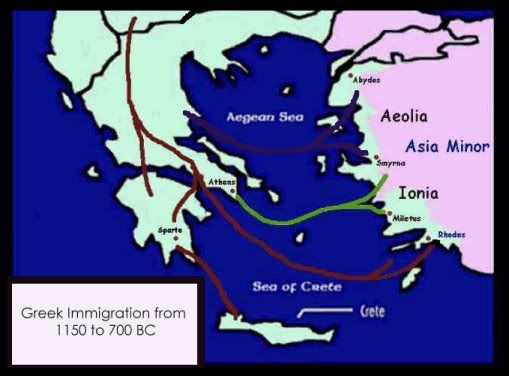
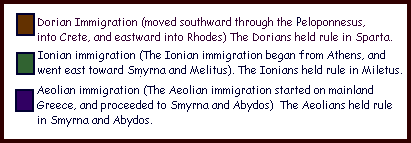
The timeframe below is from a bit earlier, but this is the most common explanation of Greek migration I get when searching the net or reading histories-
I have posted this on the Macedonia/Cretan topic as well.

greekimmigration.jpg

immigration.gif

References

"Dorian" Britannica Online.

This is an example of speculation.

Aeolic, Dorian, Ionic origins of the Macedonians - the New Greeks go from one theory to another, and none of their ideas are based on sound scientific principles.

It's all speculation. The idea that the Greeks came 'from the North' is heavily disputed.
 
This is an example of speculation.

Aeolic, Dorian, Ionic origins of the Macedonians - the New Greeks go from one theory to another, and none of their ideas are based on sound scientific principles.

It's all speculation. The idea that the Greeks came 'from the North' is heavily disputed.
First off Id like to say I am not connecting the Macedonians to the Greeks here. Some may have started from the same tribe in 1100 B.C, but in my opinion, 3000 years later, theyre DEFINITELY not the same people. Thats too many years apart for two cultures to be considered the same. I just want to put that out there before I continue. We are talking about very ancient history here which I dont believe has much relevance in the current Macedonian-Greek relations/dispute.

Honestly, in all the major encyclopedias,University papers and historic literature that Ive read backs the general idea of the above map(the above map is obviously a very simplified general picture of these events), which I would assume have the most reliable research backing, and sources.Now having said that, yes, there is some vagueness in there chronology of events, but they are minor. It is widely accepted among historians that these migrations took place.
But, again, you were referring to a later time period, which i missed in your original post, concerning this matter. So we could be debating apples and origins. If this is the case I apologise.
About the Greeks coming from the north, remember there were 3 tribes.Only the Dorians came from the north, not all.
As for this being heavily disputed as you stated above, can you post a source please, so I may read it as well.
I dont mean this as a challenge in any way, I honestly just want to read it, as I have never come across anything disputing the origins of the Dorians. Pelloponesian history is of great interest to me, and I have read alot about it, if im missing something I would really like to know.
 
Вардарец,

Are you half Greek/ half Macedonian? I don't get your name and your signature of converting Orthodox Hellens to the Hellenic religion of old and zeus worship?


What's your position on the Macedonia/Greek conflict?

My position is :

Da gi eba site gartsi vo gazo. Ako i ti si grk, i tebe da te eba.:D

My signature is about the group of Greece which numbers around 100k people. They have abandoned orthodoxy and are preaching/practising the Olympus Gods religion. With my signature, i call upon all Greeks, which call themselves Hellenes, to join them, because the term Greek had religious (ORTHODOX) meaning before 1-2 centuries.

My nickname Вардарец (latin : Vardarets ) :
Means a guy from Vardar Macedonia, as none of my parents are Greeks. My heritage is from places in Vardar Macedonia.

What about you? :cool:
 
Вардарец;3968 said:
My position is :

Da gi eba site gartsi vo gazo. Ako i ti si grk, i tebe da te eba.:D

My signature is about the group of Greece which numbers around 100k people. They have abandoned orthodoxy and are preaching/practising the Olympus Gods religion. With my signature, i call upon all Greeks, which call themselves Hellenes, to join them, because the term Greek had religious (ORTHODOX) meaning before 1-2 centuries.

My nickname Вардарец (latin : Vardarets ) :
Means a guy from Vardar Macedonia, as none of my parents are Greeks. My heritage is from places in Vardar Macedonia.

What about you? :cool:


I'll do it to you the Greek way, son
 
Last edited:
Spartan,

Anyone, and I mean anyone, erudite or not, who argues that the Greeks orginated in the north or that they migrated from the north is erroneous.

This assumption is not based on science but on European myths of race. Europeans want us to believe that the ancient Hellenes were a product of northern Europe; the fact is, however, the ancient Hellenes, like the Macedonians, were one of the first European people and they both migrated to the balkans from the south, namely, modern day south west asia or near Alexandria, Egypt.

My source for this is better than any biased historian; rather, it comes from science. DNA lineage and migration patters indicate that the Greeks and Macedonians arrived to the Balkans from south west asia.
This is fact and can not be gainsaid.
 
"Ako i ti si grk, i tebe da te eba" Oh my, what might this mean?


I am not a Greek. The confusion lies in the fact that your name is Macedonian and yet you used a Hellenic signature. I assumed you were mixed. I stand disabused.
 
Spartan,

Anyone, and I mean anyone, erudite or not, who argues that the Greeks orginated in the north or that they migrated from the north is erroneous.

This assumption is not based on science but on European myths of race. Europeans want us to believe that the ancient Hellenes were a product of northern Europe; the fact is, however, the ancient Hellenes, like the Macedonians, were one of the first European people and they both migrated to the balkans from the south, namely, modern day south west asia or near Alexandria, Egypt.

My source for this is better than any biased historian; rather, it comes from science. DNA lineage and migration patters indicate that the Greeks and Macedonians arrived to the Balkans from south west asia.
This is fact and can not be gainsaid.


We'll have to agree to disagree on this one then :)
 
Spartan, my dear friend:

I respect your opinions and look forward to your posts. We have different views on this subject and that is okay.

I understand your argument; an older friend of mine, a Cypriot Greek, told me the same thing; and I have read the same information as you.

My problem with the theory of a migration from the north is that it is not (for me) logical. I mean, if we start with the assumption that life began or evolved in the south, whether africa or south west asia, or thereabouts, and start with the premise that the earliest recorded civilizations began in south west asia, i.e. mesopotamia, etc, it seems perfectly good sense to argue that Greeks arrived to the Balkans from south west asia and the city states created civilization.

For the Greeks to have originated in the north is not possible; to argue this would mean that either (a) certain humans originated in the north independent of the south; or (b) migrated from south west asia, bypassed the balkans, went to the north, and then decided to migrate back to the balkans.

Why not argue that they migrated to the balkans and the islands and stayed thither? And from there they built civilization and culture?
This issue is solved decades now. All historians agree that Pre hellenic tribes (which later evolved to the first Greeks) arrived in Greece from Asia minor.
 
Spartan, my dear friend:

I respect your opinions and look forward to your posts. We have different views on this subject and that is okay.

I understand your argument; an older friend of mine, a Cypriot Greek, told me the same thing; and I have read the same information as you.

My problem with the theory of a migration from the north is that it is not (for me) logical. I mean, if we start with the assumption that life began or evolved in the south, whether africa or south west asia, or thereabouts, and start with the premise that the earliest recorded civilizations began in south west asia, i.e. mesopotamia, etc, it seems perfectly good sense to argue that Greeks arrived to the Balkans from south west asia and the city states created civilization.

For the Greeks to have originated in the north is not possible; to argue this would mean that either (a) certain humans originated in the north independent of the south; or (b) migrated from south west asia, bypassed the balkans, went to the north, and then decided to migrate back to the balkans.

Why not argue that they migrated to the balkans and the islands and stayed thither? And from there they built civilization and culture?
Thank -you for the response Philosopher, I think we've misunderstood each other here. I am not saying that the ancient Greek tribes(Dorians) originated in the north, definitely not. That would mean they would have to be a species other than homo sapiens, as man originated in the south as you say. Im saying they(Dorians) came into the region from the north.
The example of yours which I bolded is perfectly feasible in my opinion(except the part thats underlined), and is my understanding of these events based on what I have read. Im saying that this tribes route into the Pelloponese was done on land, not the sea. Their migration(as I see it) would have began in Asia minor and then moved west and north to beyond the hellespont, through Thrace and Macedonia(perhaps Epirus as well), and then south into the Pelloponese.

On a different note-I also believe Mt.Olympus was a big factor in ancient times(specifically pre-800-900bc) in regards to the cultural demographic of the area. It isolated the people north and south from one another, and thus, they evolve seperately and are distinctly different from a cultural standpoint after so many generations apart. The same, to an extent, can be said for the pelloponese, which by land, is only accesible to the north(central Greece) by a strip of land only a few miles in length, and was thus, easily defended from invaders. Of course these have not been big factors, in the last thousand years or so, seeing as man has bridged these obstacles very easily, but in ancient days would have isolated people from each other for long periods of time.
 
Last edited:
I know that someone else had once brought up a source or two with regard to the origins of Aristotle, in favour of him being Macedonian.

Does anybody recall? Are we able to get the information put up on this thread?
 
Here is something cited earlier from Indigen, which demonstrates that Aristotle did not view the Macedonians as Greeks;

http://www.perseus.tufts.edu/hopper/text?doc=Perseus:text:1999.01.0058:book=7:section=1324b

[1324b] [1] "...... and also among all the non-Hellenic nations that are strong enough to expand at the expense of others, military strength has been held in honor, for example, among the Scythians, Persians, Thracians and Celts. Indeed among some peoples there are even certain laws stimulating military valor; for instance at Carthage, we are told, warriors receive the decoration of armlets of the same number as the campaigns on which they have served; and at one time there was also a law in Macedonia that a man who had never killed an enemy must wear his halter instead of a belt. Among Scythian tribes at a certain festival a cup was carried round from which a man that had not killed an enemy was not allowed to drink. Among the Iberians, a warlike race, they fix small spits1 [20] in the earth round a man's grave corresponding in number to the enemies he has killed. So with other races there are many other practices of a similar kind, some established by law and others by custom...."

Aristot. Pol. 7.1324b
 
I know that someone else had once brought up a source or two with regard to the origins of Aristotle, in favour of him being Macedonian.

Does anybody recall? Are we able to get the information put up on this thread?

Aristotol/Aristotle, at the very least, was a Macedonian national and a loyal servant of Macedonian Imperialism.

ARISTOTLE: THE ART OF RHETORIC

Published by Penguin Classics, 1991. Translation, Introduction and Notes by Hugh Lawson-Tancred, 1991. ISBN 014-044-5102.

ARISTOTLE was born at Stageira, in the dominion of the kings of Macedonia, in 384 BC. For twenty years he studied at Athens in the Academy of Plato, on whose death in 347 he left and, some time later, became tutor of the young Alexander the Great. When Alexander succeeded to the throne of Macedonia in 336 Aristotle returned to Athens and established his own school and research institute, the Lyceum, to which his great erudition attracted a large number of scholars. After Alexander's death in 323, anti-Macedonian feelings drove Aristotle out of Athens, and he fled to Chalcis in Euboea, where he died in 322. His writings, which were of extraordinary range, profoundly affected the whole course of ancient and medieval philosophy, and they are still eagerly studied and debated by philosophers today. Very many of them have survived, and among the most famous are the Ethics and the Politics. These are published in the Penguin Classics, together with Aristotle's De Anima.

HUGH LAWSON-TANCRED was born in 1955. He was educated at Eton and read Literae Humaniores at Balliol College, Oxford. Since 1980 he has taught classical subjects at Mander, Portman, Woodward in London, where he is Head of the Classics Department. He is reading for a Ph.D. in the philosophy of cognitive science at Birkbeck College. He has also translated Aristotle's De Anima for the Penguin Classics.


51AYKpEewsL._BO2,204,203,200_PIsitb-sticker-arrow-click,TopRight,35,-76_AA300_SH20_OU01_.jpg

The Greatest Philosopher, Aristotole the Macedonian!


INTRODUCTION

[page 5] The developments of the 420s paved the way for the full flowering of Attic oratory. Thucydides, writing his history of the Peloponnesian War in the period between his exile in 423 and his death probably soon after the fall of Athens in 404, includes, amid his otherwise sparse narrative, a number of highly wrought and elaborate rhetorical exercises, betraying no little rhetorical training and, despite his claim to be composing a possession for all time, pandering to the contemporary demand for rhetorical elaboration. By the end of the century the wealthy metic Lysias, impoverished by the fall of the city, had taken to the profession of a logographos, a writer of speeches for others to use (Greek practice, unlike Roman, required the litigant to present his own case in court). The emergence around this time of the logographoi is of great significance for the rise of rhetorical theory. Now for the first time there was a class of men whose primary occupation and means of livelihood was the production of effective speeches, often on topics in which they were not directly involved themselves. It was vitally important for them to reflect on how to render their productions convincing, and from this time onwards a secondary industry develops which seeks to supply both professional and amateur speakers with the technical underpinning essential for consistent success. This is the tradition of those composing the 'Arts' of rhetoric, to which Aristotle makes frequent reference in this work and indeed of which it was itself later accepted as the supreme example. The age of the 'Arts' of rhetoric stretches from about 400 to 320 BC and was brought to an end almost as much by the magisterial summary of Aristotle as by the rise of Macedonian power.

The present work is, then, the masterpiece of one particular literary genre that flourished in the fourth century BC in Greece, that of the rhetorical manual, and it is a remarkable fact that it should have fallen to Aristotle to write it. It is natural enough to experience astonishment at the breadth of Aristotle's achievement. Few men have reached such eminence, or exercised such influence, in so diverse a range of fields. Even if we allow, as we should, that much of the research and indeed many of the ideas that went into the great treatises should be at least in part credited to the scholars of the Lyceum that he founded, it remains remarkable that so much [page 6] should have flowed from the pen of a single man. ...[...]... The reason for the foundation of the [Platos'] Academy, which can be tentatively dated to shortly after 390, when Plato returned from a decade of travel, was not just to promote the general study of philosophy but also to produce a new generation of revolutionaries who would put the new politics into practice in the cities of Greece. Plato was also determined, in his vindication of the memory of Socrates himself as a saint of reason, to expose the absurdities and weaknesses of the whole democratic system of government. An important element in the latter task was the exposure of the absurdity of rhetoric. Though Plato would firmly have rejected Aristophanes' suggestion that Socrates was in any way responsible for the growing obsession with the rhetoric of the late fifth century, he would equally firmly have agreed with his assessment of its disastrous social consequences, and in two dialogues in particular, the Gorgias and the Phaedrus, he sets out his own fundamentally hostile approach to rhetoric. Now it was at the Academy at precisely this time (367) that the seventeen-year-old son of the Macedonian court physician arrived to begin his studies in philosophy.

[page 7] The question of Aristotle's general relations with Platonism has been the subject of a great deal of discussion since 1923, when Werner Jaeger published his account of the philosopher's gradual evolution away from the Academy. What is perhaps most widely agreed is that for at least the first of the two decades in which Aristotle was a member of the Academy he was a fairly loyal Platonist, his ideas reflecting the changes and developments taking place in Plato's own thought but never opposing his fundamental outlook. It is thus reasonable to suppose that such was also his attitude to rhetoric, and that view is substantiated by what we know of the fragments of the early dialogue the Gryllus, probably written about 360 BC. This, then, produces the puzzle. How can a man who, for a significant phase of his formation, shared his master's opposition to rhetoric have in maturity composed a masterpiece of the formal study of rhetoric? This question can, in fact, be given an historical answer and it reveals the importance of the present work. The answer is in reality relatively uncontroversial. Aristotle cultivated an interest in rhetoric to counterbalance the effectiveness of rhetoric as a form of tertiary education as established by his rival Isocrates.

The fact that the Athenian elite was much more attracted to the school of Isocrates (436-338 BC) than to the Academy did not fail to make its mark on Aristotle. He had left Athens in the year after the death of Plato, motivated probably both by pique at his non-selection as the successor to the Scholarchy and by fears of rising anti-Macedonian sentiment, and taken himself to the northern Aegean to engage in the foundation of the science of empirical biology. Twelve years later, he returned to Athens, now made safe by the victory of Philip of Macedon at the battle of Chaeroneia, and, perhaps with the direct support of Philip, established his own school, with aims that were clearly distinct from those of both Isocrates and Plato. The hallmark of the new school was to be its catholicity. All branches of learning were to be studied, including those only recently put on the map by Aristotle himself. Evidently, with such a remit the art of rhetoric could be neglected neither on ideological nor on practical grounds, and this too was to be absorbed into the curriculum and given its place in the hierarchy of sciences.


[page 8] However, although the systematic study of rhetoric was now to be countenanced, this constituted a renunciation of Aristotle's Platonist background and he was at least resolved that it should be studied in a form that emphasized its most general and philosophical aspects; in other words, rhetoric was to be surveyed from the standpoint of philosophy.

The notion of philosophical rhetoric or of a philosophy of rhetoric may not strike us as extraordinary, but it must have seemed strange to the men of the fourth century, and it is from this combination that both the difficulties and the greatness of the present work are derived. The difficulties are real, but the greatness should also not be missed. For in making the subject of rhetoric safe for philosophy Aristotle was obliged to treat it in a manner that for the first time thoroughly investigated its underpinnings in the other areas of human life in which it plays a role. In other words, the mature Aristotelian approach to rhetoric involved the philosopher in three major topics otherwise not covered in the corpus of his works: the detailed psychology of the emotions, the use of informal reasoning and the aesthetics of prose style. Whereas previous exponents of the art of rhetorical theory had concentrated on what were in effect only tricks and devices for ad hoc success, Aristotle sought to grasp the very roots of persuasion itself, which required him to ponder the nature of character and emotion and also the method of demonstration in the absence of deductive certainty. Thus persuasiveness becomes for the first time a fully systematic and even scientific exercise; it can indeed be taught, but only by a deep grasp of some of the most central features of human nature. Thus the study of rhetoric, instead of being a philosophical outcast, transcends its humble and practical origins to become an important component in the general study of man. ..[...]...

[page 25]...The fact is that Aristotle's account of anger is very much geared to the rather hierarchic society in which he lives. Aristotle is certainly no egalitarian and he will not have imbibed either from his early upbringing in Pella or from the society of the Academy, or yet from the friendship with Hermias and the years on Assos, any particularly enlightened attitudes to his social inferiors. Amongst his own pupils, he will no doubt have been accorded a kingly status, and in his dealings with the political forces he may well have enjoyed a prestige comparable to that of a Renaissance cardinal. .....

.... [page51]....Within five years of the death of Aristotle, Athens had come under the mild tyranny of Demetrius of Phalerum, and the great democratic experiment, which had been so rich in both triumph and disaster, finally came to an end. Aristotle cannot be entirely absolved from blame for this. Although, in the Politics, he advocates a limited democracy such as had long been the ideal of the Athenian upper classes, yet he was in practice a loyal servant of Macedonian imperialism, in the name of which the Lyceum was very probably founded in 335 BC, and there is no reason to suppose that any influence he may ever have enjoyed over the young Alexander was exercised in the interests of democracy, however limited. Moreover, Demetrius was himself a product of Aristotle's Peripatetic School, now under the leadership of the founder's friend, pupil and successor, Theophrastus. Whatever the responsibility of the Lyceum may have been for the corrosion of democratic values at the end of the fourth century, it is clear that the collapse of open constitutions was profoundly inimical to the development of the art of oratory.

For fair use only.
 
Aristotle of Macedonia
384-322 B.C.
Macedonian philosopher
In short, the habits we form from childhood make no small difference, but rather they make all the difference. -- Aristotle

Birth to age 19: 384-365 BC

Aristotle was born in 384 BC in the city of Stagira [Macedonia]..... He was the son of Nichomachus, who became the court physician to the Macedonian royal family. One of his likely playmates was the king's son, Phillip.

Put two and two together and the conclusion is inescapable - Aristotle's formative stage was in Macedonia and in a Macedonian environment.
 
The story of the Greek people : an elementary history of Greece

"Seek another empire, my son," he said, "for that
which I shall leave you is not worthy of you."
Philip had provided tutors for his son, but he saw now that
he had a boy to deal with who would not be satisfied with any
ordinary teachers. The most famous philosopher of the day Aristotle,
was Ar'is-tot-le. He was a Macedonian, but had long been a stu- tury'B.Cc.n
dent in the school of Plato in Athens. To him Philip sent the
following letter: —
"Be informed that I have a son, and that I am thankful to the gods, not so
much for his birth as that he was born in the same age with you; for if you will
undertake the charge of his education, I assure myself that he will become
worthy of his father, and of the kingdom which he will inherit."
So it was that Aristotle became the teacher of the boy Alex-
He becomes ander, and remained with him for at least three years, and pos-
of Alexander sikly untu" ne became king. Philip gave him a princely reward,
for he rebuilt the philosopher's birthplace, the city of Sta-gi'ra,
which he had once destroyed, and brought back the inhabitants,
who had either fled or been sold as slaves. Aristotle liked to talk
with his pupils while they were walking about together; so for
a schoolroom Philip made ready a large and beautiful garden
with seats of stone and cool, shady paths. Alexander not only
liked philosophy, but he enjoyed reading the old plays and his-
tories, and used to send long distances for them

http://babel.hathitrust.org/cgi/pt?...d=uc1.$b416957;u=1;num=223;page=root;orient=0
page:223-224
 
Aristotle or Alexander?

Aristotle or Alexander?

Is it just me, or is the youth and almost every nationalist in Macedonia/Greece concerned with their blood stained heroes? What ever happened to the glorious philosophers? I always wonder why Macedonians don't bloat about their intellect Aristotle who contributed SO much to philosophy and the sciences. No offense, but from a utilitarian perspective it seems Aristotle has the upper whim. Same thing in Greece...a nationalist prefers the Persian-ass kicking Leonidas over the glorious Plato, Socrates, Sophocles, and others. Is it just me for being a book-worm or is nationalism in the Balkans intellectually degrading?

I also think it's funny how Greeks and Macedonians argue over Aristotle, Plato, and Socrates indirectly when if they were here today they'd be a trio laughing at us all for our 'ethnic nationalistic pride'. Is it possible David Hume was right? That philosophers are outcasts whom are sought after their deaths by the few rational and philosophical but never convene to the masses?

:alucard: <- this smiley is bad-ass...had to include it.
 
You're not the only book-worm. I love to read so much that after my job in the library I opened my own bookstore.

I personally prefer Plato over Aristotle, and the Stoics over Plato. But I also study a lot of eastern philosophy, namely Daoism, Confucianism, Hinduism and Zoroastrianism. I'm not a big fan of Buddhism however.

The purpose of the educational system is indoctrination and a preparation for servitude to the state by glorifying ancient warriors and generals, instead of teaching children how to think for themselves when they reach adulthood and learn through the examples of the philosophers, particularly ancient philosophers who were more keen on thinking about how to live a good life and live by virtue. By emphasizing ancient hatreds and taking glutinous, irrational and warmongering savages as heroes no wonder we get nations whose citizens think that the best solution to peace is to destroy all their neighbours, as if they would personally benefit from their annihilation, since their leaders persuaded them that their neighbours are the cause of even their most basic problems. They're in essence doing what the power-holders want them to do, and that is secure their own position in power or a prospect of one.
 
Back
Top