• Welcome to the new Macedonian Truth Forum. All posts, members and private messages have been moved over from the old forum.

    Passwords from the old forum could not be carried over, so please use Forgot your password? to set a new one. The reset link is emailed to the address on your account.

  • Rules and Regulations at the forum of the Macedonian Truth Organisation (MTO)

    (1) The national-ethnic and cultural-linguistic identity of the Macedonian people is historically Macedonian, and derives its character from the native, indigenous and geographic homeland of the Macedonians, which is called Macedonia. To ensure that their human rights, integrity and heritage are appropriately respected, the only nouns and adjectives acceptable when reference is made to the above character and identity markers is Macedon, Macedonia, Macedonian and Macedonians.

    (2) The nation-state of the Macedonian people is the Republic of Macedonia, and is to be referred to by this official title so long as the 'republic' prefix is consistently applied to other states. Alternative references are the Macedonian Republic, or simply, Macedonia.

    (3) The 'ethnic' prefix is only acceptable for Macedonians in cases where differentiation is specifically required - so long as it is in context and consistent where it concerns its application to other ethnic groups.

    (4) Should any other differentiation be specifically required, the names of other ethnic groups that reside with Macedonians in either the Republic of Macedonia or the occupied Macedonian regions in Greece, Bulgaria, Serbia or Albania, are to be given a prefix.

    (5) Negating the identity, language and culture of the Macedonian people by deliberate avoidance of the terms Macedonia, Macedonian and Macedonians, or by any other means, is not permitted.

    (6) Systematic anti-Macedonian propaganda and rhetoric are not permitted.

    (7) Threads irrelevant to the Macedonian Cause, the community at the Macedonian Truth Organisation or the Macedonians in general may be considered as spam or not in the spirit of the forum. In such cases they are not permitted.

    (8) Continual posting of messages in threads with the sole purpose of deviating from the initial topics with the use of unrelated and unnecessary information is not permitted.

    (9) All posts, external articles, reports, etc that are cited in languages other than Macedonian or English, must be accompanied with a translation in one or both of the said languages.

    (10) Despite the possibility of some conversations and debates becoming heated, extreme abuse and/or racism, vulgar language and/or terminology, threats, revelation of personal information about others, harassment, and other such behavior will not be permitted. If deemed necessary all relevant information including member details will be reported to the appropriate authorities for investigation which may result in legal action.

    (11) Threads that are created must have a summary of a topic or excerpt of an article found in pertinent link(s) that have been included. One line threads will be considered unaccetable spam and are therefore not permitted.

    (12) Compulsive and deliberate lies, irrespective of the topic, are not permitted.

    (13) Any symbols or avatars found to be perceived as offensive to Macedonians are not permitted.

    (13) Any explicit or extreme material is not permitted.

    Failure to adhere to the above rules and regulations will result in a ban after 3 breaches. This may be reconsidered in some cases should the circumstances be of an unorthodox nature and/or require special consideration. To assure an effective deterrent against an individual or individuals with the sole purpose of causing dissent through spamming, racism or other improper means, the above rules will be strictly enforced.

    The MTO administration will monitor all discussions as reasonably practical and reserve the right to remove any post and/or member from the forum, and update the rules and regulations as required. Members are encouraged to immediately report any post and/or member to the MTO administration if they feel that these rules have not been abided by.

    The views expressed on this forum are those of the individuals. The only official representation of the MTO is made by the "Macedonian Truth Organisation (Site Owner)" username, and no other.

  • Macedonian Cause

    The Macedonian Truth Organisation calls on God in Heaven to protect, bless and guide the endeavour it is committing to undertake, and that is to work towards:

    Securing Macedonia as a free, independent and democratic republic in which sovereignty lies with the Macedonian citizens; as the nation-state of the Macedonian people in which they can preserve their culture, language and identity; as a state in which the Macedonian language and culture form the basis of public life and act as important unifying elements of Macedonian society; as the home of all its citizens to which it guarantees and obliges their inalienable natural rights and corresponding responsibilities;

    The acknowledgment as self-evident and irrefutable the existence of the:

    1) Indigenous, ethnonational name of Macedonia;
    2) Macedonian people, language and identity;
    3) Macedonian culture, symbols and folklore;
    4) Macedonian ancestry, heritage and history in its entirety; and
    5) Macedonian Orthodox Church;

    Securing recognition by the International Community of the tragedies endured by the Macedonian people, of the division of Macedonia with the signing of the Treaty of Bucharest on August 10, 1913, and the genocide committed against the Macedonian people at the hands of the Greek, Bulgarian and Serbian states and their respective churches during the 19th and 20th centuries;

    Ensuring that the Interim Accord is declared ‘null and void’ and that all constitutional provisions, acts, commitments, agreements, legislation, regulations, policies or programs emanating from, supporting or consequential to the Interim Accord are also declared ‘null and void’, including the use of any symbols and the completion of any acts imposed by, or originating from, the Interim Accord.

    Ensuring that the Framework Agreement is abolished and that all constitutional provisions, acts, commitments, agreements, legislation, regulations, policies and programs emanating from, supporting or consequential to the Framework Agreement are also abolished and replaced by a framework of constitutional and statutory law based on inalienable natural rights and corresponding responsibilities and universally codified human rights mechanisms.

    Securing the abolishment of any existing constitutional provisions, acts, agreements, legislation, regulations, policies and programs that discriminate against the Macedonian people, in any international organisation or any of the countries of the International Community where such constitutional provisions, acts, agreements, legislation, regulations, policies and programs exist, and thereby ensuring the freedom for Macedonians to exercise their inalienable natural rights and fulfil their corresponding responsibilities, and practice their culture, language and religious faiths in all the countries of the International Community without hindrance;

    The empowerment of Macedonians to undertake a moral revolution and to instil and/or reinvigorate within themselves a deep-rooted national, cultural, linguistic and historical dignity and a commitment to the exercise of freedom based on inalienable natural rights and corresponding responsibilities;

    The recognition of the Macedonian minorities in the neighbouring states of Macedonia as well as the respect for the inalienable rights and freedoms of the Macedonian minorities, as provided for by natural law and as codified by the United Nations Charter, the Universal Declaration of Human Rights and other universally codified human rights mechanisms;

    The full and unreserved respect of, and the support for, the rights of all people of non-Macedonian descent living in Macedonia and around the world, who share a reciprocal full and unreserved respect for the Macedonian people, their homeland and their state;

    The cultural unification and solidarity of the Macedonian people living in all parts of historical Macedonia and adjacent territories, as well as Macedonians throughout the world;

    The unity of all Macedonians on the principles, objectives and achievement of the Macedonian cause as defined by this declaration.

Aristotle, the Macedonian?

Philosopher

New member
Clearly, both Greeks and Macedonians claim the great teacher Aristotle as their own. Aristotle was from Macedonia but he is deemed to have been Greek by everyone.

Was not Aristotle mixed, part Macedonian and part Hellenic? Does anyone have any supporting evidence? Was his father Macedonian or mother?

It would make sense to argue that Philip, the Macedonian King, entrusted his son's education with Aristotle, a fellow Macedonian for the job. But, alas, all of Aristotle's works were written in Greek; like St. Paul's epistles were written in koine, even though he was not a Hellene.

So this doesn't mean Aristotle was a hellene, even though people start with an a prior assumption that this is the case.

Suggestions...?
 
I dont know his lineage, but Im pretty sure he was educated in Athens, by Plato and other Athenian scholars.Thus all his works are in Greek. Imo, he must have been at least half Greek to have been given a Greek name by his parents.Although this is no guarantee, it is likely as I see it.
 
Clearly, both Greeks and Macedonians claim the great teacher Aristotle as their own. Aristotle was from Macedonia but he is deemed to have been Greek by everyone.

Was not Aristotle mixed, part Macedonian and part Hellenic? Does anyone have any supporting evidence? Was his father Macedonian or mother?

It would make sense to argue that Philip, the Macedonian King, entrusted his son's education with Aristotle, a fellow Macedonian for the job. But, alas, all of Aristotle's works were written in Greek; like St. Paul's epistles were written in koine, even though he was not a Hellene.

So this doesn't mean Aristotle was a hellene, even though people start with an a prior assumption that this is the case.

Suggestions...?

It doesn't mean he was a hellene, your right.

I don't think he was into politics, in the way, say Herotodus might be into it, or from another point of view, Demosthenes.

What is certain is that Aristotle taught Alexander the Great to speak in Greek. Aristotle would have had to have learned his Greek from somewhere, but at the same time, it is interesting that Phillip chose a native of Macedonia. Would he have intrusted the education of Alexander to a Greek?

Perhaps there is more to this story than meets the eye? Perhaps it was the Macedonian, in Aristotle, that made him the suitable candidtate to educate Alexander?

I havn't heard anyone describe Aristotle as a Greek. I've heard him desribed as a Greek Philosopher, but that is not the same thing. What are we disputing here?
 
Spartan,

It is common knowledge that Aristotle was a disciple of Plato and of Athenian education. That is not the question. As for his name being Greek and thus he was a "Greek," my response is this.

There are many instances of people having Greek names, who were not Greek themselves. The apostle Philip, one of the 12 disciples, was a Jew through and through; and yet, he had a "Greek name." The same applies for Petros (Saint Peter), etc. If your name was Michael or Daniel or Gabriel, etc, does this make you a Hebrew or Jew? No, it is an international name used by different cultures.

Since you are Orthodox and you believe in Christ, does this make you a Jew, since you worship a Christ? Are the ancient Macedonians "Greek" because they worshipped Greek gods, even though these gods were not really Greek at all? I don't think so.

Aristotle's name is not in dispute; the question is: was he a Greek or Macedonian.

I'm rather surprised that Macedonians don't argue over this subject more than they do; with Alexander the Great Macedonians fight to death to proclaim him a Macedonian but with Aristotle, there is less noise.

Im just saying it is likely, imo, that he was at least half Greek, given his name and language. Of course, this may not be the case, as you explained in your examples above, it however seems the most logical explanation given what we know of the man.
Again, this is just my opinion.
The reason his identity is not argued as much imo, is that his written works and teachings pale in comparison to the conquerings of Alexander and the Macedonians. Not to say they are of less importance, but defietely not as "glorious" to the average reader of history.

I can see how you might think he is a Greek, given his name and use of the Greek langauge - Sure, given what we know of the man I can see the logic.

But, given what we know of ancient Macedonia, and the ancient Macedonians, changes the picture.

I think that is the point. The ancient Macedonians were not Greeks, given the weight of contemporary sources - now if we sketch in this context, then questions about Aristotel rightfully have their place.
Was he a Greek or a Macedonian?
 
Alexander the Great, his letter, and Atlantis.

Alexander the Great, his letter, and Atlantis.

The ancient Macedonian King, Alexander the Great, was taught when he was young by Aristotle, his pupil and perhaps second only to Plato in philosophic importance, the great mysteries, which, hitherto, were only known by the adepts. This philosophy was secret; legend has it that Plato's teaching's on Atlantis, the great city that Zeus destroyed with a deluge, was fact, as Plato himself intimates.

It is argued that Aristotle believed that Plato fabricated the story of Atlantis to serve as a moral inducement towards piety and righteousness. However, some argue that Aristotle believed Plato's account was true but that he feared that non-initiates would understand the great Mysteries and the great Plan which was hitherto cloaked.

The young Alexander, being the product of a profound liberal education, desired to conquer and unite the world under a system of world government--to realize the dreams of his tutors before him. His conquests were not, contrary to common knowledge, any desire to spread Hellenic culture and language; Alexander was a globalist like few in his day. He understood in order that the Great Plan to be fullfilled he would have to subdue the known world. This was but the first element in the Great Plan to come.

As Aristotle so hotly pursued to fulfill these dreams, he was reproved by Aristotle for revealing too much of the Mysteries to the unitiated. Aristotle warned and chided him that if the Great Plan was to be a success, he would have to keep it cloaked.

In the influential book, "City of God," St. Augustine recounts a story "And, to treat Numa with all honor, let us mention as belonging to the same rank as these writings that which Alexander of Macedon wrote to his mother as communicated to him by Leo, an Egyptian high priest. In this letter not only Picus and Faunus, and Aneas and Romulus or even Hercules, and Aesculapius and Liber, born of Semel, and the twin sons of Tyndaresu, or any other mortals who have been deified, but even the principal gods themselves, to whom Cicero, in his Tusculan questions, alludes without mentioning their names, Jupiter, Juno, Saturn, Vulcan, Vesta, and many others whom Varro attempts to identify with the parts or the elements of the world, are shown to have been men. There is, as we have said, a similarity between this case and that of Numa; for the priest being afraid because he had revealed a mystery, earnestly begged of Alexander to command his mother to burn the letter which conveyed these communications to her."

The Ancient Mystery plans to establish a New Atlantis, according to some, was Alexander's great dream. When Alexander invaded Judea, he believed he was acting according to the plans of the Great God himself, as the Prophet of old had predicted "The king of Javan" will come to Judea. It is interesting to note that this same Prophet, Daniel, predicted that after Alexander's fall, "The ram that thou hast seen possessing two horns, are the kings of Media and Persia. And the young he-goat, the hairy one, is the king of Javan; and the great horn that is between its eyes is the first king; and that being broken, stand up do four in its place, four kingdoms from the nation do stand up, and not in its power."

Alexander searched far and wide to learn more about the secret Wisdom; he understood that, after Atlantis fell, a few Atlanteans had survived and took their great and vast knowledge to Egypt, India, and Tibet. Alexander went in search of such knowledge.

Plato believed that the Atlantean myth was fact and that it was the universal example of the ideal form of Government, similar to his Philosopher Kings in the Republic. Plato endeavored, through his Academy, in his lifetime, to create adepts who would pass on this secret knowledge from generation to generation until the Great Plan was realized.

Alexander did not achieve the Great Plans. This plan is still ciculating today among the Adepts of the Mysteries.
 
Interesting. Never read anything like this before.
NO?

then u have to buy this book

Наслов: Александар Македонски - Македонизам
ISBN: 9989-9728-3-4
Година: 2000
Автор: Пандил Костурски, Ристо Поповски
Издавач: П. Костурски, Скопје
Формат: 155 str., 24cm

aleks.jpg
 
Aristotle was from a greek conoly in Macedonia. This colony along with all greek colonies in Macedonia was destroyed by Philip II.

Now comming from a greek colony you would imagine he was a greek..
 
which begs the question what is a greek colony doing in macedonia if macedonians were greek to begin with. but it must be also pointed out the greek cities had many non greeks living in them.
 
which begs the question what is a greek colony doing in macedonia if macedonians were greek to begin with. but it must be also pointed out the greek cities had many non greeks living in them.

Exactly !

Greek colonies show a clear migration between 500 and 300 B.C, northward.

Bronze Age sites in the Aegean, show Greek words mixed with non-Greek words - providing one tiny piece of evidence that perhaps the Greek colonies, were mixed.
 
Вардарец,

Are you half Greek/ half Macedonian? I don't get your name and your signature of converting Orthodox Hellens to the Hellenic religion of old and zeus worship?


What's your position on the Macedonia/Greek conflict?
 
Exactly !
Greek colonies show a clear migration between 500 and 300 B.C, northward.

From what Ive read and heard, the opposite is true.
Do you have a source, so I can read it as well?
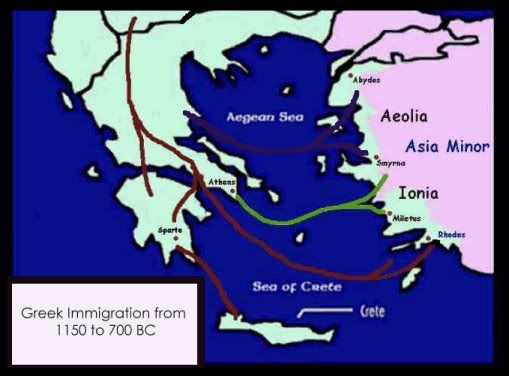
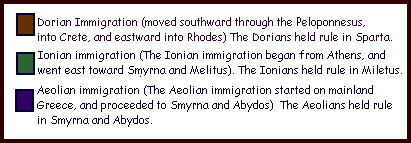
The timeframe below is from a bit earlier, but this is the most common explanation of Greek migration I get when searching the net or reading histories-
I have posted this on the Macedonia/Cretan topic as well.

greekimmigration.jpg

immigration.gif

References

"Dorian" Britannica Online.
 
Last edited:
Back
Top