
• Welcome to the new Macedonian Truth Forum. All posts, members and private messages have been moved over from the old forum.

    Passwords from the old forum could not be carried over, so please use Forgot your password? to set a new one. The reset link is emailed to the address on your account.

  • Rules and Regulations at the forum of the Macedonian Truth Organisation (MTO)

    (1) The national-ethnic and cultural-linguistic identity of the Macedonian people is historically Macedonian, and derives its character from the native, indigenous and geographic homeland of the Macedonians, which is called Macedonia. To ensure that their human rights, integrity and heritage are appropriately respected, the only nouns and adjectives acceptable when reference is made to the above character and identity markers is Macedon, Macedonia, Macedonian and Macedonians.

    (2) The nation-state of the Macedonian people is the Republic of Macedonia, and is to be referred to by this official title so long as the 'republic' prefix is consistently applied to other states. Alternative references are the Macedonian Republic, or simply, Macedonia.

    (3) The 'ethnic' prefix is only acceptable for Macedonians in cases where differentiation is specifically required - so long as it is in context and consistent where it concerns its application to other ethnic groups.

    (4) Should any other differentiation be specifically required, the names of other ethnic groups that reside with Macedonians in either the Republic of Macedonia or the occupied Macedonian regions in Greece, Bulgaria, Serbia or Albania, are to be given a prefix.

    (5) Negating the identity, language and culture of the Macedonian people by deliberate avoidance of the terms Macedonia, Macedonian and Macedonians, or by any other means, is not permitted.

    (6) Systematic anti-Macedonian propaganda and rhetoric are not permitted.

    (7) Threads irrelevant to the Macedonian Cause, the community at the Macedonian Truth Organisation or the Macedonians in general may be considered as spam or not in the spirit of the forum. In such cases they are not permitted.

    (8) Continual posting of messages in threads with the sole purpose of deviating from the initial topics with the use of unrelated and unnecessary information is not permitted.

    (9) All posts, external articles, reports, etc that are cited in languages other than Macedonian or English, must be accompanied with a translation in one or both of the said languages.

    (10) Despite the possibility of some conversations and debates becoming heated, extreme abuse and/or racism, vulgar language and/or terminology, threats, revelation of personal information about others, harassment, and other such behavior will not be permitted. If deemed necessary all relevant information including member details will be reported to the appropriate authorities for investigation which may result in legal action.

    (11) Threads that are created must have a summary of a topic or excerpt of an article found in pertinent link(s) that have been included. One line threads will be considered unaccetable spam and are therefore not permitted.

    (12) Compulsive and deliberate lies, irrespective of the topic, are not permitted.

    (13) Any symbols or avatars found to be perceived as offensive to Macedonians are not permitted.

    (13) Any explicit or extreme material is not permitted.

    Failure to adhere to the above rules and regulations will result in a ban after 3 breaches. This may be reconsidered in some cases should the circumstances be of an unorthodox nature and/or require special consideration. To assure an effective deterrent against an individual or individuals with the sole purpose of causing dissent through spamming, racism or other improper means, the above rules will be strictly enforced.

    The MTO administration will monitor all discussions as reasonably practical and reserve the right to remove any post and/or member from the forum, and update the rules and regulations as required. Members are encouraged to immediately report any post and/or member to the MTO administration if they feel that these rules have not been abided by.

    The views expressed on this forum are those of the individuals. The only official representation of the MTO is made by the "Macedonian Truth Organisation (Site Owner)" username, and no other.

  • Macedonian Cause

    The Macedonian Truth Organisation calls on God in Heaven to protect, bless and guide the endeavour it is committing to undertake, and that is to work towards:

    Securing Macedonia as a free, independent and democratic republic in which sovereignty lies with the Macedonian citizens; as the nation-state of the Macedonian people in which they can preserve their culture, language and identity; as a state in which the Macedonian language and culture form the basis of public life and act as important unifying elements of Macedonian society; as the home of all its citizens to which it guarantees and obliges their inalienable natural rights and corresponding responsibilities;

    The acknowledgment as self-evident and irrefutable the existence of the:

    1) Indigenous, ethnonational name of Macedonia;
    2) Macedonian people, language and identity;
    3) Macedonian culture, symbols and folklore;
    4) Macedonian ancestry, heritage and history in its entirety; and
    5) Macedonian Orthodox Church;

    Securing recognition by the International Community of the tragedies endured by the Macedonian people, of the division of Macedonia with the signing of the Treaty of Bucharest on August 10, 1913, and the genocide committed against the Macedonian people at the hands of the Greek, Bulgarian and Serbian states and their respective churches during the 19th and 20th centuries;

    Ensuring that the Interim Accord is declared ‘null and void’ and that all constitutional provisions, acts, commitments, agreements, legislation, regulations, policies or programs emanating from, supporting or consequential to the Interim Accord are also declared ‘null and void’, including the use of any symbols and the completion of any acts imposed by, or originating from, the Interim Accord.

    Ensuring that the Framework Agreement is abolished and that all constitutional provisions, acts, commitments, agreements, legislation, regulations, policies and programs emanating from, supporting or consequential to the Framework Agreement are also abolished and replaced by a framework of constitutional and statutory law based on inalienable natural rights and corresponding responsibilities and universally codified human rights mechanisms.

    Securing the abolishment of any existing constitutional provisions, acts, agreements, legislation, regulations, policies and programs that discriminate against the Macedonian people, in any international organisation or any of the countries of the International Community where such constitutional provisions, acts, agreements, legislation, regulations, policies and programs exist, and thereby ensuring the freedom for Macedonians to exercise their inalienable natural rights and fulfil their corresponding responsibilities, and practice their culture, language and religious faiths in all the countries of the International Community without hindrance;

    The empowerment of Macedonians to undertake a moral revolution and to instil and/or reinvigorate within themselves a deep-rooted national, cultural, linguistic and historical dignity and a commitment to the exercise of freedom based on inalienable natural rights and corresponding responsibilities;

    The recognition of the Macedonian minorities in the neighbouring states of Macedonia as well as the respect for the inalienable rights and freedoms of the Macedonian minorities, as provided for by natural law and as codified by the United Nations Charter, the Universal Declaration of Human Rights and other universally codified human rights mechanisms;

    The full and unreserved respect of, and the support for, the rights of all people of non-Macedonian descent living in Macedonia and around the world, who share a reciprocal full and unreserved respect for the Macedonian people, their homeland and their state;

    The cultural unification and solidarity of the Macedonian people living in all parts of historical Macedonia and adjacent territories, as well as Macedonians throughout the world;

    The unity of all Macedonians on the principles, objectives and achievement of the Macedonian cause as defined by this declaration.

BBC: Greece's invisible minority - the Macedonian Slavs

Niko777

New member
Link: https://www.bbc.com/news/stories-47258809

By ratifying an agreement with the newly renamed Republic of North Macedonia, Greece has implicitly recognised the existence of a Macedonian language and ethnicity. And yet it has denied the existence of its own Macedonian minority for decades, says Maria Margaronis. Will something now change?

Mr Fokas, 92, stands straight as a spear in his tan leather brogues and cream blazer, barely leaning on the ebony and ivory cane brought from Romania by his grandfather a century ago. His mind and his memory are as sharp as his outfit.

A retired lawyer, Mr Fokas speaks impeccable formal Greek with a distinctive lilt: his mother tongue is Macedonian, a Slavic language related to Bulgarian and spoken in this part of the Balkans for centuries. At his son's modern house in a village in northern Greece, he takes me through the painful history of Greece's unrecognised Slavic-speaking minority.
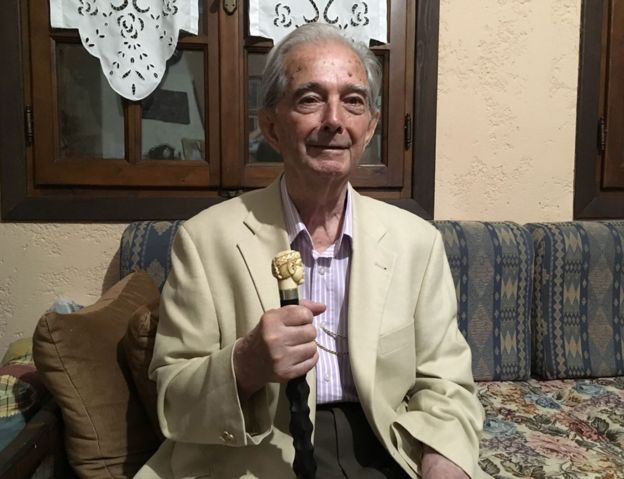
_105706296_fokas976.jpg


Mr Fokas takes care to emphasise from the start that he is both an ethnic Macedonian and a Greek patriot. He has good reason to underline his loyalty: for almost a century, ethnic Macedonians in Greece have been objects of suspicion and, at times, persecution, even as their presence has been denied by almost everyone.

Most are reluctant to speak to outsiders about their identity. To themselves and others, they're known simply as "locals" (dopyi), who speak a language called "local" (dopya). They are entirely absent from school history textbooks, have not featured in censuses since 1951 (when they were only patchily recorded, and referred to simply as "Slavic-speakers"), and are barely mentioned in public. Most Greeks don't even know that they exist.

That erasure was one reason for Greece's long-running dispute with the former Yugoslav republic now officially called the Republic of North Macedonia. The dispute was finally resolved last month by a vote in the Greek parliament ratifying (by a majority of just seven) an agreement made last June by the countries' two prime ministers. When the Greek Prime Minster, Alexis Tsipras, referred during the parliamentary debate to the existence of "Slavomacedonians" in Greece - at the time of World War Two - he was breaking a long-standing taboo.
_105709969_quote-metaxas-nc.jpg


The use of the name "Macedonia" by the neighbouring nation state implicitly acknowledges that Macedonians are a people in their own right, and opens the door to hard questions about the history of Greece's own Macedonian minority.

When Mr Fokas was born, the northern Greek region of Macedonia had only recently been annexed by the Greek state. Until 1913 it was part of the Ottoman Empire, with Greece, Bulgaria and Serbia all wooing its Slavic-speaking inhabitants as a means to claiming the territory. It was partly in reaction to those competing forces that a distinctive Slav Macedonian identity emerged in the late 19th and early 20th Century. As Mr Fokas's uncle used to say, the family was "neither Serb, nor Greek, nor Bulgarian, but Macedonian Orthodox".

In the end, the Slav Macedonians found themselves divided between those three new states. In Greece, some were expelled; those who remained were pushed to assimilate. All villages and towns with non-Greek names were given new ones, chosen by a committee of scholars in the late 1920s, though almost a century later some "locals" still use the old ones.

In 1936, when Mr Fokas was nine years old, the Greek dictator Ioannis Metaxas (an admirer of Mussolini) banned the Macedonian language, and forced Macedonian-speakers to change their names to Greek ones.

Mr Fokas remembers policemen eavesdropping on mourners at funerals and listening at windows to catch anyone speaking or singing in the forbidden tongue. There were lawsuits, threats and beatings.

Women - who often spoke no Greek - would cover their mouths with their headscarves to muffle their speech, but Mr Fokas's mother was arrested and fined 250 drachmas, a big sum back then.

"Slavic-speakers suffered a lot from the Greeks under Metaxas," he says. "Twenty people from this village, the heads of the big families, were exiled to the island of Chios. My father-in-law was one of them." They were tortured by being forced to drink resin oil, a powerful laxative.

When Germany, Italy and Bulgaria invaded Greece in 1941, some Slavic-speakers welcomed the Bulgarians as potential liberators from Metaxas's repressive regime. But many soon joined the resistance, led by the Communist Party (which at that time supported the Macedonian minority) and continued fighting with the Communists in the civil war that followed the Axis occupation. (Bulgaria annexed the eastern part of Greek Macedonia from 1941 to 1944, committing many atrocities; many Greeks wrongly attribute these to Macedonians, whom they identify as Bulgarians.)

When the Communists were finally defeated, severe reprisals followed for anyone associated with the resistance or the left.

"Macedonians paid more than anyone for the civil war," Mr Fokas says. "Eight people were court-martialled and executed from this village, eight from the next village, 23 from the one opposite. They killed a grandfather and his grandson, just 18 years old."

Mr Fokas was a student in Thessaloniki then - but he too was arrested and spent three years on the prison island of Makronisos, not because of anything he'd done but because his mother had helped her brother-in-law escape through the skylight of a cafe where he was being held.

Most of the prisoners on Makronisos were Greek leftists, and were pressed to sign declarations of repentance for their alleged Communist past. Those who refused were made to crawl under barbed wire, or beaten with thick bamboo canes. "Terrible things were done," Mr Fokas says. "But we mustn't talk about them. It's an insult to Greek civilisation. It harms Greece's good name."

Tens of thousands of fighters with the Democratic Army, about half of them Slavic-speakers, went into exile in Eastern bloc countries during and after the civil war. About 20,000 children were taken across the border by the Communists, whether for their protection or as reserve troops for a future counter-attack.

Many Slavic-speaking civilians also went north for safety. Entire villages were left empty, like the old settlement of Krystallopigi (Smrdes in Macedonian) near the Albanian border, where only the imposing church of St George stands witness to a population that once numbered more than 1,500 souls.
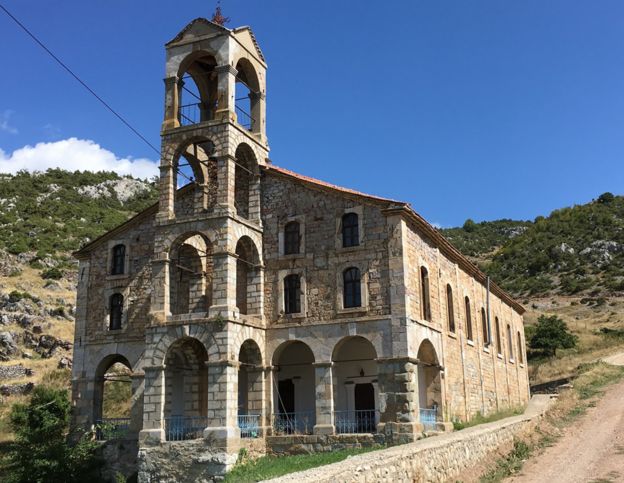
_105708004_georgechurch976.jpg


In 1982, more than 30 years after the conflict's end, Greece's socialist government issued a decree allowing civil war refugees to return - but only those who were "of Greek ethnicity". Ethnic Macedonians from Greece remained shut out of their country, their villages and their land; families separated by the war were never reunited.

Mr Fokas's father-in-law and brother-in-law both died in Skopje. But, he points out, that decree tacitly recognised that there were ethnic Macedonians in Greece, even though the state never officially recognised their existence: "Those war refugees left children, grandchildren, fathers, mothers behind. What were they, if not Macedonians?"
_105709972_quote_speaking-nc.jpg


It's impossible accurately to calculate the number of Slavic-speakers or descendants of ethnic Macedonians in Greece. Historian Leonidas Embiricos estimates that more than 100,000 still live in the Greek region of Macedonia, though only 10,000 to 20,000 would identify openly as members of a minority - and many others are proud Greek nationalists.

The Macedonian language hasn't officially been banned in Greece for decades, but the fear still lingers. A middle-aged man I met in a village near the reed beds of Lake Prespa, where the agreement between Greece and the North Macedonian republic was first signed last June, explained that this fear is passed down through the generations. "My parents didn't speak the language at home in case I picked it up and spoke it in public. To protect me. We don't even remember why we're afraid any more," he said. Slowly the language is dying. Years of repression pushed it indoors; assimilation is finishing the job.

And yet speaking or singing in Macedonian can still be cause for harassment. Mr. Fokas' son is a musician; he plays the haunting Macedonian flute for us as his own small son looks on. He and a group of friends used to host an international music festival in the village square, with bands from as far away as Brazil, Mexico and Russia.

"After those bands had played we'd have a party and play Macedonian songs," he says. "None of them were nationalist or separatist songs - we would never allow that. But in 2008, just as we were expecting the foreign musicians to arrive, the local authority suddenly banned us from holding the festival in the square, even though other people - the very ones who wanted us banned - still hold their own events there."

At the last minute, the festival was moved to a field outside the village, among the reeds and marshes, without proper facilities - which, Mr Fokas's son points out, only made Greece look bad.

"And do you know why the songs are banned in the square but not the fields outside?" his father adds. "Because around the square there are cafes, and local people could sit there and watch and listen secretly. But outside the village they were afraid to join in - they would have drawn attention to themselves by doing that."

The ratification of Greece's agreement with the Republic of North Macedonia - and its implicit recognition of a Macedonian language and ethnicity - is a major political breakthrough which should help to alleviate such fears. But the process has also sparked new waves of anger and anxiety, with large, sometimes violent protests opposing the agreement, supported by parts of the Orthodox church.

An election is due before the end of the year. Greece's right-wing opposition has been quick to capitalise on nationalist sentiments, accusing the Syriza government of treason and betrayal. For Greece's Slavic-speakers, who have long sought nothing more than the right to cultural expression, the time to emerge from the shadows may not quite yet have arrived.

Mr Fokas has been referred to by his first name to protect his identity
 
One can only hope that more Macedonians in Greece can realize that there is nothing to fear. Maybe the real Macedonian movement can start in Egejska and teach those baboons in the North a thing or two.

The cultural movement has already begun and has made large gains in Egejska. The challenge remains how to turn it into a political movement for the protection of human rights, language, and identity.
 
I was in Lerin 3 years ago, I spoke to 8 or more people, and all of them spoke Macedonian, with the exception of one of them, all of them claimed to be Macedonian.

FFS, it’s 2019. Language and cultural rights should be afforded to the Aegean’s without fear of reprisal.

They should start by teaching Macedonian in schools where relevant.
 
Why can’t we start an initiative to open a language school in the Lerin region..? Like the ones we have in Aus?

Fark even if you get 10 kids, that’s something!
 
The cultural movement has already begun and has made large gains in Egejska. The challenge remains how to turn it into a political movement for the protection of human rights, language, and identity.

I've already heard this from a Pontian that lives in Egejska. Many people from the republic are also intermarrying with people across the border, in addition to moving to Greece. These people are teaching their children Macedonian and are strongly advocating the introduction of Macedonian language schools.
 
Why can’t we start an initiative to open a language school in the Lerin region..? Like the ones we have in Aus?

Fark even if you get 10 kids, that’s something!

Because the government won't allow it. There was a Macedonian Cultural Centre that opened in Voden a couple years ago, it lasted a few months before it was forced to shut down.
 
How about setting up online courses for Macedonian on YouTube for free? Or perhaps, on some other, more suitable online learning platform (Moodle or Desire2Learn)? This should circumvent governmental limitations.

PS: Also, I'd recommend starting with teaching stories, poems and songs. That will attract more easily someone in the language and culture rather than a dry lesson on grammar.
 
Last edited:
How about setting up online courses for Macedonian on YouTube for free? Or perhaps, on some other, more suitable online learning platform (Moodle or Desire2Learn)? This should circumvent governmental limitations.

PS: Also, I'd recommend starting with teaching stories, poems and songs. That will attract more easily someone in the language and culture rather than a dry lesson on grammar.

Government monitors what sites its citizens access.
 
It's 2019 the last time I checked. We should not be talking about circumventing govt. limitations:

Adopted by General Assembly resolution 47/135 of 18 December 1992

Article 1

1. States shall protect the existence and the national or ethnic, cultural, religious and linguistic identity of minorities within their respective territories and shall encourage conditions for the promotion of that identity.

2. States shall adopt appropriate legislative and other measures to achieve those ends.

Article 2

1. Persons belonging to national or ethnic, religious and linguistic minorities (hereinafter referred to as persons belonging to minorities) have the right to enjoy their own culture, to profess and practise their own religion, and to use their own language, in private and in public, freely and without interference or any form of discrimination.

Etc.

URL:
https://www.ohchr.org/en/professionalinterest/pages/minorities.aspx
 
@Carlin

These are great guidelines and I hope that countries (including Greece) were aiming in upholding them.

However, keep in mind that Greece only needs to wait 20-25 years and the "problem", as most Greeks perceive it, will "solve" itself. I'm in my mid-thirties and virtually no Greek citizen my age doesn't speak Greek or doesn't feel Greek. Things might have been different, in the 70s and 80s but soon, everyone but the Muslim Greeks will be completely assimilated. Tick tock

If we want to preserve indigenous diversity, we have to protect it beyond what the government does. You are from Canada, residential schools are a fresh memory; First Nations' numbers are negligible in comparison to the other ethnic groups.

Another suggestion I have is to invite Greeks that are willing to help to these Macedonian cultural events. They can attend, safeguard and normalize the Macedonian (or Ntopia) culture within Greece. As I had said in a previous topic, I strongly believe we need the Greek people to intervene for their Macedonian compatriots.
 
Apologies for the source of the article

https://neoskosmos.com/en/130325/bb...donian-slavs-as-invisible-minority-of-greece/

BBC report casts focus on Macedonian Slavs as “invisible minority” of Greece

The Prespes Agreement may expressly leave no room for raising the existence of a “Macedonian minority” of North Macedonia origin living in Greece, however it is open for interpretation for a number of factions and a portion of the press.

A BBC report, titled “Greece’s invisible minority – the Macedonian Slavs”, states that Greece has implicitly recognised the existence of the Macedonian language and ethnicity through its ratification of the Prespes Agreement.*

The article focuses on retired lawyer Mr Fokas, aged 92, – no first name given. He identifies as both an “ethnic Macedonian and Greek patriot” and, in the interview with Maria Margaronis, discusses the rights of “Greece’s unrecognised Slavic-speaking minority.”

Mr Fokas talks of his group’s history in Greece as one of persecution and erasure and adds that they do not appear in school textbooks, are barely mentioned in public and most Greeks don’t even know that they exist. As a group, Mr Fokas said that “Slavomacedonians” became invisible in 1936 when Greek dictator Ioannis Metaxas *forced Macedonian speakers to change their names to Greek and forbade their language. As a child, he remembers policemen eavesdropping to ensure that the language was not spoken, and his own mother was arrested and fined 250 drachmas for speaking the language.

The interview with Mr Fokas prompted a statement by the Greek government. A diplomat told the Athens-News Macedonian Agency (ANA) on Sunday that the report contained inaccurate and distorted information about history and the Prespes Agreement.

“The Prespes Agreement leaves no room for raising the issue of a minority,” said the source.

The Greek government is planning to send the BBC a letter in order to refute the reportage.
 
I dont get it, i thought after the prespa agreement Macedonians are now 'Northern Macedonians' - whey are they still reffered to as 'Slav Macedonians'?

I thought the Prespa agreement was to 'fix' and 'resolve' everything? woweeee
 
Sad, but predictable.

YuriB, Greece has no intention of following the "Declaration on the Rights of Persons Belonging to National or Ethnic, Religious and Linguistic Minorities" UN guidelines. The Greek govt. reacted in a very predictable manner.

Senior diplomatic sources told the Athens News Agency that the Greek government plans to send a letter to the BBC in which it will refute allegations of the claim that "there is a Macedonian minority in the country that has been oppressed for decades." This is incorrect and distorted view, diplomatic sources say. The largest opposition party, "New Democracy" (ND), called on the government "to clarify these issues and to categorically say that there is no Macedonian ethnic minority in Greece". ND accused the government that the Prespa Agreement opened the Pandora's box for unhistorical claims and claims against Greece.

Грција експлодира по написот на Би-би-си за угнетеното македонско малцинство

URL:
https://www.mkd.mk/makedonija/polit...-bi-bi-si-za-ugnetenoto-makedonsko-malcinstvo

Високи дипломатски извори изјавија за Атинската новинска агенција (АМНА) дека грчката влада планира да испрати писмо до Би-би-си во кое ќе ги побие наводите за тврдењето дека „во земјата постои македонско малцинство што со децении е угнетувано". Ова е неточен и искривен поглед, наведуваат дипломатските извори.

И најголемата опозициска партија Неа демократиа (НД) ја повика владата „да ги разјасни овие работи и категорично да каже дека во Грција не постои прашање за македонско етничко малцинство“. НД ја обвини владата дека со Преспанскиот договор се отвори Пандорината кутија за неисториските барања и тврдења во однос на Грција.

Во репортажата на Би-би-си се вели дека со ратификуваниот договор со новоименуваната Република Северна Македонија, Грција имплицитно го признала постоењето на македонскиот јазик и етничката припадност и дека со децении го негираше постоењето на своето македонско малцинство.

Употребата на името „Македонија“ од страна на соседната национална држава директно и јасно признава дека Македонците се самостоен народ и ја отвора вратата за тешки прашања во врска со историјата на грчкото македонско малцинство, пишува Би-би-си.
 
Here we go -

Greek ambassador refutes 'Macedonian minority' claim in BBC report

URL:
http://www.ekathimerini.com/238067/...futes-macedonian-minority-claim-in-bbc-report

Greece's Ambassador to the UK, Dimitris Karamitsos-Tziras, send a letter of complaint to the BBC on Monday, following a report which spoke of the existence of a “Macedonian minority” in the country.

Karamitsos-Tziras said the report contains “important historical inaccuracies and distortions against Greece” and “does not do justice” to the Prespes agreement by attempting to raise a “non-existent issue.”

The article, titled “Greece's invisible minority - the Macedonian Slavs,” argued that, by ratifying the Prespes accord with the renamed North Macedonia, “Greece has implicitly recognised the existence of a Macedonian language and ethnicity.”

The agreement, signed between Athens and Skopje to resolve the 27-year-old name dispute, does not recognize an ethnicity, but a nationality, the ambassador said, adding that while Greece recognizes equality before the law, the country recognizes only one minority - the Muslim.

“Greece maintains the right to refer to the people who belong to the majority ethnic group residing in the neighboring country as it has done to date, while the citizens of that ethnicity retain the right to self-determination,” he said in the letter.


WobNXRc.jpg
 
Last edited:
Hopefully the BBC stands by their article and reporting. If the UN and other human rights groups don't follow through then WTF was this whole "name issue" and agreement about? So far I have seen some lip service from Amnesty and a few other groups, but The Hauge IICJ (or whatever the hell place FYROMFROMRONM "won" a court case on Greece violating the old Interim accord...has proved useless. I am still baffled by the speed and idiocy of this decision.
 
There is a knee-jerk reaction in Greece to the term minority. Most Greeks perceive it as a first step towards autonomy and subsequently, secession. Probably, because Greece has used its own minorities in the past to expand its territory.

I believe the whole thing needs to be rebranded as maintaining the cultural individuality of the region. It's crucial (somehow) to make the average Greek citizen to realize they have lots to gain by supporting (or the very least, tolerating) the local Macedonian culture.

In fairness we would probably secede if given the institutions to do so.
 
In fairness we would probably secede if given the institutions to do so.
If the institutions mean kicking out all the imported former Turkish nationals who arrived under the Lausanne Treaty, then maybe. Otherwise, I doubt it. The region is mixed (on purpose) and the time has long gone when ethnic Macedonians were the dominant people of the region.
 
Back
Top