• Welcome to the new Macedonian Truth Forum. All posts, members and private messages have been moved over from the old forum.

    Passwords from the old forum could not be carried over, so please use Forgot your password? to set a new one. The reset link is emailed to the address on your account.

  • Rules and Regulations at the forum of the Macedonian Truth Organisation (MTO)

    (1) The national-ethnic and cultural-linguistic identity of the Macedonian people is historically Macedonian, and derives its character from the native, indigenous and geographic homeland of the Macedonians, which is called Macedonia. To ensure that their human rights, integrity and heritage are appropriately respected, the only nouns and adjectives acceptable when reference is made to the above character and identity markers is Macedon, Macedonia, Macedonian and Macedonians.

    (2) The nation-state of the Macedonian people is the Republic of Macedonia, and is to be referred to by this official title so long as the 'republic' prefix is consistently applied to other states. Alternative references are the Macedonian Republic, or simply, Macedonia.

    (3) The 'ethnic' prefix is only acceptable for Macedonians in cases where differentiation is specifically required - so long as it is in context and consistent where it concerns its application to other ethnic groups.

    (4) Should any other differentiation be specifically required, the names of other ethnic groups that reside with Macedonians in either the Republic of Macedonia or the occupied Macedonian regions in Greece, Bulgaria, Serbia or Albania, are to be given a prefix.

    (5) Negating the identity, language and culture of the Macedonian people by deliberate avoidance of the terms Macedonia, Macedonian and Macedonians, or by any other means, is not permitted.

    (6) Systematic anti-Macedonian propaganda and rhetoric are not permitted.

    (7) Threads irrelevant to the Macedonian Cause, the community at the Macedonian Truth Organisation or the Macedonians in general may be considered as spam or not in the spirit of the forum. In such cases they are not permitted.

    (8) Continual posting of messages in threads with the sole purpose of deviating from the initial topics with the use of unrelated and unnecessary information is not permitted.

    (9) All posts, external articles, reports, etc that are cited in languages other than Macedonian or English, must be accompanied with a translation in one or both of the said languages.

    (10) Despite the possibility of some conversations and debates becoming heated, extreme abuse and/or racism, vulgar language and/or terminology, threats, revelation of personal information about others, harassment, and other such behavior will not be permitted. If deemed necessary all relevant information including member details will be reported to the appropriate authorities for investigation which may result in legal action.

    (11) Threads that are created must have a summary of a topic or excerpt of an article found in pertinent link(s) that have been included. One line threads will be considered unaccetable spam and are therefore not permitted.

    (12) Compulsive and deliberate lies, irrespective of the topic, are not permitted.

    (13) Any symbols or avatars found to be perceived as offensive to Macedonians are not permitted.

    (13) Any explicit or extreme material is not permitted.

    Failure to adhere to the above rules and regulations will result in a ban after 3 breaches. This may be reconsidered in some cases should the circumstances be of an unorthodox nature and/or require special consideration. To assure an effective deterrent against an individual or individuals with the sole purpose of causing dissent through spamming, racism or other improper means, the above rules will be strictly enforced.

    The MTO administration will monitor all discussions as reasonably practical and reserve the right to remove any post and/or member from the forum, and update the rules and regulations as required. Members are encouraged to immediately report any post and/or member to the MTO administration if they feel that these rules have not been abided by.

    The views expressed on this forum are those of the individuals. The only official representation of the MTO is made by the "Macedonian Truth Organisation (Site Owner)" username, and no other.

  • Macedonian Cause

    The Macedonian Truth Organisation calls on God in Heaven to protect, bless and guide the endeavour it is committing to undertake, and that is to work towards:

    Securing Macedonia as a free, independent and democratic republic in which sovereignty lies with the Macedonian citizens; as the nation-state of the Macedonian people in which they can preserve their culture, language and identity; as a state in which the Macedonian language and culture form the basis of public life and act as important unifying elements of Macedonian society; as the home of all its citizens to which it guarantees and obliges their inalienable natural rights and corresponding responsibilities;

    The acknowledgment as self-evident and irrefutable the existence of the:

    1) Indigenous, ethnonational name of Macedonia;
    2) Macedonian people, language and identity;
    3) Macedonian culture, symbols and folklore;
    4) Macedonian ancestry, heritage and history in its entirety; and
    5) Macedonian Orthodox Church;

    Securing recognition by the International Community of the tragedies endured by the Macedonian people, of the division of Macedonia with the signing of the Treaty of Bucharest on August 10, 1913, and the genocide committed against the Macedonian people at the hands of the Greek, Bulgarian and Serbian states and their respective churches during the 19th and 20th centuries;

    Ensuring that the Interim Accord is declared ‘null and void’ and that all constitutional provisions, acts, commitments, agreements, legislation, regulations, policies or programs emanating from, supporting or consequential to the Interim Accord are also declared ‘null and void’, including the use of any symbols and the completion of any acts imposed by, or originating from, the Interim Accord.

    Ensuring that the Framework Agreement is abolished and that all constitutional provisions, acts, commitments, agreements, legislation, regulations, policies and programs emanating from, supporting or consequential to the Framework Agreement are also abolished and replaced by a framework of constitutional and statutory law based on inalienable natural rights and corresponding responsibilities and universally codified human rights mechanisms.

    Securing the abolishment of any existing constitutional provisions, acts, agreements, legislation, regulations, policies and programs that discriminate against the Macedonian people, in any international organisation or any of the countries of the International Community where such constitutional provisions, acts, agreements, legislation, regulations, policies and programs exist, and thereby ensuring the freedom for Macedonians to exercise their inalienable natural rights and fulfil their corresponding responsibilities, and practice their culture, language and religious faiths in all the countries of the International Community without hindrance;

    The empowerment of Macedonians to undertake a moral revolution and to instil and/or reinvigorate within themselves a deep-rooted national, cultural, linguistic and historical dignity and a commitment to the exercise of freedom based on inalienable natural rights and corresponding responsibilities;

    The recognition of the Macedonian minorities in the neighbouring states of Macedonia as well as the respect for the inalienable rights and freedoms of the Macedonian minorities, as provided for by natural law and as codified by the United Nations Charter, the Universal Declaration of Human Rights and other universally codified human rights mechanisms;

    The full and unreserved respect of, and the support for, the rights of all people of non-Macedonian descent living in Macedonia and around the world, who share a reciprocal full and unreserved respect for the Macedonian people, their homeland and their state;

    The cultural unification and solidarity of the Macedonian people living in all parts of historical Macedonia and adjacent territories, as well as Macedonians throughout the world;

    The unity of all Macedonians on the principles, objectives and achievement of the Macedonian cause as defined by this declaration.

Deconstruction of the term Bulgar/B'lgar/Bugar/Voulgar!

The Greeks and Bulgars use people like Cvijic and Novakovich against the Macedonians, ignoring the fact that people like Pulevski long before advocated for the autonomy of the Macedonian people and identity.

Bulgars say that the Serbs supported the Macedonians for the purpose of distancing them from the Bulgars, with the ultimate goal of absorbing them into the Serbian nation. I am not sure if Novakovich or Cvijic state exactly that, but it would be intersting to read more about what they did and their intentions.
 
Here is a little chronology to put things into perspective as to what exactly was meant by the use of the 'Bulgar' terms through various periods in history.

Roman Times: Vulgar means the common mass, rough, peasants, for example, the 'vulgar crowd'.

7th Century: After the tribes of Asparuk settled in Thrace, the term 'Bulgar' comes to represent the Turkic ruling class bearing that same name as a tribal/national description.

9th Century: At the time of Boris, 'Bulgar' became an umbrella term for the Slavic-speaking people in most of the Balkans, as Boris himself did away (instead promoting Christianity and Slavic) with the remaining remnant Turkic Bulgars and their quest to retain the Turkic pagan identity. It is from such a background of general and generic description that the identity of Samuel's realm came to be, where by that time the Turkic Bulgar element was long gone and all that was left of those who brought the name with them was the actual name itself.

11th Century: 'Bulgaria' was used to describe an East Roman Theme consisting of the majority of Macedonia and Serbia (excluding the regions of the Turkic Bulgar kingdom) with Skopje as its capital. However, the term 'Bulgar(ian)' often retained its generic purpose of lumping most of the Slavic-speaking people in the Balkans in one group. This may also be a reason why the terms 'Bulgar' and 'Vulgar' were identified in a similar manner, for the Slavic-speaking people in the Balkans were in fact the overwhelming majority and mass in the region.

Ottoman Empire: While there are several sources that distinguish between Macedonians, Serbs, Bulgars, etc, before, during and in subsequent centuries, this generic use of 'Bulgar' continued to be the case even into the Ottoman Empire, from where it developed an added meaning of a lowly peasant as opposed to a 'Greek' who was a merchant and/or upper class type. It is from there that the people of upper Thrace began to use the 'Bulgar' term as a national descriptor in the modern sense.


Give us some thoughts and suggestions on what should be changed or added to the above. After we do this, we need to start gathering and consolidating the sources together.
 
This term Bulgar was caried by the Patriarchists ("Greeks") during the Ottman times. Misirkov explains it good:

Ниiе видофме во грците дуовни господари и верцки началници. Ниiе бефме и кон ниф, исто така принизени, као и кон турците. Грците со црквата не експлоатираа нас и сакаа да извршат под турцкото владичество тоа, шчо не можаа до него. За да не претопат нас, они избегуваа да не вел'ат со народното име.

Они ни кажуваа, да сме биле ниiе рисiани, и ниiе тврдефме:
абре брате, рисiани сме, ами шчо сме! Кога ке се расрдеа на нас, и ке не наречеа тврдоглаи бугари, ниiе пак ке речефме: е пак така си iет: вистина рисiани сме, ама не сме образуани, као грците! Нашите глаи не разбираат; ниiе сме бугари.

Со iеден збор во турцко време ниiе потврдуафме и се согласуафме со се, шчо ке ни кажеа турците и грците.

Но турците со тоа, шчо не нарекоа нас: раiати и г'аури, гледаа на нас као на л'уг'е, не од известна народност, а шчо сет во известен однос кон ниф, господарите и праоверните.

Во истата смисл'а употребуафме и ниiе, односуаiки кон себе, тиiе имиiн'а. Значит турците во нивната држаа не признаваа народности. Исто така не знаiефме за ниф и ниiе.

Грците исто така не разликуваа словенцките народности и сите словени, особено тоi дел од ниф, шчо им причини наi големи неприiатности и се наог'аше во турцко време под нивната опека, они го презираа и го велеа со презреното за ниф име „бугари".

Но тоа име искажуаше презреiн'ето на грците, а не и достоинства на бугарите, затоа се сопроводуаше со зборот тврдоглав или „хондрокефалос".

Taken from: http://www.misirkov.org/sostauala.htm

translation:

We saw in the greeks spiritual masters and religious leaders. We had the same attitude towards them as we had towards the Turks. The greeks were exploiting us in the church and wanted under the Turk rullership to achieve their goal which they were not able to do before their rule. To assimilate us, they wre avoiding to call us with our national name.

They were calling us Risyani (Christians), and we approved: of course brother, we are Risyani, what else should we be! When they got angry at us, and they would call us stubborn Bulgarians: we would say: it is true, we are Risyani, but we are not that educated, as the greeks! Our heads do not understand; we are Bulgarians.

With other word, in Turkish time we were approving and agreeing with everything that the Turks and the Greeks were telling us.

But the Turks, with designating us: Rayati and Giuri, they did not see us as people of certain Nationality, but with relation to them as a masters and people of orthodox religion.

With same respect we were using this name's between us. That means, that the Turks were not recongnizing Nations in their country. So we were doing the same.

The Greeks did not distinguish between the slavic Nations and all the Slavic people, specially the part fo them, who was making the troubles for them during the Turkish rule and were under their Juristdiction (church), they were hating them and calling them with the name "Bulgarian" wich for tham was dispicable name.

This name was expressing the Greek detest, and not the honor of the bulgarians, that's why it's epithet was "hondrokefalos".

Translated from: http://www.misirkov.org/sostauala.htm

This explaination of Misirkov goes in line with the meaning of "Vulgar" as well as the Greek version Βουλγαρος which is pronounced Vulgaros.

Commoner, non educated, stupid peasant.

Hondrokefalos > stubborn
Vulgaros > commoner, peasant, uneducated.

As addition, read the meaning of Hellene on my Signature...
 
Last edited:
makedonin, thank you for your great contribution in this thread!

Bulgarians watch out, we will deconstruct you as we have done with the Greeks, soon we will also deconstruct the Serbs.......
 
Excellent work Makedonin. This explains alot of things that I hope many Macedonians who did not know before know now. Excellent stuff guys.
 
You are welcome guy's, but this is old stuff.

We just have to read what our people said before.... they knew it, it was in their time, before this stupid Nationalism have screwed the things up.
 
We just have to read what our people said before.... they knew it, it was in their time, before this stupid Nationalism have screwed the things up.

Well put.

How ridiculous. One of the oldest nations (Macedonia) failed to grasp the modern pale imitation version of nationalism and has suffered ever since.
 
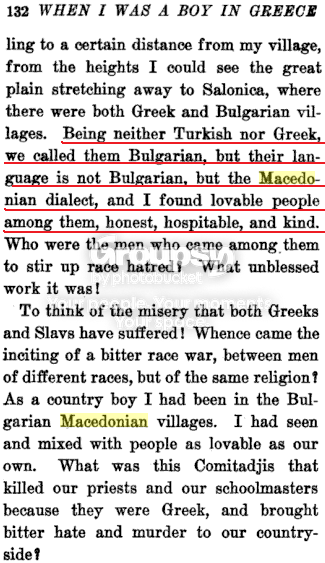
Here's something I think belongs in here.

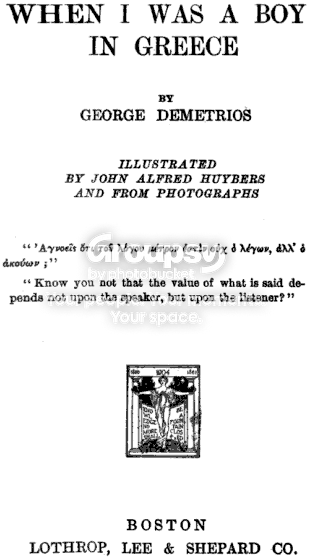
gd.png

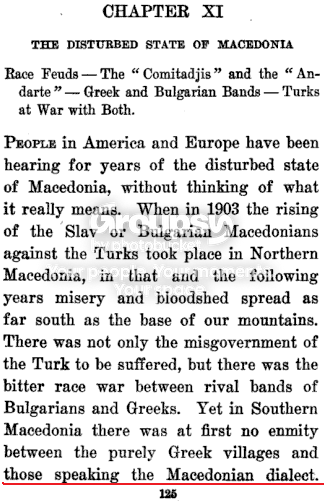
gd125.png

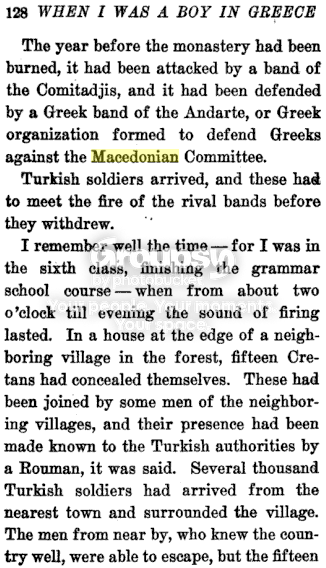
gd128.png

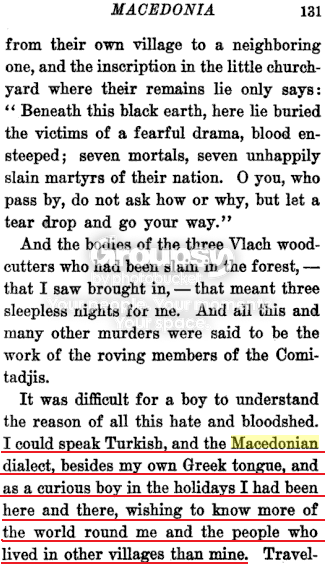
gd131.png

gd132.png


Just like the front cover of the book states, "Know you not that the value of what is said depends not upon the speaker, but upon the listener?" (By the way this book was published in 1913 when propaganda in Macedonia was peaked.)
As you read through this book you realize that it is mired in racist ideological diatribe that the modern "greek" government has embedded in the population of not just modern "greece" but most of the world. Like the Nazis once said; If you tell a lie long and loud enough, especially a big lie, people will eventually start to believe it.

Here is a person who lived in Macedonia with the supposed "greeks", Vlachs, Albanians, Turks, and the supposed Bulgarian Macedonians. Well.....as illustrated in the pages I posted on here these people do not really speak Bulgarian but a Macedonian Dialect. And that the author, George Demetrius, states "we called them Bulgarian". Calling them this does not necessarily make them this.

Here's Krste Misirkov's statement at the time of why the Macedonians were labelled "bulgarians"-(Thanks Makedonin ;))

We saw in the greeks spiritual masters and religious leaders. We had the same attitude towards them as we had towards the Turks. The greeks were exploiting us in the church and wanted under the Turk rullership to achieve their goal which they were not able to do before their rule. To assimilate us, they were avoiding to call us with our national name.

They were calling us Risyani (Christians), and we approved: of course brother, we are Risyani, what else should we be! When they got angry at us, and they would call us stubborn Bulgarians: we would say: it is true, we are Risyani, but we are not that educated, as the greeks! Our heads do not understand; we are Bulgarians.

With other word, in Turkish time we were approving and agreeing with everything that the Turks and the Greeks were telling us.

But the Turks, with designating us: Rayati and Giuri, they did not see us as people of certain Nationality, but with relation to them as a masters and people of orthodox religion.

With same respect we were using this name's between us. That means, that the Turks were not recongnizing Nations in their country. So we were doing the same.

The Greeks did not distinguish between the slavic Nations and all the Slavic people, specially the part fo them, who was making the troubles for them during the Turkish rule and were under their Jurisdiction (church), they were hating them and calling them with the name "Bulgarian" wich for tham was dispicable name.

This name was expressing the Greek detest, and not the honor of the bulgarians, that's why it's epithet was "hondrokefalos".


Translated from: http://www.misirkov.org/sostauala.htm


The brainwashed George Demetrius, whatever his true background may be, displayed the contradiction relevant even in todays society.
 
Well that is very interesting TM.

Confirmation of Misrikovs statement by wonna be "Greek".

Besides their awareness of the difference between the Macedonians and Bulgarians, they kept calling them Bulgarians. Derogative designation....

His statement even gains momentum, since he spoke spoke Turkish and the Macedonian "dialect" and he could tell the difference.

Good one TM
 
Being neither Turkish nor Greek, we called them Bulgarian, but their language is not Bulgarian, but the Macedonian dialect, and I found lovable people among them........

The Macedonian dialect of what? He stops short of referring to the language of those "lovable people" as simply Macedonian. I doubt very much that those "lovable people" went around calling their language a "Macedonian dialect", to them it was simply Macedonian.

Not matter what (lies) he mentions in other parts of the text which exhibit his confusion (or denial), they are all betrayed by the above quote.

Not Turkish, not Greek, not Bulgarian, but Macedonian-Makedonski-Makedonika.
 
As Misirkov put's it:

The Greeks did not distinguish between the slavic Nations and all the Slavic people, specially the part fo them, who was making the troubles for them during the Turkish rule and were under their Jurisdiction (church), they were hating them and calling them with the name "Bulgarian" wich for tham was dispicable name.

All in all, those lovable people were for them Hondrokephalos Bulgaris, cause they were not wanting to become descendants of Pericles.

And he wonders why the Macedonian Comettee as he call's it was killing those double faced Greek Priests, the tool for Hellenisation.
 
Last edited:
Have you heard about the Solun Legend?

Here is what those Medieval writers considered as Bulgarian:

"The Bulgarian heard of me, the Great Knez Desimir of Moravia, Radivoi Knez of Preslav and all of the Knez bulgarian gethered together around Solun, and fought for the great blood and talked: send us a one of ours. So they sent me. The Bulgarians received me celebrant and brougth me in the town Ravn on the river Bregalnica. I wrote them their letter(characters). I teached them, and many of them converted on their own. They swore to give the Pravoslav Faith of Christ further. "(free translation)

It is from the book:
(Й. Иванов, "Български старини из Македония", БАН, 1970 г. ).'
Online Link for the Solun Legend

So the Moravian Knez Desimir....Knowing that Cyril and Methody were sent to Moravia region in the Czech Republic to teach them the "Slavic" letter, than this text would make the Czech's being Bulgarians.

This text shows that the word Bulgarian had no Ethnic meaning, since the Moravian Knez, and the other "Slavic" speaking Knez were also considered as Bulgarian.
A Bulgar tried to dump this conclusion, pointing to the Great Moravia region in Serbia, but this would be noticed in the text as Desimir the Great Moravian Knez, which is not.

And even so, that would make the Serbs of Great Moravia a Bulgarians, which in this case can't hold the water. And since the "Other Knez" were also Bulgarian, and the Bulgarians had only one the only reasonable conclusion would be that, the term Bulgarian in deed refered to the "Slavic" spaking peasants, commoners and their rules.
 
Which year or century is it from?

Here what it say's:

Comments
the author of the e-Edition
of Solunska legend "


"Solunska legend is autobiographic story of St. Cyril of Christianity by the Bulgarians and the Bulgarian alphabet invention. Besides all the other merits of this document, it is also one of the many direct evidence izvekovnoto presence of Bulgarians in Cappadocia, Asia Minor. In the transcript found in the village of Turnovo around town Kriva (Tarnovski copy) The story begins thus: "He was born in Cappadocia moe ...". The other two copies known to us (copy Konstantinov - found by x vazrozhdenetsa Jordan. Konstantinov - Dzhinot and copy Tikveshki) begin as follows: "It was a legend in Cappadocia moe ...".
"Solunska legend" shows us that so-called "Gothic" to Christianity, became the territory of modern Bulgaria during the IV century Christianity is actually Bulgarians, and that "Gothic" Vulfila Bishop (born in Cappadocia) is the identity of St. Kurilo (vulf = Kurt = wolf), "Gothic" writing is nothing other than the Cyrillic alphabet. This link in a peremptory manner proved his works Dr. Gancho Tsenov.

Source: here

Translated with Google Translate.

On the other hand, I have seen this on Wikipedia:

Yordan Hadzhikonstantinov-Dzhinot found a manuscript of a Bulgarian medieval story "An oration of Saint Cyryl, how he baptized the Bulgarian people"', called "Solunska legenda" ("A legend from Thesalonika"). It was published in Glasnik magazine in 1856.

http://en.wikipedia.org/wiki/Yordan_Hadzhikonstantinov-Dzhinot

I can't tell you which Century it is so far.
 
Back
Top