• Welcome to the new Macedonian Truth Forum. All posts, members and private messages have been moved over from the old forum.

    Passwords from the old forum could not be carried over, so please use Forgot your password? to set a new one. The reset link is emailed to the address on your account.

  • Rules and Regulations at the forum of the Macedonian Truth Organisation (MTO)

    (1) The national-ethnic and cultural-linguistic identity of the Macedonian people is historically Macedonian, and derives its character from the native, indigenous and geographic homeland of the Macedonians, which is called Macedonia. To ensure that their human rights, integrity and heritage are appropriately respected, the only nouns and adjectives acceptable when reference is made to the above character and identity markers is Macedon, Macedonia, Macedonian and Macedonians.

    (2) The nation-state of the Macedonian people is the Republic of Macedonia, and is to be referred to by this official title so long as the 'republic' prefix is consistently applied to other states. Alternative references are the Macedonian Republic, or simply, Macedonia.

    (3) The 'ethnic' prefix is only acceptable for Macedonians in cases where differentiation is specifically required - so long as it is in context and consistent where it concerns its application to other ethnic groups.

    (4) Should any other differentiation be specifically required, the names of other ethnic groups that reside with Macedonians in either the Republic of Macedonia or the occupied Macedonian regions in Greece, Bulgaria, Serbia or Albania, are to be given a prefix.

    (5) Negating the identity, language and culture of the Macedonian people by deliberate avoidance of the terms Macedonia, Macedonian and Macedonians, or by any other means, is not permitted.

    (6) Systematic anti-Macedonian propaganda and rhetoric are not permitted.

    (7) Threads irrelevant to the Macedonian Cause, the community at the Macedonian Truth Organisation or the Macedonians in general may be considered as spam or not in the spirit of the forum. In such cases they are not permitted.

    (8) Continual posting of messages in threads with the sole purpose of deviating from the initial topics with the use of unrelated and unnecessary information is not permitted.

    (9) All posts, external articles, reports, etc that are cited in languages other than Macedonian or English, must be accompanied with a translation in one or both of the said languages.

    (10) Despite the possibility of some conversations and debates becoming heated, extreme abuse and/or racism, vulgar language and/or terminology, threats, revelation of personal information about others, harassment, and other such behavior will not be permitted. If deemed necessary all relevant information including member details will be reported to the appropriate authorities for investigation which may result in legal action.

    (11) Threads that are created must have a summary of a topic or excerpt of an article found in pertinent link(s) that have been included. One line threads will be considered unaccetable spam and are therefore not permitted.

    (12) Compulsive and deliberate lies, irrespective of the topic, are not permitted.

    (13) Any symbols or avatars found to be perceived as offensive to Macedonians are not permitted.

    (13) Any explicit or extreme material is not permitted.

    Failure to adhere to the above rules and regulations will result in a ban after 3 breaches. This may be reconsidered in some cases should the circumstances be of an unorthodox nature and/or require special consideration. To assure an effective deterrent against an individual or individuals with the sole purpose of causing dissent through spamming, racism or other improper means, the above rules will be strictly enforced.

    The MTO administration will monitor all discussions as reasonably practical and reserve the right to remove any post and/or member from the forum, and update the rules and regulations as required. Members are encouraged to immediately report any post and/or member to the MTO administration if they feel that these rules have not been abided by.

    The views expressed on this forum are those of the individuals. The only official representation of the MTO is made by the "Macedonian Truth Organisation (Site Owner)" username, and no other.

  • Macedonian Cause

    The Macedonian Truth Organisation calls on God in Heaven to protect, bless and guide the endeavour it is committing to undertake, and that is to work towards:

    Securing Macedonia as a free, independent and democratic republic in which sovereignty lies with the Macedonian citizens; as the nation-state of the Macedonian people in which they can preserve their culture, language and identity; as a state in which the Macedonian language and culture form the basis of public life and act as important unifying elements of Macedonian society; as the home of all its citizens to which it guarantees and obliges their inalienable natural rights and corresponding responsibilities;

    The acknowledgment as self-evident and irrefutable the existence of the:

    1) Indigenous, ethnonational name of Macedonia;
    2) Macedonian people, language and identity;
    3) Macedonian culture, symbols and folklore;
    4) Macedonian ancestry, heritage and history in its entirety; and
    5) Macedonian Orthodox Church;

    Securing recognition by the International Community of the tragedies endured by the Macedonian people, of the division of Macedonia with the signing of the Treaty of Bucharest on August 10, 1913, and the genocide committed against the Macedonian people at the hands of the Greek, Bulgarian and Serbian states and their respective churches during the 19th and 20th centuries;

    Ensuring that the Interim Accord is declared ‘null and void’ and that all constitutional provisions, acts, commitments, agreements, legislation, regulations, policies or programs emanating from, supporting or consequential to the Interim Accord are also declared ‘null and void’, including the use of any symbols and the completion of any acts imposed by, or originating from, the Interim Accord.

    Ensuring that the Framework Agreement is abolished and that all constitutional provisions, acts, commitments, agreements, legislation, regulations, policies and programs emanating from, supporting or consequential to the Framework Agreement are also abolished and replaced by a framework of constitutional and statutory law based on inalienable natural rights and corresponding responsibilities and universally codified human rights mechanisms.

    Securing the abolishment of any existing constitutional provisions, acts, agreements, legislation, regulations, policies and programs that discriminate against the Macedonian people, in any international organisation or any of the countries of the International Community where such constitutional provisions, acts, agreements, legislation, regulations, policies and programs exist, and thereby ensuring the freedom for Macedonians to exercise their inalienable natural rights and fulfil their corresponding responsibilities, and practice their culture, language and religious faiths in all the countries of the International Community without hindrance;

    The empowerment of Macedonians to undertake a moral revolution and to instil and/or reinvigorate within themselves a deep-rooted national, cultural, linguistic and historical dignity and a commitment to the exercise of freedom based on inalienable natural rights and corresponding responsibilities;

    The recognition of the Macedonian minorities in the neighbouring states of Macedonia as well as the respect for the inalienable rights and freedoms of the Macedonian minorities, as provided for by natural law and as codified by the United Nations Charter, the Universal Declaration of Human Rights and other universally codified human rights mechanisms;

    The full and unreserved respect of, and the support for, the rights of all people of non-Macedonian descent living in Macedonia and around the world, who share a reciprocal full and unreserved respect for the Macedonian people, their homeland and their state;

    The cultural unification and solidarity of the Macedonian people living in all parts of historical Macedonia and adjacent territories, as well as Macedonians throughout the world;

    The unity of all Macedonians on the principles, objectives and achievement of the Macedonian cause as defined by this declaration.

Exposing Bulgarian Myths and Lies

FieldsofWheat83.jpg


Fields of Wheat, Hills of Blood by Anastasia Karakasidou, page 83

Karpat.jpg

Karpat467.jpg


Jelavich347.jpg


History of the Balkans by Barbara Jelavich

 
It just goes to show that Bulgaria has been relentless in it's pursuit to falsify anything macedonian.If they could access any historical archives they& would twist & turn it into a propaganda material to say that macedonians are bulgarian,it's all lies & manipulations of history.
 
RWSeton-Watson.jpg

RWSeton-Watson351.jpg

RWSeton-Watson351a.jpg

RWSeton-Watson352.jpg


The Bulgar's awakener wasn't even Bulgarian but a Slovak :14: And these people have the nerve to question the Macedonian identity when their own identity throws up red flags just like the new grk one the philhellenes fostered.
 
MilitaryHistoryofMacedoniapage215.jpg


Military history of Macedonia, by Vanče Stojčev page 215


Is there anyone with reasonable mind can deny this? Ofc Bulgaria created by the Russians and you know what, they even invaded whole eastern Thrace for few months at Balkan war, so if we wouldn't be able to kick them out from here, Bulgaria would be even bigger country today for only 5 million people.

They are slowly disappearing anyway cuz as you know, there are still 5 million Bulgars in there after 130 years and their population consists of older people and decreases every year.
 
http://www.americanchronicle.com/articles/view/50566

Macedonians are not Bulgars

January 29, 2008, by Dr. Muhammad Shamsaddin Megalommatis


In the deliberately confused political landscape of the Central Balkans, historical truth, moral standards, ideological clarity, and political resoluteness are necessary for all if peace, progress and prosperity are truly sought after.

The fabricated nationalistic falsehood, diffused in various Balkan countries by entrapped chauvinistic parties, associations and organizations, has far reaching consequences that the various propagandists cannot even imagine; this is the reason they stick to their historical falsehood that will finally be detrimental to them as well. Few have perceived so far the real end of the nationalisms incited in most of the Balkan states by the Anglo-French colonial establishments since the early 19th century; even fewer can see clearly the impending dangers due to the chauvinistic rekindling perpetrated again by the Anglo-French diplomats and advisors since 1991.

One of the worst lies diffused among various Balkan peoples is the assumption that the Modern Macedonians are Bulgarians; the argument is mostly linguistic and has to do with the apparent vicinity between the Macedonian and the Bulgarian languages.

It would be parallel to the hypothesis that the Portuguese are Spaniards, because Portuguese and Castillan Spanish have great similarities. Indeed, before 500 years the Galician language of NW Spain (gallego) and Portuguese were one and the same Iberian language (named gallego – portugues); they diverged in more recent eras. However, as no nationalistic feelings were involved in this case, not a single Spaniard ever denied the authenticity of the Portuguese nation and language. Unfortunately, the same did not happen in the case of the Macedonians.

I am delighted to have gone through an excellent essay composed by two great Macedonian scholars and intellectuals, Aleksandar Donski and Risto Stefov, that focuses precisely on this subject; indeed, the Macedonians have nothing to do with the Bulgars, and even most Bulgarians are not Bulgars – to repeat here the subtitle of this excellent analysis. Before publishing here integrally the pertinent contribution that completely clarifies the issue, I will present a brief biographical sketch of the two intellectuals.

Alexander Donski was born in 1960 in Štip, Republic of Macedonia; he is a Macedonian historian, writer and translator. He is known for his work about Macedonian history in which he argues for ethnic continuity between modern Slav Macedonians and the ancient population of Macedon, as well as for an ancient and fundamental ethnic distinction between Macedonians and Bulgarians (http://en.wikipedia.org/wiki/Aleksandar_Donski).

Risto Stefov, was born in 1953 in the village Oshchima, Lerin / Florina Region, in Macedonian Greece. As his family immigrated to Canada in 1966, Risto completed his secondary education in Canada (Westview Centennial Secondary School) and in 1978 got his Bachelor in Electrical Engineering from the University of Toronto. Risto was recruited by the Village Association Benefit Society Oshchima (formed in 1907) where he served for many years on the board of directors and was later voted President, a title which he holds to this day. In the early 1990´s, he joined the newly formed Lerin Region Macedonian Cultural Association of Ontario where he served on the board of directors for two terms as treasurer and just recently completed his second term as President.

Macedonians are not Bulgars

(Even most Bulgarians are not Bulgars)


By Aleksandar Donski and Risto Stefov

January 24, 2008

It is high time the truth be known that Bulgarians know very little about their own history. It is a well known fact that Bulgarian propaganda has influenced many Macedonians to believe that they are Bulgarian but the facts show differently.

Let us begin by asking some questions like: "Who were the Bulgars of History?", "How do these historic Bulgars relate to the modern Bulgarians?" and "Could these Bulgars be the ancestors of the modern Macedonians?"

Before answering the above questions we need to make a couple of points:

(1) According to mainstream history to which most of the world subscribes today, the Slavs arrived in the Balkans around the 5th and 6th centuries AD while the Bulgars arrived in the Balkans about a century and a half later.

(2) Also according to mainstream history, the Bulgars were Oriental people who had names like Kubrat, Omurtag, Telec, Toktu, Pagan, Cok, etc., and spoke an Asiatic language.

A common argument Bulgarians make today is that Tsar Samoil´s kingdom was "Bulgarian" and that Macedonian historiographers are attempting to hide this from the world. Is this true?

According to mainstream history Tsar Samoil ruled a vast region that encompassed today´s Bulgaria , Macedonia , Greece , Albania , Montenegro , Serbia , Bosnia and even Croatia . But if we are to believe the Bulgarians that Samoil´s kingdom was Bulgarian then we must also believe that there were no Macedonians, Greeks, Albanians, Montenegrins, Serbians, Bosnians or Croatians in Samoil´s kingdom and that all these people were actually "Bulgarians"!

The truth is that Tsar Samoil´s kingdom was a multi-ethnic kingdom and the same can be said about his army. Clearly Macedonia was the center of Samoil´s kingdom where he had his capitals but he recruited his soldiers from the various ethnic groups living in his vast kingdom.

So, the Bulgarian argument that Samoil´s kingdom was Bulgarian is clearly false.

How then do we account for some Byzantine authors calling Samoil´s army ´Bulgar´?"

There are historic documents that show that Byzantine authors did use the word "Bulgars" to refer to Samoil´s soldiers. These however were not ethnic references. These were more like references to a certain "class" of people.

When the "Bulgars" arrived in the Balkans around the 7th century AD, their behaviour seemed unusual and barbaric. They were described by some as wild and highly uncivilized barbaric people who ate raw meat and buried their prisoners alive. In the eyes of the more cultivated Byzantines, besides being barbaric, these "Bulgars" seemed "uneducated", "primitive" and "dirty". With time the word "Bulgar" too became associated with "uneducated", "primitive" and "dirty".

Even today in modern Greek the word "bulgar" means "primitive". The French too define "Bulgar poetry" as the poetry of "common people". In some Macedonian dialects the verb "se izbugari" means "to have become rotten".

Therefore it would appear that some Byzantine authors called Samoil´s soldiers "Bulgars" not because they were ethnic Bulgarians but because they looked poor, dirty and seemed uneducated and primitive like the real Bulgars.

Assuming that during Tsar Samoil´s reign Macedonians were actually "Bulgars" as the modern Bulgarians would have us believe, then "Who were the historical Bulgars from whom they descended?"

Mainstream history tells us that the first Bulgars arrived in the Balkans around the 7th century AD and established their first State in the northeastern part of present day Bulgaria in 681 AD. If we are to believe that, and we have no reason not to, then who lived in Macedonia before the arrival of the Bulgars?

Those who subscribe to the "Slav migration theory" would say it was the Slavs who lived in Macedonia and had lived there for at least one and a half centuries before the arrival of the Bulgars.


Those who believe that the Macedonians descended from the ancient Macedonians, would say Macedonians lived in Macedonia at least a thousand years before the arrival of the Bulgars.

History also tells us that the "Bulgars" never settled in Macedonia . They may have looted and pillaged Macedonia but they never settled there. In fact when the Bulgars conducted campaigns in Macedonia they conducted them against the Macedonians.

Byzantine author Leonnis Diakonis in his book "History" wrote: "In September, Simeon the Bulgarian, advanced with his army against Constantinople . He robbed Thrace and Macedonia where he devastated and ruined everything." This testimony is taken from a Bulgarian history book (GIBI).

Nicholaos Mystikos also offers testimony about Bulgarian Middle Age terror in Macedonia : "ruined homes, burned churches and monasteries, raped virgins and tortured priests..."

There are many such testimonies of Bulgarian atrocities committed in Macedonia . Why would the Bulgars do that to themselves if Macedonians were truly Bulgarian?

If we are to assume, as some Bulgarians have done, that the Macedonians have descended from the Bulgars, then we need to have some basis for "when" the Macedonians became "Bulgars"; what century, what year and what month on which to make our assumptions? Obviously such information does not exist because the Macedonians are not and never where Bulgars!

Again then why are such claims still made? From what we know from history the Bulgars did invade Macedonia a couple of times for short periods of time during the Middle Ages. Unfortunately this act alone does not qualify as a valid reason for Macedonians to have become Bulgars. This is like saying because of Hitler´s occupation of France for four years, the French people are now ethnic Germans.

The most obvious reason of course for Macedonians and others to be claiming to be Bulgars then is the same reason as Macedonians claimed to be Turks, Greeks, Serbians, etc., later and that is because by doing so they had something to gain.

Even today, after Yugoslavia ´s disintegration we have some 200 self declared Yugoslavs living in Macedonia . Why? Especially since Yugoslavia no longer exists? These people declared themselves Yugoslavs because they obviously had some personal connection to Yugoslavia and not necessarily because they were "ethnic Yugoslavs". Similarly some Macedonians during the Middle Ages declared themselves Bulgars because they had something to gain.

Another point to make is that there were no declared Yugoslavians in Macedonia before Yugoslavia came to exist just as there were no declared Bulgarians in Macedonia before the Bulgars invaded and briefly occupied parts of Macedonia in the 9th century.

Unlike Bulgaria or Yugoslavia however, the names Macedonia and Macedonian have never disappeared since ancient times.

In conclusion, claims made by Bulgarians that Bulgars exist in Macedonia (like those of Yugoslavs existing in Macedonia ) are a result of some social or economic factor and not necessarily because they are "ethnic Bulgars". Even today Macedonians declare themselves as Bulgarians so that they can get Bulgarian passports and be able to work in the European Union. Obviously, this is a reflection of economic factors rather than of ethnic ones.

It is often said: "Macedonians, Bulgarians, they are the same people, after all they speak the same Bulgarian language; right?"

Statements such as the above are more a reflection of modern day Bulgarian propaganda than they are a reflection of historical reality.

We have shown above that the Bulgars arrived in the Balkans during the 7th century AD and that they were an Oriental group that spoke an Asiatic language. Today´s Bulgarians however, are a predominantly Caucasian group of people who speak a Slavic language. We have also shown above that when the Bulgars arrived in the Balkans they found people living there, speaking a Slavic language.

So, given the above statements we can conclude that the Macedonians are not Bulgarians and they do not speak the Bulgar language. However, given that the historic Bulgars were Orientals and spoke an Asiatic language and the modern Bulgarians are predominantly Caucasian and speak a Slavic language, we can also see that there is an inconsistency in the Bulgarian model which postulates that the modern Bulgarians are the descendants of the historic Bulgars.

If we were to ask any modern Bulgarian today about who his or her ancestors were, he or she would say they were khan Kubrat and khan Asparuh (whose name in Bulgarian means "swift horse"). But, as we can see Kubrat and Asparuh were Orientals! Also the title "khan" is a well-known Mongolian title. So then, how is it possible that Caucasians have descended from Orientals?

We also know from history that the Bulgars were a very small group in comparison to those they found in the Balkans. It is conceivable then to assume that the small oriental group of people who spoke an Asiatic language was assimilated by the larger group of Caucasian people who lived on those lands and spoke a Slavic language.

So, the next question that begs to be asked is: "Who were these Caucasians from whom the modern Bulgarians descended?"

The truth is that today´s modern Bulgarians, to a large extent are the descendants of a small mix of "historic Bulgars" with a heaping large mix of historic Thracians, Slavs, Antes, Ancient Macedonians, Vlachs and other people who lived in the regions of modern day Bulgaria.

According to the renowned Bulgarian historian Dimitar Angelov, more that 100,000 Caucasian Thracians lived in Bulgaria in the beginning of the Middle Ages. There is no historic event to show that these people moved or vanished so it is conceivable that the small Oriental Turko-Mongo Bulgar tribe melted among the great ancient Thracian tribes producing the modern Bulgarian nation.

Professor Angelov also mentioned that many Thracian cultural elements such as customs and people´s names still do exist in Bulgaria to this day.

Why then do modern Bulgarians, the vast majority of whom are Caucasians, still claim to be the descendants of the Khans who in fact were Orientals?

The answer to this question lies in the 19th century when the Bulgarian people began their struggle to liberate themselves from the Turks. At that time most Bulgarian revolutionaries were educated in Russia which instilled in them that they were the descendants of the fierce fighting Khans. As true as that may be, Russia failed to instill in them that the modern Bulgarians are also the descendants of the mighty ancient Thracians, a descent which they partly share with the Macedonians.

So there is some truth to the rumors that Macedonians and Bulgarians are the same people, or should we say similar people, since both partly descended from the ancient Thracians and they both speak dialects of languages that have Thracian words.

Should our readers require more information or clarification on any of the above subjects, please feel free to write to us at adonski@mt.net.mk (Aleksandar Donski, author of the book Ethno-genetic differences between Bulgarians and Macedonians), or rstefov@hotmail.com (Risto Stefov, author of the book History of the Macedonian People from Ancient Times to the Present).
 
http://www.americanchronicle.com/articles/view/104798

Amnesty International Report 2009 on Bulgaria = The Forthcoming Inevitable Explosion is Nigh!

June 03, 2009, by Dr. Muhammad Shamsaddin Megalommatis


Bulgaria is not a nation; it´s a collection of minorities. This does not mean that the state would fall apart, if a consensus were built. But this is what Bulgaria has been missing ever since the Soviet regime collapsed, before almost 20 years.

In fact, today nothing can keep together Bulgaria´s Macedonians, who passionately desire to merge with Macedonia, Bulgaria´s Turks, who want to unite with Turkey, and Bulgaria´s Romani, who strive for autonomy.

The disastrous policies of the present corrupt, unrepresentative and impotent regime will certainly bring forth an incredible explosion that will mark the end of Bulgaria. In the light of the Amnesty International Report 2009 on Bulgaria, this catalytic event seems to be nigh; and there is no power to thwart the development.

I therefore republish the Report integrally.

Amnesty International Report 2009 – Bulgaria

http://thereport.amnesty.org/en/regions/europe-central-asia/bulgaria

Portrait

Head of state: Georgi Parvanov

Head of government: Sergey Stanishev

Death penalty: abolitionist for all crimes

Population: 7.6 million

Life expectancy: 72.7 years

Under-5 mortality (m/f): 16/12 per 1,000

Adult literacy: 98.2 per cent

Amnesty International Report 2009 – Bulgaria

Asylum-seekers continued to be detained for months and even years, and were denied protection. Discrimination against minorities persisted. Lesbian, gay, bisexual and transgender (LGBT) people continued to experience violence and intolerance. Reports of ill-treatment by law enforcement officials were received throughout the year.

Political developments

The European Commission´s progress report in July urged Bulgaria to increase efforts to combat corruption and criminality, following the country´s accession to the EU. In the wake of a previous report by the anti-fraud EU agency OLAF, the Commission condemned the misuse of EU funds and adopted sanctions against Bulgaria.

Asylum-seekers and migrants

Refugees, asylum-seekers and migrants continued to be detained for months and even years awaiting expulsion. National NGOs continued to express concern that such detentions had become routine practice, contravening legislation that such a measure should be used only as a last resort.

Excerpt:

"...150 peaceful marchers faced violence from counter-demonstrators who threw stones, bottles and Molotov cocktails."

In April, Iraqi asylum-seekers set light to furniture in the Special Centre for the Temporary Accommodation of Foreigners (SCTAF) in Busmantsi, near the capital, Sofia, in protest against a change of policy decreasing the level of protection in Bulgaria for Iraqi asylum-seekers. UNHCR, the UN refugee agency, had previously raised concerns about this change, which the authorities defended by alleging lack of space in the reception centres. The NGO Bulgarian Helsinki Committee (BHC) filed appeals in the courts against more than 40 decisions to reject applications between December 2007 and March 2008.

Said Kadzoev, a Russian national of Chechen origin, continued to face forcible return to the Russian Federation where he would be at serious risk of torture and other ill-treatment. He had been held in detention in the SCTAF in Busmantsi since 1 November 2006, and in solitary confinement for prolonged periods with no explanation from the authorities. The Head of the Migration Directorate of Bulgaria announced in May that a third safe country would be sought for Said Kadzoev´s deportation. In October a complaint was filed with the European Court of Human Rights on the grounds that the rejection of his asylum claim, his administrative detention for more than two years and his arbitrary placement in solitary confinement for excessive periods, compounded by alleged physical ill-treatment during detention, constituted a violation of his rights.

Discrimination – minorities

Romani minority

The Romani minority continued to face discrimination at the hands of public officials and private individuals. The BHC reported cases of discrimination in access to housing, including forced evictions, and access to public services.

In June, the UN Committee on the Rights of the Child noted that despite government efforts to ensure equal enjoyment of rights for Romani children such as through the National Action Plan on the Decade of Roma Inclusion, concerns remained about the negative attitudes and prejudices displayed towards Roma by the general population, as well as about the overall situation of children of minorities, particularly Roma. The Committee especially highlighted discrimination and disparities such as segregation in education, and unequal access to health care, housing, employment and an adequate standard of living.


Macedonian minority

In May, representatives of the OMO Ilinden PIRIN party, which represents the Macedonian minority in Bulgaria, reported on a campaign of harassment and intimidation by police officers against supporters of a new application for its registration. According to the party´s allegations, police officers summoned supporters for interrogation at police stations without a written order and questioned them about the party. Its registration had been denied three times in 2007 despite a ruling by the European Court of Human Rights in 2005 and several calls by the EU.

Turkish minority

In April, the Sofia City Court ruled that Volen Siderov, leader of the far-right party Ataka (Attack), was guilty of using hostile and discriminatory language against the ethnic Turkish minority and of creating an atmosphere of animosity towards them. He was threatened with a fine if he ignored the ruling that he should stop using such language.

Rights of lesbian, gay, bisexual and transgender people

In June, the first LGBT Pride event to be held in Bulgaria was organized in Sofia by Gemini, a Bulgarian organization working for the rights of LGBT people.

Increased intimidation of LGBT people in Bulgaria was reported in the run-up to the event, which was opposed by some religious authorities and far-right groups. Some 150 peaceful marchers faced violence from counter-demonstrators who threw stones, bottles and Molotov cocktails. More than 60 people were arrested by the police. The Prime Minister, although acknowledging the right to demonstrate peacefully, expressed his personal opposition to the march.

Torture and other ill-treatment

In February, the Council of Europe´s Committee for the Prevention of Torture (CPT) issued a report on its visit to Bulgaria in September 2006 stating that efforts should be increased to combat ill-treatment of detainees and to improve detention facilities.

In April, the BHC denounced the non-compliance with international standards of legislation covering the use of firearms by law enforcement officials. The BHC also reported on cases of ill-treatment by police officials, in particular towards Roma, at the time of arrest or during detention. These were often not adequately investigated.

On 2 October, Sofia´s Military Court sentenced five police officers to a total of 82 years´ imprisonment after convicting them of beating 38-year-old Angel Dimitrov to death in 2005. His death was initially explained by the police as the result of a heart attack, but a second autopsy demanded by relatives showed that he had died from blows to the head. An appeal against the decision, to be reviewed by the Military Court of Appeals, was pending at the end of the year.

Sofia´s Military Court had previously issued a sentence against the five police officers in November 2007, but the decision was repealed by the Military Court of Appeals.

Ill-treatment in custody

In February the CPT reported overcrowding and verbal abuse against inmates in prison facilities visited in 2006, as well as allegations of physical ill-treatment by prison staff.

The BHC also reported that conditions in many prisons continued to be below those required by international standards.

On 6 March, Bulgaria was found by the European Court of Human Rights to be in violation of the prohibition of inhuman or degrading treatment. Nikolai Kirilov Gavazov, a prisoner accused of rape, spent nearly two years on remand in a tiny, windowless cell in Pazardjik prison, central Bulgaria. The Court also found that the seven-year length of the court case was excessive.

Mental health institutions

In February the CPT, following visits to mental health and social care institutions in 2006, raised serious concerns about admission procedures, ill-treatment and living conditions at the institutions visited.

The CPT highlighted the lack of staff, staff training and resources in such institutions, conditions which had led to violent incidents, limited therapeutic options and insufficient provision of rehabilitation programmes. Despite recommendations by the CPT in 2002 that attention be given to improving living conditions, these remained inadequate.

In February, following a BBC television documentary highlighting extremely poor conditions at the Mogilino childcare institution, the Minister of Labour and Social Policy announced that this and another six similar institutions would be closed down.
 
Is there anyone with reasonable mind can deny this? Ofc Bulgaria created by the Russians and you know what, they even invaded whole eastern Thrace for few months at Balkan war, so if we wouldn't be able to kick them out from here, Bulgaria would be even bigger country today for only 5 million people.

They are slowly disappearing anyway cuz as you know, there are still 5 million Bulgars in there after 130 years and their population consists of older people and decreases every year.

Onur there still remains a large ignorant class of scholars (from Bulgaria) who feel differently than what the truth says.
 
The Chronicle becomes relevant as a source for Samoil’s Empire in Chapter XXXIII which refers to the emergence of Samoil (‘Eo tempore surrexit in gente Bulgarinorum quidem Samuel’), his proclamation as an emperor (‘qui se imperatorem vocari iussit’) and to the expulsion of the Greeks (‘et commisit proelia multa cum Graecis preicitque eos ex tota Bulagria, ut in diebus eius Graeci non auderent propinquare illuc’).
Basotova paid special attention to the ethnonym ‘Bulgarini’ used by the priest of Duklja whenever he referred to the subjects both of Samoil and his successors and highlighted the clear distinction made between this term and the ethnonym ‘Bulgari’[1], a fact neglected by almost all other interpreters of this text.

She further drew attention to the fact that the suffix –inus is productive in Latin for the creation of adjectives which are used as attributes to denote belonging to something, affiliation or similarity to something, as well as being characteristic of adjectives ‘derived from nouns which denote names of cities, and the adjectives themselves become substantives again… in order to denote the inhabitants of those cities or areas. For example Ameria (a city in Umbria) as opposed to Amerini (inhabitants of Ameria), Arpi as opposed to Arpini, Calatia as opposed to Calatini… All these examples are identical both in form and derivation to our form Bulgarini, because this form derived from the territorial denotation Bulgaria by addition of the suffix –inus: Bulgaria – Bulgarinus –Bulgarini. This means that the form Bulgarini as used by the priest from Duklja is not equivalent to the form Bulgari, which is a real ethnonym, but denotes ‘inhabitants of a certain territory, in this case the inhabitants of the territory of ‘Bulgaria’
[1] Similarly, in chapter VIII, we read that Constantine-Cyril christened ‘omnem gentem Bulgarinorum, that Samoil ‘surrexit in gente Bulgarinorum’, while Peter is named ‘imperator Bulgarorum’.


Consequently, Basotova concludes that the priest of Duklja made a clear distinction between the Bulgars and the Bulgarines, and for this reason he found it necessary to create a new form to denote a part of the population of Bulgaria, the inhabitants that become subjects of Samoil’s state. She believes that this supports the thesis about the Slavic origins of the author of the Chronicle, because he was able to perceive the difference, first and foremost, in the language of these two peoples: a difference which would be lost to both Byzantine and Western writers[1].

[1] This difference was felt also by Srećković, Istorija srpskog naroda, 1884, and Badžović D., Kojoj slovenskoj grani pripadaju Sloveni u Gornjoj Albaniji I Makedoniji.


Source: Basotova Lj., The Chronicle of the Priest of Duklja as a Source for Macedonian Medieval History.
EUROCLASSICA CONGRESS Dubrovnik, 29.03-02.04.05
 
Another Bulgarian dellusive interpretation, namely, they claim the Bulgarian origin of Samoil and his state with these several documents which are to be analysed one by one.

Myth N'1.

In a letter to Pope Innocent in Tsar Kaloyan calls the Bulgarian Tsars Simeon, Peter and Samuil his ancestors


After that, last June, our Majesty sent our Archbishop and /head/ of the entire Bulgarian land and of the universal holy and great Church of Turnovo and a great man of my Kingdom, now raised to a Primate and Archbishop of all Bulgaria and Wallachia, named Vassilii, who, on his arrival in Drac was not allowed to proceed to Your Holiness, so that Your Holiness might fulfill the wish of our Majesty in accordance with the custom of my predecessors, the Tsars of the Bulgarians and the Wallachians - Simeon, Peter and Samuil, the ancestors of myself and of all other Tsars of the Bulgarians.

ЛИБИ, III p. 338, letter No. 19; Pgr CCXXV, col. 290-291, letter No. 6; I. Duichev, op. cit, pp 47-48; the original is in Latin


Pope Innocent III replies to Tsar Kaloyan's letter


You, however, humbly asked the Roman Church to give you a crown, as it is said in your books that it was granted to Peter, Samuil and your other predecessors of illustrious memory ... We, therefore, gave instructions that our registers be carefully read the better to assure ourselves and we learned clearly that many tsars were crowned in the land subordinated to you.


ЛИБИ, Ш. p. 312, letter No. 3; Pgr CCXIV, col. 1113-1115, letter No. 116; I. Duichev, op. cit, PP- 22-25, letter No. 3; the original is in Latin


Original: " Petisti ... Ut coronam tibi ecclesia Romana concederet, sicut illustri memorie Petro, Samueli et aliis progenitoribus tuis in libris tuis legitur concessisse. Nos ergo, ut super hos maiorem certitudinem haberemus, registra nostra perlegi fecimus diligenter, ex quibus evidenter comperimus, quod in terra tibi subiecta multi Reges fuerant coronati. "


The result:

Kaloyan was NOT given the crown!

Bulgarian propaganda tries to imply Bulgarian origin of Samoil by the letter of Kaloyan where he also tries to justify his grounds for the crown, of course, he was lying and he didn't received a crown.
 
Last edited:
Myth N' 2.

Bulgarians claim that the state of Tsar Samoil was continuance of the Bulgarian, but that's clearly not the case:

"In 972 the emperor Joan Tsimishi destroyed the political and ecclesiastical independence of the Eastern Bulgarian kingdom."

Original: През 972 г. император Йоан Цимисхи унищожава политическата и църковна независимост на Източното българско царство.

Source: Църковен Вестник, Издание на Българската Православна Църква, Година 103, брой 9 и 10, София, 1-30 май 2003, наслов “Българските патриарси през Средновековието” Александра КАРАМИХАЛЕВА).

After what the Bulgarian Kingdom ceased to exist and the Bulgarian crown was taken to Constantinopol.
Because of these 2 points, the end of the kingdom and the captured crown, it's more than obvious Samoil couldn't be the successor of the Bulgarians.
 
Myth N' 3.

Bulgarians often try to claim that Vasil II " the Bulgarslayer" has earned his nickname because he defeated exactly the "Bulgarians" of Samoil, as a prof.

If we pay attention when did he got this name we will come to this:

In chapter five, Stephenson explores how the contemporary authors referred to Basil. An extensive survey of the Byzantine sources reveal that instead of Voulgaroktonos, Basil was generally referred to as porphyrogennetos or "born in the purple" to show he was the reigning emperor.Otherwise he was referred to as "the younger" or "the second". Thus Basil was known to the chroniclers and others as Basil II. This trend continued in the literature well beyond the life of Basil. Stephenson also reveals that this was well known even to biographers in the seventeenth century.

It is not until chapter six thatthe mystery is revealed in why Basil transforms from porphyrogennetos into the Voulgaroktonos. As one might suspectit has more to do with political changes, particularly in the ways that Bulgars were viewed in the twelfth century, rather than any particular historical activities. However, Basil image would decline again in later centuries, particularly with the rise of the Turks and a decline in the threat from the Bulgars.

The Legend of Basil the Bulgar-Slayer
http://www.deremilitari.org/REVIEWS/...nson_basil.htm

The nickname "Vulgaroktonous" is first mentioned in 14th century in the Ephraim Aenii Historia Chronica.
 
Myth N' 4.


In addition they often use the Byzantine author John Scylitzes, with this text to depict Samoil and his people as "Bulgarians":

The emperor [Basil] did not relent, but every year he marched into Bulgaria and laid waste and ravaged all before him. [The Bulgarian ruler] Samuel was not able to resist openly, nor to face the emperor in open warfare, so, weakened from all sides, he came down from his lofty lair to fortify the entrance to Bulgaria with ditches and fences. Knowing that the emperor always made his incursions through so-called “Kiava Longon” 1 and [the pass known as] “Kleidion,” he undertook to fortify the difficult terrain to deny the emperor access. A very wide fence ( phragmon ) was built and worthy defenders were committed to it to stand against the emperor. When he arrived and made an attempt to enter [Bulgaria], the guards defended the wall manfully and bombarded and wounded the attackers from above. When the emperor had thus despaired of gaining passage, Nikephoros Xiphias, the strategos of Philippopolis, met with the emperor and urged him to stay put and continue to assault the wall, while, as he explained, he turned back with his men and, heading round to the south of Kleidion through rough and trackless country, crossed the very high mountain known as Belasica. On 29 July, in the twelfth indiction [1014, Xiphias and his men] descended suddenly on the Bulgarians, from behind and screaming battle cries. Panic stricken by the sudden assault [the Bulgarians] turned to flee, while the emperor broke through the abandoned wall. Many [Bulgarians] fell and many more were captured; Samuel barely escaped from danger with the aid of his son, who fought nobly against his attackers, placed him on a horse, and made for the fortress known as Prilep. The emperor blinded the Bulgarian captives -- around 15,000 they say -- and he ordered every hundred to be led back to Samuel by a one-eyed man. And when [Samuel] saw the equal and ordered detachments returning he could not bear it manfully nor with courage, but was himself struck blind and fell in a faint to the ground. His companions revived him for a short time with water and smelling salts, and somewhat recovered he asked for a sip of cold water. Taking a gulp he had a heart attack and died two days later on 6 October

http://homepage.mac.com/paulstephenson/trans/scyl1.html


But what they forgot to mention is that:

1. Skylitzes was born in the beginning of 1040's.

2. The Theme Bulgaria on the territory of Macedonia, Serbia, Albania, Bulgaria already existed since 1018.
http://en.wikipedia.org/wiki/Theme_of_Bulgaria

3. Skylitzes was writing most probably between 1079 and 1096, thus already up to eighty years after the battle.

He lived in changed reality, the existance of the different administrative territorial name and in respect of this fact he was reffering to the history.

4. Skylitzes did not called Basil as "Vulgaroktonos"!


5. Skylitzes says quite clearly that Skopje is the capital of Bulgaria, and the people of Bulgaria Bulgarians (for uprising of Czar Peter DELJAN in "Chronicle" from Skylitzes).
But Skopje was the capital of BULGARIA THEME, not the state of Bulgaria and John himself tells that under Bulgarian means citizens of Bulgaria theme!


If the state of Samuil was really called and was Bulgaria, then Skylitzes would speak of Ohrid as the capital of Bulgaria.
 
Last edited:
The biggest historical paradox in the Bulgarian historiography is the next:

Roman was the king of Bulgaria (977-997).

Samuel's empire existed from 976 until 1018.

Now, whether is it possible that Bulgarians at the same time had two Emperors?

Roman 977 -997
Samuel 976 - 1018

So 21 years Bulgarians have been a kingdom with two Emperors.
 
What did Bulgaria represent for Macedonia, 1913!

September 5, 1913

Dimitrija Chupovski: What did Bulgaria represent for Macedonia

The Bucharest Conference of the Balkan states completely destroyed Article 23 of the Berlin Congress which stipulated the introduction of reforms in Macedonia as a self-governing province of Turkey. At the time this stipulation gave wings to the hopes of the Macedonians for the possibility of creating an autonomous Macedonia and proved to be a counter-balance to the stipulations of the Treaty of San Stefano, which defaced Macedonia by its inclusion within the boundaries of Greater Bulgaria. However, regardless of the stipulations of the Berlin Congress, the Treaty of San Stefano constantly instigated the Bulgarians to actions for creating a Greater Bulgaria at the expanse of Macedonia and they continually spent millions of rubles for agitation in Macedonia by opening their own, purely Bulgarian, schools and churches. As a result of this, Bulgaria began regarding itself as the only future liberator of Macedonia, comparing its role in the cause of the liberation of Macedonia with the role of Russia in the liberating Russo-Turkish War. We, however, cannot agree at all with such a comparison….Russia was Bulgaria’s liberator, and accordingly, to compare its role with the role of Bulgaria in the present war is, at the very least, absurd and ridiculous for our contemporaries, before whose eyes this tragicomedy was being acted. The role of Bulgaria as regards to Macedonia was from the very beginning criminal; it was first to violate…the article of the Berlin Treaty which bound Turkey to introduce reforms in Macedonia. Moreover, carrying out unbearable, extremely chauvinist, propaganda among the Macedonians through its Constantinople Patriarchate, Bulgaria was the first to cause rivalry and the introduction of similar propaganda by the Greeks and the Serbs, thus instilling discord among the Macedonians. During the whole 30 years of its existence as a state, Bulgaria has carried out anti-Macedonian policy. Flattering and attracting the Macedonians to its side. at the same time it persecuted them with ferocity and hatred and strove to destroy in them any idea of an autonomous Macedonia; while doing so, the Bulgarians did not shrink from using any means. Thus, in 1888, the Bulgarian Government destroyed the ‘Macedonian Literary Society’ under the presidency of Georgi Pulevski….Two years later, in that same Sofia, the Bulgarian Government closed the evening schools, specially opened for the emigrant Macedonian craftsman, and the heads of those schools. Macedonian patriots – Damjan Gruev, Delchev, Petre Pop Arsov and many others – were expelled from Bulgaria. In addition, let us consider just those persecution to which the so-called Internal Macedonian Organization was exposed, working on the spiritual revival of Macedonia and its political liberation. Its members were persecuted both by the Bulgarian government and the Exarchate, the local instrument of those governments. In order to paralyze the successes resulting from the activity of the Internal Macedonian Organization, the Bulgarian government formed with Macedonian emigrant a requisite counter-Macedonian organization (made of the dregs(?) of society), known under the name of the Supreme Macedonian-Adrianople Committee, the task of which was to trumpet to the whole world that Macedonia is a purely Bulgarian country. Who does not know the shameful role of this Committee shown through its activity on the partition of Macedonia as a whole and of the Macedonian intelligentsia in particular? Guided by the Bulgarian government through its teachers and generals of the type of Mihajlovski and Conchev, this Committee acted against the Macedonian liberation movement and worked with all means on the annexation of Macedonia to Bulgaria. Still more criminal was the role of Bulgaria in this shameful ‘liberation’ war. Did not Bulgaria hold long negotiations concerning the division of Macedonia with its present occupiers? Did it not, according to the treaty of 29th February 1912 with the Serbs, give to them the whole western section of Macedonia and thus violate its integrity? Did not Bulgaria, which attracted Greece, too, to the Serbo-Bulgarian alliance, start to divide Macedonia? Could it not know that the Greeks might join the alliance only because they had in mind the acquisition of the southern section of Macedonia? Is not Bulgaria to be blamed for the partition of Macedonia, hiding the real aim of the war from the representatives of the Macedonian people, which it had to reckon with. On the contrary, starting the war, it declared to the Macedonians that it was fighting against Turkey alongside the allies for their liberation. Allowing the Macedonians to organize themselves into military units, Bulgaria committed a hunderdfold crime, because it did not allow them to fight against Turkey in their native land, but directed them to Thrace, towards the shore of the Sea of Marmara, under the walls of Adrianople and the trenches of Chataldzha, which weren’t needed, except for a bunch of Bulgarian glory-hunters; and the happened at the same time when the allied Bulgarians, Serbs and Greeks were conquering Macedonia. How can we explain this criminal act of the Bulgarians towards the Macedonians, if not by the fear that those same Macedonians with arms in their hands would defend their homeland equally from any encroachments upon its independence? But in fact Bulgaria thus ruined not only Macedonia but also all its future. Shedding now crocodile tears for the lost Macedonia, did Bulgaria at the proper time make any attempt to preserve the indivisibility of Macedonia, which it likes to call its younger sister? How can some Bulgarian patriots claim that Bulgaria was in respect to Macedonia that biblical mother which appeared before Solomon’s court? Would not a mother worthy of setting an example rather prefer to renounce her own son in only he could thus remain intact? However, as we all know, Bulgaria was the first to agree to the partition of Macedonia. Why has not Bulgaria up to this moment acted like a real “native mother” with her unselfishness, with motherly generosity towards Macedonia, with a project for its autonomy? This is exactly the attitude of Bulgaria which could have ensured the integrity and indivisibility of Macedonia, peace among the Balkan peoples and would have preserved the dignity of the “native mother” herself – Bulgaria. What hindered it, having included the item about the autonomy of Macedonia in the treaty, from raising at the proper time the question about the realization of that item? Nobody hinder it at all, but it did not make any attempts itself to raise this question. It did not make this attempt after the end of the first half of the war, when it realized that its allies of yesterday, the Serbs and the Greeks, having occupied Macedonia, would not like to leave it. And instead of submitting a project for autonomy, it decided to go to war, in order to gain as great as possible a section of Macedonia for itself. Even following the defeat, when the question was posed not for Macedonia but for Bulgaria itself – I am referring here to the Conference of Bucharest, where Bulgaria was “generously” offered an eighth or tenth part of Macedonia – here, too, it preferred to take that part, and did not follow the example of the biblical mother, renouncing its share of the child. I repeat, the following of this, there are some people again who compare the present position of Bulgaria to the position of Russia in the liberating Russo-Turksih War, with a desire in this way to represent it in the role of the same unselfish liberator as Russia was with regard to Bulgaria itself, refusing to see that the main reason for the misfortunes of Macedonia were precisely the Bulgaria aspiration towards this long tortured land.

Taken from Dimitrija Chupovski, Makednoskii Golos, pages 130-133
 
Nice research Bratot and Makedonetz. The arguement for Tsar Samoil being a Bulgar is a politicized modern arguement. Speaking of political;

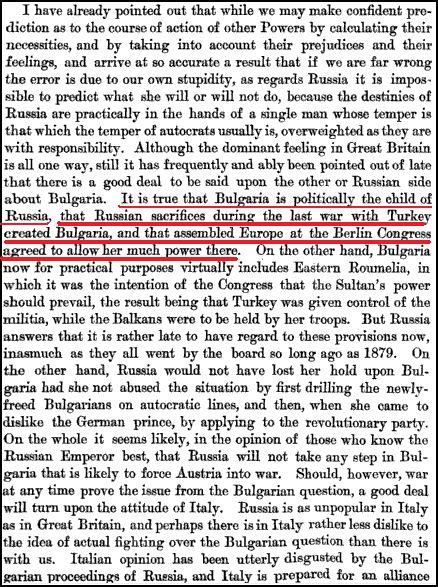
PresentpositionofEuropeanpolitics.jpg

PresentpositionofEuropeanpolitics1.jpg

PresentpositionofEuropeanpolitics19.jpg
 
Myth N' 2.

Bulgarians claim that the state of Tsar Samoil was continuance of the Bulgarian, but that's clearly not the case:

"In 972 the emperor Joan Tsimishi destroyed the political and ecclesiastical independence of the Eastern Bulgarian kingdom."


Source: Църковен Вестник, Издание на Българската Православна Църква, Година 103, брой 9 и 10, София, 1-30 май 2003, наслов “Българските патриарси през Средновековието” Александра КАРАМИХАЛЕВА).

After what the Bulgarian Kingdom ceased to exist and the Bulgarian crown was taken to Constantinopol.
Because of these 2 points, the end of the kingdom and the captured crown, it's more than obvious Samoil couldn't be the successor of the Bulgarians.

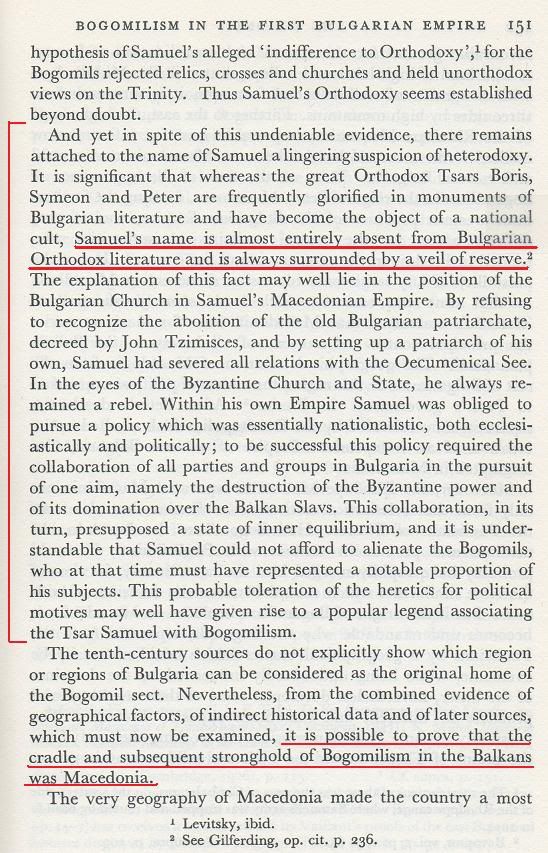
Here is something I hope we can add on to Bratot;

TheBogomils.jpg

TheBogomils147.jpg

TheBogomils151.jpg
 
Back
Top