
• Welcome to the new Macedonian Truth Forum. All posts, members and private messages have been moved over from the old forum.

    Passwords from the old forum could not be carried over, so please use Forgot your password? to set a new one. The reset link is emailed to the address on your account.

  • Rules and Regulations at the forum of the Macedonian Truth Organisation (MTO)

    (1) The national-ethnic and cultural-linguistic identity of the Macedonian people is historically Macedonian, and derives its character from the native, indigenous and geographic homeland of the Macedonians, which is called Macedonia. To ensure that their human rights, integrity and heritage are appropriately respected, the only nouns and adjectives acceptable when reference is made to the above character and identity markers is Macedon, Macedonia, Macedonian and Macedonians.

    (2) The nation-state of the Macedonian people is the Republic of Macedonia, and is to be referred to by this official title so long as the 'republic' prefix is consistently applied to other states. Alternative references are the Macedonian Republic, or simply, Macedonia.

    (3) The 'ethnic' prefix is only acceptable for Macedonians in cases where differentiation is specifically required - so long as it is in context and consistent where it concerns its application to other ethnic groups.

    (4) Should any other differentiation be specifically required, the names of other ethnic groups that reside with Macedonians in either the Republic of Macedonia or the occupied Macedonian regions in Greece, Bulgaria, Serbia or Albania, are to be given a prefix.

    (5) Negating the identity, language and culture of the Macedonian people by deliberate avoidance of the terms Macedonia, Macedonian and Macedonians, or by any other means, is not permitted.

    (6) Systematic anti-Macedonian propaganda and rhetoric are not permitted.

    (7) Threads irrelevant to the Macedonian Cause, the community at the Macedonian Truth Organisation or the Macedonians in general may be considered as spam or not in the spirit of the forum. In such cases they are not permitted.

    (8) Continual posting of messages in threads with the sole purpose of deviating from the initial topics with the use of unrelated and unnecessary information is not permitted.

    (9) All posts, external articles, reports, etc that are cited in languages other than Macedonian or English, must be accompanied with a translation in one or both of the said languages.

    (10) Despite the possibility of some conversations and debates becoming heated, extreme abuse and/or racism, vulgar language and/or terminology, threats, revelation of personal information about others, harassment, and other such behavior will not be permitted. If deemed necessary all relevant information including member details will be reported to the appropriate authorities for investigation which may result in legal action.

    (11) Threads that are created must have a summary of a topic or excerpt of an article found in pertinent link(s) that have been included. One line threads will be considered unaccetable spam and are therefore not permitted.

    (12) Compulsive and deliberate lies, irrespective of the topic, are not permitted.

    (13) Any symbols or avatars found to be perceived as offensive to Macedonians are not permitted.

    (13) Any explicit or extreme material is not permitted.

    Failure to adhere to the above rules and regulations will result in a ban after 3 breaches. This may be reconsidered in some cases should the circumstances be of an unorthodox nature and/or require special consideration. To assure an effective deterrent against an individual or individuals with the sole purpose of causing dissent through spamming, racism or other improper means, the above rules will be strictly enforced.

    The MTO administration will monitor all discussions as reasonably practical and reserve the right to remove any post and/or member from the forum, and update the rules and regulations as required. Members are encouraged to immediately report any post and/or member to the MTO administration if they feel that these rules have not been abided by.

    The views expressed on this forum are those of the individuals. The only official representation of the MTO is made by the "Macedonian Truth Organisation (Site Owner)" username, and no other.

  • Macedonian Cause

    The Macedonian Truth Organisation calls on God in Heaven to protect, bless and guide the endeavour it is committing to undertake, and that is to work towards:

    Securing Macedonia as a free, independent and democratic republic in which sovereignty lies with the Macedonian citizens; as the nation-state of the Macedonian people in which they can preserve their culture, language and identity; as a state in which the Macedonian language and culture form the basis of public life and act as important unifying elements of Macedonian society; as the home of all its citizens to which it guarantees and obliges their inalienable natural rights and corresponding responsibilities;

    The acknowledgment as self-evident and irrefutable the existence of the:

    1) Indigenous, ethnonational name of Macedonia;
    2) Macedonian people, language and identity;
    3) Macedonian culture, symbols and folklore;
    4) Macedonian ancestry, heritage and history in its entirety; and
    5) Macedonian Orthodox Church;

    Securing recognition by the International Community of the tragedies endured by the Macedonian people, of the division of Macedonia with the signing of the Treaty of Bucharest on August 10, 1913, and the genocide committed against the Macedonian people at the hands of the Greek, Bulgarian and Serbian states and their respective churches during the 19th and 20th centuries;

    Ensuring that the Interim Accord is declared ‘null and void’ and that all constitutional provisions, acts, commitments, agreements, legislation, regulations, policies or programs emanating from, supporting or consequential to the Interim Accord are also declared ‘null and void’, including the use of any symbols and the completion of any acts imposed by, or originating from, the Interim Accord.

    Ensuring that the Framework Agreement is abolished and that all constitutional provisions, acts, commitments, agreements, legislation, regulations, policies and programs emanating from, supporting or consequential to the Framework Agreement are also abolished and replaced by a framework of constitutional and statutory law based on inalienable natural rights and corresponding responsibilities and universally codified human rights mechanisms.

    Securing the abolishment of any existing constitutional provisions, acts, agreements, legislation, regulations, policies and programs that discriminate against the Macedonian people, in any international organisation or any of the countries of the International Community where such constitutional provisions, acts, agreements, legislation, regulations, policies and programs exist, and thereby ensuring the freedom for Macedonians to exercise their inalienable natural rights and fulfil their corresponding responsibilities, and practice their culture, language and religious faiths in all the countries of the International Community without hindrance;

    The empowerment of Macedonians to undertake a moral revolution and to instil and/or reinvigorate within themselves a deep-rooted national, cultural, linguistic and historical dignity and a commitment to the exercise of freedom based on inalienable natural rights and corresponding responsibilities;

    The recognition of the Macedonian minorities in the neighbouring states of Macedonia as well as the respect for the inalienable rights and freedoms of the Macedonian minorities, as provided for by natural law and as codified by the United Nations Charter, the Universal Declaration of Human Rights and other universally codified human rights mechanisms;

    The full and unreserved respect of, and the support for, the rights of all people of non-Macedonian descent living in Macedonia and around the world, who share a reciprocal full and unreserved respect for the Macedonian people, their homeland and their state;

    The cultural unification and solidarity of the Macedonian people living in all parts of historical Macedonia and adjacent territories, as well as Macedonians throughout the world;

    The unity of all Macedonians on the principles, objectives and achievement of the Macedonian cause as defined by this declaration.

Greater Albania

VMRO

New member
Code:
https://euobserver.com/opinion/128340
1b062c80f54e6e61274ec0ddace1d2c1-800x.jpg


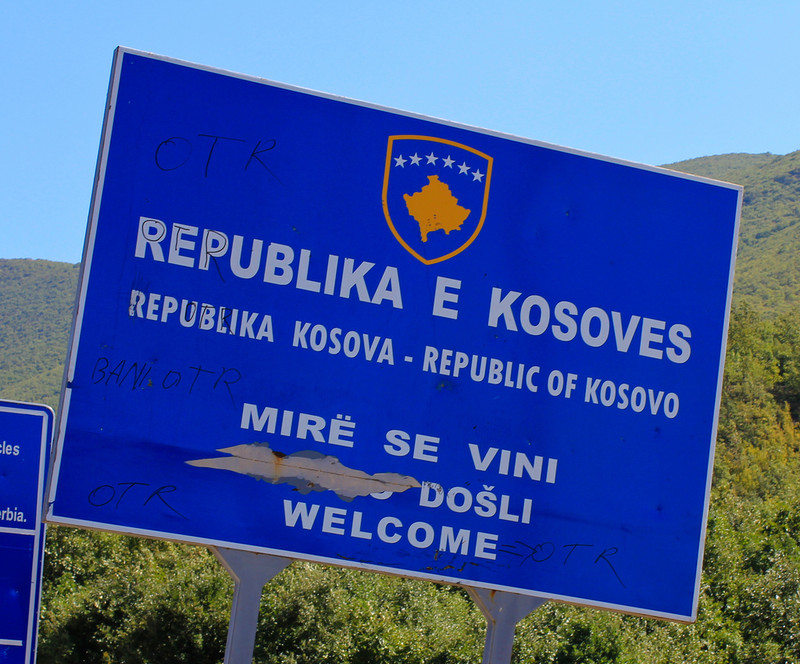
Since August 2014, at least 100,000 Kosovars fled to Europe

It seems as though playing chicken with the European Union is becoming an ever more popular sport among Third World countries’ leaders.

The league of charming, if assertive gentlemen south of the Danube has gotten its most recent addition, in the person of Albanian PM Edi Rama.

In a joint interview with Kosovo’s foreign minister (and ex-PM), Hashim Thaci, Rama said that “the unification of the Albanians of Albania and Kosovo is inevitable and unquestionable”, the only question being how it will happen.

“Will it happen in the context of the EU as a natural process and understood by all, or will it happen as a reaction to EU blindness or laziness”, wondered Rama.

These meditations came in the context of Kosovo’s visa liberalisation issue. Should the EU continue to refuse extending a visa-free regime to Kosovars, Rama hinted, borders in the Balkans may once more be redrawn.

The sceptical European publikum might move to dismiss these threats as all hat, no cattle, but, mind you, there's a crew of would-be statesmen behind the bars of Scheveningen’s prison whose project of a Greater Serbia was once lowballed as self-deluded idle talk (see how that turned out).

This is not to suggest that undue paranoia is a particularly productive way of approaching all future border-setting ploys.

But the memory of the nationalist hysteria and aggressive ultimata which, time and again, managed to combust the region’s powder keg should invite careful consideration of how credible the Albanian PM’s threat really is.
A 'Great Albanian' state

That a problem exists is evident: a Gallup poll conducted among ethnic Albanians in 2010 revealed that 62 percent of them in Albania, 81 percent in Kosovo and 52 percent in Macedonia supported the formation of a "Great Albanian" state.

A cavalier assessment of what these numbers suggest is, at best, grossly irresponsible.

But, a proper understanding of Albanian expansionism must, I think, go beyond the matter-of-fact reporting of a security brief.

The stark contrast between the grandeur of the Greater Albanian idea - an ethnic state encompassing Albania, Kosovo, parts of Macedonia, Montenegro and Serbia - and the reality of life within these mythical Greater Albanian borders is important to grasp.

This contrast is nowhere more apparent than in downtown Tirana.

I remember visiting the place a couple years ago; the robust highway which took me from the country’s northern border to the capital was dotted with bunkers, concrete monuments to the totalitarian madness which erected them.

The few blocks of Tirana’s inner centre display the usual lot - shapely buildings with dimly lit facades, wide streets, a spacious square with the national hero’s equestrian statue and a Sheraton hotel.

However, venture a little further down the road and you will witness the chaotic traffic, the decaying architecture, and the squalor of run-down neighbourhoods.

This inner-city bubble, shielding the fiction of order and strength from a reality in which neither exists, is reminiscent of those colossal parade boulevards in Bucharest and former East Berlin - grand facades built to conceal poverty, misgovernance, and corruption.

It seems to me that, in a certain sense, the Greater Albania dream is another layer of this facade.
Ethno-imperialism

That the arousal of aggressive expansionism is an efficient antidote to domestic distress and discontent has been one of the sad facts of history.

We have seen it, not so long ago, in the region, when bellicose calls to an ethnically pure Greater Serbia were (successfully) made in the midst of a failing process of democratic transition and a massive economic crisis.

We are seeing a similar occurrence in Russia, whose regime’s (fairly recent) turn towards overt ethno-imperialism has been, at least in part, motivated by the grievances articulated by the 2011 wave of anti-Putin protests.

As Walter Benjamin would put it, “behind every fascism, there is a failed revolution”.

In Albania, the fall of totalitarian dictatorship in 1991 and the subsequent years of anarchy lead to a transitional process which yielded much similar results as elsewhere in south-eastern Europe - frail institutions, soaring crime, rampant corruption, illiberal governments, and false elections.

Meanwhile, the average Albanian citizen lives on less than €400 per month.

In Kosovo, the post-independence euphoria, though still strong, is encountering an increasingly formidable challenge - the reality of a deeply dysfunctional state, with a third of the country and over half of the youth unemployed, and three out of 10 Kosovars officially living in poverty.

It is within this predicament that the Greater Albanian opiate finds its way into the bloodstream of a disenchanted populace. As the discontent grows stronger, the political elites should be expected to resort to this sedative with increasing ardour.

Rama’s criticism of “EU blindness or laziness” is not, therefore, solely an attempt at blackmailing the European Union (“if you don’t grant Kosovo a visa-free regime, we will drag the region into another round of ethnic tensions”).

It is also a panicked reaction to a mounting challenge to the self-legitimising narratives of Albanian and Kosovar political leaders, manifested by the waves of mass emigration from Albania and Kosovo.
Exodus

In the past 25 years, a quarter of Albania’s population has left the country.

Since August 2014, at least 100,000 Kosovars have fled to Europe - 7 percent of the country’s adult population, in less than a year.

People are packing their belongings in sports bags and covertly boarding midnight busses, fleeing from the fictitious realm of Greater Albania into less romanticized, but more prosperous countries.

One is reminded of Milton Friedman’s assertion that migration is voting with one’s feet - if so, the hypothetical party of Kosovars who recently decided to emigrate would be the third largest and, by far, the fastest growing political force in Kosovo.

If Rama and Thaci’s declared wish came true and EU borders were fully open, one can only imagine how much emptier the supposed Greater Albanian territory would become.

The ensuing exodus would, in a way, be an ipso facto vote of no-confidence to societies whose prospects inspire no optimism and political elites that offer no solutions.

Beating the war drums will do no good and may cause much harm - the sooner Rama and Thaci realised this, the better off everyone will be.
 
European Parliament: Edi Rama’s statement “inappropriate”


BRUSSELS – The European Parliament’s (EP) Foreign Affairs Committee has described Albanian Prime Minister Edi Rama’s recent statement about unification of Kosovo and Albania as inappropriate, during a debate at the EP on the reports assessing the progress made by Bosnia-Herzegovina and Albania, Al Jazeera has published on its website.

european_parliament_ep-650x4242

In the recent interview that Rama and Kosovo’s Foreign Minister Hasim Taci have given together to Pristina-based broadcaster Klan-Kosova, the Albanian prime minister has said there are two alternatives for “the unification of Kosovo and Albania”, and that everything depends on the EU’s approach.

The first option is the unification within the EU. However, if the EU closes the door to Kosovo’s EU integration then, as Rama put it, “the two states will be forced to unite in a classic way”.

Chair of the EU-Serbia Stabilization and Association Parliamentary Committee Eduard Kukan said for the Monday issue of the Belgrade-based daily Blic that he got nervous when he heard what Albanian Prime Minister Edi Rama said about the unification of Kosovo and Albania, and underscored that he does not like such statements.
 

Albania 'Banging War Drums' Over Kosovo Unification Claims

Read more: http://sputniknews.com/europe/20150407/1020578733.html#ixzz3Y5b0KTQD

1020579919.jpg


Serbia has accused Albania of "inciting instability," after Albanian Prime Minister Edi Rama said the unification of his country and Kosovo was "inevitable," with or without the support of the European Union.

In an interview with Kosovo broadcaster Klan Kosova, Mr Rama spoke about the urge for Albanians to unite with the majority-Albanian province of Kosovo, which controversially declared its independence from Serbia in 2008.

Both Albanian and Kosovar leaders had previously spoken of their desire to unify under the EU, where the free movement principle would allow people and goods to move unrestricted through the region.

"The unification of the Albanians of Albania and Kosovo… is inevitable and unquestionable," he said.
Serbia's Minister for Foreign Affairs and Organization for Security and Co-operation in Europe (OSCE) Chairperson-in-office for 2015 Ivica Dacic speaks during a press conference in Belgrade, Serbia, Sunday, Feb. 1, 2015


Serbia in Talks With Kosovo to Ease Relations, Not to Recognize State

Despite continuing calls for Albania and Kosovo to be included in the EU, Rama said he was in support of unification, even if it wasn't approved or ratified by the bloc.

"The question is how it will happen. Will it happen in the context of the EU as a natural process and understood by all, or will it happen as a reaction to EU blindness or laziness."

Albania, Kosovo Will 'Never Unite' — Belgrade

The comments drew a quick reaction from officials in Belgrade, who were unimpressed with talk of an "inevitable" unification.

The issue of Kosovo's independence has been an ongoing source of tension between Serbia and Albania in recent years, following Kosovo's decision to succeed in 2008.

Serbia was vehemently against Kosovo's declaration of independence and has since stated that it will never recognize it as an independent state, with many Serbs citing the significance Kosovo plays in the history of Serbia and the Orthodox religion.

An adviser to Serbian President Tomislav Nikolic said Rama should stop "banging the war drums" over the tense issue. Serbian presidential adviser Marko Djuric told a news conference:

"We warn the Republic of Albania to stop banging the war drums, to devote itself fully to respecting its international and good-neighborly obligations."

Meanwhile, Serbian Prime Minister Aleksandar Vucic took to Twitter to express his anger at Mr Rama's comments, saying Albania and Kosovo would "never unite."

"I ask Albanian leaders to stop inciting instability in the region," Vucic tweeted.

The Paranoia of Greater Albania

The latest comments are sure to inflame fears in the Balkans of further Albanian expansion, with many commentators highlighting the concerns of neighboring countries in regards to Albanian borders.
Kosovo
© Sputnik/ Natalya Grebenyuk
Kosovo Loses Its People: Thousands Run Away in Search for Better Life

Critics of Albania have accused the country of pushing an aggressive, nationalist, expansionist agenda calling for the creation of 'Greater Albania' — a state consisting of all ethnic Albanians — which has increased tensions in the region.

This fear, dubbed as the 'paranoia of Greater Albania' was heightened in recent years with former Prime Minister Sali Berisha speaking of 'Albanian lands,' consisting of significant parts of Macedonia, Montenegro, Serbia and even some small sections of Greece.

Despite these concerns, Albanian PM Rama has repeatedly refuted the suggestion that the creation of a 'Greater Albania' is an agenda of his ruling party, or any major party involved in Albanian politics, labeling it merely a "fear" held by some sections of the Serbian population.
 
The fact that a "Greater Albania" is even mentioned should be enough to wake everybody up and deal with these terrorists in a manner befitting terrorists!
 
This is actually a pretty important statement.

The PM of the Albanian state, claiming “the unification of the Albanians of Albania and Kosovo is inevitable and unquestionable” should be subject to a lot more scrutiny then it has been.

Outright irredentism when saying “the two states will be forced to unite in a classic way”.

Can't even imagine the meltdown from the EU if Serbia had said the same thing.
 
Like usual they have the right to say an do what ever they want, but god forbid anyone says anything remotely connected to Albanians. If you speak up you are threatening the peace "destabilization".

Of all the freaking people in the Balkans that we could get stuck with Albanians would be my last choice. Ill take anyone, even Greeks before Albanians.

They are like a combination of Osama Bin Laden, a petulant child and brick wall.
 
If Albania try and expand its borders and provoke war, the Republic should take advantage of the situation to liberate and lift the occupation of our country from foreign forces.
 
Funny how Albo manages to fish out all sorts of garbage about Macedonia yet fails to mention this. Anyway, here's some more thoughts from Rama, the Godfather of the Tirana Platform:

http://www.balkaninsight.com/en/art...ement-over-unification-with-kosovo-04-21-2017

US Ambassador Calls Rama's Pan-Albanian Talk 'Careless'

News 21 Apr 17

The US ambassador to Tirana, Donald Lu, said 'careless' calls for the unification of Albania and Kosovo undermined regional stability - after Albania's leader, Edi Rama, raised the prospect in an interview.

The US Ambassador to Albania, has criticised the Albanian Prime Minister, Edi Rama, for mulling the possible unification of Albania and Kosovo if both countries felt rejected by the European Union. "The US Government supports the sovereignty of Kosovo and Albania. We are against careless talk of unification. It undermines the stability of the region and the European path of both country," Lu told BIRN. In an interview for Politico Europe published on April 18, Rama, said that if the doors to Europe were closed on the Western Balkans, other smaller unions might emerge, such as the union of Albania with Kosovo.

Rama insisted that this was not what he himself wished for, but added that if the EU failed to integrate the Balkans, anything could happen.
"The only way to keep the Balkans in this peaceful and cooperative mode… is to keep the path to the EU open ... No one would like to turn [in] on themselves and look for smaller unions, everyone would like to unite in the big union. But if there’s no hope, no perspective, no space, then, of course, little unions may happen," Rama said.

On April 19, Rama's statement was seconded by the President of Kosovo, Hashim Thaci, who expressed frustration over what he called "the lack of vision by the EU toward the region". "I have said also in 2013, and I can repeat that now: if the EU is closing the door for Kosovo, all Albanians in the region are going to live in the same space, in order to later integrate into the European family," Thaci said.

Rama's and Thaci's statements have angered some in Serbia, where politicians condemned them as irresponsible and dangerous. Serbia still claims Kosovo as part of its own territory. The former province declared independence in 2008. Most EU countries have recognised this, but Serbia, Russia, China and a number of other countries have not.
So the leaders of both Albania and Kosovo are essentially advocating a Greater Albania if they don't get into the EU soon.
 
Will the Next War Erupt in the Balkans?

Forget the Middle East and Korea: The Balkans are on the boil again

by Justin Raimondo, April 26, 2017

As the world focuses on the Middle Eastern and Korean flashpoints, the next war may not occur in either region, but rather in a replay of an old conflict that has been largely forgotten.

In an interview with Politico’s European edition, Albanian Prime Minister Edi Rama threatened war if Kosovo is denied entry into the European Union:

“Albania’s prime minister said a union between Albania and Kosovo cannot be ruled out if EU membership prospects for the Western Balkans fade.

“In an interview with Politico … Prime Minister Edi Rama said Europe would face ‘a nightmare’ if the Balkans ‘go crazy’ because EU accession is off the agenda, with the region becoming a ‘gray zone in which other actors have more influence than the European Union.’”

What does Rama mean by “go crazy”? Sounds like war to me. And that would clearly be the result of a merger between Kosovo and Albania, which Rama is threatening. Serbia would quickly act to ensure the safety of Kosovo’s beleaguered Serbian minority, in that event: and Russia, standing behind Belgrade, would back the Serbs.

The reluctance of the EU to admit both Kosovo and Bosnia is rooted in the brazenly undemocratic practices of these two thugocracies, where political violence, election fraud, and open corruption are routine.

Since the Kosovo war in 1999, a pan-Albanian movement that seeks to create a “Greater Albania” has spread throughout the region. In supporting Kosovo’s drive for independence, attacking the former Yugoslavia in the process, the US actively supported this movement both militarily and politically.

Now it is coming back to haunt us, threatening a replay of the Balkan conflict. In Kosovo, the biggest opposition party is determined to hold a referendum on unity with Albania, despite an explicit prohibition of this option in the country’s constitution. In neighboring Macedonia, sporadic terrorist activity by Albanian separatists has posed a threat to the unity of the country. In Bosnia, where the Muslims dominate the “multicultural” state, the Serbian minority seeks independence. And in Montenegro, they make demands for autonomy alongside a radical fringe advocating for “Greater Albania.” Not even Greece, portions of which are claimed by the Albanian ultra-nationalists, is immune. In short, the Albanian minorities across the region – radicalized by ultra-nationalist ideology – are a destabilizing factor.

Rama is threatening to, in effect, annex Kosovo and create a “Greater Albania,” a move that is certain to ignite a conflict with Serbia, which seeks to protect what is left of the Serbian minority in the northern part of the country. He told Politico that such a union isn’t “my wish but a possible alternative to the closed door of the European Union.”

This is outright blackmail: give us EU membership or the specter of war will once again be raised in the volatile Balkans: As Rama put it:

“The only way to keep the Balkans in this peaceful and cooperative mode … is to keep the path to the EU open, to keep the perspective clear, to keep emotions about the EU positive. No one would like to turn [in] on themselves and look for smaller unions, everyone would like to unite in the big union. But if there’s no hope, no perspective, no space, then, of course, little unions may happen.”

The Serbian response was swift and unambiguous:

“Serbian officials warned on Friday of another war in the Balkans if Albanians try to form a joint state with Kosovo in the war-weary European region and the West does not reject such a plan….

“Serbian government minister Aleksandar Vulin said he expects the EU and NATO to denounce such statements, otherwise there could be another war in the Balkans.

“Vulin said that a new war in the Balkans would also include Macedonia and Montenegro which have large ethnic-Albanian populations.”

A pertinent point was made by Serbian Prime Minister Alexsander Vucic, who remarked: "If I said that all Serbs should live in one state, I would be hanged from a flagpole in Brussels.” This is quite true. But why is that? Why the double standard?

The Western powers have always used the Albanians as a battering ram to limit Russian influence in the Balkans. This was the real cause of the Kosovo war, and of Western support to the Bosniaks. Political correctness is also a factor: the Albanians are primarily Muslim, while the Serbs and the other Slavic peoples are Orthodox Christians.

The Kosovo war birthed a gangster state in the midst of the Balkans: Kosovo is the heroin capital of Europe, and the Albanian Mafia’s tentacles reach outward from Pristina to penetrate all the countries of Western Europe. It is also the epicenter of support for Muslim terrorism in the region: during the Kosovo war, al-Qaeda sided with the Western powers in that particular power struggle. Kosovo is a fertile recruiting ground for terrorist groups.

Western troops, including American soldiers, are in Kosovo to this day, in order to keep the thuggish Albanians separated from the ever-dwindling Serbian minority.

With both Albania and Montenegro now NATO members, the ancient blood feuds of the Balkans could easily draw the United States into a renewed conflict. And this would have to mean a fresh confrontation with Russia, the historic protector of the Slavs – which is just what the War Party is gunning for.

What in the name of all that’s holy is tiny Albania doing in NATO, let alone minuscule Montenegro? What possible US interest is served by siding with the Albanians in their bid to create a “Greater Albania” – an ambition that puts them on a direct collision course with every other nation in the region?

The Balkans are synonymous with ethno-religious division and conflict: Google “balkanization.” They don’t call it the tinderbox of Europe for nothing. While the world’s attention is fixated on the Middle East and Eastasia, where ISIS and Kim Jong-un, respectively, are the focus, the forgotten conflicts in this historically volatile minefield are due to explode at any moment. Twenty years after the US-supported “liberation” of Kosovo, the Pandora’s box of the Balkans is wide open – and what’s pouring out of it isn’t pretty.
 
Interesting article. On the one hand:
.....mainstream Albanian politicians have consistently rejected the idea as fear mongering...
Then on the other hand this:
Albanian Prime Minister Edi Rama said that he could not rule out a "little union" between Albania and Albanian-dominated Kosovo if the EU decided to take membership off the table.....
And this:
Kosovo President Hashim Thaci said that "all Albanians in the region will live in a single, united country" if the EU closes its doors.
And this:
Chairman of the Albanian National Council in Serbia, Jonuz Musliu, upped the ante by saying that Albanian-populated towns in Serbia - Bujanovac, Presevo, and Medvedja - should also join Kosovo and Albania. "Serbia should be grateful" that Albanians are not asking for even more territory, he said.
You're as delusional or deliberately mischievous as this article. First of all, Greater Albania (or rather progressive steps towards it) is not a bogeyman, it's a genuine regional threat. The opinion of that EU moron doesn't hold any weight with the people faced with this threat. Second, its total realisation might be a pipe dream right now, but it is the ultimate goal of many of your kinsmen. Just look at your leaders, they can hardly contain themselves when things don't go their way, the sentiment is never far from the surface.
 
Albanians always threaten violence if they don't get their way. I don't blame them though as this has been the only way that can achieve anything.
 
A greater or ethnic whatever country in the region.. be it Albania, Serbia, Macedonia, Croatia, Bulgaria ect.. will only occur if that's what the powers that be want it.to occur...

Even if it's not wanted by the people on the ground.. they will find or create the appropriate affiliates.. so such a scenario happens..

The borders of the Balkan states have never been decided by the balkan people and most likely won't for a very long time...

Another thing.. I don't believe that any ethnic group in the Balkans desires a "Greater" whateve more than the next..

should the opportunity be given to any people's in the region for territorial expansion or unification they would all jump on it if it was done in accordance to their extreme appetites..

Tell me one Macedonian who wouldn't want northern Greece to be incorporated into Macedonia.. or a serb who wouldn't want Kosovo and Republika Srpska incorporated into Serbia..

So I don't bother with wanting or wishing a greater Albania.. because it's simply not in the hands of any Albanian or any other Balkanite who will decide when or if it happens or not!

I strongly believe EU integration and strong local economies will lesser the calls for "Greater" states


Difference between us and the rest is that we've never received any aid. We've always been on the receiving end of partition
 
Difference between us and the rest is that we've never received any aid. We've always been on the receiving end of partition

Well depends what you mean by aid? and when?

All people of thre Balkans claim some sort of partition or lament that "everyone in the region is against us"

The facts are that Albania wasn't partitioned nor was Macedonia.. because they were never unified states to begin with .. we can all parade maps on how we wish things should be.. and argue which is ours and which is yours .. but we will get nowhere..

The only solution is the EU.. where borders become irrelevant and living standards improve!

Not sure how borders are relevant now? I drove into GypsieAlbania last year, it took 2 minutes in total..it didn't even feel like a border! Maybe it will make it easier during census time to make it easier for Albanians to pop over in MKD??

As for the the EU and prosper, perhaps ask the pigs or Croatia? Romania, BG? Home grown growth requires home grown solutions??
 
Well depends what you mean by aid? and when?

All people of thre Balkans claim some sort of partition or lament that "everyone in the region is against us"

The facts are that Albania wasn't partitioned nor was Macedonia.. because they were never unified states to begin with .. we can all parade maps on how we wish things should be.. and argue which is ours and which is yours .. but we will get nowhere..

The only solution is the EU.. where borders become irrelevant and living standards improve!

Unified Macedonian states have existed though? The ancient Kingdom of Macedon, the Macedonian Empire and Tsar Samoil's Macedonian Kingdom. All of which corresponding in the area of modern Macedonia.
 
Unified Macedonian states have existed though? The ancient Kingdom of Macedon, the Macedonian Empire and Tsar Samoil's Macedonian Kingdom. All of which corresponding in the area of modern Macedonia.

You and many others in the Balkans make the delusional mistake that tries to link ancient and medieval concepts of a "state" to modern realities of recent state formation and ethnic identity !!

The two concepts are world's apart and have minimal bearing on today's reality..
 
Back
Top