• Welcome to the new Macedonian Truth Forum. All posts, members and private messages have been moved over from the old forum.

    Passwords from the old forum could not be carried over, so please use Forgot your password? to set a new one. The reset link is emailed to the address on your account.

  • Rules and Regulations at the forum of the Macedonian Truth Organisation (MTO)

    (1) The national-ethnic and cultural-linguistic identity of the Macedonian people is historically Macedonian, and derives its character from the native, indigenous and geographic homeland of the Macedonians, which is called Macedonia. To ensure that their human rights, integrity and heritage are appropriately respected, the only nouns and adjectives acceptable when reference is made to the above character and identity markers is Macedon, Macedonia, Macedonian and Macedonians.

    (2) The nation-state of the Macedonian people is the Republic of Macedonia, and is to be referred to by this official title so long as the 'republic' prefix is consistently applied to other states. Alternative references are the Macedonian Republic, or simply, Macedonia.

    (3) The 'ethnic' prefix is only acceptable for Macedonians in cases where differentiation is specifically required - so long as it is in context and consistent where it concerns its application to other ethnic groups.

    (4) Should any other differentiation be specifically required, the names of other ethnic groups that reside with Macedonians in either the Republic of Macedonia or the occupied Macedonian regions in Greece, Bulgaria, Serbia or Albania, are to be given a prefix.

    (5) Negating the identity, language and culture of the Macedonian people by deliberate avoidance of the terms Macedonia, Macedonian and Macedonians, or by any other means, is not permitted.

    (6) Systematic anti-Macedonian propaganda and rhetoric are not permitted.

    (7) Threads irrelevant to the Macedonian Cause, the community at the Macedonian Truth Organisation or the Macedonians in general may be considered as spam or not in the spirit of the forum. In such cases they are not permitted.

    (8) Continual posting of messages in threads with the sole purpose of deviating from the initial topics with the use of unrelated and unnecessary information is not permitted.

    (9) All posts, external articles, reports, etc that are cited in languages other than Macedonian or English, must be accompanied with a translation in one or both of the said languages.

    (10) Despite the possibility of some conversations and debates becoming heated, extreme abuse and/or racism, vulgar language and/or terminology, threats, revelation of personal information about others, harassment, and other such behavior will not be permitted. If deemed necessary all relevant information including member details will be reported to the appropriate authorities for investigation which may result in legal action.

    (11) Threads that are created must have a summary of a topic or excerpt of an article found in pertinent link(s) that have been included. One line threads will be considered unaccetable spam and are therefore not permitted.

    (12) Compulsive and deliberate lies, irrespective of the topic, are not permitted.

    (13) Any symbols or avatars found to be perceived as offensive to Macedonians are not permitted.

    (13) Any explicit or extreme material is not permitted.

    Failure to adhere to the above rules and regulations will result in a ban after 3 breaches. This may be reconsidered in some cases should the circumstances be of an unorthodox nature and/or require special consideration. To assure an effective deterrent against an individual or individuals with the sole purpose of causing dissent through spamming, racism or other improper means, the above rules will be strictly enforced.

    The MTO administration will monitor all discussions as reasonably practical and reserve the right to remove any post and/or member from the forum, and update the rules and regulations as required. Members are encouraged to immediately report any post and/or member to the MTO administration if they feel that these rules have not been abided by.

    The views expressed on this forum are those of the individuals. The only official representation of the MTO is made by the "Macedonian Truth Organisation (Site Owner)" username, and no other.

  • Macedonian Cause

    The Macedonian Truth Organisation calls on God in Heaven to protect, bless and guide the endeavour it is committing to undertake, and that is to work towards:

    Securing Macedonia as a free, independent and democratic republic in which sovereignty lies with the Macedonian citizens; as the nation-state of the Macedonian people in which they can preserve their culture, language and identity; as a state in which the Macedonian language and culture form the basis of public life and act as important unifying elements of Macedonian society; as the home of all its citizens to which it guarantees and obliges their inalienable natural rights and corresponding responsibilities;

    The acknowledgment as self-evident and irrefutable the existence of the:

    1) Indigenous, ethnonational name of Macedonia;
    2) Macedonian people, language and identity;
    3) Macedonian culture, symbols and folklore;
    4) Macedonian ancestry, heritage and history in its entirety; and
    5) Macedonian Orthodox Church;

    Securing recognition by the International Community of the tragedies endured by the Macedonian people, of the division of Macedonia with the signing of the Treaty of Bucharest on August 10, 1913, and the genocide committed against the Macedonian people at the hands of the Greek, Bulgarian and Serbian states and their respective churches during the 19th and 20th centuries;

    Ensuring that the Interim Accord is declared ‘null and void’ and that all constitutional provisions, acts, commitments, agreements, legislation, regulations, policies or programs emanating from, supporting or consequential to the Interim Accord are also declared ‘null and void’, including the use of any symbols and the completion of any acts imposed by, or originating from, the Interim Accord.

    Ensuring that the Framework Agreement is abolished and that all constitutional provisions, acts, commitments, agreements, legislation, regulations, policies and programs emanating from, supporting or consequential to the Framework Agreement are also abolished and replaced by a framework of constitutional and statutory law based on inalienable natural rights and corresponding responsibilities and universally codified human rights mechanisms.

    Securing the abolishment of any existing constitutional provisions, acts, agreements, legislation, regulations, policies and programs that discriminate against the Macedonian people, in any international organisation or any of the countries of the International Community where such constitutional provisions, acts, agreements, legislation, regulations, policies and programs exist, and thereby ensuring the freedom for Macedonians to exercise their inalienable natural rights and fulfil their corresponding responsibilities, and practice their culture, language and religious faiths in all the countries of the International Community without hindrance;

    The empowerment of Macedonians to undertake a moral revolution and to instil and/or reinvigorate within themselves a deep-rooted national, cultural, linguistic and historical dignity and a commitment to the exercise of freedom based on inalienable natural rights and corresponding responsibilities;

    The recognition of the Macedonian minorities in the neighbouring states of Macedonia as well as the respect for the inalienable rights and freedoms of the Macedonian minorities, as provided for by natural law and as codified by the United Nations Charter, the Universal Declaration of Human Rights and other universally codified human rights mechanisms;

    The full and unreserved respect of, and the support for, the rights of all people of non-Macedonian descent living in Macedonia and around the world, who share a reciprocal full and unreserved respect for the Macedonian people, their homeland and their state;

    The cultural unification and solidarity of the Macedonian people living in all parts of historical Macedonia and adjacent territories, as well as Macedonians throughout the world;

    The unity of all Macedonians on the principles, objectives and achievement of the Macedonian cause as defined by this declaration.

Greece, History, Truth

This is your first warning. They were not "Slavs" they were indigenous Macedonians.

And the Muslims (Turks) learned the local language to communicate with the majority in the region. Yes, they spoke Macedonian.

Who are not Slavs? The majority of people in Macedonian were Makedonci before the Balkan Wars. Louis you say 1915 but Macedonia was under military administration for a few years if Im not mistaken and no one can know for sure what was happening there(Im sure we all know).
 
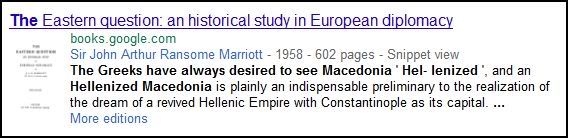
EasternQuestionMacedoniaHellenized_zps46dfa732.jpg


Macedonia "greek" for 4000 years :whistling:
 
TM
Your'e a champion! - good stuff. :40:

Thanks makedonche. But should we all be surprised by now? Today's "Hellene" was more than likely something that Demosthenes and Socrates would not recognize at all. Hell even one supposed educated "hellene" or "greek" nearer to their times thought that Rome was a "Greek city". This shows us that "Greek" was never one definition at one constant time but many definitions and ideas at many times. Never consistent, always changing, and always shifting to meet the means of the day. This isn't "hellenism" either. This is fabrication of history.
 
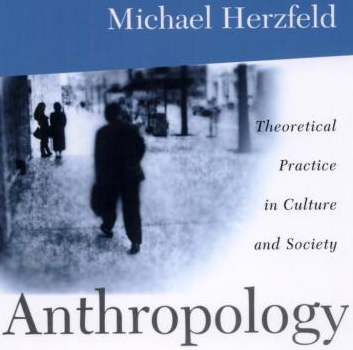
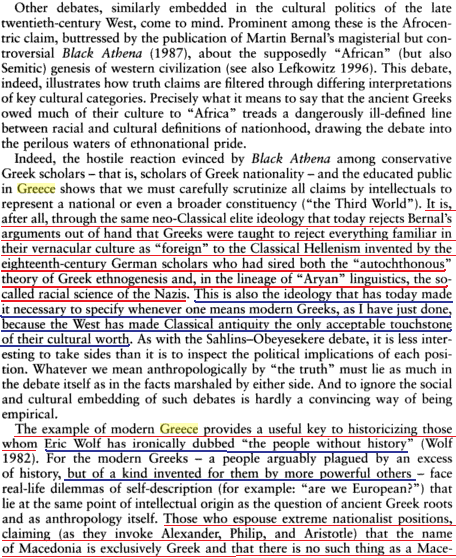
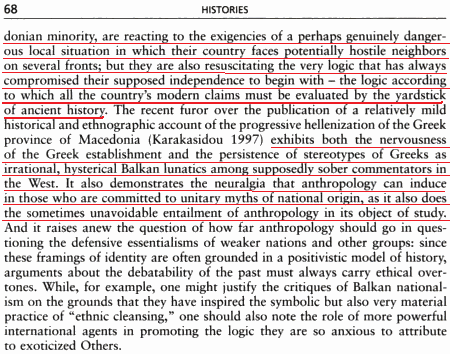
Karakasidou's excellent and scholarly study "Fields of Wheat Hills of Blood" explained through meticulous research the spread and affirmation of the Greek language in a part of the Ottoman territory of Macedonia that was incorporated into the Greek state, what Herzfeld calls "the progressive Hellenization of Greek Macedonia."

Because of their topic, books like Karakasidou's generate discussions, often heated, in any culture. This was certainly the case with "Fields of Wheat." Hertzfeld states that "the Greek establishment" objected to it without clarifying what he means by "Greek establishment" and giving the impression that the book was universally condemned which is not the case. The part of the "Greek establishment" that roundly condemned the book was the sclerotic and highly conservative Greek Orthodox Church which strongly objected to Karakasidou's passages saying the "secret schools" that were run by the Church and which "saved Hellenism for humanity" (the Church says) never existed.

Another part of the "Greek establishment" that condemned the book were the Nazi thugs and their fellow-travelers in the extreme right like the supporters and apologists of the former dictatorship, some of whom have positions in academia and in the media. There were others who objected on their own grounds. This is normal in any society.

Mr Hertzfeld's work also deserves some attention. In one underlined passage he invents a , "... persistent stereotype of Greeks as irrational Balkan lunatics..". By doing so, Hertzfeld disqualifies himself of any pretence of seriousness and objectivity and reveals a personal animus belonging to those, like the Greek Nazi Party whose discourse is motivated by racial epitaphs.

Pity that Hertzfeld did not see the 20 odd instalments of the historical analysis called "1821" produced by a Greek TV station where the real Greek establishment consisting of historians, writers, journalists, professors, authors, linguistics, artists and others from Greece and abroad discussed in the construction of the Greek state and the period preceding it. They talked about the role Germany played in constructing the national myth of foundation, the often peaceful and accommodating relationship between Greeks and Turks in many places and times during the Ottoman period. It was a mature, thorough, "warts and all" analysis of a country's historical begginings that would certainly have caused a "fury" if it had ever been done in the, say, the United States where national myths not only persist but are persistently expanded.

The quotes reveal that Hertzfeld's agenda is neither knowledge nor seriousness but racist deconstruction. And he is good at it. He has come to the right place. Enjoy!

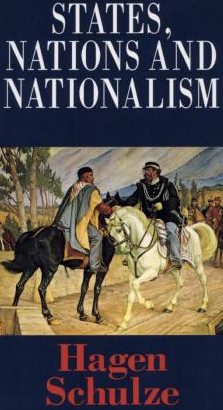
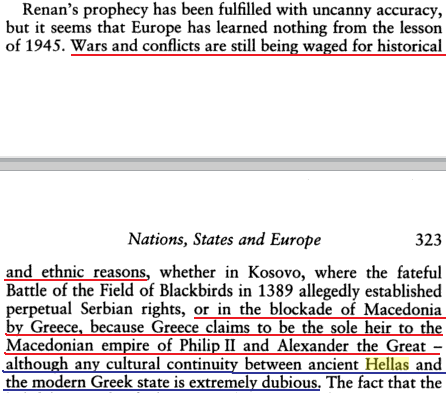
Milti, please elaborate further. I am curious to know exactly what Herzfeld's agenda is? Is it like the agenda of Hagen Schulze;

shulze.png

shulze1.png
 
@ TrueMacedonian:

If I referred you to a book whose author claimed a stereotype of "Slavic-speaking Macedonians who are irrational and hysterical Balkan lunatics" what would you think of it and how would you assess the author's competence and motivation?

Many times the works of Eugene Borza have been quoted and praised on this site. Borza was a major historian and professor. I re-produced a quote from Borza's "Macedonia Redux". In case you didn't get a chance to read it, here it is again:

"If the claim is based on ethnicity, it is an issue of a different order. Modern Slavs, both Bulgarians and Macedonians, cannot establish a link with antiquity as the Slavs entered the Balkans centuries after the demise of the ancient Macedonian kingdom. Only the most radical Slavic factions - mostly emigres from the United States, Canada and Australia - even attempt to establish a link to antiquity."

--Eugene Borza, Macedonia Redux.
 
there never was writteb so much crap about the supposed hellenes.Even to day ,whois the real hellene.In my view there is no such thing the whole thing is a masquerade.Why??
Hellenism When alexander conquered greece ended.No use saying alexander spread hellenism ,he didn't.So if hellenism ended with the arrival of alexander then,the macedonistic age entered.So many people are pretending that hellenism is still alive.It isn't don't try to be what your'e not.
 
Many times the works of Eugene Borza have been quoted and praised on this site. Borza was a major historian and professor. I re-produced a quote from Borza's "Macedonia Redux". In case you didn't get a chance to read it, here it is again:

"If the claim is based on ethnicity, it is an issue of a different order. Modern Slavs, both Bulgarians and Macedonians, cannot establish a link with antiquity as the Slavs entered the Balkans centuries after the demise of the ancient Macedonian kingdom. Only the most radical Slavic factions - mostly emigres from the United States, Canada and Australia - even attempt to establish a link to antiquity".

--Eugene Borza, Macedonia Redux.

Ouch :D! I need to say something about this quote. First "slav", "slavic" are not ethnicities and this is incorrect to define someone as "slav", my eyes are bleeding when i see what Borza said. Today, "Slavs" as a whole are mostly a linguistic group, not even cultural (Balkan Slavic-speaking peoples have a lot more in common culturally with other Balkanians than with Poles or Russians). This is just a linguistic term, linguistic term! But some peoples still referring the slavic-speaking peoples as "slavs", and think that they were in the past "one people" who originated from a same place, located in the actual territory of Ukraine. This is also the main argument used by the greeks (and albanians now) to prove that the slavic-speaking peoples of the Balkans didn't belong to theirs lands, that they are "invaders" ...

I think all this came from a big confusion. I will try to explain that later, there is so much to say about that.
 
Last edited:
@ TrueMacedonian:

If I referred you to a book whose author claimed a stereotype of "Slavic-speaking Macedonians who are irrational and hysterical Balkan lunatics" what would you think of it and how would you assess the author's competence and motivation?

Many times the works of Eugene Borza have been quoted and praised on this site. Borza was a major historian and professor. I re-produced a quote from Borza's "Macedonia Redux". In case you didn't get a chance to read it, here it is again:

"If the claim is based on ethnicity, it is an issue of a different order. Modern Slavs, both Bulgarians and Macedonians, cannot establish a link with antiquity as the Slavs entered the Balkans centuries after the demise of the ancient Macedonian kingdom. Only the most radical Slavic factions - mostly emigres from the United States, Canada and Australia - even attempt to establish a link to antiquity.

I have no issue with Borza and what he wrote. If the claim is based on ETHNICITY no one in the balkans can establish a link to antiquity. He is correct. I think the slav colonizers in what is known today as greece ultimately lumps you and your folk in that category.
 
Milti this is what you wrote in another topic on this forum to RistotheGreat;

Your statement that the Greeks had no "Greek" identity other than that introduced my katharevousa itself is belied by the fact that the katharevousa experiment did not succeed, primarily because it clashed with the spoken Demotic Greek of the population which absorbed elements of it.

It is rather extravagant (to say the least) to argue that Greek identity was formed recently by the creation of an artificial language experiment which was abandoned (officially in the 1970s as you state).

Attempts to replace the unwieldly purified versions used in literature and for official purposes with the ordinary speech of the people, known as demotic, were regarded as blows directed against the feeble unity of the country and its life-giving national myths.There were riots in Athens following the publication in 1902 of a demotic version of the New Testament.
William St. Claire That Greece Might Still Be Free

The Ancient Greece evoked by Koraes was essentially the invention of Western philhellenes. Even katharevousa, although ostensibly meant to 'refine' those who spoke and wrote it, making them more elegant, wise, freedom-loving, and virtuous (although not necessarily peaceful) by eliminating from their vocabulary the barbarity of Turkish words that kept them chained to their degeneracy - even katharevousa was produced not just for the Ottomanized Greeks, but also for Western philhellenes, as Koraes reveals when he confesses that his notes, "written in our common tongue, were ready for the printers when some friends of mine - philhellenes expert in our ancient but not our modern language - eventually persuaded me to hellenize [my notes] so that they might be understood . . . by the scholars of Europe, who are ignorant of Modern Greek" (Bien 1972:51, citing Koraes 1833:41).

Such, more or less, was the first form of invented Greek nationality -the initial vision, if you will, of the myth that, replacing (or at least displacing) the Christian world-view, provided at the deepest level a metaphysical rationale for life and death: a meaning for what would otherwise be a futile, meaningless existence. No matter that it was a double distortion: a distortion of Ancient Greek reality, and a distortion as well of Modern Greek reality. It provided (and to some degree still provides) a sense of connectedness to something apparently admirable, something that matters, and something even 'eternal', for, as I mentioned earlier, no nation can imagine its own death. As for its beginning, Ancient Greek culture lay far enough back in hazy antiquity to seem never to have not been there. In sum, Greece imagined in this way as the inheritor of ancient glory was a way to cheat contigency and fate by giving existence a kind of supernal meaning.

Peter Bien Inventing Greece
 
@ TrueMacedonian:

Your issue then is only with the word "ethnicity." You agree with the part of the quote that says "modern slavs both Macedonian and Bulgarian cannot establish a link with antiquity as the slavs entered the Balkans centuries after the demise of the ancient Macedonian kingdom."

The Greeks most definitely have a DNA/biological connection to the Slavic peoples. To some extent, the two peoples are the same. The peoples even have a cultural connection since the Orthodox Church was adopted by the Slavic people and the Slavic alphabet came through missionaries of that Greek-speaking church. Presumably and to the best of my knowledge, before Cyril and Methodius the Slavic language was not a written one.

The Greeks have a linguistic connection to antiquity. It is well-recognised empirically and academically in universities, in texts and museums throughout the world and established and even affirmed on a daily basis as you see throughout the world's media reporting on the modern Greek financial crisis endless illustrations connecting the modern state to the ancient world and to ancient references (if anything it is way overdone).

What is the connection that the Slavs have with antiquity? What is the connection that the Slavic-speaking people of the ROM have with the ancient kingdom?

Borza's words are crystal-clear: "the Slavs entered the Balkans centuries after the demise of the ancient Macedonian kingdom." You say you "have no issue with Borza's words." Settled then.

Much of the effort on this site is "disproving" the Greek connection to antiquity. OK, for the sake of argument, there is none.

Now, What is the connection of the slavic-speaking people with antiquity? What is the connection of the Republic of Macedonia with antiquity?

Borza clearly says there is none. What do you say?

You want a clear and concise example of modern Macedonian's connection to Macedonia. Ok. Here is a perfect example:

http://www.macedoniantruth.org/forum/showthread.php?t=7048
 
Milti this is what you wrote in another topic on this forum to RistotheGreat;


Attempts to replace the unwieldly purified versions used in literature and for official purposes with the ordinary speech of the people, known as demotic, were regarded as blows directed against the feeble unity of the country and its life-giving national myths.There were riots in Athens following the publication in 1902 of a demotic version of the New Testament.
William St. Claire That Greece Might Still Be Free

The Ancient Greece evoked by Koraes was essentially the invention of Western philhellenes. Even katharevousa, although ostensibly meant to 'refine' those who spoke and wrote it, making them more elegant, wise, freedom-loving, and virtuous (although not necessarily peaceful) by eliminating from their vocabulary the barbarity of Turkish words that kept them chained to their degeneracy - even katharevousa was produced not just for the Ottomanized Greeks, but also for Western philhellenes, as Koraes reveals when he confesses that his notes, "written in our common tongue, were ready for the printers when some friends of mine - philhellenes expert in our ancient but not our modern language - eventually persuaded me to hellenize [my notes] so that they might be understood . . . by the scholars of Europe, who are ignorant of Modern Greek" (Bien 1972:51, citing Koraes 1833:41).

Such, more or less, was the first form of invented Greek nationality -the initial vision, if you will, of the myth that, replacing (or at least displacing) the Christian world-view, provided at the deepest level a metaphysical rationale for life and death: a meaning for what would otherwise be a futile, meaningless existence. No matter that it was a double distortion: a distortion of Ancient Greek reality, and a distortion as well of Modern Greek reality. It provided (and to some degree still provides) a sense of connectedness to something apparently admirable, something that matters, and something even 'eternal', for, as I mentioned earlier, no nation can imagine its own death. As for its beginning, Ancient Greek culture lay far enough back in hazy antiquity to seem never to have not been there. In sum, Greece imagined in this way as the inheritor of ancient glory was a way to cheat contigency and fate by giving existence a kind of supernal meaning.

Peter Bien Inventing Greece

I want to confirm something that goes against your statement with another scholars quote on the role of Katharevousa and national identity in modern greece. Also I want you to realize that more and more scholars have been on notice about the paranoia and absolute hysteria where it concerns modern greeks and nationalism. This is rather telling about the sort of society you come from Milti.
PeterTrudgill.jpg

PeterTrudgill250.jpg

PeterTrudgill250a.jpg

PeterTrudgill251.jpg
 
TrueMacedonian writes "You want a clear and concise example of modern Macedonian's connection to Macedonia. Ok. Here is a perfect example:

http://www.macedoniantruth.org/forum...ead.php?t=7048"

No, I clearly asked for a connection between the slavic speaking people or the Republic of Macedonia to the ancient world, to the ancient Macedonian kingdom. (see my post above).

Nothing in your link refers or connects the Slavic-speaking Macedonian people, in Rpmania or anywhere else, to the ancient Macedonian kingdom or the ancient world. There is no mention whatsoever of the ancient world in your link. The name of the unfamiliar linked site "Proetnica" (sic?) is a Greek word ("proethnika).

Presumably, you misunderstood my question and now you will link me with evidence that connects the slavic-speaking people and the ROM to the ancient world. Thanks.

Interestingly, one answer to the question "what is the slavic connection to the ancient world?" is an attack on the Greeks. Typical for this site.

The name Macedonia followed the Macedonians to Romania. Are we going to be moving the goal posts when certain facts don't enjoy our fancy? There is a rather nice list Soldier of Macedon put together. I recommend you search it out. This particular topic involves the validity of modern Greek claims to "hellenism" and any cultural connections to antiquity.
 
TrueMacedonian writes: "The name Macedonia followed the Macedonians to Romania. Are we going to be moving the goal posts when certain facts don't enjoy our fancy? There is a rather nice list Soldier of Macedon put together. I recommend you search it out. This particular topic involves the validity of modern Greek claims to "hellenism" and any cultural connections to antiquity."


I asked you to show some connection between the slavic-speaking Macedonians and the ancient world, the ancient kingdom of Macedonia.

As an answer you attacked the Greeks.

The Romania of the middle ages is not the ancient world nor the ancient kingdom of Macedonia. One has nothing to do with the other.

You have found no connection, neither linguistic nor cultural nor geographic between the people or the nation of the Republic of Macedonia and the ancient kingdom because there is none.

You have verified Borza's statement that "modern Slavs both Macedonian and Bulgarian cannot establish a link with antiquity because the Slavs entered the Balkan peninsula centuries after the demise of the macedonian kingdom."

You said that you had no problem with Borza's quote. Neither do I. We both accept it as true, then. We agree.

It is good to end a friendly discussion with mutual agreement.

PS. The word "Macedonian" is first found in the Greek-language poems of Homer. The consensus is that it is the Greek word meaning "Highlander."
 
Back
Top