• Welcome to the new Macedonian Truth Forum. All posts, members and private messages have been moved over from the old forum.

    Passwords from the old forum could not be carried over, so please use Forgot your password? to set a new one. The reset link is emailed to the address on your account.

  • Rules and Regulations at the forum of the Macedonian Truth Organisation (MTO)

    (1) The national-ethnic and cultural-linguistic identity of the Macedonian people is historically Macedonian, and derives its character from the native, indigenous and geographic homeland of the Macedonians, which is called Macedonia. To ensure that their human rights, integrity and heritage are appropriately respected, the only nouns and adjectives acceptable when reference is made to the above character and identity markers is Macedon, Macedonia, Macedonian and Macedonians.

    (2) The nation-state of the Macedonian people is the Republic of Macedonia, and is to be referred to by this official title so long as the 'republic' prefix is consistently applied to other states. Alternative references are the Macedonian Republic, or simply, Macedonia.

    (3) The 'ethnic' prefix is only acceptable for Macedonians in cases where differentiation is specifically required - so long as it is in context and consistent where it concerns its application to other ethnic groups.

    (4) Should any other differentiation be specifically required, the names of other ethnic groups that reside with Macedonians in either the Republic of Macedonia or the occupied Macedonian regions in Greece, Bulgaria, Serbia or Albania, are to be given a prefix.

    (5) Negating the identity, language and culture of the Macedonian people by deliberate avoidance of the terms Macedonia, Macedonian and Macedonians, or by any other means, is not permitted.

    (6) Systematic anti-Macedonian propaganda and rhetoric are not permitted.

    (7) Threads irrelevant to the Macedonian Cause, the community at the Macedonian Truth Organisation or the Macedonians in general may be considered as spam or not in the spirit of the forum. In such cases they are not permitted.

    (8) Continual posting of messages in threads with the sole purpose of deviating from the initial topics with the use of unrelated and unnecessary information is not permitted.

    (9) All posts, external articles, reports, etc that are cited in languages other than Macedonian or English, must be accompanied with a translation in one or both of the said languages.

    (10) Despite the possibility of some conversations and debates becoming heated, extreme abuse and/or racism, vulgar language and/or terminology, threats, revelation of personal information about others, harassment, and other such behavior will not be permitted. If deemed necessary all relevant information including member details will be reported to the appropriate authorities for investigation which may result in legal action.

    (11) Threads that are created must have a summary of a topic or excerpt of an article found in pertinent link(s) that have been included. One line threads will be considered unaccetable spam and are therefore not permitted.

    (12) Compulsive and deliberate lies, irrespective of the topic, are not permitted.

    (13) Any symbols or avatars found to be perceived as offensive to Macedonians are not permitted.

    (13) Any explicit or extreme material is not permitted.

    Failure to adhere to the above rules and regulations will result in a ban after 3 breaches. This may be reconsidered in some cases should the circumstances be of an unorthodox nature and/or require special consideration. To assure an effective deterrent against an individual or individuals with the sole purpose of causing dissent through spamming, racism or other improper means, the above rules will be strictly enforced.

    The MTO administration will monitor all discussions as reasonably practical and reserve the right to remove any post and/or member from the forum, and update the rules and regulations as required. Members are encouraged to immediately report any post and/or member to the MTO administration if they feel that these rules have not been abided by.

    The views expressed on this forum are those of the individuals. The only official representation of the MTO is made by the "Macedonian Truth Organisation (Site Owner)" username, and no other.

  • Macedonian Cause

    The Macedonian Truth Organisation calls on God in Heaven to protect, bless and guide the endeavour it is committing to undertake, and that is to work towards:

    Securing Macedonia as a free, independent and democratic republic in which sovereignty lies with the Macedonian citizens; as the nation-state of the Macedonian people in which they can preserve their culture, language and identity; as a state in which the Macedonian language and culture form the basis of public life and act as important unifying elements of Macedonian society; as the home of all its citizens to which it guarantees and obliges their inalienable natural rights and corresponding responsibilities;

    The acknowledgment as self-evident and irrefutable the existence of the:

    1) Indigenous, ethnonational name of Macedonia;
    2) Macedonian people, language and identity;
    3) Macedonian culture, symbols and folklore;
    4) Macedonian ancestry, heritage and history in its entirety; and
    5) Macedonian Orthodox Church;

    Securing recognition by the International Community of the tragedies endured by the Macedonian people, of the division of Macedonia with the signing of the Treaty of Bucharest on August 10, 1913, and the genocide committed against the Macedonian people at the hands of the Greek, Bulgarian and Serbian states and their respective churches during the 19th and 20th centuries;

    Ensuring that the Interim Accord is declared ‘null and void’ and that all constitutional provisions, acts, commitments, agreements, legislation, regulations, policies or programs emanating from, supporting or consequential to the Interim Accord are also declared ‘null and void’, including the use of any symbols and the completion of any acts imposed by, or originating from, the Interim Accord.

    Ensuring that the Framework Agreement is abolished and that all constitutional provisions, acts, commitments, agreements, legislation, regulations, policies and programs emanating from, supporting or consequential to the Framework Agreement are also abolished and replaced by a framework of constitutional and statutory law based on inalienable natural rights and corresponding responsibilities and universally codified human rights mechanisms.

    Securing the abolishment of any existing constitutional provisions, acts, agreements, legislation, regulations, policies and programs that discriminate against the Macedonian people, in any international organisation or any of the countries of the International Community where such constitutional provisions, acts, agreements, legislation, regulations, policies and programs exist, and thereby ensuring the freedom for Macedonians to exercise their inalienable natural rights and fulfil their corresponding responsibilities, and practice their culture, language and religious faiths in all the countries of the International Community without hindrance;

    The empowerment of Macedonians to undertake a moral revolution and to instil and/or reinvigorate within themselves a deep-rooted national, cultural, linguistic and historical dignity and a commitment to the exercise of freedom based on inalienable natural rights and corresponding responsibilities;

    The recognition of the Macedonian minorities in the neighbouring states of Macedonia as well as the respect for the inalienable rights and freedoms of the Macedonian minorities, as provided for by natural law and as codified by the United Nations Charter, the Universal Declaration of Human Rights and other universally codified human rights mechanisms;

    The full and unreserved respect of, and the support for, the rights of all people of non-Macedonian descent living in Macedonia and around the world, who share a reciprocal full and unreserved respect for the Macedonian people, their homeland and their state;

    The cultural unification and solidarity of the Macedonian people living in all parts of historical Macedonia and adjacent territories, as well as Macedonians throughout the world;

    The unity of all Macedonians on the principles, objectives and achievement of the Macedonian cause as defined by this declaration.

Greek historiography before 1853 about Macedonia!

Bratot

New member

(Κωνσταντίνος Παπαρρηγόπουλος) (1815-1891)

http://en.wikipedia.org/wiki/Constantine_Paparrigopoulos

European historiographical influences upon the
young Konstantinos Paparrigopoulos

Ioannis Koubourlis

All national historiographies comprise texts that constitute turning points in their respective courses towards formation. In general, the main aim of the authors of such texts is to note the advances towards the writing of an all-encompassing history of the relevant national past; but, equally importantly, it is to point out persisting lacunae in such a history. These lacunae may concern certain ‘missing
links’ in a given national narrative; and this is precisely the case of Greek national historiography before 1853, which had not as yet fully integrated Byzantium or the ancient Macedonians into the Greek national past.

But these lacunae may also concern the very formation of the relevant national conception of history. For in order to reach maturity a national historiography must be based on a particular philosophy of history that establishes the ‘nation’ as the prime agent of historical action within a linear and, most importantly, homogenous historical time.


Paparrigopoulos’s second book, The Last Year of Hellenic Freedom (1844), was an attempt to prove that the destruction of Corinth by the Romans took place in 145, and not in 146 BCE. As we know, his assumptions never convinced the historical community. That notwithstanding, this work is equally revealing of the contrast between the young essayist and the future national historiographer: in this
text, Paparrigopoulos (1844, 8–11) spoke of the ancient Macedonians, in a similar vein to the Romans, as a foreign power against which the Greeks failed to unite so as to avoid being conquered.


This may in many respects have been an intellectual project, conceived and implemented from the top down. It also took shape under the influence of the Western powers, whose projections of classical models onto the new state played an important part in the process. Here the contribution of the leading German historian of ancient Greece, Johann Gustav Droysen (1808–1884), must be stressed, since it was he who composed the unitary narrative that gave Macedonia an integral place in the story of the Greek nation (Droysen 1833; 1836–43; cf. chapter 4 by Ioannis Koubourlis below).
The parallel to Mommsen’s Italian history is striking, since both operated with a strong unifying agent who overcame petty particularism in order to realize the national mission. The inspiration clearly came from contemporary Prussia, but while in Italy this role was given to Rome, in Greece it fell to Macedonia.


Johann Gustav Droysen (1808–1884), to whom Paparrigopoulos (1849–53,1.206) referred for the first time in his Textbook of 1849, but without being able to take advantage of the contribution of the great German historicist, offered him weighty arguments regarding the Greek identity of the ancient Macedonians and the spread of Hellenic civilization eastwards. He also offered him one of the key concepts of the newly born Greek national historical school: the concept of
‘Hellenism’.
Although Droysen himself restricted its use to the Hellenistic world, he and his disciples, such as Otto Abel (1824–1854), understood ‘Hellenism’ in the sense of a ‘Hellenic genius’, which had a historical trajectory of its own. In fact, what Paparrigopoulos and other Greek national historians such as Zambelios had to do after having read Droysen was to generalize the use of the concept so as to apply it to the whole of Greek history and, at another level, to identify it with the
concept of ‘Greek nation’.
The final result of this double intellectual process was the production of a series of terms and concepts well known to all contemporary Hellenists: ‘Ancient Hellenism’, ‘Macedonian Hellenism’, ‘Byzantine Hellenism’, ‘Modern Hellenism’, and so forth.

Influenced therefore by Droysen and Zambelios, Paparrigopoulos started from the mid-1850s to think of Greek history not merely as a complex of facts, as he had done early in his life, but as the history of a Geist: ‘Hellenism’. In his five volume History of the Hellenic Nation, Paparrigopoulos was to present this Geist transforming itself into something else, every time that it moves to a different
geographical terrain or historical era, and this in order to accomplish each time a different historical mission, without, nevertheless, losing its one and only identity. In fact, this particular conception of history, with all its idealistic anthropomorphism, constitutes the theoretical basis of Paparrigopoulos’s final argument in support of the Greek identity of the ancient Macedonians and the national role of the
Byzantine monarchy:
That [Macedonian Hellenism] is not Ancient Hellenism, we have [already] conceded; that it is not Hellenic at all, we deny with all our powers […] What really is a pure Hellenism […]? Nations can accomplish different missions at different periods and try to achieve different ends by different means […] So when we see the same language
and the same […] quality of moral and spiritual force, it is not permissible to doubt the existence and the action of the same nationality, even if its action has been modified by time and circumstances (Paparrigopoulos 1860–74, 2.175).

Thirlwall organized his History according to a cyclical schema of national rise and fall, based upon a theory that maintained that all nations passed through a series of analogous developmental stages.7 This national schema allowed him to rearrange the various historical and symbolic loci of Greek antiquity in a hierarchical fashion, pushing the classical period, strictly defined, towards the centre of the ancient Greek historical experience. Indeed, his History went a long way towards the positive reevaluation of ‘liberal’ Athens from the sixth to the fourth centuries BCE, while ‘heroic’ Sparta was accommodated in the background as the representative of an earlier, ‘frozen’ stage of Greek national development (Thirlwall 1835–44, 1.335–
40). Finally, monarchical Macedonia was excluded altogether from the ‘national’ space of Greece: Thirlwall presented the ascendancy of Philip over the classical city-states as a ‘conquest’ of Greece by a foreign power.8

footnote 8
Note, for example, Thirlwall’s presentation of the revolt of the Spartan Agis against Macedonian power in 330 BCE, as a struggle against foreign dominion (Thirlwall 1835–44, 6.257).​


Source:
http://www.amazon.com/Making-Hellenic-Studies-College-Publications/dp/0754664988

for ddl:
http://www.megaupload.com/?d=KCOOYLCF
 
Excellent stuff Bratot!

I observed the same thing also at Gandeto's book 'Ancient Macedonians' that more than 19 "Greek" intellectuals, scholars and historians of XIX century did not grouped Macedonians as Hellenes. I ask if the same scholars have excluded also Epirotes from Greeks?
 
I observed the same thing also at Gandeto's book 'Ancient Macedonians' that more than 19 "Greek" intellectuals, scholars and historians of XIX century did not grouped Macedonians as Hellenes. I ask if the same scholars have excluded also Epirotes from Greeks?
That's interesting. Can anyone remind me the list of the 19 "Greeks"?
http://en.wikipedia.org/wiki/Epirus_(ancient_state)
_________________________________
Odysseas Elytis - Our name is our soul
 
That's interesting. Can anyone remind me the list of the 19 "Greeks"?
http://en.wikipedia.org/wiki/Epirus_(ancient_state)
_________________________________
Odysseas Elytis - Our name is our soul


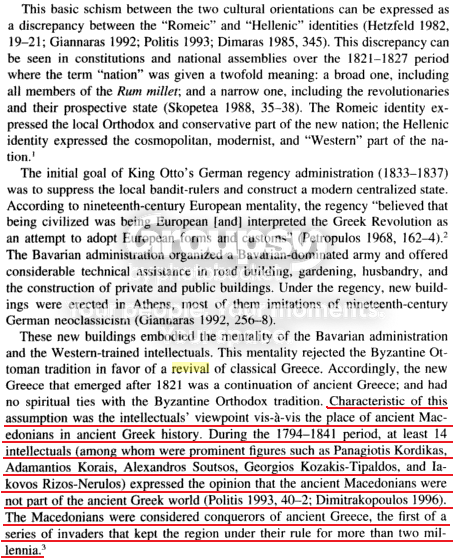
Ok, lets start with these 14 first:

NGO.jpg

roudo102.png


Jakob Burckhardt:
"Leider sind die Griechen, sobald sie nur schreiben konnten, ein Volk von Fälschern."

-"Unfortunately the Greeks, soon as they only learned to write they become a nation of forgers"
 
I kept the special part from this book for my dear deluded Greek friends:

The context of the ‘1846 Lecture’ can help us to understand the problems regarding
the writing of an all-encompassing Greek national history that Paparrigopoulos
would not overcome until at least 1853, the year of the publication of his first, one volume,
History of the Hellenic Nation. For in his earlier works, Paparrigopoulos had
essentially distinguished between the history of the Byzantine state and the history
of medieval Greece; he had then considered ancient Macedonians as a more or less
distinct nation
– because as he wrote in his Textbook of General History in 1849, ‘the
Macedonian nation accomplished, in the general history [of civilization], a different
mission from that of the Hellenic nation’
(Paparrigopoulos 1849–53, 1.193);

Enjoy it!
 
This is interesting. Thanks Bratot.

"..production of a series of terms...".

I've always been interested in 'how' the New Greeks write us out of the narrative, and write themselves in. The presupposition that Macedonia was a land of Greeks is false, nevertheless the New Greeks have managed to convince Others, mostly people in the West that it was a land of Greeks, who knew they were Macedonians, too. The only way they can construct this 'picture' is by directly engaging various rhetorical devices, bit of shorthand and other forms of interpretive mischief, such as a "Macedonian Hellene"...etc, even though no such entity ever existed throughout history.
 
Here's something from the new AMHRC Autumn review;

Hellenism and the Megali Idea

What is Hellenism? One answer is obtained by focusing on certain policies of Greek governments throughout the 19th and 20th centuries. These policies seem in significant proportion to have been given ‘historical support’ sourced from some German Romantics in the nineteenth century. An old propaganda campaign which has its roots not in Greece, but Prussia, began back when a German named Johan Gustav Droysen wrote a three volume work titled Geshichte des Hellenismus (History of Hellenism) between 1833 and 1843.

According to one of many scholars Droysen coined the term Hellenism (1) which was defined as an unbroken, unending, uninterrupted assimilatory culture that dated back from the ancient Hellenes to the present. The purpose of composing such a Romantic continuity myth was in significant part, undeniably political. The aim was to lay the foundations, on the basis of ‘historical precedent’, for a case in favour of the construction of a German national state via the sponsorship of the Prussian state-let. (2). Droysen offered an interpretation of ancient history in which he portrayed Hellenistic history as posing the problem of “freedom”, in a form relevant to his own time. The solution, in Droysen’s mind was clear, ‘re-unification’ of Germany (3). How would this be achieved and what would be the justification? Droysen would later reveal in more direct terms, that the power of the Prussian war machine should serve the purpose of‘re-unification’. The justification was found in a very romantic tracing back of German ‘roots’ to the 700’s and Charlemagne.

Modern Greece became a recognized state in 1830 via the sponsorship of Europe’s Great Powers (who for their own reasons were dismembering the Ottoman Empire) and the various elite groups controlling the state, began searching for the glue that could hold together the construction of a cohesive modern mass society. The convenience of Droysen’s Hellenism was at first not apparent to the ethno-culturally diverse strata attempting to govern the new state. Indeed, Greece’s chief historian at this time, Konstantinos Paparrigopoulos, expressed the view that the ancient Macedonians were different from the ancient Hellenes (4).

Eventually however, myths of the ‘Droysenian’ variety came to be implemented through the state education system. One version presents an essentialist history and culture that in an uninterrupted form stretches back 4000 years (5). Another became a vehicle for the Megali Idea or the Great Idea. This Megali Idea was nothing more than an attempt to justify the expansion of the new state on basis of irredentist ‘Droysenian’ myths. It was publicly proposed by the Vlach Prime Minister of Greece Ioannis Kolettis in 1844. Kolettis would go on to state in a speech well known to Greek historiography, that:

The Kingdom of Greece is not Greece. It constitutes only one part, the smallest and the feeblest. The name Hellenes describes not only those who live in this kingdom, but also those who live in Jannina, in Thessaloniki, in Serres, in Adrianople, in Constantinople, in Trebizond, in Crete, in Samos, and in any territory associated with Hellenic history and the Hellenic race…..There are two prime cores of Hellenism: Athens, the capital of the Hellenic Kingdom, and the City (Constantinople), the vision and hope of all Hellenes.(6)

A classic example of essentialist ethno-nationalistic romanticism, ignoring the ethnographic realities of the present and even baselessly dismissing historical perspectives that had been commonly held within Greece until the 1840’s. This speech marked the beginning of territorial claims upon Macedonia. Macedonia had not before been seriously considered as land to be “re-claimed” by the intelligentsia in the new Greek state. Furthermore, between 1794 – 1841, at least fourteen Greek revivalist intellectuals expressed the opinion that the ancient Macedonians were not part of the Greek world and that they should in fact be viewed as conquerors of ancient Greece (7). Notably, this perspective found traction in an attempt to foster unity between warring factions during the Greek War for independence, when the philhellene Lord Cochrane quoted a famous passage to the Albanian Klepht (bandit) leader Kolokotronis from the first Philipic “in which Demosthenes exhorts the Athenians to lay aside their differences and unite against Philip of Macedon.”(8) Another intellectual/politician who would end up becoming president of the Athens Archaeological Society stated in a speech on 25 May 1841:

……And a battle in Chaironeia took place, in which Philip won, destroying the Hellenic freedom. But Philip committed something even more disastrous, he fathered Alexander!(9)

Adamantios Korais, the chief protagonist for, and inventor of, Katharevousa, a language invented for the purpose of filtering out Turkish, Albanian, Vlach, Arabic, and other foreign words ‘unclean’ for the neo-Hellenes, saw the period of Turkish rule as simply the lowest point in the downward path that the nation had followed ever since Greece had been conquered by the Macedonian king Philip II in the second half of the fourth century BCE(10).

Eventually though, intellectuals like Konstantinos Paparrigopoulos would ‘catch on’ to ‘political requirements’ and begin to incorporate Droysen’s concept of Hellenism. Paparrigopoulos ignored a wealth of contrary historical and extant ethnographic evidence in order to create a historical narrative supporting the “unification” of the Hellenic nation that Kolettis had expressed a desire for (11). The same period that saw the rehabilitation of Byzantium in the Greek national narrative (1830’s to 1850’s) also saw ancient Macedonia fitted into the discourse of Greek national continuity; this move went hand in hand with the desire to incorporate modern Macedonia within Greek national territory(12).
The state’s ideological machines were now ready to ‘educate’ the masses with the new ideology. Kolettis and his protégé Paparrigopoulos had begun the process of the Megali Idea. The implementation of this idea was destined to have costly consequences for the inhabitants of Macedonia.
 
Ivan Hristovski


Sources

1 Alexander of Macedon, 356-323 B.C., Peter Green (1992; 482-83). Green quotes one contemporary scholar who stated ‘Droysen’s conceptions were propounded so forcefully that they have conditioned virtually all subsequent scholarship on the subject’ (1992; 483).
2 Droysen and the Prussian School of Thought, Robert Southard (1995; 1-2).
3 Ibid (1995; 11-12).
4 European historiographical influences upon the young Konstantinos Paparrigopoulos, Ioannis Koulouris -The Making of Modern Greece; Edited by Roderick Beaton and David Ricks (2009; 59).
5 Constantinos Paparrigopoulos: History of the Hellenic Nation, Vangelis Kechriotis - Discourses of Collective Identity in Central and Southeast Europe 1770-1945; Edited by Balazs Trencsenyi and Michal Kopecek (2007; 75).
6 See The Vlachs, the History of a Balkan People, Tom Winnifrith (1987; 139). Winnifrith states that Kolettis was "a Vlach who dressed like a Turk and had been a court physician to Ali Pasha" and also Ioannis Kolettis: Of This Great Idea, Vangelis Kechriotis - Discourses of Collective Identity in Central and Southeast Europe 1770-1945; Edited by Balazs Trencsenyi and Michal Kopecek (2007; 246).
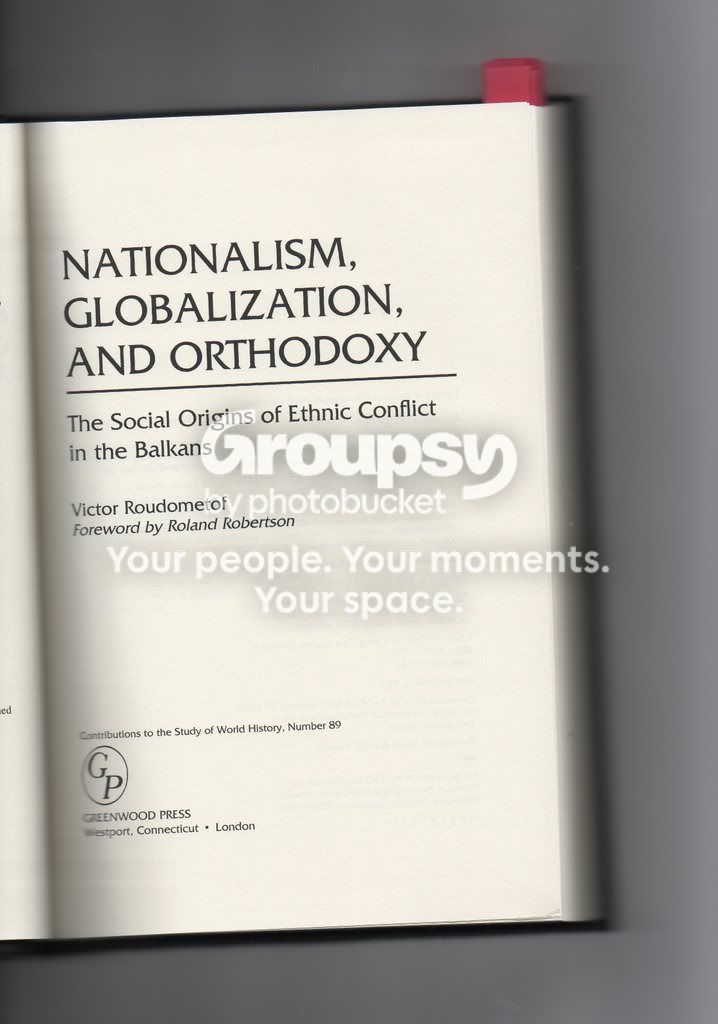
7 Nationalism, Globalization, and Orthodoxy; The social origins of ethnic conflict in the Balkans, Victor Roudometof (2001; 102).
8 That Greece Might Still Be Free; The Philhellenes in the War of Independence, William St. Clair (1972, 326).
9 The nation and its ruins; Antiquity, Archaeology, and National Imagination in Greece, Yannis Hamilakis (2007; 112). The speech was given by none other than I. Rizos Neurolos.
10 See Inventing Greece, Peter Bien Journal of Modern Greek Studies - Volume 23, Number 2, October 2005, pp. 217-234. Bien further adds 'even katharevousa was produced not just for the Ottomanized Greeks, but also for Western philhellenes, as Koraes reveals when he confesses that his notes, "written in our common tongue, were ready for the printers when some friends of mine - philhellenes expert in our ancient but not our modern language - eventually persuaded me to Hellenize [my notes] so that they might be understood . . . by the scholars of Europe, who are ignorant of Modern Greek" (Bien 1972:51, citing Koraes 1833:41) and also see: A language in the image of the nation: Modern Greek and some parallel cases, Peter Mackridge - The Making of Modern Greece; Edited by Roderick Beaton and David Ricks (2009; 182).
11 Language and National identity in Greece, Peter Mack ridge (2009; 182).
12 Ibid (2009;182).
 
I remember some Greek said:

"Greece is the most artificial of all artificial nations that resulted from the dissolution of the Ottoman empire" ?

:)
 
I remember some Greek said:

"Greece is the most artificial of all artificial nations that resulted from the dissolution of the Ottoman empire" ?

:)

indeed, Yerasimos Kaklamanis

and to fill up the topic...with a u further greek quote:

"It is an illusion to think that ancient Macedonians were Greeks". Karagatsis - a Greek writer
 
Back
Top