• Welcome to the new Macedonian Truth Forum. All posts, members and private messages have been moved over from the old forum.

    Passwords from the old forum could not be carried over, so please use Forgot your password? to set a new one. The reset link is emailed to the address on your account.

  • Rules and Regulations at the forum of the Macedonian Truth Organisation (MTO)

    (1) The national-ethnic and cultural-linguistic identity of the Macedonian people is historically Macedonian, and derives its character from the native, indigenous and geographic homeland of the Macedonians, which is called Macedonia. To ensure that their human rights, integrity and heritage are appropriately respected, the only nouns and adjectives acceptable when reference is made to the above character and identity markers is Macedon, Macedonia, Macedonian and Macedonians.

    (2) The nation-state of the Macedonian people is the Republic of Macedonia, and is to be referred to by this official title so long as the 'republic' prefix is consistently applied to other states. Alternative references are the Macedonian Republic, or simply, Macedonia.

    (3) The 'ethnic' prefix is only acceptable for Macedonians in cases where differentiation is specifically required - so long as it is in context and consistent where it concerns its application to other ethnic groups.

    (4) Should any other differentiation be specifically required, the names of other ethnic groups that reside with Macedonians in either the Republic of Macedonia or the occupied Macedonian regions in Greece, Bulgaria, Serbia or Albania, are to be given a prefix.

    (5) Negating the identity, language and culture of the Macedonian people by deliberate avoidance of the terms Macedonia, Macedonian and Macedonians, or by any other means, is not permitted.

    (6) Systematic anti-Macedonian propaganda and rhetoric are not permitted.

    (7) Threads irrelevant to the Macedonian Cause, the community at the Macedonian Truth Organisation or the Macedonians in general may be considered as spam or not in the spirit of the forum. In such cases they are not permitted.

    (8) Continual posting of messages in threads with the sole purpose of deviating from the initial topics with the use of unrelated and unnecessary information is not permitted.

    (9) All posts, external articles, reports, etc that are cited in languages other than Macedonian or English, must be accompanied with a translation in one or both of the said languages.

    (10) Despite the possibility of some conversations and debates becoming heated, extreme abuse and/or racism, vulgar language and/or terminology, threats, revelation of personal information about others, harassment, and other such behavior will not be permitted. If deemed necessary all relevant information including member details will be reported to the appropriate authorities for investigation which may result in legal action.

    (11) Threads that are created must have a summary of a topic or excerpt of an article found in pertinent link(s) that have been included. One line threads will be considered unaccetable spam and are therefore not permitted.

    (12) Compulsive and deliberate lies, irrespective of the topic, are not permitted.

    (13) Any symbols or avatars found to be perceived as offensive to Macedonians are not permitted.

    (13) Any explicit or extreme material is not permitted.

    Failure to adhere to the above rules and regulations will result in a ban after 3 breaches. This may be reconsidered in some cases should the circumstances be of an unorthodox nature and/or require special consideration. To assure an effective deterrent against an individual or individuals with the sole purpose of causing dissent through spamming, racism or other improper means, the above rules will be strictly enforced.

    The MTO administration will monitor all discussions as reasonably practical and reserve the right to remove any post and/or member from the forum, and update the rules and regulations as required. Members are encouraged to immediately report any post and/or member to the MTO administration if they feel that these rules have not been abided by.

    The views expressed on this forum are those of the individuals. The only official representation of the MTO is made by the "Macedonian Truth Organisation (Site Owner)" username, and no other.

  • Macedonian Cause

    The Macedonian Truth Organisation calls on God in Heaven to protect, bless and guide the endeavour it is committing to undertake, and that is to work towards:

    Securing Macedonia as a free, independent and democratic republic in which sovereignty lies with the Macedonian citizens; as the nation-state of the Macedonian people in which they can preserve their culture, language and identity; as a state in which the Macedonian language and culture form the basis of public life and act as important unifying elements of Macedonian society; as the home of all its citizens to which it guarantees and obliges their inalienable natural rights and corresponding responsibilities;

    The acknowledgment as self-evident and irrefutable the existence of the:

    1) Indigenous, ethnonational name of Macedonia;
    2) Macedonian people, language and identity;
    3) Macedonian culture, symbols and folklore;
    4) Macedonian ancestry, heritage and history in its entirety; and
    5) Macedonian Orthodox Church;

    Securing recognition by the International Community of the tragedies endured by the Macedonian people, of the division of Macedonia with the signing of the Treaty of Bucharest on August 10, 1913, and the genocide committed against the Macedonian people at the hands of the Greek, Bulgarian and Serbian states and their respective churches during the 19th and 20th centuries;

    Ensuring that the Interim Accord is declared ‘null and void’ and that all constitutional provisions, acts, commitments, agreements, legislation, regulations, policies or programs emanating from, supporting or consequential to the Interim Accord are also declared ‘null and void’, including the use of any symbols and the completion of any acts imposed by, or originating from, the Interim Accord.

    Ensuring that the Framework Agreement is abolished and that all constitutional provisions, acts, commitments, agreements, legislation, regulations, policies and programs emanating from, supporting or consequential to the Framework Agreement are also abolished and replaced by a framework of constitutional and statutory law based on inalienable natural rights and corresponding responsibilities and universally codified human rights mechanisms.

    Securing the abolishment of any existing constitutional provisions, acts, agreements, legislation, regulations, policies and programs that discriminate against the Macedonian people, in any international organisation or any of the countries of the International Community where such constitutional provisions, acts, agreements, legislation, regulations, policies and programs exist, and thereby ensuring the freedom for Macedonians to exercise their inalienable natural rights and fulfil their corresponding responsibilities, and practice their culture, language and religious faiths in all the countries of the International Community without hindrance;

    The empowerment of Macedonians to undertake a moral revolution and to instil and/or reinvigorate within themselves a deep-rooted national, cultural, linguistic and historical dignity and a commitment to the exercise of freedom based on inalienable natural rights and corresponding responsibilities;

    The recognition of the Macedonian minorities in the neighbouring states of Macedonia as well as the respect for the inalienable rights and freedoms of the Macedonian minorities, as provided for by natural law and as codified by the United Nations Charter, the Universal Declaration of Human Rights and other universally codified human rights mechanisms;

    The full and unreserved respect of, and the support for, the rights of all people of non-Macedonian descent living in Macedonia and around the world, who share a reciprocal full and unreserved respect for the Macedonian people, their homeland and their state;

    The cultural unification and solidarity of the Macedonian people living in all parts of historical Macedonia and adjacent territories, as well as Macedonians throughout the world;

    The unity of all Macedonians on the principles, objectives and achievement of the Macedonian cause as defined by this declaration.

Greek Nationalism Out of Control

Niko777

New member
Today in Aegean Macedonia was the feast day of St. Demetrius (Mitrovden). Yet the Greek government and Greek Orthodox Church did not hesitate to use this religious day for spreading its usual Greek anti-Macedonian propaganda among Christian believers....

President of Greece Prokopis Pavlopoulos today in his speech in the historic church in Solun said the following:

"Saint Demetrius, one of the most glorious figures in Holy Orthodoxy has always taught us in many ways...

First, the lesson of the obvious and implicit Greekness of Macedonia, which St. Demetrius protects, always, especially against the Slavs even as early as the 6th century AD century! The culmination of his protection resulted in the liberation of Salonica during the Balkan Wars 1912-1913...

Long live Salonica, the eternal capital of Macedonia. "


Even more disturbing was the kind of imagery used by the Greek Orthodox Church. Below is a photo from today's liturgy showing an image of the Virgin Mary with a sword above the captions "Pan-Macedonian Union" and "The Macedonian Struggle". :no:

0proedros-6.jpg
 
Last edited:
If only a follower of this church asked "why are we celebrating St Demetrius and liberation of Salonica today? When it occurred November 8th??? What's this Malakia teaching?"

I bet the answer would have been something along the lines "skasse vre gamoto"


source re Solun independence and Orthodox St Demetrius day Macedonians of Solun (and the rest of Macedonia for the matter of fact) celebrated which real Macedonians still do to this day.....
LastScan.jpg


55.jpg
 
Last edited:
Today in Aegean Macedonia was the feast day of St. Demetrius (Mitrovden). Yet the Greek government and Greek Orthodox Church did not hesitate to use this religious day for spreading its usual Greek anti-Macedonian propaganda among Christian believers....

President of Greece Prokopis Pavlopoulos today in his speech in the historic church in Solun said the following:

"Saint Demetrius, one of the most glorious figures in Holy Orthodoxy has always taught us in many ways...

First, the lesson of the obvious and implicit Greekness of Macedonia, which St. Demetrius protects, always, especially against the Slavs even as early as the 6th century AD century! The culmination of his protection resulted in the liberation of Salonica during the Balkan Wars 1912-1913...

Long live Salonica, the eternal capital of Macedonia. "


Even more disturbing was the kind of imagery used by the Greek Orthodox Church. Below is a photo from today's liturgy showing an image of the Virgin Mary with a sword above the captions "Pan-Macedonian Union" and "The Macedonian Struggle". :no:

0proedros-6.jpg

Bill
Sho chakash ot fuckin gjuptsi?
 
Today in Aegean Macedonia was the feast day of St. Demetrius (Mitrovden). Yet the Greek government and Greek Orthodox Church did not hesitate to use this religious day for spreading its usual Greek anti-Macedonian propaganda among Christian believers....

President of Greece Prokopis Pavlopoulos today in his speech in the historic church in Solun said the following:

"Saint Demetrius, one of the most glorious figures in Holy Orthodoxy has always taught us in many ways...

First, the lesson of the obvious and implicit Greekness of Macedonia, which St. Demetrius protects, always, especially against the Slavs even as early as the 6th century AD century! The culmination of his protection resulted in the liberation of Salonica during the Balkan Wars 1912-1913...

Long live Salonica, the eternal capital of Macedonia. "

What, isn't Thessaloniki the eternal capital of Macedonia?


If only a follower of this church asked "why are we celebrating St Demetrius and liberation of Salonica today? When it occurred November 8th??? What's this Malakia teaching?"

Thessaloniki was liberated on October 26, 1912, day of St Demetrius, based on the Calendar they had back then (what is now called Old Style). My grandmother WAS there in the celebrations.


Even more disturbing was the kind of imagery used by the Greek Orthodox Church. Below is a photo from today's liturgy showing an image of the Virgin Mary with a sword above the captions "Pan-Macedonian Union" and "The Macedonian Struggle". :no:

0proedros-6.jpg

According to this, you have the Akathist Hymns too. Does it ring a bell?

https://en.wikipedia.org/wiki/Akathist

https://www.youtube.com/watch?v=c7mMAcQgzg4


===
 
Last edited:
Today in Aegean Macedonia was the feast day of St. Demetrius (Mitrovden). Yet the Greek government and Greek Orthodox Church did not hesitate to use this religious day for spreading its usual Greek anti-Macedonian propaganda among Christian believers....

President of Greece Prokopis Pavlopoulos today in his speech in the historic church in Solun said the following:

"Saint Demetrius, one of the most glorious figures in Holy Orthodoxy has always taught us in many ways...

First, the lesson of the obvious and implicit Greekness of Macedonia, which St. Demetrius protects, always, especially against the Slavs even as early as the 6th century AD century! The culmination of his protection resulted in the liberation of Salonica during the Balkan Wars 1912-1913...

Long live Salonica, the eternal capital of Macedonia. "


Even more disturbing was the kind of imagery used by the Greek Orthodox Church. Below is a photo from today's liturgy showing an image of the Virgin Mary with a sword above the captions "Pan-Macedonian Union" and "The Macedonian Struggle". :no:

0proedros-6.jpg

Another example of politicisation of religion in Greece.
 
The president of Greece is sorely misinformed historically, but his comments highlight the fact that much of Orthodoxy is not about true spirituality, but one form or another of nationalism.

This does not surprise me the least. I have had similar experiences with Serbian priests.
 
I read in a book from around 1904 that Solun was thought to become an Austrian port.
So much for the perceived greekness of Solun.
 
I read in a book from around 1904 that Solun was thought to become an Austrian port.
So much for the perceived greekness of Solun.

I've also heard that the Evrejs wanted to make their Israel In Macedonia and Solun was to be their Jerusalem.
 
I read in a book from around 1904 that Solun was thought to become an Austrian port.
So much for the perceived greekness of Solun.

From Wikipedia

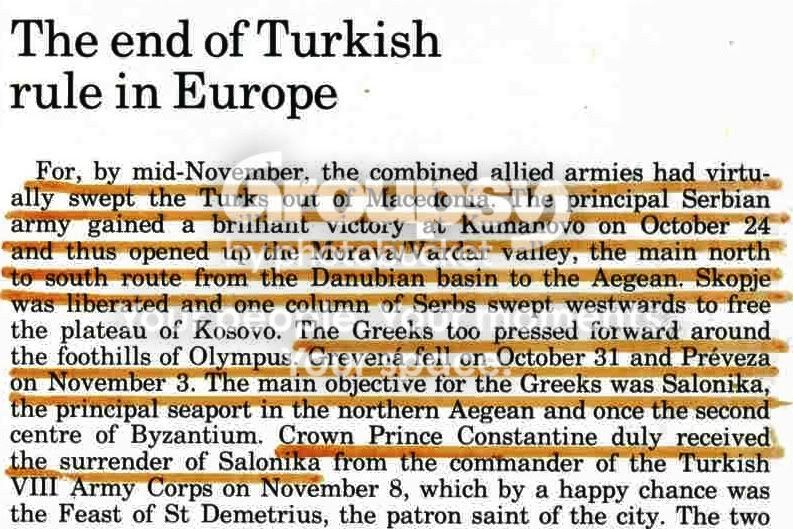
During the First Balkan War, the Ottoman garrison surrendered Salonika to the Greek Army, on 9 November [O.S. 27 October] 1912. This was a day after the feast of the city's patron saint, Saint Demetrios, which has become the date customarily celebrated as the anniversary of the city's liberation. The next day, a Bulgarian division arrived, and Bulgarian troops were allowed to enter the city in limited numbers. Although officially governed by the Greeks, the final fate of the city hung in the balance. The Austrian government proposed to make Salonika into a neutral, internationalized city similar to what Danzig was to later become; it would have had a territory of 400–460 km² and a population of 260,000. It would be "neither Greek, Bulgarian nor Turkish, but Jewish".

The reference comes from a Greek-Jewish book, so i don't know what it means or how reliable it is, or what authority or weight the Austrian view had, or if this was really the Austrian view. Austrians were allies of Turkey.


===
 
Last edited:
Europe

Changes in national boundaries after the end of the Cold War.
1918 — Poland, Latvia, Lithuania, and Estonia declare their independence from the Russian Empire. Russia recognizes the independence of Finland, declared in 1917. The Kingdom of Slovenes, Croats and Serbs (later known as the Kingdom of Yugoslavia) is formed.
1919–20 — The Austro-Hungarian Empire is formally dissolved by the Treaty of Saint-Germain signed September 10, 1919 and the Treaty of Trianon signed June 4, 1920. Austria, Hungary, and Czechoslovakia are formed. Territory of the former kingdom is additionally awarded to Italy, Poland, Romania, and Yugoslavia. In 1919, Germany suffers substantial territorial losses in the Treaty of Versailles. Belgium receives Neutral Moresnet and three German cantons as compensation for extensive damage during World War I. These three cantons still form the German speaking community of Belgium: Eupen, Malmedy and Sankt Vith. Denmark receives Northern Schleswig from Germany (with local plebiscites concluding in 1920). Most of the Prussian provinces of Posen and of West Prussia were returned to Poland. The east part of Upper Silesia and the area of Soldau in East Prussia are annexed to Poland as well. Danzig and Saarland fall under the control of the League of Nations. The Memel territory comes under a temporary French administration.
1920 — Greece is promised most of eastern Thrace as well as Ionia with the city of İzmir (Smyrna) in the Treaty of Sèvres. The Free State of Fiume is established as the result of an Italo–Yugoslav border dispute.
1922 — The Soviet Union is officially formed under the Treaty on the Creation of the USSR. In December, the Irish Free State and United Kingdom of Great Britain and Northern Ireland are formed from the United Kingdom of Great Britain and Ireland. The United Kingdom maintains Treaty Ports at Berehaven, Cobh, and Lough Swilly.
1923 — The Treaty of Sèvres is superseded by the Treaty of Lausanne under which Greece loses its earlier territorial gains and the borders of modern Turkey are established. Western Thrace is ceded by Bulgaria to Greece, a decision earlier agreed upon in the 1919 Treaty of Neuilly-sur-Seine. On the Baltic sea, Lithuania annexes the Memel territory without plebiscite. Italian military forces take control of the Greek island of Corfu.
1924 — The Treaty of Rome is concluded on January 27, ending the existence of the Free State of Fiume and the Italo–Yugoslav border dispute. The treaty assigns Fiume (Rijeka) to Italy and Sušak to Yugoslavia, with joint port administration. On March 16, Italy formally annexes Fiume.
1926 — Albania cedes territory to the Kingdom of Slovenes, Croats and Serbs.
1929 — Vatican City becomes independent after the signing of the Lateran Treaty with Italy.
1935 — Saar is annexed by Nazi Germany after a plebiscite was held.
1938 — Austria is annexed by Nazi Germany in the Anschluss with plebiscite but also with a pre-vote invasion. On April 25, the United Kingdom returns the Treaty Ports to Ireland as part of the Anglo-Irish Trade Agreement. The Munich Agreement on September 29 permits Germany to also annex the Sudetenland region of Czechoslovakia.
1939 — The Memel territory is ceded to Nazi Germany by Lithuania under pressure from Berlin on March 23. The rest of Czechoslovakia is taken over by Nazi Germany, a German protectorate called Bohemia and Moravia is formed on the remaining Czech land, while Slovak territory is split between a puppet state of Slovakia and land given to Hungary. On August 23, the Molotov–Ribbentrop Pact is signed. Nazi Germany and the Soviet Union invade Poland on September 1.
World War II — Many boundary changes occurred during the Second World War as Axis powers and the Soviet Union re-divided the areas under their control.
1945 — Following the war, the borders of Germany were moved west to the Oder-Neisse line, while the approximate boundary of the Curzon Line was used as the eastern border of Poland. In addition to incorporating the Kresy territories, the Soviet Union also annexed the Baltic states, Carpathian Ruthenia from Czechoslovakia, and Bessarabia, Hertza, and part of Bukovina from Romania. From Germany, the Soviet Union acquired the northeastern third of the former East Prussian exclave with the Klaipeda/Memel region becoming part of the Lithuanian SSR and the bulk of the territory forming the Kaliningrad Oblast of the Russian SFSR. Additionally, Finland ceded major portions of Karelia and Salla to the Soviet Union as well as islands in the Gulf of Finland, the whole Petsamo, and a lease to use Porkkala as a Soviet naval base for 50 years.
1947 — In the Paris Peace Treaties of 1947, Italy cedes the Dodecanese to Greece and Goriška, Inner Carniola, most of Istria, Zadar, its Dalmatian islands (such as Cres and Lastovo), and Rijeka (Fiume) to the newly established Socialist Federal Republic of Yugoslavia. The status of Trieste, however, is still disputed between Italy and Yugoslavia and the Free Territory of Trieste is established.
1949 — April 23, Federal Republic of Germany cedes the villages Elten and Tüddern to the Netherlands.
1949 — May 23, the Federal Republic of Germany (West Germany) is formed and shortly afterwards, the German Democratic Republic (East Germany) is established on October 7.
1954 — The Free Territory of Trieste is abolished and provisionally distributed between Yugoslavia and Italy.
1955 July 27 — Austrian State Treaty comes into force, established Austria from the four occupation zones of the Allied powers.
1956 — The Soviet Union returns Porkkala to Finland.
1957 — With plebiscite, Saar is incorporated into the Federal Republic of Germany, having previously bordered Luxembourg, France and West Germany.
1964 — Malta is independent from the United Kingdom.
1972 — The United Kingdom formally annexes Rockall (by the Island of Rockall Act 1972, declaring it to be part of Scotland).
1974 — After an attempted Greek Cypriot coup sponsored by the Greek military junta of that period, Turkey invades and occupies one-third of Cyprus.
1975 — Provisional border between Italy and Yugoslavia within the territory of the former Free Territory of Trieste is permanently fixed.
1983 — The Turkish Republic of Northern Cyprus is declared but is not recognized by any country except Turkey.
1990 — East Germany reunites with West Germany on October 3. Transnistria declares independence from the Moldavian SSR but is not recognized by any country.
1991 — With the dissolution of the Soviet Union, the USSR is split up into 15 independent states, including the European states of Belarus, Estonia, Latvia, Lithuania, Ukraine and Moldova. All the former Soviet republics had their independence recognized by December 26. Slovenia (June 25), Croatia (June 25), and the Republic of Macedonia (September 8) all declare their independence from Yugoslavia.
1992 — Bosnia and Herzegovina declares independence from Yugoslavia on March 1 and is formally recognized on April 6. The remaining rump of Yugoslavia becomes the Federal Republic of Yugoslavia (renamed Serbia and Montenegro in 2003).
1993 January 1 — Czechoslovakia is dissolved into the Czech Republic and Slovakia in the "Velvet Divorce".
2006 June 8 — The State Union of Serbia and Montenegro is dissolved. Montenegro and Serbia each become independent states.
2008 February 17 — Kosovo declares independence from Serbia and is recognized by a majority of UN member states including the United States, most western European states, Turkey, and Canada, though its independence is not recognized by Serbia, Greece, Spain, Russia, and the People's Republic of China.
2008 August 30 — After the Russian–Georgian war, Abkhazia and South Ossetia became partially recognized countries.
2014 — Annexation of Ukrainian Crimea by Russia.
North America[edit]
1927 April 1 — The Imperial Privy Council of the United Kingdom establish the boundaries of the Dominion of Newfoundland and Canada, in particular, the province of Quebec, which transfers territories claimed by Quebec to Newfoundland. Previous maps showed the disputed territory as undefined.
1949 March 31 — The Dominion of Newfoundland joins with Canada. The territory is now called Newfoundland and Labrador.
1999 — Panama Canal Zone returned from joint US–Panamanian control to Panamanian control (the actual change in borders could also be regarded as the 1979 change from US control to joint US–Panama control).
South America[edit]
1938 — A ceasefire signed between Paraguay and Bolivia awards Paraguay three-quarters of the Chaco Boreal which it took over during the Chaco War (1932–35).
1941 — The Rio Protocol recognises Peru as having control of the territory it won in the Ecuadorian–Peruvian war.
Oceania[edit]
1949 July — Territory of New Guinea joins with the Australian Territory of Papua to form The Territory of Papua and New Guinea.[5]
1955 November 23 — Cocos (Keeling) Islands transferred from the Singapore to Australia.
1957 — Christmas Island transferred from the Singapore to Australia.
1969 — Western Papua becomes part of Indonesia under the 1969 Act of Free Choice.


In the early part of the twentieth century quite a number of countries borders were changed not just Macedonia.They were absorbed into other countries at the stroke of a pen.No one asked the populations if they wanted to go.Macedonia was one of those countries."liberating them was the order of the day so they say to cover the fact of a land grab.The borders were redrawn on quite a number of European countries apart of Macedonia.The new occupiers thought that the countries belonged to them think about the associated propaganda that sprung up straight away and the denationalization and other things that were developed.
 
Last edited:
Most Greeks I see today are on a witch hunt with each other, trying to say "You're not Greek",

While they do carry a over force of propaganda and nationalism through lies I see a lot,

I think Greeks will destroy themselves before their nationalism reaches its peak.
 
I think Greeks will destroy themselves before their nationalism reaches its peak.
Their nationalism has peaked for about 60 years in my opinion. It hasn't hurt them in my opinion. They are deluded, but it takes quite a bit of self-delusion to think you're better than any other race.
 
Their nationalism has peaked for about 60 years in my opinion. It hasn't hurt them in my opinion. They are deluded, but it takes quite a bit of self-delusion to think you're better than any other race.

Not very close. Nationalism peaked in 1890s and after the 1897 humiliating defeat, it peaked up again around 1910s-1922. There was also (I guess) a nationalistic enthusiasm during dictatorships (1936-1941, 1967-1974) and wars.

The Civil War and post-Civil War period also has a stronger nationalistic and anti-communist mood.
 
Back
Top