• Welcome to the new Macedonian Truth Forum. All posts, members and private messages have been moved over from the old forum.

    Passwords from the old forum could not be carried over, so please use Forgot your password? to set a new one. The reset link is emailed to the address on your account.

  • Rules and Regulations at the forum of the Macedonian Truth Organisation (MTO)

    (1) The national-ethnic and cultural-linguistic identity of the Macedonian people is historically Macedonian, and derives its character from the native, indigenous and geographic homeland of the Macedonians, which is called Macedonia. To ensure that their human rights, integrity and heritage are appropriately respected, the only nouns and adjectives acceptable when reference is made to the above character and identity markers is Macedon, Macedonia, Macedonian and Macedonians.

    (2) The nation-state of the Macedonian people is the Republic of Macedonia, and is to be referred to by this official title so long as the 'republic' prefix is consistently applied to other states. Alternative references are the Macedonian Republic, or simply, Macedonia.

    (3) The 'ethnic' prefix is only acceptable for Macedonians in cases where differentiation is specifically required - so long as it is in context and consistent where it concerns its application to other ethnic groups.

    (4) Should any other differentiation be specifically required, the names of other ethnic groups that reside with Macedonians in either the Republic of Macedonia or the occupied Macedonian regions in Greece, Bulgaria, Serbia or Albania, are to be given a prefix.

    (5) Negating the identity, language and culture of the Macedonian people by deliberate avoidance of the terms Macedonia, Macedonian and Macedonians, or by any other means, is not permitted.

    (6) Systematic anti-Macedonian propaganda and rhetoric are not permitted.

    (7) Threads irrelevant to the Macedonian Cause, the community at the Macedonian Truth Organisation or the Macedonians in general may be considered as spam or not in the spirit of the forum. In such cases they are not permitted.

    (8) Continual posting of messages in threads with the sole purpose of deviating from the initial topics with the use of unrelated and unnecessary information is not permitted.

    (9) All posts, external articles, reports, etc that are cited in languages other than Macedonian or English, must be accompanied with a translation in one or both of the said languages.

    (10) Despite the possibility of some conversations and debates becoming heated, extreme abuse and/or racism, vulgar language and/or terminology, threats, revelation of personal information about others, harassment, and other such behavior will not be permitted. If deemed necessary all relevant information including member details will be reported to the appropriate authorities for investigation which may result in legal action.

    (11) Threads that are created must have a summary of a topic or excerpt of an article found in pertinent link(s) that have been included. One line threads will be considered unaccetable spam and are therefore not permitted.

    (12) Compulsive and deliberate lies, irrespective of the topic, are not permitted.

    (13) Any symbols or avatars found to be perceived as offensive to Macedonians are not permitted.

    (13) Any explicit or extreme material is not permitted.

    Failure to adhere to the above rules and regulations will result in a ban after 3 breaches. This may be reconsidered in some cases should the circumstances be of an unorthodox nature and/or require special consideration. To assure an effective deterrent against an individual or individuals with the sole purpose of causing dissent through spamming, racism or other improper means, the above rules will be strictly enforced.

    The MTO administration will monitor all discussions as reasonably practical and reserve the right to remove any post and/or member from the forum, and update the rules and regulations as required. Members are encouraged to immediately report any post and/or member to the MTO administration if they feel that these rules have not been abided by.

    The views expressed on this forum are those of the individuals. The only official representation of the MTO is made by the "Macedonian Truth Organisation (Site Owner)" username, and no other.

  • Macedonian Cause

    The Macedonian Truth Organisation calls on God in Heaven to protect, bless and guide the endeavour it is committing to undertake, and that is to work towards:

    Securing Macedonia as a free, independent and democratic republic in which sovereignty lies with the Macedonian citizens; as the nation-state of the Macedonian people in which they can preserve their culture, language and identity; as a state in which the Macedonian language and culture form the basis of public life and act as important unifying elements of Macedonian society; as the home of all its citizens to which it guarantees and obliges their inalienable natural rights and corresponding responsibilities;

    The acknowledgment as self-evident and irrefutable the existence of the:

    1) Indigenous, ethnonational name of Macedonia;
    2) Macedonian people, language and identity;
    3) Macedonian culture, symbols and folklore;
    4) Macedonian ancestry, heritage and history in its entirety; and
    5) Macedonian Orthodox Church;

    Securing recognition by the International Community of the tragedies endured by the Macedonian people, of the division of Macedonia with the signing of the Treaty of Bucharest on August 10, 1913, and the genocide committed against the Macedonian people at the hands of the Greek, Bulgarian and Serbian states and their respective churches during the 19th and 20th centuries;

    Ensuring that the Interim Accord is declared ‘null and void’ and that all constitutional provisions, acts, commitments, agreements, legislation, regulations, policies or programs emanating from, supporting or consequential to the Interim Accord are also declared ‘null and void’, including the use of any symbols and the completion of any acts imposed by, or originating from, the Interim Accord.

    Ensuring that the Framework Agreement is abolished and that all constitutional provisions, acts, commitments, agreements, legislation, regulations, policies and programs emanating from, supporting or consequential to the Framework Agreement are also abolished and replaced by a framework of constitutional and statutory law based on inalienable natural rights and corresponding responsibilities and universally codified human rights mechanisms.

    Securing the abolishment of any existing constitutional provisions, acts, agreements, legislation, regulations, policies and programs that discriminate against the Macedonian people, in any international organisation or any of the countries of the International Community where such constitutional provisions, acts, agreements, legislation, regulations, policies and programs exist, and thereby ensuring the freedom for Macedonians to exercise their inalienable natural rights and fulfil their corresponding responsibilities, and practice their culture, language and religious faiths in all the countries of the International Community without hindrance;

    The empowerment of Macedonians to undertake a moral revolution and to instil and/or reinvigorate within themselves a deep-rooted national, cultural, linguistic and historical dignity and a commitment to the exercise of freedom based on inalienable natural rights and corresponding responsibilities;

    The recognition of the Macedonian minorities in the neighbouring states of Macedonia as well as the respect for the inalienable rights and freedoms of the Macedonian minorities, as provided for by natural law and as codified by the United Nations Charter, the Universal Declaration of Human Rights and other universally codified human rights mechanisms;

    The full and unreserved respect of, and the support for, the rights of all people of non-Macedonian descent living in Macedonia and around the world, who share a reciprocal full and unreserved respect for the Macedonian people, their homeland and their state;

    The cultural unification and solidarity of the Macedonian people living in all parts of historical Macedonia and adjacent territories, as well as Macedonians throughout the world;

    The unity of all Macedonians on the principles, objectives and achievement of the Macedonian cause as defined by this declaration.

Herodotus on Thessaly

Carlin

New member
If Thessalians were Greek, if at all, they did not care much for the "Greek cause" during the war with the Persians. They cared for their own country and their own interests first thank you very much.

http://www.sacred-texts.com/cla/hh/hh8020.htm
http://www.sacred-texts.com/cla/hh/hh8030.htm
http://academic.reed.edu/humanities/hum110/hdt/hdt8.html
http://classics.mit.edu/Herodotus/history.8.viii.html

The Thessalians demand surrender, and threaten to have the Persians overrun tiny Phocis, the site of the oracle at Delphi. The angry refusal of the Phocians is motivated by hatred of Thessaly, not by Panhellenic feeling.

Notice the interesting translation: it says that the Thessalians, in the past, were on the Greek side solely out of their interest ("so long as it pleased us to be on that side"):

Bearing then a grudge for both of these things, the Thessalians sent a herald and addressed them thus:

"Phokians, we advise you to be more disposed now to change your minds and to admit that ye are not on a level with us: for in former times among the Hellenes, so long as it pleased us to be on that side, we always had the preference over you, and now we have such great power with the Barbarian that it rests with us to cause you to be deprived of your land and to be sold into slavery also. We however, though we have all the power in our hands, do not bear malice, but let there be paid to us fifty talents of silver in return for this, and we will engage to avert the dangers which threaten to come upon your land."


30. Thus the Thessalians proposed to them; for the Phokians alone of all the people in those parts were not taking the side of the Medes, and this for no other reason, as I conjecture, but only because of their enmity with the Thessalians; and if the Thessalians had supported the cause of the Hellenes, I am of opinion that the Phokians would have been on the side of the Medes. When the Thessalians proposed this, they said that they would not give the money, and that it was open to them to take the Median side just as much as the Thessalians, if they desired it for other reasons; but they would not with their own will be traitors to Hellas.

31. When these words were reported, then the Thessalians, moved with anger against the Phokians, became guides to the Barbarian to show him the way: and from the land of Trachis they entered Doris; for a narrow strip of the Dorian territory extends this way, about thirty furlongs in breadth, lying between Malis and Phokis, the region which was in ancient time called Dryopis; this land is the mother-country of the Dorians in Peloponnese. Now the Barbarians did not lay waste this land of Doris when they entered it, for the people of it were taking the side of the Medes, and also the Thessalians did not desire it.

32. When however from Doris they entered Phokis, they did not indeed capture the Phokians themselves; for some of them had gone up to the heights of Parnassos,--and that summit of Parnassos is very convenient to receive a large number, which lies by itself near the city of Neon, the name of it being Tithorea,--to this, I say, some of them had carried up their goods and gone up themselves; but most of them had conveyed their goods out to the Ozolian Locrians, to the city of Amphissa, which is situated above the Crissaian plain. The Barbarians however overran the whole land of Phokis, for so the Thessalians led their army, and all that they came to as they marched they burned or cut down, and delivered to the flames both the cities and the temples:

33. for they laid everything waste, proceeding this way by the river Kephisos, and they destroyed the city of Drymos by fire, and also the following, namely Charadra, Erochos, Tethronion, Amphikaia, Neon, Pedieis, Triteis, Elateia, Hyampolis, Parapotamioi and Abai, at which last-named place there was a temple of Apollo, wealthy and furnished with treasuries and votive offerings in abundance; and there was then, as there is even now, the seat of an Oracle there: this temple they plundered and burnt. Some also of the Phokians they pursued and captured upon the mountains, and some women they did to death by repeated outrage.


Were Ancient Thessalians bilingual/multilingual? Strabo stated that certain parts of Thessaly were held by Thracians. Also, there were a few Epirote tribes which were incorporated into Thessaly. It wouldn't be too hard to speculate and propose that Thessalians were a mix of Thracians, Epirotes, Hellenes, and (perhaps) others.
 
Last edited:
Were Ancient Thessalians bilingual/multilingual? Strabo stated that certain parts of Thessaly were held by Thracians. Also, there were a few Epirote tribes which were incorporated into Thessaly. It wouldn't be too hard to speculate and propose that Thessalians were a mix of Thracians, Epirotes, Hellenes, and (perhaps) others.

If we are to believe the ancient testimonies, then southern Thessaly is the cradle of the Hellenic nation. Be that as it may, Thessaly was engulfed by northern invasions, i.e Illyrians & Thracians who held a certain part of its territory until the classical period. That's why Thessaly has been excluded from Hellas by Dionysis:

29daghw.png

P.S: I took the scanned image from an Albanian forum
 
More on the Thracians.

Not sure where to put the following info, might as well add it here (since according to Strabo, Thracians in his time held significant parts of Thessaly). Let's see if the Thracians appear further south.

Quotes from "A History of Boeotia", By Robert J. Buck

http://books.google.ca/books?id=5Ad...Q6AEwAA#v=onepage&q=Thracians Arcadia&f=false

Summary:

- Invasions & expulsions by fierce attackers, variously named Phlegyians, Pelasgi, or Thracians. Phlegyians were held to be of Thracian stock, while Thracians a Pelasgian people [it seems that, Thracians = Pelasgians].
- Presence in Classical Greece of Thracian cults, divinities, or Thracian traces in various cults, in Boeotia and Arcadia.
- Thracian place-names, notably in Malis, Attica, Euboea and Arcadia; simple explanation: presence of Thracians in these regions.
- Memory survived of fights with invading Thracians, fights in Phocis, Boeotia, western Attica and Megara at times close to the Trojan War.
- Thracians were believed to have maintained their grip for a time in Phocis and western Boeotia.

Conclusion: ancient Hellenes, notably Boeotians and Arcadians (and others), had a significant Thracian admixture.

Some of the most notable and famous ancient Thracian Hellenes: Thucydides, Themistocles, Cimon.
 
- To the Athenian mind Thessaly was also foreign. Having colluded with the Persians during their second invasion of mainland Greece, the Thessalians were likewise referred to as barbarians.

- Thessaly followed a course of development strangely remote from the main channel of Greek civilization.

- During the prehistoric period Thessaly was ‘largely independent of external influences’ 15 and was more akin to its northern neighbours than its southern. Mycenaean civilisation had little influence, with the
exception of Phthia and Iolcus in the southeast, as the Homeric catalogue attests 16. Throughout the prehistoric period Thessaly’s culture differed greatly from the south. Without the Mycenaean and civilising influences Thessaly ‘always continued in a backward and barbarous state of civilisation’ 17.

- From the prehistoric period to the 4th century BCE Thessaly’s development was a complete contrast to the progress in southern Greece.

- Thessaly was geographically ostracised from the Greek world in the
pre-classical period:

Thessaly never became completely Hellenized and was regarded rather as a bulwark against the barbarian north than as a genuine and fully privileged member of the Hellenic world. 47

- The Athenian accusation of untrustworthiness was also political. Trust in the Thessalians had been broken. In 462 Thessaly had forged an alliance with Athens. Before the development of their own cavalry, the Athenians relied on their Thessalian allies for support since they were ‘famed for their skill as cavalrymen’. 104 When Thessaly’s help was needed against Sparta, the Thessalian cavalry deserted its allies at Tanagara in favour of the Spartans. 105 During the same campaign the Thessalian cavalry were openly hostile towards the Athenians and attacked an Athenian supply train in a premeditated raid. 106
This was not the first time Athens had felt betrayed by Thessaly. During the Persian wars Thessaly had ‘medized’ 107. Even before Persia marched through Thessaly in 480 BCE, Herodotus suggests a Thessalian contingent journeyed to Persia to offer their support and ‘to promise all the assistance which it was in their power to give’ the Persians for an invasion of Greece. He suggests this support may have contributed to the Persian decision to invade Greece. 108 Xerxes’ army marched
through Thessaly on its assault of southern Greece. After their defeat at Salamis Mardonios, the Persian general, along with the Persian army wintered in Thessaly where there was ample food and shelter.

- The Persian invasion helped to consolidate the Greek notion of barbarian and ‘other’:

The all-embracing genus of anti-Greeks later to be termed ‘the barbarians’ does not appear until the fifth century. 114

http://www.astrosynthesis.com.au/articles/The Witches of Thessaly.pdf
 
Interesting. Do you think what later become known as hellenes were already a mixed lot and the hellenes were just a special development of an underlying mixed mass...that way you can see hellenic as more of a cultural term even in the ancient world
 
Interesting. Do you think what later become known as hellenes were already a mixed lot and the hellenes were just a special development of an underlying mixed mass...that way you can see hellenic as more of a cultural term even in the ancient world

Not only do I think that the Classical Hellenes were a mixed people, I am of the 'belief' that the Hellenes (even as late as, say, 4th century B.C.) were primarily a multi-ethnic religious community that was likely bilingual or trilingual in certain communities.

I am reading Herodotus again - and with a completely new and different approach and frame of mind. When a person is conditioned to think a certain way all his life, it's hard to look at things differently. However, now when I see phrases in Herodotus (who was of Carian stock, but a proud Greek) such as "Greek family of nations", that's a red flag for me. :)
 
Interesting I see where your line of thought is going should be very fruitful. The cultic aspect is very interesting; some thoughts: could be the ancient "greeks" were a religious cult that brought their hybrid culture from elsewhere(here I mean only the priesthood etc and the cultic leaders and retinues) whereas the mass was something different(note theres no such thing as mass society in the ancient world). So you may be able to throw out any connection betwen ancient greek culture and tribal development(which may or may not be Hellenic-consider the difference proto-Hellenic, Hellenic, Anatolian is blurred; does Myceanean explain the bridge doubtful, or consider the explanation of the greek dark ages that explains all these discontinuities is mostly forced and extrapolated-i.e merely a hypothesis). Also, political and religious consolidation within the "hellenic" areas of the southern Balkans may explain alot, including the fabricatory quality of processes.
 
Last edited:
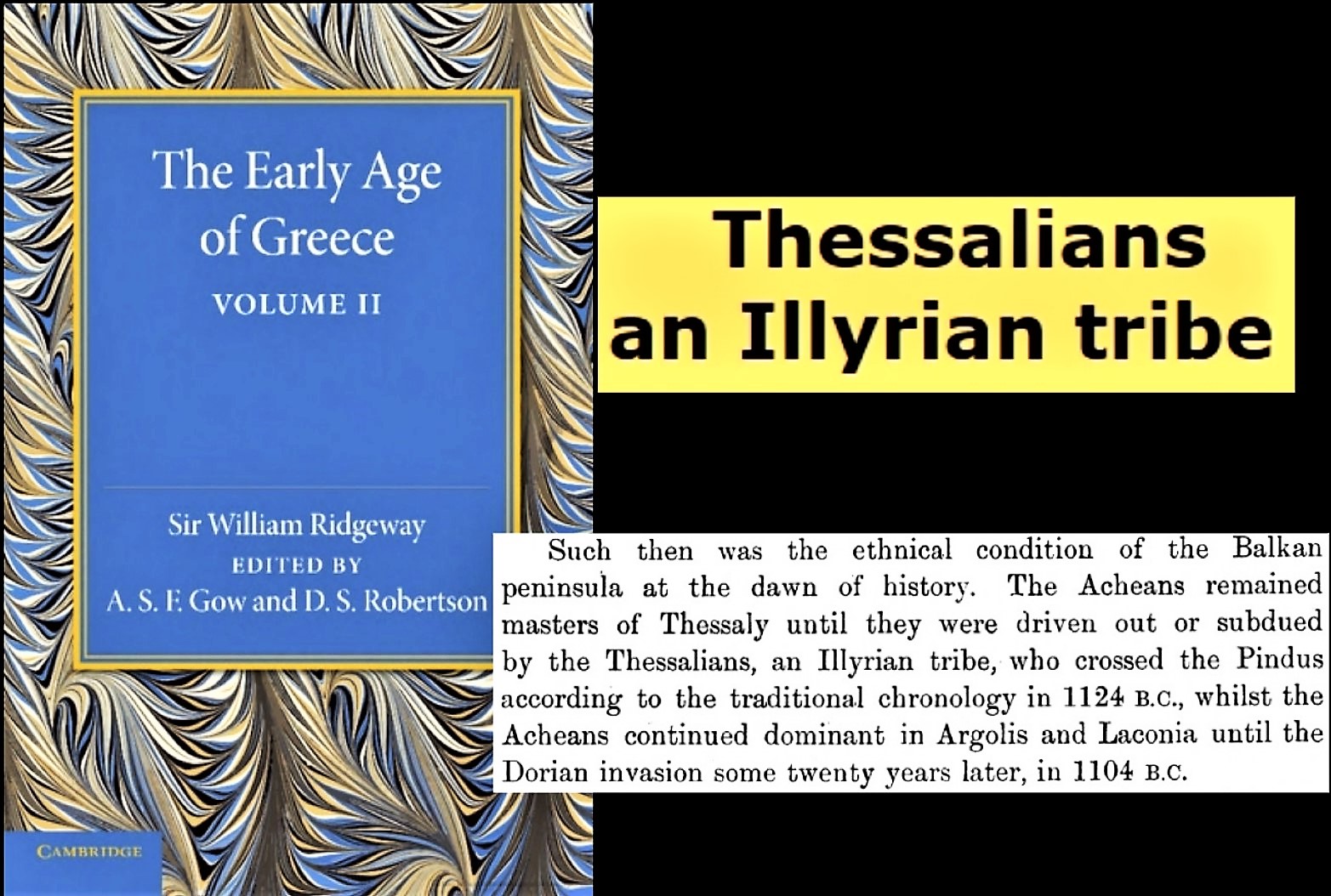
"The Acheans remained masters of Thessaly until they were driven out or subdued by the Thessalians, an Illyrian tribe, who crossed the Pindus according to traditional chronology in 1124 B.C."

-- The Early Age of Greece, Volume II, Sir William Ridgeway
 
"The Acheans remained masters of Thessaly until they were driven out or subdued by the Thessalians, an Illyrian tribe, who crossed the Pindus according to traditional chronology in 1124 B.C."

-- The Early Age of Greece, Volume II, Sir William Ridgeway

Eeh... traditional chronology in Greece starts at 776 BC. I don't think there are any sources setting ANY event 248(!) years before the beginning of time.

Just, HOW do you find this shit?
 
Eeh... traditional chronology in Greece starts at 776 BC. I don't think there are any sources setting ANY event 248(!) years before the beginning of time.
The difference is 348, not 248 (!). And the Iliad was supposedly written in the late 700's B.C. yet refers to events that purportedly took place centuries earlier. Questions about its historicity notwithstanding, do you not consider that a source?
 
Eeh... traditional chronology in Greece starts at 776 BC. I don't think there are any sources setting ANY event 248(!) years before the beginning of time.

Just, HOW do you find this shit?

Well, Sir William Ridgeway was an accomplished and respected classical scholar. He contributed articles to the Encyclopedia Biblica (1903), Encyclopædia Britannica (1911) and wrote The Origin of Metallic Currency and Weight Standards (1892), and The Early Age of Greece (1901) which were significant works in Archaeology and Anthropology.

http://ellines-albanoi.blogspot.com/?m=1

What do you think of the assertion that Thessalians were Illyrians?

Another book is cited there (from 1921), "A Companion to Latin Studies":

"...whilst there is no doubt that the Thessali, who gave their name to Thessaly, and the Dorians themselves, were Illyrian tribes."
 
Last edited:
Yes, he sounds like embarrassingly idiot. I understand this is 19th Century Science, but still I can't even imagine where these dates came from.

RTTRTRTR.jpg
 
And there's more:

In The Early Age of Greece (1901), Ridgeway introduced the controversial theory that Homeric Achaeans were Celts who invaded Greece about two generations before the Trojan War and learned Greek from the Aegean peoples, and that the civilisation described by Homer belonged to the Early Iron Age. Discouraged by criticism, especially bearing on his insubstantial definition of Celts for purposes of the theory, he did not publish the second volume, which finally appeared in the form of separate essays edited by AJB Wace in 1926.
 
Back
Top