• Welcome to the new Macedonian Truth Forum. All posts, members and private messages have been moved over from the old forum.

    Passwords from the old forum could not be carried over, so please use Forgot your password? to set a new one. The reset link is emailed to the address on your account.

  • Rules and Regulations at the forum of the Macedonian Truth Organisation (MTO)

    (1) The national-ethnic and cultural-linguistic identity of the Macedonian people is historically Macedonian, and derives its character from the native, indigenous and geographic homeland of the Macedonians, which is called Macedonia. To ensure that their human rights, integrity and heritage are appropriately respected, the only nouns and adjectives acceptable when reference is made to the above character and identity markers is Macedon, Macedonia, Macedonian and Macedonians.

    (2) The nation-state of the Macedonian people is the Republic of Macedonia, and is to be referred to by this official title so long as the 'republic' prefix is consistently applied to other states. Alternative references are the Macedonian Republic, or simply, Macedonia.

    (3) The 'ethnic' prefix is only acceptable for Macedonians in cases where differentiation is specifically required - so long as it is in context and consistent where it concerns its application to other ethnic groups.

    (4) Should any other differentiation be specifically required, the names of other ethnic groups that reside with Macedonians in either the Republic of Macedonia or the occupied Macedonian regions in Greece, Bulgaria, Serbia or Albania, are to be given a prefix.

    (5) Negating the identity, language and culture of the Macedonian people by deliberate avoidance of the terms Macedonia, Macedonian and Macedonians, or by any other means, is not permitted.

    (6) Systematic anti-Macedonian propaganda and rhetoric are not permitted.

    (7) Threads irrelevant to the Macedonian Cause, the community at the Macedonian Truth Organisation or the Macedonians in general may be considered as spam or not in the spirit of the forum. In such cases they are not permitted.

    (8) Continual posting of messages in threads with the sole purpose of deviating from the initial topics with the use of unrelated and unnecessary information is not permitted.

    (9) All posts, external articles, reports, etc that are cited in languages other than Macedonian or English, must be accompanied with a translation in one or both of the said languages.

    (10) Despite the possibility of some conversations and debates becoming heated, extreme abuse and/or racism, vulgar language and/or terminology, threats, revelation of personal information about others, harassment, and other such behavior will not be permitted. If deemed necessary all relevant information including member details will be reported to the appropriate authorities for investigation which may result in legal action.

    (11) Threads that are created must have a summary of a topic or excerpt of an article found in pertinent link(s) that have been included. One line threads will be considered unaccetable spam and are therefore not permitted.

    (12) Compulsive and deliberate lies, irrespective of the topic, are not permitted.

    (13) Any symbols or avatars found to be perceived as offensive to Macedonians are not permitted.

    (13) Any explicit or extreme material is not permitted.

    Failure to adhere to the above rules and regulations will result in a ban after 3 breaches. This may be reconsidered in some cases should the circumstances be of an unorthodox nature and/or require special consideration. To assure an effective deterrent against an individual or individuals with the sole purpose of causing dissent through spamming, racism or other improper means, the above rules will be strictly enforced.

    The MTO administration will monitor all discussions as reasonably practical and reserve the right to remove any post and/or member from the forum, and update the rules and regulations as required. Members are encouraged to immediately report any post and/or member to the MTO administration if they feel that these rules have not been abided by.

    The views expressed on this forum are those of the individuals. The only official representation of the MTO is made by the "Macedonian Truth Organisation (Site Owner)" username, and no other.

  • Macedonian Cause

    The Macedonian Truth Organisation calls on God in Heaven to protect, bless and guide the endeavour it is committing to undertake, and that is to work towards:

    Securing Macedonia as a free, independent and democratic republic in which sovereignty lies with the Macedonian citizens; as the nation-state of the Macedonian people in which they can preserve their culture, language and identity; as a state in which the Macedonian language and culture form the basis of public life and act as important unifying elements of Macedonian society; as the home of all its citizens to which it guarantees and obliges their inalienable natural rights and corresponding responsibilities;

    The acknowledgment as self-evident and irrefutable the existence of the:

    1) Indigenous, ethnonational name of Macedonia;
    2) Macedonian people, language and identity;
    3) Macedonian culture, symbols and folklore;
    4) Macedonian ancestry, heritage and history in its entirety; and
    5) Macedonian Orthodox Church;

    Securing recognition by the International Community of the tragedies endured by the Macedonian people, of the division of Macedonia with the signing of the Treaty of Bucharest on August 10, 1913, and the genocide committed against the Macedonian people at the hands of the Greek, Bulgarian and Serbian states and their respective churches during the 19th and 20th centuries;

    Ensuring that the Interim Accord is declared ‘null and void’ and that all constitutional provisions, acts, commitments, agreements, legislation, regulations, policies or programs emanating from, supporting or consequential to the Interim Accord are also declared ‘null and void’, including the use of any symbols and the completion of any acts imposed by, or originating from, the Interim Accord.

    Ensuring that the Framework Agreement is abolished and that all constitutional provisions, acts, commitments, agreements, legislation, regulations, policies and programs emanating from, supporting or consequential to the Framework Agreement are also abolished and replaced by a framework of constitutional and statutory law based on inalienable natural rights and corresponding responsibilities and universally codified human rights mechanisms.

    Securing the abolishment of any existing constitutional provisions, acts, agreements, legislation, regulations, policies and programs that discriminate against the Macedonian people, in any international organisation or any of the countries of the International Community where such constitutional provisions, acts, agreements, legislation, regulations, policies and programs exist, and thereby ensuring the freedom for Macedonians to exercise their inalienable natural rights and fulfil their corresponding responsibilities, and practice their culture, language and religious faiths in all the countries of the International Community without hindrance;

    The empowerment of Macedonians to undertake a moral revolution and to instil and/or reinvigorate within themselves a deep-rooted national, cultural, linguistic and historical dignity and a commitment to the exercise of freedom based on inalienable natural rights and corresponding responsibilities;

    The recognition of the Macedonian minorities in the neighbouring states of Macedonia as well as the respect for the inalienable rights and freedoms of the Macedonian minorities, as provided for by natural law and as codified by the United Nations Charter, the Universal Declaration of Human Rights and other universally codified human rights mechanisms;

    The full and unreserved respect of, and the support for, the rights of all people of non-Macedonian descent living in Macedonia and around the world, who share a reciprocal full and unreserved respect for the Macedonian people, their homeland and their state;

    The cultural unification and solidarity of the Macedonian people living in all parts of historical Macedonia and adjacent territories, as well as Macedonians throughout the world;

    The unity of all Macedonians on the principles, objectives and achievement of the Macedonian cause as defined by this declaration.

Historians on the Ancient Macedonians

- All of the Macedonians' names are Greek. If only Phillip and Alexander had Greek names then I would consider that they spoke the language for administrative purposes. This is not the case and all the Macedonian soldiers referred to have Greek names.

Why would the illiterate and most likely peasant Macedonian populace who had no day to day interactions with the Greeks give their children Greek names unless it was their indigenous language?

"Many historical sources are written in Greek, and it was a common practice among Greek historians to hellenize foreign sounding names. For example, the name of the powerful first king of the Persian empire, Kurush, ought to be trancribed as Kourous or Kouroux in Greek, but became Kyros, because this looks like a Greek word )"Mr. Amighty"). The name that is rendered as Alexandros, which has a perfect Greek etymology, may in fact represent something like Alaxandus (not my personal view since 'Aleksandar', as a name, is one of the most popular names stretching from R. Macedonia, in the south, all the way to Russia, in the north), which is not Greek. A related argument that forces us to hesitate is that the Greeks nearly always converted the names of foreign deities. Supreme gods like Jupiter and Marduk are called 'Zeus". So, the fact that Greek authors use Greek names for Macedonian people and deities does not prove very much about the Macedonian language." (Jona Lindering, 2005).

The author from whom I sourced this quote adds some of his own examples of this well known Greek practice such as: "Rushanak" became Roxana; "Ahasuerus" became Xerxes; "Kshattra" became satrap; "Takscacila" became Taxila; "Paurava" became Porus and so on. I'll just add my own perspective to this argument and suggest that the adoption of a foreign sounding name is hardly an argument for belonging to a certain ethnicity.
 
More on the Macedonian personal names issue...The following are quotes from a Macedonian author:

And perhaps the shakiest construct of the "Greek position" is the Macedonian names. What is of importance here and must be addressed is the following: Did Macedonians use Greek names because they were Greeks or because the Greeks saw meanings in the Macedonian names?...As a matter of fact, one is hard pressed to find any Greek from Classical or from Hellenistic times to bear the name 'Philip'. With the exception of Alexander from Epirus, a contentious point to begin with (I'm guessing because he feels the Molossians were most likely a Macedonian tribe anyway - they even fought shoulder to shoulder with the Macedonians against the Romans during the Third Macedonian War), we rarely, if at all, find another 'Alexander' among the Greeks. Thus, the argument that Philip in Greek means lover of horses cannot by itself carry the load of justification for ascribed Greekness for the ancient Macedonians. We must look elsewhere for comparable evidence in order to make such an inclusion. Since Philip and Alexander have Greek etymology - "Philipos" lover of horses and "Alexander" the protector of men - the assigned Greek meanings must be seen as Greek viewpoints of foreign names...The author also gives examples of Persian names that are given Greek equivalents to reinforce his point.
 
- The primary sources indicate that Alexander himself considered the Macedonians to be Greek. He speaks of "Macedonia and the rest of Greece" in a letter to Darius and there is also the inscription in Asia Minor of "Alexander and the Greeks except the Spartans".

About that letter to Darius. This is what Professor Edmund F.Bloedow has to say in The Ancient History Bulletin 9.3-4 (1995, p.93-110) with regards to that letter:

"The designation of Macedonia as part of Greece has intrigued modern critics. This, according to Schachermeyr, is enough to take one's breath away. He went so far as to suggest that, however brief, it encapsulates a whole and bold strategy: to counter the Great King's strategy of attempting to exploit the age-old distinction between Macedonians and the Hellenes. The reason for including Macedonia as part of a larger Hellas was designed to justify Macedonian participation in the so called war of revenge. Of course Macedonians never regarded their territory as forming part of Greece, and certainly the Greek poleis did not regard Macedonia as being another Greek polis."

As for the gift Alexander sent, of 300 Persian armours, to the Parthenon of Athens as an oblation to Athena, with the epigram: "Alexander, son of Philip, and the Greeks, except of Lacedaemonians, from the barbarians who live in Asia", this has to be seen in the dark humour with which it was intended on Alexander's part. This was early on in the campaign and Alexander was still playing his "avenging Greece" card as propaganda for Greek audiences. The Macedonians had just defeated the Persians at the Granicus River and slaughtered 18,000 Greeks out of a total of 20,000, fighting in the Persian ranks against the Macedonians, their supposed avengers for past Persian atrocities. Don't you find that just a little bit ironic? There was no need to slaughter the Greeks that day. The battle had already been won and the Persians had tucked tail and run off. Do you think this was Alexander expressing his love for the Greeks when he unleashed his Macedonians on them and slaughtered them on the spot without mercy? And what of "his" own Greeks within his own army? That is, all 7,000 of them compared to Darius' grand total of 50,000 Persian-paid Greek mercenaries? The 7,000 reluctant Greek conscripts from the deal that was made in Corinth after Chaeronea? Why do you think Alexander left them behind before he set out to meet the Persians on their first pitched battle? It was because he knew he couldn't trust their loyalties when they came face to face with 20,000 of their Greek compatriots that were fighting for Darius.
 
"Many historical sources are written in Greek, and it was a common practice among Greek historians to hellenize foreign sounding names. For example, the name of the powerful first king of the Persian empire, Kurush, ought to be trancribed as Kourous or Kouroux in Greek, but became Kyros, because this looks like a Greek word )"Mr. Amighty"). The name that is rendered as Alexandros, which has a perfect Greek etymology, may in fact represent something like Alaxandus (not my personal view since 'Aleksandar', as a name, is one of the most popular names stretching from R. Macedonia, in the south, all the way to Russia, in the north), which is not Greek. A related argument that forces us to hesitate is that the Greeks nearly always converted the names of foreign deities. Supreme gods like Jupiter and Marduk are called 'Zeus". So, the fact that Greek authors use Greek names for Macedonian people and deities does not prove very much about the Macedonian language." (Jona Lindering, 2005).

The author from whom I sourced this quote adds some of his own examples of this well known Greek practice such as: "Rushanak" became Roxana; "Ahasuerus" became Xerxes; "Kshattra" became satrap; "Takscacila" became Taxila; "Paurava" became Porus and so on. I'll just add my own perspective to this argument and suggest that the adoption of a foreign sounding name is hardly an argument for belonging to a certain ethnicity.

More on the Macedonian personal names issue...The following are quotes from a Macedonian author:

And perhaps the shakiest construct of the "Greek position" is the Macedonian names. What is of importance here and must be addressed is the following: Did Macedonians use Greek names because they were Greeks or because the Greeks saw meanings in the Macedonian names?...As a matter of fact, one is hard pressed to find any Greek from Classical or from Hellenistic times to bear the name 'Philip'. With the exception of Alexander from Epirus, a contentious point to begin with (I'm guessing because he feels the Molossians were most likely a Macedonian tribe anyway - they even fought shoulder to shoulder with the Macedonians against the Romans during the Third Macedonian War), we rarely, if at all, find another 'Alexander' among the Greeks. Thus, the argument that Philip in Greek means lover of horses cannot by itself carry the load of justification for ascribed Greekness for the ancient Macedonians. We must look elsewhere for comparable evidence in order to make such an inclusion. Since Philip and Alexander have Greek etymology - "Philipos" lover of horses and "Alexander" the protector of men - the assigned Greek meanings must be seen as Greek viewpoints of foreign names...The author also gives examples of Persian names that are given Greek equivalents to reinforce his point.

This is the famous lexicon of ancient (mostly Greek-Roman) biographies by William Smith. It is in three long volumes (3 pdf files, about 1200 pages each). It is a classic, useful in many occasions.

In pages 110-128 (of Volume 1) you can find many people by the name Alexander (Alexandros) (the first one, mostly known as Pares, appears in Homer).

https://babel.hathitrust.org/cgi/pt?id=hvd.hn4ws9;view=1up;seq=130

In Volume 3, at pages 270-293 you can find people by the name Philip (Philippos).

https://babel.hathitrust.org/cgi/pt?id=umn.31951p00338375t;view=1up;seq=309

The two most famous of them who are not Macedonian can also be found in Wikipedia (search Philip).
 
"Many historical sources are written in Greek, and it was a common practice among Greek historians to hellenize foreign sounding names. For example, the name of the powerful first king of the Persian empire, Kurush, ought to be trancribed as Kourous or Kouroux in Greek, but became Kyros, because this looks like a Greek word )"Mr. Amighty"). The name that is rendered as Alexandros, which has a perfect Greek etymology, may in fact represent something like Alaxandus (not my personal view since 'Aleksandar', as a name, is one of the most popular names stretching from R. Macedonia, in the south, all the way to Russia, in the north), which is not Greek. A related argument that forces us to hesitate is that the Greeks nearly always converted the names of foreign deities. Supreme gods like Jupiter and Marduk are called 'Zeus". So, the fact that Greek authors use Greek names for Macedonian people and deities does not prove very much about the Macedonian language." (Jona Lindering, 2005).

The author from whom I sourced this quote adds some of his own examples of this well known Greek practice such as: "Rushanak" became Roxana; "Ahasuerus" became Xerxes; "Kshattra" became satrap; "Takscacila" became Taxila; "Paurava" became Porus and so on. I'll just add my own perspective to this argument and suggest that the adoption of a foreign sounding name is hardly an argument for belonging to a certain ethnicity.

More on the Macedonian personal names issue...The following are quotes from a Macedonian author:

And perhaps the shakiest construct of the "Greek position" is the Macedonian names. What is of importance here and must be addressed is the following: Did Macedonians use Greek names because they were Greeks or because the Greeks saw meanings in the Macedonian names?...As a matter of fact, one is hard pressed to find any Greek from Classical or from Hellenistic times to bear the name 'Philip'. With the exception of Alexander from Epirus, a contentious point to begin with (I'm guessing because he feels the Molossians were most likely a Macedonian tribe anyway - they even fought shoulder to shoulder with the Macedonians against the Romans during the Third Macedonian War), we rarely, if at all, find another 'Alexander' among the Greeks. Thus, the argument that Philip in Greek means lover of horses cannot by itself carry the load of justification for ascribed Greekness for the ancient Macedonians. We must look elsewhere for comparable evidence in order to make such an inclusion. Since Philip and Alexander have Greek etymology - "Philipos" lover of horses and "Alexander" the protector of men - the assigned Greek meanings must be seen as Greek viewpoints of foreign names...The author also gives examples of Persian names that are given Greek equivalents to reinforce his point.

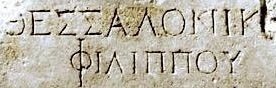
Alexandros and Philippos were not called/written so by others (as you imply) but by themselves, in the inscriptions and coins of their time.
 
Alexandros and Philippos were not called/written so by others (as you imply) but by themselves, in the inscriptions and coins of their time.

I gave my personal view with regards to Alexander's name in my first quote that you included that I don't believe Alexander's name was a case of "interpretatio graeca." The only thing that I'm implying is that reaching the conclusion that the ancient Macedonians were Greeks based on names is very speculative at best. Names transcend borders very easily.
 
Risto - My dissertation has absolutely nothing to do with the issue of Macedonian ethnicity. If you doubt that I actually went to KCL and studied Alexander then see the attached transcript.

Notice that I did a module called War? This was a thematic module on how aspects of war have changed over the course of history. One of the areas we looked at was monuments of war.

An English guy in my class used your capital Skopje as an example. He stated that the Republic of Macedonia had no claim to the Ancient Macedonians yet had spent millions on statues of a man brilliant of war in order to inspire patriotism.

The lecturer said that it was a great point and that particular fabrication a sign of how powerful monuments of war could still be in the modern day.

Transcript_Kings.jpg


A laughable comment? Not supported by any eminent historians?

How can you say that with a straight face unless you are deliberately trolling me? I've posted quotes from historians from the best universities in the world. 75 authors who are of publishable quality and I'm sure there are a tonne more.

If these were quotes from Greek historians then fair enough but it's your comment that is absolutely laughable and plain ignorant.

Robin Lane Fox not prominent enough? A lecturer at the best university in the world?

Never mind what historians think, the fact that they spoke Greek is reflected in every first hand piece of evidence. Their names, inscriptions, their months of the year, their location names and accounts from Livy and Curtius.

Tomche - You think it's wrong to cite historians as evidence? Why do you think that? These are people who have examined all of the primary evidence. I do not mean to be rude but why would you or anyone on this forum know any better?

Let's ignore the historians then and turn to evidence. Do you have any evidence that the Macedonians did not speak Greek? From what I understand the only reference to a Macedonian language is when Alexander "shouted in Macedonian".

That's meaningless though, Koine Greek was also referred to as Macedonian. It does not mean that by speaking Macedonian he was not speaking a form of Greek. I'm sure Alexander spoke Macedonian all the time just as Leonidas spoke Spartan.

I am not claiming that Modern Greeks are 100% the same as Ethnic Greeks. I was told by vicsinad that Modern Greeks have nothing to do with Ancient. I am simply telling him that genocide would have had to occurred for that to happen.

You claim to be the descendants of the Ancient Macedonians yet likewise state that Modern Greeks are completely unrelated to the Ancient? That's completely illogical considering you were ruled by the same empire.

I have been to Pella and spoke Greek to the locals. Care to tell me why my statement is a cracker?

Even if the Ancient Macedonians were not Greek, we know that they eventually spoke Koine Greek and were accepted as Greek by the time of Strabo. Regardless of their original ethnicity, Macedonia was eventually accepted to be part of Greece and their descendants have been part of the Greek world ever since and live in modern-day Macedonia, in Greece.

Are we expected to believe that they suddenly lost this Hellenic identity and became Slavic speaking? What is your story? You guys are so intent on proving that the Macedonians were not Greek, but what claim do you have to them? We know for a fact that they did not speak Slavic.

Simply calling yourselves Macedonians does not make you their descendants. I can call myself Spider-Man, it does not mean I suddenly become him. You have no cultural or linguistic ties to them, only a fraction of your country is actually located in the region of Macedonia.

Why did Alexander insist that the Persians learn Greek and not Macedonian?

Carlin -Well there's a lot of strong assertions made without any supporting evidence.

It's interesting that he mentions the Thracians. We have four surviving inscriptions of their language and all of our sources clearly indicate that they were not Greek speakers?

Why is this not also the case for the Macedonians? Especially as they were an infinitely more prosperous civilization than the Thracians.

It's wishful thinking to assume that the Macedonians never wrote in their own language.

It's funny that 100s of Greek inscriptions have been excavated from Macedon yet not even one has been found in the supposedly distinct Macedonian language.

The Macedonians did write in their own language and it was a unique form of Doric-Greek, see the Pella Curse Tablet. That's your Macedonian language right there.

Karposh - Read Ian Worthington's "The Question of Macedonian Identity". It's actually one of the most convincing pieces I've seen on their Greek identity.

Greeks with the Sun Hats comes from an inscription on Darius I's grave. He conquered Macedonia. I'm sure he knew what language they spoke.

As Amphipolis says, Alexander and Phillip themselves clearly went by Alexandros and Phillipos. Do we know of any Persians called Antipatros, Kassandros and Ptolemaios? Persian names weren't made into actual Greek names as the Macedonian names clearly are. There weren't any Greeks called Xerxes.

Better yet, the Macedonian names reflect an East-Doric dialect and this is the same dialect found in Macedonian inscriptions. Let me guess, coincidence?

Good job on finding historians who state that the Macedonians were not Greek, I concede that some may have this view. It's certainly a minority opinion however.
 
Last edited:
- There is no reference to translators being needed when the Macedonians attended the Athenian court. We have references to them being needed when the Thracians and Illyrians attended.

- Greek plays were performed in Macedonia. These would be pointless unless the people spoke Greek.

- There is very clear evidence that the Trojans did not speak Greek. This was hundreds of years before Alexander. Why would their different language not be documented if it existed?

- On the contrary, every excavation from Macedonia is in Greek. The Pella Curse Tablet is the most important of these as it demonstrates that Macedonian was a peculiar dialect of Greek - Hence why it may have been considered a barbarian tongue by the Athenians.

The Macedonians conquered all the way to India yet we are expected to believe that this great and powerful civilisation did not produce a single written document in its own language?

- Macedonia is a Greek word. All of the locations in Ancient Macedonia had Greek names. Presumably these would have been named long before the Macedonian aristocracy supposedly decided to start imitating the Greeks. They would have been named as soon as the people settled in the area, with the indigenous language.

- The Macedonians were angered by Alexander's adoption of Persian customs. They believed that the Macedonian way was best. They would not have such a complex if they themselves had merely copied their culture from the Greeks. They certainly did not believe in cultural assimilation. Their would suggest their Greek culture was indigenous.

- We are told that the Macedonians pronounced P as B. Why would we not have been told that they spoke a different language altogether? Instead we just have a comment about their pronunciation of Greek.

- Livy speaks of the Aetolians, Acarnanians and Macedonians as "Men of the same language"

-Livy speaks of a Roman proclamation being translated from Latin to Greek for the Macedonians to understand.

- Rufus says that the Branchidae spoke the same language as the Macedonians.

- Why was the period following Alexander called the "Hellenistic Period"? If the Macedonians had their own language, it is inconceivable that at least one of the successor kingdoms would have spoken Macedonian and not adopted Greek.

-----------------------------------------------------------------------------------------

Still waiting for responses to these.

Not to say that the responses to the other points have been any good but at least you tried.

You know what else I just thought of? Arrian etc refer to the people of Cyprus as Cypriots and not Greeks. We all know what language they spoke though.

Just because the sources refer to the "Macedonians and Greeks", it does not mean that the former did not speak Greek.
 
Leo, you wrote a dissertation on Alexander. We like the guy. Put it here for review.
Even if the Ancient Macedonians were not Greek, we know that they eventually spoke Koine Greek and were accepted as Greek by the time of Strabo. Regardless of their original ethnicity, Macedonia was eventually accepted to be part of Greece and their descendants have been part of the Greek world ever since and live in modern-day Macedonia, in Greece.

Are we expected to believe that they suddenly lost this Hellenic identity and became Slavic speaking? What is your story? You guys are so intent on proving that the Macedonians were not Greek, but what claim do you have to them? We know for a fact that they did not speak Slavic.
We know that modern Macedonians who come from what is now Greece were the absolute dominant culture in what is now Northern Greece. We also know the region became more "Greek" after the million odd former Turkish nationals found their way there about 100 years ago.

They (we) didn't speak Greek. Perhaps they (we) did speak it as bi-linguals 2000 years ago. But just because some imports speak it there now should not confuse you about 2000 years ago.

We don't know the language of the ancient Macedonians and I dare any historian to say what it was because proof will be essential.

I'll have more to say but really must insist on your dissertation regarding Alexander. It is entirely relevant on a Macedonian forum.
 
Leo255 said:
A laughable comment? Not supported by any eminent historians?
Professor Paul Cartledge wrote this for a Greek Newspaper. I will not comment on whether he was paid for the article.

It's very difficult today to classify precisely the language of the ancient Macedonians, because so few examples of it have been preserved. But two things about it are reasonably certain, or at least agreed among the experts. It was basically a dialect of Greek, but so interlarded with words of non-Greek, mainly Thracian origin that not just because of accent but also because of vocabulary it could be incomprehensible to speakers of 'standard' Greek dialects. For example, Alexander himself when under the stress of huge emotion is recorded as speaking 'in Macedonian'.

I will let you look up the author.

So "Greeks" would not have been able to understand Macedonians.
Perhaps like Germans and English speakers.
Perhaps like French and Romanian speakers.
Who knows?
Nobody knows.
You (especially) don't know.

The professor wrote that in a Geek newspaper and the Greeks were patting themselves on their backs. A big LOL to the Greeks.

Leo (the lying, not Lion) please put your dissertation here. I honestly need some humour in my life right now.
 
Leo relies a lot on the argument of language, that Macedonians spoke Greek, or a form of it, and therefore the entire Macedonian people were Greek. However, there is no consensus amongst the writers of the day on whether the Macedonians were Greek or not, and no linguist could possibly declare one or the other considering we have only isolated Macedonian words with no context or inflexion. Furthermore, some of these appear to be connected to Greek, some appear to have no connection to Greek, and some appear to be beyond the form of a Greek dialect.

From a genealogical standpoint, do we assume the Macedonian royal family represents the entire Macedonian people or not?

Was it not usual, for the day, to refer to an alien people/culture as barbarian?

We can rally from the baseline all day if you wish.
 
Leo relies a lot on the argument of language, that Macedonians spoke Greek, or a form of it, and therefore the entire Macedonian people were Greek. some appear to have no connection to Greek, and some appear to be beyond the form of a Greek dialect.


We can rally from the baseline all day if you wish.

Can anyone on this forum please show any valid or reputable ancient Macedonian words or inscriptions that have "no connection to Greek or appear to be beyond the form of a Greek dialect"? I have not yet been able to find any?
 
Can anyone on this forum please show any valid or reputable ancient Macedonian words or inscriptions that have "no connection to Greek or appear to be beyond the form of a Greek dialect"? I have not yet been able to find any?

Poli, you saw what I quoted from an eminent historian who had to admit the following notwithstanding he is on the Greek payroll:
It's very difficult today to classify precisely the language of the ancient Macedonians, because so few examples of it have been preserved.
Given the ruling elite started to use Attic Greek in the 5th century BC as an administrative language, I would imagine some Greek words found their way into the ancient Macedonian language over the next few hundred years. Yet in Alexander's time, the poor Greeks STILL could not understand him when he spoke Macedonian.

Here it is:
but so interlarded with words of non-Greek, mainly Thracian origin that not just because of accent but also because of vocabulary it could be incomprehensible to speakers of 'standard' Greek dialects.
Take it up with Cartledge and ask him if he deserves to be on the Greek payroll given the fighting words he uses here.

Only a stupid Greek would imagine the ancient Macedonians spoke pure Greek and that it was understood by all.
 
Last edited:
Poli, you saw what I quoted from an eminent historian who had to admit the following notwithstanding he is the Greek payroll:

Yet in Alexander's time, the poor Greeks STILL could not understand him when he spoke Macedonian.

Here it is:


Only a stupid Greek would imagine the ancient Macedonians spoke pure Greek and that it was understood by all.

Greetings wise Risto....

I must be a "Stupid Greek", because I have not been able to find any inscribed evidence to the contrary (I have googled thousands of texts throughout the years) presenting ancient Macedonian as anything other than a loose Greek dialect?

I am happy to be proved incorrect, if anyone can provide evidence or an inscription for further discussion and analysis. Out of context statements like "Alexander spoke in Macedonian", whilst factually correct, doesn't translate to "Macedonian" being a magical exclusive language.
 

Attachments

  • 15909590_1201890283181961_957969308_n.jpg
    15909590_1201890283181961_957969308_n.jpg
    16.8 KB · Views: 0
Poligiros, you will lean on the low probability equations of your linguists which derive unclear outcomes based on Greek words, and all of a sudden they must be Greek, or a Greek dialect or a loose dialect as you put it, or whatever fits the agenda.
 
First time I’ve seen anyone post their academic transcripts on a forum…

I would say that the Romans and Ottomans were imperial rulers and not colonisers

How did you manage to pass your Byzantine history subject?

Good job on finding historians who state that the Macedonians were not Greek, I concede that some may have this view. It's certainly a minority opinion however


History is not a science and it will never be. A hypothesis in history cannot be tested, especially if it’s based on events that occurred 2000+ years ago. In science, minorities whom are against certain theories that are widely accepted are generally frowned upon, but in this case it is because they’re clenching on to a hypothesis which has tiny p-value, i.e highly unlikely in experimental setting. In science you can measure such things, unlike history. So, I’d personally see that in the context of history, reasonable ideas that conflict with something which widely accepted should be treated with the same amount of respect because as I said it before, validity of historical theories cannot be measured.

Also, you probably should’ve paid more attention to the subject ‘Europe 1793-1999’, maybe could have done some extra study about the state of the Balkans around this time, that alone is enough to end the Macedonia-Greece Dispute fiasco. In addition, starting with the year after the French Republic was founded (1792), should have opened your eyes about the meaning of nationalism and more specifically what exactly is a nation.

And lastly, a question for you Leo. Just out of curiosity, what exactly is the job prosperity in doing a bachelor of arts/history degree? Anything that you can potentially contribute to the welfare of society? Or is just something to make your opinion seem more valid on internet forums?
 
Why does everyone keep entertaining these trolls?
Do we have to post the same things over and over again every time some Greek clown shows up and starts provoking?
Admins should just point out the relevant links to these guys so that they can see for themselves, there are heaps of arguments on this forum about this, it's been debated and debated over and over.
It's like a never-ending loophole that we keep going back to.

Agreed. As a matter of fact, I was about to reply to that very same clown that you just spoke of but decided against it because of the same reasons you just mentioned.
 
Back
Top