• Welcome to the new Macedonian Truth Forum. All posts, members and private messages have been moved over from the old forum.

    Passwords from the old forum could not be carried over, so please use Forgot your password? to set a new one. The reset link is emailed to the address on your account.

  • Rules and Regulations at the forum of the Macedonian Truth Organisation (MTO)

    (1) The national-ethnic and cultural-linguistic identity of the Macedonian people is historically Macedonian, and derives its character from the native, indigenous and geographic homeland of the Macedonians, which is called Macedonia. To ensure that their human rights, integrity and heritage are appropriately respected, the only nouns and adjectives acceptable when reference is made to the above character and identity markers is Macedon, Macedonia, Macedonian and Macedonians.

    (2) The nation-state of the Macedonian people is the Republic of Macedonia, and is to be referred to by this official title so long as the 'republic' prefix is consistently applied to other states. Alternative references are the Macedonian Republic, or simply, Macedonia.

    (3) The 'ethnic' prefix is only acceptable for Macedonians in cases where differentiation is specifically required - so long as it is in context and consistent where it concerns its application to other ethnic groups.

    (4) Should any other differentiation be specifically required, the names of other ethnic groups that reside with Macedonians in either the Republic of Macedonia or the occupied Macedonian regions in Greece, Bulgaria, Serbia or Albania, are to be given a prefix.

    (5) Negating the identity, language and culture of the Macedonian people by deliberate avoidance of the terms Macedonia, Macedonian and Macedonians, or by any other means, is not permitted.

    (6) Systematic anti-Macedonian propaganda and rhetoric are not permitted.

    (7) Threads irrelevant to the Macedonian Cause, the community at the Macedonian Truth Organisation or the Macedonians in general may be considered as spam or not in the spirit of the forum. In such cases they are not permitted.

    (8) Continual posting of messages in threads with the sole purpose of deviating from the initial topics with the use of unrelated and unnecessary information is not permitted.

    (9) All posts, external articles, reports, etc that are cited in languages other than Macedonian or English, must be accompanied with a translation in one or both of the said languages.

    (10) Despite the possibility of some conversations and debates becoming heated, extreme abuse and/or racism, vulgar language and/or terminology, threats, revelation of personal information about others, harassment, and other such behavior will not be permitted. If deemed necessary all relevant information including member details will be reported to the appropriate authorities for investigation which may result in legal action.

    (11) Threads that are created must have a summary of a topic or excerpt of an article found in pertinent link(s) that have been included. One line threads will be considered unaccetable spam and are therefore not permitted.

    (12) Compulsive and deliberate lies, irrespective of the topic, are not permitted.

    (13) Any symbols or avatars found to be perceived as offensive to Macedonians are not permitted.

    (13) Any explicit or extreme material is not permitted.

    Failure to adhere to the above rules and regulations will result in a ban after 3 breaches. This may be reconsidered in some cases should the circumstances be of an unorthodox nature and/or require special consideration. To assure an effective deterrent against an individual or individuals with the sole purpose of causing dissent through spamming, racism or other improper means, the above rules will be strictly enforced.

    The MTO administration will monitor all discussions as reasonably practical and reserve the right to remove any post and/or member from the forum, and update the rules and regulations as required. Members are encouraged to immediately report any post and/or member to the MTO administration if they feel that these rules have not been abided by.

    The views expressed on this forum are those of the individuals. The only official representation of the MTO is made by the "Macedonian Truth Organisation (Site Owner)" username, and no other.

  • Macedonian Cause

    The Macedonian Truth Organisation calls on God in Heaven to protect, bless and guide the endeavour it is committing to undertake, and that is to work towards:

    Securing Macedonia as a free, independent and democratic republic in which sovereignty lies with the Macedonian citizens; as the nation-state of the Macedonian people in which they can preserve their culture, language and identity; as a state in which the Macedonian language and culture form the basis of public life and act as important unifying elements of Macedonian society; as the home of all its citizens to which it guarantees and obliges their inalienable natural rights and corresponding responsibilities;

    The acknowledgment as self-evident and irrefutable the existence of the:

    1) Indigenous, ethnonational name of Macedonia;
    2) Macedonian people, language and identity;
    3) Macedonian culture, symbols and folklore;
    4) Macedonian ancestry, heritage and history in its entirety; and
    5) Macedonian Orthodox Church;

    Securing recognition by the International Community of the tragedies endured by the Macedonian people, of the division of Macedonia with the signing of the Treaty of Bucharest on August 10, 1913, and the genocide committed against the Macedonian people at the hands of the Greek, Bulgarian and Serbian states and their respective churches during the 19th and 20th centuries;

    Ensuring that the Interim Accord is declared ‘null and void’ and that all constitutional provisions, acts, commitments, agreements, legislation, regulations, policies or programs emanating from, supporting or consequential to the Interim Accord are also declared ‘null and void’, including the use of any symbols and the completion of any acts imposed by, or originating from, the Interim Accord.

    Ensuring that the Framework Agreement is abolished and that all constitutional provisions, acts, commitments, agreements, legislation, regulations, policies and programs emanating from, supporting or consequential to the Framework Agreement are also abolished and replaced by a framework of constitutional and statutory law based on inalienable natural rights and corresponding responsibilities and universally codified human rights mechanisms.

    Securing the abolishment of any existing constitutional provisions, acts, agreements, legislation, regulations, policies and programs that discriminate against the Macedonian people, in any international organisation or any of the countries of the International Community where such constitutional provisions, acts, agreements, legislation, regulations, policies and programs exist, and thereby ensuring the freedom for Macedonians to exercise their inalienable natural rights and fulfil their corresponding responsibilities, and practice their culture, language and religious faiths in all the countries of the International Community without hindrance;

    The empowerment of Macedonians to undertake a moral revolution and to instil and/or reinvigorate within themselves a deep-rooted national, cultural, linguistic and historical dignity and a commitment to the exercise of freedom based on inalienable natural rights and corresponding responsibilities;

    The recognition of the Macedonian minorities in the neighbouring states of Macedonia as well as the respect for the inalienable rights and freedoms of the Macedonian minorities, as provided for by natural law and as codified by the United Nations Charter, the Universal Declaration of Human Rights and other universally codified human rights mechanisms;

    The full and unreserved respect of, and the support for, the rights of all people of non-Macedonian descent living in Macedonia and around the world, who share a reciprocal full and unreserved respect for the Macedonian people, their homeland and their state;

    The cultural unification and solidarity of the Macedonian people living in all parts of historical Macedonia and adjacent territories, as well as Macedonians throughout the world;

    The unity of all Macedonians on the principles, objectives and achievement of the Macedonian cause as defined by this declaration.

How did Golo Brdo & Mala Prespa come under Albanian cotrol?

You call bullshit on a the -phone terminology? It is a legitimate linguistic term, not much more I can say than that. Either way, this isn't relevant to the thread nor my statement.
This is a Macedonian forum and any Macedonians who feel they are being more correct by using the language of our enemy (in this case Greeks) must have souvlaki in his head.

You have the opportunity to present facts as Macedonians deservedly should acknowledge and see them. And, if we could muster any kind of thoughtful and cohesive action, the world might begin to follow.

Another example is what you might call "Church Slavonic" is what I call "Old Macedonian". See what I did there? Nobody else can take that away from us. But when people like you give it away for free, it is offensive.

And the last time I ever heard the words:
Germanophone,
Anglophone,
Hispanophone,
Francophone, etc.
... was never.

So while you believe my point has nothing to do with this thread, I agree for different reasons. "Slavophones" have nothing to do with Macedonians. Therefore you introduced the irrelevance. I simply pointed it out.
 
Gorica is not apart of Macedonia and its non-Albanian population died off long ago.
Peco Cingovski was a Macedonian communist fighter during WWII who was born in Gorica. The paternal great-grandparents of some of my distant cousins in Macedonia were born in Gorica and moved to the village of Trap in Bitola at the beginning of the 20th century. All of these individuals identified as Macedonians. Your earlier suggestion that they "died well back into the 18th century" is, quite simply, wrong.
There is no way of knowing if they spoke Macedonian or another language similar to it, we can't force our identity and language on people who can't speak for themselves anymore. It's recorded "Slavic" was spokein Gorica but its exact relation to Macedonian or any other language is not known for sure.
The vernacular spoken in Gorica belongs to the south-western group of Macedonian dialects, which means it is close to the vernacular spoken in Kostur. There is a document from the 16th century where words and phrases are recorded from the south-western region of Macedonia and they are almost identical to the dialects spoken in Bitola and Lerin. Geographically, Gorica is roughly about 50km or so from Kostur or the Macedonian-controlled part of Lake Prespa. It is less than a 100km to reach either Bitola or Lerin. The nearest predominantly "Slavophone" town outside of historical Macedonia is probably Podgorica in Montenegro which is about 300km away. Look at a map and then take a wild guess as to which language the Gorica dialects would most resemble.
It would be the same as claiming the historical Slavophone population of Epirus and Thessaly were Macedonians as well.
Not really. Aside from toponyms we don't have much more to compare for these two regions. That said, due to continuum if such dialects were still spoken in those regions it would naturally follow that they would be more related to Macedonian than any other language further north.
 
So who do you personally think these Slavic speakers likely were?, Serbians?, Bulgarians?, Ukrainians?, Poles?, Russians?, Slavophone Greeks?, Greeks?, Albanians?, Turks?, Germans?, Irish?, Swedes?, Iranians?, Japanese?, Brazilians?, Nigerians?

Possibly their own people completely independent of all modern nations, like the Thracians.
 
Possibly their own people completely independent of all modern nations, like the Thracians.

Do you believe Macedonian communities were capable of existing anywhere else in the world?, Or did the impenetrable border security that existed prior to the 20th century preclude them from travelling to any region outside of what we now consider the geographic borderlines of Macedonia? (even to, say, one of the closest cities to rural villages on the outskirts of those traditional geographic Macedonian borders i.e. Gorica?)
 
Peco Cingovski was a Macedonian communist fighter during WWII who was born in Gorica. The paternal great-grandparents of some of my distant cousins in Macedonia were born in Gorica and moved to the village of Trap in Bitola at the beginning of the 20th century. All of these individuals identified as Macedonians. Your earlier suggestion that they "died well back into the 18th century" is, quite simply, wrong.

The vernacular spoken in Gorica belongs to the south-western group of Macedonian dialects, which means it is close to the vernacular spoken in Kostur. There is a document from the 16th century where words and phrases are recorded from the south-western region of Macedonia and they are almost identical to the dialects spoken in Bitola and Lerin. Geographically, Gorica is roughly about 50km or so from Kostur or the Macedonian-controlled part of Lake Prespa. It is less than a 100km to reach either Bitola or Lerin. The nearest predominantly "Slavophone" town outside of historical Macedonia is probably Podgorica in Montenegro which is about 300km away. Look at a map and then take a wild guess as to which language the Gorica dialects would most resemble.

Not really. Aside from toponyms we don't have much more to compare for these two regions. That said, due to continuum if such dialects were still spoken in those regions it would naturally follow that they would be more related to Macedonian than any other language further north.


Fair enough, you make good points.
 
Do you believe Macedonian communities were capable of existing anywhere else in the world?, Or did the impenetrable border security that existed prior to the 20th century preclude them from travelling to any region outside of what we now consider the geographic borderlines of Macedonia? (even to, say, one of the closest cities to rural villages on the outskirts of those traditional geographic Macedonian borders i.e. Gorica?)


Oh course we can and did/do. The borders of Macedonia just all other nations are the results of politics above all else. The Macedonian peasant in the Ottoman period would have no clue about these regional borders and could have travelled and settled anywhere.
 
germanophone
[ʒɛʀmanɔfɔn ]
adjective
German-speaking
masculine and feminine noun
German-speaker
While you are at it, each of your justifications relate to nations. German is used above. "Slavophone" relates to the Kingdom of the Slavs? What is "Slavic"? I have never heard anyone speak Slavic. How do you say "In the service of Greeks" in "Slavic". And ultimately, what is a "slavophone"? A Greek can tell us, but I don't trust them much.
 
Why the term 'slavophone' should not be used by any self-respecting Macedonian should not even have to be explained in 2018. Its beyond preposterous. But I think it will disappear shortly - even in Greece. Surely those "slavophone greeks" will become "gornophone greeks"?
 
Last edited:
I disagree, Gorica is not apart of Macedonia and its non-Albanian population died off long ago. There is no way of knowing if they spoke Macedonian or another language similar to it, we can't force our identity and language on people who can't speak for themselves anymore. It's recorded "Slavic" was spokein Gorica but its exact relation to Macedonian or any other language is not known for sure. It would be the same as claiming the historical Slavophone population of Epirus and Thessaly were Macedonians as well.

I disagree with the above, there is still a sizable non Albanian population in Gorica/Korcha. Many Macedonians from Gorica are active on facebook.

Andre Mazon painted a nice picture of the Macedonian elements in Gorica and surrounding areas in the 1930's; his book is a testament to this. The relation to Macedonian is known and like i said it in the book by Andre Mazon.

7sbAjm.png


uhLcB5.png


YP5OQB.png


One of the current community leaders of the Macedonians in Albania is also from Gorica/Korcha - Vasil Sterjovski.

5eZGjJ.png
 
While you are at it, each of your justifications relate to nations. German is used above. "Slavophone" relates to the Kingdom of the Slavs? What is "Slavic"? I have never heard anyone speak Slavic. How do you say "In the service of Greeks" in "Slavic". And ultimately, what is a "slavophone"? A Greek can tell us, but I don't trust them much.


I have seen Germanophone used in contexts to refer to people who speak a Germanic language. It's used in this context in some texts detailing language and nationalism in the Austro-Hungarian Empire.
 
I disagree with the above, there is still a sizable non Albanian population in Gorica/Korcha. Many Macedonians from Gorica are active on facebook.

Andre Mazon painted a nice picture of the Macedonian elements in Gorica and surrounding areas in the 1930's; his book is a testament to this. The relation to Macedonian is known and like i said it in the book by Andre Mazon.

7sbAjm.png


uhLcB5.png


YP5OQB.png


One of the current community leaders of the Macedonians in Albania is also from Gorica/Korcha - Vasil Sterjovski.

5eZGjJ.png


My main point is that Gorica does not fall under the definition of Macedonia. I know there are villages close to it where Macedonians still live, perhaps the people who work in Gorica (like the one you provided) originate from these villages.
 
My main point is that Gorica does not fall under the definition of Macedonia. I know there are villages close to it where Macedonians still live, perhaps the people who work in Gorica (like the one you provided) originate from these villages.

Because there is no possible way they could originate from Gorica itself... I mean that impenetrable border security stood strong for thousands of years!
 
My main point is that Gorica does not fall under the definition of Macedonia. I know there are villages close to it where Macedonians still live, perhaps the people who work in Gorica (like the one you provided) originate from these villages.

That's not correct, Dimitrija Chupovski's map of Macedonia included Gorica.

JdYd6m.jpg


b6VN2k.png


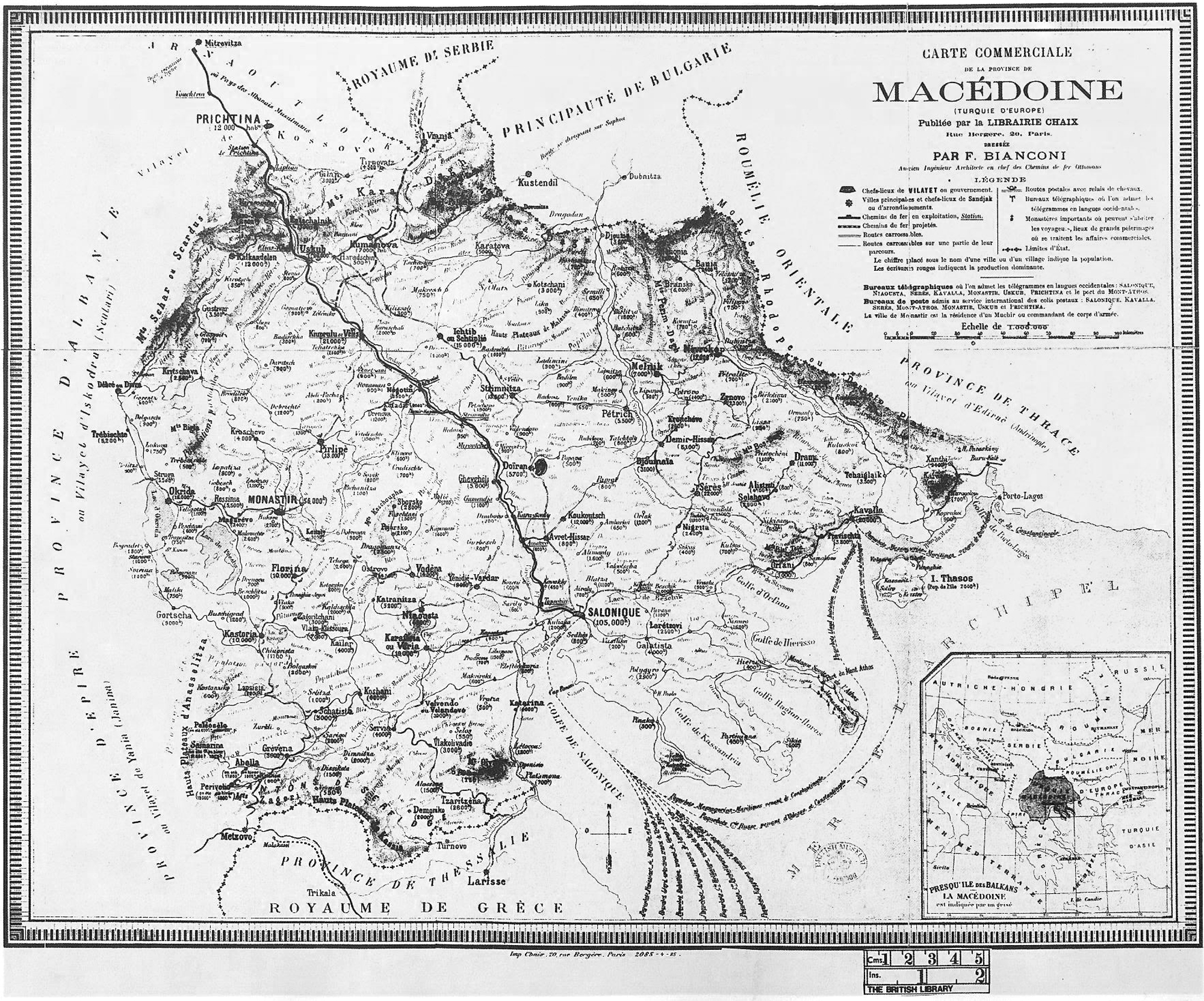
So did the French cartologist F. Bianconi


F. Bianconi: Carte commerciale de la province do Macedoine, 1:1,000,000, 48x37 cm. Paris, 1885

85mapmacedonia.jpg


fWo7hG.png
 
Back
Top